This guide is independent and contains no paid placement. Rink dog policies change by venue and by season, so always check the official guidance before you travel.
Dogs at UK ice rinks are spectators, not skaters: they stay off the ice and watch from the seating or the rink-side perimeter where the venue allows it. Outdoor seasonal rinks are usually the easier option, indoor rinks are stricter, and the whole visit works better when you plan for cold, crowds and a warm-up break.
Start with the spectator, not the skater
The first thing to accept about dogs at ice rinks in the UK is also the most useful: your dog is almost certainly not going on the ice. Rinks exist for skaters, the surface is hard and slippery, and a dog on the ice would be a danger to itself, to skaters and to anyone trying to help it. No UK rink of any size runs a regular dog-skating session, and the few novelty photographs of dogs on ice that circulate online are not a policy you can book. Once you stop planning a skating dog and start planning a watching dog, the whole day gets simpler, because the questions change from "can my dog skate?" to the far more answerable "where can my dog sit, how long can it stay comfortable, and what else is nearby?"
That shift matters because a rink visit is really three visits in one. There is the ice itself, which your dog will watch from a distance. There is the spectator area, which is where your dog will actually spend its time: a cold stand, a barrier-side strip, a cafe balcony or an open-air viewing deck. And there is everything around the rink, which is often where the best part of the day happens: a Christmas market, a riverside path, a warm cafe, a park. Dogs do well at the second and third parts and are simply absent from the first, so a good rink day is one where the seating is comfortable and the surroundings give you somewhere to go when the dog has had enough of sitting still.
It also helps to be honest about your dog before you choose a rink. A calm older dog that settles on a blanket for an hour is a natural spectator. A young, excitable dog that lunges at anything moving fast will find a rink full of gliding, falling, shouting people very hard to ignore, and the same is true of a noise-sensitive dog faced with music, tannoy announcements and the scrape of blades. If your dog struggles with crowds or with sitting still, the rink-side walk and market may be the whole day, with the ice as something you glance at from the edge rather than sit through for a full session. There is no failure in that: a short, happy visit beats a long, stressful one, and the dog will not know it missed a figure-skating routine.
Finally, treat every rink as its own case. Dog policies in Britain are set venue by venue, not by a national rule, and they change with the session, the season and sometimes the crowd. A rink that welcomes dogs at a quiet weekday public session may bar them from a Saturday evening disco skate or an ice hockey fixture, and a seasonal outdoor rink may allow dogs in the daytime market but not in the evening skate queue. The only reliable check is the venue's own website or a phone call for the exact session you plan to attend, and that check is worth making even when a guide like this one says a rink is "usually" dog-friendly. Policies change, and a wasted journey in winter weather is nobody's idea of a day out.
Two kinds of rink, two sets of rules
Almost everything about taking a dog to an ice rink follows from one distinction: permanent indoor rinks and seasonal outdoor rinks are different kinds of place, run under different pressures, and they treat spectator dogs differently. Understanding the contrast before you pick a destination saves most of the disappointment, because the two types differ in space, temperature, noise, crowding and the sheer number of rules they need to enforce.
Permanent indoor rinks are purpose-built sports venues. They run year-round, host skating clubs, lessons, figure-skating practice and ice hockey, and their spectator areas are designed around seated audiences watching a sport, not around visitors wandering with dogs. Indoor rinks are enclosed, echoing and often surprisingly cold, and their staff have to manage skate hire, changing areas, first aid and crowd flow in a confined building. Dogs add complications in all of those areas: a dog in a narrow changing corridor, a dog barking during a quiet figure-skating programme, a dog in a seated stand where people are carrying hot drinks and sharp skates. That is why indoor rinks are the stricter of the two types, and why a "dogs welcome" answer for an indoor rink often comes with conditions attached, such as designated seating, a lead rule, a ban during fixtures, or a limit on the number of dogs per group.
Seasonal outdoor rinks are a different proposition. They appear in city squares, parks and shopping districts from roughly November to January, they are built for festive leisure rather than sport, and most of the visit happens outdoors: the queue, the viewing area, the market stalls, the food stands and the walk to and from the rink are all open-air. A dog on a lead in an outdoor viewing area is far less of a management problem than a dog in an indoor stand, and many seasonal rinks therefore allow dogs in the surrounding area as a matter of course, even when the ice itself and the skate-hire tent are off-limits. The trade-off is weather: wind, rain and slush, darkness by mid-afternoon, and a viewing area that may be standing-only with no shelter. Outdoor rinks are easier on the rules and harder on the body, which is a fair exchange for most dog owners.
The practical way to use this contrast is to match the rink type to your dog and your plan. If the skating is the main event and the dog is calm, an indoor rink with a confirmed dog-friendly spectator policy can work, especially at a quiet session. If the skating is one part of a festive day out, an outdoor seasonal rink with a market and a walk nearby is almost always the better choice, because the dog has somewhere interesting to be before and after the skating, and because the rules are more forgiving. If your dog is reactive, elderly or very cold-sensitive, neither type is ideal for a long seated session, and the rink-side day out described later in this guide is the honest answer.
There is also a middle category worth knowing about: indoor leisure centres and shopping-centre rinks that appear in winter inside a larger complex. These borrow from both types. The ice is indoors, but the surrounding complex may be dog-friendly in its corridors and cafes, so the dog can wait somewhere warm and interesting while part of the group skates. Ask specifically about the rink seating and the wider building, because a "dogs welcome in the centre" sign does not automatically mean "dogs welcome beside the ice".
Indoor rinks: what spectators need to know
At a permanent indoor rink, the spectator area is the dog's whole world for the visit, so it pays to understand it before you go. Most indoor rinks have a raised stand or a barrier-side viewing strip, sometimes with a cafe or balcony overlooking the ice. Seating is usually bench-style or fixed plastic, the floor is concrete or tiled, and the temperature sits a few degrees above freezing near the ice. It is louder than people expect: music, announcements, the scrape of blades and the thud of falls all echo off hard surfaces, and a hockey fixture adds shouting, horns and a crowd that stands and surges. A dog that is fine in a park may still find an indoor rink overwhelming, and that is worth testing at a quiet session before committing to a busy one.
Rules at indoor rinks tend to cluster around five points. First, dogs stay on a lead at all times and are not allowed on the ice, in the skate-hire area or in changing rooms. Second, dogs are usually confined to a specific part of the spectator area, often the back rows or a designated section, so that other spectators are not surprised by a dog beside them. Third, some rinks require dogs to be kept off the seats, on the floor at their owner's feet, with a blanket or mat underneath. Fourth, assistance dogs are treated separately and are generally admitted even where pet dogs are not, which is a legal distinction worth knowing but not one to confuse with a general dog policy. Fifth, many rinks reserve the right to ask an owner to leave if a dog barks persistently or causes a disturbance, and a refund for the skating party is not guaranteed in that case. None of this is unreasonable, but all of it should be confirmed for your session, because a rink that allows dogs at a Tuesday morning public skate may not allow them at a Saturday hockey game.
Session choice is the single biggest lever you have at an indoor rink. Quiet weekday public sessions, early-morning sessions and family sessions with music kept low are the easiest for a spectator dog. Disco skates, evening sessions and fixtures are the hardest: louder, darker, more crowded, and more likely to have a dog restriction in force. If you are taking children skating while the dog watches, a family session also means other children will want to greet your dog, so a dog that is not comfortable with strangers leaning over it needs a seat at the end of a row, away from the aisle traffic.
What to pack for an indoor rink follows from the cold and the hard floor. A blanket or insulated mat for the dog to lie on, a warm coat for short-coated dogs, a chew or long-lasting treat for settling, a water bowl and a small bottle of water, and poo bags for the walk outside before and after. Skate guards are not needed for a spectator dog, but a short lead is: a long extending lead in a crowded stand is a tripping hazard and will draw staff attention fast. Arrive early enough to settle the dog before the session starts, because a dog that is still scanning the room when the music starts and the crowd surges is starting from a disadvantage.
One more indoor-specific point: the air. Indoor rinks can smell strongly of cold, rubber and cleaning products, and some dogs sneeze or fuss in that atmosphere. If your dog has respiratory sensitivity, a short trial visit matters more than any reassurance in a guide. The same applies to dogs that are sensitive to flashing lights, which some disco sessions use. When in doubt, choose the plainest session on the timetable, sit near an exit, and be ready to leave early. Leaving early is not a failed visit; it is a dog owner reading their dog correctly.
Outdoor seasonal rinks: looser, but not lawless
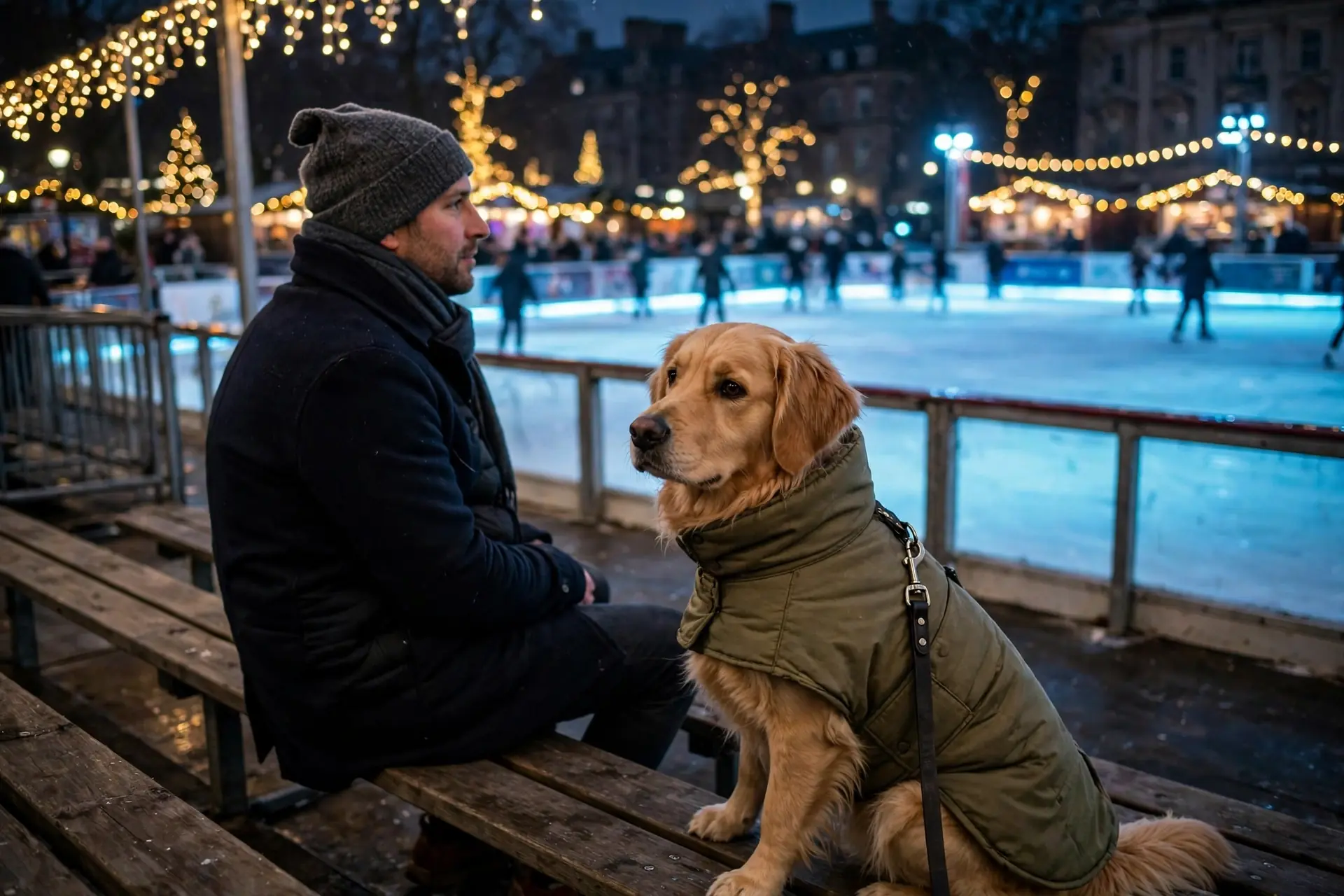
Outdoor seasonal rinks, the kind that appear in British city centres and parks each winter, are where most dog owners will have their easiest rink experience, and it is worth understanding why the rules feel looser and where they still bite. The viewing area at an outdoor rink is usually open-air and often unseated: a barrier-side strip, a raised deck or simply the edge of the square. Dogs on leads are a familiar sight in these spaces, because the same square hosts a market, food stalls and general foot traffic, and a dog is not an anomaly there. Staff attention is focused on the ice and the skate queue, not on policing the viewing strip, and the open air removes the echo, the enclosed crowd and the changing-room corridor problems that make indoor rinks strict.
That does not mean anything goes. The ice surface itself is always off-limits to dogs, and the skate-hire area is normally a no-dog zone, because it is crowded with people carrying blades and sitting on low benches to change footwear. Some outdoor rinks restrict dogs from the immediate barrier during peak evening sessions, when the viewing strip is packed and a dog underfoot becomes a tripping risk. Others ask that dogs be kept on a short lead and kept clear of the queue, and a few festive rinks run specific dog-friendly sessions or quieter daytime slots. The pattern to expect is permissive in the daytime and around the market, stricter at the barrier in the evening peak, and always subject to the event organiser's page for that season.
Weather is the real gatekeeper at outdoor rinks. Rain turns viewing areas muddy and slippery, wind drives cold through a sitting dog, and darkness by late afternoon means the evening session is a different experience from the daytime one. Ice conditions also matter: outdoor rinks close or pause in heavy rain, strong wind or unseasonable warmth, and a closure announced on the morning of your visit is not a dog problem but a wasted journey problem. Check the rink's social media or event page on the day, not just the week before, and have a nearby warm alternative in mind, such as a dog-friendly cafe, so a closure becomes a change of plan rather than a ruined day.
Footing deserves a mention too. Outdoor rink surroundings mix wet paving, temporary decking, metal grates and slush, and some dogs slip or refuse certain surfaces. Salt and grit used on icy paths can irritate paws, so a quick paw check after the visit and a wipe-down at home are worth building into the routine. Dogs that wear boots may cope better on gritted ground, but boots are a matter of training, not a purchase made on the morning of the visit. If your dog has never worn boots, do not introduce them at a crowded festive rink.
Finally, outdoor rinks are seasonal in a way that affects planning. They typically run from mid-November to early January, they are busiest in the two weeks before Christmas and between Christmas and New Year, and they may change their dog policy mid-season if an incident occurs. A November weekday visit and a 23 December evening visit are effectively different events at the same rink, and the dog-friendly answer can differ between them. Go early in the season, go in daylight, and treat the festive peak as a spectacle to walk through rather than a session to sit through with a dog.
Settling in the spectator area
However good the rink, the visit succeeds or fails on whether your dog can settle, and settling is a skill you can prepare rather than a temperament you must hope for. The best preparation is a tired, toileted dog arriving at a rink it has already sniffed from the outside. Walk the dog properly before you go in, let it toilet, and give it ten minutes of sniffing around the rink-side area so the new smells are less exciting by the time you sit down. A dog that arrives bursting with energy and a full bladder is not going to settle on a cold bench, and no treat will fix that.
Seat choice is a small decision with a large effect. An aisle seat or an end seat lets you leave quickly without climbing over strangers, and it gives the dog a wall or a barrier on one side, which many dogs find reassuring. Avoid the middle of a row, where the dog is surrounded and every passer-by leans over it, and avoid the front row at an indoor rink, where the dog is closest to the ice, the music and the falling skaters. At an outdoor rink, a spot slightly back from the barrier, where the dog can see without being in the flow of people leaning on the rail, is usually calmer than the prime viewing position. Arrive early to claim that spot rather than squeezing in after the session has started.
Settling gear is simple but specific. A familiar blanket or mat that smells of home, a chew or a stuffed Kong that lasts, a water bowl that will not tip, and a coat if the dog wears one. Avoid bringing a new toy that squeaks, because a squeaker in a quiet indoor stand will attract exactly the wrong kind of attention. Avoid feeding a large meal just before the visit, because a full dog in a cold, exciting place is more likely to be sick or restless. A small, high-value treat given for settling quietly is more useful than a pocketful of treats handed out constantly, which teaches the dog that the rink is a place where food arrives non-stop and excitement is rewarded.
Watch the dog, not the skating, for the first ten minutes. A settling dog yawns, sighs, shifts onto its side and starts watching the room calmly. A dog that is not settling paces, pants, whines, fixates on every skater or scans the crowd constantly. If the second pattern persists past ten minutes, do not wait for it to improve: take a break outside, walk a loop, and try again once, or accept that today is a short visit. Pushing a stressed dog to sit through a full session teaches it that rinks are places where stress is ignored, and the next visit will be harder, not easier.
Children and other spectators are part of the settling equation. At family sessions, children will approach dogs, and not every child asks first. A polite, firm "please don't stroke him, he's resting" is easier said before a hand reaches the dog than after, and a dog that is nervous with children should not be seated where children queue past. Similarly, other dogs in the spectator area can undo a good settle in seconds, so if another dog arrives beside yours and the two fixate, move early rather than hoping they will ignore each other. Spectator dog etiquette is mostly about distance: keep space, keep the lead short, and do not let your dog greet every dog it sees.
Cold, stillness and keeping warm
Cold is the factor dog owners most underestimate at ice rinks, because the cold that matters is not the cold of a winter walk. A dog walking briskly generates heat and stays warm in temperatures that chill a sitting dog quickly. A spectator dog sits still on cold concrete or damp decking for an hour, in air that is deliberately kept cold near the ice, and loses heat steadily through its belly and paws. The result is a dog that starts the session happily and ends it shivering, stiff and reluctant to move, and the owner often notices too late because the dog was quiet and "well-behaved" right up to the point it got too cold.
Which dogs feel it first is predictable. Short-coated breeds, small dogs, puppies, elderly dogs and lean, muscular dogs such as greyhounds and whippets chill fastest, and any dog with arthritis will stiffen in the cold even if it does not shiver. Thick-coated breeds cope better but are not immune, especially on wet ground, and a wet dog of any breed loses heat far faster than a dry one. Rain on the way to the rink, a splash from a puddle, or a damp blanket all turn a manageable cold into a real chill, so dryness is as important as insulation.
The practical kit is straightforward. A well-fitting dog coat for dogs that need one, put on before the dog gets cold rather than after, because a coat warms a cold dog slowly. An insulated mat or thick blanket between the dog and the ground, because conduction through cold concrete is the fastest route to a chilled belly. A second dry blanket to swap in if the first gets damp. A warm-up plan: a cafe, a market hall or a heated indoor area nearby where the dog can spend twenty minutes warming up halfway through the visit. And a time limit decided in advance: for most dogs, an hour of sitting at a rink is plenty, and for cold-sensitive dogs, thirty to forty minutes with a warm break is more honest.
Signs of cold are worth learning before you need them. Shivering is the obvious one, but also watch for a dog that curls tightly, tucks its tail, lifts its paws alternately, hunches its back, becomes reluctant to walk, or goes unusually quiet and still. A dog that was alert and interested and becomes flat and withdrawn is often a cold dog, not a bored one. If you see these signs, warm the dog up: move to a warmer place, add a blanket, offer a short walk to generate heat, and do not return to the cold seat until the dog is moving freely again. If the dog does not warm up quickly, end the visit. Hypothermia in dogs is rare in this setting, but stiffness, misery and a ruined next visit are common enough.
After the visit, the warm-up matters too. A short, gentle walk home or to the car, a towel-down if the dog is damp, and a warm bed once home all help, and an arthritic dog may benefit from a warm, draft-free resting spot for the evening. If your dog is stiff the next morning after a rink visit, the session was too long or too cold for that dog, and the next visit should be shorter, warmer or skipped in favour of the rink-side walk instead. Dogs do not complain in advance, so the owner has to set the limit.
Skate blades, crowds and the barrier
Skate blades are the one hazard at an ice rink that has no equivalent on an ordinary day out, and they deserve direct attention. A skate blade is sharp, it is carried at roughly dog-head height by people walking to and from the ice, and it swings as people walk, sit and change footwear. In a skate-hire area, blades are everywhere: on feet, in hands, on benches, on the floor. A dog that weaves between people's legs in that area, or that greets a skater by jumping up, can be cut badly in a moment, and the injury is often to the face or ears. This is why dogs are kept out of skate-hire areas, and why a spectator dog should never be allowed to approach someone who has just stepped off the ice.
The barrier is the second blade-adjacent risk. At the edge of the ice, skaters fall, slide and occasionally lose control near the barrier, and a dog leaning on or nosing over the barrier is in the path of a falling skater and a swinging blade. Keep the dog back from the barrier, on a short lead, and do not let it put its paws on the barrier rail. At outdoor rinks, the same applies to the temporary fencing: it flexes, it has gaps, and a dog that pushes through a gap is suddenly beside the ice. A dog that wants to watch can watch perfectly well from a metre back, and a metre is the difference between a spectator and an incident.
Crowds bring their own risks, and they are less dramatic but more common. A crowded viewing strip means feet, pushchairs, hot drinks and dropped food, all at dog level. A dog that scavenges dropped food may eat something harmful, and a dog that is stepped on may snap. Keep the dog close, keep food out of reach, and choose your position to avoid the densest flow: the end of a row, the edge of a viewing deck, or a spot where people pass on one side only. If the crowd thickens during a session, move before it becomes a crush, because moving a stressed dog through a packed crowd is much harder than moving a calm one through a thinning one.
Noise and sudden movement complete the picture. Music, announcements, applause and the sound of falls are all sudden and loud in an enclosed rink, and skaters falling is a visual trigger for many dogs, which see a person dropping and want to investigate. A dog that lunges at falling skaters, even playfully, is a danger to itself and to the skater. If your dog reacts strongly to people falling or to sudden loud sounds, an indoor rink is a poor choice, and an outdoor rink viewed from a distance, where falls are smaller and quieter, is a better test. Desensitisation to these triggers is a training project for home, not something to attempt for the first time at a busy rink.
Finally, have an exit plan before you need one. Know where the nearest exit is, keep your belongings packed so you can leave in a minute, and agree with your group who takes the dog if the group splits. A dog owner who can leave calmly and quickly is a dog owner who will use that option early, and early exits are what keep rink visits safe and pleasant. The group can always return to the ice; the dog cannot unlearn a frightening crush.
Christmas-season special arrangements
The Christmas season changes ice rinks in ways that matter for dogs, and not only because the rinks are busier. Seasonal outdoor rinks are built as part of a larger festive event, and the dog rules for the rink are often part of the event's wider rules, which may be written by a market operator rather than a rink manager. That means the dog policy you find on a Christmas market page may differ from the policy on the rink's own page, and the stricter of the two is the one that will be enforced on the day. Read both pages, and if they disagree, ask the organiser directly rather than assuming the friendlier version wins.
Festive extras bring their own dog considerations. Santa's grottos, live music stages, fireworks displays and late-night shopping events all share space with the rink, and each has its own crowd and noise profile. Fireworks are the obvious problem: a rink-side fireworks display will terrify many dogs, and a dog that copes with a rink may not cope with fireworks at the same venue. Check the event programme for fireworks, brass bands and other loud attractions, and plan to be elsewhere with the dog when they happen. Similarly, grottos and performance areas often have queues that are not dog-friendly, even when the wider market is.
Opening hours stretch in the festive season, and the evening sessions are the most crowded, the most brightly lit and the most likely to restrict dogs. Daytime sessions, especially weekday mornings, are the dog owner's friend: quieter, calmer, easier to park, and more forgiving if the dog needs a break. If the only time your group can go is a Saturday evening in mid-December, be honest about whether the dog should come at all. A festive evening is a wonderful spectacle for people and a hard test for a dog, and leaving the dog at home with a sitter, or splitting the group, may be the kindest and most practical choice.
Booking also changes at Christmas. Many seasonal rinks require advance booking for skating slots, and the booking page may ask about dogs, group size and accessibility. Read the booking terms for the dog clause, because a ticket bought without reading it may not be refundable if the dog is refused entry. Some rinks offer specific quiet or family sessions in the festive period that suit spectator dogs better, and these are worth seeking out. If the rink offers a dog-friendly session, take it, even if it is not your first-choice time, because it is the session where staff expect dogs and other spectators expect them too.
Finally, the festive season is when rink-side infrastructure is at its best and its worst simultaneously. Markets, food stalls, heated tents and decorated streets make the surroundings wonderful, but they also mean more litter, more dropped food, more chocolate and more hazards at dog level. Keep the dog on a short lead in market areas, watch for dropped food, and remember that chocolate, cooked bones and rich festive foods are all harmful to dogs. A festive rink day with a dog is a day of constant small vigilance, rewarded by a genuinely magical atmosphere that dogs, in their own way, clearly enjoy.
Beyond the barrier: markets, hot drinks and walks
The most enjoyable rink days for dogs are often the ones where the rink is the excuse rather than the main event, and the surroundings do the heavy lifting. A Christmas market beside an outdoor rink gives the dog a long, interesting walk on a lead, new smells, food stalls to watch from a distance, and a warm drink stop for the owner. A riverside path near a city-centre rink gives the dog a proper walk before and after sitting. A park near an indoor rink gives the dog somewhere to run off the excitement of the building. Planning these surroundings is not an optional extra; it is what turns a cold hour on a bench into a day out.
Markets deserve a dog-specific approach. Keep the dog on a short lead, keep to the edges of the market where the flow is thinner, and avoid the densest food-stall queues, where hot food, dropped food and feet combine at dog level. Many market traders welcome dogs and will offer a fuss or a treat, but do not assume every stall does, and keep the dog from nosing into food displays. If the market has a covered or heated section, it can double as a warm-up stop, but check the dog policy for that section, because covered food halls are sometimes stricter than the open market. A market visit also gives the dog a reason to move, which is the antidote to the stillness of the spectator seat.
Hot drinks are the other half of the rink-side day, and they are where the dog's comfort and the owner's comfort meet. A warm cafe after the rink is a chance for the dog to warm up, dry off and settle, and for the owner to plan the next leg. Many British cafes welcome dogs, but the rules vary by chain and by branch, and a cafe that is dog-friendly in one town may not be in another. Our guide to dogs in coffee chains compares the major chains, their seating rules and their puppuccino policies, which is worth reading before you promise the group a warm stop that turns out to be dogs-outside-only. A flask of hot drink and a dog treat, carried as a backup, means a closed or crowded cafe does not end the day.
Walks near rinks are worth researching in advance, because the walk you take before the rink sets the dog up for sitting, and the walk after the rink lets it decompress. Look for a park, a riverside path or a quiet residential loop within ten minutes of the rink, and check whether it is lit after dark, because winter rink visits often end in darkness. A walk that is lovely at noon can be unlit and muddy at five, and a dog that has just sat still for an hour needs a walk that is safe and straightforward, not an adventure. If the rink is in a city centre, a loop around a nearby square or along a canal towpath is often the best option, and it has the advantage of being easy to find in the dark.
Finally, think about the rhythm of the day. A good rink day for a dog alternates movement and rest: walk, sit and watch for a while, walk again, warm up in a cafe, walk again. A day that is all sitting, or all walking, is harder than a day that mixes the two. Plan the alternation in advance, tell the group the plan, and be the person who says "time for the dog's walk" before the dog has to ask by barking. Dogs do not keep diaries, but they remember whether a place meant a good day, and a rink day built around movement, warmth and short sits is one they will enjoy repeating.
Getting there, parking and the last mile
Winter travel to a rink adds a layer of planning that summer days out do not need, and dogs are affected by all of it. Public transport is often the simplest option for city-centre seasonal rinks, because parking near a festive market is scarce and expensive, but train and bus rules for dogs vary, and a crowded festive train is a harder environment for a dog than a quiet off-peak one. Check the operator's dog policy, travel off-peak if you can, and keep the dog on a short lead and off the seats. A dog that is comfortable on a train in October may still struggle on a packed December Saturday train full of shoppers, so choose your travel time as carefully as your rink session.
Driving to a rink brings parking questions. Indoor rinks usually have their own car parks, but these fill up for fixtures and evening sessions, and the walk from a distant overflow car park to the rink in winter darkness, rain and cold is a real part of the visit for a dog. Seasonal rinks in city centres often have no dedicated parking at all, and the nearest car park may be a ten-minute walk through crowded streets. Check parking in advance, allow extra time, and consider a park-and-ride or a suburban station with a short walk, which is often calmer for a dog than a city-centre multi-storey. If you drive, never leave the dog alone in the car while the group skates: a cold car in winter is dangerous, a car park is not a safe waiting room, and a dog left alone will bark, stress and potentially cause damage.
The last mile, the walk from transport or parking to the rink, deserves its own thought. In winter it is often dark, wet and crowded, with temporary barriers, market stalls spilling onto pavements, and grit or salt on the ground. A reflective lead or harness, a torch for unlit stretches, and a route that avoids the densest market flow all help. If the last mile involves crossing busy roads, a short lead and a dog that walks calmly beside you matter more than any gadget. For elderly or small dogs, consider whether the last mile is too long in the cold, and whether a closer drop-off point is possible.
Timing the journey matters too. Arriving at a rink in daylight, even in winter, is a different experience from arriving in darkness, because the dog can see where it is going, the owner can see hazards, and the settling walk is easier. If your rink session is in the evening, arrive early enough to walk the dog in the last light, find the spectator area, and settle before the crowd builds. A rushed arrival in the dark, straight into a crowded stand, is the worst possible start for a spectator dog, and it is entirely avoidable with an earlier train or a longer parking allowance.
If dogs are not allowed: better alternatives
Some rinks will not allow dogs, and some dogs will not enjoy rinks, and both situations deserve a good plan rather than a disappointed shrug. The simplest alternative is to split the group: one person skates while another walks the dog nearby, then swap, so the dog gets a walk and the group gets its skating. This works best when the rink has a good walk nearby, and it works worst when the non-skating person is left standing in the cold with a bored dog, so the walker needs a real destination, not just a pavement outside the rink. A park, a market or a cafe gives the waiting person a purpose, and the dog a better day.
A second alternative is to build the day around the rink without entering it. Many seasonal rinks sit in squares and parks where the market, the lights and the atmosphere are free and open, and a dog can enjoy all of that without ever approaching the spectator stand. A walk through a festive square, a look at the lights, a hot drink from a stall and a riverside walk can be a complete winter day out, with the rink as a backdrop rather than a destination. For dogs that dislike crowds or cold sitting, this is not a consolation prize; it is the better day, and it is worth presenting it that way to the group.
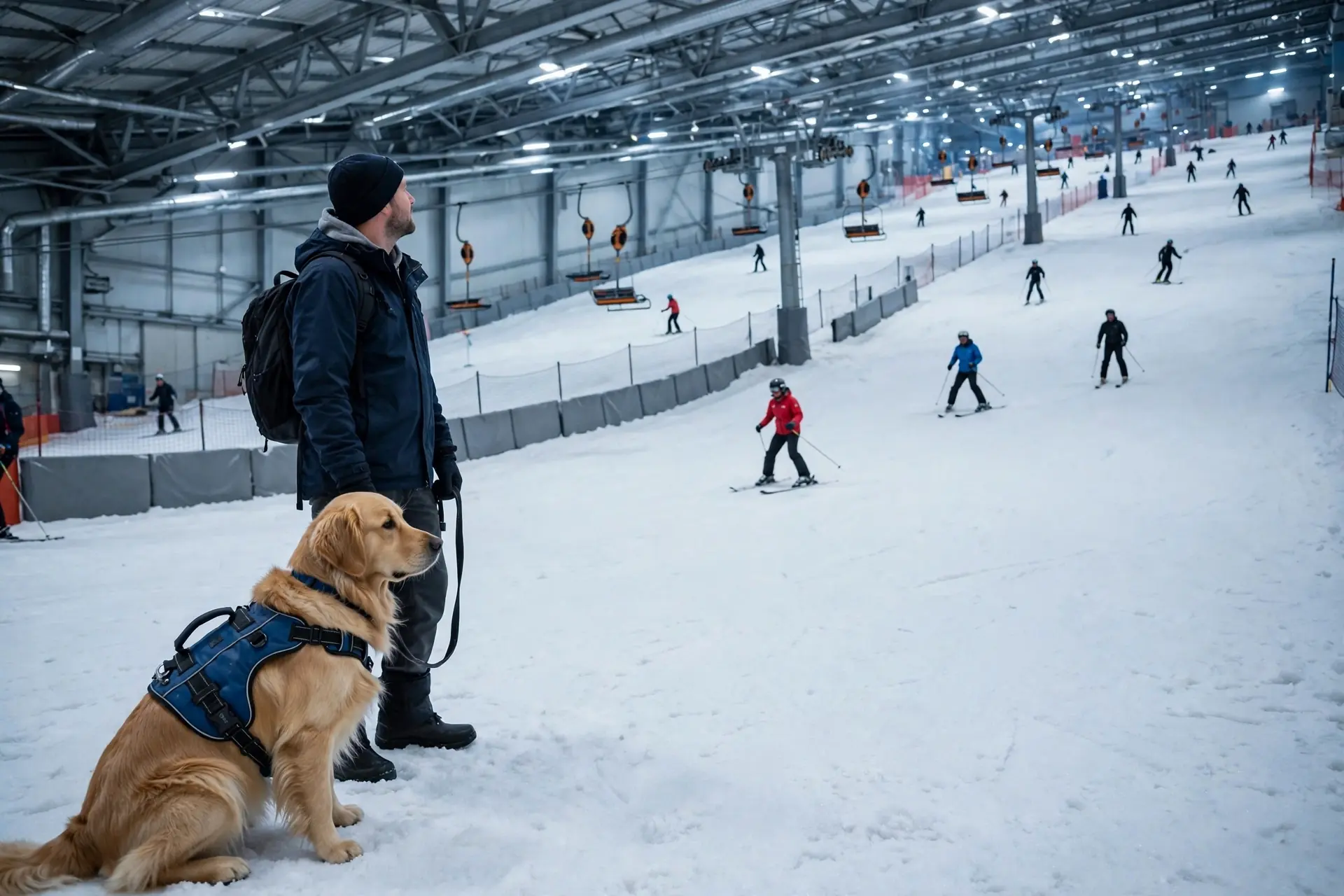
A third alternative is to choose a different winter activity altogether. Winter in Britain offers plenty of dog-friendly days out that do not involve sitting still in the cold: country parks, coastal paths, forest trails, garden centres and indoor attractions that welcome dogs. Our guide to dogs on ski lifts covers another winter spectator situation, at indoor slopes and dry centres, where the same questions of seating, cold and crowd apply in a different setting, and it is a useful comparison if your group is choosing between winter activities. The principle is the same: pick the activity that fits the dog, not the activity the group assumed, and the day will be better for everyone.
Finally, consider the dog's own preference. Some dogs love the buzz of a festive square and some dogs hate it, and the owner who knows their dog will make a better choice than any guide. A dog that pulls towards every market stall and greets every stranger may love a rink-side market, while a dog that hides behind its owner at a firework display will not. Trust that knowledge, and do not let a group's enthusiasm override it. A winter day out that the dog enjoys is a day the owner enjoys too, because a relaxed dog makes a relaxed group.
A rink-day checklist
A short checklist, run through the night before, prevents most rink-day problems. First, confirm the dog policy for the exact session, by checking the venue's website and, if anything is unclear, by phone. Second, check the rink's opening status on the day, especially for outdoor rinks, where weather can cause closures. Third, pack the dog's kit: coat, blanket or mat, lead, water and bowl, treats, poo bags, towel and a torch for the walk home. Fourth, plan the walks: one before the rink, one after, and a warm-up stop in between. Fifth, agree the exit plan with your group, including who takes the dog if the group splits and where you will meet if you leave early.
On the day, run a second, shorter check. Is the dog toileted, walked and reasonably tired? Is the coat on before the dog gets cold? Is the seat at the end of a row, away from the barrier and near an exit? Is the dog settling, or is it time for a break? These five questions, asked honestly, are the difference between a dog that enjoys a rink visit and a dog that endures one. And if the answer to the last question is "time for a break", take it without guilt. A short visit that ends well is a successful visit, and it makes the next rink day easier, not harder.
One last thought: rinks are a winter pleasure, and winter pleasures in Britain are best taken in small, warm doses. A rink visit with a dog is not about proving that dogs can go everywhere; it is about finding the version of the day that works for the dog in front of you, whether that is an hour in the spectator stand, a walk around the market, or a riverside path while the rest of the group skates. Get that version right, and the dog will be as keen as you are when the lights go up next winter.
Practical questions
Before you go
Can my dog go on the ice with me at a UK ice rink?
Almost never. UK rinks are built for skaters, and dogs are not permitted on the ice surface. Your dog's role on a rink visit is as a spectator from the seating area or the rink-side perimeter, where the venue allows dogs at all. Check the venue's own dog policy before you travel, because it varies from rink to rink.
Are dogs allowed at indoor ice rinks in the UK?
Some are, some are not, and the rule often depends on the session. Permanent indoor rinks are more likely to restrict dogs, especially during busy public skating sessions and ice hockey fixtures. A small number welcome well-behaved dogs in spectator seating, so always confirm with the rink for the exact session you plan to attend.
Are dogs allowed at outdoor Christmas ice rinks?
Outdoor seasonal rinks are usually more relaxed because much of the visit happens outside: the queue, the viewing area and the surrounding market are open-air. Even so, dogs are normally kept off the ice and out of skate-hire areas, and some rinks restrict dogs during peak evening sessions. Read the event page for that season before you go.
How do I keep my dog warm at an ice rink?
Spectator areas at ice rinks are cold, and a dog sitting still loses heat faster than a dog walking. Use a warm coat for short-coated, elderly or small dogs, bring a blanket or insulated mat to sit on, and take breaks in a warmer cafe or market area. Watch for shivering and reluctance to settle, and cut the visit short if your dog is cold.
What should I do about skate blades and crowds at an ice rink?
Keep your dog on a short lead, well away from the barrier and from skate-hire queues where blades are carried at dog-head height. Choose an aisle or end seat so you can leave quickly, avoid the busiest sessions, and never let your dog greet skaters as they step off the ice. If the crowd thickens, move to the rink-side perimeter or leave.
What if the rink I want to visit does not allow dogs?
Split the group, with one person skating while the other walks the dog nearby, or build the day around the rink-side area instead: Christmas markets, riverside paths and nearby parks are often the better part of the outing anyway. Check the official guidance before you travel, and never leave a dog alone in a car while you skate.