This guide is independent and contains no paid placement. Flowering dates and farm rules vary by year and by site, so check the official guidance before you travel.
Go in August, early in the day, on a short lead, and stay on the marked grass paths. Tall rows hide other visitors and hold bees, paths turn to mud after rain, and picking is allowed only in marked visitor rows, so check the farm's rules before you cut anything.
The layout: tall rows and hidden corners
A sunflower field is unlike any other flower field a dog owner will visit, because of its scale. Sunflowers grow to two metres or more, their stems are thick, their leaves are broad, and their heads turn to follow the sun, so a visitor walking between rows is walking through a green corridor with yellow walls, unable to see more than a few metres in any direction. For a person, that enclosure is part of the charm; for a dog, it is a world of hidden smells, sudden encounters and no sightlines. A dog that is comfortable in open fields may still be unsettled in tall rows, where another dog can appear around a corner at nose distance with no warning, and where children can dart out of a side row without being seen first.
Understanding the layout before you enter helps enormously. Most visitor fields are planted in long, straight rows with grass paths between them, plus a wider headland path around the edge and one or two cross paths that let visitors move between blocks. The headland is the safest place for a dog: open sky, sightlines, room to step aside, and an easy exit to the car park or shop. The interior rows are the most photogenic and the most challenging, because they are narrow, busy and blind. A good first visit uses the headland for most of the walk, with short excursions into the rows for photographs, rather than a long march through the interior. That pattern gives the dog the experience without the stress of constant blind encounters.
Field size varies hugely, from a single acre beside a farm shop to tens of acres grown for seed or oil with a small visitor corner. A large field sounds impressive, but for a dog owner it often means a longer walk in the sun, more mud, and a greater distance back to water and shade. A smaller field, with a clear loop path and a shaded seating area, is usually the better dog day, and the photographs are just as yellow. Check the farm's map, if one is published, and ask staff which loop suits a dog on a lead, because staff walk the field daily and know where the paths are widest, where the mud is worst, and where the quiet corners are.
One more layout point: sunflower fields are often part of a larger farm attraction in August, with a maize maze, a play area, a cafe and a shop sharing the same site. That combination can be wonderful for a family day, but it also means the dog's visit involves navigating between zones, each with its own rules. The maize maze, in particular, is usually unsuitable for dogs, because its paths are narrow, dark and crowded, and a dog that panics in a maze is difficult to extract. Plan the zones in advance, agree who stays with the dog during any maze visit, and treat the sunflower field as the dog's part of the day, not as one stop in a long itinerary that leaves the dog waiting.
Flowering window and summer weather
Sunflowers in Britain usually flower from late July to September, with August the peak month for most visitor fields. The window is longer than the bluebell or lavender windows, but it is also less predictable, because sunflowers are an agricultural crop as much as a visitor attraction, and a field grown for seed may be left to mature and dry, turning brown and drooping, while a visitor field is managed for colour. A field that was glorious in early August may be past its best by late August, with heads bowing under the weight of seed, and a field that looks green in July may not flower until September if it was sown late. The farm's flowering report, checked in the week before travel, is the only reliable guide, and photographs from the last few days are worth more than any article.
Summer weather shapes the visit in two opposite directions. A dry, sunny August produces firm paths, bright flowers and happy dogs, but also heat, glare and dusty soil, while a wet August produces mud, humidity and flowers that bow under rain, but also softer light and fewer visitors. A thunderstorm is the worst combination: tall sunflowers conduct no lightning risk to a visitor on a path, but a storm turns paths to slurry, sends visitors running, and frightens many dogs, so check the forecast and have a threshold for abandoning the visit. A light shower, by contrast, can be a blessing, cooling the air, deepening the yellow, and emptying the field, provided you have waterproofs and a towel for the dog.
Time of day matters for sunflowers more than for most flowers, because the heads follow the sun. In the morning, heads face east, catching the low sun and photographing beautifully from the eastern paths, while in the afternoon they turn west, and the light changes completely. Early morning also brings cooler air, fewer visitors and bees that are still warming up, which is the kindest combination for a dog. Midday brings the full heat of an open field with no shade, and late afternoon brings long shadows and golden light, but also tired dogs and closing-time pressure. For a first visit, a weekday morning in August is the clear winner, and it is worth taking time off to get it.
Heat deserves emphasis, because a sunflower field offers no shade at all between rows. The plants themselves cast narrow shadows that move with the sun, but they do not shade a path, and a dog walking a long row at midday is walking in direct sun with reflected heat from dry soil. Brachycephalic breeds, older dogs and overweight dogs are at particular risk, and a cooling coat, frequent water and a short visit are essential. If the temperature is high, shorten the field walk to a brief look and a photograph, then retreat to shade, a cafe or a woodland walk, rather than persisting through a long loop because you have paid for entry. The flowers will still be there on a cooler day.
Muddy paths and what to wear
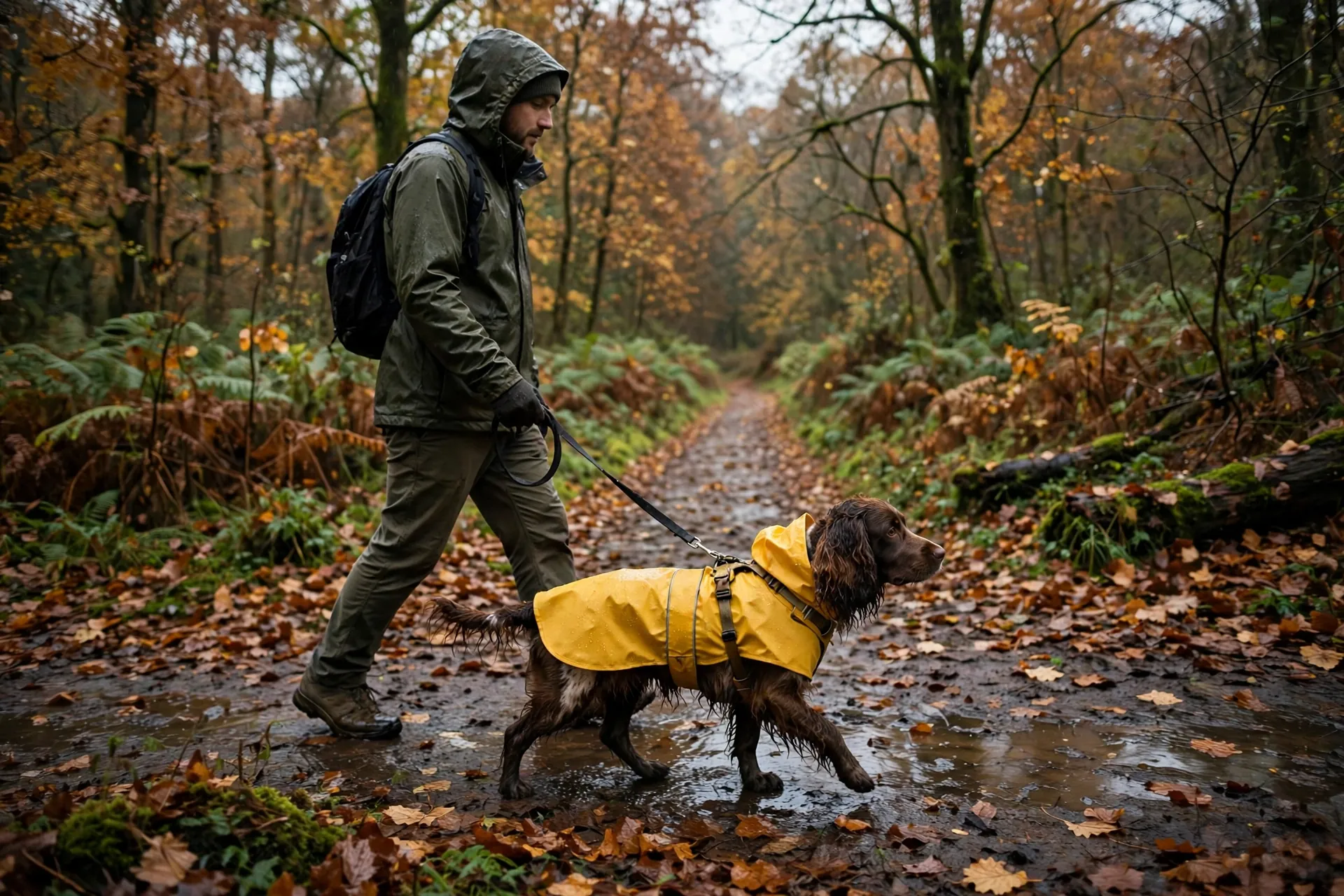
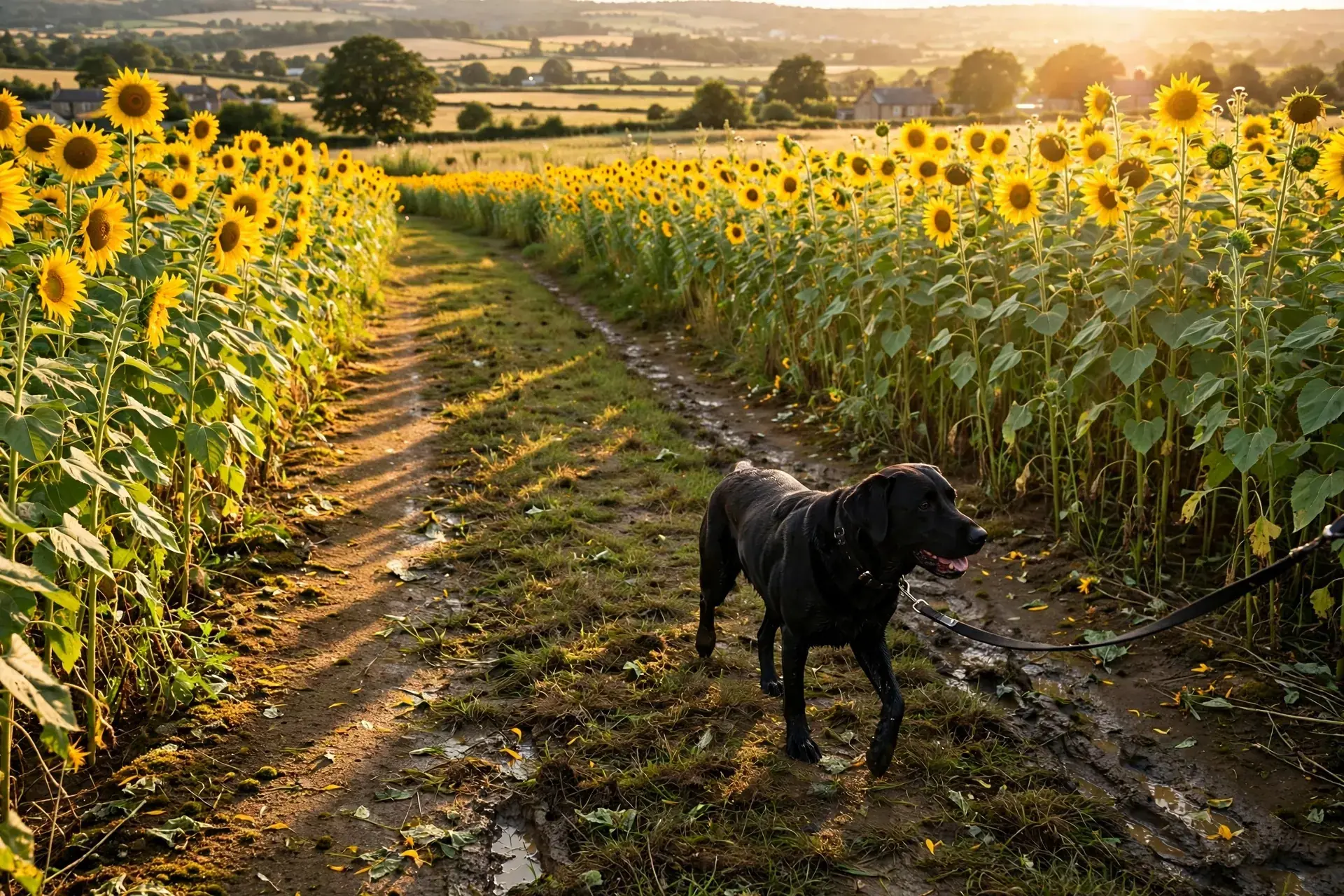
Sunflower paths are grass, soil or a mixture of both, and they hold water in a way that a paved path does not. After a summer storm, the grass paths between rows become slippery, rutted and deeply muddy, with puddles that hide ruts and stones. A dog that runs through such a path can slip, twist a foot or cut a pad on a sharp stone hidden in mud, and a person in trainers can slip just as easily. Wellies are the right footwear for a sunflower field after rain, not walking boots, because wellies rinse clean and grip better in slurry, and an old waterproof jacket, rather than a new one, is the right outer layer. For the dog, a drying coat is worth packing, because it absorbs mud while the dog is still in the field, rather than transferring it all to the car.
The car needs preparation to match. Line the boot with a waterproof liner, add a towel on top, and keep a bag for muddy leads and wellies, because a sunflower field in August can produce as much mud as a pumpkin patch in October, and visitors are often surprised by it. Bring two towels, one for the field and one for the car park, and a bottle of water for rinsing paws, because a farm tap may not be available at the field exit. Check paws after the visit for mud packed between toes, cuts and swelling, and dry the dog thoroughly before the drive home, because a wet dog in an air-conditioned car chills quickly, even in August.
Path etiquette in mud is the same as in any flower field: stay on the marked paths, even when they are muddy, rather than stepping into the rows to find firmer ground, because stepping into the rows damages the crop and risks a bee sting or a hidden encounter. If a path is truly impassable, turn back or take a cross path, rather than creating a new route through the plants. Farms notice where visitors have trampled rows, and a field that is trampled in August may not welcome dogs the following year. The mud is part of the visit, not a reason to break the rules, and a dog owner who accepts mud gracefully is a dog owner a farm will welcome back.
Finally, pack for the weather you might get, not the weather on the forecast at breakfast. A summer storm can arrive by lunchtime, and a field that was dusty at ten in the morning can be muddy by noon. A waterproof coat for the dog, for small or short-coated dogs, a spare dry coat for the journey home, and gloves for handling a muddy lead in a downpour are all worth their space in the car. August rewards the prepared, and a muddy dog that is dried, watered and comfortable in the car is a dog that will enjoy the next field visit, while a muddy dog that is cold and uncomfortable will not.
Leads and visibility among tall stems
A short lead is essential in a sunflower field, not just because farms require it but because tall rows remove visibility. A dog on a long line or a retractable lead can disappear around a corner, wrap its lead around sunflower stems, and meet another dog nose-to-nose before either owner can react, all within a few seconds. A standard short lead, held in one hand, keeps the dog beside you, visible to you and to other visitors, and it prevents the lead tangling in stems, which is a common and frustrating problem in tall rows. If your dog pulls, a harness the dog knows will make the walk easier than a collar the dog strains against, especially on a muddy path where a sudden lunge can pull an owner off balance.
Encounters in tall rows need a plan, because they happen suddenly. When you hear voices or another dog ahead, slow down, shorten the lead, move to the edge of the path, and let the other party pass, rather than meeting head-on in a narrow row. If your dog is reactive, use the headland path for most of the walk, where sightlines are long and encounters can be seen coming, and dip into the rows only when they are empty. A reactive dog can enjoy a sunflower field, but only with an owner who manages space proactively, choosing wide paths and quiet times over narrow rows at peak hours. The same applies to children: a child darting out of a side row is startling for a dog, so keep the dog close at junctions and cross paths, where encounters are most likely.
Calling a dog back in a sunflower field is unreliable, even for a dog with a good recall in open ground, because the dog cannot see you, the scent of other visitors and animals is overwhelming, and the rows all look alike. Do not rely on recall in a sunflower field, and do not let the dog off lead "just for a photograph" among the stems, because a loose dog in tall rows is a lost dog risk, a crop damage risk and a bee sting risk all at once. The best sunflower photographs with a dog are taken from a path, with the dog beside you and rows behind it, and they are more honest and more beautiful than a photograph taken inside the crop.
Other dogs deserve the same courtesy as in any flower field, but the tall rows make it harder to offer. A greeting that goes wrong in a narrow row has nowhere to go, and two dogs on short leads, face to face in a corridor of stems, cannot perform the curved approach that polite dogs prefer. Keep your dog moving past other dogs, reward a calm pass, and do not stop for a meeting in a bottleneck. If another owner stops for a greeting, a polite "we are just passing through" and a steady walk past is perfectly acceptable, and most owners understand. The field is for walking and looking, not for socialising dogs, and a calm pass is a kindness to both animals.
Bees, sun and heat together
Sunflower heads are magnets for bees, and a field in August hums with them. Honeybees, bumblebees and solitary bees work each head methodically, and a dog that walks a row is walking through a busy workplace. Most dogs ignore bees, and most bees ignore dogs, but a dog that snaps at bees, chases them or stands still among dense heads can be stung, and a sting on the nose or mouth swells quickly and hurts. Keep the dog on the path, away from the heads themselves, and keep moving through the rows rather than lingering among them, because a moving dog is a less interesting target than a stationary one. If the dog fixates on bees, whines or snaps repeatedly, move to the headland, where bee density is lower, and shorten the visit.
A sting, if it happens, needs a calm response. A single sting on a paw or nose usually causes local swelling that settles within hours, and a cold compress helps if one is available. Remove a honeybee sting by scraping, not squeezing, and watch for signs that need urgent veterinary help: swelling spreading to the face or throat, difficulty breathing, vomiting, collapse, or multiple stings. Keep the nearest vet's number in your phone before the visit, because a field with poor signal is a poor place to search for help. Dogs that have reacted badly to stings before should be discussed with a vet before a sunflower visit, and an owner who knows their dog is bee-reactive should choose a field edge walk over a row walk.
Sun and heat combine with bees to make August fields demanding. A dog that is hot, thirsty and surrounded by bees is a dog under triple stress, and the answer is the same for all three: a short visit, frequent water, shade breaks and a prompt retreat to the car park or shop if the dog shows signs of distress. Signs to watch for include heavy panting that does not settle, drooling, a bright red tongue, wobbliness, refusal to walk, and frantic snapping at bees. Any of these means the field visit should end, not continue, because a dog that is pushed through distress will associate flower fields with misery, and the next visit will be harder.
Sun protection for dogs is a smaller point, but worth mentioning for dogs with thin coats, pink skin or hairless patches, which can sunburn on ears and noses in strong August sun. A pet-safe sunscreen, applied before the visit if your vet recommends it, and a shaded break every few rows, are sensible precautions, though most dogs with normal coats need no sun protection for a short field visit. The greater risk is heat, not sunburn, and the greater protection is water, shade and brevity. A sunflower field at ten in the morning, with water and a shade plan, is a joy; the same field at two in the afternoon, without them, is an endurance test.
Picking rules: seed, oil and visitor rows
Picking rules at sunflower farms are more complicated than at pumpkin patches, because sunflowers are grown for different purposes. A field grown for seed or oil is a commercial crop, and picking from it is not allowed, because each head represents seed that will be harvested, dried and sold. A field grown for visitors is planted with varieties chosen for colour and size, and picking is often allowed from marked rows, for a fee, with scissors provided. The distinction is not visible from the path: a seed field and a visitor field look identical in August, so the farm's signs and staff are the only authority, and cutting a head without permission is theft from a crop, however innocent it feels.
Where picking is allowed, the system is usually simple: pay at the shop or field entrance, receive a bag or a bunch allowance, cut only from the marked visitor rows, and use the farm's scissors, cutting the stem cleanly below the head. Keep the dog on the path while you cut, rather than letting it wander among the rows, because a dog among cut stems is a dog among bees, fallen heads and other visitors' scissors. Cut heads are heavy and awkward, and a head carried with a lead, a camera and a bag is a juggling act, so agree who holds the dog and who carries the flowers before you start cutting. A single head, chosen well, is a better souvenir than an armful that wilts in a hot car.
What to do with a picked sunflower at home is worth a thought before you cut it. A fresh head lasts a few days in water, provided the stem is cut cleanly and the water is changed, but it sheds petals and seeds, and a dog that investigates a vase can knock it over or eat fallen petals. Keep cut sunflowers out of the dog's reach, in a stable vase away from the dog's tail, and dispose of a drooping head promptly, because a mouldy head in a vase is an invitation for a curious dog. Dried heads, kept for seed, should be stored where the dog cannot reach them, because a dog that eats a large amount of seed, especially salted seed meant for humans, can develop stomach upset.
If picking is not allowed, the farm shop usually sells bunches, and a bought bunch is a better souvenir than a cut head, because it is fresh, properly wrapped, and does not damage the crop. A shop bunch also avoids the awkwardness of carrying a head through a field with a dog, and it supports the farm directly. Whether you pick or buy, keep the flowers away from the dog in the car, wrapped in paper, because a loose head in a car sheds seeds everywhere and tempts a dog to chew it. The flower is for the house, not for the dog, and a little wrapping keeps it that way.
Children and photography in tall rows
Children love sunflower fields, and a field in August is full of them, running between rows, hiding, shouting and waving heads they have picked. For a dog owner, that energy needs managing, because a child darting out of a row is startling for a dog, and a dog that jumps up at a child holding a sunflower is a collision waiting to happen. Keep the dog close at junctions, cross paths and field entrances, where children appear suddenly, and use the headland for most of the walk if your dog is nervous around children. If your dog loves children, still manage greetings: a sit for a stroke, rather than a jump, is the behaviour to reward, and a child who is taught to stroke a calm dog gently is a child who will enjoy dogs for life.
Photography in tall rows is both easier and harder than in other flower fields. Easier, because the rows provide natural leading lines, the colour is vivid, and the dog, photographed from a path with rows behind it, looks wonderful. Harder, because the light is harsh at midday, the rows cast confusing shadows, and the best angles often require standing in a row, which is not allowed. The solution is the same as in other flower fields: photograph from the path, keep the camera at the dog's eye level, use the rows as a background, and take the photograph early in the visit, while the dog is fresh and the light is soft. Morning light, from the east, flatters sunflowers and dogs alike, while afternoon light, from the west, gives a different, warmer picture, so the time of day you choose shapes the photographs you take.
Other photographers in a sunflower field are usually patient, but paths block easily when a group stops for a photograph in a narrow row. Take your photograph quickly, move on, and leave the viewpoint for others, because the field belongs to everyone and a queue in a tall row is uncomfortable for dogs. If you want a quiet photograph, walk to the far end of the field, where the crowds thin, rather than waiting for a famous viewpoint to empty. Drones, as in other flower fields, are usually prohibited and should be left at home, because a drone over a field in August disturbs bees, birds and visitors alike, and a ground-level photograph is honestly more beautiful.
One practical photography warning: keep the phone and camera safe from heat, dust and mud. A phone left in direct sun on a path overheats, a camera dropped in mud is a common August casualty, and a camera strap around the neck is safer than a hand-held phone while also holding a lead. Bring a cloth to wipe the lens, because dust and pollen coat a lens quickly in a dry field, and back the photographs up when you get home, because August photographs are the ones you will look back on in winter, when the field is a distant memory and the dog is asleep by the fire.
What a dog may and may not eat here
Sunflower plants are not dog food, and the distinction between a seed, a petal and a stem matters. Plain, unsalted sunflower seeds, in tiny amounts, are not usually harmful to dogs, and they appear in some dog foods, but that does not make a field head a dog snack. Petals, stems and leaves can cause stomach upset if eaten in quantity, and a head that has begun to mould, or that has been treated with agricultural sprays, is definitely not food. Salted, flavoured or coated seeds meant for humans should be avoided entirely, because salt and flavourings are unsuitable for dogs. The rule, as in other flower fields, is simple: the dog looks and sniffs, but does not eat, and any head or seed the dog picks up should be traded for a treat.
Fallen heads and seeds on the path are a particular temptation, because they smell interesting and lie at nose height. A dog that scavenges along a path can eat a surprising amount quickly, especially if the path is littered with heads dropped by other visitors. Keep the dog's nose out of the litter where you can, walk at a steady pace through littered sections, and carry a high-value treat to trade for anything the dog picks up, which is far more effective than chasing the dog around a field. If the dog does eat a large amount of seed or plant material, watch for vomiting, diarrhoea or lethargy, and seek veterinary advice if symptoms persist, because a field snack that seems harmless can still upset a sensitive stomach.
Farm food is another temptation, because sunflower farms in August often sell ice cream, cakes, drinks and snacks, all of which smell interesting to a dog. Keep the dog away from the table edge while food is served, do not share human food with the dog, and give the dog its own chew or treat under the table while humans eat, which prevents begging and the stomach upset that follows a shared cake. A settled dog under a table is a welcome dog, while a begging dog is a dog that other visitors notice, and a farm that feels respected by dog owners will keep welcoming them. The same applies to picnics: eat in a designated area, keep food away from the dog, and clean up completely, because dropped food attracts wasps as well as dogs.
Water, as ever, is the most important thing a dog consumes at a sunflower field. Offer it frequently, from a clean bowl, rather than letting the dog drink from puddles, irrigation ditches or farm tanks, which may hold fertiliser, algae or bacteria. A dog that drinks from a stagnant puddle after a storm can develop stomach upset, and a dog that drinks from a tank meant for irrigation may ingest chemicals. Carry your own water, offer it often, and treat puddle drinking as something to prevent, not something to allow. Clean water, offered frequently, is the simplest health measure on any summer field visit, and it costs nothing but a bottle and a bowl.
End of season and the wider day out
By September, sunflower fields change character. Heads bow under seed, petals drop, leaves yellow, and the field takes on a golden-brown, harvest-ready look that is beautiful in its own way but very different from the August blaze. Some farms close their visitor fields at this point, some offer a final picking weekend, and some leave the field for harvest, with machinery moving through the rows. Check the farm's status before a September visit, because a field that welcomed dogs in August may be closed for harvest in September, and a dog among harvest machinery is a serious safety risk. The end of the season is also a good time for a quieter visit, if the farm remains open, because crowds thin and the light softens, though the flowers are past their best.
A sunflower visit pairs naturally with a wider late-summer day out. Many farms sit near country parks, riverside walks or villages with dog-friendly pubs, and a walk after the field gives the dog the exercise it missed while on a lead among tall rows. Our guide to dogs in pub gardens covers the etiquette of a post-field drink with a muddy dog, and our autumn dog holiday checklist helps bridge the gap between late summer and autumn, with mud routines, lights and seasonal rule changes that become relevant as September turns to October. A sunflower field, a walk and a pub garden, in that order, is a classic late-summer day, and it is one the dog will enjoy from start to finish, provided the lead stays short and the water bottle stays full.
Finally, record what you found, because sunflower flowering shifts each year and local knowledge is the most valuable kind. A note of the farm, the date, the flowering state, the mud, the bees and the dog's behaviour helps you plan next year's visit, and it helps other dog owners if you share it. A farm that was perfect on a weekday morning in August may be crowded on a weekend in September, and a note that says so saves someone else a wasted journey. Fields survive as visitor attractions because people care about them, and caring includes sharing honest information about when to go, where to park and how the dog coped. That is the quiet work of a good dog owner in late summer, and it is work worth doing, with a sunflower head in a vase at home to remember it by.
Practical questions
Before you go
When do sunflowers flower in the UK?
Usually from late July to September, with August the peak month for most visitor fields. Check the farm's flowering report, because harvest and weather can shorten the window.
Are sunflower fields muddy after rain?
Yes, often very muddy. Paths between tall rows drain slowly and hold water after summer storms, so wear wellies, bring a towel, and keep the dog on the marked paths.
Can my dog eat sunflower seeds or petals?
Plain, unsalted sunflower seeds in tiny amounts are not usually harmful, but petals, stems and mouldy heads are not dog food, and salted or flavoured seeds should be avoided.
Do dogs have to stay on a lead in sunflower fields?
Yes, at almost every visitor field. Tall rows hide other visitors, children and dogs, and a loose dog among the stems is a collision and crop-damage risk.
Are bees a problem for dogs in sunflower fields?
Bees work sunflower heads heavily, so keep the dog on the path, discourage snapping at bees, and seek veterinary advice if a sting causes spreading swelling or breathing difficulty.
Can I pick sunflowers to take home with a dog?
Only where the farm offers picking, and only from marked rows with the farm's scissors. Many fields are grown for seed or oil, so picking is not allowed everywhere.