This guide is independent and contains no paid placement. If affiliate links are added later, they will be clearly marked and will not change our editorial checks.
Many British antique shops welcome dogs, but the welcome is always the shop owner's to give. Ask at the door, keep the lead short, keep your dog away from low shelves of porcelain and glass, and plan the day so the dog gets a proper walk and a rest between shops. A calm dog and a careful owner are welcome almost everywhere; a loose lead in a room full of china is welcome nowhere.
Ask before you cross the threshold
The single most important habit for dogs in antique shops is also the simplest: ask before you go in. The most expensive object in the room is very often sitting at tail height — a porcelain vase on a low cabinet, a pair of glass decanters on an open shelf, a clock on a side table at exactly the height of a spaniel's wagging tail. The shop owner knows where the fragile stock is. A thirty-second conversation at the door tells you whether dogs are welcome, whether some rooms are off limits, and where the tight corners are. That conversation is the whole difference between a relaxed browse and an expensive accident.
There is no general legal right to take a dog into a private shop in the UK. Assistance dogs are a separate matter and have legal protection, but a pet dog enters only because the owner says yes. Policies vary enormously, and they vary for reasons that have nothing to do with how well behaved your dog is. A shop may have an insurance condition that excludes animals, a landlord who forbids them, a dealer whose stock is on open shelves at knee height, or simply a bad experience with a previous visitor's dog. None of that is a judgement on your dog. Accept a no graciously and move on; arguing at the door helps nobody and guarantees the next dog owner gets a colder reception.
Look for the signs before you even speak. Many dog-friendly shops put a sticker in the window, a water bowl by the door, or a note on the counter. A bowl by the door is a good sign, but it is not a guarantee — it may belong to the owner's own dog, or it may have been left out for a regular. If there is no sign either way, the default is to ask. Stand at the doorway with the dog behind you or beside you, not already halfway inside, and ask plainly: "Are dogs welcome in here?" If the answer is yes, ask one follow-up: "Is there anywhere you'd rather we didn't go?" That second question is the one that saves vases. It tells the owner you are thinking about their stock, and it usually produces useful information — "the back room is fine, but keep clear of the glass cabinet on the left" — that no sign would ever tell you.
Checking ahead saves the doorstep conversation entirely. Most antique shops and centres now have a website, a Facebook page or an Instagram account, and many mention dogs explicitly. A quick search before you set out lets you build a route from confirmed dog-friendly stops rather than discovering one refusal after another on a wet high street. If the listing says nothing about dogs, a short message or phone call the day before is worth the effort. Shops that welcome dogs usually say so proudly; shops that are silent on the subject are often the ones where the answer depends on the day, the stock on display, or who happens to be on the counter.
Timing matters too. A shop that is delighted to see a calm dog on a quiet Tuesday morning may be far less enthusiastic on a packed Saturday when three other customers are already squeezing past the same cabinet. If you have a choice, visit antique shops early in the day or in the last hour before closing, when the floor is quieter and the owner has time to chat. Avoid market days in the same town unless you are prepared for crowds, and avoid the first hour after opening on a fair day, when dealers are still setting up and the floor is full of boxes and unwrapped stock at ground level.
Finally, judge your own dog honestly before you ask. A dog that settles quickly, walks calmly on a short lead and ignores other people is a good candidate for an antique shop. A dog that pulls, jumps up, barks at strangers or has never been in a shop before is not — yet. There is no shame in leaving a dog in the car for ten minutes on a cool day with proper ventilation while one of you pops in to check, or in taking turns with a travel companion so the dog gets a walk instead. The goal is a day that works for the dog as well as for the shopper, and sometimes that means the dog waits outside with a person and a treat rather than inside among the porcelain.
Antique centres: big rooms, small gaps
Antique centres — large buildings divided into dozens or hundreds of dealer pitches — are usually the easiest place to start shopping for antiques with a dog. The floors are wider, the ceilings are higher, and there is usually a central aisle broad enough for a dog to walk beside you without brushing against stock. Many centres are converted warehouses, mills, chapels or farm buildings, so the ground floor often has the generous proportions that a small high-street shop cannot offer. The sheer size also works in your favour: if one aisle is crowded or full of low glassware, you can take another route and come back later.
That said, a centre is not a single shop. Each pitch belongs to a different dealer, and the centre's overall dog policy does not always apply to every corner of the building. The entrance may say dogs are welcome, but an individual dealer may have asked that dogs keep out of their particular unit, usually because it holds small, high-value items or because the pitch is enclosed by a low barrier that a dog could knock. Look for small signs on individual pitches and respect them. If a pitch is roped off or marked, do not lift the dog over the rope or let the lead trail across it.
Centre layouts have their own hazards. The central aisle is safe, but the gaps between pitches can be narrow, and the ends of display units often hold the most fragile stock at the lowest height. Dealers tend to put eye-catching pieces at the end of a unit — a pair of vases, a lamp, a small table — precisely where a turning dog's tail will sweep. Walk your dog on the side away from the displays where possible, and keep the dog on the inside of your body when you stop to look at something. If you need to crouch down to inspect a low shelf, shorten the lead first and tuck the dog close, because a dog that wanders while you are crouched is a dog whose lead is about to pull a table leg.
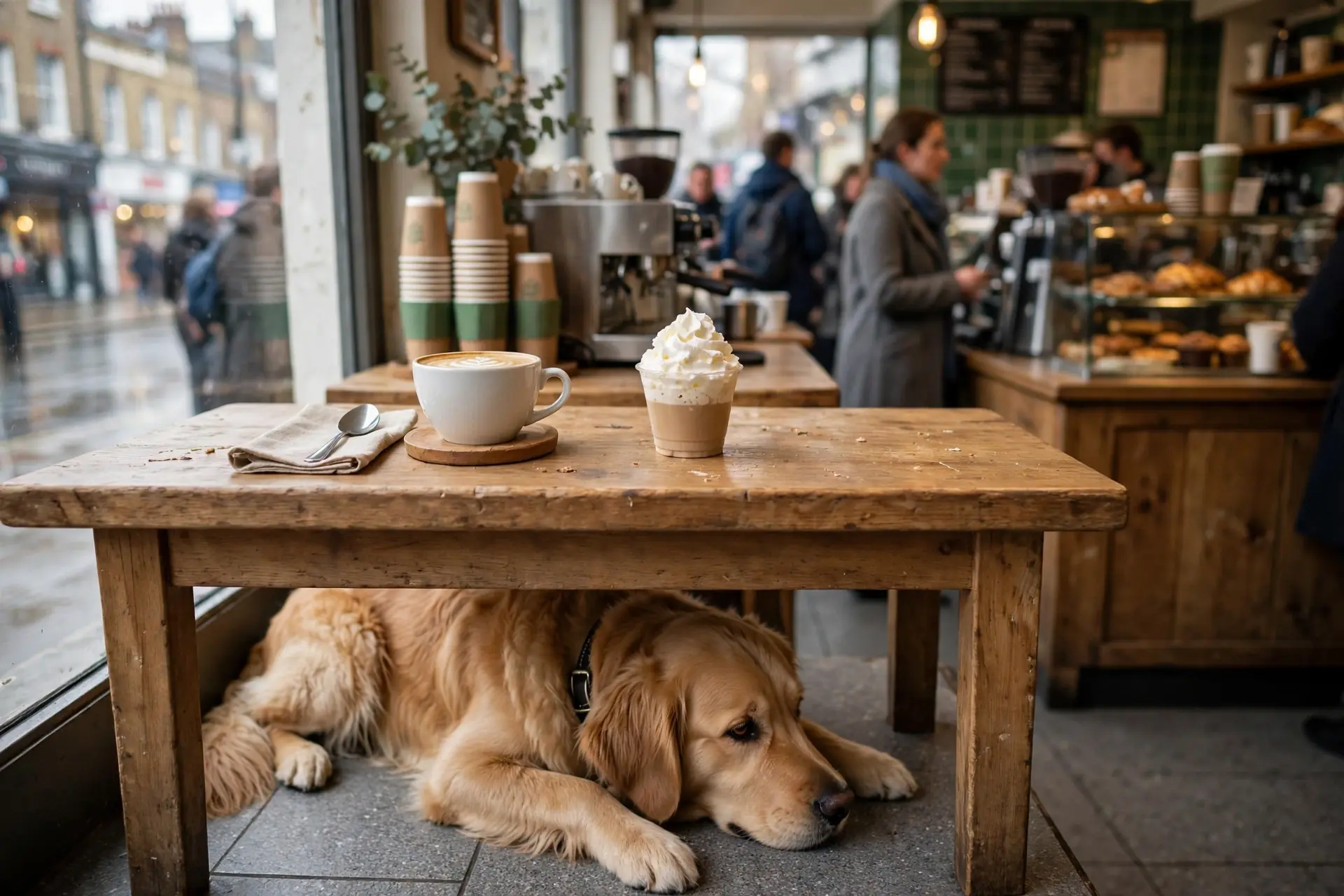
Centres also have the practical advantages that make a longer visit possible. Most have a cafe or tea room, and many of those welcome dogs in at least part of the seating area, which means you can take a proper break without leaving the building. Our guide to dog friendly cafes in the UK explains how to check indoor seating rules before you sit down, and the same habits apply here: ask, choose a corner table, and keep the dog under the table rather than in the walkway. Centres usually have toilets, parking nearby, and a staffed desk where you can ask about dog policy, storage, and whether there is a quieter route through the building. Use the desk. The staff answer the same questions all day and will often point you to the dealers who are happiest to see a dog.
Watch the floor as well as the shelves. Centres in old buildings often have uneven stone flags, worn wooden boards, thresholds between rooms, and rugs that slide. A dog that is watching the smells rather than the ground can slip, and a slipping dog grabs for balance with its paws — sometimes against the nearest piece of furniture. Walk slowly through doorways and over thresholds, and avoid the temptation to let the dog trot ahead on a long lead through a room you have not yet seen. If the centre has an upstairs, check before you go up: steep, narrow stairs with open treads are hard for older dogs, and the upper floor of a centre often holds the smaller, more delicate stock.
Finally, remember that a centre visit is long. Two hours of slow browsing through warm, scented rooms is tiring for a dog, even a calm one. Plan a break halfway through: a short walk outside, a drink of water, a few minutes on a patch of grass. Many centres are on the edge of town with a lane or a green nearby, and a ten-minute reset makes the second half of the visit far safer than pushing a tired dog through another aisle of glass.
Independent shops: small rooms, close quarters
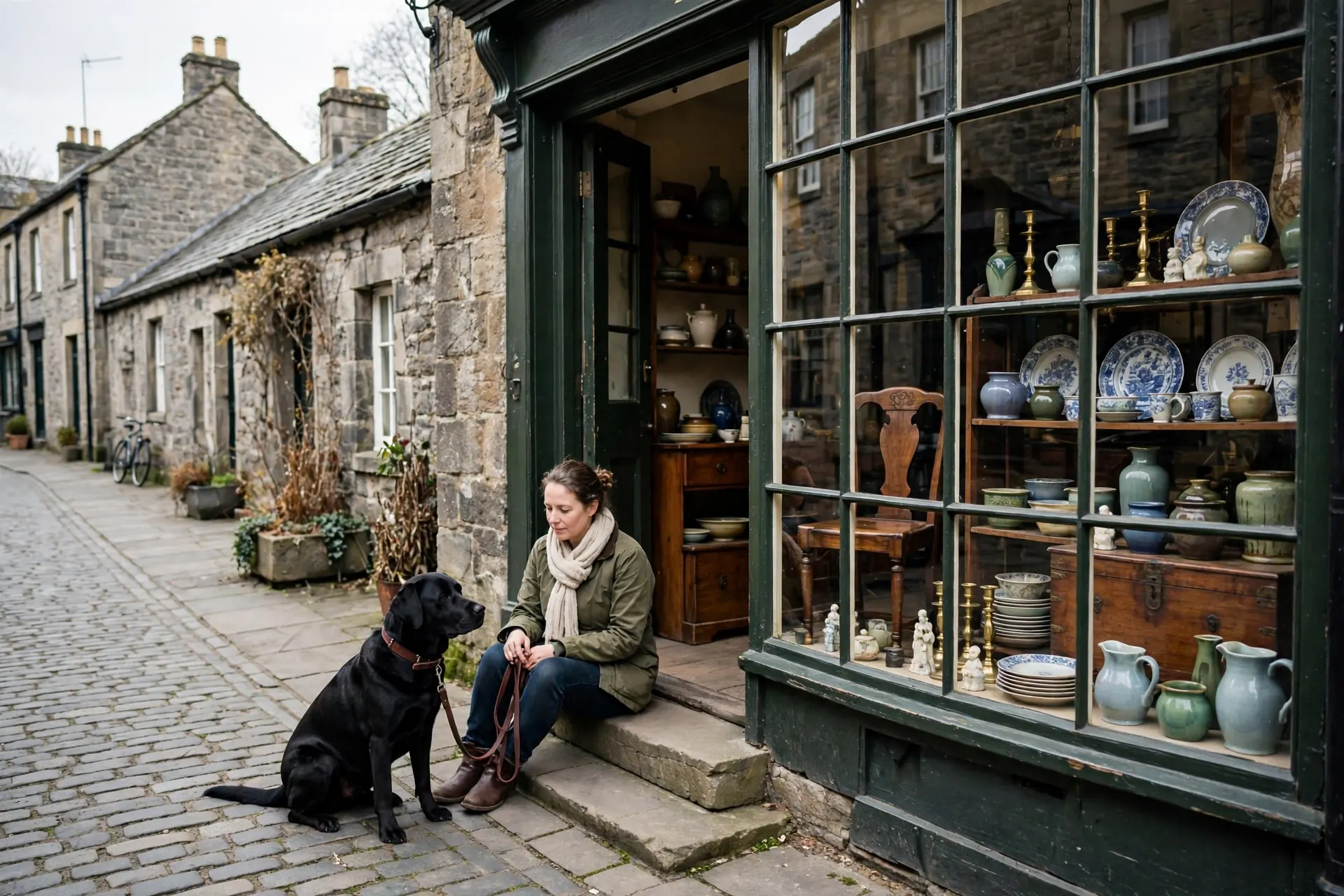
The independent antique shop — one owner, one room, or two rooms joined by a narrow doorway — is where the best finds often live, and it is also where a dog needs the most careful handling. These shops are usually in old buildings with small windows, low ceilings and floors that slope gently in one direction. Stock is packed in because the rent is high and the space is small. A dresser may hold a dozen pieces of pottery, a table may carry a lamp, a clock and a stack of books, and the gap between two cabinets may be barely wide enough for one person, let alone a person and a dog.
The approach here is different from a centre. In a centre you can wander; in an independent shop you should move deliberately, one section at a time, with the dog always on your inside and always visible to you. Never let the dog go around a cabinet while you go the other way. The lead should be short enough that the dog cannot reach the next display while you are looking at this one. If the shop is very small — a single room with stock on every wall — consider whether the dog should come in at all. A large dog in a tiny shop is a risk even when the dog is perfectly behaved, because there is simply no room for the dog to turn around without touching something.
Talk to the owner. In an independent shop the owner is usually also the buyer, the valuer and the person who will wrap your purchase, and they know every piece in the room. Tell them what you are looking for and ask where it is. This is not just polite; it is practical. The owner will often move a fragile piece out of the way, clear a path, or suggest that you look at the sturdier stock first and the porcelain last. Many owners keep a biscuit behind the counter and a water bowl by the door, and a dog that is greeted warmly and given a treat will settle far faster than a dog that is ignored. If the owner offers a treat, accept it graciously — and mention any dietary restrictions your dog has before they hand it over.
Be particularly careful with the classic hazards of a small shop: the table just inside the door, the cabinet at the end of the counter, and the shelf at knee height by the till. The table by the door is where the owner puts new arrivals and interesting small pieces to catch the eye, which means it is also the first thing a dog meets. Walk past it slowly with the dog on the far side. The till area is where people queue, bags swing, and dogs get stepped on or bumped; keep your dog out of the queueing space and settle them beside you while you pay. And never let a dog sniff a low open shelf of china: a wet nose on a 200-year-old plate is a cleaning problem, and a curious paw is a breakage waiting to happen.
Small shops also reward patience. If the owner is with another customer, wait outside or in a quiet corner rather than wandering the fragile stock while they are distracted. If you want to handle a piece, ask first and let the owner lift it down for you; never reach over a dog to pick up a vase, and never hand a fragile piece to a companion while the dog is pulling. Buy slowly, wrap carefully, and carry purchases in a bag that closes — a paper bag with a porcelain figurine poking out of the top is an accident on a lead.
One more thing about independent shops: they are often the heart of a high street, and the owner may know the other dog-friendly businesses nearby. Ask where else welcomes dogs. A good owner will point you to the cafe that allows dogs inside, the bookshop with the resident spaniel, or the pub garden around the corner. That local knowledge is worth more than any list, and it turns a single shop visit into a proper dog-friendly day out.
Antique market stalls: open air, different rules
Outdoor antique markets and fairs are a different proposition from indoor shops, and in many ways they suit dogs better. There is fresh air, open space, grass or tarmac underfoot, and no walls to bounce sound around. Many of the best-known fairs in Britain welcome dogs, and a morning spent wandering between stalls with a dog is one of the more relaxed ways to hunt for antiques. But the rules are not the same as in a shop, and the hazards are different.
First, the rules belong to two people at once: the market organiser and each individual stallholder. The organiser may welcome dogs across the site, while a stallholder with a table full of glass may ask you to keep your dog back from their pitch. Both are entitled to set their terms. Check the fair's website or social media before you go, and check the official guidance before you travel, because some fairs change their dog policy for busy dates, and some charge admission that may or may not include dogs. If the fair is indoors — a hall or a marquee — the rules are closer to those of a shop, and the same ask-first habit applies.
The physical hazards of a market are at ground level. Stall legs, guy ropes, tent pegs and the corners of folding tables are all at nose and paw height. A dog that walks into a guy rope can pull a whole stall canopy sideways, and a dog that circles a table leg can wind its lead around it in seconds. Keep the lead short and keep the dog on the walkway side of the stall, not between the stall and its stock. Low displays are everywhere at a market: boxes of china on the ground, trays of jewellery at knee height, a pile of books on a tarpaulin. These are designed to be looked at from above by a standing person, which puts them exactly at the height of a dog's nose, tail and paws. Walk your dog past low displays on the far side, and never let them step onto a tarpaulin or a ground sheet.
Crowds are the other factor. A popular fair can be shoulder-to-shoulder by late morning, and a dog in a crowd is stressed, stepped on, and liable to panic. Go early, when stallholders are still setting out and the aisles are clear, or go late, when the crowds have thinned and dealers are more willing to negotiate. Avoid the middle of the day if you can, and avoid the food stalls and the hot-food queue, where dropped food and hot fat create a different set of risks. If the fair is on grass, remember that wet grass and muddy paths make dogs slip, and that a muddy dog in a crowded fair is a hazard to other people's stock as well as to your own clothes.
Weather decides more at a market than anywhere else. On a hot day, a dog on tarmac or gravel can overheat quickly, and there may be little shade between the stalls. Bring water, find shade, and be ready to leave early. On a wet day, the ground turns to mud and the stock moves under cover, which narrows the walkways. On a cold day, a dog standing still while you browse will get cold faster than you will. In all three cases, the right call is often a shorter visit and a longer walk afterwards, rather than a long browse in conditions that do not suit the dog.
Finally, markets are where the social side of antique hunting is at its best for dogs. Stallholders are usually happy to chat, other dog owners are everywhere, and a well-behaved dog is a natural conversation starter. Let the dog be greeted, but manage the greetings: keep them short, keep the lead short, and move on before the dog gets over-excited. A market is also the best place to practise the skills that make shop visits work — short lead, calm walking, settling on cue — because the space forgives a mistake that a porcelain shelf would not.
Lead length and the tail-height rule
If there is one practical rule that governs dogs in antique shops, it is this: the lead should be short, and the tail should be treated as the most dangerous part of the dog. A dog's tail sweeps at exactly the height of a low shelf, a side table and the bottom row of a display cabinet. A happy dog wags. A dog in a new place full of interesting smells wags more. Every wag is a small, fast, uncontrolled movement at precisely the height where the most breakable things live. The owner of the dog cannot feel the tail. The owner of the shop can hear it, though — a soft click against porcelain is the sound every antique dealer dreads.
Use a lead of about one metre, held in your hand, with the dog walking at your side. A standard short lead is ideal; a long training lead is not, and a retractable lead is the worst choice indoors. A retractable line can extend across a room before you notice, sweep across a table of glassware, and wrap around a chair leg or a cabinet handle. The locking mechanism is also slow to engage when you need it most. Leave the retractable lead in the car and bring a fixed short lead, ideally one with a comfortable handle and a clip you trust. If your dog pulls, use a well-fitted harness rather than a collar alone, because a sudden pull on a collar in a room full of china can send both dog and owner off balance.
Position matters as much as length. Walk the dog on the side away from the displays whenever the aisle allows it — if the stock is on your left, the dog walks on your right, and vice versa. When you stop to look at something, bring the dog in close and, if the dog knows the cue, ask for a sit or a settle. A sitting dog's tail is on the floor, not sweeping the shelf. A dog that lies down beside your feet is safer still, and many dogs will settle happily on a mat or a blanket you bring with you. A small, washable mat is one of the most useful things you can carry into an antique shop: put it down, ask the dog to settle on it, and you have a defined, safe space that keeps the dog out of trouble while you browse.
Watch the turns. Most accidents happen when a dog turns around in a narrow gap — the body turns one way and the tail sweeps the other. In a tight space, do not let the dog turn freely. Guide the dog with the lead, turn slowly yourself, and keep the dog's rear away from the shelves. If the gap is too narrow for the dog to turn safely, back the dog out the way you came in rather than asking them to turn in place. This feels slow and fussy, and it is exactly the kind of slow, fussy behaviour that keeps a shop full of china intact.
Also think about the dog's nose. Dogs explore with their noses, and a wet nose on a low shelf leaves marks on old wood, old paper and old fabric. Keep the dog's nose away from open books, textiles, framed prints at low level, and anything that looks like it would be damaged by moisture. If your dog is a keen sniffer, keep the lead shorter still, and give them something to sniff outside the shop — a patch of grass, a tree, a lamppost — before you go in, so the need to investigate is partly satisfied before the porcelain arrives.
Finally, keep the lead in your hand at all times. Do not loop it over a chair, a door handle, a cabinet knob or a table leg while you look at something with both hands. A dog that is tied to furniture is a dog that can pull that furniture over, and a lead looped over a handle is a lead that will tighten around the handle when the dog moves. If you need both hands, ask the dog to sit, hold the lead in one hand, and use the other to handle the object — or ask the shop owner to hold the piece while you look. Two hands on a vase and no hands on a lead is how accidents happen.
Porcelain, glass and the fragile zone
Every antique shop has a fragile zone, and learning to spot it is a skill worth developing. The fragile zone is not always marked, and it is not always where you expect it. It is any place where small, breakable, high-value objects are displayed at low level or on open shelves: a dresser full of tea cups, a cabinet of glass decanters, a table of ceramic figurines, a shelf of clocks with exposed mechanisms. The common features are low height, open display, and objects that are light enough to be knocked by a tail or a lead but valuable enough that a fall is a real loss.
Porcelain is the classic risk. A single plate or cup may be worth a few pounds or a few hundred, and the difference is not visible to a visitor. A dog does not know the difference either. Treat every piece of porcelain as if it were the most valuable thing in the room, because the piece you assume is cheap may be the one the dealer has been saving for a collector. The same applies to glass: decanters, vases, paperweights and old bottles are heavier than they look and break into sharp pieces that are dangerous for paws as well as for wallets. If glass does break, keep the dog well away from the shards, tell the staff immediately, and do not try to clear it up yourself while also holding a lead.
Some materials are more forgiving. Solid wooden furniture, cast iron, heavy stone and large metal objects can survive a bump from a dog without damage, and a dog brushing against a oak dresser is not a problem. But even sturdy furniture can be a risk if it is top-heavy: a tall, narrow cabinet with a heavy object on top can be rocked by a large dog leaning against it, and a leaning bookshelf can shed its contents. Test nothing. If a piece of furniture wobbles when you touch it gently, keep the dog away from it entirely.
Textiles, books and paper are a quieter risk. A dog's wet nose, muddy paws or wagging tail can damage old fabric, rare books and framed prints that look robust but are not. Keep dogs away from open books on low tables, from rugs laid out on the floor for inspection, and from baskets of textiles. If the shop has a rug on the floor, do not let the dog walk across it; step around it, and keep the dog on the bare floor or on your mat. Water damage is also a concern: a dog that has just come in from the rain will drip, and drips on old wood, paper or fabric can leave marks. Towel the dog down before you go in, and if the dog is very wet, wait outside until they have dried off a little.
Ask the owner where the fragile zone is. This is the single most useful question in the shop, and owners answer it gladly because it shows you are taking their stock seriously. The answer is often specific — "the whole left-hand wall is glass, but the right-hand side is furniture, so keep to the right" — and it turns a room full of unknown risks into a route you can follow safely. Some owners will even move a piece or two out of the way if they know you are coming with a dog, which is another reason to phone ahead.
Teach yourself to read a room the way a dealer does. Look at shelf heights, look at what is on the bottom shelf, look at whether objects are behind glass or out in the open, and look at the gaps between pieces. A cabinet with a glass door is safe; a cabinet with an open front and a row of vases at knee height is not. A table with a heavy lamp in the middle is safe; a table with a dozen small objects around the edge is not. The more you practise reading rooms, the faster you will be able to decide whether a shop is a comfortable visit for your dog or one best left for another day.
How to talk to the shop owner
The conversation with the shop owner is not a formality; it is the main tool that makes a dog-friendly antique shop visit work. Owners who feel respected will help you. Owners who feel their stock is at risk will not. The difference is usually made in the first minute, by the way you arrive, the way you ask, and the way you show that you are thinking about their business as well as your own enjoyment.
Start outside the shop, not inside it. Stand at the door with the dog settled beside you and the lead short, and ask from the threshold: "Hello — are dogs welcome in here today?" The word "today" matters. It acknowledges that the answer may depend on the day, the stock on display, or how busy the shop is, and it gives the owner a graceful way to say no without feeling they are making a permanent rule. If the answer is yes, follow up with two more questions: "Is there anywhere you'd rather we didn't go?" and "Is there a good place for her to settle while I look?" The first question protects the stock; the second shows you intend to keep the dog still and out of the way, which is what every owner wants to hear.
Introduce your dog briefly. A sentence is enough: "She's a seven-year-old labrador, very calm, and she'll settle by my feet." Age, breed and temperament tell the owner more than any reassurance. A calm older dog is a different proposition from an excitable puppy, and the owner will adjust accordingly — perhaps by suggesting the quieter back room, or by moving a fragile piece out of the way. If your dog has any quirks that matter — nervous around strangers, reactive to other dogs, prone to jumping up when excited — say so honestly. An owner who knows what to expect can plan around it; an owner who discovers it mid-visit will not be pleased.
Listen to what the owner says about their stock, and take it seriously. If they say the glass cabinet is fragile, do not test it. If they say the dog is welcome but the back room is not, respect the boundary even if the back room looks interesting. If they say another dog is already in the shop, ask where it is and keep your dog away from it until you know how the two will react. Owners often know the regular dogs by name, and they will tell you if the resident terrier is friendly or if it guards the counter. That information is gold, and it costs nothing to ask.
Be a good customer as well as a good dog owner. Buy something if you find something you like, even something small. Ask questions about the pieces that interest you, because owners enjoy talking about their stock and will often share the history of a piece, which is part of the pleasure of antique shopping. Thank the owner when you leave, mention the dog by name, and say you will come back. A shop that remembers your dog as a calm, well-managed visitor will welcome you again; a shop that remembers a near-miss with a vase will not. Word travels between dealers, too, and a reputation as a careful dog owner opens doors across a whole town.
If the answer is no, accept it well. Thank the owner, ask if there is a good walk nearby while the dog waits, and move on without arguing. You can ask, politely, whether the policy is about dogs in general or about the stock on display today — sometimes the answer is "not today, we've just had a delivery of glass" — but do not push. A polite no today may become a yes next month, especially if the owner remembers you as the person who took the refusal gracefully. A scene at the door guarantees the opposite.
One last point about talking to owners: if you are travelling with a companion, agree beforehand who holds the dog and who handles the objects. The classic failure is two people and a dog in a small shop, where one person is holding a vase, the other is holding a lead, and nobody is watching the dog. Decide in advance: one person holds the dog, the other browses and handles stock. Swap roles when you need to, but never both browse at once while the dog stands unattended.
Building a day around antiques and a walk
An antique shop is rarely a whole day out, and it should not be. The best days combine a few shops with a proper walk, a cafe stop, and time for the dog to be a dog — sniffing, running, resting — between the careful indoor stretches. A dog that has had a good walk before the first shop will settle far better inside it than a dog that has been in the car for two hours and is bursting with energy. Plan the walk first and the shops second, not the other way round.
Start with the walk. Most antique towns in Britain have a river, a park, a common or a stretch of coast within a short distance of the high street, and a forty-minute walk before shopping changes the whole day. Let the dog sniff, toilet, and burn off the first burst of energy. Bring water and a towel, because a dog that arrives at a shop wet and muddy is a dog that should not go in. After the walk, give the dog ten minutes to settle in the car or on a bench, then visit the first shop while the dog is still in that calm, post-walk state.
Choose your shops in a sensible order. Start with the easiest — usually the antique centre with wide aisles — and leave the small, packed independent shop until later, when you know how the dog is coping. If the dog is settling well, the small shop is a pleasure; if the dog is already restless, skip it and come back another day. Two good shops are better than five rushed ones, and a dog that has had enough will tell you clearly: pulling on the lead, whining, refusing to settle, scanning the room rather than relaxing. Listen to those signals and stop.
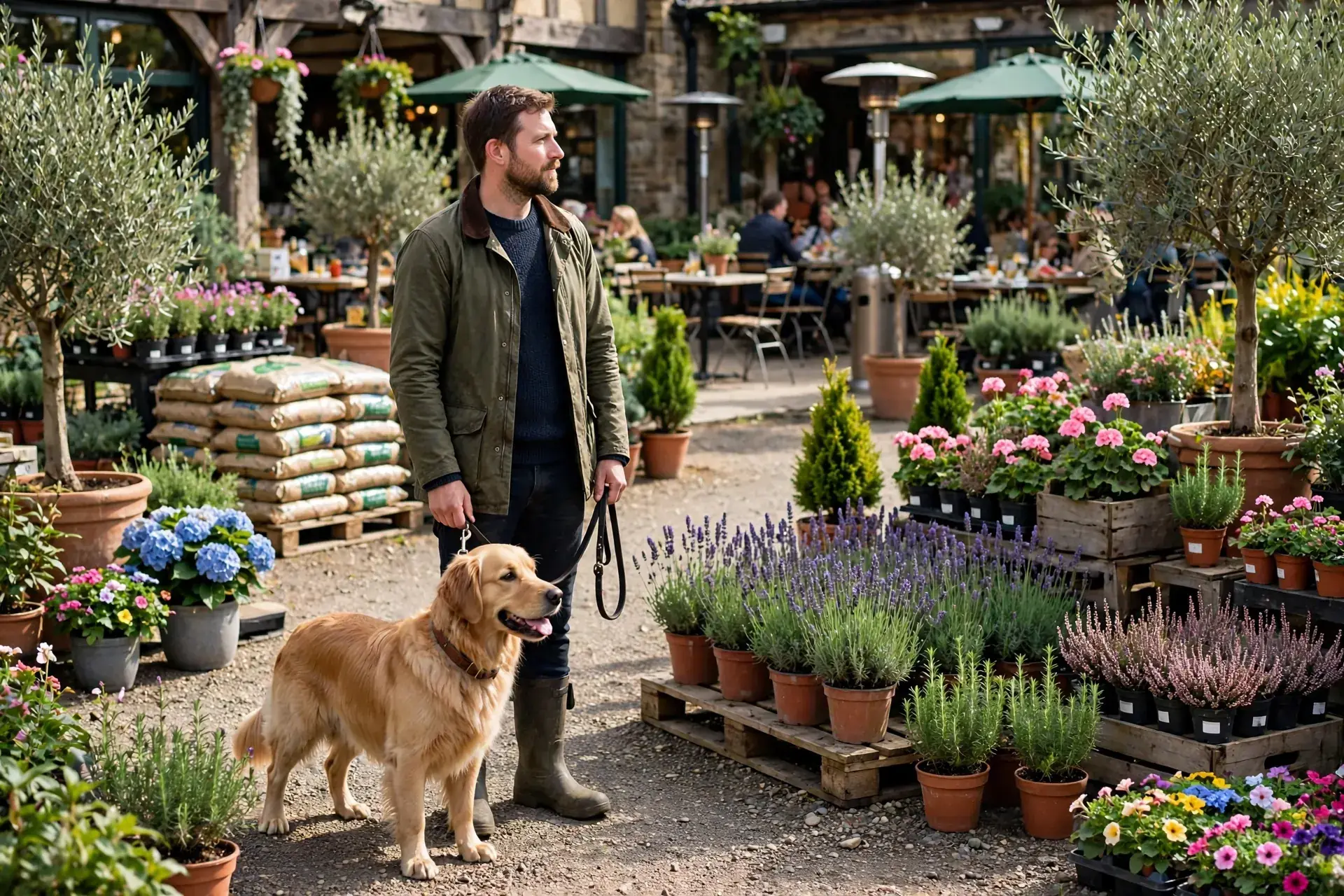
Build in a cafe stop. A mid-morning coffee in a dog-friendly cafe gives the dog a rest, gives you a chance to look at what you have bought, and breaks the day into manageable pieces. Our guide to dogs at garden centres in the UK covers a similar kind of shopping stop, where a cafe and a browse are combined, and the same logic applies: a break with water and a quiet corner makes the next shop visit safer. Choose a cafe with indoor seating for dogs if the weather is poor, and a terrace if it is fine; either way, keep the dog under the table and out of the walkway, and order something the dog can watch you eat without begging for it.
Think about the route between shops. A high street with narrow pavements, heavy traffic and no green space is tiring and stressful for a dog, especially if you are carrying bags. Look for the quieter back streets, the churchyard, the park, or the riverside path that runs parallel to the shops. Many market towns have a loop — shops on one side, green space on the other — and walking the loop between stops keeps the dog exercised and calm. If the town is small, a ten-minute walk to the edge of town and back is enough to reset a restless dog.
Plan for the purchases, too. Antiques are awkward to carry: heavy, fragile, oddly shaped, and often wrapped in paper that tears. Bring a sturdy bag, and if you buy something large or very fragile, ask the shop to hold it while you finish the day's browsing, or to post it to you. Many shops will hold a purchase for a few hours or arrange delivery, and that is far safer than carrying a porcelain lamp through three more shops with a dog on a lead. If you are buying furniture, check the collection arrangements before you pay; a chest of drawers does not fit in a car with a dog crate, and you may need to come back with a van.
Finally, end the day with the dog, not with the shops. A final walk — a riverside path, a park, a beach if the season allows — lets the dog finish the day the way dogs like to finish days: moving, sniffing, and tired in a good way. The antiques will still be there tomorrow. The dog's patience will not, and a day that ends with a happy dog is a day you will both want to repeat.
If something breaks: liability and damage
Even careful owners have accidents, and it is worth knowing where you stand before one happens. In general, if your dog damages something in a shop, you are responsible for the damage. The shop owner may be understanding — many are, especially if the accident was minor and you handled it well — but they are not obliged to absorb the loss. The price of an antique is whatever the owner says it is, and a piece that looks modest may have a value that surprises you. This is why the habits in this guide matter: the cheapest breakage is the one that never happens.
If something does break, stay calm and act quickly. Tell the shop owner or a member of staff immediately. Do not try to hide the damage, do not leave the shop, and do not touch the broken pieces more than you need to — broken porcelain and glass are sharp, and moving pieces can make the damage worse or obscure what happened. Apologise, give your name and contact details, and ask how the owner would like to handle it. Some owners will wave away a small breakage, especially if it was a low-value piece and you have been a careful visitor. Others will want to agree a price and a payment method. Let the owner lead, and keep the conversation friendly and factual.
Do not argue about the price on the spot unless you have a genuine reason to think it is wrong. The owner knows the value of their stock better than you do, and a dispute in the shop helps nobody. If the amount is large, ask for a written note of what was damaged, the agreed price, and the payment terms, and take a photograph of the piece and any price label if the owner agrees. Pay promptly if you can, or agree a clear date for payment. Keep any receipt or written agreement, and keep the owner's contact details.
Check your insurance before you need it. Many pet insurance policies in the UK include third-party liability cover, which can cover damage your dog causes to someone else's property. The cover level, the excess and the conditions vary widely, so read your policy or call your insurer and ask specifically whether damage to shop stock is covered, what the excess is, and what you need to do to make a claim. Some household policies also include personal liability cover that may apply. Check the official guidance before you travel if you are unsure, and do not assume you are covered until you have confirmed it. Keep the policy number and the insurer's claims number on your phone when you go shopping, so a claim can start the same day if it is needed.
There are also practical steps that reduce the financial risk. Keep the dog away from the most valuable stock — ask the owner which pieces are the most expensive and steer clear of them. Avoid handling high-value items yourself while also holding a lead; ask the owner to hold the piece, or hand the lead to your companion first. Do not let children hold fragile pieces while a dog is nearby, and do not let a dog and a small child share the same narrow aisle. If you are shopping with a puppy or a young dog that is still learning to settle, choose centres and markets rather than small shops, where the cost of a mistake is lower and the space is more forgiving.
Finally, remember that the shop owner's reaction will be shaped by how you behaved before the accident. An owner who has watched you ask permission, keep the lead short, and settle the dog carefully is far more likely to be generous about a mishap than an owner who has watched a dog roam on a long lead through the glassware. Good behaviour is not just polite; it is the best insurance you have. If you do have an accident, the way you handle it — immediate, honest, calm, and willing to pay — is what the owner will remember, and it is what determines whether you are welcome back.
What to pack for an antique-shop day
A little preparation makes an antique-shop day far smoother, and most of what you need fits in a small bag. The essentials are a short fixed lead, a well-fitted harness or collar, water and a collapsible bowl, a towel for wet paws, a small mat for the dog to settle on, and a few treats. The mat is the most underrated item on the list: a washable, non-slip mat gives the dog a defined place to lie down in a shop, keeps muddy paws off the floor, and signals to the owner that you have thought about the visit.
Treats are for settling, not for bribing. A small, quiet treat given when the dog settles on the mat reinforces the behaviour you want. Avoid noisy chews, smelly treats, or anything that crumbles onto the floor of a shop. A lick mat smeared with a little dog-safe paste can keep a dog occupied for ten minutes while you browse, but use it only if the shop owner is happy and only on your own mat, not on the shop floor. Poop bags are essential, even in a town — a dog that toilets on a high street outside a shop creates a problem for the owner and for every other dog visitor that day.
Think about the weather and the season. In summer, bring extra water and a shade plan; a dog that is hot will pant, pace and wag harder, which is the opposite of what a porcelain shelf needs. In winter, bring a drying coat or a towel, because a wet dog drips on old wood and old paper. In wet weather, consider dog boots or a paw wash, and always towel the dog down before entering a shop. If the day involves a market, bring a lightweight blanket for the dog to lie on beside your chair at a cafe, and a spare lead in case the first one gets muddy or tangled.
Carry your purchases sensibly. A sturdy, closable shopping bag protects both the purchase and the dog: a paper bag with a vase poking out of the top is a hazard, while a zipped bag with padding inside is safe. Bring bubble wrap or a soft cloth if you plan to buy fragile pieces, or ask the shop to wrap them — most will, and many will do it beautifully. If you buy something large, ask the shop to hold it or deliver it rather than carrying it through the rest of the day. And keep your car tidy: a dog crate or a secured space in the boot keeps the dog safe on the drive home and keeps purchases from sliding around.
Finally, pack patience. Antique shopping with a dog is slower than antique shopping alone, and that is part of its charm. You will visit fewer shops, look at fewer pieces, and spend more time talking to owners and walking between stops. In return, you get a day that works for both of you, a dog that is calm and happy, and the kind of slow, attentive browsing that antique hunting rewards. The best finds are rarely the ones you rush to; they are the ones you notice while your dog is settling quietly beside you and you finally have time to look properly.
Practical questions
Before you go
Can I take my dog into any antique shop in the UK?
No. There is no general right to take a dog into a private shop. Each shop sets its own policy, and many antique shops welcome dogs while others do not, often because of fragile stock, narrow aisles or insurance conditions. Always ask at the door or check the shop's website or social media before you enter, and respect a no-dogs answer without arguing.
What should I do if my dog knocks something over in an antique shop?
Stay calm, do not touch the broken pieces more than necessary, and tell the shop owner or a member of staff straight away. Apologise, offer your contact details, and ask how they would like to handle it. Do not leave the shop without speaking to someone. Your pet insurance may include third-party liability cover, so check your policy and keep any receipt or written agreement.
Are antique centres more dog-friendly than small independent shops?
Often, yes, because antique centres tend to have wider aisles, more open floor space and several dealers under one roof, which gives a dog room to move without brushing against stock. Small independent shops can be just as welcoming but are harder to navigate, with tighter gaps between cabinets and more items at tail height. The policy still varies by venue, so ask every time.
Should I keep my dog on a short lead inside an antique shop?
Yes. A short lead of around one metre or less keeps your dog close to your side and stops the lead trailing across the floor or wrapping around furniture legs. A retractable lead is a poor choice indoors because the line can sweep across a table of glassware before you can reel it in. Hold the lead in your hand, not looped over a chair or a cabinet handle.
Can my dog come to an outdoor antique market?
Many outdoor antique markets and fairs welcome dogs, but the rules are set by the market organiser and by each stallholder, so they can differ from one pitch to the next. Keep your dog on a short lead, watch for stall legs, guy ropes and low displays at nose height, and avoid the busiest hour if your dog is nervous in crowds. Check the official guidance before you travel, as some fairs charge admission and may restrict dogs on hot days.
What if the shop says dogs are welcome but my dog is nervous?
A welcome sign does not mean the visit suits your dog. If the shop is busy, noisy or full of unfamiliar smells, it is kinder to keep the visit short or to skip it and wait outside. Take your dog in for a brief look first, watch their body language, and leave at the first sign of stress. A calm five-minute browse that ends well is better than a long visit that ends in a broken vase.