This guide is independent and contains no paid placement. Garden centre rules change by branch, so treat anything described here as a starting point and confirm the details with the centre you plan to visit.
Shop the centre in this order: settle the dog in the car park, walk the outdoor plant area first while the dog is fresh, then the indoor shop, then the restaurant last. Keep the dog on a short lead, stop it mouthing any plant, and check the restaurant seating rule before you queue for food. If any part of that sequence will not work for your dog, shorten the trip rather than forcing it.
Begin in the car park, before the first plant bench
Most garden centre trips with a dog go wrong before anyone reaches a plant. The car park is busy, trolleys rattle past, children run between cars, and the dog arrives already over threshold. A slow start here pays for itself in every aisle that follows. Park away from the main pedestrian flow if you can, ideally near a grass verge where the dog can toilet before going in. Give the dog water, a few minutes of sniffing on a loose lead, and a clear signal that this is a calm outing, not a race to the bedding plants. If the dog is already barking at every passing trolley in the car park, the plant area will not calm it down; a ten-minute settle, or a shorter visit, is the honest fix.
Use the car park minutes to do the jobs that are awkward once you are holding a trolley. Check the centre entrance for its dog signs, because the policy is usually posted at the door rather than on the website in full. Look for water bowls, dog waste bins and any marked dog toilet area, and note where the exit route runs, so you are not hunting for it with a heavy trolley later. If you are shopping with another person, agree the plan now: who holds the lead, who pushes the trolley, and where you will meet if you split up. A dog handed between two people mid-aisle, with a lead looped around a trolley handle, is how tangles and escapes happen.
Pack the car-park kit as a single bag you can grab without thinking. A short lead, a longer lead for the outdoor area if the centre allows it, a collapsible bowl and a bottle of water, waste bags, a towel for muddy paws, and a chew or lick mat for the restaurant stop will cover most visits. Leave the retractable lead at home: garden centre aisles are narrow, plant benches are at nose height, and a dog on a long extending line can be around a corner and into a display before you have reacted. A fixed lead of one to two metres gives the dog enough freedom to sniff without giving it the whole aisle.
Finally, set a time limit before you go in. Garden centres are designed to slow you down, with seasonal displays, gift departments and food halls placed along the route, and a dog that copes beautifully for forty minutes may struggle at ninety. Decide in advance that you will buy the plants on your list first and browse only if the dog is still relaxed, rather than browsing first and discovering at the checkout that the dog has had enough. A trip that ends while the dog is still happy is a trip you can repeat; a trip that ends in barking, pulling and a chewed label is one the dog will dread next time.
One centre, three rulebooks: plants, shop and restaurant
The single most useful idea for shopping with a dog at a garden centre is that you are not entering one dog policy, but three. The outdoor plant area, the indoor shop and the restaurant usually operate under different rules, set by different managers, and enforced with different levels of strictness. A centre that welcomes dogs warmly among the trees may still bar them from the food hall, and a restaurant that allows dogs on the terrace may not allow them at indoor tables. Treating the whole building as either dog-friendly or not is what produces the awkward moment at the restaurant door, with a trolley full of plants and nowhere to put the dog.
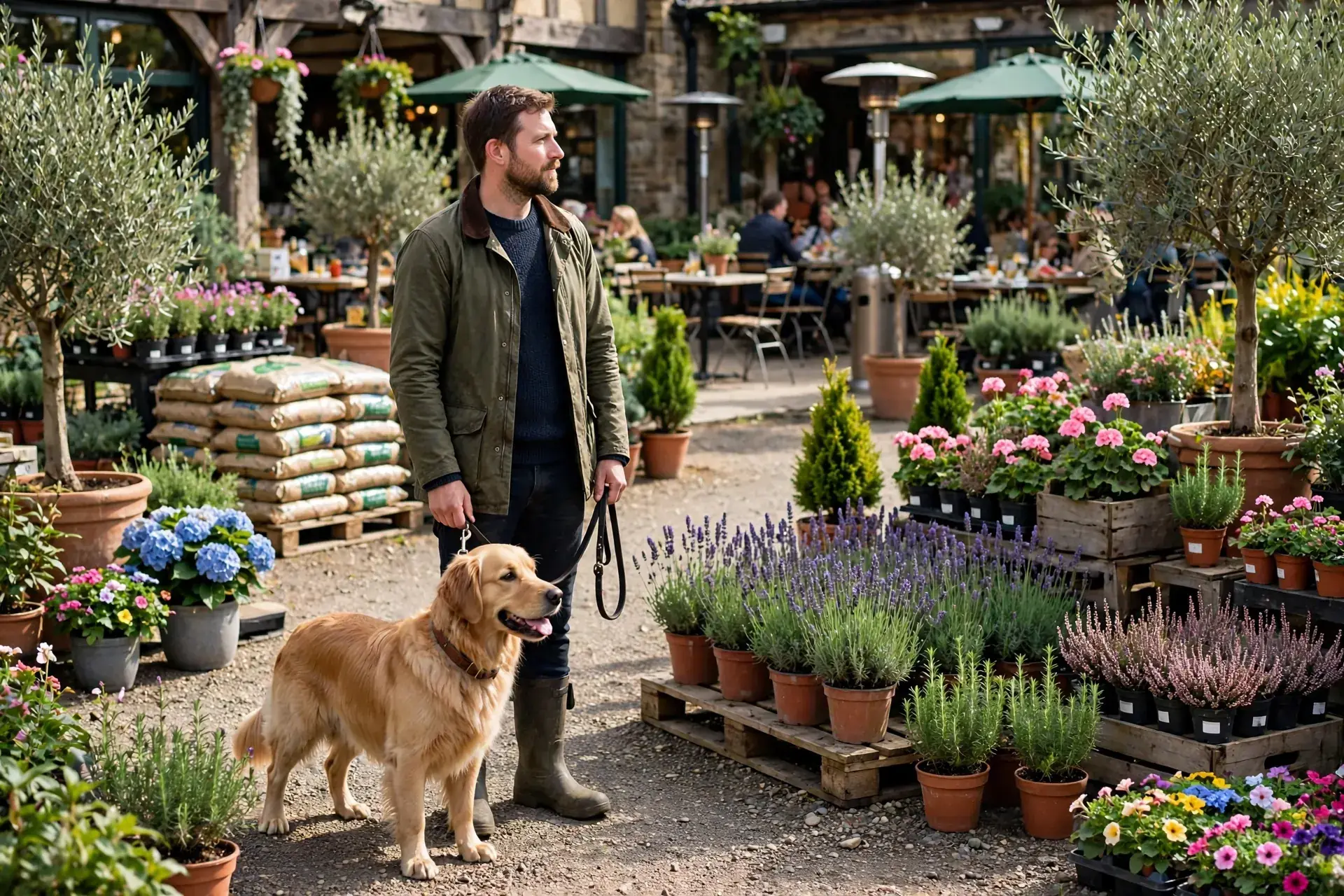
The outdoor plant area is normally the most permissive zone. Dogs on leads are widely accepted among the benches, and this is where most of the shopping happens. Even here, though, there are limits worth noticing. Some centres close off propagation houses, alpine houses or areas with delicate stock, and staff may ask you to keep dogs out of gravel beds or away from freshly watered displays. These are not personal rejections; they protect stock that a single excited dog can destroy in seconds, and they protect the next customer from a display that has been watered by a dog rather than a hose.
The indoor shop sits in the middle. Gift departments, clothing sections, pet departments and food halls often welcome dogs, but individual concessions inside a larger centre may set their own rules, and a concession that sells food usually cannot admit dogs in the same way. Watch for signs at internal doorways, not just at the main entrance, and be ready for the answer to change halfway through the building. If a sign is unclear, ask a member of staff before you walk in with the dog, rather than after; staff would much rather answer a question than deal with a dog among food displays.
The restaurant is the strictest zone and the one to plan around most carefully. Some restaurants welcome dogs throughout, some offer a defined dog section, and some allow dogs only on the terrace. The difference matters because it changes what you can order, where you can sit, and whether you can eat at all on a wet day. Before you start shopping, walk past the restaurant and read its signs, or ask at the entrance desk which seating areas accept dogs. Knowing this before you have a trolley full of compost is far better than learning it with a tray in your hands. If the dog-friendly seating is outdoors only and the weather is poor, plan to eat elsewhere, take food away if that is allowed, or split the visit so one person eats while the other waits with the dog.
Walk the shop in the order that suits a dog, not the shop
Garden centres lay out their route to maximise browsing: seasonal displays near the entrance, the plant area in the middle, and gifts, food and the restaurant at the far end. A dog-friendly route runs in almost the reverse order of temptation. Start with the plants on your list, because that is the main reason for the trip and the part of the centre where the dog has the most space and the most interesting smells. Do the browsing afterwards, only while the dog is still comfortable, and treat the restaurant as the reward at the end, not a pit stop in the middle that leaves the dog wound up for the rest of the shop.
Within the plant area, work in a loop rather than doubling back through the same benches. Dogs find repeated routes through the same smells increasingly exciting, and doubling back also doubles the number of other dogs you meet head-on in narrow gaps between benches. Pick a direction, keep to the wider central paths where possible, and step aside into a gap to let other shoppers pass rather than squeezing past with a lead stretched across the path. If you need to compare two plants at opposite ends of the area, carry the first one with you or leave it in a marked bay rather than dragging the dog back and forth; most centres are happy for you to set plants aside while you decide.
Break the shopping into rounds if the list is long. A first round for the bulky items, such as compost, pots and trees, lets you load the car and return for a second, lighter round for bedding plants and gifts with a calmer dog and an empty trolley. This also solves the heavy-trolley problem: a fully loaded flatbed trolley plus a dog on a lead is genuinely difficult to steer, and the loading round removes the worst of it before you enter the narrowest indoor aisles. If you are shopping alone, tell staff at the entrance that you may need to leave plants at the till while you move the car closer; most centres have a collection point for exactly this.
End the route deliberately. Before the checkout, find a quiet corner and let the dog have water and a few minutes of doing nothing. Dogs that have been asked to walk, wait, sniff and ignore other dogs for an hour need a pause before the final queue, which is the most boring and most crowded part of the visit. A dog that queues calmly is a dog that has been given a break, not a dog that has been marched from bench to checkout without one. If the queue is long and the dog is already restless, step out of line, settle the dog, and rejoin when you can queue without pulling; nobody in the queue will mind a short wait as much as they will mind a barking dog at knee height.
Plant-area rules: sniffing is fine, sampling is not
Sniffing is the dog's way of reading the plant area, and it should be allowed generously. A dog that is permitted to sniff each bench briefly, at its own pace, will walk more calmly than a dog that is dragged past everything interesting. The rule to hold is simple: nose on, mouth off. Sniffing a pot is fine; mouthing leaves, digging in compost, pulling a plant out of its pot, or chewing a stem is not. Staff notice mouthing immediately, and they are right to, because a chewed plant is damaged stock, and some of the plants on those benches can make a dog seriously ill.
Watch the low-level hazards that are easy to miss. Freshly watered benches leave puddles that may contain fertiliser run-off, and dogs will drink from them given the chance. Bags of compost and bark that have been split open invite digging and eating, and loose bulbs spilled on the ground look, to a dog, exactly like something worth picking up. Keep the dog on the path side of the bench rather than between the bench and the wall, where spilled soil and fallen leaves collect, and steer around displays of bulbs and seeds rather than through them. If your dog does pick something up, trade it for a treat rather than wrestling it out of the mouth; a chase around a plant bench teaches the dog to swallow faster next time.
Toilet behaviour needs the same attention indoors and out. Dogs will try to lift a leg against pots, benches and display trees, and a single incident can soak a row of plants and draw a justified complaint. Walk the dog before entering the plant area, keep moving through the narrowest sections, and watch the body language that precedes marking: intense sniffing of one pot, circling, and a raised leg. If it happens, apologise, tell staff straight away, and offer to pay for the damaged plant. Staff deal with this regularly and will respond far better to honesty than to a shopper pretending not to notice. Carrying waste bags and cleaning up immediately is the minimum; telling staff is what keeps the centre welcoming for the next dog.
Children and dogs need a little choreography in the plant area too. Garden centres attract families, and children often approach dogs without asking, sometimes with food in their hands. Keep the dog on your far side when passing a family group, shorten the lead through the busiest displays, and be ready to step between your dog and a small child who is reaching out. This is not about your dog being unfriendly; it is about a strange environment, exciting smells and a tired dog being a poor combination for unplanned greetings. A calm dog that is not asked to greet every stranger will stay calm for much longer than a dog that is expected to be sociable on demand.
Plants to keep out of reach: a toxicity warning list
This is the section to read before you shop, not after. Garden centres sell many plants that are toxic to dogs, and they sell them at nose height, in pots a dog can reach, often with no warning on the label aimed at pet owners. The risk is not that a dog will deliberately eat a whole shrub; it is that a bored, curious or anxious dog will mouth a leaf, chew a stem or dig up a bulb while you are reading a label. Knowing the worst offenders in advance lets you steer the dog past them rather than discovering the risk afterwards.
Bulbs are the most common garden centre danger, because they are sold loose, in open trays and in net bags at exactly the height of a medium dog's mouth. Daffodil, tulip and hyacinth bulbs are all toxic to dogs, and daffodil bulbs in particular can cause vomiting, diarrhoea, abdominal pain and, in larger amounts, more serious effects. Dogs are attracted to bulbs partly because they are buried, and digging is a natural behaviour, so keep dogs away from bulb displays entirely and be careful with bulb displays at home too: a bag of bulbs left on the floor after a garden centre trip is a poisoning waiting to happen. Crocus species vary in toxicity, so do not assume a small bulb is safe; check the official guidance before you travel if you are unsure about a species.
Flowering shrubs and trees carry the next group of risks. Azalea and rhododendron contain toxins that can cause vomiting, drooling, weakness and heart problems. Foxglove is highly toxic and affects the heart. Laburnum seeds are poisonous, and yew, including its berries and foliage, is extremely dangerous. Oleander, sometimes sold as a container plant, is also highly toxic. None of these needs to be eaten in large quantities to matter, and none of them looks dangerous: they are among the most attractive plants in the centre. The practical rule is to keep the dog from mouthing any shrub or tree, and to treat any plant you cannot identify as potentially unsafe until you have checked.
Houseplants and cut flowers deserve the same caution, because they are often bought as gifts and then placed at home without thinking about the dog. Lilies are famously dangerous for cats, and while dogs are less sensitive than cats, lilies can still cause illness in dogs and should be kept away from pets altogether. Chrysanthemums, cyclamen, poinsettia, ivy and mistletoe all appear on toxicity lists with varying severity, and the safest approach is to check each species before buying rather than relying on a general impression that a pretty plant is harmless. If you are buying flowers for a household with pets, ask staff for pet-safe options and read the label; many centres now stock pet-safe ranges, but they are not always signposted.
Compost, fertiliser and plant food are a quieter hazard. Some composts contain cocoa shell mulch, which is toxic to dogs, and fertilisers, slug pellets and weed killers sold alongside plants can all poison a dog that licks a spill or chews a bag. Keep the dog away from open bags, do not let it drink from puddles near the fertiliser displays, and store everything in a closed container at home, out of reach. If a product label mentions cocoa shell, keep it out of any garden the dog uses.
If your dog does eat part of a plant, act quickly and calmly. Move the dog away from the plant, keep a photograph of the plant label or a sample if you can do so safely, and contact a vet promptly, telling them the plant name, roughly how much was eaten, and when it happened. Do not try to make the dog vomit unless a vet instructs you to, and do not wait to see whether symptoms develop, because some toxins act slowly. Vomiting, drooling, lethargy, shaking, difficulty breathing or collapse are all reasons to seek urgent veterinary help. Save the number of a vet near the centre before you travel, because a poisoning scare is a poor time to search for one. When in doubt about any plant, check the official guidance before you travel, and if you cannot confirm a plant is safe, do not buy it for a home with a dog.
The restaurant question: where dogs sit and how ordering works
The restaurant is where garden centre dog policies become most visible, and most misunderstood. A centre that welcomes dogs in the plant area may still restrict the restaurant to a dog section, to the terrace, or to the cafe rather than the full restaurant. The distinction is rarely about disliking dogs; it is about food hygiene rules, seating layouts and the simple fact that a busy restaurant with waiters carrying hot plates is a difficult place for a loose dog. Accept the rule as it stands, and plan your meal around it, rather than trying to negotiate an exception at the door with a hungry dog and a trolley.
Work out the seating before you queue. Ask staff, as soon as you arrive, where dogs may sit, whether the dog section is indoors or outdoors only, and whether you order at the counter or at the table. Counter ordering changes the logistics completely: if you must leave the dog to collect food, you need a second person, or you need to order food to take away, or you need to skip the restaurant on this trip. Table service, where it exists, is much easier with a dog, because one person can stay seated with the dog while the other orders. If you are alone with the dog and the system requires leaving the dog unattended at a table, do not do it; a dog left alone in a restaurant will bark, wander, or be approached by strangers, and staff are entitled to ask you to leave.
Once seated, set the dog up to succeed. Choose a table at the edge of the dog section, away from the main walkway and the food pass, where the dog is not in the path of every waiter and every other dog. Put the lead under your chair leg or hold it, with enough slack for the dog to lie down but not enough to reach the next table. Give the dog water and something to settle with, such as a chew or a lick mat, and keep food off the floor: dropped chips, cake crumbs and bones are both a choking hazard and an invitation to begging that will embarrass everyone. Do not feed the dog from your plate, however tempting the eyes across the table may be, because restaurant food is seasoned, fatty or spiced in ways that upset dogs, and because feeding from the table teaches the dog that restaurants are places where food falls from above.
Terrace seating deserves a special note. A terrace that is lovely in May can be a wind tunnel in November, and a dog that is happy on a sunny terrace may be cold, wet and miserable on a draughty one. Bring a blanket or a dog coat for outdoor seating in cooler months, and check whether the terrace is enclosed or open to the car park, because a dog that can see every arriving car will bark at every arriving car. If the terrace is the only dog option and the weather is poor, the kindest choice is often to eat elsewhere and return to the centre another day for the restaurant, rather than making the dog endure an hour on a cold terrace for the sake of a meal. Similar terrace manners apply at pubs too, and our guide to dog pub garden etiquette covers the shared habits that work in both places.
Leads, trolleys and passing other dogs
The trolley question sounds trivial until you are trying to steer a flatbed loaded with compost while holding a lead attached to a dog that has just spotted another dog. The honest answer is that a trolley and a lead together are a two-person job at full size, and a careful one-person job at small size. A small basket trolley can be pushed with one hand while the other holds a short lead, and it fits down indoor aisles without blocking them. A large flatbed trolley needs two hands on corners and cannot be steered safely with a dog pulling in another direction, so if you are alone, either shop in two rounds, ask staff for help to the car, or bring a companion.
Lead length is the other half of the equation. A short lead of one to two metres is right for indoor aisles and for passing other dogs, because it keeps your dog close and prevents the lead from wrapping around plant benches, display stands and other shoppers' legs. A longer lead is fine in the outdoor plant area if the centre allows it and the paths are wide, but shorten it again before entering any indoor section. Never tie a lead to a trolley handle and walk away, even for a moment at the till: a dog tied to a trolley can pull the whole load over, or slip the lead and be loose in a shop full of open doors.
Passing other dogs is the moment most garden centre visits become stressful, because the aisles are narrow and the dogs are at nose height with plants between them. Do not allow on-lead greetings in a garden centre aisle, however friendly both dogs appear. On-lead greetings in confined spaces create frustration, tangled leads and, occasionally, a fight in a place full of breakable pots. Instead, step aside, shorten the lead, keep your dog's attention on you with a treat or a cue, and let the other dog pass. If a gap between benches is too narrow for two dogs to pass comfortably, wait at the end of the row until it is clear. Other dog owners will understand; they are managing the same problem from the other side.
Children, pushchairs and mobility aids share the same aisles, and the etiquette is the same in every case: give space, move predictably, and keep the dog close when the path narrows. Step off the main path to let a pushchair or wheelchair pass rather than expecting them to squeeze around a dog and a trolley. If your dog is nervous around wheels, trolleys or pushchairs, keep to the wider outdoor paths and avoid the busiest indoor sections at peak times. Saturday mornings and bank holidays are the hardest times to shop with a dog; weekday mornings and late afternoons are usually calmer, and the staff have more time to help.
Seasonal shopping: what changes through the year
Garden centres change completely with the seasons, and so does the dog-friendly shopping experience. Spring is the busiest and most exciting season, with bedding plants, seed displays and young vegetable plants everywhere, and also the season with the most bulb and seed displays at dog height. It is also the season when centres are fullest, so a spring visit with a dog needs the calmest timing you can manage: a weekday morning, a short list, and a plan to leave before the crowds build. Spring plants are also the most tempting to a dog, because fresh growth smells strongly, so keep the mouth-off rule firmly in mind.
Summer brings heat, watering and outdoor displays that stretch across the car park and terrace. Heat is the main dog welfare issue: a garden centre on a hot day has sun-baked tarmac, warm indoor areas and a terrace with little shade, and dogs overheat faster than people expect. Bring water, watch for panting and seeking shade, and cut the trip short if the dog is struggling. Summer is also the season for outdoor living displays, with barbecues, garden furniture and lighting that dogs will investigate, so keep the dog from chewing cables and display items. If you are combining a garden centre trip with a longer day out, our guide to dog friendly botanical gardens in the UK explains how glasshouse and outdoor rules differ in larger planted spaces, which helps when planning a full day of garden visiting.
Autumn is often the best season for shopping with a dog. Centres are quieter, the plant area is full of trees, shrubs and bulbs for autumn planting, and the weather is cool enough for a comfortable outdoor visit. The hazards shift rather than disappear: bulb displays return in force, fallen leaves hide spilled compost and berries, and conker and acorn season brings its own risks in the car park and outdoor areas, since both are toxic to dogs if eaten in quantity. Autumn is also the season for Christmas preparation displays arriving early, so expect a mix of garden stock and gift displays, with narrower aisles as seasonal stock fills the shop.
Winter and the Christmas season are the hardest test for a dog-friendly garden centre visit. Christmas displays bring trees, lights, decorations and food halls, all at dog height, with crowds, music and excited children. Real Christmas trees are not highly toxic, but their needles can irritate mouths and stomachs, the water in a tree stand may contain fertiliser or preservatives, and decorations, tinsel and baubles are choking and blockage hazards. Many centres run grotto and Santa events that are wonderful for children and overwhelming for dogs, so check whether dogs are welcome at those events specifically, rather than assuming the general dog policy covers them. A winter visit can still work, especially on a quiet weekday, but keep it short, keep the dog away from the Christmas food displays, and be ready to leave the restaurant queue if the dog has had enough.
Checkout, loading and the drive home
The checkout is where a good garden centre trip often unravels, because it combines a queue, a narrow till area, a trolley full of plants, and a dog that has been patient for an hour. Choose a till with space around it rather than the shortest queue, and keep the dog on your far side, away from the next customer's trolley. Unload plants onto the belt in an order that keeps the dog's interest away from the till: heavy items first, while the dog is still settled, and small tempting items, such as seed packets, last. If the till area has a display of dog treats, expect the dog to notice, and have a treat of your own ready so you are not negotiating with a shop assistant over a chewed packet.
Loading the car deserves the same care as the shopping. Put plants where they cannot fall onto the dog, and keep the dog's travel space separate from loose soil, pots and bags of compost. A dog travelling loose in a car full of plants will stand on pots, eat soil and arrive home covered in compost, and a sudden stop can send a heavy pot sliding into the dog. Use a boot guard, a crate, or a harness where appropriate, and place tall plants where they cannot topple. On the drive home, check the dog for soil in its paws and mouth, and for any leaf or stem it may have picked up; a quick check now is easier than a veterinary call later, when you are unsure what the dog ate.
At home, the garden centre trip continues in the form of unpacking. Keep new plants out of the dog's reach until they are planted, and store bulbs, fertiliser and compost in closed containers, not in open bags on the garage floor. Check each plant against a toxicity list before planting it where the dog roams, and if you have bought a plant that turns out to be toxic to dogs, either plant it in a fenced-off area the dog cannot reach or return it. The shopping trip is only a success if the garden that results is safe for the dog that came with you to choose it.
When the kindest choice is a shorter trip or no trip
Not every garden centre trip should include the dog, and recognising that is part of responsible dog ownership, not a failure. A dog that is ill, recovering from surgery, in season, or newly rehomed and still settling in will not enjoy a busy centre, however dog-friendly it claims to be. A puppy that has not completed its vaccinations should not be put down on floors where many dogs have walked, and a dog that is fearful of crowds, trolleys or loudspeaker announcements will find a garden centre genuinely distressing. In these cases, shop alone and bring home a plant for the dog to sniff in the garden, which is a far better experience for everyone.
Weather and timing can also make a trip unsuitable on the day. A hot day, a thunderstorm forecast, a centre running a major event, or a Saturday morning in the Christmas season are all reasonable reasons to leave the dog at home or to postpone. If you arrive and the car park is overflowing, the entrance queue is long, and the dog is already anxious, turning around is not wasted effort; it is good judgement. You can return on a quieter day, and the plants will still be there.
Finally, watch the dog during the visit for signs that the trip should end early. Panting that does not settle, yawning, lip licking, avoidance, barking at every passer-by, or a sudden refusal to walk are all signals that the dog has had enough. Dogs do not complain politely; they escalate, and the kindest response to an early signal is to finish the shopping quickly or abandon the non-essential items and leave. A short trip that ends well teaches the dog that garden centres are manageable places, and that is worth more than any single plant. Check the official guidance before you travel if you are unsure about local rules, and when in doubt, choose the shorter, calmer version of the trip.
Practical questions
Before you go
Can dogs go into every part of a UK garden centre?
No. Most centres welcome dogs in the outdoor plant area and in at least part of the shop, but food preparation areas, some indoor plant houses and some restaurant seating areas may be dog-free. Check the centre's own signs and website before you travel, and plan your route around the zones that welcome dogs.
Which garden centre plants are most dangerous for dogs?
Lilies are extremely dangerous for cats and can also harm dogs, and bulbs such as daffodil, tulip and hyacinth are a common poisoning risk because dogs may dig or chew them. Azalea, rhododendron, foxglove, yew, laburnum and oleander are also widely listed as toxic. Keep dogs from mouthing any plant, and check the official guidance before you travel if you are unsure about a species.
What should I do if my dog eats part of a plant?
Move the dog away from the plant, keep a sample or a clear photograph of the label if you can do so safely, and contact a vet promptly. Do not try to make the dog sick unless a vet tells you to, and note the time and roughly how much was eaten. If signs such as vomiting, drooling, shaking or collapse appear, treat it as urgent and seek veterinary help at once.
Are dogs allowed in garden centre restaurants?
It depends on the centre. Many allow dogs in a defined part of the restaurant or on the terrace, while others restrict dogs to the cafe area or to outdoor seating only. Ask staff where dogs may sit before you queue for food, keep the dog on a lead under the table, and do not feed the dog from your plate.
Should I use a trolley, a lead, or both with my dog?
Use a short lead in every case, and add a trolley only when it genuinely helps. A large flatbed trolley can separate a small dog from ground-level plants and other dogs, but it is hard to steer one-handed with a lead in the other hand. If you cannot control both safely, choose a smaller basket trolley, shop in two shorter rounds, or ask a companion to hold the lead.
Can I leave my dog in the car while I shop inside?
Do not leave a dog in a parked car to go shopping. Cars heat up quickly even on mild days, and a shopping trip almost always takes longer than planned. If the centre will not admit your dog to the areas you need, shorten the trip, shop with a companion who can stay with the dog, or come back another day.