This guide is independent and contains no paid placement. Chain policies change and vary by branch, so treat everything here as a practical starting point: check the official guidance before you travel and follow the signage in the branch you are standing in.
In a chain coffee shop, the seat matters more than the brand. Pick a corner or wall-side table out of the queue flow, keep the lead short, order in two calm stages if you need to, and ask for water or a puppuccino only once the dog has settled. A chain that welcomes dogs in principle can still have one branch where the layout makes a visit miserable, so judge the room in front of you, not the logo on the door.
Start outside: the 60-second branch check
Chain coffee stops go wrong most often before anyone reaches the counter. A dog that is already over threshold from a busy pavement, a wet coat and a narrow doorway does not become calmer because the menu is familiar. Give the branch a minute from outside. Look through the window for the shape of the room: where is the queue, where do people wait for drinks, and is there a table that is not in either flow? If the only free tables are beside the door or in the middle of a thoroughfare, that branch is a takeaway branch for your dog today, however welcoming its policy may be in general. Policies vary by branch and by manager, and the branch's latest signage is the version that counts, so check the official guidance before you travel if you are relying on a particular branch for a longer stop.
Read the door as you would read a beach sign. Some branches display a clear dog-welcome notice, some show a dogs-on-leads symbol, and some say nothing at all, which usually means you should ask rather than assume. A small branch inside a station, hospital or shopping centre may follow the landlord's rules rather than the chain's, and those rules can be stricter. If a sign says dogs are welcome only in a certain area, believe the sign, not a memory of another branch. The same applies to outdoor seating: a pavement terrace may be the dog area in one town and a no-dogs zone in another because of a local licence condition. Asking one question at the door saves the awkwardness of settling down, ordering, and then being moved.
Use the pause outside for the dog, not just for reconnaissance. A short toilet break before you go in, a drink of water from your own bottle, and thirty seconds of standing still while the dog watches the door traffic will tell you a lot about whether this stop is sensible. A dog that can watch people come and go without lunging, whining or pulling hard towards the smell of food is ready for a table. A dog that cannot stop staring at the door, or that is already barking at passers-by, will not improve inside a smaller, louder room. In that case, buy a takeaway, walk to a bench or a quieter green space, and treat the chain as a drinks supplier rather than a destination. That is not a failed outing; it is good lead management.
Two practical checks complete the outside scan. First, work out the exit route: can you leave quickly with a dog, a cup and a bag without crossing the whole queue? A branch with a second door, or a table near the exit that is not in the main flow, is worth more than a fashionable window seat. Second, check the weather and the floor. Wet paws on smooth tiles, a long queue on a polished floor, and a dog that slides when it stands up are a recipe for a scrabble-and-bark episode. A mat solves the sliding, but only if the dog will actually lie on it, so put the mat down before the dog decides the bare floor is its place. None of this takes expertise. It takes sixty seconds of looking before you commit to a table, and it is the single habit that separates relaxed chain visits from chaotic ones.
Choose the seat before you choose the drink
Inside a chain, think of the floor as three zones, even though no sign will label them that way. The queue zone runs from the door to the counter and back to the collection point. The service zone is the ring of tables that staff cross with trays, and where delivery riders, prams and wheelchairs pass. The settling zone is everything left over: corners, wall benches, window bays that are not beside the door, and the far end away from the counter. Your dog belongs in the settling zone, and your drink choice comes second. If the only settling-zone table is a high stool table with no floor space underneath, it is not a dog table, however empty it looks. A low table with floor space beside a wall, where the dog can lie with its back protected, is almost always the better choice, even if the view is worse.
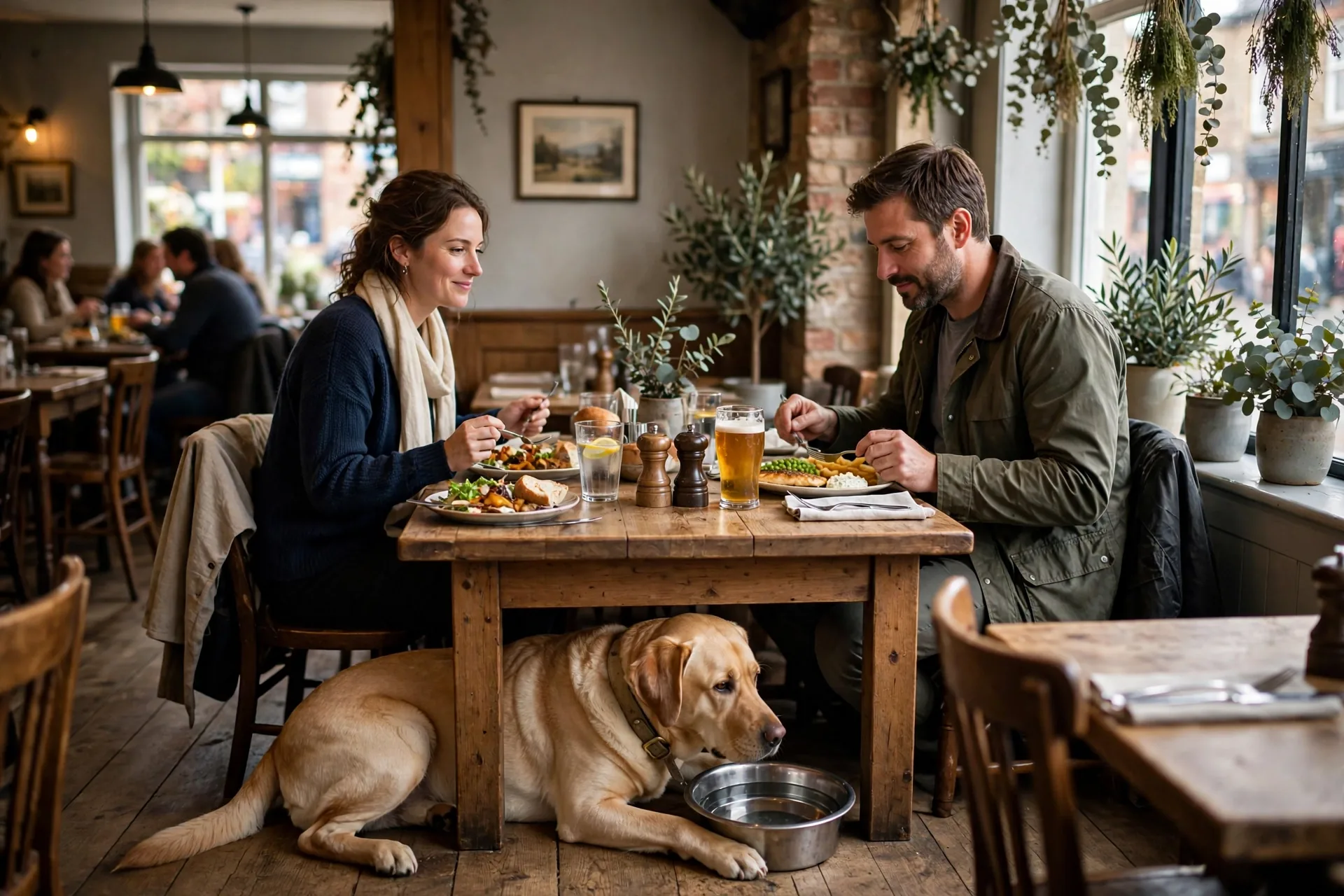
Seat the dog, not just yourself. Put the mat down first, on the side of the table away from foot traffic, so the dog's head is not in the path of every passing leg. Keep the lead short enough that the dog cannot reach the next table, the queue or the door, but not so tight that the dog feels trapped: a loose short lead, with the handle looped around your wrist or under your foot, gives you control without constant tension. For a dog that likes to watch the room, angle the mat so the dog can see you and the door without having to twist around. For a dog that gets aroused by watching, turn the mat towards the wall and give the dog something to do, such as a chew that is quiet and not smelly, rather than expecting willpower to do the work. This is where a small mat earns its place in your bag: it is a portable "this is your spot" signal, and in a chain where the dog has no familiar smells, that signal matters.
Table shape changes the whole visit. A round table in a corner lets you tuck the dog into the angle between wall and table leg, which naturally blocks approaches from two sides. A long communal table, by contrast, puts your dog nose-to-nose with strangers and their food, and puts you in the position of apologising for a dog that is simply curious. Window seats look appealing, but a window beside the door means a stream of dogs, children and delivery riders passing at nose height, which is a lot of excitement for a dog that is supposed to be resting. A window at the far end of the room is different: the same light, a fraction of the traffic. Similarly, soft seating can be a trap. A low sofa invites the dog to climb up, and once a dog is on the furniture in a chain, you are negotiating with both the dog and the staff. Keep the dog on its mat on the floor unless the branch clearly invites dogs onto seating, and check the branch's latest signage if you are unsure, because seating rules differ between branches.
Plan for the neighbours you cannot choose. In a chain, the next table may hold a toddler with a biscuit, a person with a laptop who does not want a nose on their keyboard, or another dog that is also supposed to be settling. Leave a full table-width of buffer where you can, and if you cannot, choose a different branch or a takeaway. Water helps here too: a bowl on the floor beside the mat gives the dog a reason to stay put and gives you a reason to check in every few minutes. If the branch provides a water bowl, use it; if it does not, your collapsible bowl and a bottle are faster than asking staff during a rush. The goal is not to make the dog invisible. It is to make the dog's place so clear, and so boring, that nobody needs to think about it, including the dog.
Ordering with a dog on the lead
Ordering is the moment when most chain visits unravel, because it asks one person to do three jobs at once: hold a lead, read a menu and pay, while the dog watches a queue full of interesting legs. Split the job into stages and the tangle disappears. Stage one happens before you join the queue: decide your order, check whether you need a dog drink or water, and put your payment method where you can reach it without opening a bag one-handed. Stage two is the queue itself, and it should be as short as possible. If the queue is long and winding through the seating area, consider ordering from your table through the chain's app, if the branch offers it, or sending one person to order while the other stays with the dog. Solo visitors can do the same trick in reverse: settle the dog first, then queue, and return to a dog that already knows where its place is.
In the queue, lead handling is everything. Stand to one side of the queue line rather than in the middle of it, so people can pass without stepping over your dog. Keep the dog on the side away from the counter, where food smells and hands reaching down are fewer, and reward the dog for staying behind you or beside you rather than in front. A dog that stands in front of you in a queue is in the path of every person who steps forward, and each step forward is a new invitation to greet. A dog behind you or tight beside your leg is out of the greeting line, and you can feel a pull before it becomes a lunge. If the dog starts to whine, pace or pull, step out of the queue, walk a small loop around the seating area or outside the door, and rejoin when the dog has reset. Losing your place in a coffee queue is a small price for a dog that returns calm.
At the counter, keep the exchange short and specific. Staff in a busy chain are juggling orders, and a long explanation of your dog's dietary needs will slow everyone down. A simple form works: your drink, any dog item, and a clear question about where to wait. For example, ask whether you can wait at your table and whether staff will bring the order over, or whether collection from the counter is expected. Many branches will happily bring drinks to a table when they see a dog settled there, but they will not offer unless asked, and they cannot carry a tray through a crowd while you are also holding a lead. If you must collect from the counter, leave the dog's lead looped under your foot at the table only if the dog is genuinely settled and you are in sight; otherwise, take the dog with you and carry one cup at a time, or use a tray. Never tie a lead to a table leg and walk away in a busy room: a startled dog can drag a table, and a table leg is not a secure anchor.
Paying deserves its own thirty seconds of planning. Contactless payment, a phone wallet or an app order removes the fumble of cards, cash and a lead in one hand. If you are ordering for a group, take one order at a time or write it down, because a queue behind you will not wait while you negotiate three milk alternatives. When the drinks arrive, put the dog's water or treat down first, then your own drink, and only then sit down properly. That order matters: a dog that has something to lick or drink while you arrange your coat and bag is a dog that is not rehearsing a bark. And if the branch offers a loyalty app or a receipt survey, leave it until you are seated. The counter is not the place to multitask with a dog.
For visitors travelling with a dog, the same flow works on longer journeys, with one extra step: think about the next stop before you order this one. A coffee stop that sits between a walk and a drive, for example after a morning on a beach where dogs are welcome under local rules, works best when the dog has already had a toilet break and a drink. Our guide to dog-friendly beaches and their rules explains why checking the local restrictions first saves a wasted walk, and the same logic applies here: a dog that has already toileted and drunk is a dog that can settle for twenty minutes in a chain. If the dog has not, order a takeaway, find a green space, and come back to the chain idea at the next town.
Puppuccinos and other dog drinks
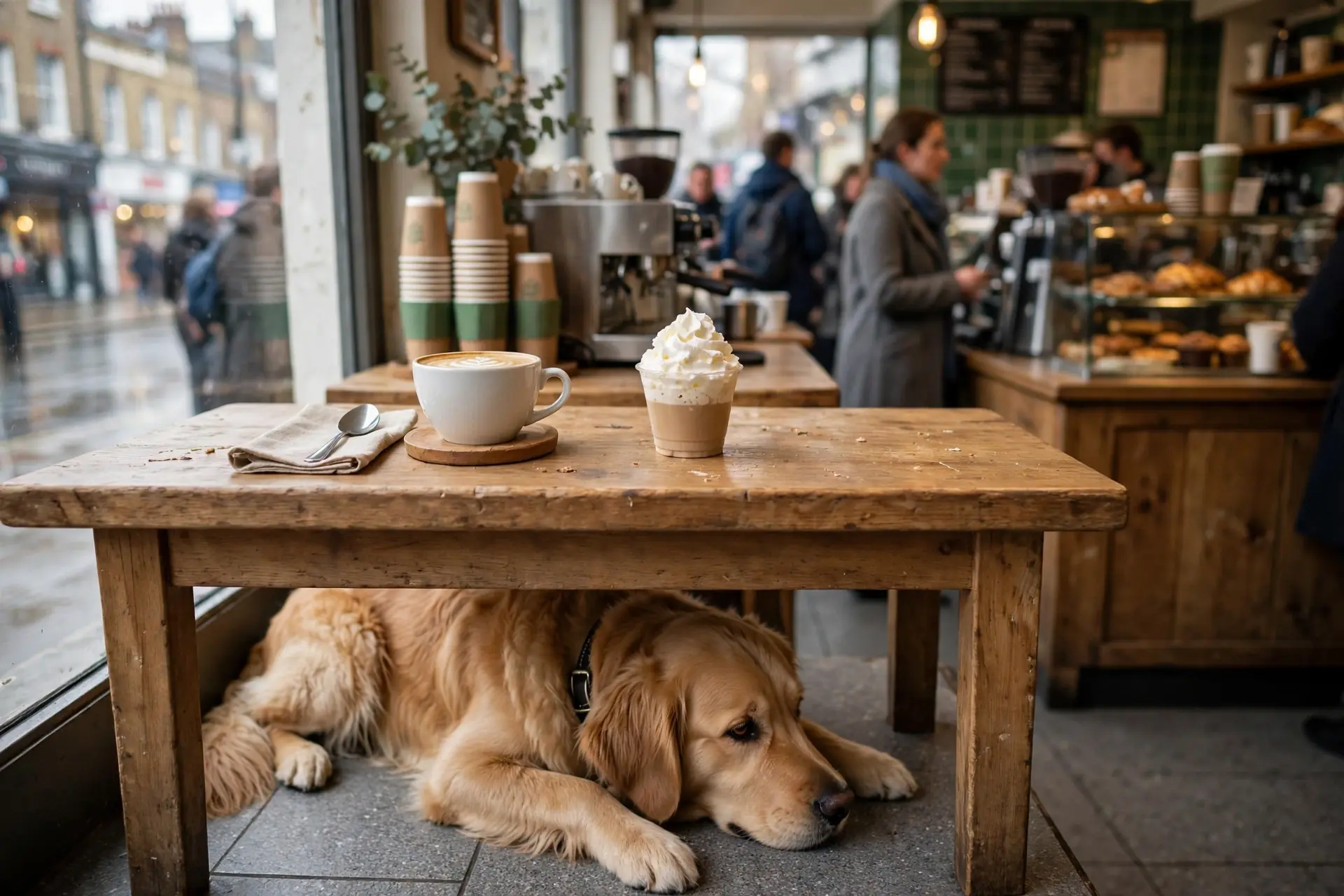
The puppuccino is the most famous dog item in a chain coffee shop, and the most misunderstood. In most branches that offer one, it is a small cup, often an espresso-sized cup, filled with whipped cream, sometimes with a biscuit or a sprinkle on top, and it contains no coffee. It is a treat, not a drink, and it is usually offered free on request, although some branches charge a small amount or limit it to one per visit. Because it is not a standard menu item in every chain, and because branch practice varies, ask for it by name and accept a polite no without argument: the branch's latest practice is the one that applies, and check the official guidance before you travel if you are planning a visit specifically for a dog treat. For dogs with sensitive stomachs, dairy intolerance or weight issues, a puppuccino is a poor choice however photogenic it looks, and a small amount of water or a plain biscuit from your own bag is kinder.
Timing the treat is more important than the treat itself. A puppuccino handed over while the dog is still standing, pulling or barking rewards exactly the behaviour you do not want in a coffee shop. Wait until the dog is on its mat, lying down or at least standing calmly, then place the cup on the floor and let the dog lick it there, not from your hand at table height. Floor placement keeps cream off the table, off your coat and out of the path of the next customer, and it gives the dog a clear job: finish the cup, then settle. For a dog that inhales whipped cream in three seconds and then looks for more, a lick mat smeared with a little plain yoghurt or peanut butter that is safe for dogs, brought from home, lasts longer and causes less of a sugar rush. Some owners split a puppuccino between two dogs, or ask for a smaller amount, which staff will usually do if you ask before they make it.
Water is the drink that matters most, and it is the one most often forgotten. Chains vary in whether they provide a communal dog bowl, a disposable bowl or nothing at all, so bring your own collapsible bowl and a bottle as standard. Ask staff for tap water rather than assuming a bowl on the counter is for dogs, and refill before the dog is thirsty rather than after a long walk in warm weather. In winter, a dog that has come in from rain and cold may drink eagerly and then need a toilet break sooner than you expect, so factor that into how long you plan to sit. In summer, the same logic applies in reverse: a dog that has been panting on a hot pavement needs water and shade before it needs a treat, and a chain with air conditioning can be a useful cooling stop, provided the dog is not left in a hot car while you queue.
Food rules deserve a paragraph of their own, because they are where dog owners and other customers most often disagree. Do not feed your dog from your plate at the table, and do not let the dog beg from neighbouring tables, even if the neighbours offer. A chain table is not a pub garden, and the etiquette that works outdoors, where space and fresh air forgive a dropped chip, does not transfer indoors. Our guide to dogs in pub gardens covers lead manners, table boundaries and water bowls in an outdoor setting, and the indoor version is stricter: keep food at your table, keep the dog on its mat, and keep treats in your pocket until you choose to give them. If your dog needs a longer-lasting chew to settle, choose one that is quiet, not crumbly and not smelly, and take it away when you leave. A chew that ends up under the next table is a hazard for the next dog, and a smell that fills a small room will be remembered by staff long after you have gone.
Chain by chain: how the big names differ in practice
It helps to think of chains in types rather than as a league table, because branch layout matters more than brand reputation. Large high-street branches with table service and a wide floor, the kind you find in bigger towns and shopping centres, tend to have at least one settling zone and staff who are used to dogs. Small kiosk-style branches, railway station units and branches inside other shops tend to have less floor space, faster turnover and stricter practical limits, even when the chain as a whole welcomes dogs. A branch that is essentially a counter with four stools is not a place to settle a dog for half an hour, whatever the policy says. Judge the branch type first, then the brand.
Within that frame, a few practical patterns are worth knowing, always subject to the branch's latest signage. Starbucks branches in the UK commonly welcome dogs in many locations and are widely associated with the puppuccino, but the offer, the cup size and whether dogs are welcome inside or only in a particular area still vary by branch, so check the branch before you promise a treat. Costa branches also commonly welcome dogs in many locations, often with water bowls and a relaxed attitude in larger stores, yet smaller or franchise branches may have different rules because of their landlord or layout. Pret a Manger branches are often smaller, faster and more counter-focused, which makes them better for a quick takeaway with a dog than for a long sit-down, and their dog-drink offer is less standardised than the puppuccino, so ask rather than assume. Caffe Nero and Greggs branches vary widely: some are spacious and dog-welcome, others are standing-room-only, and a Greggs visit is usually a takeaway visit by design. None of this is a promise about any single branch, and chain policies can change, so the branch's latest signage and staff confirmation are the final word on the day.
A comparison table makes the differences easier to use, provided you read it as a starting point for questions rather than as a rulebook. Use it to decide which branch to try first, not to argue with staff if the branch differs.
| Branch type | Seating pattern to expect | Ordering note | Dog drink note | Check first |
|---|---|---|---|---|
| Large high-street branch | Corner tables and wall benches; a real settling zone | Table delivery sometimes possible on request | Water bowl often available; puppuccino-style treat often on request | Which area is the dog area, if any |
| Station or shopping-centre unit | Fast turnover; tables close to the queue | Counter collection usual; keep the visit short | Water by request; treat offer varies | Landlord rules for the centre or station |
| Small counter-focused branch | High stools or a few small tables; little floor space | Takeaway is the kindest option for most dogs | Ask; do not assume a dog menu exists | Whether dogs are welcome inside at all |
| Drive-through or retail-park branch | Seating may be limited; car park is not a dog waiting room | Order inside with the dog, or take away | Water by request; treat offer varies | Never leave a dog in a car while you queue |
The table also explains why independent cafes can feel easier, even when a chain is technically dog-friendly. An independent cafe often has one room, one owner and a consistent rule, while a chain has many rooms and many managers. If you want a long, relaxed sit-down, our guide to dog friendly cafes in the UK explains how to check an independent cafe before you go, including what to ask about indoor seating and assistance dog rights. Use chains for what they do best: predictable locations, familiar menus, toilets, shelter from rain, and a reliable stop on a long drive. Use independents when you want a long stay in one room and a host who knows the regular dogs by name. Both have a place in a dog trip, and the skill is choosing the right one for the length of stop you actually need.
Finally, remember that staff are the best source in the room. A barista who has worked the same branch for a year knows which table is quietest at 11am, which regular dog your dog should avoid, and whether the water bowl is kept behind the counter. Ask one open question, such as where dogs usually settle here, and you will often get a better answer than any guide can give, including this one. Thank staff when a visit goes well, clean up any water spills or treat crumbs before you leave, and leave the mat spot as you found it. Chain staff remember dogs that settle and owners who tidy up, and that memory is what makes the next visit easier, not a policy document.
Rush hour, queues and other dogs
Every chain has a rush, and the rush is when dog visits fail. The morning commuter peak, roughly 7.30 to 9.30am in most towns, is the worst time to introduce a dog to a chain: the queue is long, people are in a hurry, and the floor is a moving obstacle course. The lunchtime peak, roughly 12 to 2pm, is busy but slower, with more seated customers and more food smells, which is a different challenge for a food-motivated dog. The late-afternoon school-run and shopping peak brings children, prams and dogs that have just come from a park, all at once. The calmest windows are usually mid-morning after the commuters have gone, and mid-afternoon before the school run, but this varies by location: a station branch is calmest at midday, a shopping-centre branch is calmest early, and a branch near a school is calmest during lessons. If you can choose your time, choose the calm window; if you cannot, choose a takeaway.
Queue management with a dog is a skill, not a personality trait. The dog should be behind you or beside you, not in front, and the lead should be short but loose. If another dog joins the queue behind you, create a buffer by stepping to one side or letting the other party go first, rather than testing whether two strange dogs can share a metre of floor space. If a dog approaches yours off lead inside the shop, which happens more often than it should, stand between the dogs, ask the owner to recall theirs, and move your dog behind a table leg or a chair. Do not pick a small dog up in a panic unless you have to: a lifted dog is still in the other dog's eye line, and a dropped lead is worse than a controlled step back. Staff can help by holding a door or clearing a path, and asking for help is not a failure; it is the fastest way to end an encounter before it escalates.
Children deserve a specific note, because chain coffee shops are family spaces. A child who runs to stroke a dog without asking is not being rude; they are being a child, and the dog owner is the adult in the interaction. Teach your dog a default behaviour for approaching children, such as looking at you or moving behind your legs, and practise it before you need it in a chain. If a child approaches, step back, put your body between child and dog, and invite the child to ask first. If your dog is not comfortable with children, choose a table away from the family area, visit at a quieter time, or take away. The same principle applies to other dogs' owners: a polite "mine needs space, please" said early, with a smile, prevents far more trouble than a correction said late, when both dogs are already aroused.
Noise is the other rush-hour problem. Espresso machines, blenders, music, announcements and a dozen conversations create a soundscape that is tiring for a dog, especially a young or anxious one. A dog that is fine for twenty minutes may start to whine, pace or bark at forty minutes, not because it is badly behaved, but because it is tired. Watch for the early signs: lip licking, yawning, turning away, a tail that goes still, or a dog that stops settling and starts scanning the room. Those are your cues to leave, not to order another round. A short, successful visit that ends while the dog is still calm teaches the dog that chains are safe places. A long visit that ends in barking teaches the opposite, and the next branch will inherit that lesson.
When a coffee stop is not working
Every dog owner needs a graceful exit plan, because even a well-chosen branch can go wrong: a dog arrives, another dog barks, a delivery rider blocks the door, and the calm you planned for evaporates. The exit plan should be decided before you order, not improvised when you are already embarrassed. It is simple: if the dog cannot settle within five minutes of arriving, or if barking, lunging or toileting happens, switch to takeaway. Ask staff to make your drink to go, pack the mat, and walk to a bench, a park or the car, in that order. You do not owe the room an explanation, and you do not need to finish a sit-down visit to prove a point. A takeaway in the fresh air is a better memory for the dog than a forced sit-down that ends in a telling-off.
Accidents happen, and how you handle them matters more than the fact that they happened. Carry poo bags and a small pack of wipes as standard, even for a coffee stop, because a nervous dog may toilet indoors despite a pre-visit break. If it happens, clean up immediately, tell staff straight away, apologise briefly, and offer to pay for any cleaning if asked. Do not blame the dog, do not blame the branch, and do not linger to explain. Staff deal with spills every day, and a calm, quick clean-up is remembered far more favourably than a long apology. The same applies to a knocked-over cup or a water bowl spill: mop it, tell staff, and move on. Chains are public rooms, not showrooms, and a small mess handled well is not a reason to avoid chains in future.
Barking deserves honesty, not embarrassment. A single bark when the doorbell rings or another dog passes is normal; sustained barking, or barking that distresses other customers, is a signal to leave. Do not shout over the barking, do not drag the dog out by the lead, and do not punish the dog in front of a room full of people. Stand up, gather your things, walk out calmly, and let the dog decompress outside with a short walk or a sniffing break. If barking in chains is a pattern rather than a one-off, the answer is not a stricter chain or a louder correction; it is shorter visits, quieter branches, and training for settling in busy rooms, ideally with a qualified trainer who uses reward-based methods. A chain is a training environment only if the dog can succeed in it, and success means leaving before the dog fails, not after.
There is also a kinder exit: the planned short visit. Tell yourself before you go in that you will stay for one drink, or twenty minutes, whichever comes first, and then leave while the dog is still settled. That discipline turns chains into a reliable tool on a trip, rather than a gamble. A dog that has had twenty calm minutes in three different branches is better prepared for a longer cafe visit than a dog that has had one ninety-minute ordeal in a single branch. If you are travelling between destinations, a series of short chain stops, each with a toilet break and a drink, is often more restful for both of you than one long stop that tries to do everything at once.
Build a chain routine that travels
A routine is what turns a one-off good visit into a repeatable habit. The routine has five parts, and it fits in a small bag: mat, collapsible bowl, water bottle, poo bags and wipes, and a quiet chew or a few treats. Add a short lead, not a long line, because a long line in a chain is a trip hazard and a greeting invitation. Add a towel in wet weather, and a drying coat if your dog wears one. That is the whole kit. Everything else, including a puppuccino, is optional. Pack the bag the same way every time, so you are not searching for the bowl while holding a lead and a queue ticket. The routine, not the brand, is what makes the visit predictable for the dog.
Teach the routine at home before you test it in a chain. Practise "on your mat" in the kitchen, then in the garden, then in a quiet independent cafe, and only then in a busy chain at a quiet time. Each step should be short and successful, with the dog rewarded for lying on the mat while you sit nearby with a cup. If the dog cannot settle at home for ten minutes, it will not settle in a chain for thirty, and the chain is not the place to discover that. Short, successful repetitions build a dog that walks into a chain, finds its mat, and lies down without being asked twice. That is the real puppuccino moment: not the whipped cream, but the dog that knows what to do when the mat appears.
Keep a mental note of branches that worked, and why. A branch that worked because it had a quiet corner at 10am may not work at 1pm, and a branch that worked for a calm older dog may not work for a young spaniel. Note the time, the table, and the dog's behaviour, not just the brand. Over a trip, you will build a personal map of reliable stops: the station branch that is calm at midday, the high-street branch with the far corner table, the retail-park branch that is best avoided at weekends. Share that map with anyone travelling with you, so a partner or friend can order while you settle the dog, or vice versa, without a discussion in the doorway. A shared routine is faster than a perfect branch, because it removes decisions at the moment when the dog needs you to be calm.
Finally, keep the chain in its place. Chains are convenient, but they are not the whole of dog-friendly Britain. A chain stop is best used as a pause between the things dogs actually enjoy: a walk, a beach, a pub garden, a long drive with a proper break. Use the chain for shelter, a toilet stop and a drink, then move on to somewhere the dog can run, sniff and be a dog. That balance is what makes a trip feel generous rather than transactional, for the dog as well as for you. Check the official guidance before you travel when a specific branch matters to your route, follow the branch's latest signage on the day, and let the routine, not the logo, do the work. If you do that, the puppuccino becomes what it should be: a small, occasional treat at the end of a calm visit, not the reason for the visit itself.
Practical questions
Before you go
Can I take my dog into every branch of a dog-friendly coffee chain?
No. A chain-wide welcome is not a branch-by-branch guarantee. Individual branches vary by size, layout, landlord rules and local management, so check the door sign and ask staff before you settle in, and have a nearby alternative in mind.
What is a puppuccino, and is it free?
A puppuccino is usually a small cup of whipped cream offered as a dog treat, not a coffee drink. Many branches offer it free on request, but availability, size and any charge vary by branch, so ask politely and treat it as an occasional small treat, especially for dogs with sensitive stomachs.
Where should my dog sit in a busy coffee shop?
Choose a corner or wall-side table where your dog can lie out of the main walkway, with the lead short enough to prevent tripping or greeting every passer-by. Avoid doorways, the queue route and the gap between tables, and bring a mat so your dog has a clear place to settle.
Can I order at the counter while holding my dog's lead?
Yes, in most dog-welcome branches, provided the dog is under control and out of the queue flow. Keep the lead short, step to one side while you pay, carry one item at a time if needed, and ask staff whether they can bring your order to your table when the counter area is crowded.
What should I do if my dog barks or another dog approaches our table?
Stay calm, shorten the lead without yanking, move your dog behind you or behind the table leg, and redirect with a treat or a known cue. If the other owner cannot recall their dog, stand up, create distance and ask staff for help rather than letting the dogs sort it out between tables.
Are assistance dogs treated differently from pet dogs in coffee chains?
Yes. Assistance dogs have legal access rights in Britain and should not be refused entry or charged a pet fee, whereas pet-dog access depends on each branch's policy. If access is questioned, stay polite, explain the dog's role, and check the official guidance before you travel if you need the exact legal wording.