This guide is independent and contains no paid placement. If affiliate links are added later, they will be clearly marked and will not change our editorial checks.
Never assume a gallery allows pet dogs. Check the official guidance before you travel for that gallery, confirm which rooms allow dogs, keep the dog on a short lead, plan a short visit, and leave promptly if the dog cannot settle.
There is no single gallery rule
The first thing to understand about dogs in art galleries is that there is no national rule for pet dogs. A large national gallery, a small independent space, a university gallery and a commercial gallery can all have completely different policies, and the same gallery can change its policy for a special exhibition, a loan show or a private event. A website that lists a gallery as dog-friendly may be out of date, and a social media photograph of a dog in a gallery proves only that one dog was welcome on one day. The only reliable check is the gallery's own current information, confirmed close to the visit.
Why do policies differ so much? Galleries balance several concerns that do not apply to a park or a pub garden. Artworks are often irreplaceable and sometimes displayed without barriers, floors may be polished stone or wood that shows every mark, and rooms are designed for quiet looking rather than movement. Lenders and insurers can impose conditions on a particular exhibition, and a gallery that welcomes dogs in its permanent collection may restrict them when borrowed works are on display. Conservation, insurance, visitor comfort and the physical layout of the building all pull in different directions, so two galleries in the same city can reasonably reach opposite conclusions.
The practical consequence is simple: treat every gallery visit as a fresh check. Search for the gallery's visitor information, look for a dogs or access page, and read the exact wording rather than the headline. "Dogs welcome" may mean the whole building, the ground floor only, or the cafe only. "Assistance dogs only" means pet dogs are not admitted to the exhibition rooms, even if a cafe area is more relaxed. When the wording is unclear, contact the gallery before you travel. A short message asking which rooms allow pet dogs, whether there are size limits, and whether dogs must stay on a lead will save a wasted journey and an awkward conversation at the door.
Assistance dogs and pet dogs are different
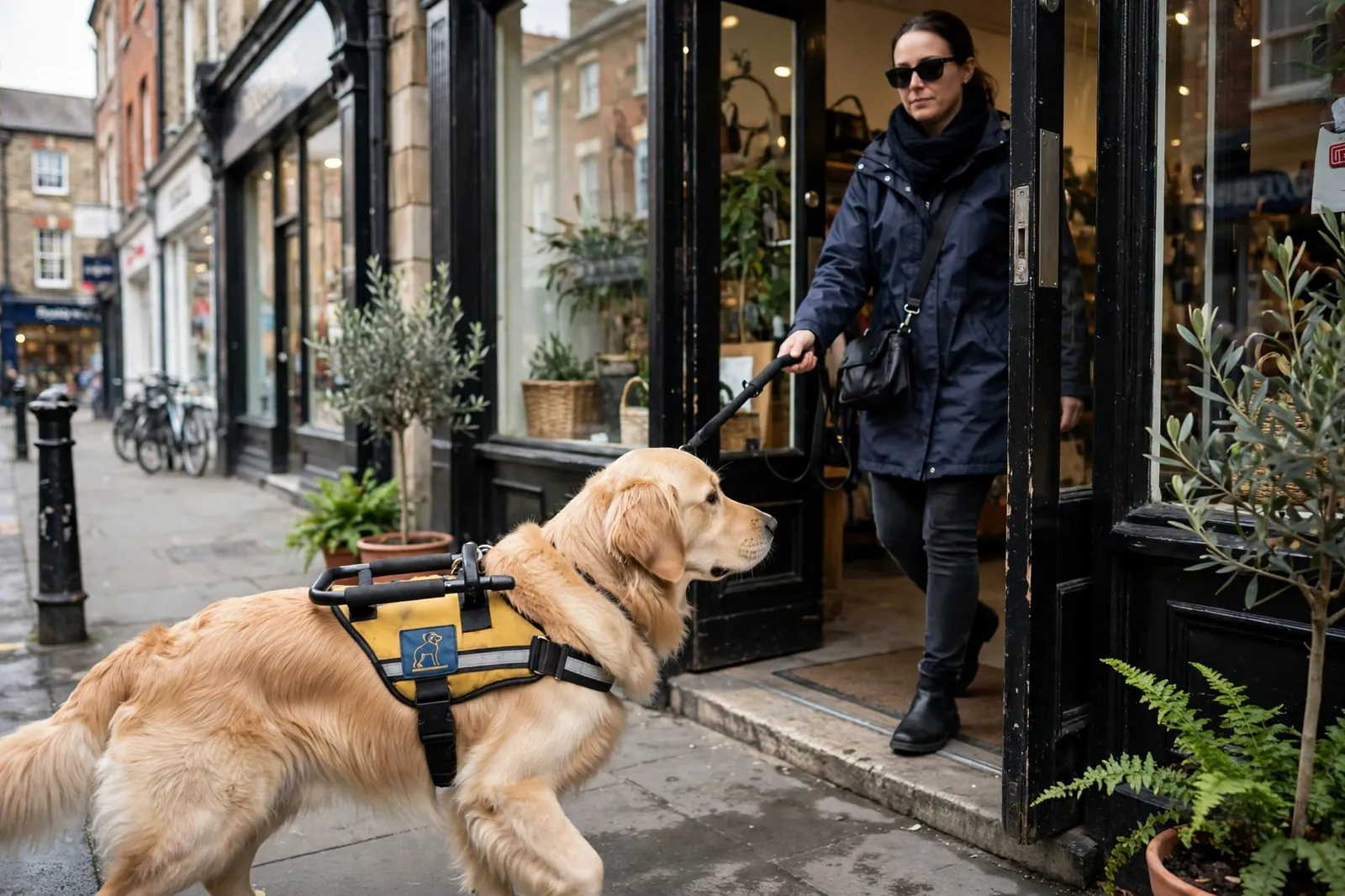
The distinction between an assistance dog and a pet dog is the most important legal point in this whole guide, and it is often misunderstood. Assistance dogs, trained to support a disabled handler, have access rights in Britain that pet dogs do not. A gallery, like other service providers, should not refuse entry to an assistance dog, and should not impose extra conditions such as a fee or a requirement to wait outside. Pet dogs, however welcome they may be in a particular gallery, have no general legal right of entry, and a gallery is free to set, change or withdraw its pet policy.
For handlers, the details matter. Our guide to assistance dog access rights in the UK explains where access must be given, how ID and jackets work, and what to do if entry is refused. In a gallery, a handler should not need to prove disability, and staff should be trained to recognise assistance dogs, but in practice it helps to know the gallery's access information in advance, to arrive with any documentation you normally carry, and to have a calm plan for speaking to staff if there is a misunderstanding. The law is on the handler's side; the visit still goes better when both sides are prepared.
For pet dog owners, the distinction cuts the other way. Seeing an assistance dog in a gallery that does not allow pet dogs is not evidence of inconsistency or unfairness, and arguing the point at the door helps nobody. Equally, a pet dog wearing a vest, a harness or a bandana does not become an assistance dog, and presenting a pet as an assistance dog undermines the access rights of people who genuinely rely on them. The honest approach is to accept the gallery's pet policy as it stands, choose a gallery that welcomes pet dogs if that matters to you, and leave the assistance dog question entirely alone.
The five-minute check before you travel
A five-minute check before you travel prevents most gallery problems. Start with the gallery's own website and look for visitor, access or FAQ pages. Note three things: whether pet dogs are allowed, which rooms or floors they can enter, and whether any condition applies, such as a lead rule, a size limit or a requirement to carry small dogs. Then check for exhibition-specific rules, because a special show may have stricter conditions than the permanent collection. Finally, check opening times, ticket requirements and any timed entry system, since a dog that waits in a long queue outside is already tired before the visit begins.
If the website is silent or ambiguous, contact the gallery directly. Email is often better than a phone call for this purpose, because the reply becomes a record you can show at the door. Ask specific questions: are pet dogs allowed in the exhibition rooms today, or only in the shop and cafe? Is there a lead rule or a carrying rule? Are there any rooms where dogs are never allowed? Is there a water bowl, a dog relief area or a place to tie up outside? Specific questions get specific answers, while a general "are you dog-friendly?" often gets a general answer that hides the detail you need.
Save the answer. Screenshot the policy page or keep the email on your phone, and note the date you checked it. Gallery policies change, staff rotas change, and the person on the door may not have seen the same page you saw. A polite "your website said dogs are welcome in the ground floor galleries, and I checked yesterday" resolves most misunderstandings quickly. If the policy has changed since you checked, accept the new rule gracefully and use your plan B rather than arguing about a page that is no longer current.
One building, several different rules
Many galleries are really several spaces in one building, each with its own rule. The shop may welcome dogs, the cafe may welcome dogs in one area but not another, the permanent galleries may allow dogs on a lead, and a temporary exhibition may allow only assistance dogs. A visitor who hears "dogs welcome" at the entrance and walks into every room can therefore break a rule without realising it, while a visitor who hears "no dogs" at the shop desk may miss a dog-friendly cafe upstairs. The building, not the headline policy, is what you need to understand.
On arrival, confirm the rules room by room. Ask at the entrance which spaces allow pet dogs, whether there is a route that avoids restricted rooms, and where the dog-friendly toilets, water and exit are. Look for signs at each gallery door, since a room that was dog-friendly last month may be restricted for a loan exhibition this month. If you are visiting with another person, agree a plan: one person can visit a restricted room while the other waits with the dog in the cafe or outside, then swap. That simple arrangement turns a restriction into a minor inconvenience rather than a ruined visit.
Special exhibitions deserve extra care. Loaned works often arrive with conditions from the lending institution, and a gallery may need to restrict dogs, bags or photography for that show alone. The restriction is not a judgement on your dog; it is a condition of borrowing the art. Check the exhibition page separately from the general visitor page, and do not assume that a dog-friendly permanent collection means a dog-friendly special show. When in doubt, visit the permanent collection with the dog and return for the special show another time, or use the swap plan with a companion.
Quiet-room etiquette that actually works
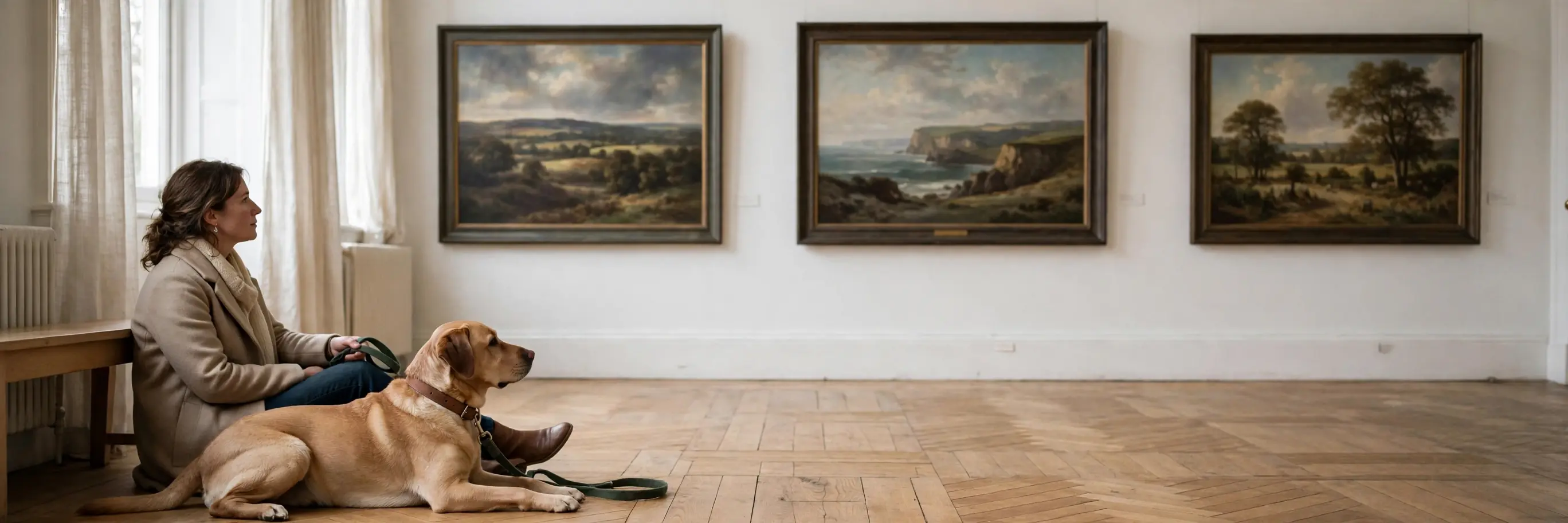
Gallery etiquette is less about rules and more about reading a room. A gallery is designed for slow looking, quiet conversation and long pauses in front of a single work, and a dog that is comfortable in a busy pub garden may still find a silent room strange. The sounds are different: footsteps echo, voices carry, and a dog's nails on a stone floor can sound surprisingly loud. Before you enter a gallery room, pause in the doorway, let the dog take in the space, and only proceed if the dog is calm. A dog that pulls into a quiet room will not settle by magic once inside.
Keep the dog on a short lead, close to your side, and away from artworks, plinths, benches and other visitors' legs. Do not let the dog sniff a painting, lean on a plinth or investigate a sculpture, however well behaved they usually are. Other visitors may be allergic, nervous around dogs or simply trying to look at art in peace, and their comfort matters as much as yours. If another visitor approaches to greet the dog, it is fine to smile and move on, but do not let a stranger's enthusiasm turn into a long interaction in the middle of a gallery. A brief greeting in a lobby is one thing; a crowd forming around a dog in front of a painting is another.
Watch for the early signs that a visit should end. Panting, restlessness, whining, pulling towards the exit or fixating on another dog are all signals that the dog has had enough, even if you have only seen half the exhibition. Leave promptly and calmly, without making a scene, and reward the dog outside. A short, successful gallery visit builds a dog's confidence for the next one; a long, stressful visit teaches the dog that galleries are places to dread. The art will still be there another day, and a dog that enjoys galleries is worth more than a single completed exhibition.
What to bring, and what to leave behind
The gallery kit list is short, and that is the point. Bring a short lead, a harness or collar the dog is comfortable in, poo bags, a small water bottle and a collapsible bowl for use outside the galleries, and a mat if you plan to sit in a cafe afterwards. A treat pouch with a few small, quiet treats can help a dog settle, provided you use it discreetly and never near an artwork. Leave the long line, the squeaky toy, the ball and the extendable lead at home: none of them belongs in a gallery, and each one creates noise, distance or a trip hazard that a quiet room cannot absorb.
Think about the dog's comfort before the gallery's convenience. Walk the dog properly before the visit, give them a toilet break, and let them burn off energy in a park or on a street walk first. A dog that arrives tired and toileted is a dog that can settle; a dog that arrives bursting with energy will struggle in a room that demands stillness. Dress for the gallery too: polished floors can be slippery for dogs, so a dog that slips on smooth floors may benefit from a shorter visit or a different route, and owners should wear shoes that let them move quietly and steadily.
Food and drink need a plan. Most galleries do not allow food or drink in the exhibition rooms, and a dog that smells food in a cafe may become restless in the gallery afterwards. Eat before or after the gallery visit, not during it, and keep treats to a minimum inside the building. If the gallery has a dog-friendly cafe, that is the place for a longer settle, a drink and a rest. The gallery rooms themselves are for looking, briefly and calmly, and then leaving while the experience is still positive.
Children, crowds and other dogs
Galleries on a school holiday, a free-entry weekend or a popular exhibition day are a different environment from the same galleries on a quiet weekday morning. Crowds mean more noise, more movement, more children at dog height, and more chances for a lead to tangle or a tail to be stepped on. If your dog is nervous around children, crowds or other dogs, choose a quiet time: a weekday morning, the first entry slot, or a late afternoon when school groups have left. The same gallery can be a calm experience at ten in the morning and a stressful one at noon.
Children and dogs in galleries need mutual respect. A child who rushes to stroke a dog can startle even a friendly animal, and a dog that jumps up in excitement can knock a small child over on a hard floor. Keep the dog close, step aside when a school group passes, and do not invite children to stroke the dog in a gallery room, however friendly the dog is at home. If a child asks, a brief, calm greeting in a lobby area is safer than an interaction in front of an artwork. Parents, too, should be able to look at art without worrying about a strange dog, and that consideration runs both ways.
Other dogs are the wildcard. Even in a dog-friendly gallery, you may meet another dog in a narrow corridor, on a staircase or at a doorway, and neither dog may have room to pass comfortably. Keep your dog on a short lead, create space by stepping into a doorway or a wider area, and do not let dogs greet nose to nose in a confined space. If your dog is reactive, a gallery with a one-way system and narrow rooms may simply be the wrong choice, and a garden, a sculpture park or an outdoor exhibition may suit the dog far better. Choosing the right venue is part of good ownership, not a failure.
If you are refused entry
Refusal happens, and how you handle it matters. If staff say pet dogs are not allowed, accept the decision politely, ask whether any part of the building welcomes dogs, and ask whether there is a safe place to wait outside or a nearby walk you could do instead. Staff are applying a policy, not making a personal judgement, and a calm response leaves the door open for a future visit when the policy or the exhibition changes. Arguing, filming staff or insisting on an exception rarely changes the outcome and can make the next dog visitor's experience worse.
Assistance dog handlers face a different situation. If an assistance dog is refused entry, the refusal may be unlawful, and the handler should know the steps to take. Our guide to assistance dog access rights in the UK sets out the position clearly, including what to say, what to record and where to seek help afterwards. In the moment, stay calm, explain that the dog is an assistance dog, and ask to speak to a manager if necessary. Record the date, time, location and the name or role of the person who refused entry, and follow up in writing afterwards. The goal is access, not confrontation, and a written follow-up is usually more effective than a heated exchange at the door.
For pet dog owners, a refusal is information, not an insult. Note the gallery, the date and the reason given, and use it to plan better next time. Some galleries welcome dogs in the shop and cafe but not the galleries; some welcome dogs on quiet weekdays but not at weekends; some change policy by exhibition. A refusal today does not mean a refusal forever, and a polite enquiry before the next visit may give a different answer. The galleries that welcome dogs well are worth supporting, and the ones that do not are worth understanding rather than resenting.
A plan B that saves the day
Every gallery visit with a dog needs a plan B, and the best plan B is decided before you leave home. It might be a nearby park, a riverside walk, a dog-friendly cafe, or another gallery that does welcome dogs. The point is that a refused entry, a restless dog or a closed exhibition never leaves you standing outside with a disappointed party and no alternative. A plan B also takes pressure off the gallery visit itself: when you know you can leave at any time and still have a good day, you are far more likely to leave at the right time, while the dog is still calm.
Combine the gallery with a walk whenever you can. A morning walk, a gallery visit, a cafe lunch and an afternoon walk is a balanced day for most dogs, and it means the gallery is one part of a larger outing rather than the whole point of the trip. For a longer stay, our guide to dog-friendly holiday parks in the UK covers the same balance at holiday scale: a base that suits the dog, a walk that tires them properly, and a cultural visit that fits around the dog rather than forcing the dog to fit around it. The principle is identical, whatever the scale.
Finally, remember that galleries are only one kind of cultural visit. Sculpture parks, historic houses with gardens, outdoor exhibitions and gallery cafes all offer art and architecture with more space for a dog, and a dog that enjoys those settings may gradually enjoy indoor galleries too. Start with the easiest cultural visit your dog can enjoy, build confidence slowly, and let the dog's comfort set the pace. A dog that loves a sculpture park today may love a quiet gallery next year, and that gradual progress is worth far more than a single forced visit. If you check the official guidance before you travel, keep the lead short, and leave while the visit is still good, galleries can become a genuine part of your dog's life rather than a place you avoid.
Practical questions
Before you go
Are dogs allowed in UK art galleries?
It depends on the gallery. Some welcome pet dogs throughout, some allow them only in the shop or cafe, and some allow only assistance dogs. Check the official guidance before you travel for the specific gallery, and do not assume one gallery's policy applies to another.
What is the difference between an assistance dog and a pet dog in a gallery?
Assistance dogs have legal access rights in Britain and should not be refused entry to public galleries. Pet dogs have no such general right, so a gallery can set its own pet policy. Our assistance dog guide explains handlers' rights, ID and what to do if access is refused.
Should I keep my dog on a lead in a gallery?
Yes. Keep dogs on a short lead at all times in a gallery, keep them close to you, and keep them away from artworks, plinths and other visitors. A gallery floor is not a place for a long line or for off-lead exploration.
What if my dog barks in a gallery?
Leave the gallery space calmly and promptly, settle the dog outside or in a lobby area, and return only if the dog is calm. Do not try to train through barking in a quiet room, and do not wait for staff to ask you to leave.
Can dogs go into gallery cafes and shops?
Often yes, even when the exhibition rooms do not allow pet dogs, but the rules can differ between the shop, the cafe and the galleries in the same building. Check each area separately before you travel, and confirm the current policy on arrival.
How do I plan a gallery visit around my dog?
Walk the dog first, choose a quiet time, plan a short visit with a clear exit, and have a back-up walk or cafe ready. A tired, toileted dog that visits for forty minutes enjoys a gallery far more than a restless dog dragged through a full afternoon.