This guide explains general rights for information and is not legal advice. Individual cases turn on their facts; the equality bodies and assistance dog charities can advise on specific disputes. Check the latest official guidance before you travel.
Disabled handlers generally have the right to take an assistance dog into shops, restaurants, hotels, taxis and public services without extra charge. There is no official register or compulsory ID. Refusal is usually unlawful discrimination, and the practical defence is calm assertion, good records and reporting every refusal so patterns get fixed.
The principle: an aid, not a pet
Every access dispute becomes clearer once one distinction is held firmly: an assistance dog is trained to perform tasks that mitigate its handler’s disability, and in law and in daily life it functions as an aid to independence — closer to a wheelchair or a white cane than to a companion animal. A venue’s “no dogs” rule exists for pets, and applying it to an assistance dog removes the person’s means of using the service at all. That is why access is framed as a right held by the disabled person, not a privilege granted to a dog, and why charging a “pet fee” for an assistance dog is generally as impermissible as charging extra for a wheelchair.
The range of work these dogs do is wider than the famous guide dog partnership most people picture. Hearing dogs alert deaf handlers to alarms and doorbells. Mobility assistance dogs pick up objects, open doors and help with balance. Medical alert dogs warn of impending seizures, blood-sugar crashes and other episodes. Psychiatric assistance dogs perform grounding, interruption and crowd-buffering tasks for conditions including post-traumatic stress and autism. The tasks differ; the legal logic does not. If the dog is trained to assist a disabled person, the partnership is what equality law protects.
Understanding this also explains the handler’s side of the bargain. Access rights assume a dog that is well trained, under close control, healthy and clean, working unobtrusively in public. Handlers invest enormous effort — often years of training — in exactly that standard, because their independence depends on public confidence in it. When businesses and the public grasp both halves, right and standard together, most access problems quietly disappear.
The equality law underneath the right
In England, Scotland and Wales the Equality Act 2010 places duties on service providers, employers, landlords and transport operators not to discriminate against disabled people, and to make reasonable adjustments. Refusing service, offering a worse service, or imposing extra charges because a person is accompanied by an assistance dog will normally amount to unlawful discrimination under that framework, unless a genuinely narrow justification applies. Northern Ireland operates under its own disability discrimination legislation to a similar effect. Government guidance for businesses states the position plainly: assistance dogs should be allowed into premises, and staff should not challenge handlers beyond what is needed.
Two features of the law surprise people. First, the duty is anticipatory in many service settings: businesses are expected to have thought about disabled customers in advance — training staff, adjusting no-dogs policies — rather than improvising when a handler arrives. Second, allergies and phobias held by other customers or staff do not ordinarily override the handler’s right, because equality law does not rank one person’s preference above another’s access; businesses are expected to manage spacing and service flow instead. Genuine, specific safety risks are handled case by case, but “another customer might not like it” is not a lawful basis for refusal.
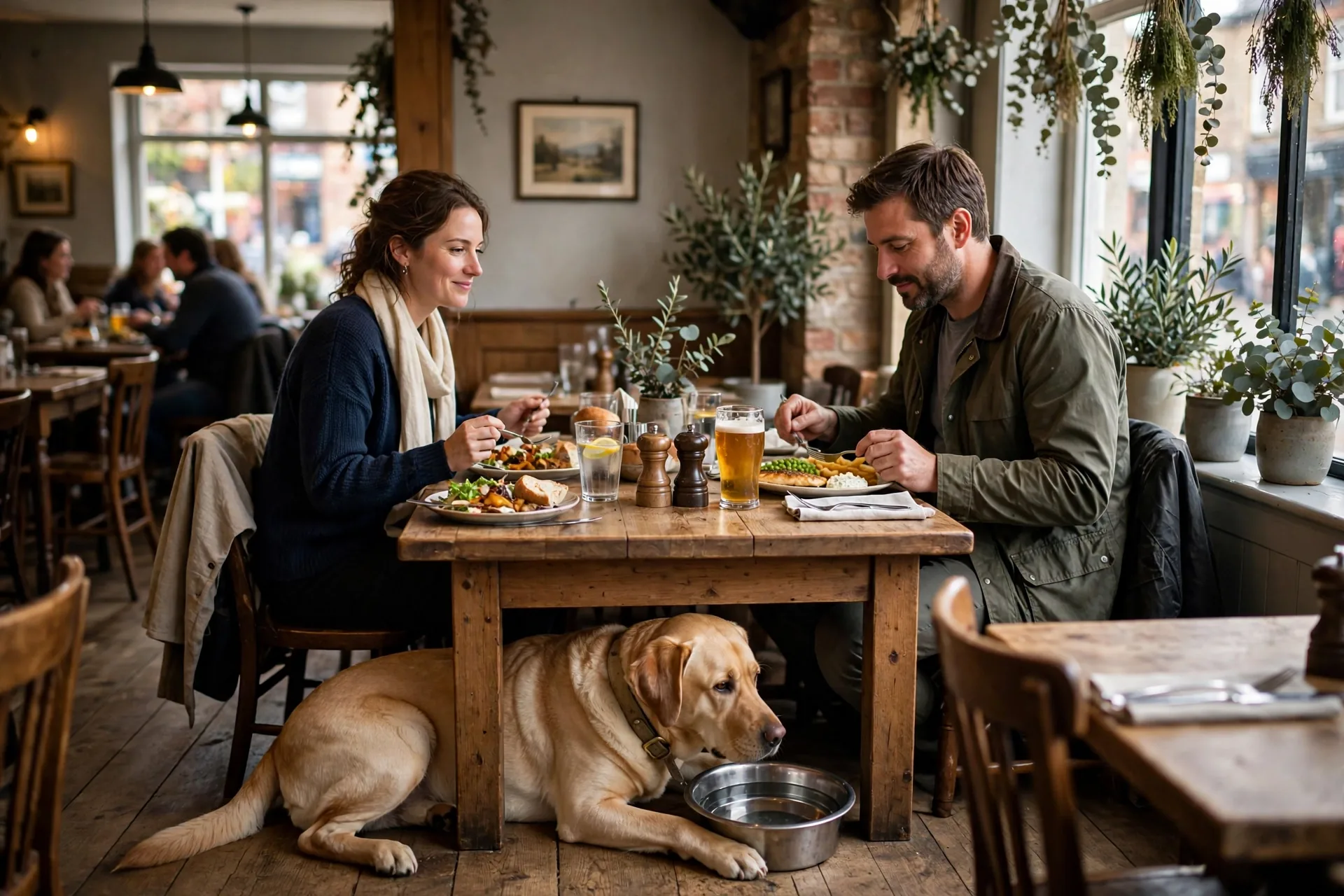
Food hygiene is the most commonly misquoted objection. Environmental health guidance is clear that assistance dogs are permitted in public areas of food premises, including restaurants and cafés; they are excluded from food preparation areas like any member of the public. A café that seats pet dogs outside only may still be obliged to seat an assistance dog partnership inside. Handlers planning meals out will find the everyday picture in our guide to dog-friendly restaurants in the UK, but remember the legal starting point differs: for assistance partnerships, access does not depend on a venue choosing to be dog-friendly.
Shops, cafés, hotels and attractions
Retail is where rights are exercised most often and challenged most casually — usually by a staff member applying a pet policy they were taught on day one. The correct position is simple: assistance dogs may enter shops, supermarkets, shopping centres and markets with their handlers, should not be charged for, and should not be required to wait outside. Supermarkets sometimes worry about hygiene codes; the answer given by regulators is the same as for restaurants — public areas are fine, food preparation and storage areas are not public areas anyway.
Hotels and guest accommodation must treat assistance dogs as part of the guest, not as a pet booking. That means no pet fee, no restriction to “dog-friendly rooms” in a way that worsens the service, and no refusal of a booking because of the dog. Sensible practical conversations — where the dog can relieve itself, whether a ground-floor room helps the handler — are welcome and lawful precisely because they improve the service rather than gatekeep it. Compare the ordinary pet situation in our guide to booking dog-friendly hotel rooms to see how different the starting positions are. Holiday parks and caravan sites follow the same principle, and reputable operators state it in their terms.
Attractions, museums, theatres and visitor centres are services too. Most national attractions state their assistance dog welcome openly, provide water bowls and sometimes offer familiarisation visits — worth asking about for a dog new to crowds and dark galleries. Where part of a site is genuinely unsuitable, perhaps a walk-through aviary or a close-contact animal encounter, staff should explain the specific reason and offer the closest equivalent experience rather than a blanket no. A handler who is told “no dogs anywhere” at a major attraction is almost certainly hearing an untrained answer, and asking for the duty manager usually resolves it.
Taxis, trains and public transport
Taxis and private hire vehicles carry the sharpest rules in this whole area. Drivers must carry assistance dogs at no extra charge, and refusal is a criminal offence unless the driver holds a medical exemption certificate issued by the licensing authority and displayed as required. The exemption exists for drivers with genuine conditions such as severe dog allergy; it is personal, evidenced and relatively rare. “I don’t take dogs” from a driver without a displayed exemption is not a preference the law recognises — it is an offence that licensing authorities prosecute, and handlers should report it with the vehicle registration, driver badge number if visible, time and booking reference.
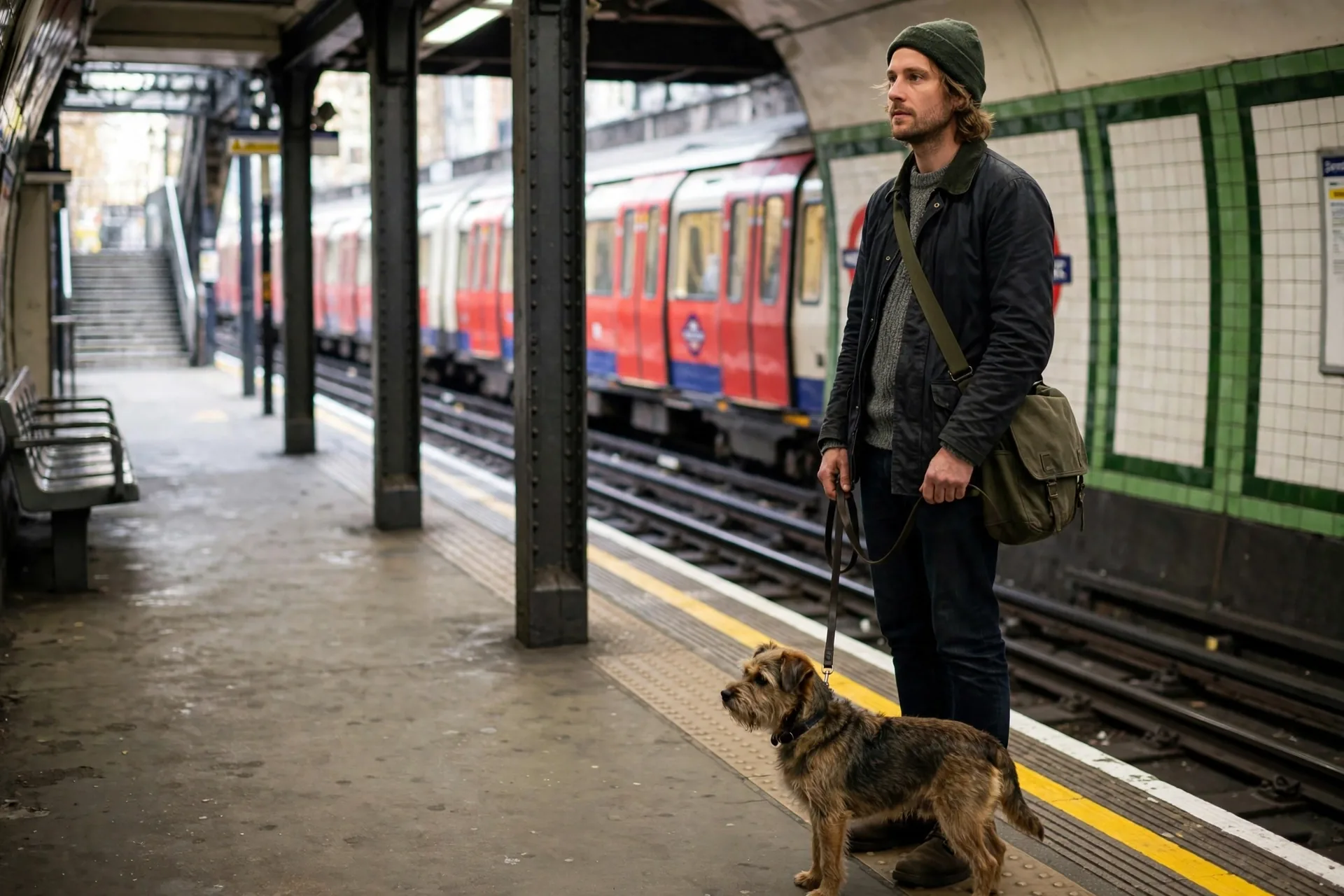
Trains, buses, trams and the London Underground carry assistance dogs free of charge, and staff are trained to recognise working dogs. Practicalities still help a journey: travelling off-peak while a partnership is new, using staff assistance schemes booked ahead where offered, and knowing where the dog settles on each type of carriage. Our companion guide to dogs on the London Underground covers the network’s general rules; for assistance partnerships, add that lifts and staff help can be requested at every step, and escalator training is part of many programmes because a dog that cannot use an escalator safely should be routed to lifts instead.
Ferries and domestic flights vary more and reward advance contact. Ferry operators generally welcome assistance dogs in passenger areas with prior notification, while airlines operate detailed assistance dog policies tied to recognised training standards, with documentation checked at booking. International travel adds pet-travel paperwork on top. In every case, notify early, get the acceptance in writing, and carry it — a confirmed email has ended more gate-side arguments than any statute quoted from memory. For sea crossings generally, see our guide to dogs on UK ferries.
ID, jackets and the register myth
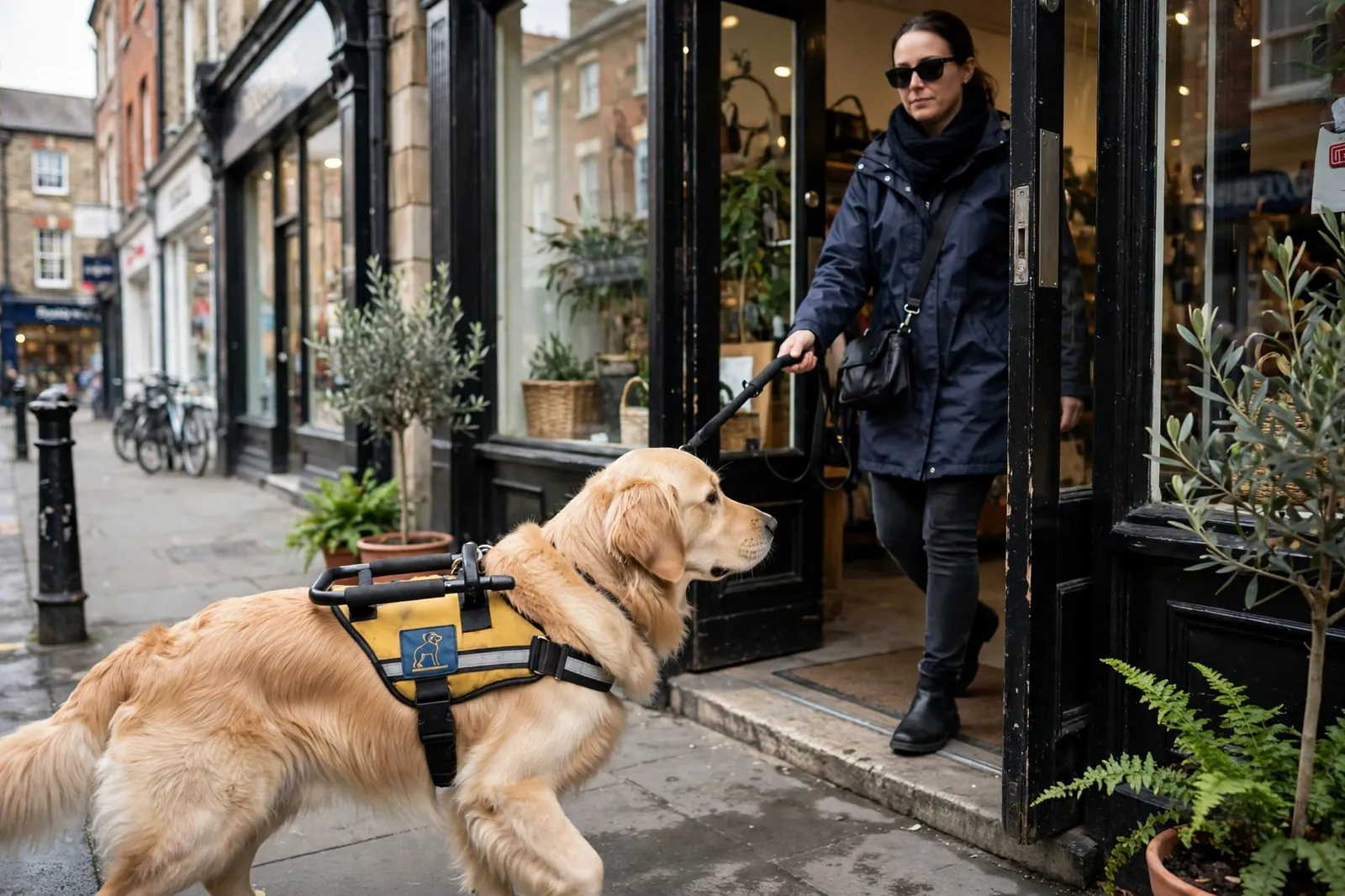
Few myths cause more friction than the belief that assistance dogs appear on an official government register and must produce a certificate on demand. No such register exists in the UK. Dogs trained by charities that belong to the main assistance dog umbrella bodies usually carry an ID booklet or card from their organisation, and many handlers choose jackets, harnesses or lead slips marked “assistance dog” because they communicate instantly and spare the handler a conversation at every doorway. These are practical tools, not legal licences, and a business insisting on one particular document misunderstands its position.
The confusion is fed by websites selling official-looking “registrations”, certificates and ID cards for any dog for a fee. These documents confer no legal status whatsoever, and using them to pass a pet off as an assistance dog undermines the credibility of genuine partnerships and can amount to fraud in some circumstances. Handlers are understandably fierce on this point: every pet in a bought vest that misbehaves in a café becomes the reason a staff member challenges the next real partnership at the door.
For businesses, the workable approach recommended by equality guidance is to welcome the partnership, observe the dog’s behaviour — trained assistance dogs settle quietly and ignore food and strangers — and address any genuine behaviour problem with the individual, exactly as they would any customer issue. For handlers, carrying whatever identification your training organisation provides, plus a phone photograph of it, remains the pragmatic choice even though the law does not compel it. Both sides lowering the temperature at the doorway serves the same goal: the transaction, the meal or the journey simply proceeding.
Owner-trained and psychiatric assistance dogs
A growing share of UK partnerships are owner-trained: a disabled person trains their own dog, sometimes with a charity programme or private trainer, to perform the tasks they need. Because equality law protects the disabled person and asks whether the dog genuinely assists them, owner-trained dogs are not a lesser legal category. The dog must still meet the behavioural standard the public is entitled to expect — calm, controlled, toilet-trained, unobtrusive — and handlers carry the burden of reaching that standard without an organisation’s structure behind them, which good owner-trainers take extremely seriously.
Psychiatric assistance dogs test public understanding most, because the disability is invisible and the tasks — deep pressure during panic, creating space in crowds, interrupting repetitive behaviours, guiding a disoriented handler to an exit — are subtle. “But you don’t look disabled” is not a question any business is entitled to pursue, and handlers do not have to disclose a diagnosis to justify access. What can legitimately be visible, and usually is, is the dog’s training: steady, task-focused behaviour that speaks for itself across a whole visit.
Emotional support animals are the boundary case to state plainly. In the UK, simply providing comfort by presence does not give a dog assistance dog status, and landlords, airlines and venues are not generally obliged to treat an emotional support animal as an assistance dog. Some housing providers and services make discretionary allowances, which are welcome but discretionary. Blurring this line — in either direction — helps nobody: handlers of task-trained psychiatric dogs face extra scepticism, while pet owners given false expectations meet avoidable refusals. Clear categories, honestly used, protect everyone’s access in the long run.
Housing, workplaces and education
At home, the same equality logic applies to landlords and housing providers. A blanket “no pets” clause should not be applied to exclude an assistance dog, because the dog is an auxiliary aid rather than a pet, and refusing consent or charging pet rent for one risks unlawful discrimination. Tenants are wise to raise the dog transparently before signing, with a short explanation of its training and work, and to get the agreement recorded in writing — not because permission creates the right, but because a documented conversation prevents the dispute entirely. Our general guide to renting with a dog covers the pet route; assistance handlers should treat its consent negotiations as context, not as the legal basis of their housing.
Workplaces must consider assistance dogs as a reasonable adjustment for disabled employees. Employers can legitimately plan — where the dog rests, toileting breaks, colleagues with allergies or phobias, hygiene in clinical or food settings — and almost every practical concern has a workable answer that thousands of existing partnerships demonstrate daily. Refusing a dog outright without exploring adjustments is the position most likely to end in a tribunal. Colleagues, for their part, need one briefing point above all: the dog is working, so admire from a distance and never distract, feed or call it without the handler’s invitation.
Schools, colleges and universities make the same adjustments for pupils, students and staff, usually through a short risk assessment and an agreed plan covering classrooms, dining areas and fire evacuation. Parents and students should start the conversation a term ahead where possible, not because the right needs negotiating but because the logistics — routes, resting places, assembly points — genuinely benefit from planning. A well-run introduction also teaches an entire school community how to behave around working dogs, which pays forward to every handler those children meet for the rest of their lives.
When refusal happens: a calm playbook
Even with the law settled, refusals still happen — handlers’ organisations have reported them for years, most often in taxis, small restaurants and independent shops. The playbook that resolves most incidents at the door has three steps. First, identify the dog plainly and without apology: “This is my assistance dog; she is trained to help me with my disability.” Second, name the law briefly: “Refusing us is unlawful discrimination under the Equality Act.” Third, escalate one level: ask for the manager or duty supervisor, because front-line refusals are usually training gaps, and managers have usually had the briefing.
If refusal holds, the counter-intuitive best move is to leave and document rather than stand ground into confrontation. Record the business name, address, date and time, the words used as accurately as you can, staff names or descriptions, and any witnesses. Keep booking confirmations, receipts and the taxi details if relevant. Photographs of “no dogs” signage applied to you can help. Then report: to the business’s head office, to the local authority licensing team for taxis, to the equality advisory services, and to your assistance dog organisation if you have one. Reports create the paper trail that changes businesses; a single complaint letter with a training offer attached has reformed many a café chain’s staff manual.
Handlers should also know the formal routes exist beyond complaints. Discrimination claims in services can be brought in the county court in England and Wales or the sheriff court in Scotland, generally within six months, and legal aid and charity support may be available. Most cases settle once a business takes advice, because the law is not ambiguous. But the deeper fix is cultural, and it is already under way: every uneventful, welcomed partnership in a busy restaurant teaches staff and customers more than any poster — which is why handlers who keep going out, visibly and confidently, are themselves the strongest enforcement the system has.
Etiquette for everyone else
This guide is read by pet owners planning trips as much as by handlers, so it ends with the public’s half of the contract. Never distract a working dog: no calling, whistling, feeding or stroking, however friendly the intention, because a distracted alert dog can miss the episode it exists to warn about. Talk to the handler, not the dog, and accept a brief answer gracefully — handlers field the same questions daily and are sometimes simply busy living their lives. Give the partnership space in queues, doorways and lifts, and keep your own dog at a distance; a working dog should not have to manage your pet’s enthusiasm as well as its job.
If you run a business, a handful of cheap measures will make you exemplary: train every new starter that assistance dogs are welcome and extra charges are prohibited; add an assistance-dogs-welcome line to your website and door signage; decide where a dog can drink and relieve itself so staff can answer instantly; and treat any access complaint as urgent and senior-level. Businesses consistently discover that this costs nothing and buys loyalty from disabled customers, their families and their friends that no advertising reaches.
And if you witness a refusal, your voice matters more than you might expect. A calm “I think assistance dogs are allowed by law” from another customer has settled many doorway standoffs, and offering your details as a witness strengthens any later complaint. Access rights survive on exactly this: a majority who understand them treating them as ordinary. The goal of everything above is a country where a handler plans a trip around the walks, the weather and the cake — like every other reader of this site — and not around which doors might be closed to them.
Practical questions
Before you go
Can a shop or restaurant legally refuse my assistance dog?
Generally no. Refusing access to a disabled person because of an assistance dog, or charging extra for the dog, is usually unlawful discrimination under equality law in Great Britain, with a similar framework in Northern Ireland. Very narrow exceptions can arise, such as a genuine risk that cannot be managed, but a no-dogs policy alone is not a lawful reason.
Does my assistance dog need an official ID card or jacket by law?
There is no single government register or legally required ID for assistance dogs in the UK. Many handlers carry identification from the charity that trained the dog, or use a jacket or lead slip to signal the dog is working, because it reduces challenges in practice. A business should not demand a specific card as a condition of entry.
Can a taxi or minicab driver refuse my assistance dog?
It is an offence for taxi and private hire drivers to refuse an assistance dog or charge extra for it, unless the driver holds a genuine medical exemption certificate displayed in the vehicle. Report refusals to the licensing authority with the vehicle and driver details, time and place, as licensing teams treat these cases seriously.
Are owner-trained assistance dogs protected in the same way?
Equality law focuses on the disabled person and whether the dog assists them, rather than on who trained the dog, so owner-trained dogs that genuinely mitigate a disability can be covered. In practice handlers may face more questions, so evidence of training standards and the tasks the dog performs can help resolve challenges calmly.
What should I do if I am refused access?
Stay calm, state clearly that your dog is an assistance dog and that refusal is unlawful discrimination, and ask for the manager. If refusal continues, leave rather than escalating, note the time, place, staff names and witnesses, keep any receipts or messages, and report the business to the relevant equality body, council or assistance dog organisation for follow-up.