This guide is independent and contains no paid placement. If affiliate links are added later, they will be clearly marked and will not change our editorial checks.
Most UK rental companies allow dogs, but few advertise it clearly. Declare the dog when you book, ask for the pet policy in writing, protect the seats and boot, restrain the dog properly, and clean the car thoroughly before return. Pet damage is often excluded from insurance, so prevention is cheaper than any cover you can buy. Check the official guidance before you travel.
Which rental companies allow dogs
There is no single UK rule on dogs in rental cars, and the answer depends on the company, the branch and sometimes the individual agent. The large international firms, such as Enterprise, Hertz, Avis, Europcar and Sixt, generally allow dogs in their vehicles, because a dog is treated as a passenger rather than a prohibited cargo. The smaller local firms and the peer-to-peer platforms vary more: some welcome dogs, some charge a fee, and a few refuse them outright. The pattern is that the bigger the company, the more likely the answer is yes, but the more likely the cleaning charge is to be enforced, because large firms inspect every return against a standard checklist.
The important point is that "allowed" does not mean "free" or "without conditions". A company that allows dogs may still require the dog to travel in the boot or on the back seat only, may forbid dogs in certain vehicle classes such as luxury cars or convertibles, and may charge for any cleaning beyond a normal return. Some firms treat a dog like a smoker: the car must be returned in the same condition, and any sign of the dog can trigger a charge. Others are relaxed about a well-behaved dog in a covered car. The only way to know is to ask the specific company and the specific branch, and to get the answer in writing, because a phone agent's reassurance is worth very little if the return desk disagrees.
Peer-to-peer hire, where you rent a private owner's car, is a different world. The owner sets the rules, and many owners refuse dogs outright, because it is their own car and they know what a wet spaniel does to leather. The ones who do allow dogs often charge a fee or require a deposit, and the terms are in the listing. Read the listing carefully before you book, message the owner to confirm, and keep the reply. If the listing says nothing about pets, do not assume dogs are welcome; ask first. A refused booking is a minor inconvenience, while a dog in a car that forbids them can mean a cancelled hire, a lost deposit and a bad review.
Declaring the dog at booking
Declare the dog when you book, not when you arrive at the desk. The booking form rarely has a pet field, so the declaration usually happens by phone, by email, or in the special requests box, and the point of doing it early is to create a paper trail. A written confirmation that dogs are allowed, with any fee stated, is the document that protects you at return, because it shows the company knew about the dog from the start. Without it, a cleaning charge is much harder to dispute, because the company can argue the dog was never declared.
When you declare, give the useful details: the number of dogs, their size and breed, and how they will travel. A single small dog in a crate is a different proposition from two large dogs loose on the back seat, and the agent can advise on the right vehicle class. Ask three questions and write down the answers: is there a pet fee, is there a cleaning charge and how is it assessed, and are there any vehicle classes where dogs are not allowed? Also ask whether the dog counts against the passenger limit, because a large dog in a small car with four passengers may not be practical. If the agent cannot answer, ask to speak to the branch, because the branch is where the car will be returned and inspected.
Booking through a broker or a comparison site adds a layer of confusion, because the broker's terms and the rental company's terms are different documents, and the broker may know nothing about pets. The rental company's terms are the ones that govern the hire, so read those, not just the broker's summary. If the broker's site offers an add-on for pets, read what it actually buys: it may be a cleaning waiver, or it may be nothing more than a note on the booking. When in doubt, call the rental company directly after booking through the broker, confirm the dog, and ask for the confirmation email to be updated. It takes ten minutes and it can save a dispute worth hundreds of pounds.
Pet fees and cleaning charges
Rental companies handle dogs in two ways: a fee at booking, or a charge at return. The fee at booking is usually a flat amount per hire, and it is the better deal, because you know the cost in advance and the company has accepted the dog. The charge at return is a cleaning fee, applied when the car comes back with hair, mud, smell or damage, and it can be much larger, because it is priced as a valeting job rather than a pet fee. Some companies do both: a small pet fee at booking and a cleaning charge if the car is returned dirty. Ask which model your company uses before you pay.
Cleaning charges are the most common surprise, and they are also the most avoidable. A car returned with a boot full of hair, muddy paw prints on the door cards and a wet-dog smell will attract a charge, because the company has to valet the car before the next hire, and that takes time and money. A car returned with seat covers removed, the boot liner lifted out, the seats vacuumed and the smell gone will usually pass inspection without a charge. The difference is about an hour of your time at the end of the hire, and it is the cheapest hour of the whole trip. Budget for a car wash and a vacuum near the return branch, because a service station vacuum is rarely good enough for a thorough clean.
Keep every receipt and every piece of paperwork. If a cleaning charge is applied, ask for the itemised invoice and photographs of the mess, because the company should be able to show what needed cleaning. If the charge seems unfair, dispute it in writing with the evidence: the booking confirmation showing the dog was declared, photographs of the car at return, and the receipt from the car wash. Credit card chargeback is a last resort, and it works best when you have a clear paper trail. The best outcome, though, is never to be charged at all, and that comes from prevention: covers, liners, a brushed dog, and a proper clean before return.
What damage cover actually covers
Damage cover is the part of the hire that most people misunderstand, and dogs make the misunderstanding expensive. The standard collision damage waiver, usually included in the hire price, covers accidental damage to the car, such as a scrape in a car park, up to the excess. The excess reduction products sold at the desk reduce that excess, sometimes to zero. What neither of them usually covers is damage caused by a pet. Chewed seatbelts, scratched leather, torn upholstery, a stained headliner and a chewed door card are all classed as damage caused by misuse or by a pet, and the policy wording often excludes them explicitly.
Read the policy wording before you travel, not after the damage happens. Look for the words "pet", "animal" and "misuse" in the exclusions, and read the section on interior damage, because that is where dog damage lives. Some policies exclude all interior damage; others exclude damage caused by animals specifically. If the wording is unclear, ask the company in writing whether dog damage is covered, and keep the reply. Do not assume that the excess reduction product you bought at the desk covers the dog, because the desk agent may not know, and the product's terms are what matter. If the policy excludes pet damage, assume that any damage the dog causes will be charged to you in full, and plan accordingly.
The practical consequence is that prevention is the only real cover. A seat cover protects the upholstery, a boot liner protects the boot floor, a door card protector stops scratches, and a harness stops the dog climbing into the front and damaging the dashboard. A crate is the best protection of all, because the dog cannot reach the car's trim at all. If the dog is a chewer, do not leave it alone in the car, even for a few minutes, because a bored dog can do a surprising amount of damage to a seatbelt in a short time. And if damage does happen, report it honestly at return rather than hoping nobody notices, because a hidden repair is always more expensive than an honest one.
Excess, deposits and your liability
The excess is the amount you pay towards any damage, and on a UK hire it is commonly between £500 and £2,000, depending on the car and the company. The deposit held on your card is usually the same amount, and it is released after the hire if there is no damage or charge. Dog damage sits outside the normal excess structure, because it is often excluded from cover entirely, which means the company can charge the full repair cost, not just the excess. A chewed leather seat can cost hundreds of pounds to repair, and a stained headliner can mean a full replacement, so the numbers are not trivial.
Third-party excess insurance, bought separately from the rental company, can help with the normal excess, but it rarely helps with pet damage, because the same exclusions apply. Read the third-party policy as carefully as the rental company's, and look for the pet exclusion. Some annual excess policies cover a wider range of damage, but even those usually exclude damage caused by animals. If you hire cars regularly with a dog, the honest calculation is that the dog is an uninsured risk, and the money is better spent on protection — covers, liners, a crate — than on insurance that does not cover the risk.
At collection, inspect the car carefully and photograph every existing mark, including the interior. Pay attention to the seats, the door cards, the boot and the seatbelts, because those are the places a dog will damage and the places the company will inspect at return. Report any existing damage to the agent and make sure it is noted on the hire agreement before you drive away. If the car already has a scratched door card or a stained seat, and it is not noted, you may be charged for it at return. Photographs with a time stamp are the best evidence, and they take two minutes. Keep the hire agreement, the damage report and the photographs together until the deposit is released, which can take several days after return.
Restraint, Rule 57 and keeping the dog safe
Rule 57 of the Highway Code requires dogs to be suitably restrained in a vehicle, so they cannot distract the driver or injure themselves or others if the vehicle stops quickly. The rule is not a suggestion: a dog that causes a distraction can lead to a charge of driving without due care and attention, and an unrestrained dog in an accident can be thrown around the car with enough force to injure passengers. In a rental car, the stakes are higher, because an unrestrained dog can also damage the car, and that damage may not be covered by insurance. Our guide to dog car law in the UK explains Rule 57, the penalties and the practical checklist in detail.
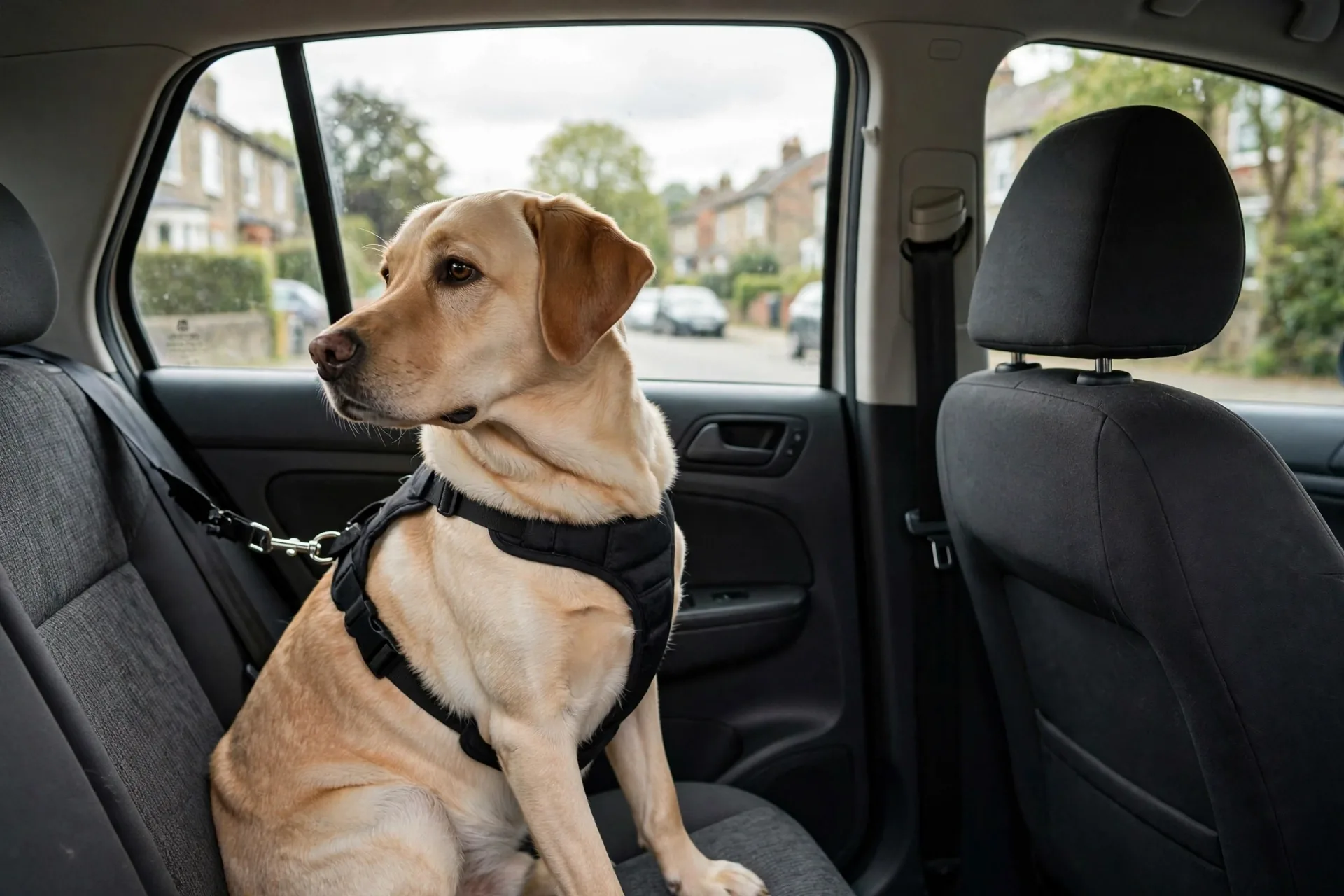
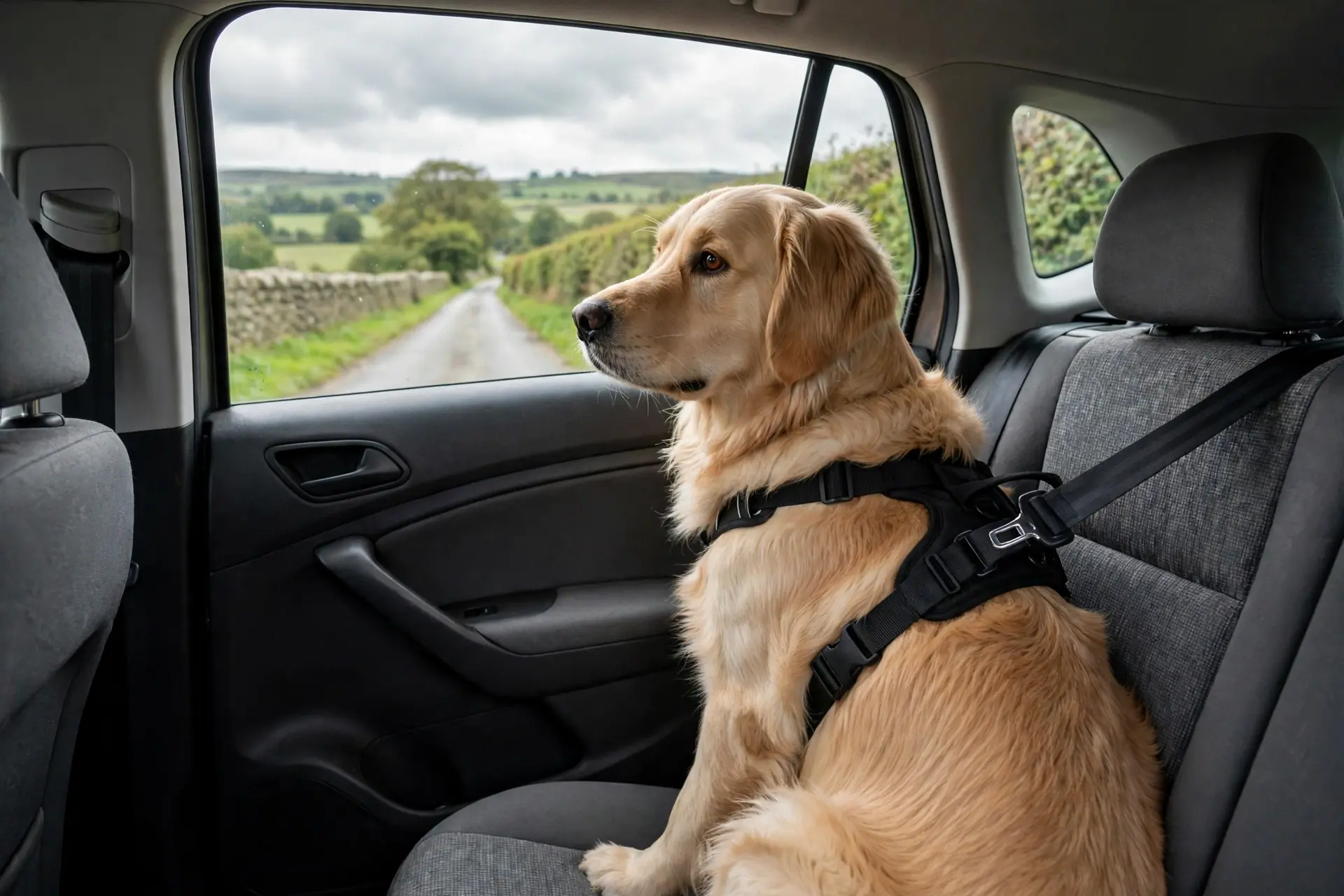
A crash-tested harness attached to a seatbelt is the simplest restraint, and it suits most dogs in most hire cars. The harness should fit snugly, the seatbelt attachment should be short enough to stop the dog climbing into the front, and the dog should be on the back seat, not the front. A secured crate in the boot is the safest option for a dog that travels well in a crate, but check that the crate fits the hire car's boot before you travel, because boots vary and a crate that fits your own car may not fit a hire car. A dog guard between the boot and the cabin is a third option, and it works well in estate cars and SUVs, but it does not stop the dog moving around in the boot, so combine it with a non-slip mat. Our comparison of dog car harness versus crate covers the fitting, the crash claims and which restraint suits which dog, and it is worth reading before you choose.
Never let the dog ride with its head out of the window, and never let it sit on the driver's lap or on the front passenger seat without a restraint. A dog on the front seat is a distraction and an airbag risk, and a dog with its head out of the window can be injured by debris or by the window closing. On a long journey, stop every two hours for a toilet break, water and a stretch, because a dog that is restrained for hours without a break will become restless and stressed. In hot weather, never leave the dog in a parked hire car, even with the windows open, because the temperature inside rises fast and the company can charge for any damage the dog causes while distressed. If you need to leave the car, take the dog with you or find shade and ventilation.
Choosing the right car and fuel type
The right hire car for a dog is not the cheapest one; it is the one with the space, the surfaces and the access that suit the dog. An estate car or an SUV is the natural choice for a medium or large dog, because the boot is big enough for a crate or a bed, the loading height is manageable, and the rear seats fold flat for a long dog. A small hatchback can work for a small dog in a harness on the back seat, but it is a poor choice for a large dog, because the dog will be cramped, the seats will be damaged, and the journey will be miserable. When you book, think about the dog's size, the amount of luggage, and the length of the journey, and choose the class that fits all three.
Surfaces matter as much as space. Leather seats are easier to clean than cloth, but they scratch more easily, and a scratched leather seat is an expensive repair. Cloth seats hide scratches but hold hair and smell, and a wet dog on a cloth seat is a cleaning job. The best approach is to cover whatever the car has: a seat cover on the back seat, a boot liner in the boot, and a towel on the floor. Vinyl and rubber boot liners are the easiest to clean, and a fitted liner that covers the boot floor and the back of the rear seats is worth buying before the trip. If the hire company offers a pet protection pack, ask what it contains and what it costs, because a company-supplied liner may be cheaper than buying your own, but it may also be thin and poorly fitted.
Fuel type matters too. A petrol or diesel car is the simplest choice for a touring holiday, because fuel stations are everywhere and refuelling takes minutes. An electric hire car adds a complication: charging stops are longer, charging points are not always in places where a dog is welcome, and a dog left in a car at a charging point is the same problem as a dog left anywhere. If you hire an electric car, plan the charging stops in advance, choose stops with a café or a walk nearby, and never leave the dog in the car while you wait for a charge. A hybrid is a reasonable middle ground, because it refuels like a petrol car and the battery handles the town driving. Whatever the fuel, check the boot space before you book, because the battery in some electric cars reduces the boot, and a crate that fits a petrol estate may not fit its electric equivalent.
Collecting the car with a dog
Collection day is the busiest part of the hire, and the dog adds a layer of complexity. Arrive with the dog already exercised and toileted, because the collection process takes time, and a restless dog in a hire office is a poor start. Keep the dog on a short lead in the car park, and if possible leave the dog with a travelling companion while you do the paperwork, because the office is not a place for a dog to wander. Bring the driving licence, the booking confirmation, the payment card and the pet confirmation, and have them ready, because fumbling for documents with a dog on the lead is how things get dropped.
Inspect the car before you drive away, and do it thoroughly. Walk around the outside and note any scratches, dents or marks, then inspect the interior: the seats, the door cards, the boot, the seatbelts and the dashboard. Photograph everything, including the mileage and the fuel level, and make sure any existing damage is noted on the hire agreement. Fit the seat covers and the boot liner before the dog gets in, not after, and fit the harness or the crate, so the dog's first experience of the hire car is a settled one. If the car has a smell, a stain or damage that was not noted, raise it with the agent before you leave, because it is much harder to dispute after you have driven away.
Before you set off, check the practical things: how the seats fold, where the boot release is, how the air conditioning works, and whether the car has a spare wheel or a repair kit. A dog owner needs the air conditioning to work, because a hot car with a dog is a welfare issue, and a hire car with weak air conditioning in summer is a problem. Test the windows and the locks, and make sure the child locks are set as you want them, because a dog that can open a door is a danger. Plan the first stop: a toilet break and a walk within the first hour, so the dog settles into the routine of the hire car rather than associating it with a long, boring drive.
Returning the car spotless
Returning the car is where the dog either costs you money or does not, and the difference is the hour before return. Plan a cleaning stop near the return branch, with enough time to do the job properly. Start by removing the seat covers and the boot liner, and shaking them out away from the car. Vacuum the seats, the footwells and the boot, paying attention to the seams and the seatbelt buckles, where hair collects. Wipe the door cards, the sills and the dashboard with a damp cloth, and clean any mud from the pedals and the floor mats. If the dog has been sick or has had an accident, clean the area thoroughly with a pet-safe cleaner and air the car out, because smell is the hardest thing to remove and the easiest thing for an inspector to notice.
After cleaning, inspect the car as the agent will. Look for hair on the seats, mud on the mats, scratches on the door cards, and any damage to the seatbelts or the trim. If you find damage, photograph it and report it honestly, because a disclosed repair is cheaper than a discovered one. Remove all of your belongings, including the dog's, and check the boot, the glovebox and under the seats. Return the car with the fuel level as agreed, and keep the fuel receipt, because a fuel dispute is a common extra charge. When you hand over the keys, ask the agent to inspect the car with you and to confirm that it is accepted without a cleaning charge, and get that confirmation in writing if you can.
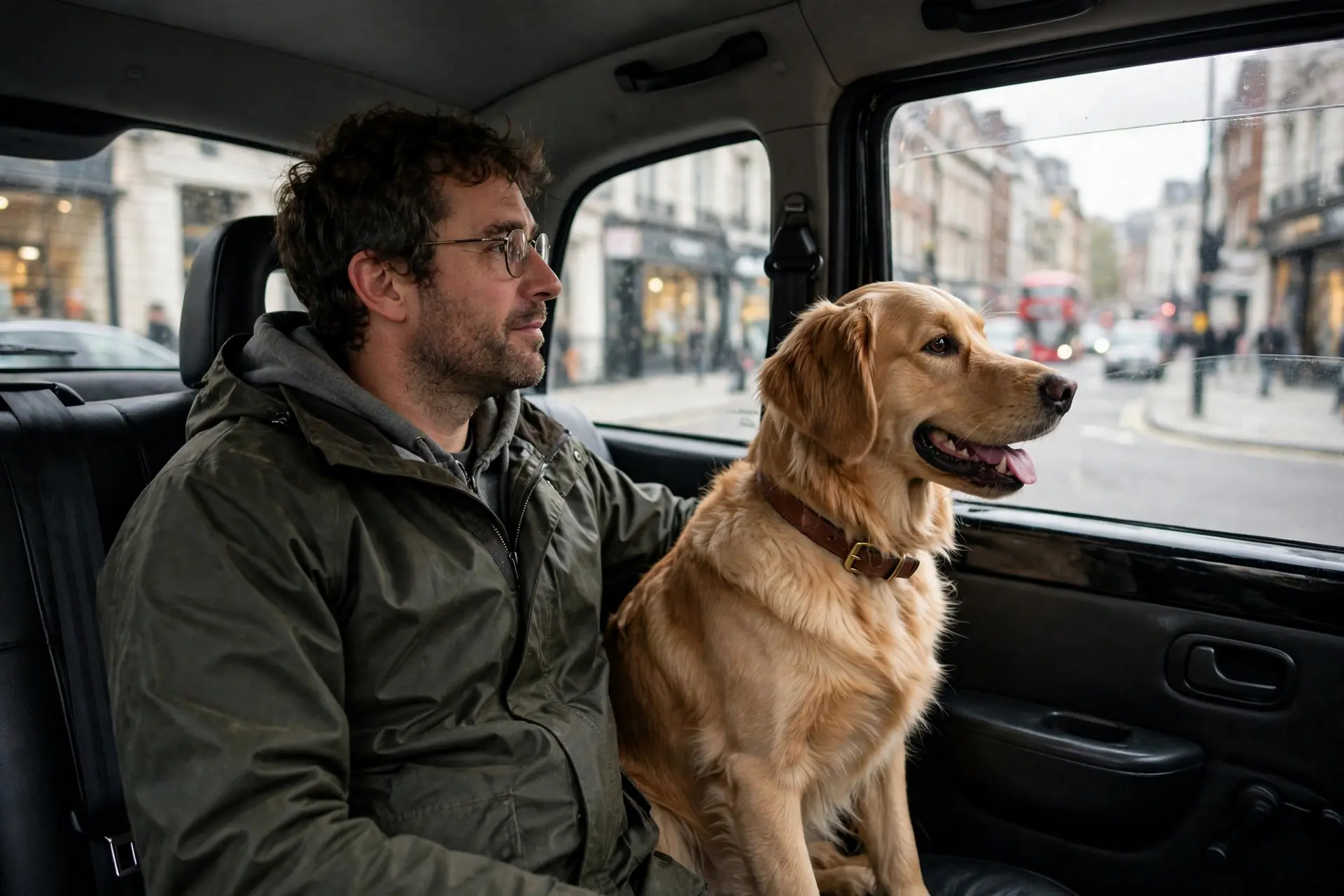
Keep the return paperwork, the photographs of the clean interior, and the fuel receipt until the deposit is released, which can take several days. If a cleaning charge or a damage charge appears on your card after return, contact the company in writing with the evidence: the photographs, the cleaning receipt, and the booking confirmation showing the dog was declared. A charge that is applied without photographs or an itemised invoice is worth disputing, and a credit card chargeback is the last resort. The best outcome, though, is a clean return with no charge, and that comes from the hour of cleaning, not from an argument at the desk. Our guide to dogs in UK taxis is a useful comparison for the short journeys at either end of a hire, where a taxi may be cheaper than a day of hire.
Long trips and multi-day hires
A multi-day hire with a dog is a different proposition from a single day, because the car becomes the dog's second home, and the routine matters. Plan the route around the dog, not just the destination: stops every two hours for a toilet break, water and a stretch, and a longer stop for a proper walk at lunchtime. A dog that is restrained for six hours without a break will be stiff, stressed and likely to damage the car, while a dog that has had regular breaks will settle and sleep. Choose stops with green space rather than service stations, because a service station is noisy, busy and full of traffic, while a village green or a country park is a proper break for both of you.
Overnight stops need the same care as the car. The dog's bed, food, water bowl and medication should be in a bag that comes into the accommodation each night, not left in the car, because the car is not a safe place for the dog overnight. If the accommodation is dog-friendly, check the rules for leaving the dog alone, because many places forbid it. If the dog cannot be left alone, plan the evenings around the dog, eating at places where the dog is welcome or cooking at the accommodation. A tired dog after a day of travelling will sleep well, but a dog that has been in a car all day and then left alone in a strange room will not.
For a long hire, the cleaning routine needs to be ongoing, not just at the end. Vacuum the car every couple of days, shake out the covers, and air the car out each morning, because hair and smell build up over a week and become much harder to remove at the end. Keep a small cleaning kit in the boot: a lint roller, a damp cloth, a plastic bag and a bottle of pet-safe cleaner. If the dog is sick or has an accident during the hire, clean it immediately, because a stain that sets over days is a repair, while a stain cleaned at once is a wipe. And check the mileage limit on the hire agreement, because a touring holiday can exceed a daily limit, and excess mileage is charged per mile. Plan the route, check the limit, and ask the company to increase it before you travel if you need to.
Practical questions
Before you go
Can I take a dog in a UK rental car?
Usually yes, but the rules differ by company, and some firms charge a cleaning fee or restrict dogs to certain vehicles. Always declare the dog when you book and ask for the pet policy in writing, because a company that allows dogs in principle may still charge for cleaning or damage. Check the official guidance before you travel for the latest terms of the company you are booking with.
Will I be charged a cleaning fee for taking a dog in a rental car?
Possibly. Many rental companies charge a cleaning fee if the car is returned with excessive hair, mud or smell, and the amount can be substantial. Some charge a flat pet fee at booking instead. Protect the seats with covers, use a boot liner, brush the dog before travel, and clean the car thoroughly before return to reduce the risk of a charge.
Does rental car insurance cover damage caused by my dog?
Usually not. Standard collision damage waiver and excess reduction products cover accidental damage to the car, but damage caused by a pet, such as chewed trim, scratched leather or stained upholstery, is often classed as negligence or misuse and excluded. Read the policy wording before you travel, and assume that any dog damage will be charged to you unless the terms say otherwise.
Do I need a harness or crate for my dog in a rental car?
Yes, in practice. Rule 57 of the Highway Code requires dogs to be suitably restrained in a vehicle so they cannot distract the driver or injure themselves or others. A crash-tested harness, a secured crate or a dog guard all count. A loose dog in a rental car is a safety risk and a damage risk, and it can also void the insurance if an accident happens.
Can I leave my dog alone in a rental car?
Only for a very short time and only in safe conditions, and it is rarely a good idea. A parked car heats up fast in summer, and a dog left alone may bark, chew trim or scratch doors. The rental company can charge for any damage, and in hot weather leaving a dog in a car can be an animal welfare offence. Plan stops so the dog is with you or in safe shade with ventilation.
What should I check when I return a rental car with a dog?
Remove all hair, mud and smell before you hand the keys back. Vacuum the seats and boot, wipe the door cards and sills, remove the seat covers and boot liner, and air the car out. Photograph the interior at return, and ask the agent to confirm the car is accepted without a cleaning charge. Keep the return paperwork until any deposit hold is released.