This guide is independent and contains no paid placement. Licensing rules vary by local authority, so check the official guidance before you travel if a detail affects a booking you cannot afford to lose.
For a pet dog, no driver has to say yes unless the dog is an assistance dog. Hackney carriages can be hailed or taken from a rank, private hire cars and app rides must be pre-booked, and in every case the winning move is the same: declare the dog before the car is dispatched, name its size, and ask for the total fare including any pet charge. That one habit prevents most refusals, most cleaning disputes and most missed trains.
Hackney, private hire and app rides: the legal distinction
Britain does not have one kind of taxi. It has two licensed categories, plus app-based services that sit inside the second one, and the distinction decides how you book, what you can be charged and whether a driver can refuse your dog. Getting the vocabulary right is half the booking, because the words people use in everyday speech do not match the legal labels. In London, a black cab is a hackney carriage. In most other towns, the car on the rank is also a hackney carriage, even if it looks like an ordinary saloon. A minicab, in the strict sense, is a private hire vehicle: a car that can only take a booking made in advance through a licensed operator. App-based rides from the large platforms are, for licensing purposes, private hire jobs dispatched through an app rather than a phone call. The app changes the interface, not the legal category.
A hackney carriage is licensed by the local authority to ply for hire. That means it can be hailed in the street, picked up from a rank, and, in many areas, booked by phone. The fare is normally set by a meter calibrated to a tariff fixed by the council, and the driver cannot simply invent a higher price because a dog is on board. That does not mean the driver must accept the dog. For a pet dog, acceptance is at the driver's discretion in most licensing areas, and the reasons drivers give are familiar: allergies, a freshly cleaned interior, a dog that has just come off a muddy walk, or a vehicle that is about to carry a passenger with an allergy. The meter protects you on price, not on acceptance.
A private hire vehicle cannot be hailed and cannot legally pick up a passenger who flags it down. Every private hire journey must be pre-booked through a licensed operator, and the operator, not the driver, accepts the booking. This is why declaring the dog to the operator matters so much: the operator can match the job to a driver who is willing to carry dogs, to a vehicle with a boot large enough for a crate, or to a driver who keeps a blanket in the car. If you flag down a private hire car and climb in, the journey is uninsured and unlicensed in the eyes of the law, whatever the driver says. The same applies to an app ride that you try to arrange by waving at a car rather than through the app: the booking must exist in the system before the wheels turn.
App-based rides add a layer of platform policy on top of private hire law. Some platforms let you add a note or select a pet option where it exists; others give you only a free-text field. Platform policy can be stricter or more generous than the law, and it can change without a council vote. A platform may, for example, allow drivers to opt out of pet trips, charge a cleaning fee through the app, or suspend a passenger account after repeated mess complaints. None of that changes the underlying rule that the job must be booked through the operator, but it does change the practical question of how you signal the dog. Where a pet option exists, use it rather than burying the dog in a note, because the option routes the job to drivers who have opted in. Where no pet option exists, a short note at booking time is still far better than a surprise at the kerb.
Local variation is the final wrinkle. Licensing is a local authority function, so tariff rules, vehicle standards, driver badge conditions and even the definition of what counts as a hackney carriage differ from one council to the next. London is licensed by Transport for London, while a market town twenty miles away may be licensed by a district council with different conditions. Some councils publish a dog policy for licensed vehicles; most do not, and silence in the conditions usually means driver discretion for pet dogs. That is why this guide avoids promising that any particular town will behave a certain way, and why the phrase that recurs here matters: check the official guidance before you travel if the journey is time-critical, such as an airport run or a hospital appointment. A two-minute check of the council licensing page, or a direct question to the operator, beats a confident assumption.
The practical summary is short. Hail a hackney carriage and you are asking one driver, on the spot, to accept the dog. Book a private hire car or an app ride and you are asking an operator to find a driver who will accept the dog before the car leaves. The second route gives you more control, more warning and a record of what was agreed. It is almost always the better route for a dog journey, and it is the only lawful route for a minicab in any case. The rest of this guide is about making that booking well.
Head-to-head: booking, price, policy and vehicle size
Booking method is the first real difference. A hackney carriage can be hailed, taken from a rank or booked by phone, which makes it the fastest option when you are already standing outside a station in the rain. A private hire firm takes bookings by phone, website or its own app, and needs a pickup address, a destination and a time; it cannot legally accept a street hail. An app-based service takes bookings only through the app, shows an estimated fare and an estimated arrival time, and lets you cancel or rebook without a phone call. For a dog owner, the speed of a rank pickup is a real advantage, but it comes with the risk of a refusal after you have already queued. A pre-booked car takes longer to arrange and is far more predictable, because the dog was part of the booking from the start.
Driver choice is the second difference, and it cuts both ways. At a rank you get the next car in line, not the driver most enthusiastic about dogs, and asking to skip to a dog-friendly driver is not always possible when a queue is forming. With a private hire firm, the operator can note a preference, send a driver who has carried your dog before, or avoid a driver with a known allergy. App platforms vary: some let you see the driver's name and vehicle before arrival, some let you message the driver, and a few let you request a driver again, but none guarantees a particular driver. If your dog is nervous, large or reactive, the ability to request a known driver through a local firm is worth more than any app feature. Tell the firm the driver's name if you have one; local operators keep informal records of exactly this kind of preference.
Price certainty differs in a way that matters for budgeting. A hackney fare is metered to a council tariff, with extras such as luggage or late-night rates defined in that tariff, so the price is predictable once you know the route. A private hire fare is usually quoted at booking, which gives certainty before you travel, but the quote can change if the journey changes, if waiting time accrues, or if a pet surcharge is added at the end. An app fare is an estimate that can rise with demand pricing, traffic and route changes, and a cleaning fee may be applied after the trip through the platform rather than at the kerb. For a short town trip the differences are small. For an airport run of forty miles, a fixed private hire quote is often the cheapest and least stressful option, provided the dog surcharge was included in the quote rather than discovered afterwards.
Dog policy is where the three types diverge most in practice. Hackney drivers decide individually, so two cars on the same rank can give opposite answers. Private hire firms often have a house policy: some welcome dogs on a blanket, some restrict dogs to the boot or to estate cars, and some leave it to the driver but record the dog on the booking so the driver is not surprised. App platforms add their own layer, and the driver still has the final say on the day for a pet dog. The pattern to remember is that a firm-level policy is more useful than a platform-level promise, because the firm is the party you can call back and complain to. When comparing options, ask the operator a direct question: is this booking recorded as a dog booking, and has the driver accepted a dog? A yes to both is worth more than a website banner that says dog-friendly.
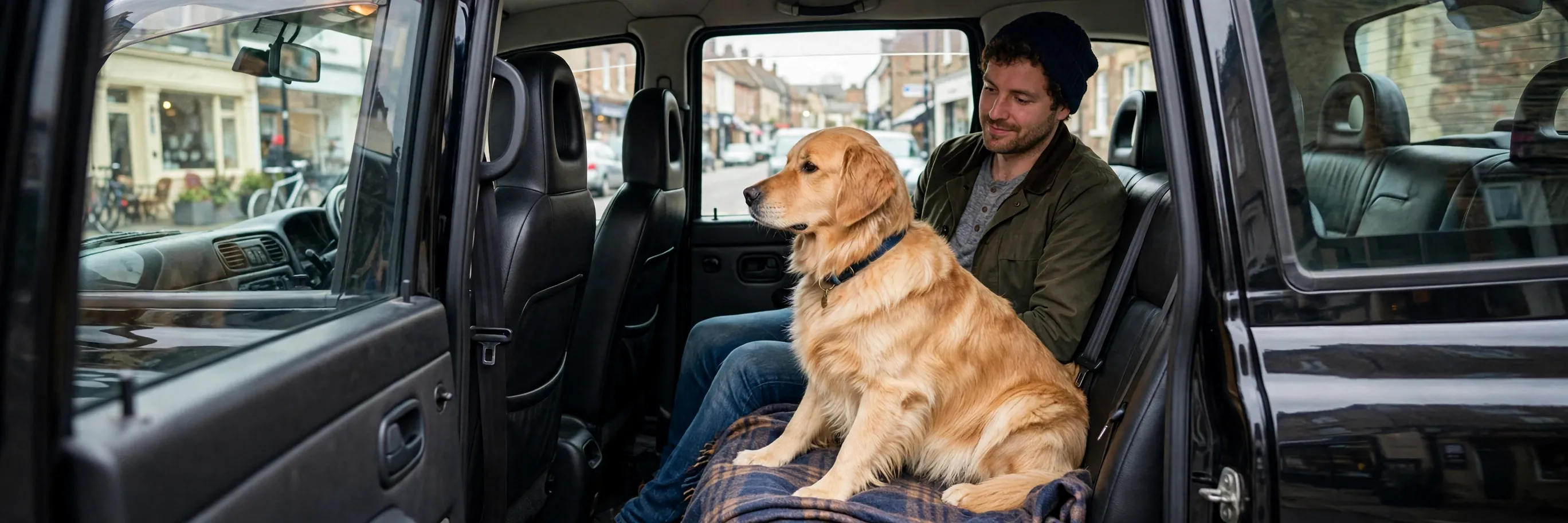
Vehicle size is the most overlooked difference. A standard saloon has a boot that fits a small crate or a folded blanket, but a large dog in a crate needs an estate car, a multi-purpose vehicle or a van. Hackney carriages in many towns are purpose-built vehicles with a separate passenger compartment and a flat floor, which suits a large dog lying on a blanket, while in other towns the hackney fleet is ordinary saloons with no extra space. Private hire firms can dispatch a specific vehicle class if you ask: estate, multi-purpose vehicle, or a vehicle with a dog guard. App platforms usually offer vehicle classes too, from standard to extra-large, but the class names describe passenger space, not boot space, so a large vehicle class does not guarantee a crate will fit. Measure the crate, including its height, and give the operator the numbers. A crate that fits in one estate car may not fit in another, and the driver who arrives with the wrong car cannot solve that at the kerb.
Waiting time, cancellations and complaints complete the comparison. A hackney carriage at a rank has no waiting charge before you board, while a pre-booked car may charge waiting time after a grace period, typically five to ten minutes. Cancelling a private hire booking is usually free up to a point, while cancelling an app ride after dispatch may incur a fee. Complaints about a hackney driver go to the council licensing team; complaints about a private hire job go first to the operator and then to the council; complaints about an app ride go first to the platform, which may or may not pass the matter to the council. Keep the booking reference, the vehicle registration and the time of the journey, because every route of complaint asks for those three facts. A dog owner who keeps them has a complaint; a dog owner who does not has only a story.
Booking scripts: phone and app notes that work
Most failed dog taxi journeys fail before the car arrives, in a booking call that was too vague. The operator cannot match a dog they do not know about, and the driver cannot prepare for a dog they were not told to expect. A good booking script is short, specific and boring, and it gives the operator everything needed to say yes with confidence. The phone version below works for local firms and for hackney bookings made by phone, and the same facts, compressed, work as an app note.
For a phone booking, say: "Hello, I would like to book a car for tomorrow at 9.30am from 12 Station Road to the vet surgery on London Road, for one passenger and one dog. The dog is a medium Labrador, about 28 kilograms, clean and dry, travelling on a blanket on the back seat. Do you have a driver who takes dogs, and is there a pet charge? Could you confirm the total fare and send an estate car if one is available?" Every clause does a job. The time and addresses let the operator price the job. The passenger count prevents a car that is too small. The breed, size and weight let the operator judge the vehicle. The words clean and dry, if true, remove the driver's main worry. The blanket tells the driver the seats will be protected. The direct question about a pet charge forces the surcharge into the open before travel. The request for an estate car is a preference, not a demand, which keeps the operator cooperative.
For an app booking, compress the same facts into the note field: "1 passenger + 1 medium Labrador, 28kg, on own blanket on back seat, clean and dry. Please confirm dog OK." If the app offers a pet option, select it first and still add the note, because the option may only tell the platform that a pet is travelling, not how large the pet is. If the app lets you message the driver after matching, send the note again once the driver is assigned, phrased as a question rather than a demand: "Hello, just checking you are happy with a medium Labrador on a blanket on the back seat?" A driver who replies yes has accepted the dog in writing inside the app, which is useful if a dispute follows. A driver who replies no has saved you a refusal at the kerb, and you can cancel and rebook before the car arrives.
Adapt the script for the awkward cases. For a puppy, add that the puppy is toilet trained or, if not, that it will travel in a carrier with absorbent bedding, because a carrier changes the driver's calculation entirely. For a reactive dog, say so plainly: "He barks at strangers for the first minute but settles on the back seat with me." Honesty loses some bookings and saves far more, because a driver who knows about barking will not panic when it happens, while a driver who was promised a calm dog and gets a barking one may end the journey. For a wet dog after a beach walk, say so and offer a towel and a drying coat: "She will be towel-dried and in a drying coat, plus a blanket." Drivers remember passengers who protect the seats, and local firms remember them too.
Confirmations deserve the same care as the booking itself. Ask the operator to read back the pickup time, the dog note and the total fare, and ask for a booking reference or a text confirmation. Save the text. If the operator says the driver will call on arrival, make sure your phone is charged and audible, and be ready at the pickup point five minutes early with the dog toileted, the blanket in hand and the lead short. A driver who waits ten minutes for a passenger who is still looking for a lead is a driver who will think twice next time, and local firms talk. The best dog passengers are boringly punctual, and their dogs get picked up without a second thought.
Two habits round out the booking. First, book earlier than you think you need to for airport runs, vet appointments and late-night journeys, because a dog booking that needs a specific vehicle cannot be conjured at peak time. Second, if a firm has served you well with a dog, say so and ask for the driver's name for next time. Local firms keep mental lists of good dog passengers, and a passenger who is known, punctual and clean will find that the next booking is easier than the first. Reputation is the closest thing a dog owner has to a guarantee in a system built on driver discretion.
Money: surcharges, cleaning fees and tipping
Dog charges in taxis fall into three buckets, and confusing them is how most arguments start. The first bucket is a pet surcharge: a fixed extra added to the fare because a dog is travelling. Private hire firms sometimes charge it, hackney tariffs sometimes allow a small extra, and app platforms sometimes build it into a pet option. The second bucket is a cleaning fee: a charge applied after the journey because the vehicle needed cleaning beyond normal use, such as mud on the seats, hair ground into fabric, or an accident. The third bucket is damage: a charge for something broken, such as a chewed seatbelt or a scratched door card. A surcharge is agreed before travel. A cleaning fee and a damage charge are argued after travel, which is why the before-travel agreement matters so much.
Ask for the surcharge figure before the journey, in pounds, not as a vague assurance. The question is: "Is there a pet charge for this booking, and what is the total fare including it?" If the answer is that there is no pet charge, ask for that to be noted on the booking, because a later cleaning claim is harder to sustain when the booking recorded no charge and no warning. If the answer is a surcharge, compare it honestly: a few pounds on a short town trip is reasonable, a large surcharge on a long airport run may make a different firm cheaper, and a firm that charges nothing but sends a driver who refuses the dog is not cheaper at all. Price and acceptance must be judged together.
Cleaning fees deserve a defensive routine. Photograph the back seat before the dog gets in and after the dog gets out, with the blanket in place, so that any claim about pre-existing hair or mud can be answered with evidence. Use your own blanket or a seat cover, and take it with you when you leave, because a blanket left behind becomes a cleaning story. If the dog is wet, muddy or shedding heavily, say so at booking and offer to pay a modest cleaning contribution in advance rather than disputing a larger fee afterwards. For app rides, read the platform's cleaning policy before you travel: some platforms set fixed cleaning fees by severity, some let the driver submit photographs, and some give the passenger a short window to respond. Knowing the process before the trip is the difference between a fee you can challenge and a fee that is already deducted.
Tipping is simpler, and it is where dog owners can buy goodwill cheaply. There is no obligation to tip a taxi driver in Britain, but a driver who has carried a muddy spaniel cheerfully, waited while you settled the dog, or helped load a crate has earned a tip, and a tip of a pound or two on a short trip, or rounding up on a longer one, is remembered. For app rides, tipping through the app after the trip, with a short note of thanks, has the same effect and is recorded on your account. Do not tip to apologise for a mess you could have prevented, and do not withhold a tip to punish a driver who was honest about a cleaning charge. Tip for good service, protect the seats as a matter of routine, and the economics of dog taxi travel stay friendly.
Payment method is a final money detail. Many hackney carriages now take card payments, but some still prefer cash, and a card machine that fails at the end of a journey with a dog on board is an avoidable stress. Ask at booking whether card payment is available, and carry a backup payment method for rank pickups. For private hire and app rides, payment is normally through the account or the app, which removes the kerbside payment problem entirely, but check whether a cleaning fee would be taken from the same payment method automatically. A passenger who knows how a fee would be collected is a passenger who can respond to it promptly rather than discovering it on a bank statement a week later.
Refusal at the kerb: what to do in the moment
A refusal at the kerb feels personal, but it is usually practical: the driver has an allergy, the car has just been valeted, the next passenger is allergic, or the driver simply does not take dogs. Arguing on the roadside rarely changes the outcome and can make the next booking harder, because the driver will remember the argument and the operator will hear about it. The useful response has three steps, and they take less than a minute. First, confirm calmly whether the refusal is about the dog or about something else, such as vehicle size or a soiling risk you can solve with a blanket or a carrier. Second, if the answer is still no, thank the driver and step back so the car can leave. Third, call the operator or rebook through the app immediately, stating that the previous car refused a declared dog, and ask for a replacement vehicle.
What you say to the operator matters. Give the booking reference, the time, the vehicle registration if you saw it, and the exact reason the driver gave. Operators can only act on specifics: a driver who refused a declared dog needs a note on the booking, a driver who refused because the dog was undeclared needs the operator to remind the next passenger to declare, and a driver who refused an assistance dog needs a formal report. Do not exaggerate the reason or invent a motive, because operators hear both sides and an exaggerated complaint is discounted. A factual report, made promptly, is the one that changes how the next dog booking is handled.
Protect yourself against repeat refusals by changing one variable at a time. If the refusal happened at a rank, book a private hire car next time so the dog is on the booking. If the refusal happened on a pre-booked job, check whether the dog note actually reached the driver, because a note lost between operator and driver is a common cause. If the refusal happened on an app ride, use the pet option or the driver message next time rather than relying on a note alone. If the refusal happened because the dog was wet or muddy, add a drying coat and a blanket to the routine before the next attempt. Each change removes one reason for the next driver to say no, and after two or three changes most dog owners find a routine that works reliably in their town.
There is one situation where calm acceptance is the wrong response, and that is an assistance dog refusal, covered in detail later in this guide. For a pet dog, however, the law gives the driver discretion, and the fastest route to your destination is almost always a new booking rather than a dispute. Keep a backup plan for time-critical journeys: the number of a second firm, an app installed and logged in, and a bus or train alternative if the journey allows it. A dog owner with a backup plan is inconvenienced by a refusal; a dog owner without one misses a train. The difference is preparation, not luck.
Airport and station pickups
Airport and station pickups are where dog taxi planning either pays off or falls apart, because the pickup point, the waiting rules and the flight or train timetable all interact. At an airport, the driver cannot simply wait outside arrivals indefinitely: most airports charge for drop-off and pickup, restrict waiting to designated areas, and fine vehicles that linger. Tell the operator your flight number, not just your landing time, so the driver can track delays and arrive when you actually land rather than when you were scheduled to land. State where you will meet the driver: a named meeting point, a pickup zone, or the rank outside the terminal, and agree who calls whom. A driver circling an airport while you search for a meeting point is a driver accumulating waiting charges.
Prepare the dog for the airport leg specifically. Airport terminals are noisy, crowded and full of smells, and a dog that has just spent hours in a carrier on a flight, or hours in a car to reach the airport, will need a toilet break before the taxi leg. Find the terminal's dog relief area or the nearest grass before you meet the driver, carry water and a bowl, and let the dog settle for ten minutes. A calm, toileted dog on a blanket is a driver's easiest passenger. A dog that needs the toilet in the back of a taxi is a cleaning fee waiting to happen, and the driver knows it. The same logic applies in reverse for departures: toilet the dog before the taxi arrives, not after it is waiting with the meter running.
Station pickups are simpler but have their own traps. The rank outside a main station can be long, and at peak times the next car may be a small saloon that cannot fit a crate. If you are arriving with a crate, book a private hire car to meet you at a named point, such as the station forecourt or a nearby street, rather than joining the rank and hoping. Give the operator your train arrival time and a mobile number, and be ready to answer the phone, because station pickups often involve a short call to confirm exactly where you are standing. If your train is delayed, tell the operator as soon as you know, because a driver who has waited twenty minutes for a delayed train and then finds a large dog he was not told about is a driver primed to refuse.
For both airports and stations, luggage changes the vehicle calculation. A dog plus two suitcases plus a crate does not fit in a standard saloon boot, and a driver who arrives with a small car cannot solve that by good will. Tell the operator the luggage as well as the dog: "One large suitcase, one cabin bag, one medium dog crate, one passenger." The operator can then send an estate car or a multi-purpose vehicle, and the fare quoted will be for the vehicle you actually need. A vehicle that fits is cheaper than two vehicles, and it is certainly cheaper than a missed flight caused by a car that could not carry everything.
Large dogs and multi-dog groups
Large dogs are where generic dog-friendly claims break down, because a policy written for a terrier does not automatically cover a Great Dane. A large dog needs floor space to lie down, headroom to sit without pressing against the roof, and a door opening wide enough to step in without scrambling over the seat. Purpose-built hackney vehicles often suit large dogs well, because the passenger compartment is flat and boxy, while a low saloon with a sloping roofline can be uncomfortable and, for a dog with hip or joint problems, genuinely difficult. When booking, give the dog's weight and height at the shoulder, not just the breed, because a lean 35-kilogram lurcher and a stocky 35-kilogram bull breed occupy space differently. A car seat cover or a thick blanket also matters more for a large dog, because more weight means more pressure on the seat fabric and more hair over a larger area.
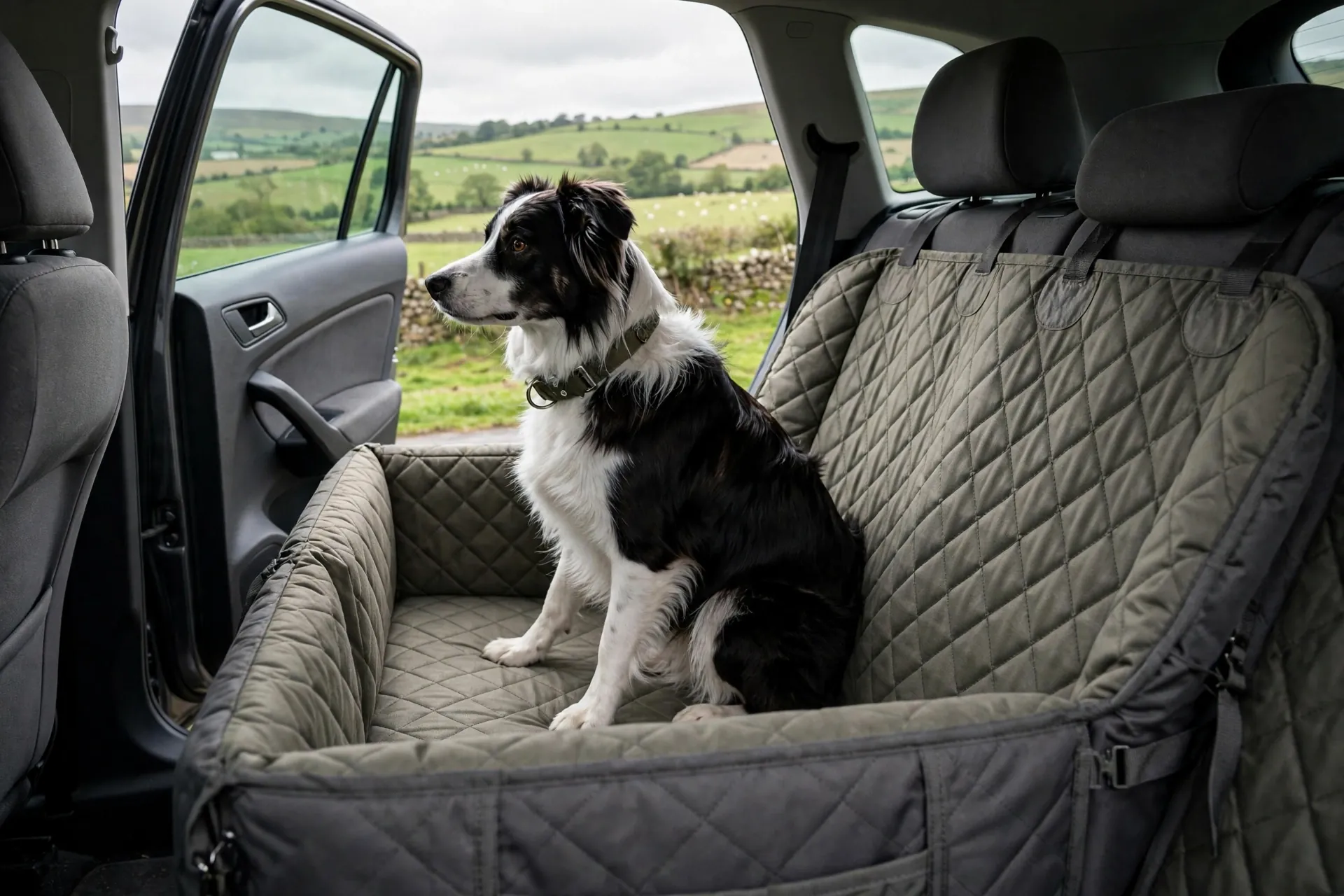
Crates change the calculation again. A crate that fits in the boot of an estate car may not fit through the boot opening, and a crate assembled inside the vehicle may not come out again without folding seats. Measure the crate in three dimensions, give the operator the numbers, and ask whether the vehicle has a flat load space with the seats down. If the dog travels loose on the back seat, it must still be restrained in a way that does not distract the driver: a harness clipped to a seatbelt anchor, a dog guard between boot and cabin, or a carrier for smaller dogs. The Highway Code expects a dog to be suitably restrained so it cannot distract the driver or injure passengers if the vehicle stops suddenly, and a driver who sees an unrestrained large dog roaming the cabin has a safety reason, not just a preference, to decline the journey. Restraint is therefore part of the booking, not an afterthought.
Multi-dog groups need a count, not a description. Two calm Labradors are a different booking from three terriers, and an operator who hears "a couple of dogs" may send a car that fits two small dogs but not three medium ones. State the number, the sizes and whether the dogs travel together on one blanket or in separate carriers, and ask whether the firm has a per-vehicle dog limit. Some firms cap dogs at two per vehicle, some allow more in a multi-purpose vehicle, and some will send two cars rather than overload one. Two cars booked deliberately is a better outcome than one car that arrives, sees three dogs and refuses, leaving you to rebook under time pressure. For groups of three or more, also ask about the boot: three leads, three blankets and a water bowl take space, and a driver who has to rearrange luggage at the kerb is a driver whose goodwill is already spent.
Behaviour matters as much as size for large and multi-dog bookings. A large dog that settles on a blanket is easier to carry than a small dog that barks continuously, and operators know it. If one dog in the group is reactive, say so and explain the management: the reactive dog travels in a carrier, or sits beside you with a short lead, or wears a muzzle it is comfortable with. A muzzle, properly introduced at home, is a practical tool, not a confession of danger, and it reassures drivers who have been nipped or startled before. The booking that succeeds for a large or multi-dog group is the booking that leaves the operator with no unanswered questions about size, space, restraint and behaviour.
Assistance dogs: a different set of rules
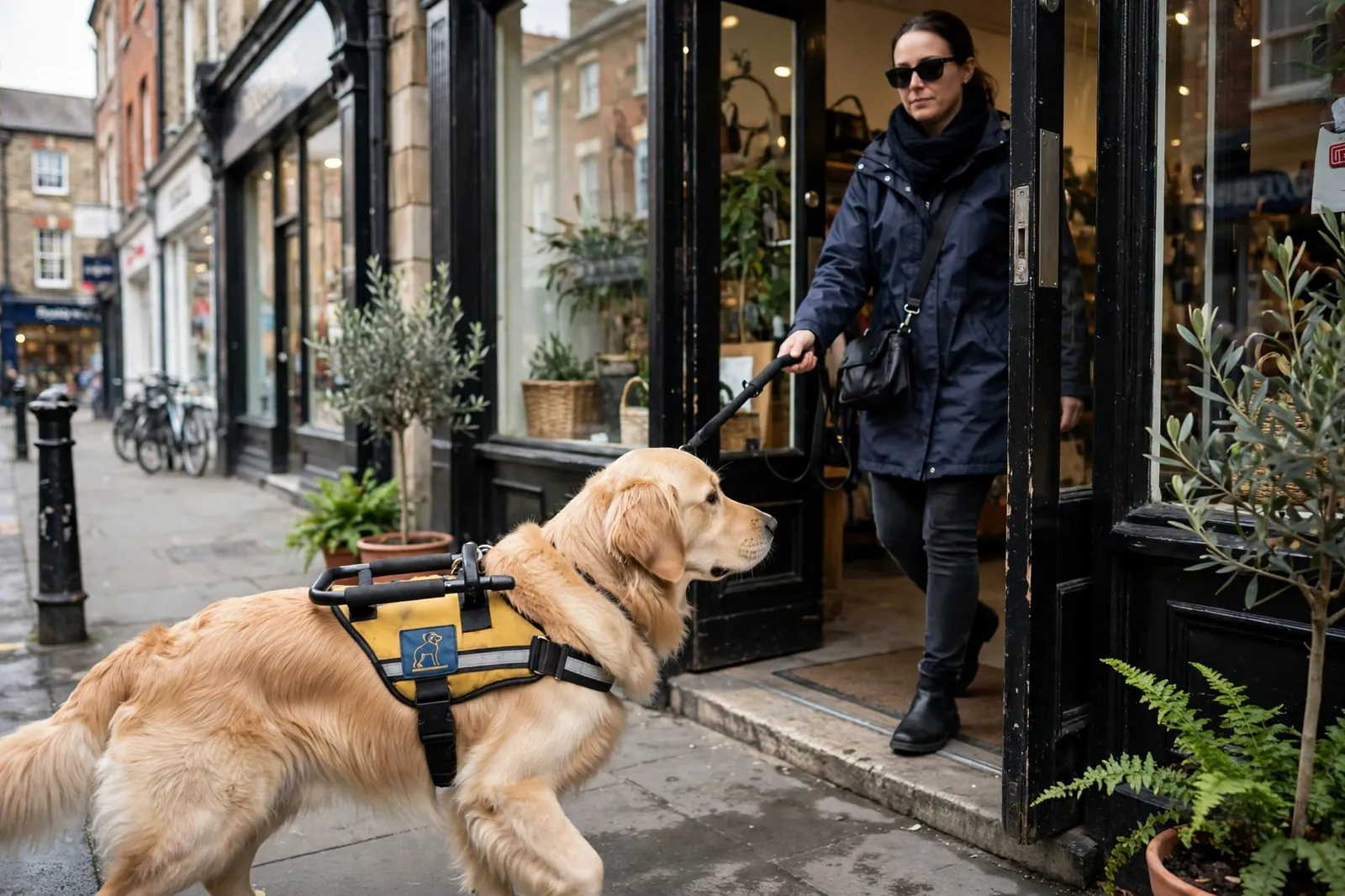
Assistance dogs are not pets in the eyes of taxi law, and the distinction changes everything. A driver of a licensed taxi or private hire vehicle must carry an assistance dog, must not charge extra for it, and must not refuse it on grounds of allergy, dislike or a freshly cleaned car. The dog travels with its handler, normally on the floor by the handler's feet or on a blanket, and it does not count against a pet limit or incur a pet surcharge. If a driver refuses an assistance dog, that refusal is a legal matter, not a matter of driver discretion, and it should be reported. Our full guide to assistance dog rights in the UK covers identification, jackets, housing and other settings in detail, and it is worth reading before a journey where a refusal would be costly.
In practice, most assistance dog journeys go smoothly, and the problems that do arise are usually about communication rather than hostility. Tell the operator at booking that the dog is an assistance dog, give the dog's working role only if you wish to, and state where the dog will travel. A driver who is told in advance can prepare the footwell, move a bag from the floor, and avoid the surprise that causes a hesitant refusal. Carry identification if your dog has it, such as an assistance dog identification book or a harness that identifies the dog's role, but remember that the legal duty does not depend on a particular jacket or card, and a driver who demands a specific form of identification beyond what the law requires should be reported rather than argued with at the kerb.
If a refusal happens, the procedure is different from a pet dog refusal. Do not argue on the roadside. Note the vehicle registration, the driver badge number if visible, the operator name, the time and the place, and keep any booking confirmation that shows the dog was declared. Report the refusal to the local licensing authority, which can investigate and, where appropriate, take action against the driver's licence. Some drivers hold a medical exemption from carrying assistance dogs, granted on genuine medical grounds, and such drivers should display an exemption notice; a refusal by an exempt driver is handled differently, so the licensing authority is the right body to judge the case, not the passenger at the kerb. Keep the report factual and prompt, because licensing investigations rely on details that fade quickly.
For handlers travelling with a pet dog as well as an assistance dog, or with family members and luggage, the booking needs both halves of the story: the assistance dog, which must be carried, and the pet dog, which remains at driver discretion. Declare both, distinguish them clearly, and book a vehicle large enough for the group. Operators handle this routinely when they are told in advance, and the journey that fails is usually the one where the second dog appeared as a surprise. Clarity at booking protects the assistance dog's legal right by removing any confusion about which dog is which.
Late-night and rural journeys
Late-night journeys change the supply of cars, and rural journeys change the supply of firms. After midnight in a town, the number of licensed vehicles on the road falls sharply, rank queues grow, and a driver who has already carried several groups of revellers may be less willing to add a dog to a tired interior. Book late-night dog journeys in advance whenever possible, even if you would normally hail a car, because a pre-booked job gives the operator time to find a willing driver before the peak. State the return time as well as the outward time if you need both legs, because a firm that can do the outward journey at 7pm may not have a dog-willing driver at 1am. For nights out where the dog stays with you, such as a restaurant or a pub visit, agree the return booking before you go in, and keep the firm's number in your phone rather than relying on an app at 1am with a low battery.
Rural areas present the opposite problem: fewer firms, longer distances and drivers who may need to travel a significant distance to reach you. A rural firm may have only a handful of vehicles, and a dog booking that needs an estate car may require a driver to come from the next village. Book rural journeys a day ahead, give a precise pickup point such as a farm gate, a pub car park or a what3words-style description if the address is ambiguous, and expect a minimum fare or a pickup charge that reflects the driver's empty mileage. A dog that is muddy after a country walk is normal in a rural area, but it still needs a blanket and a towel, because rural drivers clean their own cars and remember the passengers who left them clean.
Weather and seasons affect both late-night and rural dog travel. Winter nights mean wet dogs, muddy paws and dark pickup points where the driver cannot see you waving. Carry a torch or use your phone light to signal the car, stand somewhere lit, and have the dog toileted and towel-dried before the car arrives. Summer brings the opposite risk: a dog left in a car while you run an errand, or a dog overheating on a long journey with the windows closed. Never leave a dog alone in a taxi, even for a minute, and ask the driver to keep the air conditioning or ventilation running if the dog is panting. A driver who sees a passenger managing heat and mess proactively is a driver who will take the dog again.
Finally, plan the fallback for every late-night and rural dog journey, because the fallback is what turns a refusal from a crisis into an inconvenience. Save the number of a second firm, keep a charged phone and a payment method, know the last bus or train time, and, for a longer stay, ask your accommodation about local dog-friendly taxi firms on arrival rather than on the night you need one. Guests who ask the host of a dog-friendly holiday park for a recommended firm on the first day usually get a name that works for the whole stay, because hosts hear which firms actually turn up with dogs. A recommendation from a host who has seen the firm work is worth more than a search result, and it is the closest thing to a guarantee that rural and late-night dog travel offers.
Practical questions
Before you book
Can a taxi driver refuse to take my dog?
In most cases, yes, for a pet dog. A driver of a hackney carriage or private hire vehicle may decline a pet for reasons such as allergies, vehicle condition or personal choice, unless the dog is an assistance dog, where refusal is unlawful. Booking in advance and declaring the dog removes most surprises, because the operator can match the job to a willing driver before the car is dispatched.
Do I have to declare my dog when I book a minicab?
You should always declare the dog, including its size and whether it travels in a carrier or on a blanket. An undeclared dog is the most common reason for a refusal at the kerb, and it can also leave you liable for cleaning charges if the driver was not given a chance to prepare. A declared dog, by contrast, gives the operator a chance to send the right vehicle and a willing driver.
Are assistance dogs treated differently in taxis and minicabs?
Yes. Assistance dogs must be carried in taxis and private hire vehicles, and drivers cannot charge extra for them or refuse them on grounds of allergy or dislike. If a driver refuses an assistance dog, note the vehicle details and report it to the local licensing authority. Check the official guidance before you travel if you need to confirm how exemptions are handled in your area.
Will I be charged extra for taking a dog in a taxi?
Sometimes. Hackney fares are usually metered and dog charges are limited by local licensing rules, while private hire firms may add a pet surcharge or a cleaning fee if the dog soils the vehicle. Ask for the total fare, including any pet charge, before the journey starts, and photograph the seat before and after the trip if you want evidence against a later cleaning claim.
What should I do if a driver refuses my dog at the kerb?
Stay calm, do not argue on the roadside, and ask the operator or the app for another vehicle. If the dog is an assistance dog, record the licence plate, driver badge number and time, and report the refusal to the licensing authority. For a pet dog, rebooking with a declared dog is usually faster than disputing the refusal, and changing one variable, such as the vehicle size or the firm, often solves the problem.
Can I take a large dog or two dogs in one taxi?
Often yes, but only if you book the right vehicle. A large dog may need an estate car or a multi-purpose vehicle, and two dogs may need a larger car or two bookings. Tell the operator the number, sizes and behaviour of the dogs so the vehicle sent can actually fit them, and measure any crate in three dimensions before you quote it to the operator.