This guide is independent and contains no paid placement. If affiliate links are added later, they will be clearly marked and will not change our editorial checks.
Buy the restraint first and the cover second: Rule 57 of the Highway Code requires your dog to be suitably restrained, and a seat cover alone does not satisfy it. For the cover itself, a quilted hammock with a breathable waterproof membrane fits most dogs and most British back seats — then measure your seat, align the seat-belt slots, and fit it once properly.
Rule 57: the law comes before the cover
Every conversation about dog car gear in Britain should start with Rule 57 of the Highway Code. It says that when in a vehicle you must make sure dogs or other animals are suitably restrained so they cannot distract you while you are driving or injure you, or themselves, if you stop quickly. That single sentence is the whole reason seat covers exist in a legal sense: the cover protects the car, while the restraint protects everyone inside it. Confusing the two jobs is the most common mistake people make when they shop for car seat covers for dogs.
A seat cover is upholstery protection. It is not restraint, and buying a thick quilted hammock does not move you one step closer to legal compliance if the dog underneath it is free to roam. An unrestrained dog can be treated as driving without due care and attention, which carries a fine and penalty points, and in a collision a loose dog becomes a projectile. A 20 kg dog in a 30 mph impact can strike with the force of several hundred kilograms, which is why the Highway Code frames restraint as a duty rather than a suggestion. For the full legal picture, including harnesses, crates and what police look for, our guide to driving with a dog under UK law walks through Rule 57 in detail.
The insurance angle sharpens the point. Many UK motor policies contain wording that excludes or reduces cover if the vehicle was being driven in an unsafe condition, and insurers have argued that an unrestrained animal contributed to a loss of control. If your dog is loose in the car when you have to brake hard and the car ends up damaged, your insurer may question the claim — and the policy small print is not the place you want to discover this. Check your own policy's wording on animals in the vehicle; wording varies between insurers, and if anything is unclear, check the official guidance before you travel.
None of this is meant to frighten anyone away from taking the dog along. The practical takeaway is simply an order of operations: first decide how the dog will be restrained — a crash-tested harness clipped to the seat belt, a secured crate, or a boot with a fitted guard — and then buy the cover that fits around that restraint. A well-chosen cover actually makes restraint easier, because seat-belt slots in a good cover line up with the buckles and keep straps running freely instead of tangling in bunched fabric. But the cover is the second purchase, never the first.
Four shapes compared: hammock, bench, boot liner, door guard
Nearly every dog car seat cover sold in the UK falls into one of four shapes. They solve different problems, and the right one depends on where the dog rides and who else rides with it. The table below compares them head to head; the paragraphs underneath explain the trade-offs that the table cannot show.
| Shape | Best for | Watch out for | Typical UK price band |
|---|---|---|---|
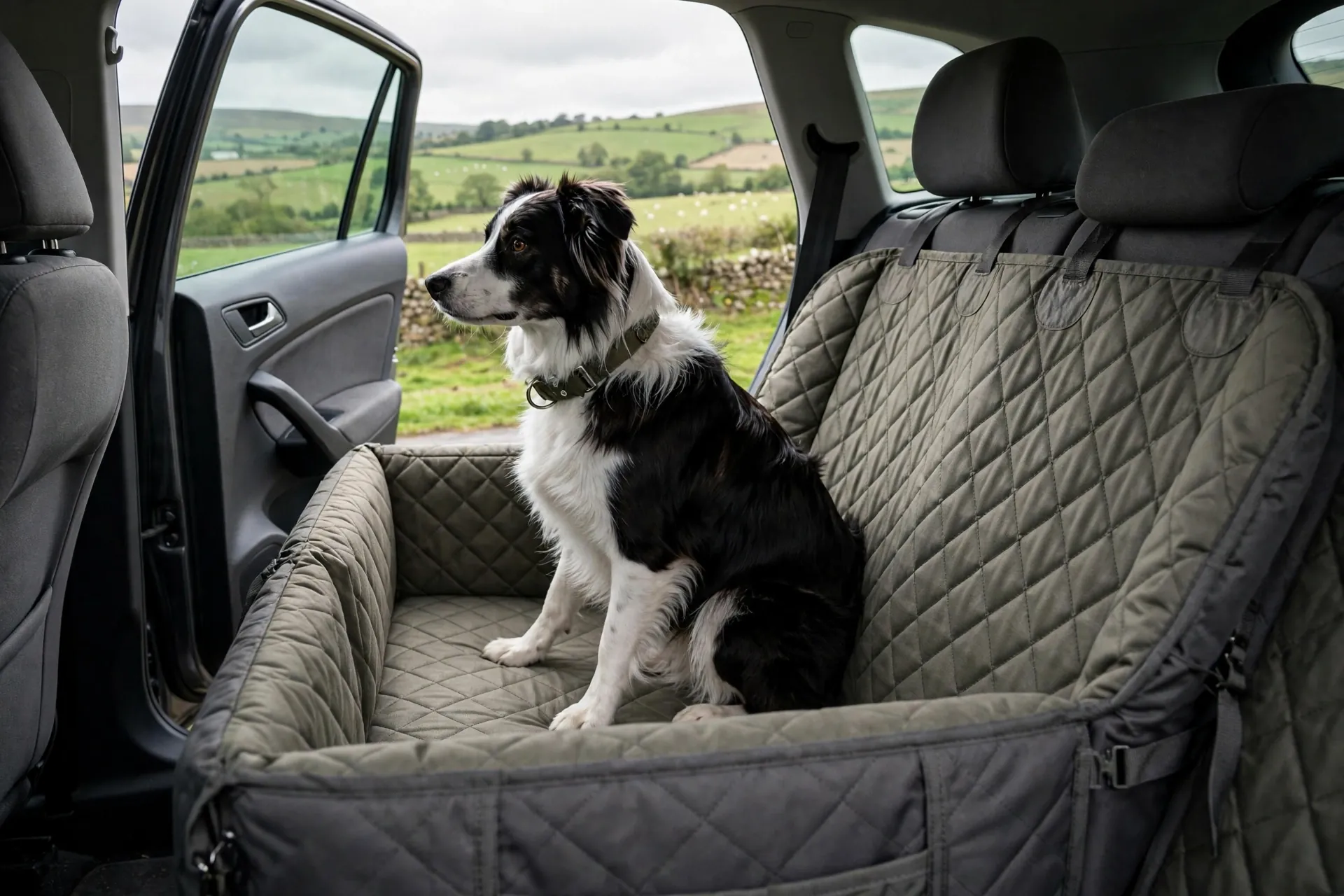
| Hammock — straps to front and rear headrests, bridging the footwell | Dogs that ride alone on the back seat; stops sliding into the footwell under braking | Blocks the back seat for human passengers; straps must reach your headrests | £25–£60 |
| Bench cover — drapes over the seat base and backrest like a fitted throw | Sharing the back seat with a dog and a person; quick on-and-off use | Footwell stays exposed; muddy paws still reach the doors and floor | £20–£45 |
| Boot liner — lines the boot floor and often the sides and back of the rear seats | Dogs that ride in the boot behind a guard; the muddiest option, contained | Needs a guard or crate to count as restraint; measure an irregular boot carefully | £30–£70 |
| Door protectors — panels that hang on the rear doors | Scratch-prone doors with excitable or climbing dogs; pairs with any of the above | Add-on cost; check window and handle cut-outs fit your car | £10–£25 per pair |
The hammock is the default recommendation for a reason. By spanning from the front headrests to the rear headrests it turns the back seat into one continuous platform, which does three useful things at once: it gives the dog more usable floor area, it stops a sleeping dog sliding into the footwell when you brake, and it blocks the gap that smaller dogs otherwise exploit to climb into the front. The cost is that the back seat becomes dog-only territory while the hammock is up. Some hammocks unzip down the middle so one half can drop for a passenger, which is worth paying a little extra for if you regularly carry both a dog and a human back there.
A bench cover is the honest choice when the dog genuinely shares the seat with people. It is quicker to fit and remove than a hammock, it leaves the seat belts fully accessible for human passengers, and it costs less. Its weakness is coverage: the footwell, the backs of the front seats and the doors are all exposed, so a wet spaniel shaking off after a walk will still find unprotected surfaces. Bench covers suit calm, mostly dry dogs that sit rather than sprawl.
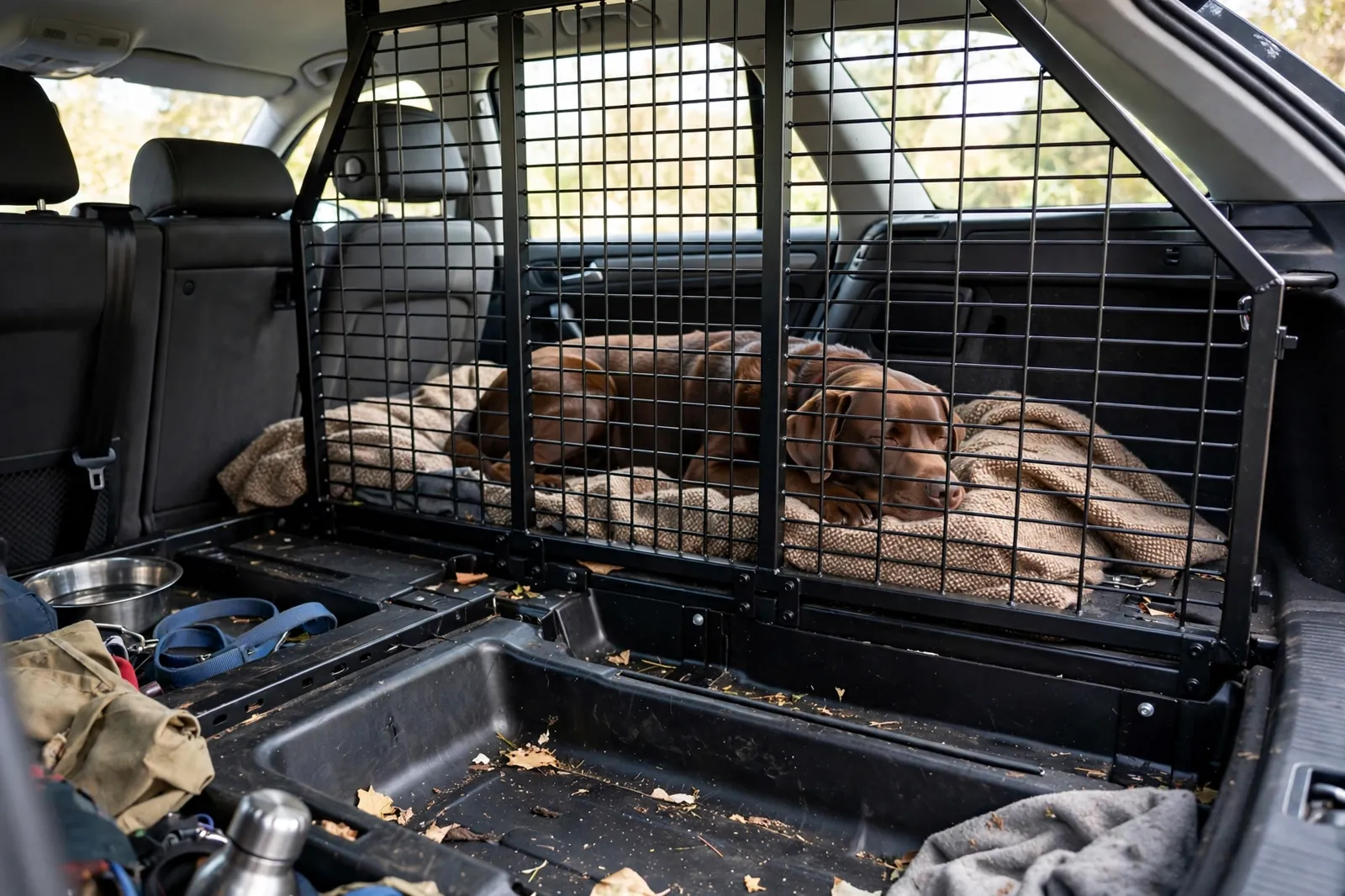
Boot liners belong to a different philosophy of dog travel: the dog rides in the boot, the boot is fully lined, and a dog guard or a crate provides the restraint that Rule 57 requires. This is the best setup for very muddy dogs, for two-dog households, and for anyone whose back seat is regularly needed by people. The trade-off is measurement: boots are irregular shapes with wheel arches, load lips and sloping seat backs, so a generic rectangular liner will bunch and slide unless it is cut for your car or has enough anchor points.
Door protectors are the finishing touch rather than a standalone solution. Rear door cards are expensive to retrim and dogs scratch them with claws every time they stand to look out of the window. Hanging panels with window cut-outs protect the paintwork and the trim for a modest price, and they work alongside any of the three main cover shapes. If your dog is a window-watcher, budget for these from the start rather than discovering the scratches a year later.
Materials: waterproofing versus breathability
Product listings love the word waterproof, but fabrics achieve it in very different ways, and the differences matter to your dog as much as to your upholstery. The cheapest covers use a PVC backing: genuinely waterproof, but heavy, stiff in cold weather, and poor at letting heat and moisture escape. A dog lying on PVC on a warm day sweats into a plastic sheet, which is unpleasant and can irritate skin on longer journeys. PVC has its place — it is cheap and it shrugs off the worst mud — but it is the least comfortable option.
The middle ground, and the best value for most owners, is 600-denier Oxford polyester with a TPU (thermoplastic polyurethane) membrane. TPU is waterproof yet breathable: it blocks liquid water while allowing water vapour through, so the surface does not turn clammy. The 600D figure refers to the thread thickness — tough enough to resist claws without being board-stiff — and the quilted versions add a padded layer that makes the cover more comfortable and better looking. Expect to pay £35–£55 for a well-made quilted TPU hammock in 2026, which is the sweet spot where durability, comfort and price meet.
At the top end are cotton-canvas or cotton-blend covers with a waterproof membrane, which feel most like ordinary upholstery and breathe best of all. They look smarter in a family car and are kinder to dogs with sensitive skin, but they cost more, wash less forgivingly, and the waterproofing needs reproofing more often. Whatever the top fabric, the underside matters too: look for a non-slip backing — silicone dots or a rubberised coating — because a cover that slides around on leather or vinyl is worse than no cover. Smooth leather seats are the hardest surface for covers to grip, so leather-interior owners should prioritise the grippiest backing they can find and use every anchor strap the cover provides.
Three smaller material details separate good covers from frustrating ones. First, seat-belt slots: these should be reinforced openings positioned to line up with your car's buckles, not flimsy slits that tear after a month. Second, a mesh viewing window in a hammock lets air circulate to the front cabin and lets an anxious dog see you, which genuinely calms some dogs; solid hammocks can make nervous dogs more restless. Third, side flaps that tuck into the seat creases or attach with elastic keep the cover from shifting sideways when the dog turns around. None of these features appears in the headline price, but all of them determine whether the cover is still in place and doing its job a year from now.
Measuring your car in five minutes
Most cover returns happen because the buyer guessed. Five minutes with a tape measure removes the guesswork entirely. You need three numbers and two observations, and it is worth writing them on your phone before you open a single product page.
- Seat base width: measure across the back seat from door panel to door panel at the widest point of the cushion. Typical UK family cars run 130–150 cm; superminis can be under 125 cm and large SUVs over 155 cm.
- Seat base depth: measure from the front edge of the cushion to the point where the backrest begins. This is usually 50–60 cm, and it determines whether the cover's tuck-in anchors will actually reach the seat crease.
- Backrest height: measure from the seat crease to the top of the backrest, not counting the headrest. Around 60–70 cm is common.
- Headrest posts: check whether your headrests are removable and how far apart the posts sit. Hammock straps need something to loop around; fixed, non-removable headrests or very wide post spacing can rule a hammock out.
- Splits and buckles: note whether the backrest splits 60/40 and exactly where each seat-belt buckle emerges from the seat. The cover's slots or zips must line up with these positions — a slot that sits 10 cm from the buckle is a slot you will curse every journey.
Compare all three measurements against the product's listed dimensions, not against a generic size label like "large". Size labels vary wildly between manufacturers; one brand's large is another's medium. Also check the strap lengths in the specification if your car has unusually tall headrests, as in many SUVs and MPVs — short hammock straps on tall headrests leave the hammock sagging, which defeats its purpose. If you drive an estate or SUV and the dog rides in the boot, measure the boot floor with the rear seats both up and folded, because liners are cut for one configuration and bunch badly in the other.
One more measurement people forget: the distance from the rear headrests to the front headrests. This is the span a hammock must bridge, and in long-wheelbase cars or cars with the front seats pushed far back, budget hammocks simply do not reach. A hammock pulled taut across too long a span puts strain on the headrest straps and can tilt the front headrests; a hammock that is too short sags in the middle and funnels the dog toward the footwell. When in doubt, choose the larger size and adjust the straps down — a slightly oversized cover adjusted tight is far more useful than a slightly undersized one stretched thin.
Fitting it once, fitting it properly
A cover fitted in a hurry is a cover that bunches, slides and gets blamed for being a bad product. Set aside fifteen unhurried minutes the first time, with the dog out of the car, and work through the fitting in order. The sequence below assumes a hammock, the most common shape; bench covers follow the same logic with fewer straps.
- Start with the rear headrests. Loop the two rear straps around the rear headrest posts and fasten the buckles. Adjust them so the cover's back edge sits just above the seat crease — too high and the cover tents, too low and it sags.
- Stretch to the front headrests. Bring the front straps forward and loop them around the front headrest posts. The hammock floor should be roughly level with, or very slightly above, the seat cushion. If it dips below the cushion at the front edge, a braking dog will slide forward into the dip.
- Anchor the seat. Push the seat anchors — the flat plastic or foam tabs on most covers — deep into the crease where the backrest meets the cushion. Then run the elastic straps under the seat and hook them to each other or to the seat frame underneath. These two steps do most of the anti-slip work.
- Align the seat-belt slots. Locate each buckle and open the corresponding slot or zip in the cover. Thread the buckle through so it stands proud of the cover fabric. Sit in the back seat yourself and click a belt in and out: if you have to fish for the buckle, realign before the dog ever rides.
- Set the side flaps. Tuck the side flaps into the gap between the seat and the door, or attach them around the seat sides as the design intends. This stops the cover creeping sideways when the dog turns in a circle before lying down — which every dog does.
- Open the mesh window, if fitted. Unzip the viewing panel for the first few journeys with an anxious dog. You can close it later once the dog is settled; starting open is kinder.
Then do the safety check that too many people skip. Grab the fitted cover with both hands and pull it hard in every direction — it should shift a little but never expose the seat beneath. Press down in the middle of the hammock: it should support your weight without the front edge dropping below the seat cushion. Check that no strap runs across a seat-belt buckle in a way that would interfere with the belt in a sudden stop, and that the cover does not cover any ISOFIX points you use for child seats. Finally, look from the driver's seat: the cover must not block your view through the rear window or interfere with the front seatbacks. If anything fails, refit rather than rationalise — a cover that moves around will annoy you into removing it, and then the upholstery is unprotected anyway.
Re-check the fitting after the first two or three journeys. Straps stretch slightly, anchors work loose, and the cover settles into the seat shape. A thirty-second tug and straighten each time you load the dog keeps it performing as designed. If the dog rides in the boot behind a liner instead, the same principle applies: re-tension the liner's anchor straps after the first few uses, because boot liners shift more than seat covers do.
Cleaning that keeps the waterproofing alive
The difference between a cover that lasts three years and one that lasts one is cleaning discipline. Mud, salt from winter roads and the oils in a dog's coat all degrade waterproof coatings if they sit, and fox-poo — the occupational hazard of British dog ownership — will defeat any fabric if left to bake in. The routine below takes minutes and protects the investment.
After every walk, shake the cover out or vacuum it before the mud dries into the quilting. A rubber pet-hair brush or a damp rubber glove lifts embedded hair from quilted fabric far better than a vacuum alone; work in one direction and the hair comes off in satisfying rolls. After wet trips, wipe the waterproof face with a damp cloth so muddy water does not dry into the coating. These two habits handle ninety percent of maintenance.
Machine-wash the cover every four to eight weeks of regular use, or immediately after sickness, fox-poo or a swim in questionable water. Wash at 30 degrees on a gentle cycle with a mild detergent, and never use fabric softener — it coats the fibres and kills the water-repellent finish. Never tumble-dry a waterproof cover; the heat delaminates membranes and melts PVC backings. Hang it to dry, ideally outdoors but out of prolonged direct sun, which fades colours and weakens elastic over time. A full-size hammock barely fits a standard 7 kg machine, so if yours is too bulky, a launderette's large machine or a thorough hose-down and air-dry is the practical alternative.
Once or twice a year, test whether water still beads on the surface. If it soaks in flat instead of beading, the durable water-repellent finish has worn off; a spray-on reproofer from any outdoor shop restores it. This is the same treatment used for walking jackets and it works identically on covers. For odour that survives washing — wet-dog smell is famously persistent — sprinkle bicarbonate of soda over the dry cover, leave it for a few hours, then vacuum thoroughly before the next wash. Avoid strongly scented sprays and plug-in fresheners in the car: what smells fresh to you can be overwhelming to a dog's nose in an enclosed cabin.
Pairing the cover with a real restraint
This is the section that makes the cover legal rather than merely tidy. Remember the order of operations from the start of this guide: the restraint satisfies Rule 57, and the cover sits underneath or around it. The good news is that every common restraint type pairs naturally with a cover, as long as you plan the combination rather than bolting one onto the other afterwards.
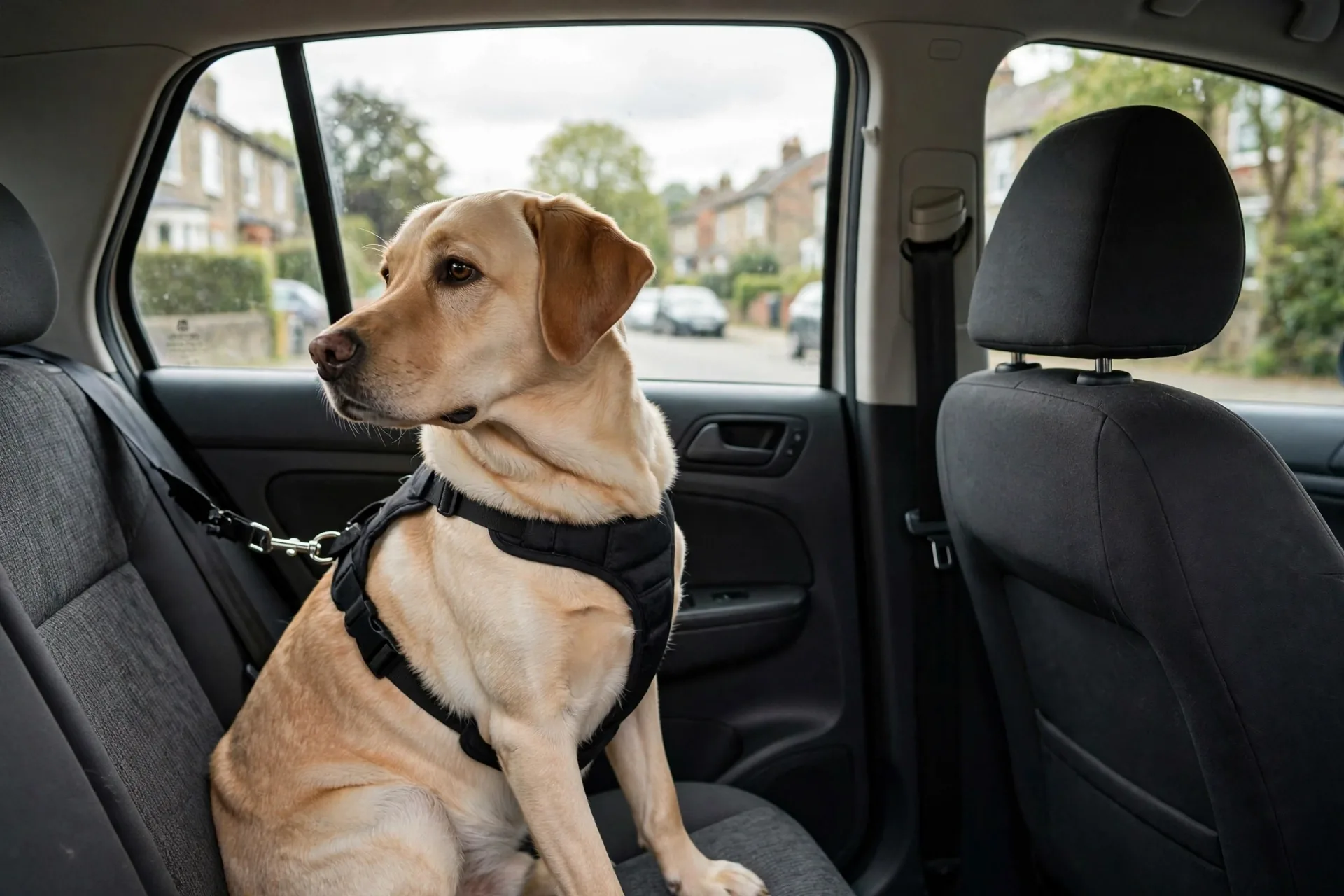
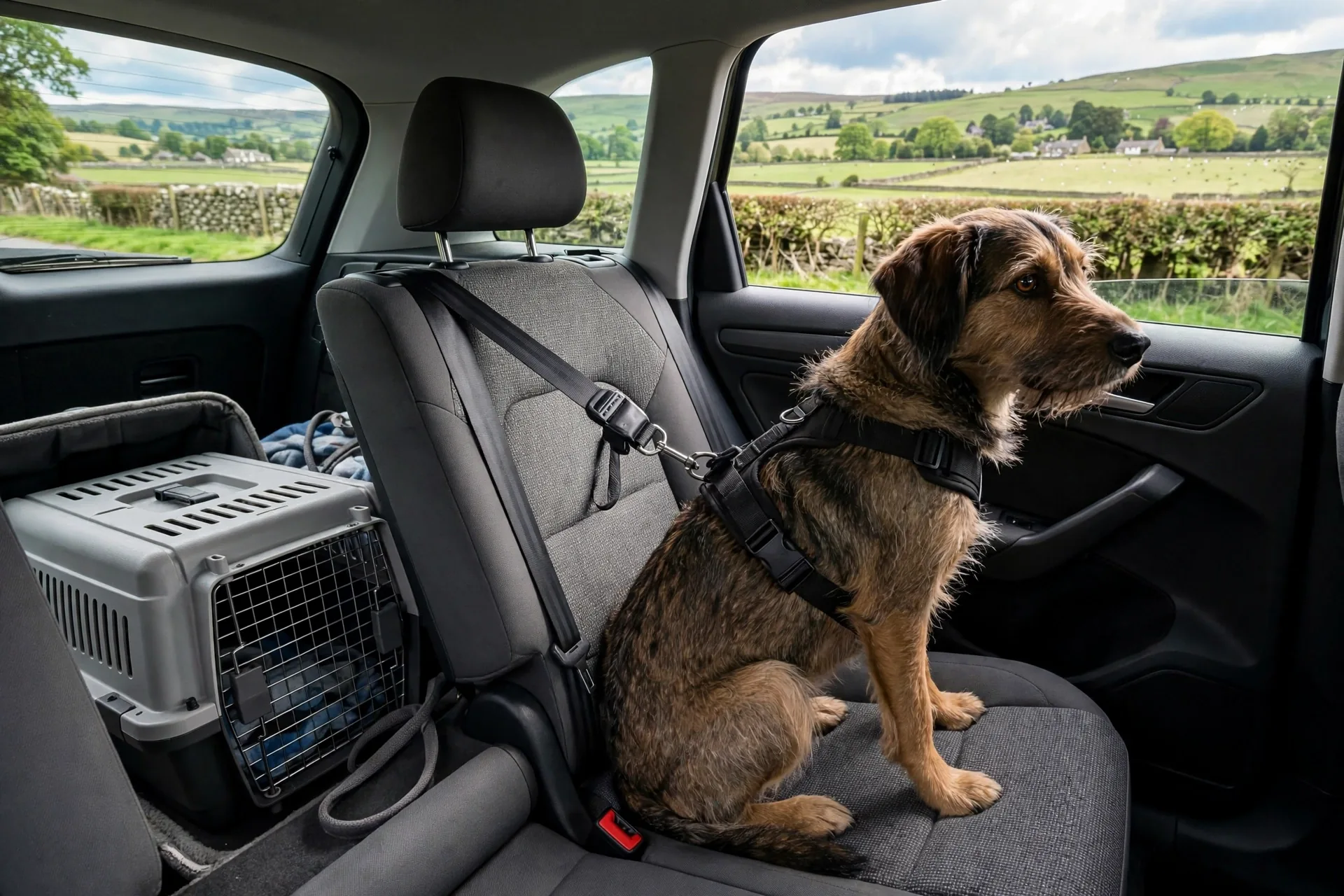
The most common pairing is a crash-tested harness clipped to the car's seat belt, with the dog on a hammock or bench cover. Thread the buckle through the cover's slot before you clip the harness in, and check that the belt webbing runs flat from the buckle to the dog without twisting across the cover fabric. A twisted belt can jam in a sudden stop, and a belt that runs across bunched fabric rather than the harness may not load the harness correctly. Harnesses vary enormously in how they attach and what they claim to withstand, so read our comparison of dog car harnesses and crates before choosing one — the cheapest harness on the marketplace is rarely the one you want between your dog and a 30 mph stop.
The second pairing is a crate in the boot with a boot liner underneath and around it. This is arguably the safest arrangement for most dogs: the crate contains the dog completely, the liner protects the boot from the crate's feet and from mud, and a fitted guard adds a second barrier between the boot and the cabin. Size the crate so the dog can stand, turn and lie down, but not so large that the dog is thrown across it in a stop. Secure the crate itself — an unsecured crate slides in braking and becomes the projectile instead of the dog. Ratchet straps to the boot's tie-down points are the reliable method; bungee cords are not.
The third pairing, for dogs that ride loose in the boot, is a boot liner plus a properly fitted dog guard. This satisfies restraint in the practical sense — the dog cannot reach the driver — though a guard alone does less for the dog in a collision than a harness or crate does. If you use this setup, fit the guard to the manufacturer's instructions for your exact car model rather than relying on pressure-fit universals, which can shift. Whichever pairing you choose, load the dog last and unload the dog first, and never leave the restraint half-done because you are in a hurry: the journeys where you skip it are statistically indistinguishable from all the others until the one time they are not.
Before you click buy: the fit checklist
With the law, the shapes, the fabrics and the measuring understood, the final decision comes down to a short checklist. Run through it against the product page before you order, and you will avoid nearly every common disappointment.
- Slots match your buckles. Count your back-seat buckles and check the cover has a slot or zip for each, in positions that line up with your measurements. Misaligned slots are the number one source of daily irritation.
- Split seats need split zips. If your backrest folds 60/40, the cover needs zips or Velcro splits in the same place, or you will be removing the whole cover every time you fold a seat.
- Non-slip backing suits your upholstery. Leather and vinyl need the grippiest silicone-dot or rubberised backing; cloth seats are more forgiving. Read reviews specifically from owners of your car model.
- Strap length fits your headrests. Tall SUV and MPV headrests defeat short-strapped budget hammocks. Check the strap specification, not just the cover dimensions.
- Weight and packability. If the cover comes off regularly — for passengers, for cleaning, for a second car — a lighter cover you will actually remove beats a heavier one you leave to rot in place.
- Warranty and returns. A two-year warranty signals a manufacturer that expects its stitching to last. And order from somewhere with free returns: the honest test is fitting it in your car, which no product photo can replicate.
- Colour with intent. Dark colours hide mud but absorb heat in summer; light colours show every paw print but stay cooler. For year-round British use, mid-tone grey or tan is the pragmatic compromise.
Price is the last filter, not the first. The difference between a £25 cover and a £45 cover is usually the membrane (PVC versus TPU), the stitching density and the strap hardware — exactly the things that determine whether it survives daily use. Buy the cheapest cover that passes the whole checklist rather than the cheapest cover on the page. Fitted well, kept clean and paired with a proper harness or crate, a good seat cover will outlast the car seat it protects and keep every journey compliant with the rule that started this guide. If anything in this guide conflicts with your car's handbook or your insurer's wording, follow those documents — and check the official guidance before you travel.
Practical questions
Before you buy
Does a dog seat cover count as restraint under Rule 57?
No. A seat cover is upholstery protection, not restraint. Rule 57 requires your dog to be suitably restrained so it cannot distract you or be injured if you stop quickly. Use the cover together with a proper restraint: a crash-tested harness clipped to a seat belt, a secured crate, or a boot with a fitted guard. A dog roaming loose on top of a seat cover is still an unrestrained dog in the eyes of the law and of most insurers.
Hammock or bench seat cover: which is better for a dog?
A hammock suits most dogs because it bridges the footwell, giving a larger flat area and stopping the dog sliding off the seat under braking. A bench cover suits passengers who share the back seat, or cars where the front headrests are hard to reach for hammock straps. If your dog travels alone on the back seat, choose the hammock; if a human regularly rides back there with the dog, choose a bench cover with seat-belt slots.
How do I measure my back seat for a dog cover?
Measure the seat base width from door panel to door panel, the base depth from the front edge to where the backrest starts, and the backrest height. Note whether the backrest splits 60/40 and where the seat-belt buckles sit, because the cover's slots must line up with them. Typical UK family-car back seats are 130-150 cm wide; compare your three numbers against the product's listed dimensions before ordering, and keep the tape measure in the car until the cover is fitted.
Will a waterproof dog seat cover make my dog sweat?
Cheap PVC-backed covers can, because they trap heat and moisture against the dog. Covers with a TPU membrane or a quilted cotton-polyester top layer breathe noticeably better while still resisting water. For summer travel, look for mesh ventilation panels and lighter colours, keep the cover's quilt thin, and never leave a dog in a parked car in warm weather, covered seat or not.
Can I use a seat cover together with a dog car harness?
Yes, and you should. Thread the seat-belt buckle through the cover's designated slot before clipping it to the harness, so the strap runs freely and the harness sits flat on the dog. Check that the slot position matches your car's buckle location on the first fitting; a misaligned slot pulls the belt across the cover instead of the dog. For harnesses that attach to the car's own belt, see our guide to driving with a dog under UK law.
How often should I wash a dog car seat cover?
Vacuum or shake it out after every muddy walk, wipe the waterproof face after wet trips, and machine-wash at 30 degrees roughly every four to eight weeks of regular use, or immediately after a fox-poo incident or a bout of car sickness. Skip fabric softener and tumble drying, which damage waterproof coatings, and re-proof the surface with a spray-on treatment once or twice a year if water stops beading.