This guide is independent and contains no paid placement. If affiliate links are added later, they will be clearly marked and will not change our editorial checks.
Assume pet dogs are not allowed in the auditorium unless the theatre says otherwise for that exact show. Book a dog-friendly or relaxed performance that explicitly includes dogs, choose an aisle seat near an exit, and leave at once if the dog cannot settle.
The default rule, and why it exists
The default position in British theatres is straightforward: assistance dogs are welcome, pet dogs are not admitted to the auditorium. That is not a single law about theatres, but the practical result of several things coming together: theatres are licensed venues with safety rules about aisles and exits, performers need a quiet auditorium, audiences pay for an uninterrupted show, and a dog in a dark, crowded, noisy room is a safety and welfare question as well as an etiquette one. A theatre that allows pet dogs in its bar or cafe is therefore not being inconsistent when it keeps the auditorium pet-free; it is applying different rules to different spaces, exactly as galleries do.
Understanding why the rule exists helps owners plan better. A theatre auditorium is dark, the sound is amplified, the audience sits shoulder to shoulder, and the aisles must stay clear for evacuation. A dog that barks, moves, or needs the toilet cannot be dealt with discreetly in the middle of a row, and a dog that panics at a sudden sound effect, a gunshot on stage or a lighting change can be genuinely distressed. Theatres also have to consider allergies, phobias and the experience of the rest of the audience, who have paid for a performance, not for a dog's first theatre lesson. None of this means dogs can never enjoy theatre; it means the exceptions need to be deliberate, advertised and prepared for.
The practical step is to check the official guidance before you travel for the specific theatre and the specific performance. A theatre's general visitor page may say "assistance dogs welcome" without mentioning pet dogs at all, which usually means pet dogs are not admitted to shows. A special event page, on the other hand, may explicitly advertise a dog-friendly performance, with its own booking conditions. Read the event page, not just the venue page, and if the wording is unclear, contact the box office. A short question about pet dogs for that date, that show and that seating area will give you a reliable answer, and the reply is worth keeping for the night itself.
Relaxed performances explained properly
Relaxed performances are widely misunderstood by dog owners, so they deserve a careful explanation. A relaxed performance is a show adapted for audience members who benefit from a more informal atmosphere: people with autism, learning disabilities, sensory sensitivities or other needs that make a conventional theatre visit difficult. The adaptations typically include house lights left up at a low level, sound and lighting effects softened, a relaxed attitude to noise and movement, and the freedom to leave and re-enter the auditorium. The audience is told in advance that noise and movement are expected, which removes the pressure to sit perfectly still and silent.
Crucially, a relaxed performance is not automatically a dog-friendly performance. The relaxation is about human audience behaviour, not about admitting pet dogs, and most relaxed performances still admit only assistance dogs in the auditorium. A dog owner who books a relaxed performance assuming dogs are welcome may be refused entry or asked to leave, through no fault of the theatre. The only relaxed performances that suit pet dogs are those that explicitly say so, and they are a subset of relaxed shows, not the whole category. Check the event listing for the words "dogs welcome" or a specific dog policy, and do not infer it from the word "relaxed" alone.
When a relaxed performance does welcome dogs, it can be an excellent first theatre experience. The lights-up atmosphere means the dog is less startled by darkness, the softer sound is kinder to sensitive ears, and the audience's tolerance for movement means a dog that shifts position or sighs loudly is less of a disruption. Even then, the usual rules apply: a short lead, an aisle seat, a mat, water for the interval, and a willingness to leave if the dog cannot settle. A relaxed audience is forgiving, not indifferent, and a dog that barks through a whole act will still spoil the show for the people around it.
Special dog-friendly shows
A small but growing number of theatres, touring companies and festivals run shows specifically for dogs and their owners. These may be advertised as dog-friendly performances, dog matinees, or shows with a canine theme, and they differ from ordinary shows in several practical ways: the audience expects dogs, the seating may be arranged with extra floor space, the show length may be shorter, and staff will have a plan for dogs that need a break. Some are full productions adapted for a dog audience; others are shorter, informal events built around dogs from the start. Either way, the key feature is that dogs are expected, not merely tolerated.
Finding these shows takes active searching, because they are not part of every theatre's regular programme. Check theatre listings for dog-friendly or relaxed performances, look at festival programmes, and search for the theatre's own news or access pages rather than relying on a general listing site. Book early when you find one, because dog-friendly shows often sell out quickly and the best seats, meaning aisle seats near exits, go first. Confirm the conditions at booking: is there a limit on dog size or number per owner, must dogs stay on a lead, is there a designated dog area, and what happens if a dog is disruptive? A show that answers those questions clearly is a show that has thought about dogs properly.
Treat a special dog show as a trial, not a test. Choose a shorter show for a first visit, arrive early so the dog can settle before the house fills, and have a low bar for success: a dog that lies quietly for most of a short show and leaves happily has had a good theatre experience, even if you missed the last ten minutes. If the show is long, loud or crowded, consider whether it suits your particular dog at all. A young, confident, well-socialised dog may love a dog-friendly matinee; an older, noise-sensitive dog may prefer an outdoor show or no show at all. The right show for your dog matters more than the most famous show in the listings.
Assistance dogs in the auditorium
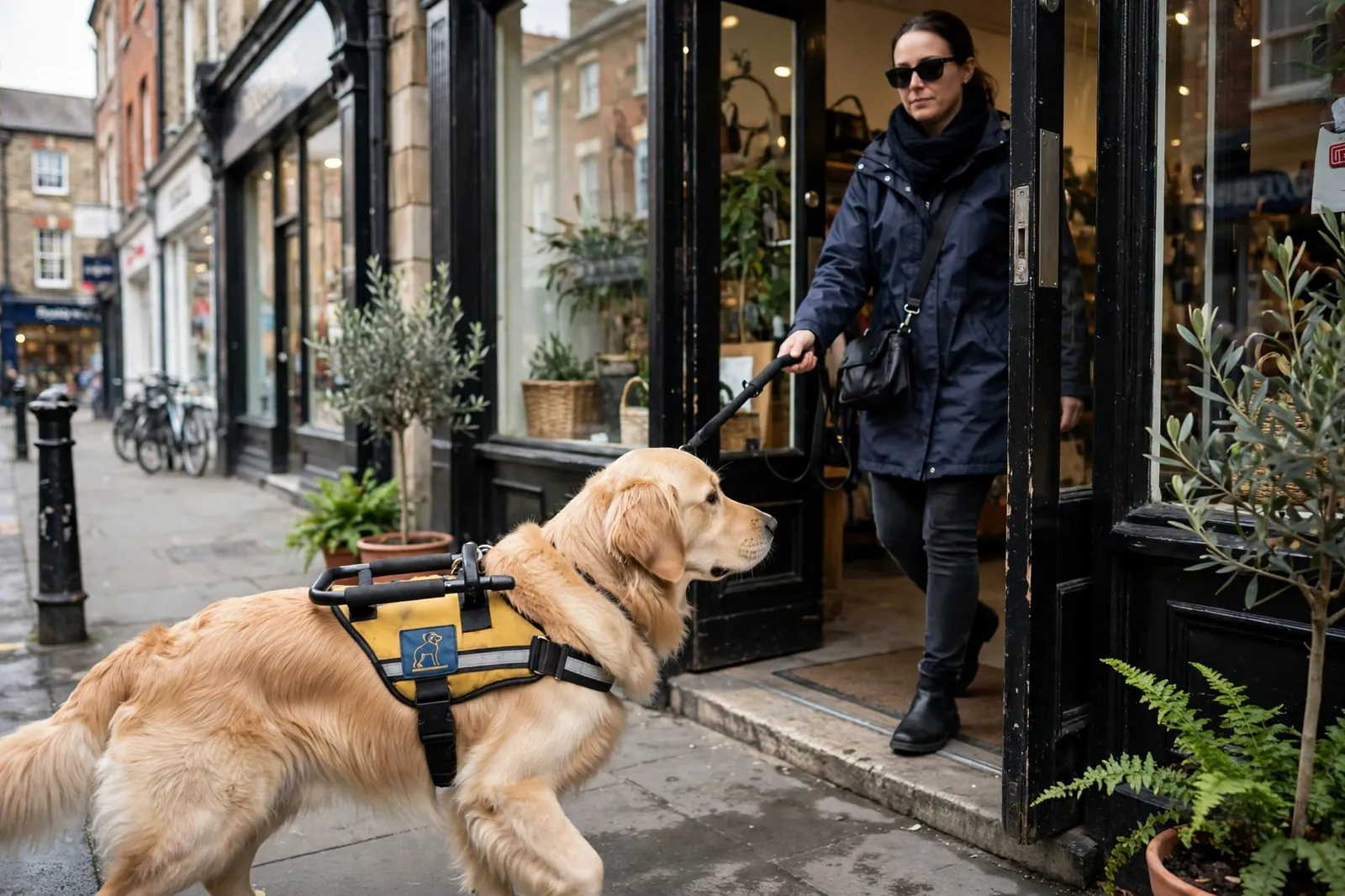
Assistance dogs occupy a different position from pet dogs in theatres, and handlers should know it clearly. An assistance dog has access rights in Britain, and a theatre should welcome the dog in the auditorium, usually with a space beside the handler's seat or in a designated area. The theatre may offer a choice: the dog can lie beside the handler, or, if the handler prefers, the dog can wait in a staffed area during the performance. That choice belongs to the handler, not the venue, and a handler should not be pressured into separating from their dog. Our guide to assistance dog access rights in the UK explains the full position, including taxis, housing and what to do if access is refused.
Practical preparation still helps. Contact the theatre's access team or box office in advance, explain that you will be attending with an assistance dog, and ask about seating, floor space, aisle width and the nearest exit. Some theatres can reserve a box or an end-of-row seat with extra space, and some can arrange for staff to show you to your seat before the house fills, which avoids navigating a crowded auditorium in the dark. Ask about the interval too: where can the dog toilet, is there a relief area nearby, and how much time will you have? A theatre that answers these questions well is a theatre that welcomes assistance dogs in practice, not just in policy.
Other audience members sometimes misunderstand assistance dogs in theatres, especially when a dog lies quietly through a show that does not admit pet dogs. Handlers owe no explanation to other audience members, and theatre staff should handle any questions. Pet dog owners, for their part, should not use the presence of an assistance dog as an argument for admitting their own dog, and should never present a pet as an assistance dog. The access rights of assistance dog handlers are hard won and essential, and they are weakened every time someone misuses them.
Choosing seats with a dog
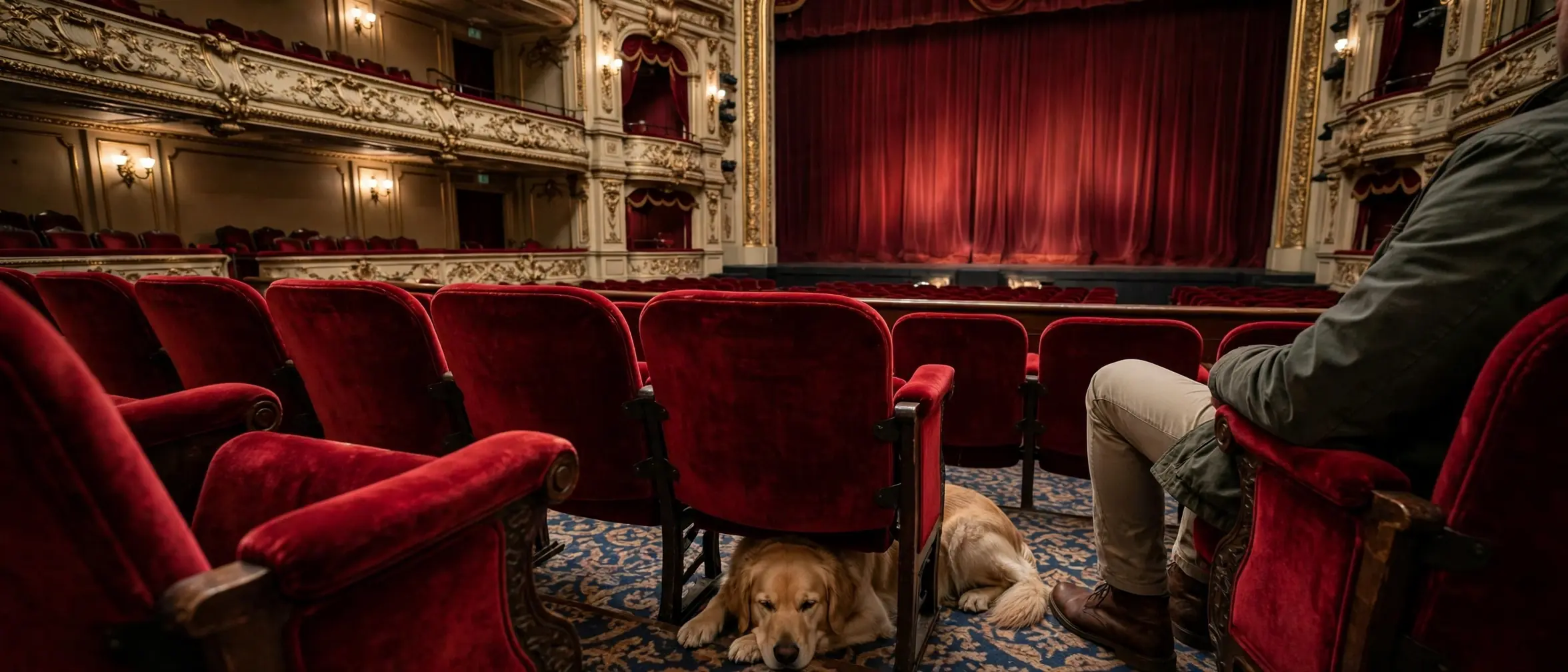
Seat choice can make or break a theatre visit with a dog, and the best seat is rarely the best seat for a human alone. An aisle seat near an exit is almost always the right choice: it gives the dog floor space without blocking neighbours, it lets you leave quickly if the dog needs a break, and it means you disturb fewer people when you move. A seat in the middle of a long row, however good the view, traps both of you, and every exit becomes a disruption. A box seat can work well if it offers floor space and privacy, but check whether the box has a low wall the dog could see over or a gap a small dog could slip through.
Avoid seats near loudspeakers, under balconies where sound concentrates, or in the front row if the dog reacts to movement, costumes or sudden entrances on stage. A dog that watches the stage intently may be fine in the stalls, but a dog that lunges at movement will be better further back, where the stage is less immediate. Consider the dog's hearing too: amplified sound, live music and sound effects can be loud even for humans, and a dog's hearing is more sensitive. A seat further from the speakers, or a show with a smaller band, may be kinder than the closest seat to the stage.
Book by phone or through the access team when seat choice matters, rather than relying on an online seat map that cannot show floor space, aisle width or speaker positions. Explain that you are attending with a dog, ask which seats have the most floor space and the easiest exit, and confirm whether an extra seat for the dog is needed or whether the dog lies on the floor. Some venues charge for a dog seat, some do not, and some allocate a specific dog space; the only way to know is to ask. A few minutes on the phone before booking saves a stressful evening in the wrong row.
Before the curtain goes up
The hour before a show matters as much as the show itself. Walk the dog properly, give them a toilet break, and let them settle before you enter the theatre, rather than arriving straight from a car journey. A dog that has walked, toileted and sniffed the streets around the theatre will sit more calmly than a dog that has been cooped up all day. Arrive early, use the foyer to let the dog take in the building, and take your seats before the house fills, so the dog is settled when the lights go down rather than being jostled by latecomers in the dark.
Prepare the dog's space before the show starts. Lay a familiar mat on the floor, offer water in the foyer rather than in the auditorium, and settle the dog in a down position with the lead short but not tight. Bring a quiet chew or a stuffed toy only if the theatre allows it and the dog can enjoy it silently; a squeaky toy, a crinkly wrapper or a bone that needs gnawing loudly has no place in an auditorium. Turn your phone to silent, not just vibrate, and keep the lead in your hand throughout, even when the dog appears asleep. A sleeping dog can wake suddenly at a sound effect, and a loose lead in the dark is a trip hazard.
Talk to the ushers. Tell them you are attending with a dog, ask where the nearest exit is, and confirm whether you can leave and re-enter if the dog needs a break. Ushers who know about the dog can help you find the best route out, hold a door, or advise on the interval timing. That conversation also means staff are not surprised if you leave mid-show, and it signals that you are a responsible owner rather than someone who smuggled a dog into a theatre. A good theatre visit is a partnership between owner, dog and venue staff, and it starts before the curtain.
The interval is part of the plan
The interval is not a break from planning; it is the most important practical moment of the evening. Use it to take the dog outside for a toilet break, offer water, and let them stretch and sniff before the second half. Do not spend the whole interval in the bar while the dog waits under a table, and do not assume the dog will happily hold on for another hour because the first half went well. A dog that toilets, drinks and moves during the interval returns to its seat settled; a dog that has waited two hours without a break is far more likely to whine, fidget or bark in the second half.
Plan the interval route in advance. Know where the nearest exit is, where the nearest green space or quiet street is, and how long the walk there and back takes. Some theatres are in busy city centres with no green space nearby, so a short pavement walk with a toilet opportunity may be the best available option. Take poo bags, a torch if it is dark, and a lead you can manage in a crowd. If the interval is short, prioritise the toilet break over a drink in the bar; the bar will still be there after the show, but a dog that needs to toilet cannot wait politely.
Use the interval to reassess honestly. Is the dog calm, settled and happy to return, or restless, panting or distressed? If the dog is struggling, it is kinder and more respectful to leave after the interval than to endure a second half hoping things improve. Leaving at the interval is not a failed evening; it is a responsible decision that protects the dog, the audience and the performers. You can always try a shorter show, a relaxed performance or an outdoor theatre another time, with the knowledge of what worked and what did not.
If the dog barks, whines or panics
Every dog owner attending a theatre should have a barking plan agreed before the show, because deciding what to do in the moment, in the dark, with an audience around you, is far harder than deciding in advance. The plan is simple: at the first bark, whine or sign of panic, leave the auditorium calmly and immediately, by the nearest exit, without waiting to see if it stops. Do not shush the dog repeatedly, do not offer treats to buy silence, and do not wait for an usher to intervene. A prompt exit respects the audience and the performers, and it gives the dog the space it needs to calm down.
Once outside the auditorium, settle the dog in the foyer, a corridor or outside, offer water, and let them decompress. Do not scold the dog: barking in a theatre is usually fear, excitement or a need to toilet, not disobedience, and punishment in a stressful moment makes the next visit worse. Assess calmly whether the dog can return. If the dog settles quickly, the cause was clear and the show allows re-entry, a return may be fine. If the dog remains agitated, is panting heavily, or has barked more than once, the kindest decision is to leave for the night. A theatre visit that ends early is still a useful experience; it tells you what to practise before the next one.
Prevention is better than any exit plan. Choose a show length, sound level and audience size that suits your dog, practise settling on a mat in busy, noisy places before the theatre, and build up from short, quiet events to longer shows. If your dog has never settled in a crowded indoor space, a theatre is not the place to start. A pub garden, a quiet cafe or a community hall event, covered in our guide to dogs in pub gardens in the UK, offers the same settling practice with far less pressure. The theatre will still be there when the dog is ready, and a dog that arrives ready is a dog that enjoys the show.
Outdoor theatre and pantomime
Outdoor theatre is often the best theatre option for dogs, because it removes several indoor problems at once. There is more space, more air, easier exits, and a generally more informal atmosphere, and many open-air venues welcome dogs on a lead in the audience area. The trade-offs are weather, ground conditions and other animals: a dog that lies happily on a rug in a garden theatre may struggle with rain, cold ground or a long evening outdoors. Bring a waterproof mat, a blanket for the dog, water, and a torch for the walk back, and check the official guidance before you travel for the venue's dog policy, since outdoor does not automatically mean dog-friendly.
Pantomime sits at the other extreme. It is loud, interactive, full of shouting, music and audience participation, and it is aimed at children who may rush to greet a dog or shriek with excitement. For most dogs, a traditional pantomime is a poor first theatre experience, however much the owner loves it. If a pantomime is specifically advertised as dog-friendly or relaxed, it may work for a confident, noise-proof dog, but a nervous, young or older dog will usually be happier with a walk and a pub visit while the family enjoys the show. Choosing not to take a dog to a pantomime is not missing out; it is matching the event to the dog.
Whatever the show, the final principle is the same: the dog's welfare comes before completing the performance. A theatre visit is a treat, not an obligation, and a dog that stays home with a sitter, a family member or a trusted boarder while you enjoy a show is not a dog that has missed out. For a longer trip, our guide to dog-friendly holiday parks in the UK covers the same balance between shared experiences and the dog's own comfort. The best theatre memory with a dog is a calm one, however short, and the best way to guarantee it is to choose the right show, the right seat, and the right moment to leave.
Practical questions
Before you go
Can pet dogs attend a normal theatre show in the UK?
Usually not. Most theatres allow only assistance dogs in the auditorium, while pet dogs may be welcome in the bar or cafe. A small number of venues run special dog-friendly shows, so check the official guidance before you travel for the specific theatre and performance.
What is a relaxed performance?
A relaxed performance is a show adapted for audiences who benefit from a more informal atmosphere, with house lights left up, sound levels adjusted, and freedom to move or make noise. It is not automatically a dog-friendly show, so check whether dogs are included in that performance's policy.
Can assistance dogs go into a theatre auditorium?
Yes, assistance dogs have access rights in Britain and should be welcome in the auditorium, often with a designated space beside the handler. Contact the theatre in advance to confirm seating, and see our assistance dog guide for the full position on access rights.
What should I do if my dog barks during a show?
Leave the auditorium calmly at once, settle the dog in the foyer or outside, and return only if the dog is fully calm and the show allows re-entry. Do not wait for an usher to ask you to leave, and do not try to train through barking during a live performance.
Which seats are best with a dog in a theatre?
An aisle seat near an exit is usually best, because it gives the dog floor space, a quick exit, and less disturbance to neighbours. Avoid the middle of a long row, seats near loudspeakers, and the front row if the dog reacts to movement on stage.
Can I leave my dog in the theatre bar during a show?
No, unless the theatre explicitly offers a supervised dog-sitting or kennel arrangement, which is rare. Do not leave a dog tied up in a foyer, bar or cloakroom during a performance, and do not leave a dog in a car while you watch a show.