This guide is independent and contains no paid placement. If affiliate links are added later, they will be clearly marked and will not change our editorial checks.
National Rail allows passengers to take up to two animals without an extra charge. Dogs should be on a lead or in a carrier, animals cannot use seats, and staff can ask you to remove an animal that causes a nuisance. Individual operators and sleeper services may add their own conditions, so check before you book.
Know the national baseline
The starting point for every dog train journey in Britain is the National Rail guidance, and it is refreshingly simple. Passengers may take up to two pets free of charge — there is no dog ticket to buy and no reservation to make for the animal. Dogs must be kept on a lead or in a suitable carrier at stations and on trains. Other small animals should travel in a rigid, closed carrier with room to stand and lie down. Animals are not allowed on seats, in either Standard or First Class, and staff can require an animal to be removed if it causes a nuisance or inconvenience to other passengers. That last clause is the one that matters most: the rules give you access, and your dog’s behaviour decides whether you keep it.
Treat this as the baseline, not the whole picture. The National Rail Conditions of Travel set the framework, but individual train operators publish their own pet policies, and those can add conditions around carriers, peak services or specific routes. Rules also change — the sources at the end of this guide were checked in October 2026, and you should re-check them close to travel rather than relying on memory or on this page. If you are planning a car-free weekend break, the train rules are only half the plan; the other half is the journey design below.
Operators can add their own conditions
Once you know your route, check the specific operator’s pet policy — it takes five minutes and prevents the worst kind of surprise, the one delivered on a platform. Most long-distance and regional operators follow the national baseline closely, but policies differ on details: some ask that dogs travel in a carrier on certain services, some restrict animals during the busiest peak trains, and the rules for assistance dogs are separate and more generous everywhere. Open-access operators and the two sleeper services have their own terms entirely, and international rail services — Eurostar and beyond — are a different regime in which pet rules vary by route and must be confirmed directly.
What to look for on the operator’s page: confirmation of the two-animal allowance, any carrier requirements, peak-time restrictions, and a contact method if your situation is unusual — a very large dog, more than two animals, or a dog that needs space for medical reasons. Screenshot or save the policy page. If a member of staff questions you on the day, a calm “the policy says this” backed by the saved page resolves most encounters. If you cannot find a written policy, call or message the operator before booking; absence of a page is not the same as permission.
Tickets, reservations and the cost for dogs
The dog travels free, but your ticket strategy still matters. Where seat reservations exist, reserve one for yourself: a reserved seat is a fixed, defensible patch of floor space where the dog can settle, instead of a roving search through a busy train. Advance tickets are cheapest but lock you to a specific train — fine for a bombproof traveller, risky if your dog might need you to bail out and take a later service. Off-Peak and flexible tickets cost more but buy the freedom to wait for a quieter train, which for many dogs is worth more than the saving.
If you are travelling as a group with several dogs, remember the allowance is per passenger, not per booking: two passengers can bring up to four animals between them. Large groups with dogs should also think about seating — a table of four gives the dogs a contained footprint, while scattered airline seats across a busy carriage multiply the management. There is no official “dog carriage” on UK trains, so your reservation choices are doing quiet work on your dog’s behalf.
Design the route around changes
A direct train is often worth a later departure, a longer journey or a slightly higher fare. Every change is a new platform, a new crowd, a new set of doors and stairs, and a window in which something can go wrong — a delayed incoming train, a lift outage, a dog that has decided it has had enough. If a change is unavoidable, build in generous time: enough to find a quiet position on the platform, to let a nervous dog decompress, and to use a toilet spot outside the station where practical. Twenty minutes between trains is a connection; forty minutes with a dog is a connection you might actually enjoy.
Study the interchange before the day. Which platform do you arrive on, which do you leave from, and is it a same-platform change or a trek via subway and stairs? Station information pages usually show step-free routes — check them in advance for an older or stiff dog, but keep a stair alternative in mind because lift outages happen. Where two routes exist, the one with the simpler station often beats the one with the faster headline time. A calm forty-minute change at a small staffed station beats a frantic twelve-minute dash across a major terminus.
Work the stations, not just the train
Stations are where dog train journeys are won or lost. Arrive with time to spare so nothing is rushed: a hurried owner transmits urgency straight down the lead. On arrival, find the quiet end of the platform — away from the entrance, the coffee queue and the departure boards where crowds bunch. Keep the dog close and out of the platform edge zone; a fixed-length lead, short but not tight, is easier to manage than a retractable line that can spool across a busy platform. Retractable leads have no place on stations: they tangle, they trip, and they let a dog reach exactly the places you do not want it.
Scout the practicalities in advance. Where are the lifts, and what is the stair alternative? Is there a patch of green or a quiet side street outside for a toilet stop before boarding? Is the station staffed at your travel time — useful if you need help, a quieter waiting area or information during disruption? Waiting rooms are a mixed blessing: warm and calm off-peak, crowded and tense at busy times. Know where they are and decide on the day. For the return journey, apply the same routine in reverse; dogs settle faster when the station ritual is identical both ways.
Travel when the train has breathing room
Avoid peak commuter services and event traffic when you can. A half-empty mid-morning train is a different experience from a standing-room-only 8:15 — for the dog, the difference is between a quiet corner and a forest of legs, bags and elbows. If you must travel at a busy time, choose your position deliberately: the end of the carriage, a seat with the dog against the wall and out of the aisle, well away from the doors where the churn of boarding and alighting never stops. Never put the dog on the seat, even on a blanket — it is against the rules, and other passengers will notice.
Consider direction and formation too. On many routes, travelling against the main commuter flow buys you space for free. Shorter trains and single-carriage services can actually be easier than long ones, because there are fewer doors and less through-traffic. Friday evenings and Sunday afternoons are leisure-travel peaks; a Saturday morning or a weekday off-peak service is usually calmer. None of this requires heroic planning — it is mostly a matter of looking at the timetable and choosing the train with air in it.
On board: positioning and etiquette
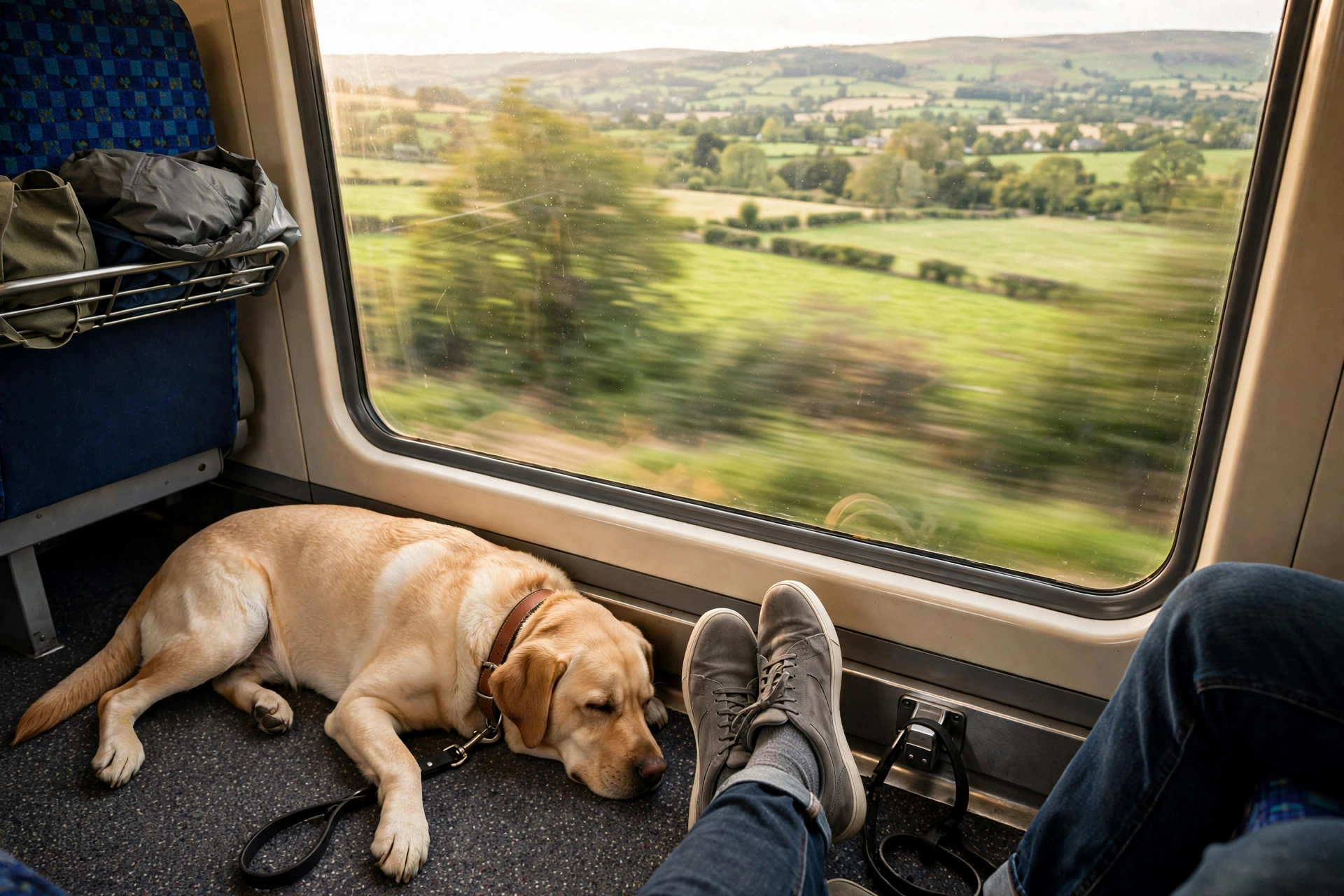
Once aboard, your job is to make the dog small, boring and invisible. Settle the dog on its mat at your feet, against the wall or under the table, clear of the aisle and the doors. The vestibule areas by the doors look spacious but are the worst seats in the house: every stop brings a wave of feet, luggage and other dogs. A window seat in the middle of the carriage, dog tucked on the floor between your feet and the wall, is the gold standard. Keep the lead short and under control without tension — a tight lead tells the dog there is something to worry about.
Etiquette extends beyond your seat. Not everyone loves dogs, and some people are allergic or afraid; the rules give you the right to be there, and courtesy keeps it. Discourage approaches to other passengers, manage greetings with other dogs firmly — a train aisle is no place for canine introductions — and clean up anything your dog produces, immediately and without fuss. If your dog cannot settle after a reasonable time, consider moving to a quieter carriage or, at the next staffed station, stepping off to regroup. Pushing a distressed dog through two more hours rarely ends well.
Carry a small, boring kit
Pack for the journey, not the destination. The essentials: water and a foldable bowl, waste bags, an absorbent towel for wet platforms and muddy paws, the familiar mat the dog settles on, and a few quiet treats for rewarding calm behaviour. Skip squeaky toys, oversized bedding and anything that expands your footprint into shared space. A fixed-length lead is the right lead for the whole journey; add a spare in the bag in case of a clip failure. If your dog wears a harness, a clearly visible one helps staff and fellow passengers read the situation at a glance.
The unglamorous items matter most. Write the route, the operator’s help number and your change details on paper or in a note on your phone’s lock screen — if your phone dies or loses signal, a dead battery should not strand you. Carry any medication the dog needs with the dosing instructions. And pack a little patience in the form of time: a buffer at each end of the journey turns a delay from a crisis into an anecdote.
Rehearse before a long journey
A three-hour journey should not be your dog’s first train. Build up: a short hop to the next station and back, then a thirty-minute ride, then an hour with a change. Each rehearsal teaches the dog the same lesson — stations are noisy but nothing happens, trains move but the mat stays put, and you stay calm throughout. Visit a station without travelling: stand on a platform, let trains come and go, reward disinterest. The air brakes, the announcements, the slamming doors — all of it is learnable in small doses.
Rehearsal also teaches you. You will discover whether your dog prefers the window side, whether the announcements trigger alert barking, how quickly the dog needs a toilet stop, and whether your bag setup actually works one-handed while holding a lead. Better to learn that the treat pouch opens too slowly on a twenty-minute local train than on the 10:04 to the far end of the country. Dogs that have rehearsed travel visibly differently: they board, circle once, and lie down. That is the whole goal.
Have a missed-connection plan
Disruption is a when, not an if. Before you travel, know which later services your ticket allows you to take and where you could step outside safely at each change. If the dog becomes distressed mid-journey, getting off at a staffed station and regrouping is kinder — and often faster in the end — than white-knuckling through. Staffed stations have waiting areas, toilets, outside space and, crucially, staff who can tell you what is actually happening with your delayed connection.
Keep the operator’s assistance number and the National Rail disruption information to hand. If you are delayed significantly, you may be entitled to compensation under Delay Repay — the dog does not get a payout, but the principle stands. For the truly stranded scenario — last train cancelled, dog exhausted — know your fallback: a dog-friendly taxi number for the area, or a nearby town where you could overnight. It will almost certainly never happen. Having the plan means you will travel like it never will.
Long journeys, sleepers and international services
Day trains cover most British dog travel, but the edges need separate checking. Sleeper services have their own pet terms — cabins are small, shared and bookable well in advance, so contact the operator before you book rather than assuming the daytime rules carry over. International rail services are stricter still: Eurostar’s pet policy differs from National Rail’s, and journeys beyond require checking each operator and, for some routes, the pet travel documentation rules for crossing borders. None of this is prohibitive; it just cannot be improvised at the barrier.
For very long day journeys — four hours and beyond — break the trip if you can. A planned stop in a dog-friendly town, with a proper walk and a toilet break on grass, divides one long ordeal into two manageable rides and gives you both something to look forward to. It also builds slack into the day: a missed connection after a break is an inconvenience, not a disaster. The fastest itinerary is not always the kindest one, and with a dog, kind itineraries arrive more reliably.
Practical questions
Before you go
Do dogs travel free on UK trains?
Yes — National Rail currently allows up to two pets per passenger at no extra charge. More animals may attract a fee, and individual operators can add their own conditions, so confirm before booking.
Can my dog sit on a train seat?
No. National Rail states that animals are not allowed on seats in Standard or First Class, even on a blanket. Keep the dog on the floor on its mat, out of the aisle.
Must a dog travel in a carrier?
A dog may travel on a lead or in a suitable carrier. Other small animals should stay in a rigid, closed carrier with room to stand and lie down. Some operators add carrier conditions on specific services, so check your operator’s policy.
What happens if my dog barks or bothers other passengers?
Staff can require an animal that causes a nuisance to be removed from the train. Choosing quiet services, settling the dog out of the aisle and intervening early keeps you comfortably inside the rules.
Can I take my dog on a sleeper train or Eurostar?
Not under the standard daytime rules — sleeper services and international routes have separate pet policies that must be confirmed with the operator before booking. Do not assume National Rail’s baseline applies.
Should I book a seat reservation when travelling with a dog?
Where reservations are available, yes. A reserved seat gives you a fixed patch of floor space for the dog to settle, instead of a search through a busy train. Flexible tickets are worth considering too, since they let you wait for a quieter service if needed.