This guide is independent and contains no paid placement. If affiliate links are added later, they will be clearly marked and will not change our editorial checks.
Many UK gondolas and cable cars welcome dogs, but there is no national rule: each operator decides, and the answer can differ between lifts at the same site. Check the official guidance for the exact lift before you travel, arrive with a short lead and a muzzle in your bag, and always have a walking or driving backup plan in case boarding is refused.
A small cabin with big differences
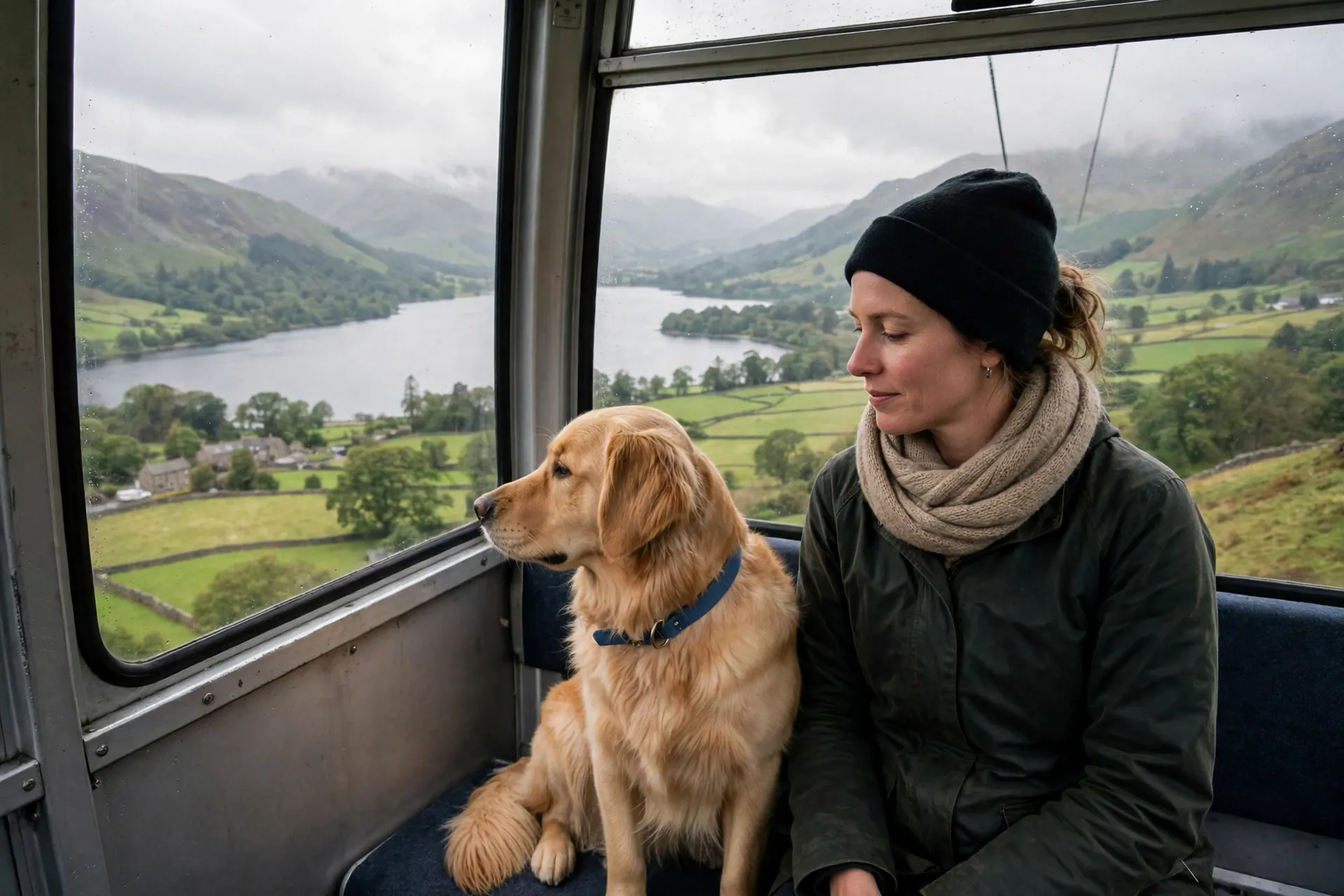
A gondola cabin is unlike any other place a dog travels. It is small, enclosed, and shared with strangers, it moves without the dog being able to see a road or a driver, and the floor can sway gently as the cabin leaves the station and passes over each tower. For a confident dog that has ridden lifts and travelled well, all of this is simply novel. For a nervous dog, a dog that guards space, or a dog that has never left the ground in a glass box, it can be a lot to process in a few minutes.
The other surprise is how much the rules vary. Trains in Britain operate under broadly similar National Rail conditions, so a dog owner can learn one set of expectations and apply it widely; our guide to taking a dog on UK trains explains that shared framework. Cable cars have no equivalent. A mountain gondola run by a ski resort, a seaside cliff lift run by a local council, and a city sightseeing gondola run by a leisure company are three different businesses with three different insurance arrangements, cabin sizes and staffing models. One may welcome dogs free of charge, the next may charge a dog fare, and the third may refuse dogs altogether because its cabins are too small or because its operating licence says so. The attraction's homepage saying "dogs welcome" is not enough: that statement often describes the grounds, the cafe terrace or the lower station, not the lift itself.
That is why this guide is organised around questions to ask rather than a list of promises. Operator policies change with seasons, ownership and safety reviews, and a policy you read last summer may have been revised since. Where a specific operator's rule is uncertain, the safe sentence throughout this guide is the same: check the official guidance before you travel. A two-minute check on the operator's own website, or a short email asking about the exact lift by name, saves a wasted journey and a disappointed dog at the ticket barrier.
It also helps to think about the ride from the dog's point of view before you think about the view. A dog does not understand that the cabin is safe, that the drop is the point, or that the journey ends in ten minutes. What the dog experiences is a confined space, unfamiliar sounds, vibration through the floor, the sensation of height, and strangers sitting close. Dogs that cope well with one or two of those things may still struggle when all of them arrive together. The preparation in this guide therefore works in layers: first choose the right kind of lift, then check the rule, then prepare the dog, and only then buy the ticket.
Three kinds of lift, three kinds of rule
Most UK cable lifts a visitor meets fall into three broad types, and the dog rules track the type closely. Knowing which type you are dealing with tells you which questions matter most.
Sightseeing gondolas are the enclosed cabins most people picture: a small room with windows on all sides, seats around the edge, and room for roughly four to eight people. They are common at visitor attractions, over rivers and harbours, and at hilltop viewpoints. Dogs are most likely to be welcome here, because the cabin is enclosed, the dog can lie on the floor, and staff can control loading. The usual conditions are a short lead, a dog that stays on the floor, and sometimes a muzzle or a dog fare. The main limits are cabin size and crowding: on a busy day, staff may ask you to wait for a quieter cabin, or may limit the number of dogs per cabin to one. If your dog is large, ask whether a whole cabin can be allocated or whether you will share; a large dog lying across a shared cabin floor is a different experience from a small dog tucked under a seat.
Ski lifts and mountain cable cars are a different world. In winter they serve skiers and snowboarders, and dogs are often restricted or refused outright, partly because the lifts are working transport for people carrying equipment, and partly because a dog loose near a ski slope is a safety risk. In summer, many of the same lifts reopen for walkers and sightseers, and the dog rules often relax — but not always, and not automatically. A summer walking ticket does not imply a dog ticket. Mountain lifts also tend to be longer and higher than sightseeing gondolas, with open sections, wind exposure and changes in temperature between valley and summit. A dog that is fine for a five-minute harbour crossing may be much less comfortable on a twenty-minute mountain ascent, especially in heat at the valley station or cold wind at the top. Check the seasonal rule separately from the winter rule, and check whether dogs are allowed on the summit trails as well as on the lift, since the two permissions are often decided independently.
Aerial cabins and open chairlifts form the third group, and here the answer is most often no for dogs, or yes only with strict conditions. Open chairlifts, where passengers sit on a bench with a safety bar and their legs dangling, are generally unsuitable for dogs: there is no floor for the dog to stand on, no barrier to stop a frightened dog jumping, and loading requires the dog to be lifted or held in a way most operators will not risk. A few mountain centres allow small dogs to be carried in a closed bag or held securely, but that is the exception and must be confirmed in writing. Enclosed aerial cabins on longer spans, sometimes called cable cars rather than gondolas, behave more like sightseeing gondolas and are more likely to accept dogs, but they are also more likely to be busy, to run to a fixed timetable, and to have a formal dog fare. The practical distinction is simple: if the dog can lie on a floor inside a closed cabin, the question is about rules and crowding; if the dog would be sitting on an open chair, the question is about safety, and the answer is usually no.
There is also a grey area worth naming: cliff railways and funiculars. These run on rails up a steep slope rather than hanging from a cable, and they are often more dog-friendly than true cable cars because the carriage is larger, the floor is stable, and the journey feels more like a train. Do not assume a cliff railway follows cable-car rules, and do not assume a cable car follows railway rules either. Treat each lift as its own case, named on the operator's website, and check that exact lift.
How to read an operator's dog rule
Operator websites are not always written with dog owners in mind, so a dog rule can hide in several places: the frequently asked questions page, the terms and conditions, the accessibility page, or a single line on the ticket page. Search the site for "dog" and read every hit, because the lift rule and the site rule are often on different pages. If the site says dogs are welcome in the cafe but says nothing about the lift, that silence is not permission.
Five details matter more than the headline yes or no. First, does the rule cover the exact lift you plan to ride, including both directions and any connecting lift at the top? Second, is there a dog fare, and is it charged per dog, per cabin or per return journey? Third, are there conditions such as a muzzle, a short lead, a ban on dogs on seats, or a limit on the number of dogs per cabin? Fourth, are there time restrictions, such as dogs allowed only on off-peak services or not at all during school holidays? Fifth, what counts as an exception: assistance dogs are handled separately under equality law, and a pet dog should never be presented as an assistance dog to get around a refusal.
When the website is unclear, email the operator and keep the reply. A useful message is short: name the lift, the date, the dog's size and temperament in one honest line, and ask four things — are dogs allowed on this lift, is there a fare, must the dog wear a muzzle, and is there a limit per cabin? A written reply is worth more than a remembered phone call at the barrier, because the person at the barrier on the day may not be the person who wrote the policy. If you travel with more than one dog, say so explicitly: a one-dog limit is one of the most common surprises, and it is rarely stated on the homepage.
Also check the rules at the destination, not just on the lift. Some hilltop attractions welcome dogs on the ride but restrict them in the summit building, the restaurant or the gardens at the top. A dog that rides up happily and then cannot enter anywhere at the summit has had a pointless journey, and you will be managing a dog in a busy station area while the rest of the party explores. The same applies in reverse: a summit with excellent dog walks makes a refused ride less painful, because the walking alternative is genuinely good rather than a consolation prize.
Finally, budget honestly. Dog fares, where they exist, are usually modest, but they add up on a return journey for two dogs, and they sit on top of adult fares that can be substantial at mountain attractions. Our guide to dog holiday costs in the UK sets out how transport extras like these fit into a trip budget, and it is worth costing the whole day — parking, lift fares, dog fares and food — before you decide the cable car is the best use of the day's money.
Heights, sway and motion sickness
Not every dog notices height, but many notice something about a gondola. The triggers are rarely the view itself. Dogs do not admire landscapes; they react to movement under their feet, to the change in air pressure and sound as the cabin leaves the station, to the sway as it passes over a tower, and to the sight of the ground dropping away through a glass floor or a low window. A dog that is calm on a high viewpoint behind a railing can still be unsettled in a moving cabin, because the ground is moving relative to the dog rather than the dog moving relative to the ground.
The best preparation is gradual and boring. Start with a glass lift in a shopping centre or a hotel, where the ride is short, the cabin is stable and you can step out immediately. Then try a high viewpoint where the dog can look out from a solid floor, then a short, low cable ride on a quiet day. Reward calm behaviour rather than excitement: a dog that is asked to settle on a mat and given a long-lasting chew or a scatter of treats is learning that the cabin is a place to lie down, not a place to patrol. Keep early sessions short and end them while the dog is still coping, rather than pushing through to a long ride and hoping the dog gets used to it. Flooding a frightened dog with a twenty-minute mountain ascent is the fastest way to create a lasting aversion.
Watch for the early signs of stress rather than waiting for obvious panic. Lip licking, yawning when the dog is not tired, panting that does not match the temperature, a tucked tail, ears pinned back, restlessness or a sudden refusal to take treats are all signals to pause the plan. Shaking, drooling, whining, trying to climb onto you, or scratching at the door are later signs, and a dog showing them should not be taken on a longer ride that day. Some dogs freeze rather than panic, going very still with wide eyes and a stiff body; stillness is not calmness, and a frozen dog deserves the same respect as a barking one.
Motion sickness is a separate problem from fear, although the two often travel together. Dogs that drool, vomit or go quiet in cars are more likely to feel sick in a gondola, because the sway and the visual movement are similar triggers. For a short ride, the usual advice helps: travel with a fairly empty stomach, so feed a small meal several hours before rather than a large meal just before boarding, keep the dog facing forward and as still as possible, and keep the cabin cool. For a long mountain ride, talk to your vet in advance about anti-sickness medication, and test any medication on a short car journey first so you know how the dog responds before you are committed to a cabin. Do not sedate a dog for a cable car ride without veterinary advice: a drowsy dog that cannot balance when the cabin sways is at greater risk, not less.
Some dogs are never going to enjoy a gondola, and that is a legitimate outcome, not a training failure. Dogs with severe height anxiety, vestibular problems, epilepsy triggered by visual motion, or a history of panic in confined spaces are better served by the backup plan than by repeated attempts. A dog that hates cable cars can still have an excellent day: most hilltop and valley attractions have a road, a walking route or a lower viewpoint that offers most of the experience without the cabin. Choosing the alternative early, cheerfully and without guilt is better dog ownership than forcing a ride for the sake of a photograph.
Before you board: the practical checklist
Good cable car days are made the evening before. Confirm the operator's dog rule in writing, check the weather forecast for both the valley and the summit, and look at the timetable: some lifts run continuously, while others run to a fixed schedule with gaps that matter if you miss one. Check whether dogs are allowed on the return journey as well as the outward one, since a few attractions restrict dogs to one direction at busy times, and a dog that rides up but cannot ride down is a serious problem.
Pack for the dog as well as for yourself. The short list is a short lead, a harness the dog is comfortable wearing, a muzzle the dog has been trained to accept, a collapsible water bowl and water, a familiar mat or blanket for the cabin floor, poo bags, and a chew or long-lasting treat for settling. A familiar mat does more work than any other single item: it gives the dog a defined place to lie, a familiar smell, and a surface that does not slide on a smooth cabin floor. If the cabin floor is metal or polished, a non-slip mat is worth its weight. For large dogs, a harness with a handle lets you steady the dog during boarding without hauling on the collar.
Toilet the dog properly before you join the queue, not after you have bought tickets. A dog that needs the toilet during a twenty-minute ride will be miserable, and there is no dignified solution inside a shared cabin. Give the dog a good walk and a chance to settle before the station, so the dog arrives tired enough to lie down but not so tired that it is already stressed. Avoid feeding a large meal immediately before the ride, and avoid an exciting play session right before boarding: a dog that arrives over-aroused will take the whole ride to come down.
Think about the other passengers too. A gondola cabin is shared space, and a dog that barks at strangers, lunges at other dogs, or climbs onto seats will make the ride unpleasant for everyone and may earn a complaint that changes the operator's policy for the next dog owner. If your dog is reactive to other dogs, ask whether you can wait for a cabin to yourselves, travel at a quiet time, or book a private cabin where that option exists. If your dog cannot be calm in a shared cabin even at a quiet time, the honest choice is the walking route. Other passengers include children, people with allergies and people with a fear of dogs; keeping your dog on the floor, on a short lead, and under your control is the basic courtesy that keeps dogs welcome on lifts.
Finally, agree the exit plan before you board. Know where the dog toilets are at the top, where the return station is, what time the last return lift runs, and what you will do if the lift closes for weather while you are at the top. Lifts close for high wind more often than visitors expect, and the walk down is not always dog-friendly: it may be steep, exposed or long. Ask at the station what happens if the lift stops, and do not board a one-way lift with a dog unless you are confident about the walk back.
Boarding step by step
Boarding is the moment most likely to go wrong, because everything happens quickly: a cabin arrives, doors open, people move, and the cabin leaves again within a minute or two. Arrive early enough to watch a few cabins load before your turn. Watching teaches you the rhythm — where the doors open, how fast the cabin moves through the station, whether it slows or stops, and where passengers are expected to stand. It also lets the dog watch cabins come and go from a safe distance, which is valuable desensitisation in itself.
When your turn comes, keep the lead short and the dog close to your leg. Step in first if the layout allows, then invite the dog in after you, so the dog follows you into a space you already occupy rather than being pushed into an unfamiliar box. Guide the dog straight to its mat on the floor, ask for a settle, and reward calm behaviour immediately. If the cabin moves while the dog is still standing, steady the dog gently with the harness handle and keep your own body calm and still; dogs take their cue from their handler, and a handler who is flapping, apologising loudly or hauling on the lead signals that something is wrong.
Sit down promptly and keep the lead short but not tight. A tight lead transmits your tension to the dog and restricts the dog's ability to balance as the cabin sways. Let the dog choose between lying on the mat and sitting where it can see out, but do not let the dog stand at the door, climb onto seats, or press against other passengers. If the dog wants to look out of the window, that is fine as long as it stays settled; if looking out makes the dog more agitated, draw the dog's attention back to the mat with a treat or a chew and block the view with your body.
For the first minute after departure, do nothing except settle. The departure is the most intense part: the cabin accelerates, sways as it leaves the station, and passes over the first tower with a small jolt. Many dogs that are worried at departure settle within a minute once the motion becomes steady. If the dog is still distressed after a couple of minutes, do not panic; keep the dog close, speak quietly, and offer a chew. On a short sightseeing ride you will be at the other end soon. On a long mountain ride, there is no getting off halfway, which is why the gradual preparation and the honest assessment of the dog's temperament matter more than any in-cabin trick.
At the top, reverse the process: wait until the cabin has fully stopped and the doors are open, then step out first and invite the dog after you. Do not let the dog bolt out of the door into a busy station. Give the dog a moment to stand on solid ground, offer water, and let the dog toilet before you set off to explore. A dog that has held itself together for a long ride deserves a calm arrival, not an immediate march into a crowded summit attraction.
Inside the cabin
Once the ride is under way, your job is simple: keep the dog settled, keep other passengers comfortable, and keep an eye on the dog's body language. Small habits make the difference. Keep the dog on the floor rather than on a seat, even if the dog usually sits on furniture at home; seats in a gondola are for people, and a dog on a seat is harder to control if the cabin sways. Keep the lead short enough that the dog cannot reach another passenger's legs or another dog, but loose enough that the dog can shift its balance. If another dog is in the cabin, create space between the dogs with your body and your mat, and do not let them greet nose to nose in a confined space where neither can retreat.
Temperature and ventilation deserve attention. Enclosed cabins in summer sun become greenhouses quickly, and a dog in a fur coat overheats faster than its owner. Carry water, watch for heavy panting that does not settle, and if the cabin has an opening window or vent, use it. In winter the reverse applies: a mountain summit can be much colder and windier than the valley, so a short-coated or older dog may need a coat for the time at the top even if it was comfortable at the bottom. Check the summit temperature before you board, not when you arrive shivering.
Children in the cabin are a common variable. Excited children may want to stroke the dog, and a dog that is already coping with height and motion may not welcome it. A polite, early sentence — "please don't stroke him, he is a bit nervous up here" — prevents most problems and is much easier than managing a startled dog afterwards. If a child is frightened of the dog, the same principle applies in reverse: keep the dog close, on the floor, and away from the child, and do not insist that the child should not be scared.
Photography is tempting, and a dog looking out of a gondola window makes a lovely picture, but keep it secondary. A phone held up in a small cabin, a flash, or a handler leaning across the dog to frame a shot can unsettle the dog and crowd other passengers. Take one quick photograph if the dog is settled, then put the phone away and go back to being the dog's anchor. The best cable car photographs are taken at the top, on solid ground, with the dog relaxed.
Finally, know what to do if the cabin stops mid-journey. Lifts stop for many routine reasons — loading delays, a passenger needing assistance, a brief safety check — and a stop over a valley is not an emergency. Stay calm, keep the dog settled, and wait for the operator's announcement or for movement to resume. Only if staff give instructions should you act on them, and never attempt to open a cabin door yourself. A dog that sees its handler stay relaxed during an unexpected stop learns that stops are boring, which is exactly the lesson you want.
If you are refused boarding
Refusals happen even to well-prepared dog owners, because policies change, staff interpret rules differently, and a lift that allowed dogs last year may not allow them today. The first step is to ask, politely, exactly which rule applies and whether it covers this lift, this direction and this dog. Sometimes the refusal is a misunderstanding — a member of staff applying a cafe rule to the lift, or a seasonal rule that has ended — and a calm question resolves it. If the staff member shows you a written rule, accept it gracefully even if you disagree; arguing at a ticket barrier rarely changes a safety decision and never helps the next dog owner.
Do not leave the dog tied up unattended outside the station while the rest of the party rides. An unattended dog at a busy attraction is at risk of theft, of frightening passers-by, and of distress, and many attractions prohibit it explicitly. The honest alternatives are to split the party so someone stays with the dog, to skip the ride together, or to use the backup plan you prepared. Splitting the party only works if the person staying behind genuinely does not mind; a resentful babysitter and a guilty rider make a poor day for everyone.
A good backup plan is specific, not vague. Before you travel, identify one walking route to a viewpoint, one road-accessible viewpoint, and one nearby dog-friendly attraction that does not involve a lift. For a mountain gondola, the walking route may be a lower trail with its own views; for a seaside cliff lift, the road to the top or a coastal path often gives a similar panorama with the dog happily on a lead. For a city sightseeing gondola, a riverside walk or a hilltop park reached by bus may be the better day anyway. Write the backup plan down, with parking and toilet stops, so a refusal becomes a change of plan rather than a ruined day.
Afterwards, it is worth telling the operator what happened, especially if the website suggested dogs were welcome. A short, factual email — the date, the lift, what the website said, what staff said — helps the operator fix a misleading page and helps future dog owners. It also creates a record you can check before a return visit. If you believe an assistance dog was wrongly refused, that is a more serious matter: keep the details, including names, times and any written rule shown, and consider raising it with the operator in writing and, if necessary, with an equality advice service.
One refusal should not end the holiday. Dogs do not keep score of attractions visited; they keep score of days that felt safe, interesting and full of smells. A refused gondola followed by a long, sniff-filled walk and a pub garden is a better dog day than a forced ride followed by a stressed dog and a tense party. Keep the perspective that matters: the lift is a means to a view, and the view is rarely worth a frightened dog.
Seasons, weather and closures
Cable cars are weather-dependent in a way trains are not. High wind is the most common reason for closure or for a reduced service, and mountain lifts may close at short notice when gusts exceed the operating limit. Rain alone rarely closes a gondola, but low cloud can remove the entire point of the ride: a dog that dislikes cabins gains nothing from a journey through fog to a summit with no view. Check the forecast for wind and cloud at the summit, not just rain at the valley, and check the operator's social media or station notice on the morning of travel, since conditions change during the day.
Seasons change the dog rules as well as the weather. Ski lifts that refuse dogs in winter may welcome them in summer, and sightseeing gondolas that welcome dogs in quiet months may restrict them during school holidays when cabins are full. Christmas markets, summer festivals and special events at the summit can all bring temporary restrictions that do not appear on the general dog policy page. If you are travelling in a peak week, check the event calendar for the attraction as well as the dog policy, and expect to wait longer for a cabin with space for a dog.
Heat deserves a specific warning. A valley station in summer sun, a queue without shade, and an enclosed cabin together can overheat a dog before the ride even starts. Brachycephalic breeds, older dogs, overweight dogs and dogs with heart or breathing conditions are at particular risk. Travel early in the day, carry water, use shade in the queue, and if the dog is already panting heavily before boarding, postpone the ride. The summit may be cooler, but the dog has to survive the queue and the cabin first.
Winter brings the opposite risk at the top: wind chill, ice on station platforms, and de-icing salt on paths that irritates paws. A dog that rides up in comfort may need a coat, paw protection and a shorter summit walk than planned. Ask at the station about gritting and about which summit paths are treated, and carry a towel to wipe paws after walking on treated surfaces. If the lift closes for weather while you are at the top, the walk down may be the only option, so check that route's length and steepness before you board, not after the announcement.
Sizes, ages and flat-faced dogs
Size changes the practicalities more than the rules. A small dog that fits on a mat under a seat is easy to accommodate in almost any cabin, and small dogs are sometimes allowed to travel in a closed carrier on lifts that refuse loose dogs. A medium dog needs a clear patch of floor and a handler who can keep it settled. A large or giant dog needs a cabin with enough floor space to lie down without blocking the door, and on a busy day that may mean waiting for a quieter cabin or travelling at an off-peak time. If your dog is very large, say so when you contact the operator: "large dog" means different things to different people, and a weight or a breed gives staff something concrete to work with.
Age matters in both directions. Puppies under about six months are often still learning to settle in new places, and a gondola is a demanding first lesson; a short, quiet ride after good preparation is reasonable, but a long mountain ascent is a lot to ask of a puppy that is still house-training and still learning that the world is safe. Older dogs may cope beautifully with the calm of a cabin but struggle with the station steps, the walk to the lift, or the cold and wind at the summit. Arthritic dogs benefit from a mat with grip, a harness handle for steadying, and a summit plan that does not require a long walk after the ride.
Flat-faced breeds — bulldogs, pugs, French bulldogs, shih tzus and similar dogs — need extra caution in enclosed cabins, especially in warm weather. Their breathing is already less efficient, and heat, stress and excitement together can tip a comfortable dog into difficulty quickly. Keep rides short, travel in cool conditions, carry water, watch breathing closely, and do not muzzle a flat-faced dog unless the operator requires it and the muzzle is a type the dog can pant and breathe through comfortably. If a flat-faced dog has ever struggled with heat or breathing on a warm day, a gondola in summer is a poor choice, and the walking alternative is the safer day out.
Multi-dog households should plan for the strictest limit, not the most generous one. Many operators allow one dog per person, or two dogs per cabin, and a third dog changes the booking entirely. If you travel with two or more dogs, contact the operator before you travel, travel with one handler per dog where possible, and be prepared to split across two cabins. A party that arrives with three dogs and one handler at a busy station is likely to be refused, not because the operator dislikes dogs, but because the cabin cannot safely hold them.
Whatever the dog's size or age, the same principle applies: the ride should be chosen for the dog, not fitted around a pre-booked ticket. A non-refundable ticket is a poor reason to take an unsuitable dog on a lift. Where tickets can be bought on the day, buy them after you have seen the station, the queue and the cabins, and after the dog has had a chance to settle. A ticket bought in haste is easy to regret; a ride skipped for the dog's sake is easy to feel good about.
Practical questions
Before you go
Can dogs ride in UK cable car gondolas?
Often yes, but never assume it. Each operator sets its own rule, and the same company may allow dogs on one lift and not on another. Check the official guidance for the exact lift before you travel, and look for a written dog policy rather than a general statement that the attraction is dog-friendly.
Do dogs need a muzzle or a lead in a gondola cabin?
A short lead is the usual minimum, and some operators also require a muzzle in enclosed cabins. Keep the dog on a short lead from the queue to the exit, sit the dog on the floor rather than on a seat unless the operator allows it, and carry a muzzle even if you are not told to use one, so a last-minute condition does not end the ride.
What if my dog is afraid of heights or gets travel sick?
Do not use a real gondola as the first test. Practise with a glass lift, a high viewpoint behind a barrier and short, calm rides first, and keep early rides short and low. For motion sickness, travel on an emptier stomach, keep the dog facing forward and still, and ask your vet about medication before a trip where a long ride is unavoidable.
Can a large dog ride, or is there a size limit?
Most enclosed gondolas have room for a large dog lying on the floor, but small cabins, busy days and shared rides can change that. Operators may limit dogs per cabin, ask large dogs to wait for a quieter cabin, or charge a dog fare. Check the official guidance before you travel and be ready to wait for a cabin with enough floor space.
What happens if we are refused boarding with our dog?
Stay calm and ask exactly which rule applies, because staff sometimes confuse a lift-specific rule with a site-wide one. If the refusal stands, use your backup plan: a walking route, a viewpoint reached by road, or another attraction nearby. Never argue your way onto a moving lift or leave the dog tied up unattended outside a station.
Are assistance dogs treated differently on cable cars?
Yes. A trained assistance dog accompanying its handler is not treated as an ordinary pet and should not be refused or charged a pet fare. Carry the dog's identification if you have it, tell the operator in advance when you can, and check the official guidance before you travel if any part of the journey involves a separate ticketed attraction.