This guide is independent and contains no paid placement. If affiliate links are added later, they will be clearly marked and will not change our editorial checks.
Book the train when you travel light with one or two settled dogs on a well-connected route and can buy advance fares early; drive when you carry holiday gear, travel with a multi-dog crew, head somewhere remote, or need to leave on your own schedule. The decision table below settles most cases in five minutes.
First, the real cost comparison
Most people compare the wrong two numbers: the price of petrol against the headline rail fare. The real comparison has six lines, not two, and the dog changes every one of them. Lay it out properly before you pick a side.
| Cost line | Driving | Train |
|---|---|---|
| Headline travel cost (2 adults, 1 dog, ~250-mile return) | Fuel roughly £75–£95 at current prices; wear on the car is real but invisible on the day | Advance fares £30–£180 for two adults — the single biggest variable in the whole comparison |
| The dog's ticket | Nothing, but you may need a restraint upgrade: a crash-tested harness from about £30 or a boot guard around £25 | Free on most operators — genuinely free, no ticket needed |
| Parking and access | £5–£15 a day at national parks, beaches and towns; remote stays may need none at all | Nothing at the destination, but you may pay for a taxi or bus from the station to the cottage |
| Food and stops en route | Dog-friendly service areas are patchy; budget one café stop with a terrace, about £15–£25 | Station food is expensive, roughly £8–£15 per person if you eat on the move |
| Last-mile cost | Zero — the car is the last mile | Can be the hidden deal-breaker: a rural taxi can cost £20–£40 each way |
| Typical weekend total (2 adults + 1 dog) | £110–£160, fairly predictable whatever you do | £60–£230 — the cheapest option if you book early, the most expensive if you book late |
The pattern in that table is the whole story. Driving is the stable option: the price barely moves whether you plan in March or panic-book on Thursday night. The train is the volatile option, swinging from dramatically cheapest to absurdly dearest on the same route in the same week. Dogs make the train's good weeks better, because the dog's seat is free, and make the car's bad weeks worse only through parking — fuel does not care how many legs are in the back.
Three cost rules of thumb survive contact with reality. First, the earlier you commit, the stronger the train's case: advance fares bought six to eight weeks out routinely undercut driving for couples. Second, every extra human passenger tilts the maths toward the car, because you fuel one vehicle however many people climb in. Third, remote destinations tilt toward the car because the train's "free dog, cheap ticket" advantage dies at the station when a £30 taxi is waiting for the final ten miles. Work the table for your own route rather than trusting anyone's general claim — including ours.
One more cost people forget on the driving side: congestion and clean-air zones. Several cities now charge non-compliant cars a daily fee, which can add £10–£15 a day to a city-based trip. Check the official guidance for the zones you will enter before you travel, because a car that is free to run in the countryside may not be free in the city you are visiting.
Comfort: motion sickness, noise and toilet breaks
Cost decides the budget; comfort decides whether the dog forgives you. Cars and trains stress dogs in completely different ways, and the right choice starts with an honest inventory of your own animal.
Car sickness is the car's biggest comfort problem. Puppies and young dogs are the most prone, and the signs — drooling, yawning, whining, then vomiting — are unmistakable. Some dogs grow out of it with age and gradual exposure: short, boring trips that end somewhere pleasant, building length slowly over weeks. Others never quite settle, and a vet can discuss travel-sickness options for a dog that genuinely cannot ride. Good habits help every dog: a cool, well-ventilated car, smooth and predictable driving, no full meal in the hour before departure, and a comfort break every two hours so the journey is broken into dog-sized chunks. A dog that travels in a familiar crate often settles faster than one loose on a seat, because the crate removes the visual swaying that triggers nausea.
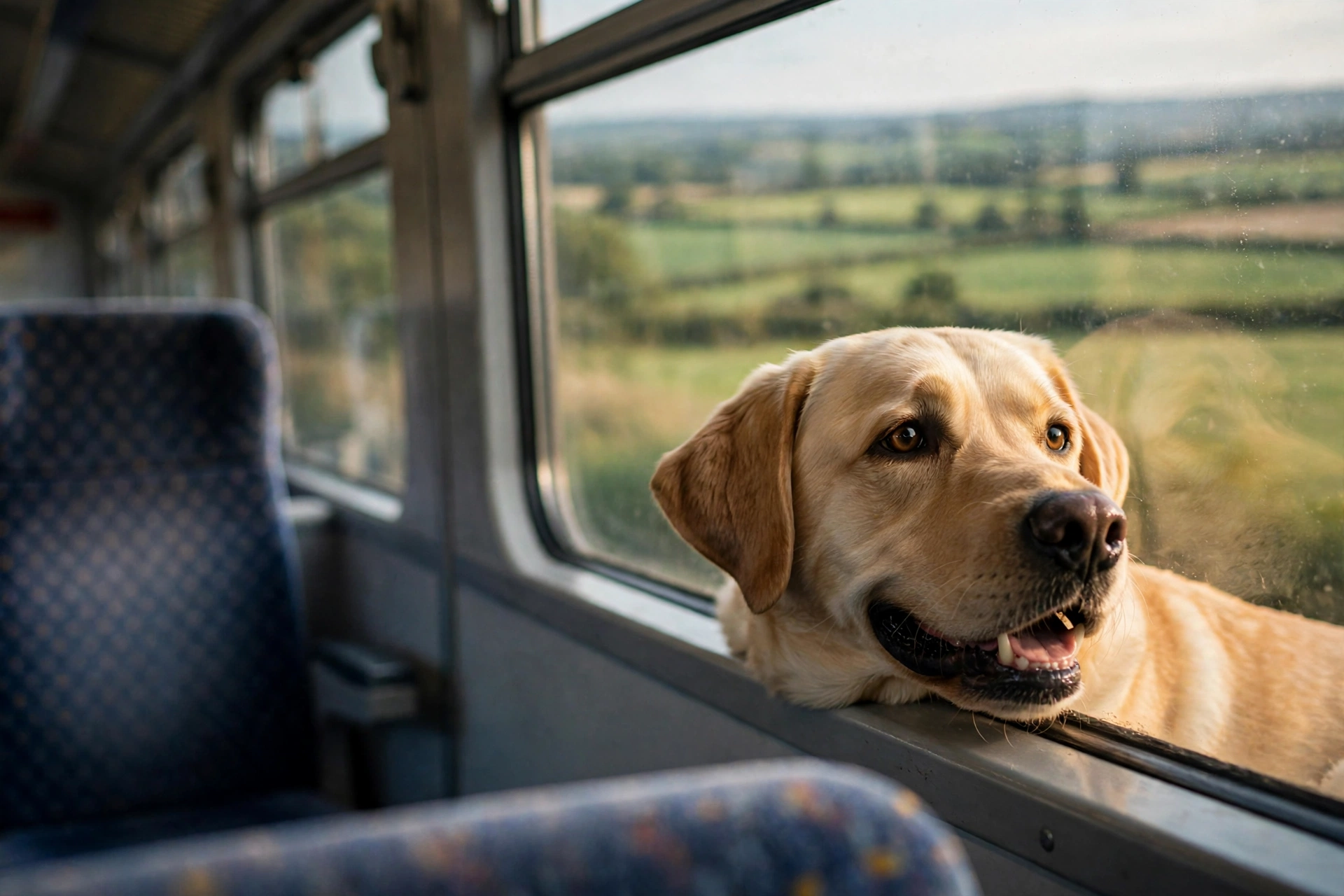
Trains trade motion for noise. The ride is smoother, and many car-sick dogs genuinely do better on rails — but the carriage is a sensory assault: public-address announcements, sliding doors, squealing brakes, luggage racks rattling, strangers' feet at nose height, and sometimes another dog three seats away. A noise-sensitive rescue that copes fine in a quiet car can fall apart in a busy carriage. You can stack the odds: travel off-peak when carriages are half empty, sit near the end of the train away from the doors and toilets, bring the dog's own mat or blanket so there is a familiar smell under them, and practise settle-on-mat training at home first. A tired dog that has had a good walk before boarding is a different animal from one that has been cooped up all morning.
Toileting is the hidden comfort line for both. In the car you control the schedule: stop every two hours at a services with a grass verge and the problem is solved, though motorway dog-walking areas vary wildly in quality — some are pleasant, some are a fence beside six lanes of traffic. On the train you are a hostage to the timetable: a two-hour journey is fine for most adult dogs, but a four-hour trip with a 40-minute delay and no station stop is a genuine welfare question for a puppy, a senior, or a dog on medication. Plan train journeys around your dog's bladder, not the departure board: choose direct services, avoid tight connections that turn a missed platform change into an hour stranded, and walk the dog thoroughly before boarding.
Ask which discomforts your dog already handles. A dog that sleeps through motorway services, ignores strangers and has an iron stomach is a natural driver. A dog that pants at engine noise, vomits in traffic and adores lying under a table watching the world is a natural train rider — provided the route is direct and the carriages are calm. Most dogs sit somewhere between, which is exactly why the later profiles exist.
Flexibility: timetables versus leaving when you like
The car's superpower is not speed; it is obedience. You leave when the dog has had its morning walk, not when the timetable says. You stop when the dog needs the verge, not at the scheduled station. You take the scenic detour to the beach you spotted on the map, load the boot with muddy boots and a week's shopping, and change the plan entirely on Sunday because the weather turned. For multi-stop trips — a night in the Peaks, two in the Lakes, home via the coast — the car is not just better, it is the only option that does not turn logistics into a second job.
The train's flexibility looks different: it frees you. Nobody drives, so nobody arrives tired; the journey becomes reading time, nap time, or the part of the holiday where you actually talk to each other. For solo travellers this matters more than people admit — a four-hour drive alone with a dog is four hours of concentration, while the same trip by rail is four hours of rest with the dog asleep at your feet. Families get a version of this too: children can move around, play games and eat properly, which a car seat simply does not allow.
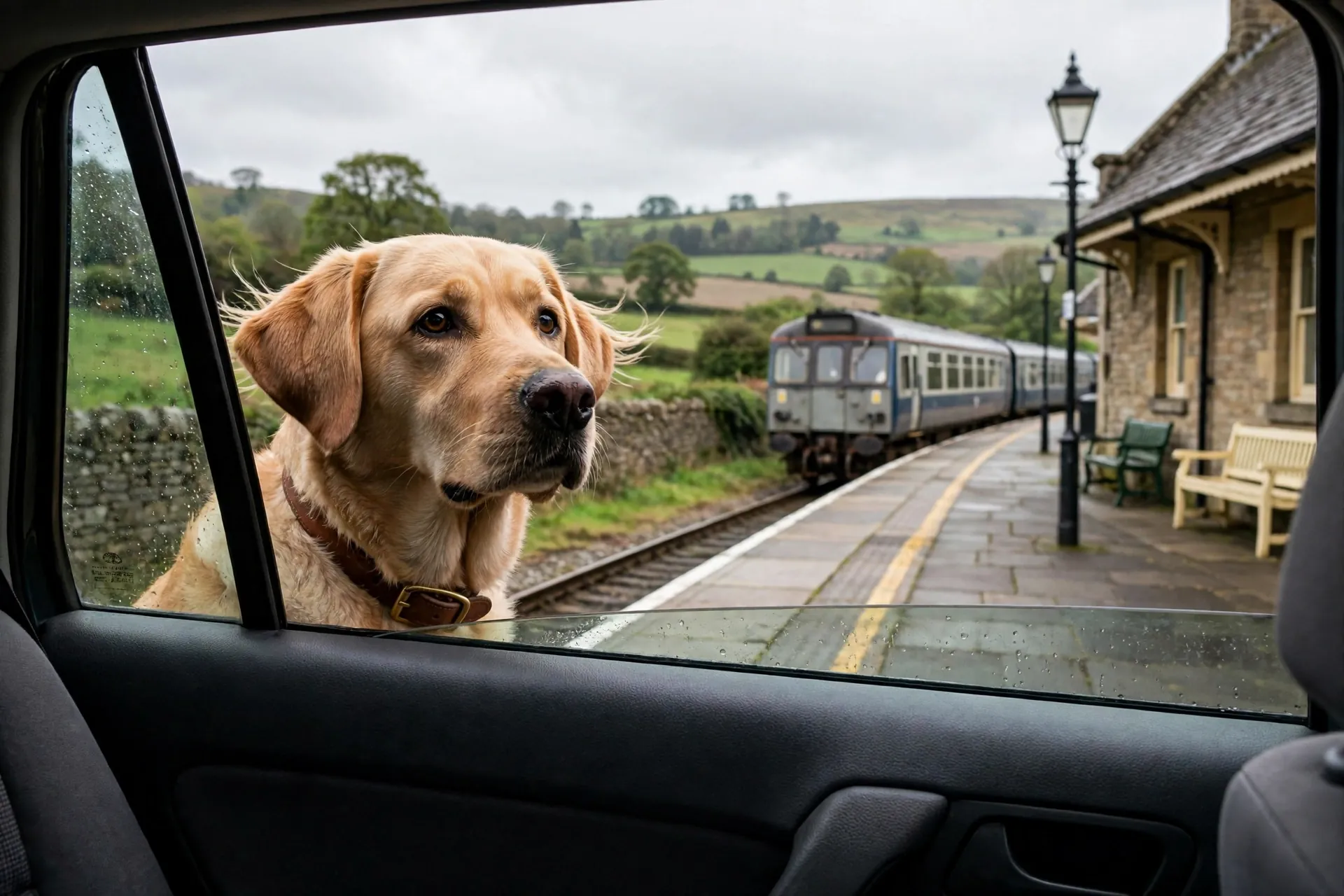
But the train takes flexibility away in ways that bite dog owners specifically. Disruption hits harder when you cannot improvise: a cancelled service with a dog means rebooking around a timetable, possibly standing on a crowded platform with an increasingly restless animal, while a driver just takes the next junction. Strikes and engineering works, which cluster around bank holidays and school breaks — exactly when you want to travel — can wreck a rail plan with little notice. And the last mile remains the train's chronic weakness: Britain's prettiest dog-walking country is disproportionately far from its stations, so "the train is relaxing" can curdle into "the train was relaxing and then we stood in a layby for 45 minutes waiting for a taxi that never came."
Score your trip on three questions. How many stops does it have? (More stops: car.) How firm are your times? (Firm times, early booking: train.) How far is the final address from a station? (Over about three miles with luggage and a dog: car, unless you have pre-booked the taxi.) Two or three car answers and the decision is made.
Rules: Rule 57 restraint versus operator policies
Both modes have rules about dogs; only one of them is about the dog's safety in a crash. Understand what each actually demands and the decision gets clearer.
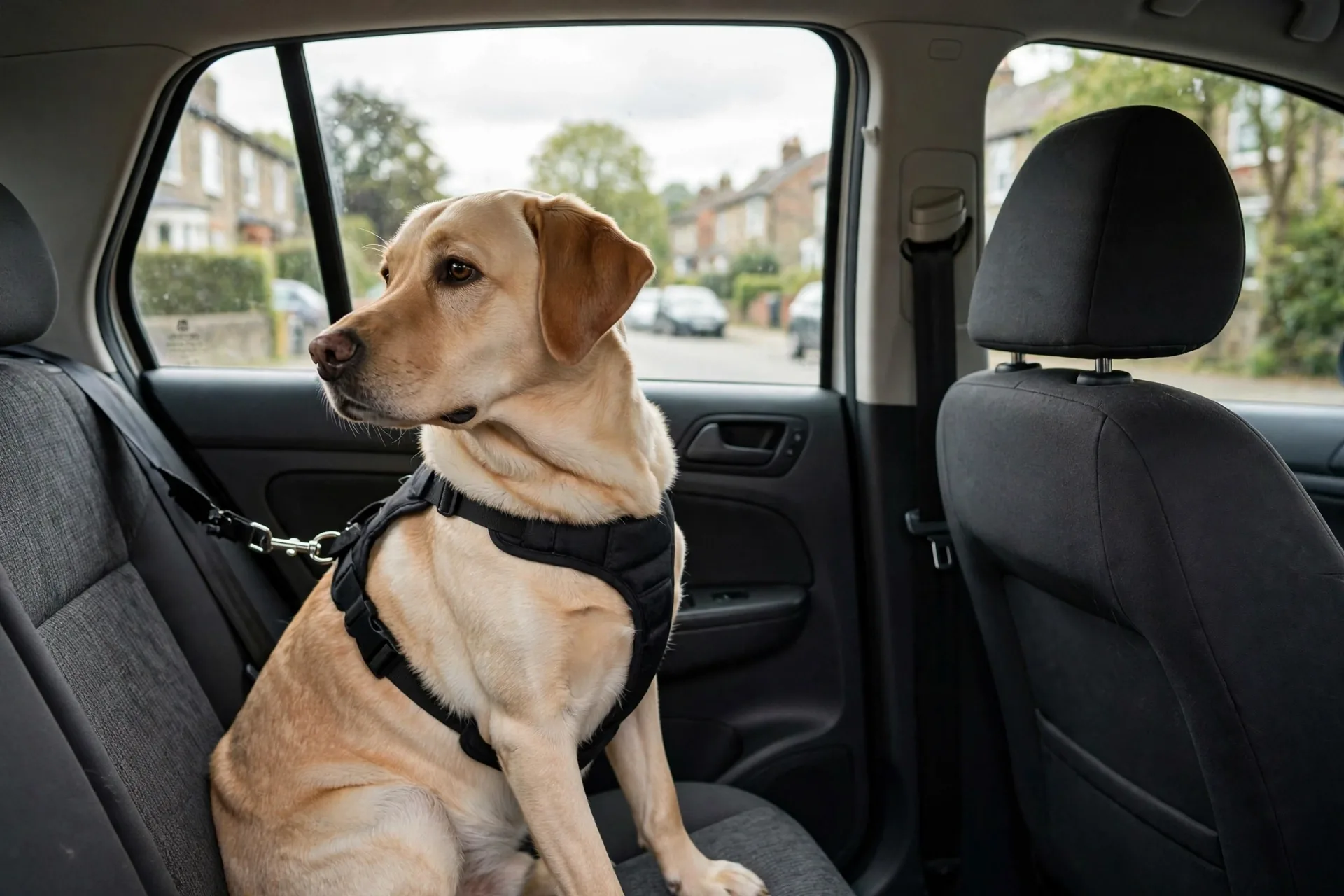
In the car, the rule is restraint. Rule 57 of the Highway Code requires dogs to be suitably restrained so they cannot distract the driver or injure occupants if you stop suddenly. In practice that means a proper harness clipped to a seatbelt point, a secured crate, or a boot separated by a fitted guard — not a lead looped around a headrest, and never a dog on the driver's lap. Rule 57 itself is guidance rather than a standalone offence, but an unrestrained dog that contributes to an incident can be cited as evidence of driving without due care and attention, which carries a fine and penalty points. Insurers can also take a dim view of claims where an unrestrained animal was in the car. Our full breakdown covers harnesses, crates, boot setups and the penalty details — read the dog car law guide before you buy any restraint kit, because the wrong harness fails the test that matters.
On the train, the rule is behaviour. Most operators welcome up to two dogs per passenger free of charge — no ticket, no reservation, no muzzle required as standard. The conditions are consistent across the network: dogs must be kept on a lead (or in a carrier), kept off the seats, and kept out of the way in aisles and doorways; you are responsible for any mess or damage. That is the baseline, but it is not universal: individual operators add their own conditions, some restrict dogs in first class or buffet cars, and staff can refuse any animal they consider a risk to other passengers. Assistance dogs are a separate, protected category with priority rights and no pet limits. Policies do change, so check the official guidance of the operator running your specific services before you travel rather than relying on a general statement — including ours.
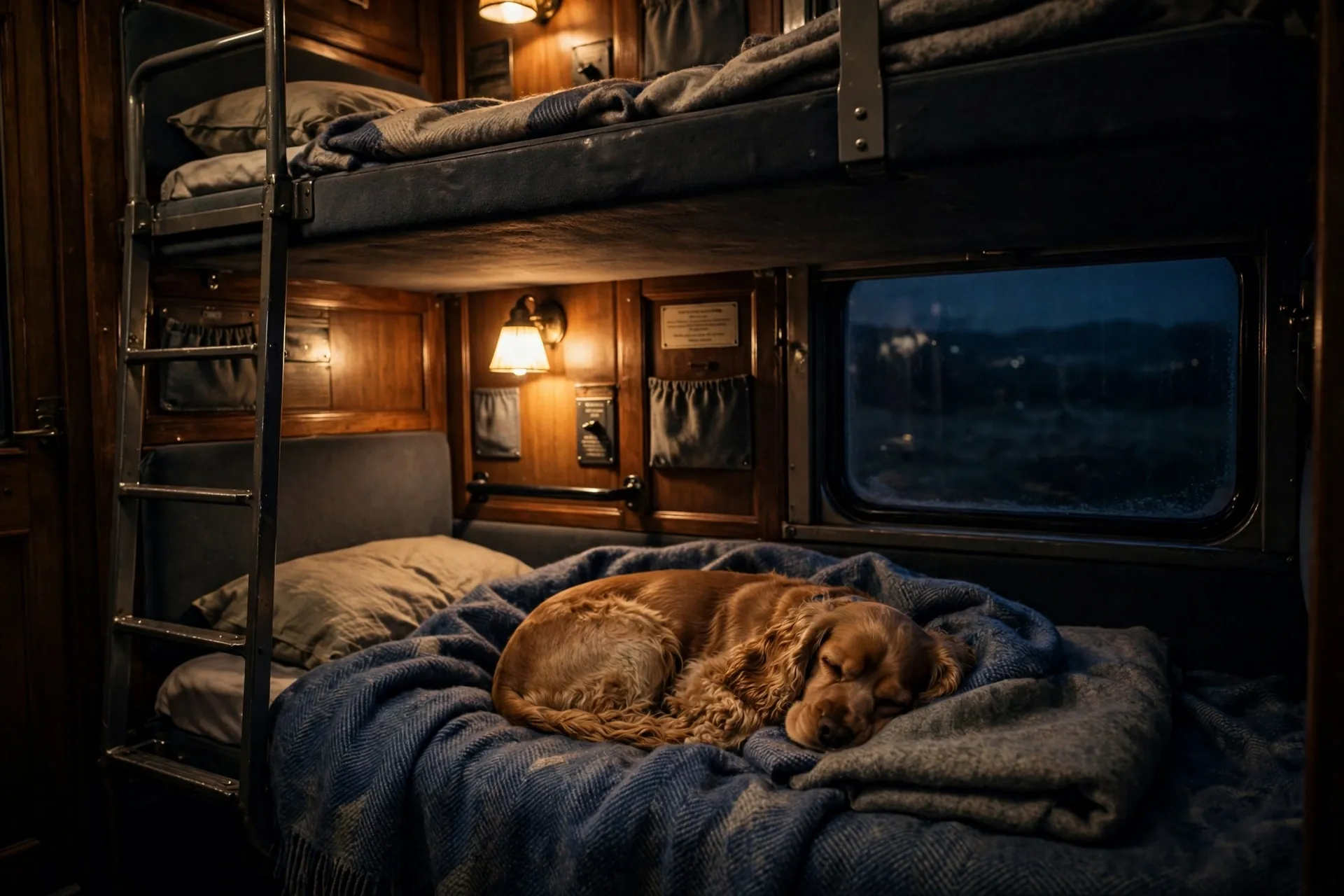
Multi-dog households hit the rail limit first. Two dogs per passenger is the standard ceiling, which means three dogs need at least two travelling adults and four dogs need the whole family — and every one of those dogs still has to behave in a crowded carriage. If your crew is large, boisterous, or includes a dog that barks at strangers, the car is not just easier; it is kinder to everyone else on the train. And if anyone in your party wants the overnight option, the rules tighten further: dogs on sleeper trains face cabin restrictions that day trains never impose, so check that guide before planning a Caledonian or Night Riviera trip around a dog.
Neither rulebook is onerous for a well-prepared owner. The car's rule asks for equipment you should own anyway; the train's rule asks for manners your dog should have anyway. The friction comes when your setup fails one of them — an unrestrained dog in the car, or an unruly one in the carriage — so pick the mode whose rule your dog already passes.
Four traveller profiles: which suits you
Abstract comparisons only go so far. Here are the four trips we see most often, with a verdict for each — and the honest exceptions.
1. The city weekend: two days, one or two settled dogs. London to the Peak District, Manchester to the Yorkshire Dales, Bristol to the Cotswolds. The train usually wins here, because these are well-served routes where advance fares are cheap, the dog rides free, and many of the best walks start near a station. The exceptions: a cottage more than a few miles from the station, or a dog that cannot cope with busy carriages. If you are going car-free, our five rail-to-trail routes are built exactly for this trip — station platforms that open straight onto dog walks.
2. The rural long holiday: a week in deep countryside. A cottage in west Wales, a croft in Sutherland, a farmhouse on the North York Moors. The car wins, and it is not close. You are carrying a week's food, walking gear, the dog's bed, possibly a crate, and you will want to drive to a different walk every day. Remote vet access matters more over a long stay, and only the car guarantees you can reach one fast. The train only enters the conversation if the accommodation is genuinely station-adjacent and you plan to stay put — which, over a full week, almost nobody does.
3. The multi-dog family: three or more dogs, or two large ones. The car wins on arithmetic alone. Trains cap dogs at two per passenger and expect every one of them to lie quietly under a table; a car with a proper boot setup or stacked crates handles a whole pack without negotiating with strangers. The comfort maths favours the car too: three dogs in a carriage multiply every risk — noise, mess, another passenger's fear — while three dogs in a familiar car are just the usual chaos. Budget a roof box if the boot is full of dogs, because human luggage still has to go somewhere.
4. The senior dog: comfort over everything. This one is genuinely individual. An arthritic dog that struggles with station stairs, gaps on platforms and long walks to the taxi rank may do better in the car, where you control every step of the journey and can lift them in and out. A dog with travel sickness that worsens with age may do better on the smoother rails. Decide by your dog's specific limitation: if the problem is mobility, the car's door-to-door control usually wins; if the problem is nausea or car anxiety, try a short off-peak train ride as an experiment before the real trip. And whichever you choose, build in more margin — seniors need the toilet stop, the water break and the rest day that younger dogs skip.
If none of the four fits neatly, you are probably a hybrid case — which is the next section.
The hybrid: drive there, train back
Sometimes the answer is not either/or. Three hybrid patterns work well in Britain, and each solves a different problem.
Pattern one: park at the railhead. Drive to a mainline station with good parking, leave the car, and take the train for the scenic leg. This suits trips where the rail journey itself is the point — the Settle–Carlisle line, the West Highland Line — but the station at the far end is too far from home to start there. You get the views without the full drive, the dog gets one calm train ride instead of a day on the motorway, and the car is waiting for the final stretch home. Check long-stay parking prices first; at some stations a week of parking costs more than the train tickets.
Pattern two: drive one way, train the other. This works when the logistics line up naturally: drive up with all the gear and a car full of holiday supplies, then send the car home with a family member while you and the dog take the train back light. It also works in reverse for one-way walking holidays — several long-distance trails end at a station but start nowhere near one. The constraint is obvious: the car has to get home somehow. If it cannot, this pattern is a fantasy, not a plan.
Pattern three: base by car, days by rail. Drive to a well-connected base — a town with a station, not a remote cottage — and use local trains for day trips. The car handles the luggage, the shopping and the vet-access insurance; the trains handle the days when you want someone else to drive and the dog to watch the world go by. This is the lowest-risk hybrid because nothing depends on the other mode working: if the trains are cancelled, the car is still outside.
Hybrids fail when people plan them backwards — booking the romantic train leg first and discovering the car logistics do not work. Plan the boring part first: where the car sleeps, who drives it home, what the taxi from the station costs. Then add the enjoyable part. A hybrid planned in that order feels clever; planned the other way, it feels stranded.
Whichever pattern you choose, the same final check applies: walk through the whole journey from the dog's point of view, stop by stop. The mode that asks your dog to endure the fewest things it dislikes — not the cheapest ticket, not the fastest route — is the right one.
Practical questions
Before you go
Can I take my dog on any train in the UK?
Almost any national rail service: most operators carry up to two dogs per passenger free of charge, kept on a lead or in a carrier and off the seats. A few operators add their own conditions around peak times or specific routes, so check the operator's pet policy for your exact journey before you book.
What does Rule 57 actually require for dogs in cars?
Rule 57 of the Highway Code says a dog must be suitably restrained so it cannot distract you or injure occupants if you brake suddenly - typically a harness, a crate or a boot guard. It is not a standalone fine, but an unrestrained dog can support a charge of driving without due care, which carries a fine and points.
How much cheaper is the train really, once the dog travels free?
On popular routes booked weeks ahead, a couple can often ride return for less than the fuel alone would cost, with the dog free. But that reverses fast: peak-time or last-minute fares for two adults can exceed driving costs, and the car wins outright once three or four people are travelling.
What if I have three or more dogs?
Trains allow up to two dogs per passenger, so a multi-dog household needs enough travelling adults to cover every dog - otherwise driving is the practical answer. In the car, each dog still needs its own restraint space, so a big boot or a crate stack matters as much as the headcount.
Can a dog that gets travel sick do better on a train?
Sometimes, but it is not guaranteed. Some car-sick dogs settle on trains because the motion is smoother and they can see out; others are worse because of noise and unfamiliar people. Try a short local train ride before committing to a long rail journey, and talk to your vet about travel-sickness options either way.
Do dogs need a ticket, a muzzle or a carrier on UK trains?
No ticket and no muzzle are generally required; dogs travel free on a lead, or in a carrier for smaller dogs. A muzzle may be required on specific services or if your dog's behaviour worries staff, and some operators restrict dogs from first class or buffet cars - check the operator's policy for your route.