This guide is independent and contains no paid placement. If affiliate links are added later, they will be clearly marked and will not change our editorial checks.
Dogs travel free on Hovertravel and stay with you in the cabin, on the floor on a lead or in a carrier — never on a seat. The Southsea to Ryde crossing takes under 10 minutes, making it the fastest Solent crossing, but it is a passenger-only service: no cars, a 30 kg luggage allowance per person, and a louder, more vibration-heavy ride than a conventional ferry.
What Hovertravel is and the Portsmouth–Ryde route
Put the numbers side by side and the appeal of Hovertravel is obvious. The conventional car ferries from Portsmouth to the Isle of Wight take roughly 40 to 60 minutes on the water, and even the fast passenger catamaran from Portsmouth Harbour to Ryde Pier Head takes around 22 minutes. Hovertravel does the same stretch of the Solent in under 10 minutes. For a dog that dislikes boats, a nervous traveller, or a family trying to fit a day trip into a tight window, that difference is not a small convenience: it turns the crossing from the main event of the day into a ten-minute hop between two seafronts.
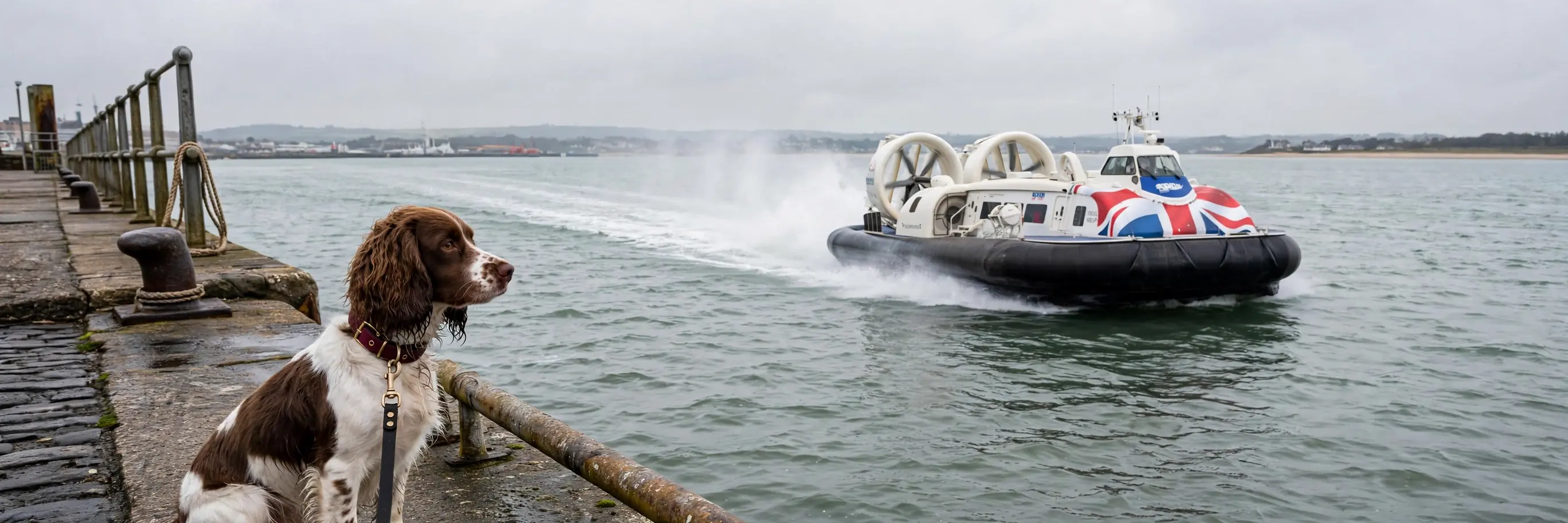
Hovertravel has operated across the Solent since 1965 and describes itself as the world’s longest-running commercial hovercraft service, and the world’s only year-round scheduled passenger hovercraft service. That history matters for dog owners because the service is a settled, routine part of island life rather than a seasonal novelty. Islanders commute on it, Portsmouth residents use it for day trips, and dogs are an ordinary sight in the queue. The current fleet, the Solent Flyer and the Island Flyer, are 12000TD craft carrying up to 78 passengers each at speeds of up to 40 knots. They do not sail in the usual sense: a hovercraft rides on a cushion of air, lifting its hull clear of the water, which is why the ride feels smoother in some ways and noisier and more vibration-heavy in others.
The route itself is simple, with only one scheduled corridor. On the mainland, the Southsea Hoverport sits on Clarence Esplanade in Southsea, Portsmouth, beside Clarence Pier and the seafront at postcode PO5 3AD. On the island, the Ryde Hoverport lands directly on the seafront at Ryde, a few steps from Ryde Esplanade station and the town’s bus station. There are no intermediate stops and no alternative Hovertravel destination: every sailing runs Southsea to Ryde or Ryde to Southsea, across about 7 kilometres — roughly 3.85 nautical miles — of the Solent. That simplicity is part of the planning advantage. You do not need to choose between terminals, compare routes, or worry about which island port suits your accommodation best, because the hovercraft only ever delivers you to Ryde Esplanade.
That single destination shapes the whole trip. Ryde is the island’s largest town and a practical base for a car-free visit, with a long sandy beach, a promenade, shops and cafés within a short walk of the hoverport. If your accommodation is in Ryde, Sandown, Shanklin or anywhere along the Island Line railway, the hovercraft drops you almost on top of your onward connection. If you are staying in Cowes, Yarmouth or the far west of the island, the crossing is still fast, but the onward bus or taxi journey is longer, and a car ferry to Fishbourne or East Cowes may suit the overall day better. Judge Hovertravel by the door-to-door journey, not by the ten minutes on the water alone, and check the official guidance before you travel for the current timetable, because frequencies change with the season.
Are dogs allowed on the hovercraft?
Yes, dogs are allowed on Hovertravel, and the headline rule is a generous one: pets travel free of charge. There is no dog ticket to buy, no pet fare added at the till, and no need to book your dog in as a separate passenger. Your dog travels with you in the passenger cabin for the whole crossing, on the floor beside your seat, rather than being left in a car, a kennel or a separate pet area. For owners used to car ferries, where the dog often stays in the vehicle or waits in a designated lounge, that togetherness is the hovercraft’s quiet advantage — you can see, touch and reassure your dog for the entire ten minutes.
The conditions attached to that free travel are clear and worth taking literally. Hovertravel states that pets must be carried in an RSPCA-approved pet carrier or restrained by a harness, collar and lead while on board, and kept on the floor in the passenger area, not on the passenger seats. In practice that means a short lead, held firmly, with the dog settled at your feet from the moment you step aboard until you step off. A long or extendable lead is a poor choice in a 78-seat cabin: it lets a curious dog wander into the aisle, sniff a neighbour’s bag, or tangle around another passenger’s legs. A harness gives you better control than a collar alone if your dog startles at the engine note, and it spreads the load if you need to guide a large dog down the ramp quickly.
Owners are also asked to make sure their pet does not cause a nuisance to other passengers. That is a deliberately broad phrase, and it covers the obvious things: barking at strangers, jumping up, begging for food, shedding on seats, and toileting on the craft, the landing pad or in the terminal. Hovertravel warns that there is a penalty if a dog fouls on the craft, pad or terminal, so the practical rule is to exercise your dog properly before boarding and to carry poo bags and cleaning wipes even for a ten-minute crossing. Water bowls are available in both terminals, which helps on a warm day, but there is no toilet break once you are called to board, and no dog toilet area on the craft itself.
There is no published size or breed limit for dogs on Hovertravel in the way some holiday parks or airlines impose one, and large dogs are regularly carried. What matters is control and footprint. A large dog still has to fit on the floor at your feet without blocking the aisle or spilling into the next seat’s space, and a reactive dog still has to cope with 70-odd strangers in a small, enclosed cabin. If your dog is very large, travels with a second dog, uses a wheelchair or a large carrier, or needs extra space to settle, contact the operator before you travel and check the official guidance before you travel. Assistance dogs are a separate category: if you travel with an assistance dog, tell the operator at booking so staff can plan boarding and seating, and check the official guidance before you travel for the current assistance-dog arrangements.
Tickets, booking and fares
You only pay for the people travelling. Dogs travel free, children under five travel free when included in a booking, and the fares below are per person for the human passengers. Hovertravel publishes standard fares and cheaper advance fares, and the gap between them is large enough to be worth planning around. Fares valid from December 2025 list a standard adult single at £25, a day return at £34 and a period return at £46. Book at least 48 hours before departure and the advance adult fares fall to £22.50 single, £30.60 day return and £41.40 period return. Child fares for ages 5 to 15 start at £12 single, £16 day return and £22 period return, with advance fares of £10.80, £14.40 and £19.80. Senior and student fares are also published at a discount, so check the official guidance before you travel for the fare that fits your party.
Families should look at the Family Flyer before buying separate tickets. A Family Flyer covers two adults and up to three children aged 5 to 15, with children aged 0 to 4 travelling free when included in the booking. The standard Family Flyer costs £70 for a day return or £100 for a period return; booked at least 48 hours in advance those fall to £65 and £90. For two adults and two or three children that is usually cheaper than buying every ticket individually, and it keeps the whole party on one booking, which simplifies boarding with a dog, a pushchair and bags. Work out the total both ways before you pay, because the saving depends on how many children are travelling and whether you need a day return or a longer period return.
Booking in advance is strongly recommended, and not only for the price. Hovertravel runs a timetable rather than a turn-up-and-go shuttle, and each craft carries a maximum of 78 passengers. In summer, at weekends and during island events, popular sailings can fill, and a family that arrives hoping to board the next departure may find itself waiting for the one after. Booking online also gives you a digital ticket to show on your phone, so you are not juggling a paper ticket, a lead, a bag and a dog at the gate. Buy your ticket before you leave home, save it where you can reach it one-handed, and check the official guidance before you travel for the current booking window and any changes to advance-fare rules.
Choose the return type with the dog in mind. A day return suits a day trip to Ryde beach or a walk along the esplanade, and it is the cheapest way to sample the hovercraft. A period return suits a longer stay, a weekend break or a visit where the return day is not yet fixed. If your plans are uncertain, check the change and cancellation terms before you book rather than after: advance fares are cheaper precisely because they carry conditions, and a ticket that cannot be moved may cost more than a flexible one if your dog has a bad morning and you need to travel later. Keep the booking confirmation and the operator’s contact details on your phone, and screenshot the live timetable on the morning of travel so you are not relying on mobile signal at the seafront.
Getting to Portsmouth terminal
The Southsea Hoverport is not inside a railway station, and that single fact catches out more first-time travellers than anything else about the service. It sits on Clarence Esplanade beside Clarence Pier, on the Southsea seafront, roughly a mile and a half from Portsmouth Harbour station and a similar distance from Portsmouth & Southsea station. You can walk it — the seafront route is flat and mostly pleasant — but walking with a dog, luggage and possibly children takes 25 to 35 minutes, and it is a poor choice in rain or with a dog that is already tired. Plan the last leg deliberately instead of assuming the train drops you at the hoverport door.
The easiest public-transport link is Hovertravel’s own H1 HoverBus, which runs from outside Southsea Hoverport to key Portsmouth stops including Portsmouth & Southsea station and The Hard and Gunwharf Quays area, timed to support hovercraft connections. If you arrive by train, stay on the train to Portsmouth Harbour if you are heading for the HoverBus connection at The Hard, or alight at Portsmouth & Southsea and pick the bus up there, and check the official guidance before you travel for the current H1 timetable and stopping points. Local buses also serve Clarence Pier: routes including the 8 and the X4 link Portsmouth Harbour station with the Clarence Pier area. Dogs are generally carried on local buses on a lead at the driver’s discretion, but check the official guidance before you travel, because bus operators set their own pet rules and a busy bus at peak time is a different proposition from a quiet mid-morning one.
Arriving by car needs a different plan again, because the hovercraft carries no vehicles at all. You park on the mainland and cross as a foot passenger, which means choosing between leaving the car in Portsmouth for the day and leaving it for the whole stay. Council-operated car parks are available close to both hoverports, and Southsea has seafront parking near Clarence Pier, but spaces fill quickly on sunny weekends and charges vary by location and duration, so check the official guidance before you travel and consider booking parking in advance where that option exists. Portsmouth Park & Ride is a useful alternative for drivers coming from outside the city: the PR1 service runs every 15 minutes from just off Junction 1 of the M275 to The Hard Interchange, where you change to the H1 Hoverbus to Clarence Pier, and a Hoverbus return can be added to a Park & Ride day ticket for a small supplement. That combination keeps you out of seafront traffic and gives the dog a calmer arrival than circling for a space.
Whichever way you arrive, build in a buffer and give the dog a proper toilet break before you reach the terminal. The seafront around Clarence Pier has grass and open space where a dog can be exercised on a lead, but the terminal itself is a busy, noisy place with trolleys, queues and announcements, and it is not the place for a first wee of the day. Arrive at least 15 minutes before departure if you already hold a ticket, and at least 15 to 20 minutes earlier still if you need to buy one, use the toilet, or settle a nervous dog. If you are cutting it fine, remember that the hovercraft will not wait while you find parking: the timetable is tight, the craft turns around quickly, and a missed sailing means waiting for the next one.
Boarding step by step
Boarding a hovercraft is not like boarding a ferry, and knowing the sequence in advance makes it far calmer for the dog. After check-in, passengers wait in the terminal until their sailing is called, then walk out to the craft across the landing pad. The hovercraft sits on the pad or on the beach at Ryde, and you board up a ramp into a low, enclosed cabin. There are no long gangways, no car decks to cross and no lift to wait for, but there is a ramp, a threshold, and a sudden change from open seafront air to a warm, enclosed cabin full of people. Walk the dog through it steadily, on a short lead, with you between the dog and the edge of the ramp where you can.
Staff will help with luggage, and passengers who need extra assistance can use the HoverCare scheme, but the dog is your responsibility throughout. Keep the lead short and the dog close to your leg as you queue, and do not let the dog greet every other dog in the line. A hoverport queue is a concentrated version of everything a reactive dog finds hard: strangers at close quarters, other dogs at nose height, luggage wheels, children, and the sound of the craft’s engines spooling up nearby. If your dog is reactive, hang back and board near the end of the group rather than pushing to the front, and choose a seat at the end of a row where the dog has a wall or a bulkhead on one side and only one neighbour to monitor.
Once inside, settle the dog before you settle yourself. Put bags down first, guide the dog onto the floor at your feet, shorten the lead, and give the dog a clear, boring job: lie down, stay, and watch you. A familiar blanket or mat helps enormously here, because it gives the dog a defined patch of floor that smells of home, and it keeps paws off a cabin floor that other passengers will walk across. Offer a small, long-lasting chew only if your dog can eat calmly without guarding it from the neighbour; a dog that resource-guards in a crowded cabin is worse off with a chew than without one. Water is available in the terminals, so offer a drink before boarding rather than trying to manage a bowl in the cabin.
Disembarkation is the mirror image, and it is the moment dogs most often get into trouble. The ramp, the pad, the open seafront and the sudden freedom after ten minutes of confinement are exciting, and a dog that has been good throughout the crossing may pull hard the moment it smells fresh air. Keep the lead short until you are clear of the pad and the passenger flow, and do not unclip the lead or switch to a long line until you are well away from the terminal, the road and the other arriving passengers. At Ryde, the promenade is right there, but so is a road, a car park and a busy interchange, so the first few minutes after landing deserve the same attention as boarding.
On board: noise, vibration, seating and where the dog goes
The cabin of a hovercraft is a small, enclosed, aircraft-like space. There are rows of seats, a central aisle, windows along each side, and a low ceiling. The dog goes on the floor at your feet, not on the seat beside you, not on your lap, and not in the aisle. That rule is stated plainly by the operator, and it is enforced for good reasons: seats are for paying passengers, the aisle must stay clear for safety, and a dog on a seat sheds hair, claws upholstery and sits at face height with strangers. A small dog in a carrier may travel in the carrier on the floor or on your lap if the carrier is secure and the crew agree, but check the official guidance before you travel, because carrier rules can depend on the size of the craft and the load on the day.
Noise and vibration are the two things every first-time passenger notices, and they are the two things that matter most to dogs. A hovercraft’s lift fans and propellers are loud, especially during the run-up to departure and the first minute of the crossing, and the whole cabin hums and vibrates while the craft is on its cushion of air. The current fleet is described as much quieter than the older craft, and most passengers find the noise manageable once the craft is under way, but it is still louder than a conventional ferry, where the engine note is muffled by a steel hull and distance. Dogs hear higher frequencies and lower volumes than we do, so a noise that you find merely intrusive may be genuinely uncomfortable for them. The saving grace is duration: ten minutes of noise is a very different proposition from an hour of it, and most dogs that settle in the first minute will stay settled until landing.
Seating choice is a small decision with an outsized effect on the dog. A window seat gives the dog a view of moving water and spray, which some dogs watch calmly and others find overstimulating. An aisle seat gives you quicker access to the door but puts the dog beside passing feet, bags and other dogs. For most dogs, a middle or window seat at the end of a row, with the dog tucked between your feet and the seat in front, is the best compromise: the dog has a defined pocket of space, you can shield them with your legs, and nobody needs to step over them. If the craft is busy, do not spread bags across the floor space your dog needs; keep the dog’s area clear and your luggage on your lap, under the seat in front, or in the designated luggage area as directed by the crew.
There are no toilets, cafés, shops or outdoor decks to visit during the crossing, and no reason to leave your seat. Stay seated, keep the dog settled, and treat the ten minutes as a short, boring wait rather than an experience to be managed minute by minute. Do not feed the dog on board, do not let the dog wander to greet other passengers, and do not lift a nervous dog onto a seat for comfort, however tempting that is. If your dog does become distressed, speak quietly, keep your own body still, and place a steady hand on the dog’s shoulder or chest. Your calm is the most effective reassurance available in a noisy cabin, and the crossing will be over before most settling techniques have had time to work.
Seasickness, anxiety and noise-sensitive dogs
Hovercraft motion is different from ferry motion, and that difference cuts both ways for dogs. A hovercraft rides above the water rather than through it, so it does not roll with the swell in the way a conventional ferry does, and many people who feel queasy on a boat find the hovercraft easier. But the craft still pitches and bumps, especially in choppy conditions, and the combination of vibration, engine noise, acceleration and an enclosed cabin can unsettle a dog that would be perfectly happy on a slow car ferry. If your dog has been sick on boats before, do not assume the hovercraft will be fine simply because it is fast; equally, do not assume it will be worse. The honest answer is that the crossing is short enough that most dogs, even mildly seasick ones, get through it before the nausea builds.
Prepare as you would for any short boat journey. Feed a light meal two to three hours before travel rather than a full meal immediately before boarding, and avoid rich treats or a large drink in the hour before departure. If your vet has previously prescribed anti-nausea medication for travel, ask whether it is appropriate for this crossing and give it at the time your vet advises; do not try a new sedative or calming drug for the first time on the day of travel, when you cannot tell whether drowsiness, wobbliness or a paradoxical reaction is the drug or the journey. A familiar-smelling blanket, a worn item of your clothing, and a calm, matter-of-fact manner from you all help more than any gadget. If your dog is sick on board, tell the crew quietly at the end of the crossing, keep the dog comfortable, and clean up as best you can with the wipes you packed.
Noise-sensitive dogs deserve specific thought. Firework-phobic dogs, rescue dogs with a history of loud-noise distress, and dogs that panic at vacuum cleaners or thunderstorms are the most likely to struggle with the engine note at departure. For these dogs, the worst moment is usually the run-up before the craft moves, when the fans spin up and the cabin fills with sound. Settle the dog early, before the noise peaks, and keep them low on the floor between your feet where the sound is muffled by seats and bodies. Some owners use canine ear protection, but only use it if your dog has been introduced to it gradually at home and your vet has advised it; forcing unfamiliar ear covers onto a stressed dog in a crowded cabin will make things worse, not better. A calming wrap or pressure garment can help some dogs, again only if it has been tried at home first.
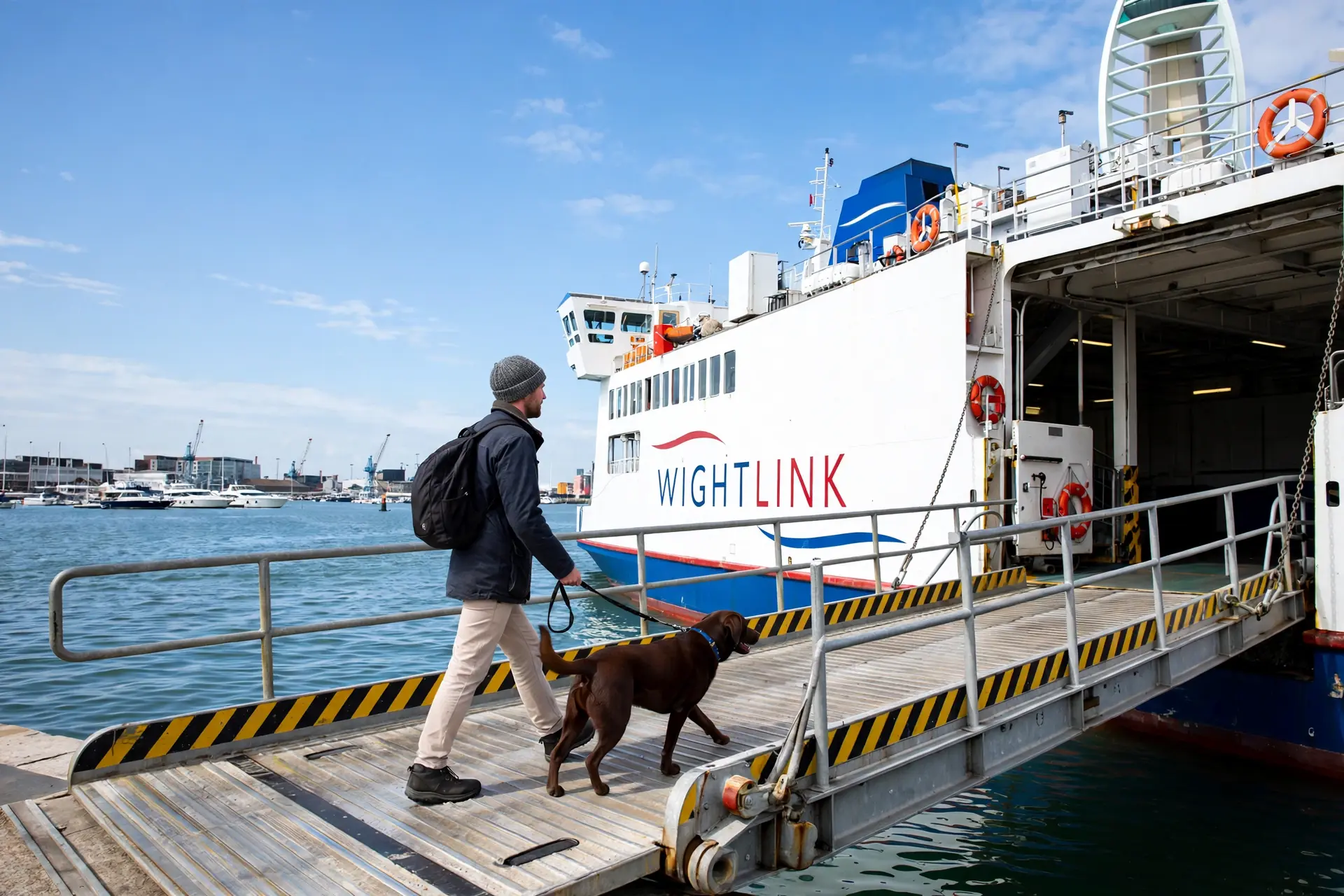
Know your dog’s stress signals and respect them. Panting, yawning, lip-licking, whale eye, trembling, drooling, trying to climb onto your lap, and a tucked tail are all signs that a dog is not coping, and they are easy to miss in a noisy cabin if you are looking out of the window. If your dog shows several of these at once, do not try to distract them with treats or play; instead, reduce stimulation, keep them close, and wait for the crossing to end. If your dog has a history of severe travel anxiety or panic, consider whether the hovercraft is the right choice at all: the Wightlink ferry with dogs offers a slower, quieter crossing with outdoor deck space, and the extra twenty minutes on the water may be a better trade for a dog that needs air and room. The fastest crossing is only the best crossing if the dog arrives in a state to enjoy the rest of the day.
Weather, cancellations and what happens next
Hovercraft are more weather-sensitive than conventional ferries, and that is the single biggest planning risk on this route. High winds, rough seas and poor visibility can all disrupt or cancel sailings, and because the craft operates on a tight timetable with a small fleet, a single cancellation can knock on into the next departures. Hovertravel publishes live service updates and a live timetable, and the operator’s own pages are the authoritative source on the morning of travel. Check them before you leave home, check them again before you leave the car park or the station, and do not rely on a timetable printed weeks earlier or on a third-party site that may not have the latest status.
Winter is the season when cancellations are most likely. From November to March the service runs hourly rather than every 30 minutes, so a cancelled sailing means a full hour’s wait for the next one rather than a 30-minute delay, and a second cancellation can turn a day trip into a long, cold wait at the seafront. Summer brings its own risks: strong winds and choppy Solent conditions can still suspend the service, and the busiest days — school holidays, festival weekends, and the days around major island events — are the days when a cancellation hurts most, because the alternative services are busy too. If your day depends on a fixed onward connection, a booked tour, or a check-in time at your accommodation, build a buffer of at least an hour into the plan, and have a fallback in mind before you need it.
When a sailing is cancelled, Hovertravel advises passengers at the terminal and through its live updates, and in qualifying cases tickets may be accepted on the Wightlink FastCat service between Portsmouth Harbour and Ryde Pier Head instead. That arrangement covers certain weather or technical disruptions, but it is not automatic for every cancellation, and it does not turn a hovercraft ticket into a flexible ferry ticket for any reason you choose. The FastCat is a slower crossing — around 22 minutes on the water — and it leaves from a different terminal, inside Portsmouth Harbour station, so a transfer means getting yourself, your dog and your luggage from Southsea seafront to the Harbour station, usually by HoverBus or taxi. Allow time for that transfer, keep your dog on a short lead through the station, and check the official guidance before you travel for the current ticket-acceptance terms.
Refunds, rebooking and compensation follow the operator’s terms, which change from time to time, so read them before you book rather than arguing about them at the terminal. Keep your booking reference and any cancellation messages, and if you are rebooked onto a later sailing, ask staff at the terminal what the expected wait is and whether the next craft has space for your party. If you are travelling with a dog that is already anxious, a long, uncertain wait in a busy terminal can be harder on the dog than the crossing itself, so use the delay well: walk the dog away from the crowds, find a quiet spot on the seafront, offer water, and let the dog settle before the next boarding call. A cancelled sailing is an inconvenience, not an emergency, unless you turn it into one by rushing.
Luggage, bikes, pushchairs and large dogs
Hovertravel is a foot-passenger service, and the luggage rules reflect that. The published limit is 30 kg of luggage per passenger, and staff will help with bags at the terminal and on board. Excess or out-of-gauge baggage is carried subject to space and may need to travel as freight at the applicable tariff, so a family that arrives with a week’s worth of suitcases, a dog crate, a pushchair and a bike should not assume everything will fit on the same sailing. Pack for a foot-passenger crossing, not for a car ferry: one bag per person that you can carry yourself, a small day bag for the dog’s kit, and nothing you cannot manage up a ramp while holding a lead.
Bikes are carried, but only in small numbers. Up to four bikes are allowed per crossing, subject to other freight and luggage, and they are taken on a first-come, first-served basis. If you plan to cycle on the island with your dog — whether the dog runs alongside on quiet lanes or rides in a trailer — arrive early, be prepared to wait for the next sailing if the bike spaces are full, and check the official guidance before you travel for the current bike policy and any charges. A dog trailer counts as additional luggage, so factor its size and weight into your packing. Pushchairs are more straightforward: a folding pushchair that collapses quickly and fits in the luggage area is far easier than a large, fixed-frame model, and a baby carrier is easier still on a crowded craft. If you are travelling with both a pushchair and a dog, practise the boarding sequence at home: lead in one hand, pushchair folded with the other, and nobody trying to do both at the ramp.
Large dogs need a plan for space rather than a special ticket. A Great Dane, a large German Shepherd or a heavy Labrador still travels free, but it still has to fit on the floor at your feet without blocking the aisle or the passenger beside you. On a quiet midweek sailing that is easy; on a full summer sailing, with every seat taken, it is a genuine constraint. Book a less busy sailing where you can, choose a seat at the end of a row, and keep the dog in a tight down-stay rather than letting it sprawl. If you travel with two large dogs, consider whether one adult per dog is needed to manage boarding, seating and disembarkation safely. A single handler with two large, excited dogs on a crowded ramp is a recipe for a tangled lead and a missed sailing.
Dog equipment deserves the same discipline as luggage. A carrier must be a suitable, RSPCA-approved pet carrier: sturdy, ventilated, large enough for the dog to stand and turn around, and secure enough not to open if it is knocked. A soft, collapsible carrier is fine for a small dog that travels in it happily; a dog that has never been in a carrier should not meet one for the first time at the hoverport. Bring a lead, a spare lead, poo bags, wipes, a water bottle and a collapsible bowl, a familiar blanket, and any medication your dog needs, all in one bag you can carry with one hand. Leave the bulky dog bed, the full bag of food and the spare crate at home unless you genuinely need them on the island: the hovercraft rewards light, organised travellers and punishes over-packers.
Arriving in Ryde and onward travel on the Isle of Wight
Arrival in Ryde is one of the hovercraft’s great strengths. The Ryde Hoverport sits on the seafront, and the moment you step off the pad you are on the Esplanade, with the beach to one side, the town behind you, and the transport interchange a few metres away. Ryde Esplanade station is immediately beside the hoverport, and the bus station is right outside it, so the onward journey starts without a long walk, a shuttle bus or a pier to negotiate. That matters with a dog: after ten minutes in a cabin, the dog wants open air, a sniff and a toilet break, and Ryde delivers all three within a minute of landing.
Give the dog that break before you do anything else. Walk along the Esplanade away from the terminal crowds, let the dog sniff and relieve itself, offer water, and only then think about trains, buses or taxis. Ryde beach is a long, sandy stretch at low tide, but check the seasonal dog rules before you let the dog off the lead: some island beaches restrict dogs during the summer months, and the rules vary by beach and by season, so check the official guidance before you travel and look for the signs at the beach entrance. Our full Isle of Wight with a dog guide covers the island’s beaches, walks and attractions in detail, including which beaches welcome dogs year-round and which have summer bans.
For onward travel, the Island Line railway runs from Ryde Esplanade and Ryde St John’s Road through Brading and Sandown to Shanklin, and it is the easiest way to reach the island’s south-east resorts without a car. Dogs are carried on the Island Line, normally on a lead and under control, but check the official guidance before you travel, because train operators set their own conditions and a busy train at peak time is a different environment from a quiet mid-morning one. Southern Vectis buses reach destinations across the island from the bus station beside the hoverport, including Newport, Cowes, Ventnor and the Needles area, and dogs are generally welcome on island buses on a lead at the driver’s discretion. Taxis are available at Ryde, but tell the firm in advance that you are travelling with a dog, and bring a blanket to protect the seat.
If you have booked accommodation, check how you will reach it from Ryde before you travel, not after you land. A cottage in Ryde itself may be a five-minute walk; a farm stay near Freshwater may need a bus, a taxi, or a pre-booked transfer. Share your arrival time with your host, confirm the dog arrangements in writing, and keep the accommodation’s phone number on your phone in case the crossing is delayed. If you are staying for a week and need a car, consider hiring one on the island rather than trying to bring one across: the hovercraft cannot carry it, and a hire car collected in Ryde or Newport may be cheaper and simpler than a car-ferry crossing for a long stay. Whatever you choose, the rule is the same: the hovercraft gets you to Ryde quickly, and the rest of the journey deserves the same planning as the crossing.
Hovertravel vs ferry: when the hovercraft wins
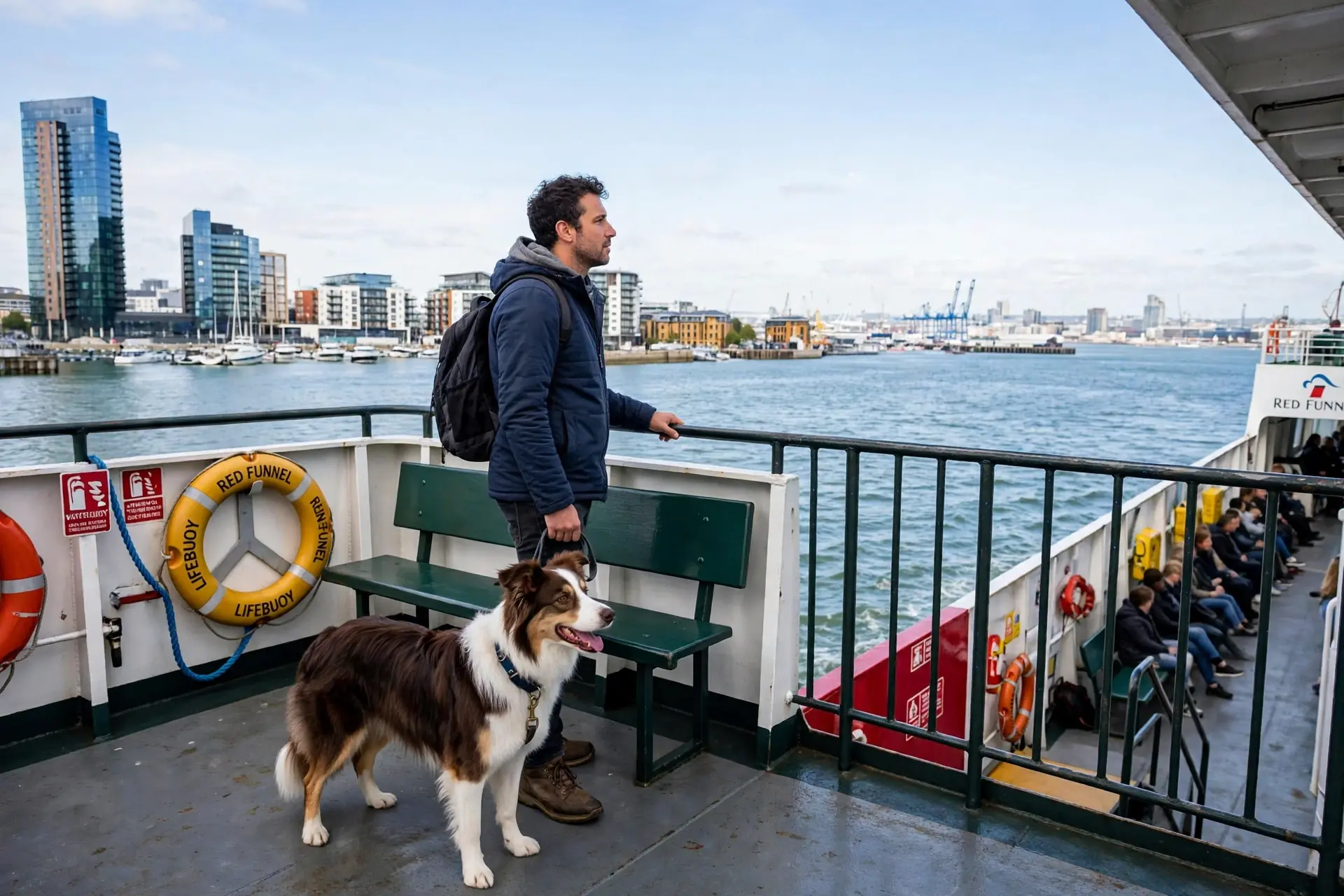
The honest comparison is not hovercraft versus ferry in general, but hovercraft versus the specific alternative for your trip. From Portsmouth, the main alternatives are the Wightlink ferry with dogs — the FastCat passenger catamaran from Portsmouth Harbour to Ryde Pier Head, taking around 22 minutes, and the car ferry from Portsmouth to Fishbourne, taking around 45 minutes — and the Red Funnel ferry with dogs from Southampton to East Cowes or West Cowes, taking 55 to 60 minutes by car ferry or around 25 minutes by Red Jet. Each has a different mainland terminal, a different island arrival point, and a different experience for the dog, so the fastest crossing is not automatically the best choice.
The hovercraft wins when speed and togetherness matter most. A ten-minute crossing with the dog at your feet is the best option for a dog that dislikes boats, for a day trip where every hour counts, for a foot passenger staying in Ryde or along the Island Line, and for anyone who wants the novelty of a hovercraft as part of the holiday. It also wins for travellers without a car who want the simplest possible journey: train to Portsmouth, HoverBus to Southsea, ten minutes across the water, and you are on the island. The total door-to-door time from central Portsmouth to Ryde can be under an hour, which no car ferry can match for a foot passenger.
The conventional ferry wins when the dog needs space, air and quiet, when you need a car on the island, or when the weather is marginal. A car ferry gives a nervous dog the option of staying in the car, waiting on an open deck, or settling in a pet lounge, and the slower pace and lower noise are easier for many dogs than a hovercraft cabin. A car ferry is also the only option if you need your own vehicle, a large amount of luggage, or a dog crate that will not fit in a hovercraft cabin. In rough weather, the larger ferries keep sailing when the hovercraft is cancelled, so a ferry booking is the safer choice for a fixed check-in, a wedding, or any day that cannot slip. And for a stay in Cowes, Yarmouth or the west of the island, a Red Funnel crossing to Cowes or a Wightlink car ferry to Yarmouth or Fishbourne may save more time on the island than the hovercraft saves on the water.
Cost is the last part of the comparison, and it is closer than it first looks. A standard adult day return on Hovertravel is £34, with an advance fare of £30.60, and the dog travels free. A foot-passenger return on the FastCat is in a similar range, and a car-ferry fare depends on the vehicle and the season, so compare the total for your whole party — people, dog, car if any, and onward travel — rather than the headline single fare. If the hovercraft is cancelled and you transfer to the FastCat, the time you saved disappears, so a tight schedule should include the cost of a possible delay. Choose the hovercraft when the ten minutes genuinely change the day; choose the ferry when space, a car or weather resilience matter more. Either way, check the official guidance before you travel for the latest fares and timetables, because prices and frequencies change with the season.
Practical checklist before you travel
Run through this list the evening before you travel, and the morning will take care of itself. First, the booking: tickets bought and saved on your phone, advance fare secured at least 48 hours ahead where possible, return type checked, booking reference noted, and the live timetable checked for the morning of travel. Second, the dog’s paperwork and health: any medication packed, vet’s number saved, ID tag on the collar with your mobile number, and the dog’s routine kept normal on the morning of travel — no new food, no new treats, and a light meal a few hours before departure rather than a full bowl at the terminal.
Third, the kit bag: a short lead and a spare, a harness that fits, poo bags, cleaning wipes, a water bottle and a collapsible bowl, a familiar blanket or mat, a chew or toy only if the dog settles with one, and a carrier if your dog travels in one. Fourth, the dog’s comfort: a proper toilet walk and exercise before you reach the terminal, water offered before boarding, and a calm, unhurried arrival at least 15 minutes before departure. Fifth, your own kit: phone charged, ticket accessible one-handed, cash or card for parking and buses, and the accommodation’s address and phone number saved for arrival in Ryde.
On the day, keep the plan simple. Check the live service status before you leave, allow extra time for the HoverBus or the walk to Clarence Pier, and do not rush the dog through the terminal. If the sailing is cancelled, stay calm, check the official updates, and ask staff about the next sailing and the FastCat ticket-acceptance arrangement before you decide whether to wait or to transfer. If the dog is struggling, remember that the crossing is ten minutes long and that you can step off in Ryde and give the dog a proper break on the Esplanade within moments of landing. A good hovercraft trip is not a complicated one: a free-travelling dog, a short lead, a settled spot on the floor, and ten minutes of patience. Get those right, and the fastest crossing in Britain becomes the easiest part of the holiday.
Planning the rest of your island break? Our guides to the Wightlink ferry with dogs and the Red Funnel ferry with dogs cover the slower crossings in the same detail, and our Isle of Wight with a dog guide brings together beaches, walks, attractions and places to stay for the whole trip.
Practical questions
Before you go
Are dogs allowed on Hovertravel?
Yes. Dogs and other pets travel free of charge on Hovertravel, and they stay with you in the passenger cabin. Your dog must be restrained by a harness, collar and lead or carried in a suitable pet carrier, and must stay on the floor, not on a passenger seat. Keep your dog close, under control and away from other passengers, and check the official guidance before you travel if your dog is large, reactive or needs extra space.
Do dogs need a ticket on the hovercraft?
No. Dogs travel free of charge and do not need a ticket of their own. You only book and pay for the people travelling. Tell the operator at booking if you are travelling with a large dog, more than one dog or a dog in a carrier, so staff can plan seating and boarding, and check the official guidance before you travel for the latest rules.
How long is the Portsmouth to Ryde crossing?
The crossing itself takes under 10 minutes, which makes it the fastest way across the Solent. Allow extra time at each end for check-in, boarding and onward travel, and aim to arrive at the terminal at least 15 minutes before departure, or earlier if you still need to buy a ticket.
Is the hovercraft too loud for dogs?
Most dogs cope well, and the current craft are quieter than the older ones, but a hovercraft is still louder and more vibration-heavy than a conventional ferry. The crossing is short, which helps. If your dog is noise-sensitive, settle them on the floor between your feet, keep them close, and consider ear protection made for dogs only if your vet has advised it; check the official guidance before you travel.
What happens if my sailing is cancelled?
If a sailing is cancelled, Hovertravel will advise you at the terminal and through its live service updates. In qualifying cases, including certain weather or technical disruptions, tickets may be accepted on the Wightlink FastCat service instead. Check the live timetable and the official guidance before you travel, and allow extra time for the slower alternative crossing.