This guide is independent and contains no paid placement. If affiliate links are added later, they will be clearly marked and will not change our editorial checks.
Red Funnel ferries from Southampton to Cowes take about an hour by car ferry and under half an hour by Red Jet. Dogs travel in the car, in the pet areas or on deck, and foot passengers can walk on with a dog. Check the official guidance before you travel, because pet areas and booking rules differ between the two boats.
Red Funnel in one page
Red Funnel runs ferries from Southampton to the Isle of Wight, and the company has been doing so for more than a century. The service has two parts: a car ferry from Southampton to East Cowes, which takes about an hour, and the Red Jet, a fast passenger boat from Southampton to West Cowes, which takes under half an hour. Both carry dogs, and both are used by islanders and visitors every day. A dog on a Red Funnel ferry is unremarkable, which is exactly what you want.
The crossing is short and the water is sheltered, which makes the whole operation simple. The dog can stay in the car, travel in a pet area, or spend the crossing on deck, depending on the boat and the owner's preference. None of the options requires a cabin or a kennel booking, and none of them asks much of the dog. A short crossing is a kind crossing, and the Solent is calm enough that seasickness is rare.
Foot passengers and cars are treated differently, and the difference shapes the trip. Foot passengers with dogs can usually turn up and travel, subject to space, while cars must be booked, especially in summer and at weekends. The Red Jet is foot passengers only, so it suits a day trip on foot, while the car ferry suits a longer stay with luggage, food and a dog's bed. Check the official guidance before you travel for the current fares and booking rules, because they change by season.
The Isle of Wight is the reason for the trip, and it is one of the most dog-friendly places in Britain. The island has beaches, coastal paths, forests and villages, and the walking is generous. Dogs are welcome on most of the beaches outside the summer restrictions, and the coastal path can be walked in sections over several days. The island is small enough that no drive is long, and the pace is slow enough that a dog can enjoy every day.
Finally, remember that Red Funnel is a working ferry service, not a tourist attraction. Islanders use it to get to work, to school and to the shops, and the timetable serves their needs as well as yours. Travel outside the commuter peaks when you can, when the boats are quieter and the dog has more space. Plan with that in mind, and the crossing will feel like part of the holiday rather than an obstacle to it.
Southampton to East Cowes: the car ferry
Southampton to East Cowes is the main Red Funnel car ferry route, and it lands you on the northern side of the island, close to Cowes, Newport and the island's main roads. The crossing takes about an hour, and the ships are large, with a pet area, a passenger deck and room to move. The route suits a longer stay, because East Cowes is close to everywhere on the island, and the drive from the port is easy.
Southampton is a large, busy port, and the check-in needs time. Arrive early, follow the marshalling instructions, and keep the dog on a short lead in the vehicle lanes. The area around the terminal has limited green space, so walk the dog before you reach the port, and use the waiting time calmly. Dogs pick up on their owners' stress, and a relaxed check-in sets the tone for the crossing.
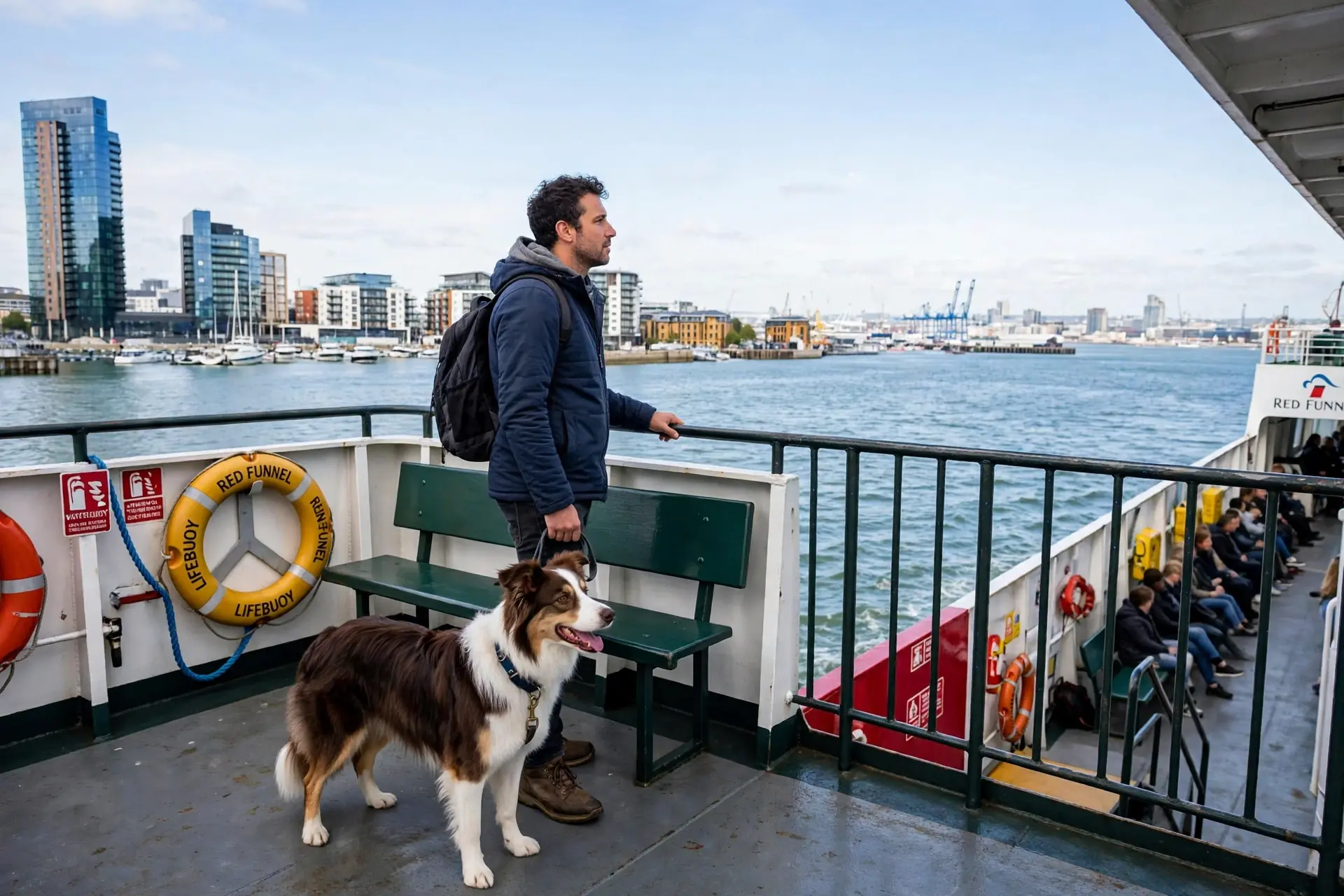
On board, the pet area is the place to settle. Find it as soon as you board, choose a quiet corner, and let the dog get used to the space. The area is warm and dry, with seating and water, and the dog can stay with you for the whole crossing. If the dog prefers fresh air, the open deck is available too, on a lead, and the Solent views are a pleasure on a clear day. Keep the dog on a short lead on deck, because the wind can be strong.
East Cowes is a quiet port, and arrival is calm. The drive out is straightforward, and Cowes itself is a few minutes away, with a harbour, shops and cafes. Plan a walk soon after landing, and keep the first day short. The northern side of the island has the Medina estuary, the beaches at Ryde and the downs above the island, and the coastal path from Cowes is a gentle introduction.
The route is popular in summer, and the car ferries book up early, especially at weekends. Book the car as soon as your dates are fixed, and be flexible about the sailing time if the one you want is full. Early morning and late evening sailings are often quieter, and a calm ship is a kinder ship for a nervous dog. Check the official guidance before you travel for the current timetable, because the frequency changes by season.
Red Jet: the fast passenger boat
The Red Jet is the fast passenger boat from Southampton to West Cowes, and it is the quickest way to the Isle of Wight. The crossing takes under half an hour, and the boat is small, quick and businesslike. There are no cars, no car deck and no long waits: foot passengers walk on, find a seat, and walk off in Cowes. For a day trip on foot with a dog, the Red Jet is hard to beat.
The boat is small, and the dog's space is limited, so the arrangement is simple: the dog stays with you, on a lead, in the designated pet area or on deck, for the whole crossing. The crossing is short enough that most dogs barely notice it, and the speed means the motion is quick rather than rolling. Dogs that are prone to seasickness may feel the motion more on a fast boat, so ask your vet about medication if your dog is sick in the car.
Boarding the Red Jet is quick and straightforward. Arrive at the terminal in good time, walk the dog before boarding, and keep the animal on a short lead in the terminal building. The boat loads quickly, so be ready to board when called, and find a seat in the pet area as soon as you are on board. The crossing is half an hour, and the best thing you can do is sit still, keep the dog close, and let the boat do the work.
West Cowes is a pretty harbour town, and arrival is a pleasure. The boat docks in the centre of town, and the streets, shops and cafes are steps away. The dog can walk straight off the boat and onto the pavement, which suits a day trip perfectly. The town has a promenade, a harbour and a castle, and the coastal path starts nearby. Plan a walk soon after landing, and keep the first day short.
The Red Jet is also the best choice for a day trip from Southampton, because the crossing is short and the boats are frequent. Walk to the terminal, sail to Cowes, walk the coast, and sail home in the evening, with the dog having had a full day out. Check the official guidance before you travel for the current timetable and pet rules, because they can change by season and the boat is smaller than the car ferry.
The pet area: a deck of your own on the Solent
Red Funnel's pet area is a deck on the passenger level, with seating, a water bowl, and space for the dog to lie down, and it is the one place on the Solent where the dog can be with you for the whole crossing. The crossing from Southampton to East Cowes takes about an hour, and the pet area turns that time into a shared one. Book it when you book, because the area has limited seats, and it fills up on summer weekends. The Red Jet, the fast catamaran to West Cowes, has its own pet area too, and the crossing takes about 25 minutes.
The pet area is not a kennel. There is no box, no door, no separation: the dog sits beside you, on a lead, on the floor or on a blanket you bring. Other dogs will be there, so the animal needs to be comfortable around strangers, and the owner needs to keep the lead short. A nervous dog will be calmer in the car, where it has its own space, and an honest owner will choose the car. A sociable dog will love the pet area, and the owner will love watching it.
Bring what the dog needs: a blanket, a water bowl, a chew, and a bag for cleaning up. The area has water, but the dog's own bowl is familiar, and familiarity is the point. Keep the visit simple: settle in, sit still, and let the dog sleep. The Solent will pass, the island will appear, and the crossing will be over before the dog has noticed it. The view from the pet area is the best on the ship, because the dog can see the water too.
Red Funnel or Wightlink: which Solent crossing?
Red Funnel and Wightlink both cross the Solent, and the choice between them is about the drive, not the dog. Red Funnel sails from Southampton to East Cowes, and the Red Jet sails to West Cowes. Wightlink sails from Portsmouth to Fishbourne and Ryde, and from Lymington to Yarmouth. The drive to Southampton is easier from the west, the drive to Portsmouth is easier from the east, and the drive to Lymington is easiest of all. Choose the port that fits your route, and the crossing will follow.
The ships are different too. Red Funnel's car ferries are large, with restaurants, a lounge and an open deck. Wightlink's are smaller, with a cafe and a lounge. The Red Jet is the fastest way across, 25 minutes, and the dog can sit in the pet area for the whole trip. Wightlink's fast catamaran to Ryde is just as quick, and the beach is minutes from the pier. The crossings are all short, so the dog will cope with any of them, and the owner should choose the one that fits the timetable.
The price changes with the time, not with the dog, and the dog travels for a small charge or free, depending on the ticket. Book early in summer, because the pet areas fill up, and the flexible fare is worth a look, because the Isle of Wight is a place where plans change. A fare that can be moved costs more up front and less in regret, and the dog is the most likely reason a trip will change.
Booking Red Funnel: the ferry is the easy part
Booking Red Funnel is the easy part of an Isle of Wight holiday, because the crossings run often and the dog is welcome on all of them. Southampton to East Cowes takes about an hour, the Red Jet to West Cowes takes about 25 minutes, and the price changes with the time, not with the dog. Open the timetable, choose the sailing that fits your day, and book the one that fits the drive. The dog travels for a small charge or free, depending on the ticket.
Add the dog when you book, and say whether it will be in the car or in the pet area. The pet area has limited seats, so book early on summer weekends, and the car needs its registration, so have it ready. The confirmation should name the route, the time, the car, and the dog, and each one is easier to fix now than at the port. Keep the confirmation on your phone and on paper, because a dead battery at Southampton is a poor start to a holiday.
The flexible fare is worth a look, because the Isle of Wight is a place where plans change. A fare that can be moved costs more up front and less in regret, and the dog is the most likely reason a trip will change. Travel insurance that covers the dog is worth a look for longer trips, and the policy should cover vet treatment on the island, not just cancellation. The dog is the most likely reason a trip will change, so insure for the dog, not just the humans.
The crossing: an hour on the Solent
The crossing from Southampton to East Cowes takes an hour, and the dog's day on it is short enough to be simple. Board, find the pet area or settle the dog in the car, and then sit still. The Solent will pass, the island will appear, and the crossing will be over before the dog has noticed it. The ship has a restaurant and a lounge, but the dog's day should be quiet, because the crossing is short enough without excitement.
The open deck is the ship's best feature, and it is the place to go when the weather allows. The wind is strong, the view is wide, and the dog is allowed there on a lead, so enjoy it together. The Isle of Wight appears slowly, green and low, and the dog will smell it before the owner sees it. A short walk on deck, a look at the water, and then back inside for the arrival. The Red Jet is different: 25 minutes, no time for a deck walk, and the dog will barely have settled before the island appears.
Disembarkation is the easy part. The car deck empties quickly, the drive off takes minutes, and the island is there. Do not let the dog out of the car in the lanes, and do not stop in the port. East Cowes is quiet, and a proper walk can begin within minutes of landing, on the beach at Cowes or the coastal path. The crossing's whole point is time saved, and the dog's whole point is a walk that is not rushed.
Cowes: the first walk on the island
Cowes is the first town most Red Funnel passengers see, and it is a good place to start. East Cowes has a beach and a waterfront, West Cowes has a harbour full of yachts and a high street with cafes. The dog can walk the seafront, sit on a terrace, and watch the boats come and go. The town is compact, so no walk is long, and the dog can have a different walk every day without ever repeating one.
The coastal path runs from Cowes around the island, and the section to Gurnard is the gentlest, a flat path along the water with views across the Solent. The dog can run off the lead on the beach, and the cafes at Gurnard put out water bowls without being asked. The island is famous for its welcome, and the dog will feel it. Keep the first day short, and let the dog discover the island at its own pace.
Staying over is easy, because Cowes is used to dogs. Hotels, cottages and guesthouses welcome them, often with a small charge, and the restaurants with terraces welcome them too. Book early in summer, because the dog-friendly rooms go first, and confirm the policy in writing, because the details vary. The town is small, so no drive is long, and the dog can have a different walk every day.
The west of the island: cliffs, fossils and beaches
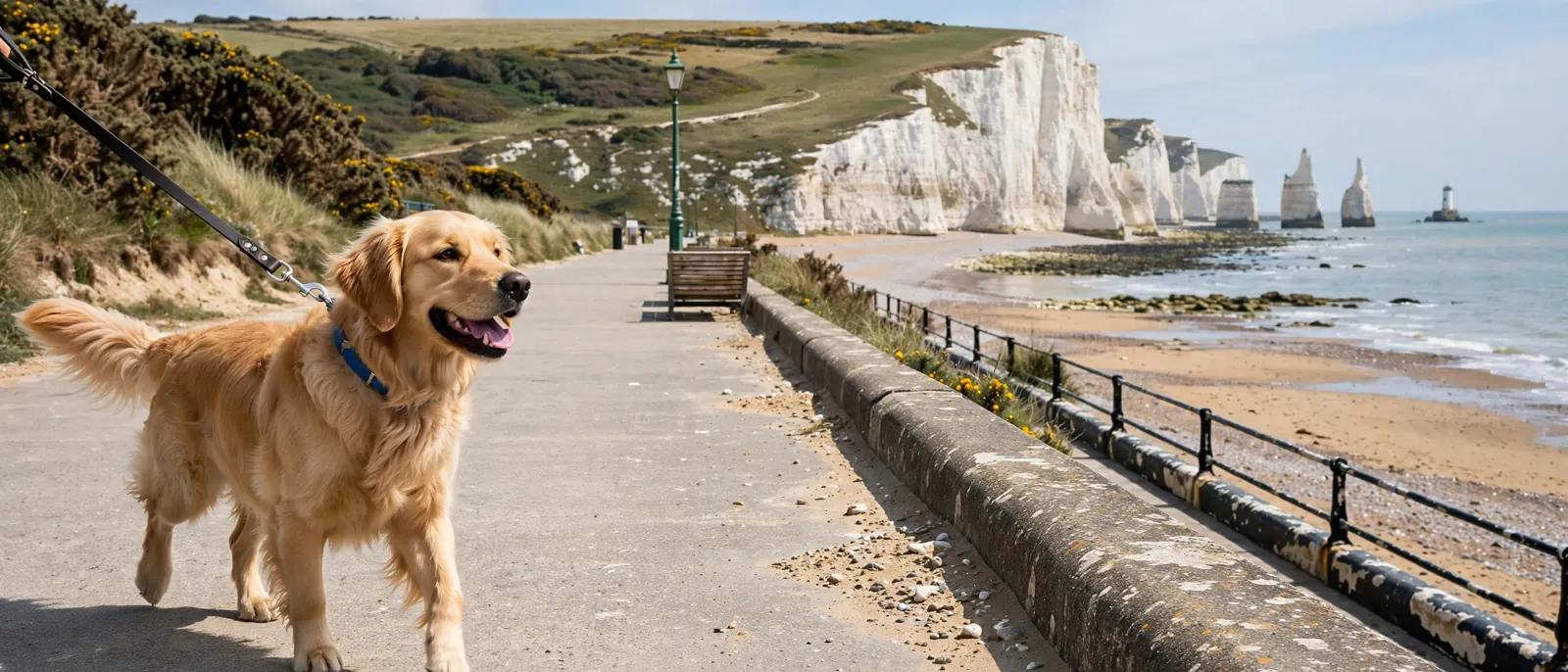
The west of the Isle of Wight is the wildest part, and the dog will love it. Compton Bay has cliffs and fossils, and dogs are welcome on the beach. The Needles, at the far west, have chalk stacks in the sea, and the coastal path runs along the top, with views that stretch for miles. The dog should be on a lead near the edge, because the cliffs are high and the wind is strong, but the walk is one of the best in Britain.
The beaches on the west coast are sandy and flat, perfect for running, and the tides matter, because the beaches change with them. At low tide, the sand stretches out, and the dog can run for miles. At high tide, the sand disappears, and the dog needs a different walk. Check the tide times before you go, and plan the beach walks for low tide. The water is cold, even in summer, and the dog should be dried off after a swim.
The villages on the west coast are small and quiet, with pubs that have gardens and cafes that put out water bowls. Freshwater has a beach and a river, Yarmouth has a harbour and a castle, and the coastal path runs between them, flat and easy. The west of the island is a place that rewards a slow holiday, and the dog will be happier for it. A week on the west coast is not enough, but it is a good start.
The way home: the Red Jet and the last walk
The way home starts with a last walk, because the dog has earned it. Walk the beach at Cowes, or the coastal path to Gurnard, and give the dog twenty minutes to stretch, drink and empty itself. The crossing is short, and the dog will sleep through it, but the last walk is the memory the dog will carry home. A short stop now makes the rest of the drive easier, and the dog will be calmer for it.
The Red Jet is the quickest way home, 25 minutes from West Cowes to Southampton, and the dog can sit in the pet area for the whole trip. The car ferry takes an hour, and the dog can be in the car or the pet area. Choose the sailing that fits the drive, and book it before you leave the island, because the pet areas fill up on summer Sundays. The flexible fare is worth it on the way home, because the dog is the most likely reason a trip will change.
Once home, give the dog a quiet day: a familiar walk, a normal feed, and a long sleep. The holiday ends the way it began, with the dog's needs first, and the memories will last longer than the tiredness. The Isle of Wight is a place that rewards a return visit, and the dog will remember the beaches long after the owner has forgotten them.
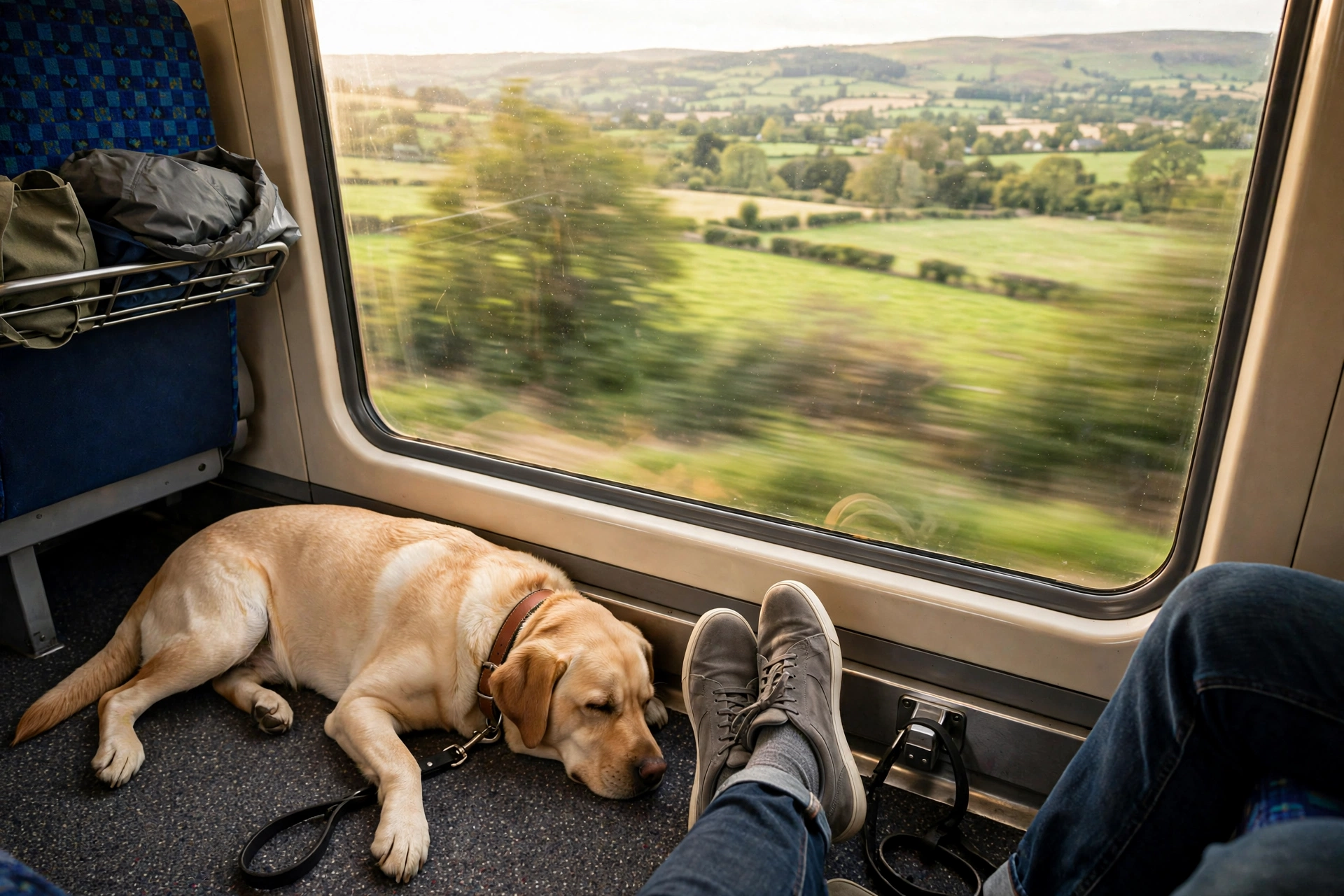
For the full island picture, read our Isle of Wight with a dog guide, and if you are travelling by train to Southampton, our taking a dog on UK trains guide covers the rail journey.
Practical questions
Before you go
Do dogs need a ticket on Red Funnel?
Yes, a small charge, or free depending on the ticket. The dog can travel in the car, in the pet area, or on foot with its owner. Book the pet area early on summer weekends, because the seats are limited.
Can my dog travel in the pet area on Red Funnel?
Yes, where the ship offers one. The pet area is a deck on the passenger level, with seating and water, and the dog sits beside you on a lead. A sociable dog will love it, and a nervous dog will be calmer in the car. Choose the arrangement that fits the dog.
How long is the Red Funnel crossing to the Isle of Wight?
Southampton to East Cowes takes about an hour, and the Red Jet to West Cowes takes about 25 minutes. The dog can be in the car, the pet area, or on foot, depending on the sailing.
Can I take my dog on the Red Jet?
Yes. The Red Jet is the fast catamaran from Southampton to West Cowes, taking about 25 minutes, and the dog can sit in the pet area for the whole trip. Book early, because the pet area fills up on summer weekends.
Which Red Funnel route is best with a dog?
Southampton to East Cowes is the most popular, with the pet area and an hour to settle. The Red Jet to West Cowes is quickest, and the harbour is minutes from the pier. The best route is the one that fits the drive and the dog.
Do dogs need documents to travel to the Isle of Wight?
No. The Isle of Wight is part of England, so no passport, certificate or vet treatment is needed. The dog needs a collar, a lead, and a microchip, as at home. Check the ferry's own rules before you travel, because they change from time to time.