This guide is independent and contains no paid placement. Ferry rules, vessel arrangements and pet charges can change, so check the official guidance before you travel and confirm the details shown on your own booking.
Most dogs cross to the Isle of Man in the vehicle or in a designated pet area, not in the main passenger lounge. Declare the dog at booking, arrive early enough for a proper toilet walk, keep the car cool and ventilated, and plan the whole door-to-door journey, including waiting and disembarkation, rather than only the sailing time.
Routes to the island: what the crossing really involves
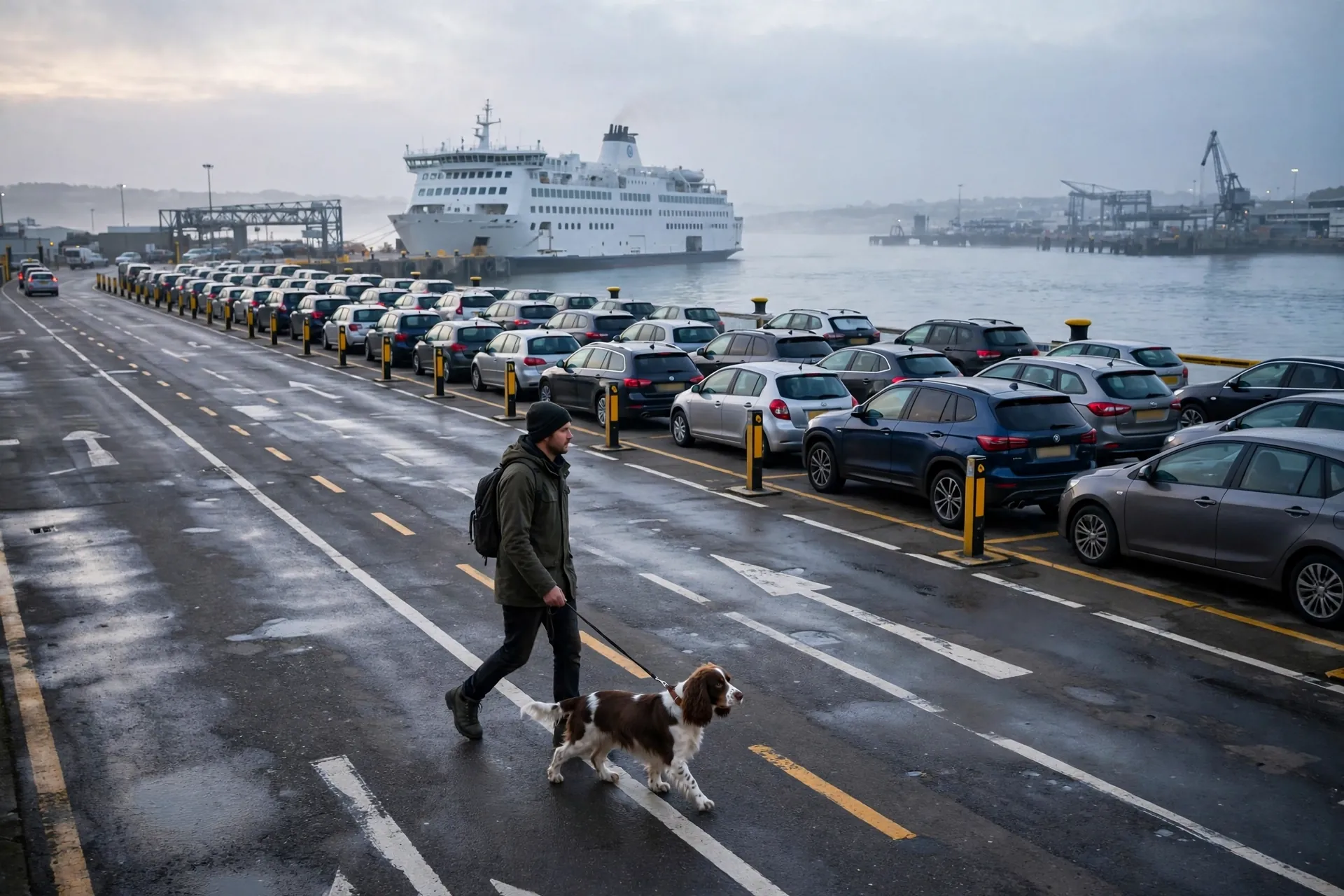
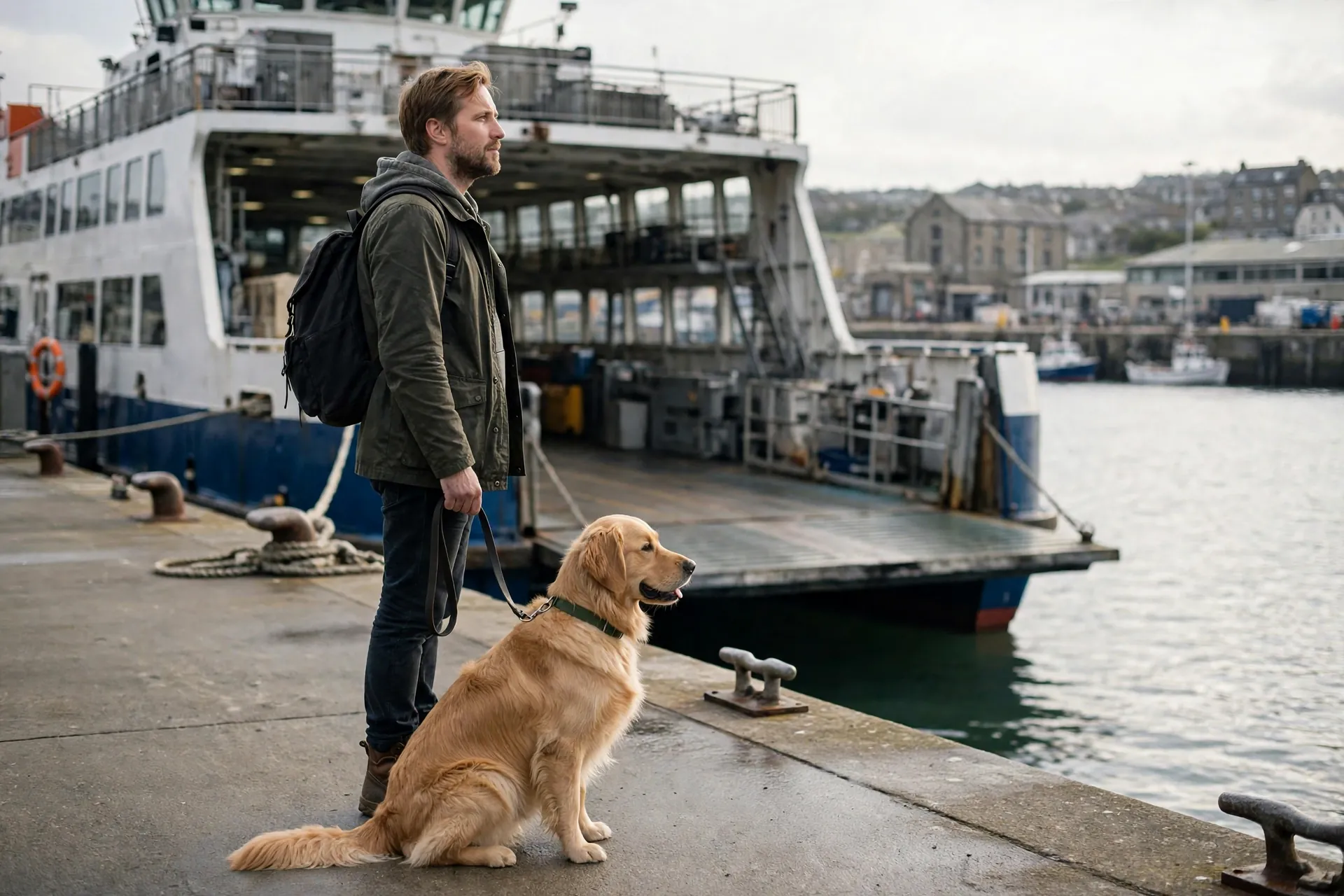
Picture the quayside on sailing day. Cars queue in lanes, foot passengers gather near the terminal doors, gulls circle above the harbour wall, and a dog on a lead sniffs the sea air while its owner checks the departure board one more time. That moment is the whole trip in miniature: a short sea crossing that still needs proper planning, because the dog cannot simply wander off for a toilet break halfway across the Irish Sea. The Isle of Man sits in the middle of that sea, between England, Scotland, Ireland and Wales, and every journey to it by ferry begins with a drive or a train ride to a mainland port, continues with a period of waiting at the terminal, and ends with a drive out of Douglas or another Manx port. Understanding that full shape matters more than memorising a single sailing time.
The principal ferry operator for the Isle of Man is the Isle of Man Steam Packet Company, which runs services to Douglas, the island capital. The best-known mainland departure points are Heysham, near Lancaster in Lancashire, and Liverpool, with additional seasonal or less frequent services from other ports including Belfast and Dublin at certain times of the year. Routes, timetables and vessels change with the season, and a winter timetable can look very different from a summer one, so the first practical step is to check the current timetable for your own dates rather than relying on a timetable remembered from a previous year. A summer service may use a fast craft with a shorter crossing, while a winter service may use a conventional vessel with a longer crossing and a different arrangement for animals. Both can work well for dogs, but they ask different things of the owner.
Crossing times also vary by vessel type. A fast craft can make the journey in a few hours, whereas a conventional ferry takes longer but often feels steadier in a swell, which can matter for a dog prone to motion sickness. Neither figure on its own tells you how long the dog will be without a proper walk. Add the drive to the port, the check-in window, the wait in the marshalling lanes, the loading process, the crossing itself, and the time needed to drive off and clear the port at Douglas, and the total time between the last comfortable toilet stop on the mainland and the first proper walk on the island can easily be twice the sailing time. That is the number to plan around. A dog that can comfortably hold on for three hours may still struggle if the door-to-door gap stretches to six, especially if traffic, a delayed sailing or a slow disembarkation extends the day.
Choosing a departure port is therefore a dog decision as well as a human one. Heysham suits travellers coming from the north of England and Scotland who want a shorter drive after an early start, while Liverpool suits travellers from the Midlands, the north-west and Wales, and offers more onward transport options. Belfast and Dublin services suit travellers already in Ireland, but they may run less often and may not suit every itinerary. Think about the drive on both sides of the water: a long mainland drive before an early sailing means an early alarm, a rushed toilet walk and a tired dog before boarding, while a shorter drive leaves time for a calm walk, water and a settle before check-in. On the island side, Douglas is the main arrival point, and from there most accommodation, beaches and walking routes are a drive away, so the first hour on the island needs its own plan, covered later in this guide.
Foot passengers travelling with a dog need extra care. A car gives the dog a familiar, contained space for the crossing and a straightforward route on and off the vessel, whereas a foot passenger has no vehicle to leave the dog in and must rely on whatever pet facility the vessel provides. That difference can decide whether a particular sailing is suitable at all, so foot passengers should confirm the pet arrangement in writing before booking, rather than assuming that a dog-friendly ferry automatically means a dog-friendly foot-passenger crossing. Cyclists and motorcyclists face a similar question: the dog needs a safe, legal and comfortable place for the whole crossing, and a carrier that works on a train or a bus may not be the right answer on a ferry. If the arrangement does not fit your dog, choose a different sailing or a different mode of arrival, and check the official guidance before you travel.
Where your dog travels on board: vehicle, kennel or designated area
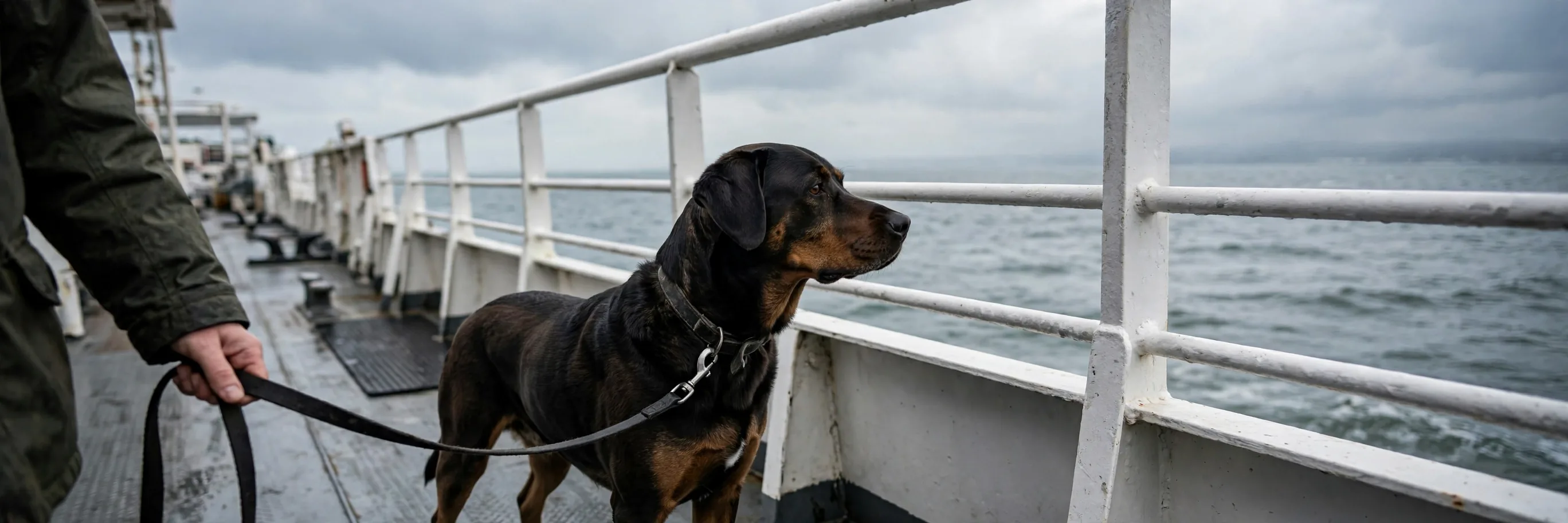
The single most important question for an Isle of Man ferry crossing is also the simplest: where will the dog actually be during the sailing? On many Isle of Man services, the default answer is that the dog stays in the vehicle on the car deck. That arrangement surprises some first-time travellers who picture the dog curled under a lounge seat, but it is common on vehicle ferries across Britain and Ireland, and it has real advantages. The car smells familiar, the dog already associates it with travel, and the owner can settle the dog with its own bed, a familiar blanket and water before leaving the deck. The trade-off is separation: owners are generally not permitted to remain on the car deck during the sailing, and access to the vehicle during the crossing may be restricted or unavailable except in an emergency or at crew discretion. Plan as if you will not see the dog again until disembarkation, and make the car comfortable enough for that whole period.
Some vessels and some ticket types offer alternatives, which is why the vessel matters. Designated pet areas, kennels or pet-friendly cabins may be available on certain services, and the availability can depend on the ship, the season and how early you book. A kennel on board suits a dog that settles in a crate and is used to unfamiliar spaces, but it can unsettle a dog that has never been kenneled, so do not book a kennel simply because it sounds more sociable than the car. A pet-friendly cabin, where available, suits a dog that settles quietly indoors and an owner who wants to stay with the animal, but cabins are limited, they cost more, and they may carry their own rules about bedding, cleaning and the number of animals. A designated deck or lounge area, where offered, suits a calm dog that is comfortable around strangers and other dogs, but it is a poor fit for a reactive dog that barks at every passer-by. Compare the options against your own dog, not against an idealised picture of ferry travel.
Whatever the arrangement, the practical rules are similar. Keep the dog on a lead in all public and terminal areas, and use a harness or a secure carrier where the operator requires one. Muzzles may be required in certain areas or for certain dogs, so check the official guidance before you travel and pack a muzzle your dog has already been trained to accept, rather than introducing one for the first time on sailing day. Bring poo bags, a portable water bowl and a towel, and clean up promptly if the dog toilets in a terminal area. Crew instructions on board override any general advice in this guide: if crew ask you to move, to wait or to use a particular route, follow their instructions promptly, because they are managing vehicle decks, passenger safety and animal welfare at the same time.
Temperature and ventilation deserve special attention for dogs travelling in vehicles. A car deck can be warm on a summer day and cold and draughty on a winter night, and a dog left in a car needs shade, airflow and water appropriate to the conditions. Before boarding, park in shade where possible, leave windows cracked only as far as the vessel rules and your own security allow, and never leave a dog in a vehicle that could overheat. A reflective windscreen shade, a battery-powered fan where permitted, and a frozen water bowl or a lick mat can help in warm weather, while a familiar blanket and a draft-free position help in cold weather. Check the official guidance before you travel about what is permitted on the car deck, because rules about fans, window positions and access differ between vessels. If you have any doubt about whether the car will stay at a safe temperature for the whole crossing, choose a different arrangement or a different sailing, and discuss the question with your vet if your dog is elderly, brachycephalic or has a medical condition that affects temperature regulation.
For general background on how pet arrangements differ between operators, our guide to dogs on UK ferries explains vehicle, kennel, pet cabin and pet lounge options across routes, and it is a useful companion read before you compare Isle of Man sailings. The details for the Isle of Man itself, however, should always be confirmed against the current Steam Packet guidance for your vessel, because a general ferry guide cannot replace the terms shown on your own ticket.
Booking and declaring your dog: get the details right first time
Declare the dog at the point of booking, not at the terminal. That single habit prevents most ferry problems for dog owners. When you book, the system needs to know that an animal is travelling, how many animals are travelling, and, where asked, the size or type of animal and the vehicle it will travel in. This lets the operator apply any pet charge, record the animal on the sailing manifest and assign the correct arrangement for the vessel. Arriving undeclared risks a refused boarding, a delay while staff amend the booking, or a pet charge applied at a higher rate, and none of those outcomes helps a dog that is already excited by the port environment. If you book by phone, ask the agent to read back the pet details; if you book online, check the confirmation email line by line before you close the browser tab.
Check the confirmation for more than the sailing time. It should show the departure port, the arrival port, the date, the vehicle registration, the number of passengers and the number of animals, and any pet facility or cabin booked. If any of those details is wrong, correct it promptly, because a misspelled registration plate or a missing animal can cause a hold-up at check-in. Keep a copy of the confirmation on your phone and, as a backup, a printed copy in the glovebox. Mobile signal at ports can be patchy, and a paper copy removes one source of stress at the check-in booth. Also note the check-in closing time, which is earlier than the departure time: ferries do not wait for late arrivals in the way a train sometimes appears to, and a dog owner who misses check-in because of a toilet stop or a traffic queue may lose the sailing altogether.
Think about the sailing time from the dog's point of view when you choose between departures. An early morning sailing often means a very early start and a dog that has not had a proper morning walk, while a late evening sailing means a tired dog, a dark arrival and a search for accommodation in the dark. A mid-morning or early afternoon sailing often gives the best balance: time for a calm morning walk at home, a relaxed drive to the port, a toilet stop near the terminal, and a daylight arrival in Douglas with time to reach accommodation before dark. School holidays, the TT races and other Manx events change the picture entirely, because sailings and island accommodation book up early and terminals become busier and noisier. If your dates coincide with a major event, book the ferry and the accommodation together, allow extra time at the terminal, and expect more noise, more people and more dogs in the marshalling lanes.
Multiple dogs, assistance dogs and unusual cases need explicit confirmation. Most operators limit the number of animals per booking or per vehicle, and a household travelling with three dogs may need a different arrangement from a household travelling with one. Assistance dogs are treated differently from pet dogs under the relevant rules, and they should not be charged as pets or refused a facility they are entitled to use, but the operator may still ask for documentation, so carry it and declare the dog's status at booking. Dogs that are anxious, reactive or recovering from illness need a conversation, not just a tick box: ask the operator what happens if the dog barks continuously, whether a different deck or facility is available, and what the crew will do if the dog becomes distressed. Write down the answer, including the name of the person you spoke to, and keep it with the booking.
Finally, book the island side before you book the ferry, or at least check that suitable accommodation exists for your dates. A ferry ticket without a place to stay leaves a dog owner searching for dog-friendly accommodation on arrival, which is a poor start to any trip. Confirm that the accommodation accepts your dog, that it accepts the number of dogs you are travelling with, and that any pet charge, cleaning rule or alone-time rule is acceptable. The ferry and the stay are one journey, not two separate purchases, and the dog's welfare depends on both halves working.
Boarding and disembarking: a calm, step-by-step routine
Arrive early, and use the extra time well. Aim to reach the port with enough margin for a toilet walk, a drink of water, a check-in queue and a calm wait in the marshalling lanes, rather than arriving at the last possible minute. On arrival, follow the lane signs for your sailing and vehicle type, and keep the dog on a lead from the moment you leave the car. Ports are busy working environments with moving vehicles, reversing lorries, forklifts and loud announcements, and a dog off lead in that environment is at risk even if it is normally reliable. If you need to take the dog out of the car for a toilet break, choose a quieter corner away from moving traffic, keep the lead short, and clean up immediately.
Check-in itself is usually straightforward: present the booking reference and identification as required, confirm the vehicle and passenger details, and follow the lane directions given by staff. This is the moment to mention anything unusual, such as a dog that becomes distressed in the car, a medical need, or a mobility issue that affects how quickly you can move between decks. Staff can often help with lane positioning or with advice about the vessel, but they can only help with problems they know about, and they cannot help after the vessel has loaded. If the dog needs medication, give it at the time your vet advised, not at the moment of boarding when excitement and stress can make dosing difficult.
Loading follows a set order, and patience helps. Vehicles are directed onto the vessel deck by deck, and drivers are asked to switch off engines, apply handbrakes, leave vehicles in gear where instructed, and move promptly to the passenger areas. Settle the dog before you leave the car: a familiar bed or blanket, a safe chew or lick mat if the dog uses one and the vessel rules allow it, fresh water in a spill-proof bowl, and ventilation appropriate to the weather. Remove anything the dog could chew dangerously, such as loose cables or medication left in a door pocket, and check that the car is locked and that valuables are with you. Take the lead, poo bags and a small bag of essentials with you to the passenger area, because you may not be able to return to the car during the crossing.
During the crossing, use the time to rest and to prepare for arrival, rather than worrying about the dog every minute. Most dogs settle after the initial excitement of loading, especially if the car is familiar and the journey is not excessively long. If you are travelling in a pet cabin or a designated pet area, follow the housekeeping rules for that space: keep the dog on its bedding, clean up promptly, and respect other passengers and their dogs. If the dog is in the vehicle, accept that you will not be able to check on it, and use the crossing to eat, to review the route from Douglas to your accommodation, and to check the weather and road conditions on the island. Avoid alcohol or medication that would impair your ability to drive off the vessel safely, because disembarkation can require concentration after a long day.
Disembarkation needs the same calm routine in reverse. Wait for the announcement for your deck, return to the vehicle promptly, and check the dog before driving off: offer water, check for signs of distress or overheating, and give the dog a moment to settle before joining the queue to leave the vessel. Drive slowly through the port, because other vehicles, pedestrians and port staff share the same routes, and do not stop for a toilet break in a traffic lane. The first proper stop should be a safe, legal place outside the port, covered in the next-but-one section, where the dog can toilet, stretch and drink before the drive to accommodation. Our guide to dogs at ferry terminals covers check-in timing, terminal walks and foot-passenger rules in more detail, and it is worth reading before a first sailing from an unfamiliar port.
Seasickness, anxiety and settling: helping a dog cope with the sea
Some dogs love boats, some tolerate them, and some become genuinely miserable at sea, and the difference is not always predictable from car travel. A dog that rides happily in a car for hours may still drool, pant, pace or vomit on a ferry, because the motion of a ship is different: a slow roll, a sudden pitch, engine vibration and the smell of fuel and other vehicles combine into an experience the dog has never met before. The first crossing is therefore a trial, and it is wiser to plan for a dog that struggles than to assume a dog that will sleep through. If you already know your dog suffers from motion sickness in cars, discuss the ferry with your vet well before sailing day, because medication, dosing and timing need professional advice and cannot be improvised at the terminal.
Preparation starts at home, not at the port. Feed a smaller meal than usual on sailing day, and time it so the dog is neither hungry nor full at boarding; a very full stomach worsens nausea for many dogs, while an empty stomach can worsen anxiety. Offer water freely, but avoid a large drink immediately before loading if the dog tends to vomit when excited. A familiar blanket that smells of home, a worn item of the owner's clothing where practical, and a long-lasting chew or lick mat can all help a dog settle, provided the item is safe to leave unsupervised in the car or kennel. Avoid new toys, new treats or new calming products on sailing day itself, because a new product that upsets the stomach or causes an allergic reaction at sea is a problem with no easy solution.
Anxiety needs a different toolkit from nausea, although the two often travel together. Signs of anxiety include panting, drooling, whining, pacing, trembling, yawning, lip-licking and an inability to settle, and they can appear before boarding, in the marshalling lanes, as soon as the vessel moves, or only when the sea becomes rough. A dog that is anxious about separation may do better in a pet cabin or a designated area with the owner, while a dog that is anxious about noise and strangers may do better in the quiet familiarity of its own car. There is no universal answer, which is why the choice of arrangement should follow the individual dog. Desensitisation helps for future crossings: short practice visits to a port area, sitting in a stationary vehicle near water, and gradually longer car journeys can all reduce novelty, but they cannot be compressed into the week before a first sailing. If anxiety is severe, ask your vet about behavioural support and about whether a ferry crossing is the right choice for this dog at this time.
During the crossing, owners in a pet cabin or pet area can help by staying calm, speaking quietly and avoiding constant fussing, which can reinforce anxiety rather than relieve it. Keep the dog's bedding in one place, offer water at intervals, and avoid opening doors or moving between areas unnecessarily. Owners whose dogs are in vehicles cannot intervene, so the preparation matters even more: settle the dog thoroughly before leaving the deck, leave a familiar scent and a safe chew, and trust that most dogs do settle once the initial excitement passes. On arrival, check for vomiting, drooling or distress, offer water and a short walk, and do not feed a large meal immediately; a small, bland meal after the dog has settled is kinder than a full dinner straight off the vessel. If vomiting, collapse, breathing difficulty or any other worrying symptom occurs, seek veterinary advice promptly rather than waiting to see if it passes, and keep the number of an island vet saved on your phone before you sail.
Older dogs, puppies and dogs with medical conditions need tailored advice. Puppies may not have completed their vaccination course, may be more prone to nausea and may need more frequent toilet breaks than a crossing allows, so check the official guidance before you travel and ask your vet whether the timing is right. Older dogs may struggle with steps, ramps and long waits, and may need more time to toilet and to settle after disembarkation. Brachycephalic breeds, such as bulldogs and pugs, are more vulnerable to heat and to breathing difficulty, and they need particular care with temperature, ventilation and stress. A dog with epilepsy, diabetes, heart disease or any condition requiring timed medication needs a plan that covers the whole door-to-door journey, including what happens if a sailing is delayed. When in doubt, the vet's advice outranks any general guide, including this one.
Douglas and the first hour on the island: toilet stops, driving and settling in
Douglas is the island's capital and its main ferry port, a Victorian seaside town wrapped around a sweeping bay, with a promenade, a harbour and a town centre within a short drive of the ferry terminal. Arriving there with a dog is a pleasure once the port routine is done, but the first hour still needs a plan. Do not drive straight to a beach or a long walk without giving the dog a proper toilet break, water and a chance to stretch. The dog has been confined, possibly for several hours, and the kindest first stop is a quiet, legal place where it can toilet without traffic, crowds or other dogs rushing up. Look for a green space or a quiet street away from the port traffic, keep the lead short, and clean up. Only after that first break should you think about the drive to accommodation, a cafe or a first walk.
Driving on the Isle of Man brings its own notes. The island has a network of main roads, rural lanes and coastal routes, and speed limits and road layouts differ from mainland Britain in places, including sections of unrestricted road outside built-up areas that surprise first-time visitors. Drive at a speed that suits the road, the weather and the dog in the back, and do not let the novelty of the island distract you after a long crossing. Plan the route from Douglas to your accommodation in advance, including a fuel stop if needed, because rural petrol stations may close earlier than mainland ones and mobile signal can be patchy in the island's interior. If you arrive late in the evening, a pre-booked meal or a simple self-catering supper is far better than searching for a dog-friendly restaurant in the dark with a tired dog.
Once at the accommodation, give the dog the same boring first hour recommended for any holiday stay. Walk the boundary or the garden, check gates and fences, find the water bowl and the bed, and let the dog sniff the new space at its own pace. Keep the first evening routine close to home: the same feeding time, the same bed, the same last-outing pattern. A dog that settles on the first night will enjoy the island far more than a dog that spends the first night pacing a strange room, and the owner will sleep better too. Save the island's best walks for the following day, when both of you are rested, and use the arrival evening for a short, calm outing rather than an ambitious coastal hike.
Beyond Douglas, the island offers a remarkable range for a small place: sandy beaches, glens, coastal paths, a steam railway and a mountain road to Snaefell, the island's highest peak. Beach rules, seasonal restrictions and livestock considerations vary by location, so check the local rules for each beach and walk before you go, keep the dog on a lead around livestock and on cliff paths, and carry water on longer walks, because island streams and troughs are not always safe or accessible. The island's size is deceptive: distances look short on the map, but narrow lanes, single-track roads and sheep on the road can slow a journey considerably, so allow generous time for every outing and never plan a tight schedule around a return ferry on the last day.
Bad weather, delays and cancellations: the Irish Sea does not keep a timetable
The Irish Sea can be rough, and Isle of Man sailings are more exposed to weather disruption than many mainland routes. Strong winds, heavy swell and poor visibility can delay a sailing, change its vessel, or cancel it outright, and the effect can last for more than one sailing if a storm sits over the sea for a day or two. This is not a reason to avoid the island, but it is a reason to build flexibility into the trip. Never plan a ferry crossing so tightly that a single cancellation ruins the holiday: allow a buffer day at the start if you can, avoid booking non-refundable accommodation or activities for the arrival evening, and keep the return journey flexible where the ticket terms allow it. A dog owner with a buffer day can wait out a storm calmly; a dog owner with a non-refundable dinner reservation and a check-in deadline cannot.
Check the forecast and the operator's sailing updates before you leave home, and check again before you leave for the port. Operators publish sailing status updates through their websites, apps and social channels, and a sailing that looks fine in the morning may be disrupted by the afternoon if the wind strengthens. If a sailing is delayed, the dog still needs toilet breaks, water and a calm place to wait, and a long wait in a car in a port car park is very different from a long wait at home. Pack extra water, food, poo bags and a towel for a delayed sailing, and know where the nearest safe walking area near the port is before you need it. If a sailing is cancelled, contact the operator promptly to rebook or to discuss a refund, and contact the accommodation to explain the delay, because island hosts are used to weather disruption and will usually be understanding if they are told early.
Seasickness and weather are linked. A rough crossing is harder for every dog, and a dog that copes well in calm water may struggle badly in a swell. If the forecast predicts rough seas and your dog is prone to sickness or anxiety, consider whether to travel on that sailing at all, and discuss the decision with your vet if medication is involved. There is no shame in postponing a crossing for the dog's welfare, and a day spent waiting on the mainland is better than a crossing that leaves the dog distressed and the owner unable to help. Conversely, a dog that travels well may cope with a moderate swell without difficulty, provided the car is secure, the dog is settled and the crossing is not excessively long. Judge the forecast against your own dog, not against other travellers' stories.
Disruption on the return journey needs the same planning. A cancelled return sailing can mean an extra night on the island, so keep a small reserve of dog food, medication and cash, and know whether your accommodation can extend by a night. Check that your pet insurance, travel insurance or booking terms cover weather disruption, and keep receipts for any extra costs, because a claim may require them. If you must be back on the mainland by a particular time for work, a vet appointment or another commitment, build in a full day of margin, and tell anyone waiting for you that a ferry delay is possible. The island rewards flexible travellers and punishes rigid ones, and that is part of its character.
Fees, documents and checks: what to confirm before you pay
Pet charges for Isle of Man ferries vary by operator, vessel, route and arrangement, so treat any figure quoted in a general guide as illustrative rather than as a price for your sailing. A dog travelling in a vehicle may attract a modest per-crossing charge, a kennel or a pet cabin may cost more, and a foot-passenger arrangement may be priced differently again. The only reliable price is the one shown on your own booking before you pay, with the pet charge itemised separately from the vehicle and passenger fares. If the charge is not itemised, ask for it to be confirmed in writing, because a charge discovered at check-in is harder to challenge and can sour the start of the trip. Budget for both crossings, not just the outward one, and remember that a change of sailing may change the pet charge if the vessel or the arrangement changes.
Documents depend on the journey, and this is an area where assumptions cause trouble. A dog travelling within the British Isles may face different requirements from a dog travelling from continental Europe or from further afield, and requirements can also depend on the dog's origin, its vaccination history and whether it has travelled internationally before. Carry the dog's identification, microchip details, vaccination records and any health documentation you hold, even if you do not expect to be asked for them, and keep them in a waterproof folder with the ferry booking. If your journey involves any border, any transit through another jurisdiction, or any unusual circumstance, such as a recently imported dog or a dog that has recently been ill, check the official guidance before you travel and ask the operator in writing what is required. Do not rely on a forum post or a previous traveller's experience as a substitute for current official advice.
Identification and control are the everyday documents of ferry travel. The dog should wear a collar and tag with the owner's name and a current phone number, and the microchip details should be up to date with the owner's current address and phone number. A dog that escapes in a port or on a vessel is far easier to reunite if its tag and chip details are current, and a dog without identification may be harder to help. A lead, a harness and, where required, a muzzle are not optional extras: they are the tools that keep the dog, other passengers and port staff safe. Pack a spare lead as well, because a broken clip or a chewed lead at a port is a problem that a spare solves in seconds.
Insurance and liability complete the picture. Pet insurance that covers veterinary treatment away from home is sensible for any island trip, because island veterinary practices may be unfamiliar with your dog's history and may charge for emergency treatment. Third-party liability cover matters too, because a dog that injures another person or another dog in a busy terminal or on a vessel can create a claim. Travel insurance that covers cancellation, delay and extra accommodation costs is worth considering for a ferry trip, especially in winter or during storm season, when disruption is more likely. Read the policy exclusions before you rely on it, and keep the policy number and the insurer's phone number with the ferry booking. For a wider island comparison, our guide to taking a dog to the Isle of Wight shows how another island's ferry rules, beach bans and walks compare, which can help first-time island travellers decide what kind of island trip suits their dog.
Packing checklist for the crossing: pack for the dog, not just for the holiday
Pack the crossing bag separately from the holiday luggage, so that everything the dog needs for the sailing is in one place and accessible without unpacking the car at the port. The list below covers the essentials, and it can be adapted for a short summer crossing or a long winter one. Start with the basics: a lead and a spare lead, a harness, a muzzle if required or if the dog is reactive, poo bags, a portable water bowl, a bottle of water, and a towel for wet paws or a wet coat. Add the dog's familiar bed or blanket, a safe chew or lick mat, and any medication in its original packaging with the vet's instructions. Keep the dog's vaccination and identification records in the same bag, in a waterproof folder, with the ferry booking and the accommodation details.
Think about temperature and comfort as part of packing, not as an afterthought. In summer, pack a reflective windscreen shade, a frozen water bottle that can thaw during the crossing, and a cooling mat if the dog uses one. In winter, pack an extra blanket, a drying coat for the arrival walk, and a torch for a late arrival, because island lanes can be dark and a dog that needs a toilet break on arrival should not have to do so in pitch darkness. In all seasons, pack a spare set of bedding, because a dog that vomits or toilets in the car will need clean bedding for the rest of the journey, and a plastic bag for soiled items keeps the car tolerable. A small first-aid kit for the dog, including any items your vet recommends, belongs in the crossing bag, not in a suitcase buried under holiday clothes.
Food and feeding need a plan that covers delays. Pack enough food for the crossing day plus one extra day, in case a sailing is delayed or cancelled, and pack it in a sealed, waterproof container rather than in an open bag that can spill in the car. Feed a smaller meal than usual before boarding, as discussed earlier, and carry a small portion for arrival, so the dog is not fed a full meal immediately after disembarkation. If the dog eats a prescription diet, pack the prescription details as well, because an island vet or pet shop may not stock the exact product. Water deserves the same care: carry more water than you think you need, because port water points may be busy, closed or unfamiliar, and a dog that is thirsty after a crossing should not have to wait for a shop to open.
Finally, pack for the owner as well as the dog. A phone charger, a paper copy of the booking, the accommodation address and phone number, the island vet's number, and a small amount of cash can all make a delayed sailing far easier. Download offline maps for the island before you sail, because mobile signal can be patchy, and save the route from Douglas to your accommodation offline. A change of clothes for the owner, in case of a wet arrival walk or a dog that vomits on the way to the car, is a small luxury that feels like a large one at the end of a long day. The crossing bag is the difference between a trip that feels organised and a trip that feels improvised, and the dog will notice the difference even if it cannot name it.
Putting it all together, the Isle of Man ferry rewards the same qualities that make any dog trip work: early booking, honest assessment of the individual dog, a calm routine at the port, and flexibility when the sea or the weather has other ideas. Choose the sailing that suits the dog, not just the timetable that suits the driver. Declare the dog, settle the car or the cabin properly, and plan the first hour on the island before you leave home. Do those things, and the crossing becomes a short, manageable part of a much longer and happier island holiday, rather than the stressful hurdle that some travellers fear. Check the official guidance before you travel, confirm the details on your own booking, and enjoy the moment when the island comes into view across the water, with the dog beside you and the holiday properly begun.
Practical questions
Before you go
Can my dog stay with me in the passenger lounge on the Isle of Man ferry?
On most Isle of Man sailings, dogs normally travel in the vehicle or in a designated pet facility rather than in the main passenger lounge, and the exact arrangement depends on the vessel and the ticket type. Check the official guidance before you travel, and confirm the arrangement shown on your own booking before you arrive at the terminal.
Do I need to book my dog in advance for the Isle of Man ferry?
Yes, declare the dog when you book rather than arriving and hoping to add one at the terminal. Advance booking lets the operator record the animal, apply any pet charge and assign the right arrangement for the vessel, and it gives you a chance to correct a mistake before sailing day.
How long is the Isle of Man ferry crossing with a dog?
Crossing times vary by route and vessel, with the faster craft generally completing the trip in well under half a day and conventional ferries taking longer. The practical point for a dog owner is the total time away from a toilet break, which includes check-in, waiting, the crossing itself and disembarkation, so plan toilet stops, water and settling time around the whole journey, not just the sailing time.
What happens if bad weather cancels my Isle of Man ferry sailing?
If a sailing is cancelled or delayed, the operator will normally offer rebooking or a refund under its own terms, but the dog still needs somewhere safe, warm and legal to wait. Keep your phone charged, check messages from the operator before leaving for the terminal, and have a backup plan for the first night, because island accommodation can fill quickly when several sailings are disrupted.
Does my dog need a passport or health certificate for the Isle of Man ferry?
Document requirements depend on where you are travelling from, where the dog normally lives and whether the journey includes any other jurisdiction, so do not assume that the rules for one route apply to every route. Check the official guidance before you travel, carry the dog's vaccination and identification records, and ask the operator in writing if anything about your journey is unusual.