This guide is independent and contains no paid placement. If affiliate links are added later, they will be clearly marked and will not change our editorial checks.
Pet dogs cannot travel on National Express coaches. There is no dog ticket, no crate option and no small-dog exception on scheduled services. Assistance dogs travel free and sit at their handler's feet. If you have a pet dog, take the train or drive instead, and check the official guidance before you travel in case the policy changes.
The short answer
If you were hoping to pop a spaniel on your lap for a cheap coach ride from London to Bristol, the answer is disappointing: National Express does not carry pet dogs. It does not matter how small the dog is, how quiet it is, how well behaved it is, or whether you are willing to pay extra. On a scheduled National Express service, a pet dog has no seat, no ticket and no place in the luggage hold. The only dogs that travel are assistance dogs, and they travel free of charge at their handler's feet.
That puts National Express in the strictest group of British transport operators. Most train companies welcome dogs without a fare, without a size limit and without a booking, and many ferry operators carry dogs in kennels, pet cabins or on deck. Coaches are different, and the reasons are practical rather than personal. A coach is a single sealed cabin with forty or more passengers, one driver, no guard, no buffet car and no corridor to escape to if a passenger has an allergy or a fear of dogs. The driver is alone at the front, responsible for driving, ticketing, luggage and passenger safety, and cannot also manage an unfamiliar animal three hours into a motorway service.
The practical consequence for dog owners is simple and worth stating plainly before any detail: do not build a trip around a National Express coach if a pet dog is coming. The risk is not a surcharge or a stern look. It is being turned away at the coach station with a ticket you cannot use, a dog you cannot leave, and no later coach that will take you either. That is the outcome this guide is designed to prevent, so read the policy section next, then skip straight to the comparison at the end if you need an alternative for the same journey.
There is one piece of good news. The rule is consistent across the whole National Express network, so you do not need to check route by route. Whether you are looking at a London to Manchester express, a late-night airport run to Heathrow or Gatwick, a cross-country service to Cornwall or a short hop between two towns in the Midlands, the position is the same. Airport services are sometimes assumed to be more flexible because they carry more luggage and run through the night, but they are scheduled services too and the same restriction applies. Seasonal services, festival extras and rail-replacement coaches contracted to National Express follow the same conditions of carriage unless a specific notice says otherwise, so check the official guidance before you travel rather than assuming a special service has special rules.
The official policy, in plain English
National Express sets out its position in its conditions of carriage, the document that governs every ticket. In plain English it says this: dogs and other animals are not carried on National Express services, with the exception of assistance dogs. That single sentence does most of the work, but it leaves a few points worth spelling out because owners keep tripping over them.
First, the ban covers all pet dogs, not just large ones. There is no weight limit, no breed list and no "small dogs in carriers" clause. A Chihuahua in a zipped carrier is treated the same as a Labrador on a lead: neither is carried. Some operators in other countries allow a small dog in a carrier under the seat, and that comparison is exactly what misleads people. National Express has never adopted that model, and a carrier does not turn a pet into luggage in the eyes of the conditions of carriage.
Second, the ban covers the whole vehicle. It is not only the passenger cabin. The luggage hold under the coach is for suitcases, rucksacks and pushchairs, and it is not a ventilated, temperature-controlled or monitored space for a living animal. Drivers are not permitted to accept a crated dog as checked luggage, and asking them to do so puts them in an impossible position: they would be breaking their employer's rules and taking responsibility for an animal they cannot see, hear or check on for hours. Do not ask, and do not expect a sympathetic driver to bend the rule, because the drivers who do are the exception and the next driver on the same route will almost certainly say no.
Third, the policy is about the ticket, not the person. Buying a second seat for the dog does not help, because there is no such product. National Express sells seats to passengers, and a dog is not a passenger under its conditions. Paying for an extra seat, buying a flexible ticket, travelling at a quiet time of day or holding a coachcard makes no difference. The restriction is not a pricing decision that a higher fare can solve; it is a carriage condition that applies to every fare type, including the cheapest advance tickets and the most expensive fully flexible ones.
Fourth, the policy is enforced at the door, by the driver. There is no central pre-approval to apply for, no pet registration form and no note that customer services can add to your booking to guarantee boarding for a pet dog. That matters because it means there is no way to settle the question in advance and no appeal on the day. If you arrive at Victoria Coach Station with a dog and a ticket, the decision is made in a few seconds by the person opening the door, and the answer for a pet dog is no. Planning around that reality, rather than hoping for a different answer, is the only sensible approach.
Policies do change, and National Express has updated its conditions of carriage before, so treat this guide as a snapshot rather than a permanent record. Before any journey that depends on the rule, check the official guidance before you travel, and look specifically for the animals and assistance dogs section rather than relying on a search result or a forum post from two years ago. If the wording has changed, the current conditions of carriage are the only version that counts at the coach door.
Size, crates and where your dog sits
Because pet dogs are not carried at all, there is no official size chart, no maximum weight and no approved crate dimension for National Express. That absence is itself the answer, but it is worth explaining in detail because owners often assume that a small dog, a well-designed crate or a quiet temperament creates a loophole. It does not. The rest of this section describes what happens for the dogs that are carried, namely assistance dogs, so that handlers know exactly what to expect and owners of pet dogs can see why the crate idea fails.
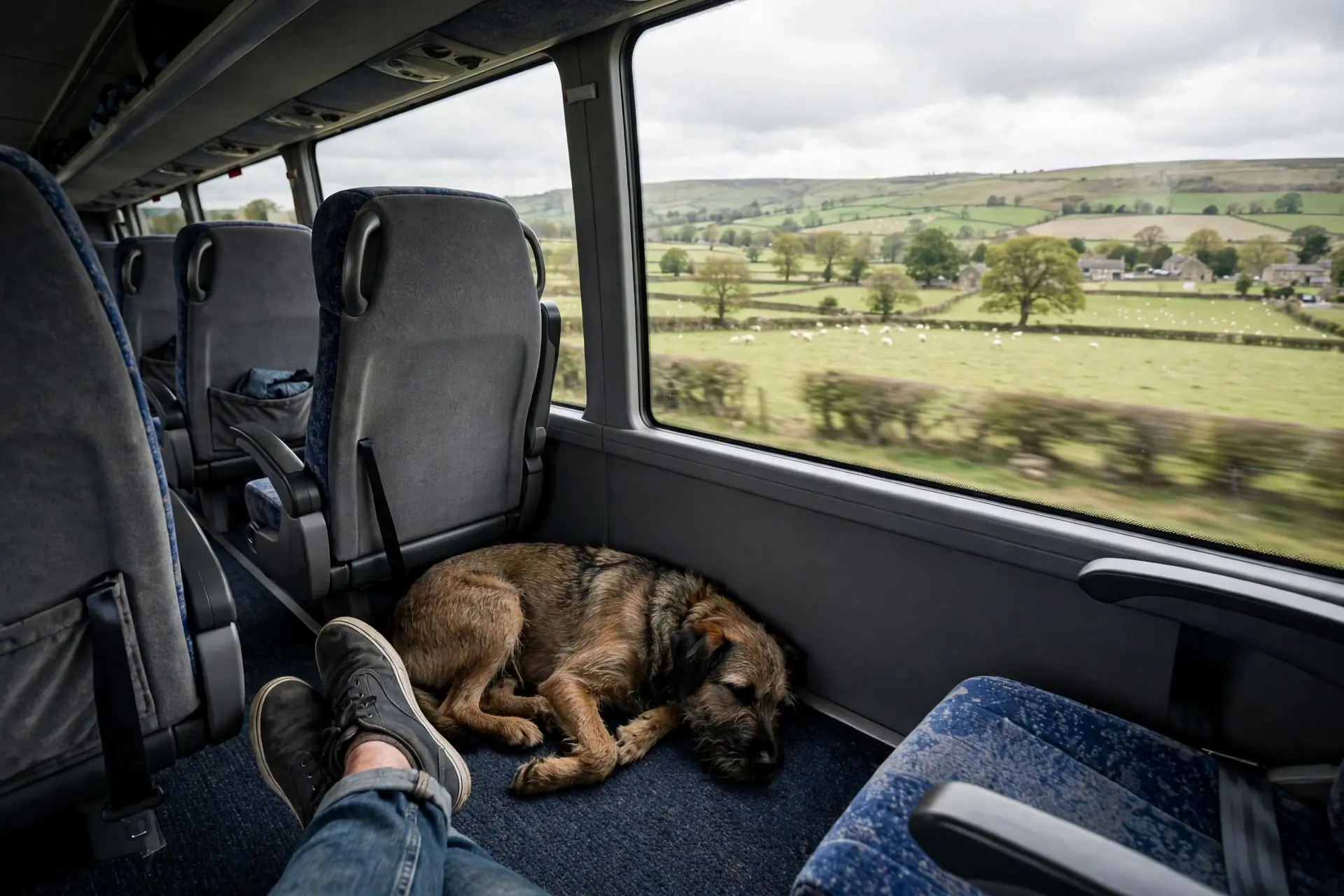
An assistance dog travels in the passenger cabin, at its handler's feet, for the whole journey. It does not sit on a seat, it does not travel on a lap, and it does not go in the luggage hold. The footwell of a modern National Express coach is roughly the same as on any long-distance coach: enough room for a medium or large dog to lie down if it curls, tight for a very large dog on a full service, and workable because the dog is trained to settle. Handlers usually choose a seat near the front of the coach, where the floor is flatter and the dog is less likely to be stepped on by passengers moving to the toilet or the door. There is no reserved assistance dog seat, so arriving early and choosing a suitable seat is part of the routine.
Crates are not part of the picture on a coach. A rigid crate will not fit in a footwell, a soft crate blocks the aisle, and neither is needed for a trained assistance dog that is expected to lie quietly at its handler's feet. For a pet dog, the crate argument fails at an earlier step: the dog is not being carried, so the question of how it is contained never arises. A few owners have asked whether a puppy in a closed carrier counts as hand luggage rather than a dog. It does not. The conditions of carriage are concerned with the animal, not the container, and staff are trained to treat a carrier with a dog inside as a dog, not as a bag.
Seating choice matters more on a coach than on a train because the journey is longer and the cabin is narrower. The front rows give the dog a shorter walk from the door and less passing traffic, while the rows over the wheels can be noisier and warmer. The back rows are the worst choice for a dog: they are near the toilet on many coaches, they collect the most foot traffic, and the engine and road noise are loudest there. If you are travelling with an assistance dog, tell the driver when you board so they know where the dog is, and keep the lead short and the dog clear of the aisle. Other passengers will step over a lead they cannot see, and a dog that spreads across the aisle on a night service is an accident waiting to happen.
Temperature is a genuine concern on long coach journeys. Coaches are heated in winter and air-conditioned in summer, but the temperature varies sharply between the front and the back, and a dog lying on the floor feels the draught from the door every time it opens at an intermediate stop. In summer, a coach that has been standing in the sun at a station can be very hot for the first twenty minutes until the air conditioning catches up, and a dog in a thick coat has no way to take a layer off. If you are travelling with an assistance dog in hot weather, carry water for the dog, offer it at stops, and do not be shy about asking the driver to adjust the heating or ventilation if the cabin is uncomfortably warm. The same applies in reverse in winter: a dog lying on a cold floor for four hours will stiffen up, so a familiar blanket or mat under the dog is worth the space in your bag.
Assistance dogs
Assistance dogs are the exception to the no-dogs rule, and they are treated very differently from pets. Under the Equality Act 2010, a disabled person travelling with an assistance dog has a right to travel with that dog, and National Express carries assistance dogs free of charge on its scheduled services. There is no fare for the dog, no weight limit, and no requirement to buy a second seat. The dog is not luggage, and it does not count against your luggage allowance.
Most assistance dogs you will see on a coach are guide dogs for blind and partially sighted people, hearing dogs for deaf people, and medical alert or mobility assistance dogs. The legal protection covers dogs trained to assist a disabled person, and National Express accepts dogs trained by recognised assistance dog organisations. If your dog is an assistance dog, carry whatever identification your training organisation issued, such as an ID book, a jacket or a harness with the organisation's branding. You are not always asked to show it, and the law does not require a specific card, but having it ready makes boarding faster and removes any doubt at the door, especially on a busy service where the driver is working through a long queue.
Emotional support animals are not the same thing, and this is the distinction that causes the most confusion. An emotional support animal that has not been trained as an assistance dog does not have the same legal status in Britain, and National Express is not obliged to carry it. A letter from a doctor or a certificate bought online does not change that. If your dog provides emotional support but is not a trained assistance dog, it is treated as a pet for carriage purposes, which means it cannot travel on a National Express coach. That is a hard message for people who rely on their dog, but it is better to hear it here than at the coach station, and the comparison section at the end of this guide sets out the alternatives that do accept pet dogs.
Booking with an assistance dog is straightforward, but it is worth doing properly. Buy your ticket in the usual way, then contact National Express to let them know an assistance dog will be travelling. There is no separate dog ticket to add and no extra charge, but telling the operator in advance means the driver is expecting you and the operator has a record if anything goes wrong. When you book, give the service number and date, and mention the dog's size if it is very large, so the driver is not surprised. Arrive at the coach station in good time, because boarding with a dog takes longer than boarding alone: you need to settle the dog, stow your bags, and let the driver see that the dog is under control before the coach leaves.
During the journey, the assistance dog should stay harnessed and at your feet. Keep the lead short, keep the dog out of the aisle, and do not let the dog approach other passengers unless they invite it. Most passengers are delighted to see a working dog and many will want to stroke it, but a working dog is on duty, and distracting it is not a kindness. If another passenger is allergic or afraid of dogs, the driver may ask you to sit in a different part of the coach, and that is a reasonable request to accept: your right to travel with the dog and another passenger's comfort both matter, and a different seat usually solves the problem without a confrontation.
At intermediate stops and at the destination, give the dog a toilet break as soon as you can. Coach stations are busy, noisy places with traffic, luggage trolleys and unfamiliar smells, so keep the dog on a short lead and head for a quiet patch of ground rather than the main concourse. If the journey is long, ask the driver at the start whether there will be a comfort break and how long it will last, so you can plan the dog's water and toilet needs around it. A dog that has been lying still for three hours will need to stretch, and a five-minute stop is enough if you use it well.
Booking: what to say and what not to expect
Booking a National Express ticket is the same whether or not a dog is involved, because there is nothing to add for a pet dog and nothing to pay for an assistance dog. You buy a ticket for yourself, in the usual way, through the website, the app, a ticket machine or a coach station counter. There is no pet option in the booking flow, no dog fare, no pet add-on and no field where you can declare a pet dog. If a third-party site offers you a dog ticket for a National Express service, treat it with suspicion: it is not a National Express product, and it will not get a pet dog on board.
What you should say depends on which kind of dog you have. If you are travelling with an assistance dog, contact National Express after booking and tell them the date, the service and the fact that an assistance dog will be travelling. This is not a permission request, because you do not need permission, but it is a courtesy that helps the driver and creates a record. If you telephone, note the name of the person you spoke to and the time of the call. If you write, keep the reply. Either way, you will have something to show if there is a dispute on the day, and you will have given the operator a fair chance to prepare.
If you are travelling with a pet dog, there is nothing useful to say to National Express, because the answer will not change. Telephoning customer services to ask for an exception wastes your time and theirs, and it can create a worse problem: a well-meaning agent might give you a vague answer that sounds like encouragement, and you will arrive at the coach station believing you have an arrangement that does not exist. If you need to be certain, ask for the answer in writing and ask the agent to point you to the relevant section of the conditions of carriage. The written answer is the one that counts, and it will confirm that pet dogs are not carried.
Do not expect the booking system to warn you. The website will happily sell you a ticket for a journey with a pet dog, because it does not ask whether you have one. That is not a loophole and it is not an oversight you can exploit: the ticket is a contract for your seat, not for your dog, and the conditions of carriage that govern it exclude pet dogs whether or not you read them. The same is true of third-party ticket sellers and travel apps, which sell National Express tickets without ever mentioning the dog rule. The responsibility for knowing the rule sits with the passenger, which is why this guide exists.
Refunds are the other thing not to expect. If you buy a ticket and then discover that your dog cannot travel, the standard ticket terms apply, and a non-refundable advance ticket stays non-refundable. The fact that you did not know about the dog rule is not, on its own, a ground for a refund, although National Express may allow a date change or a voucher at its discretion. Before you buy, check the ticket type: flexible tickets can usually be changed for a fee, while the cheapest advance fares cannot. If your plans depend on a dog travelling, do not buy the ticket first and check the rule afterwards. Check the rule, choose the transport that accepts the dog, and only then spend money.
One more booking point is worth making for assistance dog handlers. If you need a specific seat, such as a front seat with more floor space, ask when you book rather than hoping for it on the day. National Express does not guarantee a particular seat on most services, and seat selection may not be available on every route, but asking early costs nothing and sometimes helps. If seat selection is available, choose a window seat near the front, which gives the dog a wall on one side and the least passing traffic. If it is not available, arrive early, board promptly, and take the best available seat near the front before the coach fills.
Long journeys: comfort stops and feeding
National Express runs some of the longest scheduled journeys in Britain. London to Edinburgh can take nine hours or more, London to Penzance around seven, and cross-country routes such as Birmingham to Newcastle or Bristol to Leeds can easily run to four or five hours with traffic. For an assistance dog, that is a long time to lie still in a footwell, and the journey needs the same planning as any long day out with a dog, except that you cannot stop when you want to.
Comfort stops are the main variable. Many long National Express services include a scheduled stop at a motorway service area, typically twenty to thirty minutes, where passengers can use the facilities and buy food. Not every service stops, and not every stop is long enough for a dog to toilet properly, so do not assume a break is coming. Ask the driver at the start of the journey whether there is a scheduled stop and how long it will last. If there is one, use it well: take the dog straight to a quiet grassy area away from the car park, let it toilet and stretch, offer water, and get back to the coach in good time. Service areas are loud, busy and full of moving vehicles, so keep the dog on a short lead and do not let it wander near the fuel station or the coach park.
Feeding on a coach journey is a matter of timing. Do not feed a dog a full meal just before boarding. A dog that eats an hour before a long, warm, swaying journey is more likely to feel sick, and there is no dignified way to deal with a sick dog in a full coach. Feed a normal meal two to three hours before departure, offer a small snack at a comfort stop if the journey is very long, and save the main meal for after you arrive. The same logic applies to water: a dog needs water on a long journey, especially in summer, but a dog that drinks a whole bowl at once will need the toilet sooner. Offer small amounts regularly, and carry a collapsible bowl and a bottle of water in your hand luggage rather than in the hold, where you cannot reach it.
Toilet planning is the part owners worry about most, and the honest answer is that a well-trained adult assistance dog can usually manage a four-hour leg without a break, but a six- or eight-hour journey without a stop is a different matter. If your service has no scheduled stop, tell the driver before departure that you are travelling with an assistance dog and ask whether an unscheduled comfort break is possible. Drivers have timetables to keep and cannot always stop, but they can sometimes add a brief pause at a service area, and asking early is far better than asking in a panic two hours later. Puppies, older dogs and dogs with medical conditions may need more frequent breaks, and for those dogs a very long coach journey may simply be the wrong choice, however well the dog is trained.
Motion sickness deserves a mention because coaches are worse than trains for it. A coach sways, brakes and accelerates more than a train, and the view through the window moves faster and less predictably. A dog that is fine on a train can still feel unwell on a coach, especially on winding A-roads in Devon or Cornwall or on a motorway in heavy traffic. If your dog has ever been sick in a car, assume it may be sick on a coach, and speak to your vet before the journey about whether an anti-sickness remedy is appropriate. Do not give a dog medication you have not discussed with a vet, and do not feed the dog just before boarding in the hope that a full stomach will settle it, because it usually does the opposite.
Finally, think about the destination as well as the journey. A long coach ride ends at a coach station, not at your hotel, and the last leg from the station to where you are staying needs a plan of its own. Many coach stations are in city centres with limited green space, and a dog that has been lying still for hours will need a proper walk before it settles. Check in advance where the nearest green space is, whether your accommodation is a short walk or a taxi ride away, and whether the taxi you plan to use accepts dogs. Arriving tired, with a dog that needs the toilet and a hotel that is a mile away, is a poor end to a long day, and it is entirely avoidable with ten minutes of planning the night before.
When the driver says no: your options
For a pet dog, the driver saying no is not a misunderstanding to argue about; it is the policy working as intended. The best response is to accept it, step aside so the coach can leave on time, and make a new plan. Arguing with a driver who is following their employer's conditions of carriage will not change the outcome, and it will delay forty other passengers who have nothing to do with the argument. The useful question is not how to persuade this driver, but what to do next, and the answer depends on where you are and how much time you have.
Your first option is the train. Most British coach stations are near a railway station, and trains are the most dog-friendly long-distance option in the country. Dogs travel free on most services, with no size limit and no booking required, and you can usually buy a ticket at the station and be on a train within the hour. The fare will usually be higher than the coach fare, especially if you are buying on the day, but the train will actually take the dog, which is the point. Before you buy, check that the route you need is running normally and that there is no rail replacement bus on your leg, because a rail replacement bus is a coach, and the coach dog rule may apply to it instead of the train rule. Check the official guidance before you travel if your journey involves a replacement service.
Your second option is a taxi or a private hire car. A local taxi that accepts dogs can cover the first leg of a journey, and a pre-booked private hire car can cover a longer distance if you arrange it in advance. This is expensive for a cross-country trip, but it is practical for getting from a coach station to a nearby town, to a railway station on a different line, or to a hotel where you can regroup. When you book, say clearly that you have a dog, give its size, and confirm that the driver is happy. A taxi driver is not obliged to take a dog, and an assistance dog is the only case where refusal is unlawful, so a polite confirmation in advance saves a second refusal at the kerb.
Your third option is to rebook for another day by a different mode. If the journey is not urgent, the calmest response is to go home, cancel or change whatever can be changed, and rebook by train or car. That is not the answer anyone wants to hear at a coach station, but it is often the cheapest and least stressful one. A same-day train fare bought in a panic can cost several times the coach fare, while a train ticket bought a day or two ahead for the same route is often far cheaper. If your accommodation can be moved, moving it by a day and travelling by train is usually a better trip than forcing the journey on the day with a stressed dog.
For assistance dog handlers, a refusal is a different matter and should be treated as one. If a driver refuses to carry your assistance dog, stay calm, show your assistance dog identification, and ask the driver to explain the reason. Sometimes the refusal is a genuine misunderstanding, for example a driver who thinks the dog is a pet, and a calm explanation with identification resolves it. If the driver still refuses, do not block the coach or raise your voice. Note the service number, the time, the place, the coach registration if you can see it, and the driver's description. Then contact National Express customer services in writing as soon as you can, explain what happened, and ask for an investigation, an apology and a refund or rebooking. Refusing an assistance dog can breach the Equality Act 2010, and operators take written complaints about it seriously, so a clear written record matters far more than a heated exchange at the door.
Whatever happens, keep the dog's welfare first. A dog that has been turned away from a coach is not having a good day, and the priority is water, a toilet break and a calm place to wait while you sort out the next step. Coach stations have cafés and waiting areas, but they are noisy and crowded, so find a quiet corner or a patch of grass outside and let the dog settle. Sort the transport, then sort the dog's comfort, and do not try to do both at once while standing in a queue with a lead in one hand and a phone in the other.
Coach vs train vs car
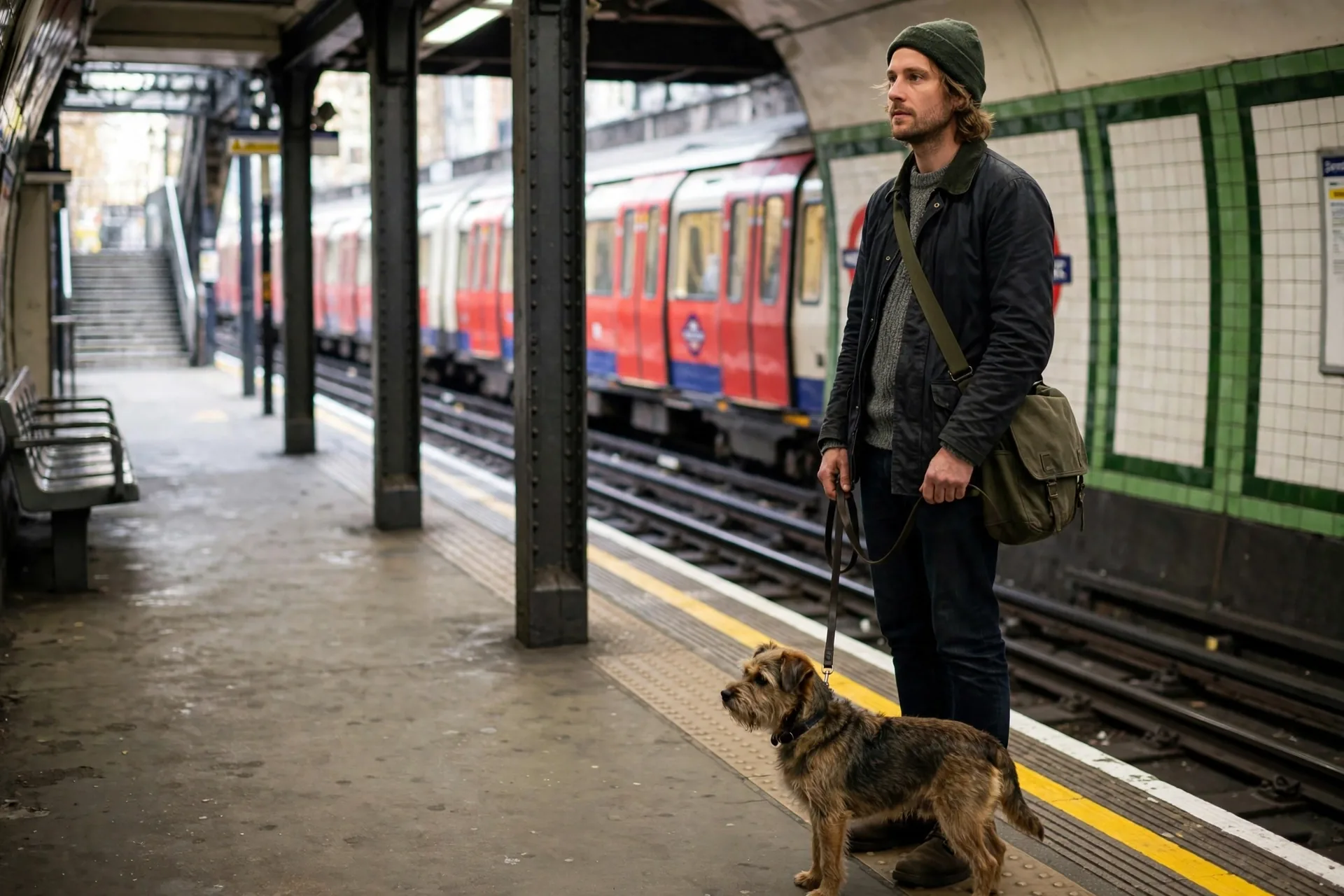
The honest comparison starts with a fact that favours the train: for a dog owner, the train is almost always the better choice for a long journey in Britain. Most train operators allow up to two dogs per passenger free of charge, with no size limit, no crate and no booking. The dog travels in the carriage at your feet, you can walk it to the buffet car or the vestibule, and at most stations you can step onto the platform at intermediate stops. The train is faster than the coach on most intercity routes, the seats are roomier, and the dog rules are published clearly by each operator. The only real disadvantages are price, because walk-up train fares can be high, and the fact that some rural branch lines have infrequent services. For a full comparison of what ferries allow, which is useful if your journey continues overseas, see our guide to dogs on UK ferries.
The car is the most flexible option of all, and for many dog owners it is the default. A car lets you stop whenever the dog needs a break, control the temperature, carry a crate, a bed, food and water, and travel at whatever time suits the dog rather than the timetable. The cost is fuel, parking and the driving itself, and for a solo traveller the train or coach is cheaper and less tiring. A car also avoids every operator's dog policy entirely, because the only rules that apply are your own and the Highway Code. If you are travelling with two large dogs, a nervous dog, a puppy or a dog that needs frequent toilet stops, the car is not just the most comfortable option; it is the only one that lets you manage the journey properly.
The coach wins on price and loses on almost everything else that matters to a dog owner. A National Express advance fare can be a fraction of the equivalent train fare, and for a passenger travelling alone without a dog it is often the best value journey in Britain. But that value disappears the moment a pet dog is part of the party, because the dog cannot travel at any price. Comparing the coach fare with the train fare is therefore the wrong comparison: the coach fare is not a cheaper version of the same journey, it is a fare for a journey the dog cannot make. The useful comparison is between the train fare, the cost of driving, and the cost of a pet-friendly taxi or hire car, because those are the journeys the dog can actually take.
There are narrow cases where the coach still makes sense for a dog owner. If you are travelling with an assistance dog, the coach is a legitimate and cheap option, and the long journey advice in this guide applies directly. If you are travelling without the dog, for example to visit a destination before deciding whether to bring the dog next time, the coach is an excellent way to scout a route cheaply. And if your dog is staying with a sitter or family while you travel, the coach is as good as any other option. What the coach cannot do is carry a pet dog, and no amount of fare saving changes that.
Other coach operators have similar rules, so switching brands rarely helps. Megabus and FlixBus, the two other large coach networks in Britain, also restrict pet dogs to assistance dogs only on their scheduled services, although the exact wording differs. Local bus services are a different world: many local buses accept dogs at the driver's discretion, often for a small fare, and a dog on a short local bus ride is a common sight across Britain. But a local bus is not a long-distance coach, and the discretion that works on a ten-minute ride into town does not extend to a five-hour express to London. For a longer journey, check the operator's conditions before you travel, and assume the answer is no unless the operator says otherwise in writing.
When you compare the options for your own journey, run the numbers honestly. Add up the train fare, the taxi to the station, and the cost of the dog's food and water for the day, and compare that with the cost of driving, including fuel, parking and any tolls. Then add the time: the train may take two hours where the coach takes four, and a dog that travels well for two hours may struggle with four. Then add the stress: a train with a dog is a known quantity, while a coach with a dog is a refusal at the door. Most dog owners who run that comparison once never need to run it again, because the train wins on every count except the headline fare, and the headline fare is the least important number once a dog is involved. If your trip ends at a holiday park, our guide to dog-friendly holiday parks covers what to ask before you book, and the London Underground rules are worth reading too if your journey passes through the capital: see our guide to dogs on the London Underground.
Practical questions
Before you go
Can I take my dog on a National Express coach?
As a general rule, no. National Express does not carry pet dogs on its scheduled coach services, and there is no pet ticket or dog fare you can buy to change that. Assistance dogs are the exception and travel free. If you are travelling with a pet dog, plan for the train, a car or a pet-friendly taxi instead, and check the official guidance before you travel in case the policy changes.
Do assistance dogs travel free on National Express coaches?
Yes. Assistance dogs travel free of charge on National Express services and do not count as luggage. Tell National Express when you book so the driver and the operator know an assistance dog will be on board, arrive in good time, and keep the dog harnessed and settled at your feet for the journey.
Can my dog travel in a crate in the luggage hold?
No. National Express does not carry pet dogs in the luggage hold, and putting a dog in a crate does not make the journey possible. The luggage hold is for suitcases and bags, it is not ventilated or monitored for live animals, and drivers are not permitted to accept a crated dog as luggage on scheduled services.
What happens if the driver refuses to let my assistance dog board?
Stay calm, show any assistance dog identification you carry, and ask the driver to confirm the reason. Refusing a genuine assistance dog is a serious matter under the Equality Act 2010. Note the service number, time and coach details, then contact National Express customer services with a written complaint and ask for the next available service or a refund.
Are there any National Express services that allow pet dogs?
No scheduled National Express service carries pet dogs as a matter of policy, including airport services, city-to-city routes and seasonal services. Private hire is a different arrangement and is negotiated separately, but a standard ticket on a timetabled coach does not cover a pet dog under any circumstances.
How do National Express rules compare with trains?
Trains are far more permissive. Most UK train operators allow up to two dogs per passenger free of charge, with no size limit and no ticket for the dog, and dogs travel in the carriage at your feet. That difference alone makes the train the usual choice for dog owners travelling between British cities, while the coach remains an option only for assistance dogs.