This guide is independent and contains no paid placement. Transport rules can change, so always check the latest Transport for London conditions of carriage before you travel.
Yes, dogs are allowed on the London Underground and they travel free. Keep your dog on a short lead and under control, carry your dog on escalators (or use lifts and stairs), avoid the busiest peak services where you can, and never let your dog block doors, seats or gangways. Always check the latest TfL guidance before you travel.
Are dogs allowed? The core rules
The short answer to “are dogs allowed on the London Underground” is yes. Transport for London (TfL) permits dogs on the Tube, and the same general permission applies across most TfL services including the Overground, the Elizabeth line, Docklands Light Railway, buses and trams, although the practical experience differs a lot between them. There is no booking step and no dog ticket to buy, but permission comes with conditions, and staff can ask you to leave a station or train if those conditions are not met.
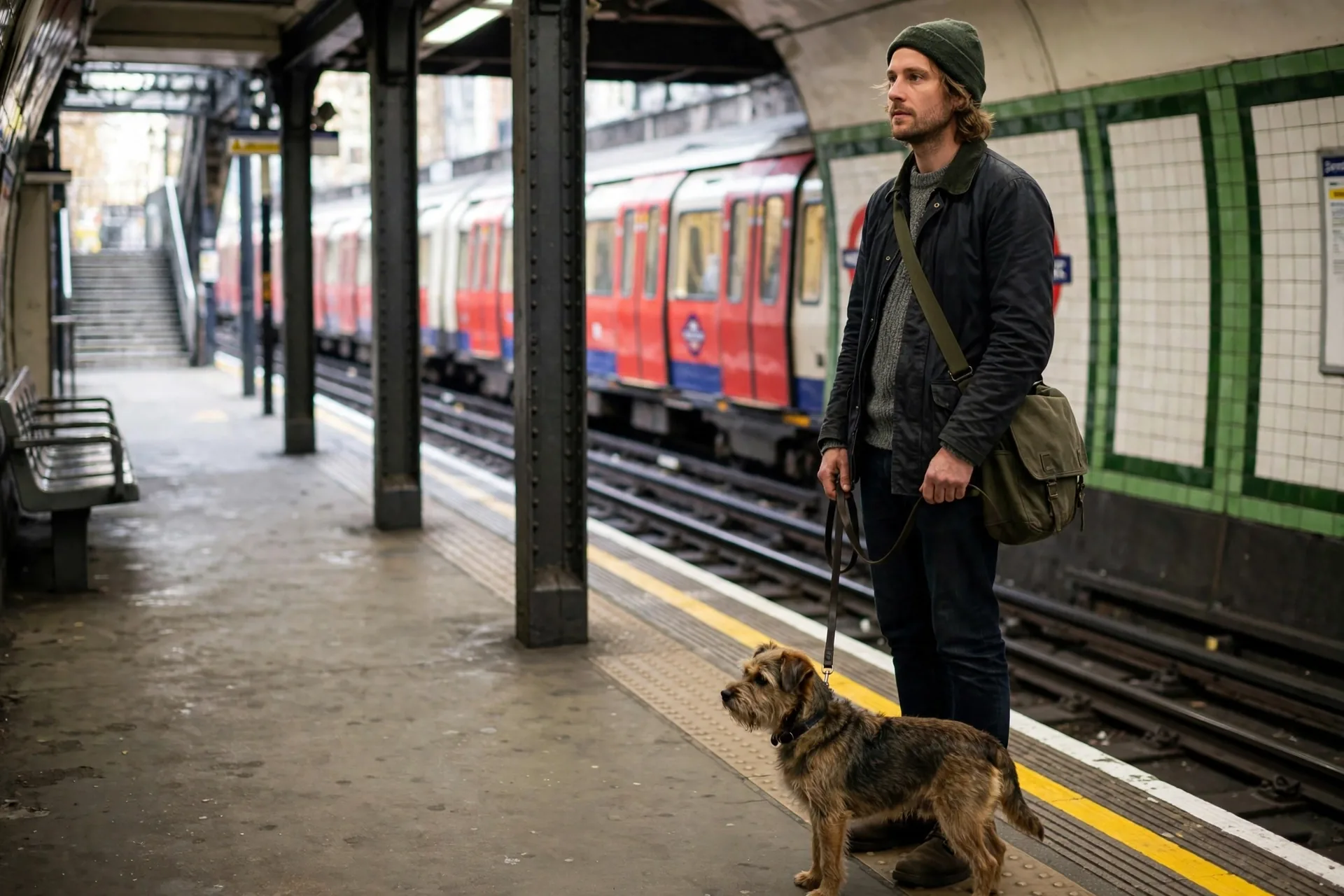
The central rule is control. Your dog must be kept on a lead and under close control at all times in stations and on trains. In practice that means a short, fixed lead rather than a long extending lead, held by a responsible person, with the dog close to your leg on platforms, in ticket halls and in carriages. A dog that is lunging, barking persistently, fouling the station or worrying other passengers can be refused travel, even though dogs in general are welcome. The rule is about behaviour on the day, not about breed labels or size alone.
A few practical details follow from that. Dogs should not sit on seats, should not block doors or aisles, and should be kept clear of the platform edge and the yellow line until the train has stopped. You are responsible for cleaning up after your dog, so carry waste bags and tissues as you would on any walk. If your dog is unwell, in season, very young and not yet confident in noisy places, or recovering from surgery, the Tube is rarely the kindest option — postpone the trip or use a taxi or a walk instead.
Conditions can be updated, and individual stations may have temporary restrictions during engineering works, events or evacuations. Treat this guide as the stable, practical summary and check the official TfL conditions of carriage on the day for the final word. The rules above match TfL's pets on public transport page, which confirms free travel, leads at all times, no seats, and no walking on escalators. If a member of staff gives you an instruction that differs from what you expected, follow it politely and sort out the route afterwards: staff decisions on the spot are about safety in a fast-moving underground environment.
Fares: do dogs travel free?
Yes. Dogs travel free on the London Underground. There is no dog fare, no dog Oyster card and no supplement for larger dogs, which makes the Tube one of the simplest parts of a London trip to budget for. You, of course, still need to pay your own fare in the usual way, with contactless, Oyster or a valid ticket, and normal fare rules, caps and peak pricing for human passengers apply as usual.
At the gateline, choose the wider manual gate where one is available rather than squeezing through a standard barrier with a dog at heel. The wider gate stays open longer, gives you room to keep the lead untangled, and avoids the common problem of the barrier closing between handler and dog. Walk through together in one movement, with the dog on the side away from the ticket reader, and do not let the lead trail across the gate line. In stations without barriers, simply keep the same close-control routine through the ticket hall.
Free travel does not mean unlimited leeway. If you are travelling onwards by National Rail after your Tube leg, the rules change slightly: mainline trains also generally carry dogs free, but with their own conditions on numbers and behaviour. Our guide to taking your dog on UK trains explains the mainline rules, including the usual two-dog limit and what to do on longer journeys, so read it before combining a Tube ride with a longer rail trip out of London.
Escalators, lifts and stairs
Escalators are the single most misunderstood part of travelling with a dog on the Underground, and the rule is strict: dogs must be carried on escalators. The reason is mechanical, not bureaucratic. Paws, claws, long fur and loose leads can get caught where the moving steps flatten at the top and bottom, and injuries from escalators are painful and entirely avoidable. A small dog that can be picked up securely for the full ride is fine. A medium or large dog that you cannot carry safely is not an escalator dog at all.
If you cannot carry your dog, plan around lifts and stairs from the start. Many central London stations have step-free routes, but provision varies by line and by station, and lifts can be taken out of service at short notice. Check the step-free status of both your starting station and your destination before you set off, and allow ten extra minutes for a lift route, which is often a longer walk through the station. Where only stairs are available, use a short lead, let your dog set a steady pace, and keep to one side so other passengers can pass. Never let a dog pull you on stairs: stop, reset, and continue calmly.
There are two habits worth building. First, practise being carried at home if your dog is small enough to carry on escalators: brief lifts onto a step, held securely against your body, rewarded calmly, so the station version is not the first attempt. Second, learn to spot the lift signs quickly — the step-free symbol on Tube maps and station signage — and build your route around lift stations even if it means one extra stop. A slightly longer journey that avoids a stressful escalator stand-off is always the better journey. If you are packing for a London day out, our dog travel packing checklist covers the small extras that help underground: a short fixed lead, a lightweight harness, water, waste bags and a familiar settle mat for cafés at the other end.
Peak hours and busy trains
There is no blanket ban on dogs during peak hours, but the peak is where good intentions meet packed carriages. The busiest periods on weekdays are roughly the morning rush into central London and the evening rush out again, when platforms fill, trains arrive already full and tempers shorten. A dog that is perfectly content on a quiet midday service can be overwhelmed at 8.30am at a major interchange, and a lead that is easy to manage in space becomes a trip hazard in a crowd.
If your schedule allows it, travel mid-morning, early afternoon or later in the evening, and favour weekends for first trips. Choose stations carefully: a smaller station one stop further out is often calmer than a famous interchange, and direct trains beat changes every time. On the platform, stand towards the ends of the train, where carriages are usually less crowded, and let a crush-loaded train go — the next one is rarely more than a few minutes away on most central lines. Time spent waiting for a boardable train is never wasted with a dog.
If you must travel at a busy time, shorten every part of the routine. Toilet your dog before entering the station, keep the station time to a minimum, position your dog between your legs or tight against a wall on the platform, and board decisively when a suitable train arrives. On board, tuck into a corner away from the doors if you can, keep the lead short and looped securely around your wrist, and be ready to get off a stop early and walk if your dog is struggling. Having an exit plan removes most of the stress, for you and for nearby passengers alike.
On the train: etiquette that works
Good Tube etiquette with a dog is mostly about taking up less space and causing less surprise. Keep your dog on the floor, never on the seats, and settle them as close to your feet as possible. In the larger vestibule areas near the doors, stand so that passengers can flow past without stepping over a lead. If your dog is wet, muddy or a heavy shedder, a quick towel-down before boarding and a position away from smart office clothing is a small courtesy that other passengers genuinely notice.
Manage greetings actively. Londoners will often want to say hello, and children in particular may approach without asking. A friendly “please let him settle, thank you” protects your dog and models good manners. Equally, do not assume other passengers, or other dogs, want contact: keep your dog from nose-to-nose meetings in carriages, watch for guide and assistance dogs working nearby and give them clear space, and never let your dog stare down or crowd another animal in a confined carriage. If two dogs cannot settle near each other, move — changing position is faster than managing a barking match underground.
Noise and air matter too. Carriages can be hot, especially on deeper lines in summer, and a panting, thirsty dog deteriorates quickly. Offer water before and after the ride rather than sloshing a bowl on a moving train, keep journeys short in heatwaves, and get off for air if your dog shows real distress: heavy panting that does not settle, drooling, whining or scrabbling at doors are all signs to end the journey at the next stop. A dog that travels well in winter may need a different plan in July, and building that judgement is part of responsible city travel.
Your first Tube trip, step by step
A successful first trip is short, quiet and deliberately unambitious. Pick a journey of two or three stops on a single line, in the middle of the day, between stations you already know. The goal is not to get somewhere; it is to teach your dog that stations, barriers, platforms and trains are ordinary. You can build distance later, and dogs that start small usually become excellent city travellers.
Before you leave, walk your dog properly, toilet them, and fit a secure harness or a well-fitting collar with a short fixed lead. Carry water, waste bags, a few high-value treats and, for a small dog, be ready to carry them on any escalator. Check for planned closures or lift outages on your route, then head out. At the station, pause in the ticket hall and let your dog take in the sounds before going through the wide gate together. Reward calm behaviour, keep moving steadily, and avoid lingering in the busiest flow of people.
On the platform, stand back from the edge, keep the lead short and let one train pass if the noise of its arrival startles your dog. Board a quieter carriage, settle your dog at your feet, and ride your two or three stops. Get off calmly, take the lift or stairs route you planned, and finish with a proper walk and water in the open air. If any stage goes badly — a panic at the barrier, freezing on the stairs, barking in the carriage — do not push on to complete the plan. Leave by the calmest route, end on an easy walk, and try again another day with an even smaller step. Dogs remember endings, and a trip that ends well teaches more than a completed route that ends in distress.
Build up gradually over several outings: a longer ride, then a journey with one change at a quiet interchange, then a trip that combines the Tube with a bus or a mainline train. Many owners pair early Tube practice with a relaxed destination, such as a large park where the dog can decompress afterwards. If you are planning a whole weekend around it, our guide to weekend breaks with dogs in the UK shows how to pace travel days so transport practice never becomes the whole trip.
When the Tube is the wrong choice
For all its convenience, the Underground is not right for every dog or every journey. Very large dogs that cannot be carried and need stations without reliable lifts, dogs that panic at underground noise and vibration, dogs that are reactive to close contact with strangers, and journeys across the whole city at rush hour in summer heat are all cases where another option is kinder and often barely slower.
Buses are the most flexible alternative: dogs are generally allowed, the journey is at street level with natural light and air, and getting off early is simple if your dog is unsettled. Walking between nearby stations is frequently practical in central London, where Tube stops can be only a few minutes apart above ground. Licensed taxis and private hire vehicles vary by operator and driver, so ask about dogs when booking rather than at the kerb. River services and the cable car have their own animal policies, which change from time to time, so check the operator page for the specific service before relying on them.
Whichever alternative you choose, the same principles apply as underground: a short lead, close control, respect for assistance dogs, water in warm weather, and a willingness to abandon the plan if your dog is not coping. City travel with a dog is a skill the two of you build together. The Tube, used at the right times with the escalator rule respected, is one of the best tools for it — and when it is not, London gives you more second options than almost any other city in Britain.
Practical questions
Before you go
Are dogs allowed on the London Underground?
Yes. Dogs are allowed on the London Underground, as well as on most other Transport for London services, provided they are kept on a lead and under control at all times. Staff may refuse travel if a dog is causing a nuisance or a safety concern, so check the latest TfL conditions of carriage before you travel.
Do dogs travel free on the Tube?
Yes. Dogs travel free on the London Underground and you do not need a separate ticket for your dog. You still need a valid ticket or contactless payment for yourself, and you should use the wider manual gates where available so you and your dog can pass through together safely.
Can my dog use the escalators on the Underground?
No, not on its own paws. TfL requires dogs to be carried on escalators because paws, claws and fur can get trapped in the moving steps. If you cannot carry your dog safely, use the lift or the stairs instead, and allow extra time to find a step-free route through the station.
Can I take my dog on the Tube at peak times?
There is no blanket ban on dogs at peak times, but travelling outside the busiest periods is strongly recommended. Crowded platforms and packed carriages are stressful for most dogs and make it harder to keep a lead short and your dog clear of the doors. If you must travel at peak time, choose a quieter station and the ends of trains where there is usually more space.
Do assistance dogs have different rules on the Underground?
Yes. Accredited assistance dogs are trained to travel on public transport and have legal access rights that pet dogs do not. They should not be charged and should not be refused because they are dogs. If you travel with an assistance dog, follow the guidance from your assistance dog organisation and TfL, which takes precedence over the general pet guidance in this article.
Do dogs need a muzzle on the London Underground?
No. TfL does not require muzzles for dogs on the Underground, but your dog must stay on a lead and under control at all times. A muzzle can still be a sensible choice for a nervous or reactive dog in crowds — check the latest TfL conditions of carriage before you travel.