This guide is independent and contains no paid placement. Snow centre rules change by site and by session, so check the official guidance before you travel.
Expect your dog to stay in viewing areas, cafes and outdoor spaces while people ski. Dogs are not normally carried on UK ski lifts, so the winning plan is a split session: one person skis while another stays with the dog, then you swap and enjoy the rest of the day together.
How a UK snow centre actually works
Britain has no resort-style mountain where a dog might trot beside a chairlift, so the whole question of dogs on ski lifts works differently here. The UK offer is indoor snow centres with refrigerated slopes, outdoor dry slopes with plastic matting, and a handful of smaller artificial slopes attached to leisure parks. Each one is a controlled building or fenced site, not an open mountainside, and that changes everything about access: doors, tickets, safety briefings, one-way flows and insurance conditions all sit between your dog and the snow. Understanding that layout before you arrive stops the most common disappointment, which is turning up with a dog and discovering that the slope itself is a staffed, ticketed, dog-free zone while the cafe upstairs is perfectly welcoming.
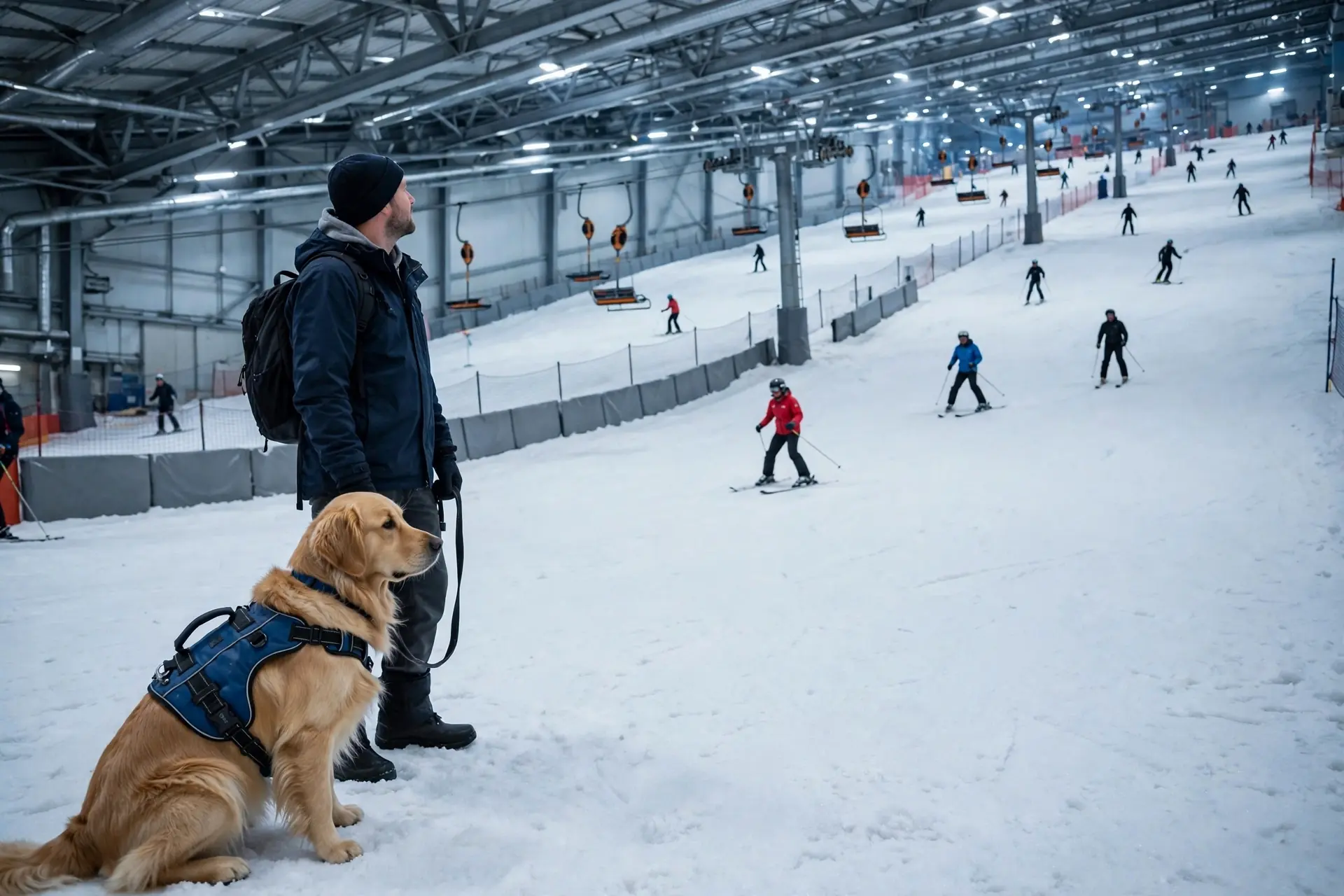
An indoor centre typically has a main slope kept at a few degrees below freezing, a separate nursery slope for beginners, a lift system running up one side, and a viewing gallery or restaurant overlooking the snow. Visitors who are not skiing buy no slope pass, or buy a spectator ticket where one is offered, and they watch from behind glass or from a balcony. The air in the gallery is usually comfortable, while the slope hall is cold and echoing, with the hum of refrigeration plant, the scrape of edges and the regular announcements that accompany group lessons. For a dog, the gallery is therefore the kindest place to be: warm enough, visually interesting, and close enough to their person that the outing still feels shared. Dogs that are sound-sensitive, however, may still find the echo and the crowd hard work, and a short first visit tells you far more than any policy page.
Session structure matters as much as the building. Many centres sell timed slope sessions, lessons and freestyle blocks, and the clock starts whether or not your group is ready. If you arrive with a dog and only then start asking where the dog can wait, you burn the first part of a session on logistics. Arrive early, walk the public areas first, find water, a toilet spot outside and a quiet corner for settling, and only then send the first skier down. The same logic applies to dry slopes, where sessions are often shorter and the site is more exposed to weather, so a wet afternoon can turn a cheerful plan into a muddy wait. A little reconnaissance converts a potentially awkward day into a relaxed one, and it costs nothing but twenty unhurried minutes.
It also helps to reset expectations about what a ski day with a dog looks like in Britain. In Alpine resorts, some lifts do carry dogs, and photographs of dogs riding gondolas create an assumption that the UK must work the same way. It does not, because the UK lift stock is different: short drag lifts, button lifts and moving carpets serving a single indoor hall, all operated under leisure-centre safety rules rather than mountain transport rules. Gondolas and large chairlifts are essentially absent from the UK indoor scene. Once you accept that the dog's role is spectator and companion rather than passenger, the planning becomes straightforward, and the day can still be a good one, especially when the centre sits near a park or riverside walk where the dog gets a proper outing before or after the skiing.
Lift types, explained for dog owners
The three lift types you will meet most often are the button lift, the magic carpet and the chairlift, and none of them is designed with dogs in mind. A button lift, also called a poma, is a pole with a small seat or disc that a skier places between their legs while being towed uphill. It demands balance, a pair of skis or a board, and a clean exit at the top, and it is plainly unsuitable for a dog: there is nowhere safe for paws, the tow line moves at skier speed, and a startled dog could be dragged or tangled. A magic carpet is a moving walkway at ground level, a bit like an airport travelator, used mainly on nursery slopes. It sounds gentle, and in isolation it is, but centres still do not admit dogs onto it, because the walkway is a moving machine in a queue of beginners, children and instructors, and a loose lead near a moving belt is a hazard for everyone. Chairlifts do exist at a few larger UK sites, but they carry skiers and boarders to the top of an outdoor slope, and dogs are not carried as passengers; the loading area is a working zone with moving chairs, and staff cannot slow the system for a nervous animal.
Knowing the names helps when you read a centre's policy or ask a question by phone, because staff will answer in those terms. If a website says dogs are welcome in the lodge but not on the lifts, that is a complete answer, not a starting point for negotiation. If it says nothing at all about dogs, treat that as a no for the slope and a question for the public areas: email or call and ask specifically whether a dog may wait in the viewing gallery, whether there is an outdoor area where a dog can toilet, and whether the dog must stay on a lead throughout. Vague answers such as "we are dog-friendly" deserve a follow-up, because they may refer only to an outdoor terrace in summer. Get the answer in writing where you can, and save it with your booking, since the person on the gate on the day may not be the person who answered the phone.
There is one partial exception worth understanding, and it is not really an exception at all. Assistance dogs have legal access rights that go far beyond pet access, and a centre must handle them under equality law rather than under its pet policy. If you travel with an assistance dog, say so when you book, explain what the dog needs, and ask how the centre will manage slope-side waiting, because the practical arrangements still need planning even though the right of access is different. For pet dogs, by contrast, access is a courtesy offered by the operator, and it can be withdrawn for a session, a refurbishment or a busy event day. Checking again close to the visit, rather than relying on a page you read months ago, is simple insurance.
Finally, remember that lift rules are only one layer. Even if a dog were allowed near a lift, the slope surface itself is a problem: indoor snow is hard, cold and treated for grip, dry slope matting is rough on paws, and both are busy with fast-moving users who cannot be expected to dodge an animal. The kindest reading of the rules is also the most accurate one: they exist because a slope is a poor place for a dog, not because centres dislike dogs. Planning around that fact, rather than fighting it, is what makes the day work.
Where dogs can and cannot go
The practical map of a snow centre, from a dog's point of view, has four zones. First, the car park and the outdoor grounds, where dogs are almost always welcome on a lead and where you will find the toilet area, though you should still clean up and keep the dog off planted beds and children's play equipment. Second, the entrance, shop and corridors, where many centres allow dogs but expect a short lead and a calm dog, because these are narrow, busy spaces with trolleys, boot bags and excited children. Third, the viewing gallery, restaurant and cafe, where policy varies most: some welcome dogs throughout, some restrict them to a terrace or a marked section, and some exclude them from food service areas entirely. Fourth, the slope hall, changing rooms, hire shop and lift queue, where dogs are not admitted. If you can picture those four zones before you arrive, you can plan who goes where without a debate at the door.
The viewing gallery deserves a closer look, because it is where your dog will spend most of the visit. A good gallery has seating away from the main walkway, a view of the slope so the dog's person can watch the skiers, and staff who are relaxed about a settled dog under a table. A poor one is a thoroughfare with no quiet corner, where every passer-by stops to fuss the dog and the dog never settles. When you arrive, choose the seat first and the view second: a corner table with the dog's blanket down and a chew on offer will beat a front-row seat where the dog is constantly approached. If the gallery is full or the dog is restless, stepping outside for a short walk and returning later is better than persisting with a stressed animal for the sake of a session you have already paid for.
Outdoor space is the unsung hero of a slope-side dog day. Most centres have at least a paved forecourt, and many sit near a park, a canal towpath or a riverside walk that gives the dog a real outing while skiers take turns. Use that space deliberately: a proper walk before the first session tires the dog just enough to settle, and a second walk between sessions breaks up the waiting. Do not, however, leave a dog tied up outside a centre while you ski. Apart from the theft and weather risks, many centres prohibit it, and a dog left alone in a strange, noisy place is likely to bark, which disturbs other visitors and can lead to staff asking you to leave. If your group cannot staff the dog indoors, the honest answer is that this is not the right day for the dog to come.
Changing rooms and hire areas need a mention because they cause quiet friction. Ski boots, helmets and boards are bulky, and the hire queue is no place for a dog weaving between legs. Leave the dog with a companion in the gallery while skiers collect and return kit, and keep leads short in corridors. The same applies to ski school meeting points, which are crowded and full of children: walk past them rather than through them, and give lessons a wide berth. Small courtesies like these are what keep a centre willing to welcome dogs at all, and they cost the dog owner almost nothing.
Checking the policy before you travel
Policy pages are often short and sometimes out of date, so a five-minute check is worth more than a long scroll. Start with the centre's own website and search for its dog or pet page, then check the frequently asked questions and the visitor information section, because the dog rule is sometimes buried under access or family information rather than given its own heading. If the page is silent, call or email with a precise question: "We are visiting on a Saturday with one dog. May the dog wait in the viewing gallery on a lead while two of us ski in turn? Is there an outdoor toilet area, and is water available?" A precise question gets a precise answer, and it also creates a record you can refer to if the policy on the day differs.
Timing matters when you check. A centre that welcomes dogs on a quiet weekday may restrict them during a school holiday competition, a freestyle night or a private hire, and a centre that has just refurbished its restaurant may have changed its food-area rules. Check within a week of the visit, and check again if you are travelling a long way or if the visit falls on a bank holiday. It is also worth checking the weather and the session timetable together: an outdoor dry slope in heavy rain is a different proposition from an indoor centre in the same weather, and a late session that runs into the evening may mean a dark walk back to the car for the dog. None of this is difficult, but all of it is easier from home than from the car park.
When you compare centres, weigh the whole day, not just the slope. A centre with a generous viewing gallery, a nearby park and a cafe that welcomes dogs may be a better dog day than a centre with a longer slope but nowhere pleasant for the dog to wait. Distance matters too: a two-hour drive each way for a one-hour slope session is a long day for a dog that spends most of it waiting, whereas a centre within an hour leaves energy for a proper walk afterwards. If you are choosing between two centres, the one with the better dog waiting facilities is usually the right choice, even if its slope is slightly shorter. The skiing is the reason for the trip, but the dog's comfort decides whether the trip feels good.
Keep a simple note of what each centre told you: the date you checked, who you spoke to, and the exact wording of the rule. This sounds fussy, but it saves arguments and it helps other dog owners when you pass the information on. It also helps you on a return visit, when you can check whether the rule has changed rather than starting from scratch. Centres change hands, refurbish restaurants and revise insurance terms, so a note from last year is a starting point, not a guarantee. As ever, check the official guidance before you travel, especially for assistance dogs, group bookings and event days.
The split-session plan that works
The most reliable way to ski with a dog in the party is to split the session and be explicit about it. Agree before you travel who skis first, who holds the lead, and how long each turn lasts, then book sessions that allow that rotation. A typical pattern is a two-hour slope block split into two one-hour turns, with a walk and a cafe stop in between, so the dog is never waiting longer than an hour and each skier still gets a proper run. If the centre sells shorter taster sessions, those can work even better for a first visit, because the dog's waiting time stays short and nobody feels guilty about cutting a session short if the dog is unsettled. Flexibility beats ambition here: a relaxed hour each is worth more than a strained two hours.
Communication inside the group matters as much as the booking. The person waiting with the dog should have everything they need: water, a bowl, a blanket, a chew, poo bags, a phone charger and a clear meeting point, so they are not stranded in a corridor while the skier is unreachable on the slope. Agree a signal for an early swap, such as a text message, and agree that an early swap is a success, not a failure. Dogs have off days, centres have noisy days, and a plan that can bend without collapsing is the plan that survives contact with a real animal. If the group includes children, assign the dog to an adult at all times, not to a child who is also excited about the snow, because a child holding a lead in a busy gallery is a recipe for a tangled lead and a loose dog.
Money is part of the plan too. Spectator access is sometimes free and sometimes ticketed, and a cafe bill for two waiting turns can add up, so budget for the waiting person's food and drink as part of the day, not as an afterthought. Parking charges, boot hire and lesson fees are the usual extras, and it is worth checking whether a spectator ticket is needed at all before you pay for one nobody asked for. If the centre offers a family or group rate, ask whether it covers a non-skiing adult with a dog, because the answer is not always obvious from the price list. A short email before booking settles all of this, and it also tells the centre to expect a dog, which is simple courtesy.
One more variation works well for larger groups: a base-camp day. One or two people ski in the morning while the rest walk the dog somewhere nearby, then everyone meets for lunch, and a different pair skis in the afternoon. This turns the slope from the whole day into one element of a day out, which suits dogs, non-skiers and children far better than a long wait in a gallery. It also gives the dog two proper outings instead of one long wait, and it means the waiting adults actually enjoy themselves. If your group is big enough to rotate, use that advantage, and let the slope be the highlight rather than the endurance test.
On the day: arrival to departure
Arrive early enough that nothing is rushed, and start with the dog, not the slope. Park, toilet the dog, offer water, and walk the outdoor areas for ten minutes so the new smells and sounds become familiar. Then go inside together, find the gallery seat or waiting spot, lay down the blanket and let the dog settle while the skiers sort kit. This order matters: a dog that has already sniffed, toileted and drunk is far more likely to settle than a dog bundled straight from the car into a noisy hall. If the dog will not settle after fifteen minutes of calm effort, that is information, not disobedience, and the group should be ready to change the plan, perhaps by shortening the first session or taking the dog out for a longer walk first.
During the session, the waiting person should keep the routine boring and predictable: blanket down, chew on offer, water topped up, lead short but slack, and no parade of strangers fussing the dog. A dog that is constantly greeted never truly rests, and a tired dog at the end of the day is usually a dog that has been over-stimulated rather than under-exercised. If strangers ask to stroke the dog, a polite "not right now, he is settling" is perfectly acceptable, and most people understand. Keep an eye on the time, too, because an hour in a gallery feels longer to a dog than to a person, and a mid-session toilet break outside resets the clock nicely.
Handover between skiers deserves a moment of care. Meet at the agreed spot, swap the lead hand to hand rather than tying the dog to a table, and give the incoming waiter a quick report: has the dog toileted, drunk, settled, barked at anyone, or seemed restless? Two minutes of handover prevents the second waiter from repeating the first waiter's mistakes, such as offering food to a dog that has just eaten or missing a toilet break. Then the outgoing skier can change, return kit and join the group without the dog being passed around like a parcel. At the end of the day, walk the dog again before the drive home, offer water, and check paws for grit, salt or matting fibres picked up in the car park or on paths.
Departure is also the moment to notice what worked. Was the gallery quiet enough? Did the dog settle within ten minutes? Was the outdoor walk good enough? A mental note, or a line in your phone, makes the next visit easier and helps you advise other dog owners honestly. Centres vary, dogs vary, and a centre that suited a calm older dog may not suit a young, social dog that wants to greet everyone. The goal is not to find a universally perfect centre but to learn which kind of centre suits your dog, and to return to that kind with confidence.
Cold, noise and slippery floors
Three environmental factors catch dog owners out at snow centres: cold, noise and slippery floors. The slope hall is cold by design, and even a gallery can be draughty near glass and doors, so small, short-coated, very young or older dogs benefit from a coat and a blanket to lie on rather than a cold floor. The coat should be one the dog already knows, not a new purchase tried for the first time on the day, because a dog fussing at an unfamiliar coat is an extra problem nobody needs. Watch for shivering, lifting paws or curling tightly, all of which suggest the dog is cold, and be ready to move to a warmer spot or cut the visit short. A dog that is cold and bored will not settle, however good the gallery view.
Noise is the second factor, and it is easy to underestimate. Refrigeration plant hums, music plays, announcements echo, children shout, and the slope itself produces a constant scrape and thud. Most dogs habituate within minutes, but noise-sensitive dogs, including many rescues, may pant, pace or bark, and a barking dog in a gallery quickly becomes a problem for everyone. A first visit should be short, and it should be treated as a trial: if the dog copes well, the next visit can be longer, and if not, you have learned something valuable without spoiling anyone's day. Ear protection for dogs exists, but it is rarely the answer for a casual visit; a shorter stay and a quieter corner usually are.
Slippery floors are the third factor, and they matter most in entrance halls, corridors and cafes where meltwater from boots meets smooth tiles. Dogs, especially older ones and those with joint problems, can slip and injure themselves on such floors, so keep the dog on a short lead, walk slowly through wet areas, and consider a non-slip mat for the gallery spot if your dog struggles. The same caution applies to outdoor steps and ramps in winter, which can ice over at dry slopes and at centres with outdoor areas. None of this should put you off, but all of it belongs in the mental checklist you run through on arrival, alongside water, toilet and settling spots.
There is also the question of what the dog wears on its paws. Indoor snow and dry slope matting are not surfaces a pet dog needs to walk on, since the dog will not be on the slope, but car park grit, de-icing salt and wet paths can still irritate paws. A quick paw check at the end of the visit, a wipe with a damp cloth, and a dab of paw balm if your dog tolerates it are enough for most days. Booties are an option for dogs that accept them, but they are not necessary for a gallery visit, and forcing unfamiliar booties onto a dog on a busy day adds stress rather than removing it. Keep paw care simple, and save the elaborate kit for a proper winter walk.
Dry slopes and summer sessions
Dry slopes deserve a separate thought because they feel more dog-friendly than indoor centres and can mislead. They are outdoors, often set in parkland, with grass around the edges, fresh air and room to walk, and a dog waiting at the fence may genuinely enjoy watching the action. The surface, however, is plastic matting with a texture like a stiff brush, and it is rough on skin and paws, so a dog must never be allowed onto it, even for a photograph. The site can also be noisy in a different way: music, coaching shouts and the rattle of boards on matting carry across an open site, and there is less building to absorb the sound. Shade matters too, because an outdoor site in summer sun offers little shelter, and a dog waiting in direct sun needs water, shade and a shorter wait.
Summer brings its own programme at many centres: freestyle nights, toboggan-style rides, tubing, and family activity days that change the atmosphere completely. A quiet weekday dry slope and a Saturday summer event are different places, and a dog that copes with the first may struggle with the second. Check the events calendar as well as the dog policy, and favour the quieter session for a first visit. Summer also brings barbecues, ice-cream vans and picnics, all of which mean dropped food and tempting smells for a dog on a lead, so keep the lead short around food areas and be ready to move away from a picnic that is too exciting to ignore.
On the plus side, dry slopes often pair well with a longer walk, because they sit in country parks or on the edge of towns with green space nearby. A dry slope visit can be the middle of a day that starts with a riverside walk and ends with a pub garden, which is a far better dog day than a long indoor wait. If you are planning a summer trip, think of the slope as one stop rather than the destination, and let the dog's walk carry equal weight in the plan. That balance is the difference between a day the dog merely tolerates and a day the dog enjoys.
Winter at a dry slope is a different calculation again. Matting can be slippery when wet or frosty, sessions may be cancelled in high winds, and daylight is short, so a late session means a dark walk back to the car. Check the forecast, bring a torch for the car park, and keep the dog's wait short. The same split-session logic applies, but the waiting person's comfort matters more outdoors: a cold, wet wait is miserable, and a miserable waiter makes for a restless dog. If the weather is truly foul, an indoor centre is the kinder choice for everyone, dog included.
If the visit is not working
Every dog owner should have a graceful exit plan, because not every visit works and that is normal. Signs that the dog is not coping include continuous barking, pacing, panting when not hot, refusal to settle after fifteen minutes, and attempts to pull towards the exit or towards other dogs. If you see these signs, do not push through for the sake of a prepaid session: take the dog outside for a walk, offer water, and reassess. Sometimes a ten-minute break resets the dog completely, and the visit continues happily. Sometimes it does not, and the right call is to leave, perhaps with one skier sacrificing a session so the group can enjoy the rest of the day elsewhere. That is not a wasted trip; it is a dog owner making a good decision.
It helps to agree this in advance, because in the moment it is hard to be the person who suggests leaving. A simple agreement, such as "if the dog has not settled in twenty minutes, we walk and rethink", removes the social pressure and protects the dog. It also protects the other visitors, who did not pay to sit beside a distressed animal, and it protects the centre's willingness to welcome dogs in future. Staff will remember a group that left gracefully far more fondly than a group that argued while their dog barked. If you do leave early, tell staff politely why, because feedback helps centres improve their dog facilities, and a centre that knows dogs left because the gallery had no quiet corner may add one.
After a difficult visit, debrief honestly rather than writing the whole idea off. Was the problem the noise, the crowd, the length of the wait, or the dog's mood that day? A dog that struggled at a busy Saturday event may thrive on a quiet weekday, and a dog that barked at children in a gallery may be fine in a quieter corner with a blanket. Equally, some dogs simply do not enjoy spectator outings, and that is useful knowledge too: for those dogs, a slope day is better spent with a sitter or at home with a long walk before and after, while their people ski unencumbered. Knowing your dog well enough to make that call is the heart of travelling well together, and it applies far beyond snow centres.
For a calmer overall break, it helps to pair a slope visit with the kind of stay that suits a dog that has had an exciting day. Our guide to dog-friendly holiday parks in the UK covers boundaries, fees and the questions that matter once you arrive, while our explanation of dog-friendly beach rules is useful if your slope trip is part of a longer coastal break. Both remind you that the best dog days are planned around the dog's needs first, with the human activity fitted in second, which is exactly the approach that makes a ski lift visit work.
Practical questions
Before you go
Can my dog ride a ski lift in the UK?
Almost never on the slope itself. Dogs are usually welcome only in viewing areas, cafes and outdoor spaces, so plan for one person to stay with the dog while others ski.
Are indoor snow centres cold enough to bother a dog?
Viewing galleries are normally kept at a comfortable temperature, but the slope hall itself is cold, so a short visit with a warm coat and a blanket is sensible for small or older dogs.
What is a magic carpet, and is it safer for dogs than a button lift?
A magic carpet is a moving walkway at ground level, which sounds gentle, but dogs are still not normally allowed on it because of moving parts, queues and other users.
Can one adult ski while the other waits with the dog?
Yes, and this is the most reliable plan. Book flexible or split sessions where possible, and agree in advance who holds the lead so nobody is rushed at the slope entrance.
What should I pack for a slope-side visit with a dog?
Pack water, a collapsible bowl, a blanket, a chew or long-lasting treat, poo bags, a towel for wet paws, and a short lead that keeps the dog close in busy corridors.
Are dry slopes different from indoor snow centres for dogs?
Dry slopes are outdoors, so dogs often have more space around the edges, but the surface is rough and the site can be noisy, so keep the dog well back from the matting and moving users.