This guide is independent and contains no paid placement. If affiliate links are added later, they will be clearly marked and will not change our editorial checks.
Dorset rewards dogs and owners who plan for gradient and ground rules, not just scenery. Keep dogs on a lead near cliffs and on heathland, respect seasonal beach zones at Studland and Swanage, never walk under cliffs after rain, and check the official latest guidance before you travel for every beach, railway and attraction rule.
Durdle Door and Lulworth Cove: the practicalities nobody puts on the postcard
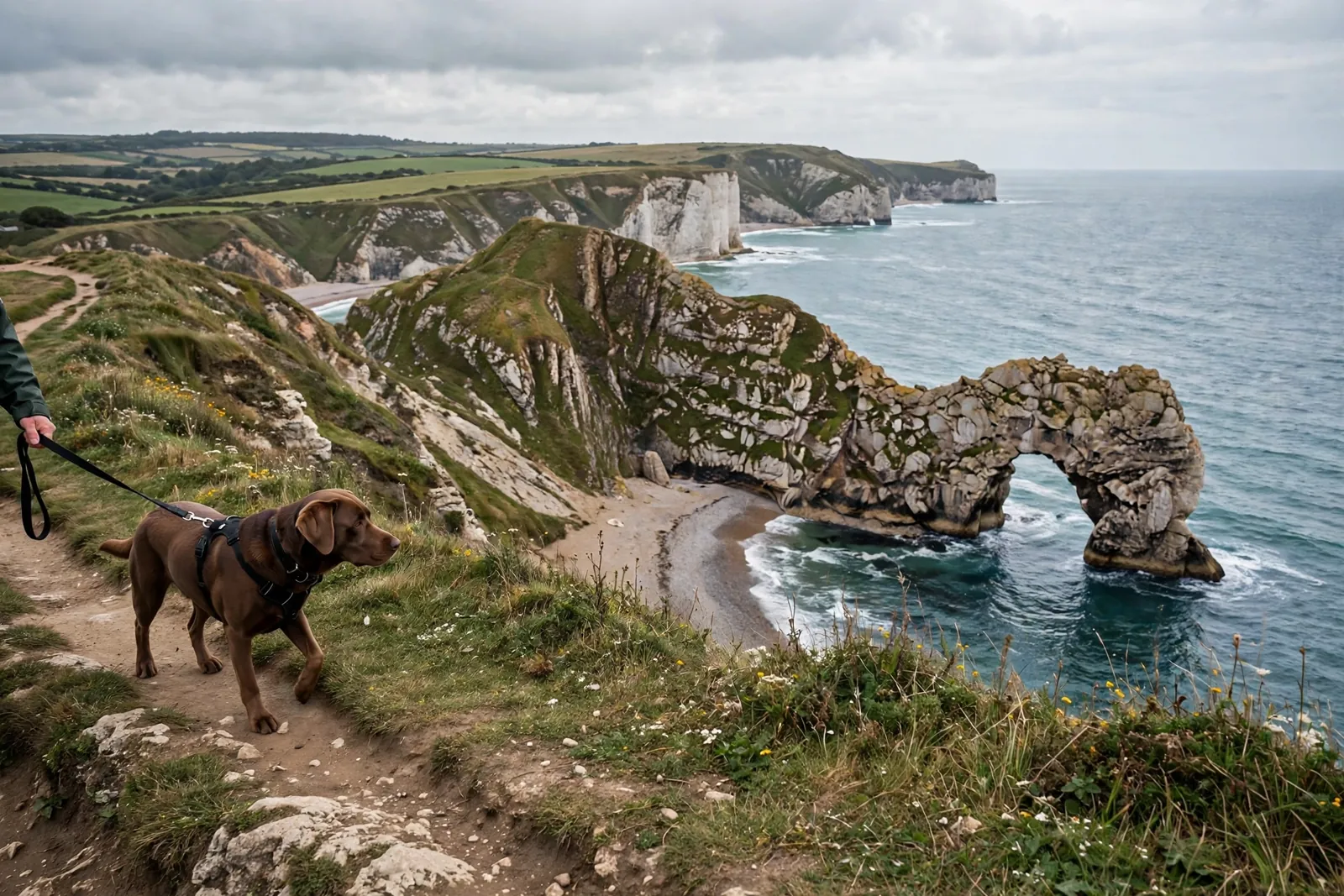
Durdle Door, the limestone arch west of Lulworth Cove, is the image most people carry to Dorset — and the walk that most often surprises them. The approach from the main car park crosses open downland before dropping steeply towards the beach. The path is exposed, the surface can be loose chalk and gravel, and the final steps down to the shingle are uneven. For a fit, sure-footed dog this is a manageable outing in dry weather. For an older dog, a puppy whose joints are still developing, a dog that pulls hard downhill, or any dog in hot weather with no shade on the route, it deserves a honest second thought before you commit.
Timing changes the experience more than fitness does. The narrowest sections become genuine bottlenecks in the middle of the day, when walkers, pushchairs and dogs on extending leads all try to pass on a steep slope. A reactive dog that copes well on an open beach may struggle badly here, not because the walk is long but because there is nowhere to create distance. Visiting early in the morning or later in the afternoon, outside the busiest summer hours, gives you passing space, cooler ground and a calmer descent. If you arrive and the path is already queued, there is no shame in enjoying the viewpoint from the top and saving the beach for a quieter day — the view from the clifftop is the famous one anyway.
Lulworth Cove itself is gentler: a sheltered, curved bay with a more gradual approach, cafés and facilities nearby, and a beach that suits a paddle and a sit-down better than a long run. Even here, keep expectations realistic in peak season. Space on the shingle is limited at high tide, the water attracts swimmers and kayaks, and dogs need to stay under close control around picnic blankets and other people's children. Bring water for your dog rather than relying on sea water, which many dogs drink enthusiastically and then regret. A short lead, not an extending lead, is the right tool in both places: it keeps your dog out of the path of descending walkers and away from the cliff edge on the exposed sections.
Parking and payment arrangements at Lulworth and Durdle Door change over time, and the walk from the car park adds distance that guidebook timings sometimes underplay. Check the official latest guidance before you travel for current parking charges, opening arrangements and any temporary path closures or diversions, especially after winter storms, when sections of coast path are periodically rerouted inland.
Cliff safety and fossil beaches: the rule that matters most
The Jurassic Coast is a working, eroding coastline, and that single fact should shape every walk you plan with a dog. Cliffs along this coast can fall without warning, and falls are more likely after heavy rain, after prolonged wet weather, and during freeze-and-thaw conditions in winter. The essential rule is simple and absolute: never walk or sit under cliffs, and never let your dog root around at the base of a cliff while you look for fossils. Keep a generous distance from the cliff foot — the standard official advice is to stay at least as far away as the cliff is high — and keep the same generous distance from the edge at the top, where ground can be undercut and crumbly in ways that are invisible from above.
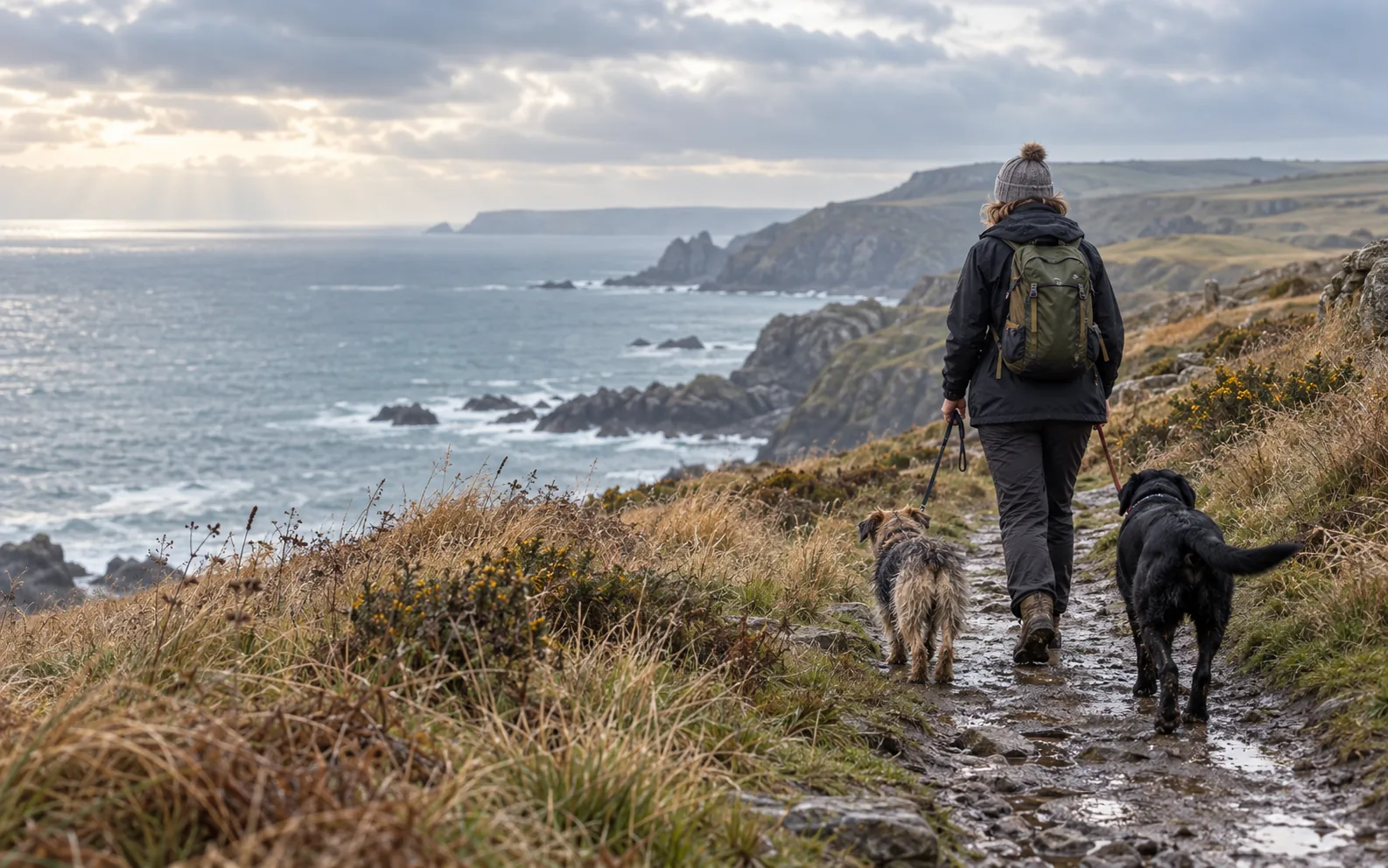
Dogs change the risk calculation at the top as well as the bottom. A dog off lead on a clifftop can chase a bird or follow a scent straight over an edge that it cannot judge, and an owner who instinctively lunges for a collar near an edge puts two lives at risk. On all exposed clifftop sections in Dorset, the sensible default is a lead on, a harness rather than a collar if your dog pulls, and no ball games, however tempting the flat grass looks. The South West Coast Path is well waymarked, but it follows the cliff line closely in places, and diversions after falls are there for a reason: if a section is closed or diverted, follow the diversion rather than the old line, even if local walkers appear to be ignoring it.
Fossil beaches add a second, quieter set of considerations. Beaches famous for fossils, such as those around Lyme Regis and Charmouth further west, reward patience on the loose shingle and foreshore rather than hammering at the cliff — and organised, guided fossil walks are a far safer introduction than improvising under an unstable face. With a dog, plan who holds the lead while the other person looks at the ground, because fossil hunting is heads-down work and a dog left to wander will wander towards the cliff base or into rock pools. Watch tides carefully: several Dorset beaches cut off quickly as the tide comes in, trapping walkers against the cliffs, which is precisely where you must not be. Check tide times before you set out, keep an escape route in mind, and check the official latest guidance before you travel for any beach-specific warnings after storms.
Ground conditions underfoot matter too. Wet chalk is exceptionally slippery, shingle is hard work for small dogs and for dogs recovering from injury, and rock pools hide sharp edges. Dog boots are overkill for most visits, but a paw check after cliff and fossil beaches — rinsing salt and grit and looking for cuts — is a two-minute habit that prevents a limping dog the next morning.
Studland and Swanage: reading seasonal beach zones properly
The sandy beaches of the Isle of Purbeck are the soft counterpoint to the cliff walks: Studland Bay offers a long sweep of sand backed by dunes and heath, while Swanage has a traditional resort beach with a promenade, facilities and a busier feel. Both are excellent dog walking territory outside the main season — and both operate seasonal arrangements that restrict where dogs can go during the busiest months. The pattern is familiar across Britain: a designated dog-friendly section remains open while the central, lifeguarded or most popular section restricts dogs, usually on a lead or not at all, for a defined summer period. Our guide to UK beach dog rules, bans and fines explains how these seasonal restrictions and local orders work in general, so you can read any Dorset beach sign with confidence when you arrive.
The practical skill is reading the specific beach, not assuming. At Studland, different parts of the bay have different managers, different facilities and different dog arrangements, and the boundaries are marked at access points rather than along the sand itself. At Swanage, the restricted zone and the dog exercise area are signed from the promenade. Arrive, find the sign at your access point, and walk the permitted section even if the forbidden sand looks emptier and more inviting. Fines under local public spaces protection orders are a real possibility for ignoring beach restrictions, and "the dog slipped the lead" is not a defence that improves the conversation.
Studland deserves one extra note: the dunes and the heath behind the beach are a protected landscape, and parts of the wider Studland area include naturist sections of beach that are clearly signed — simply follow the signs and choose your section accordingly. Dogs that chase birds should stay on a lead around the bay's quieter ends, where wading birds feed on the mud at low tide, and in Poole Harbour's shallows nearby. In summer, the sand itself can become hot enough by midday to hurt paws, parking fills early, and the chain ferry and approach roads queue; an early walk, a long midday rest in shade, and a second evening walk is a better dog day than one long expedition in the heat.
As with every beach in this guide, dates and boundaries change. Check the official latest guidance before you travel — the relevant council and landowner pages for Studland and Swanage publish the current season's dog zones — and then obey the signs on the day, which override anything printed anywhere, including here.
The Isle of Purbeck steam railway and getting around with a dog
The heritage steam railway that links Swanage with Corfe Castle and Norden is one of the most enjoyable ways to move around Purbeck without a car, and it turns a logistics problem into part of the holiday. A castle visit, a walk from a rural station and a ride back makes a satisfying dog day with no retracing of steps. However, dog policy on heritage railways is set by the operator and can change: fares for dogs, which carriages accept them, whether they must stay on the floor, and any services from which dogs are excluded are all operator decisions. Check the operator's official latest guidance before you travel rather than relying on a review from a previous season, and buy the right ticket before boarding if a dog fare applies.
On the day, set your dog up to succeed. Steam railways are noisy, steamy and theatrical — whistles, hiss, carriage doors and crowded platforms are a sensory stack that some dogs adore and others endure. Choose a quieter service where you can, board calmly rather than rushing at the whistle, settle your dog on the floor on a short lead and off the seats, and bring water for the journey. A dog that is nervous of trains will usually do better at the lineside first: watch a departure from the platform or a nearby viewpoint, let the noise become boring, and ride another day. Corfe Castle station puts you a short walk from the village and castle, which makes it an ideal first short hop.
Beyond the railway, Purbeck rewards a mixed approach. Buses in rural Dorset are infrequent enough that a missed connection reshapes a day, and dog acceptance on local buses, while common, sits with the driver and the operator's conditions — a clean, settled dog on a lead, travelling on the floor, is the expectation everywhere. Driving is simpler but brings its own constraint: car parks at the famous coastal sites fill early in summer and some lanes around Lulworth and Corfe are narrow and slow. Build slack into every plan, never leave a dog in a parked car in warm weather, even with windows cracked, and treat any timetable — rail or bus — as something to confirm against the official latest guidance before you travel.
Corfe Castle and grounds-type visits: what suits a dog
Corfe Castle, the ruined hilltop fortress above its grey stone village, is the archetype of a grounds-type visit with a dog: mostly outdoors, spectacular to walk around, and organised so that dogs on leads can share most of the experience while indoor spaces follow their own rules. Expect a steep, uneven climb on grass and stone, exposed to the weather, with slopes that are slippery after rain. It suits fit, sure-footed dogs and owners in proper footwear. A frail older dog, a dog recovering from injury, or a very young puppy may enjoy the village, the lower slopes and the views from below more than the summit — and that is still a good visit.
The general pattern for National Trust and similar heritage places is covered in our guide to National Trust dog rules and pawprint ratings: dogs are typically welcome on short leads in grounds and gardens, water bowls and dog bins are provided at key points, and houses, some cafés and formal gardens set their own limits. Corfe follows the broad logic of that pattern, but the details that matter — where exactly dogs can go on the day, whether any areas are closed for conservation or events, and where the nearest water point is — belong to the site itself. Check the official latest guidance before you travel, keep your dog on a short lead throughout, and be ready to skip any indoor element rather than tying a dog up outside, which many sites rightly prohibit.
Pace a castle visit like a walk, not a museum. Alternate exploration with pauses where your dog can simply stand, sniff and watch; carry water rather than relying only on provided bowls in summer queues; and plan the descent as carefully as the climb, because tired dogs pull downhill. In the village below, dog-friendly cafés and pubs change seasonally, so treat any list, including ours elsewhere on this site, as a prompt to check rather than a promise. If you are building a Purbeck base around several heritage visits, compare the pattern with our guide to dog-friendly holiday parks in Devon — the same booking logic about enclosed outdoor space, nearby after-dark walks and honest pet fees applies county to county.
Heathland lead rules: small signs, serious reasons
Inland Dorset holds some of the rarest habitat in Britain: lowland heath, home to ground-nesting birds such as nightjars and Dartford warblers, to sand lizards and smooth snakes, and to grazing ponies and cattle that keep the heather open. This is why the lead rules here are stricter, and enforced with more feeling, than on an ordinary footpath. During the bird breeding season in particular — broadly spring and summer — many heathland sites require dogs on a short lead, and some ask for dogs to stay on paths at all times. A dog does not need to chase to cause harm: a nesting bird flushed repeatedly off eggs by a dog quartering the heather may abandon the nest, and reptiles basking at path edges are easily injured by an off-lead dog investigating the undergrowth.
The Studland and Godlingston heaths behind the bay, the heaths around Poole Harbour, and Arne-type reserves on the harbour's edge all operate variations of this approach, with signage at car parks and main entrances explaining the current requirement. Read the sign at the entrance you actually use, not the one you remember from another site. Where a short lead is required, an extending lead locked long defeats the purpose; use a genuinely short lead, keep to the paths, and give grazing animals a wide, calm berth, crossing to the far side of the path rather than squeezing past. If cattle approach — rarely, but it happens — the standard safety advice is to let go of the lead so you and the dog can separate, rather than holding on and being pulled into trouble.
Heathland also carries a seasonal fire risk that dog owners should take seriously: in dry summers, heath fires start easily and spread fast, and some sites restrict access or close entirely in extreme conditions. Never discard anything smouldering, keep to designated parking on hard standing rather than verges in dry weather, and if you see smoke, move away and report it. Check the official latest guidance before you travel for any heathland visit in a dry spell, and be ready with a woodland or beach alternative. None of this diminishes a heath walk — on a lead, at path pace, these are some of the most atmospheric walks in Dorset, with lizards on the boardwalks and nightjars at dusk in season — it simply asks you to walk as a guest in a rare place.
Choosing a base and building realistic Dorset dog days
Where you stay shapes a Dorset dog holiday more than any single walk. Swanage makes the easiest all-round base for a first visit: beach, promenade, railway, shops and vets in one walkable town, with Corfe Castle a short ride away. Wareham suits walkers who want heathland and the River Frome on the doorstep and do not mind driving to the sea. The Lulworth and Wool area puts Durdle Door within reach for an early start — the single best tactical advantage on this coast — while Weymouth, further west, offers a larger resort base with its own beach rules and an easy rail link for car-free visitors. Rural cottages and farm stays between these towns can be wonderful, but check the after-dark toilet walk, the enclosure standard of the garden and the distance to the first real walk, because a beautiful base that needs a car for every outing quietly taxes the whole week.
Build days around one headline outing, not three. A pattern that works well with dogs is an early headline walk — Durdle Door before the crowds, Studland before the heat, a castle before the coaches — followed by a long, lazy middle of the day and a gentle local evening walk. Dogs rest better, owners queue less, and you keep a reserve for the inevitable Dorset disruption: a closed coast path section, a full car park, a beach zone you had not expected. Keep one wet-weather option in hand — a harbour town wander, a dog-welcoming café and a short woodland circuit — because Atlantic weather reaches Dorset in any month, and a dog holiday that only works in sunshine is a fragile plan.
Finally, pack for the coast you are actually visiting. A harness and a fixed short lead for cliffs and heaths, a longer line for permitted open beaches, towels for shingle-and-sea days, a paw rinse bottle, more water than you think you need, poo bags for beaches where bins are at access points only, and a printed or saved copy of tide times and the day's beach rules cover most Dorset surprises. Vets cluster in the towns — Swanage, Wareham, Dorchester and Weymouth — so save the number of the practice nearest your base before you need it, and note where you would park and pay, because a calm plan made in advance is the kindest thing you can give a sore-pawed dog. Dorset's coast is genuinely as good as its reputation; with leads in the right places, cliffs given proper respect and rules checked fresh for each trip, it is also one of the most rewarding places in England to take a dog.
Practical questions
Before you go
Are dogs allowed at Durdle Door and Lulworth Cove?
Dogs are generally welcome on a lead on the paths and beaches around Durdle Door and Lulworth Cove, but the access paths are steep, the steps can be slippery, and the busiest bottlenecks leave little passing space. Dogs must stay under close control, away from cliff edges, and should not be taken under cliffs, especially after rain. Check the official latest guidance before you travel, as access and local rules can change.
Can dogs go on Studland and Swanage beaches in summer?
Parts of Studland and Swanage operate seasonal dog zones and restrictions in the main holiday season, so a beach that is fully open in winter may be partly restricted in summer. Follow the signs at each access point, keep dogs in the permitted zone and on a lead where signed, and check the official latest guidance before you travel for the current dates and boundaries.
Can I take my dog on the Isle of Purbeck steam railway?
The Isle of Purbeck steam railway has historically welcomed well-behaved dogs in many services, sometimes for a small fare, but carriage rules, fares and any exclusions can change. Check the operator's official latest guidance before you travel, keep your dog on a short lead and off seats, and avoid the busiest services if your dog struggles with noise, steam and crowded platforms.
Are dogs allowed at Corfe Castle?
Grounds-type visits such as Corfe Castle usually welcome dogs on a short lead in the outdoor areas, while indoor spaces, cafes and some events may have different rules. The castle mound is steep and uneven, so it suits sure-footed dogs better than frail or very young dogs. Check the official latest guidance before you travel for lead rules, water points and any temporary closures.
Why do dogs need to be on a lead on Dorset heathland?
Dorset heathland protects rare ground-nesting birds, reptiles and grazing livestock, and a loose dog can cause serious disturbance even without chasing. Many heathland sites require dogs on a short lead, particularly in the bird breeding season, and some areas ask visitors to keep to paths. Follow local signs, keep to a short lead where required, and check the official latest guidance before you travel.