This guide is independent and contains no paid placement. If affiliate links are added later, they will be clearly marked and will not change our editorial checks.
Check the forecast and the wind before you decide how far to walk. The White Cliffs are a proper exposed cliff-top walk, not a park stroll: keep your dog on a lead, stay well back from the edge, and build the day around short, flexible legs with the castle grounds, the seafront and the town as calmer fallbacks.
Check the weather and wind first
Dover is a working port town on an exposed stretch of the Kent coast, and the weather on the cliff top can feel very different from the weather in the town below. Before you leave home, check the forecast for wind speed and gusts, rain and visibility, and check it again on the morning of the visit. A dry, bright day in the town can still mean a strong, cold wind on the open chalk ridge, and a dog that is happy on a sheltered street may be miserable, or unsafe, on an exposed path. The rule for this trip is simple: look at the weather and the wind first, then decide how far to walk. If the wind is gusting hard, shorten the plan. If rain is forecast for the afternoon, do the cliffs in the morning and keep the castle grounds or the seafront for later.
Wind matters more than temperature on the White Cliffs. The cliff-top path runs along an open ridge with very little shelter, and gusts can catch a dog by surprise, especially a small or light dog, a puppy, or an older dog that is less steady on its feet. A strong crosswind near an unfenced edge is a genuine hazard, not just a discomfort. As a rough guide, if the forecast shows sustained winds above about 30 miles per hour or gusts above 40, treat the cliff-top walk as a poor choice for most dogs and pick a lower route instead. That is a judgement call rather than an official limit, and you should check the official guidance before you travel if conditions look severe. Rain matters too: chalk paths turn slippery when wet, the grass beside the path becomes muddy and soft, and visibility can drop quickly in sea mist, which makes it harder to judge where the edge is.
Plan the day in legs, not as one fixed route. A flexible plan might be a short cliff-top stretch in the morning, a break at the visitor centre, and then a decision point: continue towards South Foreland Lighthouse if the dog is still keen and the weather is holding, or turn back and drop down to the seafront for a flat, sheltered walk. Tell everyone in the group the turning-back point before you start, so nobody has to argue about it halfway along an exposed ridge. Carry water for the dog even on a cool day, because there is little shade or drinking water on the cliff top, and a dog working hard in wind can get thirsty faster than you expect. A waterproof coat for the dog is worth packing in every season except high summer, and a towel in the car earns its place on wet days.
Finally, check for closures and warnings before you travel. Cliff falls happen along this coast, and sections of path can be closed or moved inland after a fall. The National Trust, which looks after the White Cliffs visitor centre and the Langdon Cliffs area, posts updates about path conditions, and Dover District Council and the harbour authorities post notices about the seafront and beach. A five-minute check the night before can save a wasted drive and a disappointed dog. If a path is closed, respect the closure: the fences and signs are there because the ground beyond them is unstable, and dogs are exactly the animals most likely to slip through a gap that looks passable.
White Cliffs paths: choosing a route that fits your dog
The White Cliffs of Dover are the reason most visitors come, and the cliff-top walk is one of the finest coastal walks in southern England. The chalk cliffs run for several miles along the coast, and the main walking route follows the England Coast Path and the North Downs Way along the cliff top. The best-known stretch runs from the National Trust visitor centre at Langdon Cliffs, east of the town, towards South Foreland Lighthouse and on to St Margaret's Bay. The full walk from Langdon Cliffs to the lighthouse is about three miles each way, which makes a six-mile round trip, and that is a long day for many dogs. Shorter out-and-back walks are the sensible choice for most visitors: walk out for thirty or forty minutes, enjoy the views, and turn back while the dog is still fresh.
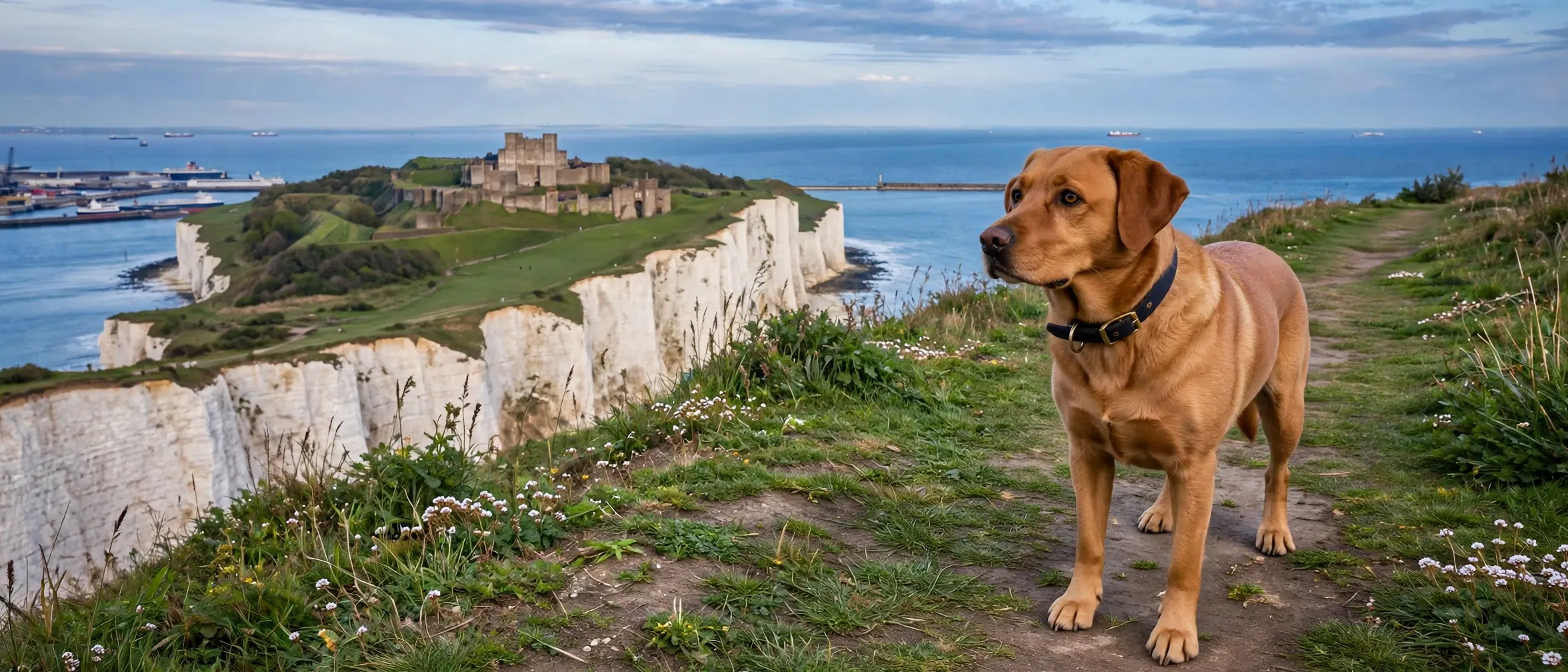
Start at Langdon Cliffs if you want the classic experience. The visitor centre sits on the cliff top above the town, with a car park, toilets and a cafe, and the path eastwards from there is wide, well surfaced and easy to follow. The first stretch gives you the famous view back towards Dover Castle and the harbour, and the grassland beside the path is rich in wildflowers in spring and summer. This is also the busiest section, especially on weekends and school holidays, so expect other walkers, other dogs and cyclists sharing the route. Keep your dog on a lead here even if the path looks wide, because the edge is close and other dogs may be off the lead. If your dog is reactive or nervous around strangers, an early start on a weekday is far calmer than a sunny Saturday afternoon.
For a quieter walk, consider the western side of Dover. The path west from the town runs towards Samphire Hoe, a nature reserve built from the spoil of the Channel Tunnel, which sits at the foot of the cliffs rather than on top of them. The walk down to Samphire Hoe is steep, so it suits fit dogs and owners, but the flat paths at the bottom, with views of the cliffs from below and the sea beyond, are a completely different experience from the cliff top. Dogs must be kept under control there, and the reserve is a sensitive place for birds, so check the official guidance before you travel and follow the signs about leads and seasonal restrictions. The Western Heights, the great fortifications above the town, also offer open grassland walks with wide views, but the ground is uneven and the paths are less formal, so they suit confident walkers and dogs that are steady on rough ground.
Think about the return journey as carefully as the outward leg. A dog that trots happily for the first two miles may be tired, footsore or overheated by mile five, and there is no shortcut off the cliff-top path in the middle of the stretch. The path between Langdon Cliffs and South Foreland Lighthouse has few exits, and the only practical way back is the way you came. That is why out-and-back walks work so well here: you can turn around at any point, and the dog gets a new set of smells on the way back. Carry more water than you think you need, offer it at every stop, and watch for signs of tiredness such as lagging behind, lying down in the shade or refusing to move. A dog that has had enough on a cliff top is not being stubborn; it is telling you the walk is over.
Cliff edges, leads and safety
The White Cliffs are chalk, and chalk crumbles. The edge can be undercut by the sea and by rain, so ground that looks solid can give way without warning, and falls of chalk and soil happen regularly along this coast. That is the single most important fact about walking a dog here. The cliff-top path is set back from the edge in most places, but in some stretches the path runs close to the rim, and there are sections with no fence at all. Never let a dog run to the edge, lean over it, or chase a bird or a rabbit towards it. A dog on a long lead can still reach the edge if the lead is longer than the distance from the path to the rim, so shorten the lead whenever the path runs near the drop, and walk with the dog on the inland side of the path, between you and the safety of the open grass.
Use a lead, not a retractable one, on the cliffs. A standard lead of about one to two metres gives you real control; a retractable lead gives a dog ten metres of freedom and a locking mechanism that can fail at the worst moment. A harness is a good choice here because it spreads the load if the dog lunges, and it gives you something secure to hold if you need to guide the dog away from the edge. Keep the dog on a lead for the whole cliff-top walk, even if your dog has perfect recall at home. Recall is not reliable when a dog is excited by seabirds, other dogs, or the smell of rabbits in the grass, and a single moment of inattention near a cliff edge is all it takes. If your dog is a known chaser, a short lead and a calm, steady pace are the only sensible combination.
Watch the ground as well as the edge. The chalk path can be slippery after rain, and the grass beside it can hide rabbit holes, uneven ground and loose chalk. Dogs that run at full speed on a cliff-top path can slip or twist a leg, and a dog that is already tired is more likely to stumble. Keep the pace steady, stop regularly, and let the dog sniff and rest. Sniffing is not wasted time: a dog that has had a good sniffing session is calmer and more tired than one that has been marched along at human pace. If you meet other dogs, pass with space, keep both dogs on leads, and do not let them tangle leads near the edge. A tangled lead can pull a dog sideways in a direction nobody intended.
Know what to do if something goes wrong. If a dog goes over the edge, do not climb down after it: call the emergency services and the coastguard, and keep other people and dogs well back from the rim. The coastguard and the local rescue teams are trained for cliff rescues, and a well-meaning owner who climbs down can become a second casualty. Carry a charged phone, know roughly where you are on the path, and note the nearest landmark or path marker so you can describe your location. It is also worth saving the number for the nearest vet before you set out, because the closest emergency vet may be some distance from the cliffs. Prevention is better than any rescue plan, and prevention here is simple: a short lead, the inland side of the path, and a generous distance from the edge at all times.
Dover Castle and its grounds with a dog
Dover Castle dominates the town from its hilltop above the harbour, and it is one of the most rewarding places in Dover to visit with a dog, as long as you plan around the building rules. The castle is run by English Heritage, and the general pattern at its sites is that dogs on leads are welcome in the outdoor grounds, while only assistance dogs are allowed inside the buildings, including the Great Tower, the wartime tunnels and the exhibitions. That means the castle works best as an outdoor visit for dog owners: the grounds, the views and the walks around the ramparts are the main event, and the interiors are something one member of the group does while another stays outside with the dog. Check the official guidance before you travel, because the rules for individual buildings and events can change, and special exhibitions sometimes have different arrangements.
The grounds themselves are generous. The castle sits on a chalk hill with wide grassy areas, paths around the medieval walls, and views across the town, the harbour and the Channel that are worth the climb on their own. The walk up from the town is steep, so many visitors drive to the castle car park or take a bus to the top and start from there. Once inside the grounds, keep the dog on a lead: the site is busy, there are children, other dogs and historic structures with uneven steps, and the ramparts have drops of their own. The grass is good for a sniffing walk, and the paths around the outer walls give a dog a proper outing without ever going near a cliff edge. On a clear day you can see across the Channel to France, which is a fine reward for the climb.
Plan the visit as a team effort if you want to see the interiors. The Great Tower, with its recreated medieval interiors, and the Secret Wartime Tunnels, which tell the story of the castle in the Second World War, are the two highlights, and both are indoors. One person can take the dog for a walk around the grounds while the other visits the tower, and then you can swap. Allow at least two hours for the grounds alone, and longer if you want to visit the interiors in turns. There is a cafe in the grounds, and outdoor seating is the practical choice with a dog. Bring water for the dog, because the hilltop is exposed and there is little shade on a hot day, and be ready for wind: the castle hill catches the same wind as the cliffs, and a dog that is cold or windswept will not enjoy the visit.
The castle is also a good wet-weather fallback. The grounds are still walkable in light rain, the paths are surfaced in the main areas, and the visit can be shortened without feeling wasted. If the weather turns properly bad, the town and the seafront offer better shelter than an exposed hilltop, so be ready to change plans. Check the opening times before you go, because the castle has seasonal hours and the tunnels sometimes run on timed entry. Tickets are usually cheaper when booked in advance, and members of English Heritage enter free, but dogs do not need a ticket for the grounds. If you are visiting Dover for more than a day, the castle and the cliffs make a natural pair: the cliffs in the morning when the light is best, and the castle in the afternoon when the dog has had a rest.
The harbour, seafront and beach
Dover's seafront is the flat, easy counterpoint to the cliffs, and it is where most dogs will be happiest. The promenade runs along the shore from the town towards the harbour, with a wide paved walk, benches, and views of the ferries coming and going. It is a straightforward, level walk that suits older dogs, puppies, and dogs that are not ready for a long climb, and it can be as short or as long as you like. The harbour area itself is a working port, so keep the dog on a lead and close to you: there is traffic, lorries, and machinery, and the quaysides are not places for a dog to wander. The Prince of Wales Pier and the marina area are pleasant for a stroll, but follow the signs and stay in the public areas.
Dover beach is a shingle beach beside the seafront, and its dog rules need checking before every visit. Seasonal restrictions have applied in the past, with dogs excluded from the main beach area during the summer months under a public spaces protection order, and the exact dates and boundaries can change from year to year. Check the official guidance before you travel, look for the signs at the beach entrances, and do not assume that the rules are the same as they were last summer. Our guide to dog-friendly beaches in the UK explains how seasonal bans and public spaces protection orders work, and how to check a beach before you go. If Dover beach is restricted on your visit, nearby beaches may have different rules, and a short drive can open up a beach where the dog can run properly.
The shingle itself deserves a mention. Dover beach is made of pebbles rather than sand, and pebbles are hard on paws, especially for dogs that are not used to them. A short visit is fine for most dogs, but a long session of running and digging on shingle can sore a dog's feet, and some dogs will try to eat or chew pebbles, which can be dangerous. Watch the dog, keep sessions short, and rinse the paws afterwards if you can. The sea here is also deep and cold, with strong currents near the harbour entrance, so do not let the dog swim near the port or the pier. If your dog loves the water, a calm, shallow beach elsewhere on the Kent coast is a safer choice for swimming than the harbour mouth.
Tides and ferries shape the seafront experience. The tide at Dover rises and falls by several metres, and the beach can narrow considerably at high tide, so check the tide times if you plan a beach walk. The ferries are a constant presence, and many dogs find the noise and movement exciting at first and tiring after a while. If your dog is noise-sensitive, the seafront near the port can be a lot to take in, and a quieter stretch of promenade further from the harbour may suit them better. The seafront is at its best early in the morning, when the light is soft, the promenade is quiet, and the dog can have a calm walk before the town wakes up. That early walk also leaves the rest of the day free for the cliffs or the castle.
Old town, cafes and places to eat
Dover town centre is compact and walkable, and it makes a good base for a dog-friendly day. The main streets run from the seafront up towards the castle hill, with shops, cafes and pubs along the way, and the town is small enough that you can walk from the seafront to the market square in a few minutes. The streets are busy with traffic near the port, so keep the dog on a short lead and watch for lorries and buses, especially around the roundabouts near the harbour. The town has a market square and a few pedestrianised stretches where a dog can walk more calmly, and the quieter side streets are a better choice than the main road if your dog is nervous around traffic.
For food and drink, look for pubs and cafes with outdoor seating or a stated dog-friendly policy. Dover has several traditional pubs, and many welcome dogs in the bar or on the terrace, though policies vary and can change, so check before you sit down. The practical approach is to ask at the door: a pub that welcomes dogs will usually have water bowls, dog treats, or a sign saying so, and the staff will tell you where dogs are allowed. Cafes on the seafront and in the town centre are often happy to serve a dog owner at an outdoor table, and a takeaway coffee and a bench on the promenade is a perfectly good Dover lunch. If you want a longer meal, choose a place where the dog can settle under the table rather than one where the dog will be in the way of other customers, and bring a mat or a blanket so the dog has its own spot.
Shopping with a dog in Dover is a matter of choosing the right shops. Some shops welcome dogs, others do not, and the only reliable way to know is to ask. The town has a mix of high street shops, independent stores and a shopping centre, and the outdoor market, when it runs, is a lively place for a dog that is comfortable in crowds but a poor choice for a dog that finds crowds stressful. If you need supplies, there are supermarkets in and around the town, and a pet shop will usually welcome a dog. Keep shopping trips short, and do not leave a dog tied up outside a shop: it is stressful for the dog, it can be unsafe, and in a busy port town it is not a good idea. One person shops while the other walks the dog, or keep the visit to shops that welcome dogs inside.
The town also rewards a slow wander. The Maison Dieu, the medieval town hall on the high street, and the Roman Painted House, a small museum with Roman wall paintings, are part of Dover's long history, though both are indoor attractions where dogs are not normally allowed inside. The riverside walk along the River Dour, which runs through the town to the sea, is a quieter route than the main road, and the small parks and green spaces in the town give a dog a break from pavements. If you are staying for the weekend, the town is a useful base for exploring further afield: Canterbury is about half an hour away by car or train, and its medieval lanes and riverside walks make a good second day out with a dog.
Staying overnight with a dog in Dover
Dover works well as an overnight stop, whether you are breaking a journey to France or spending a weekend exploring the Kent coast. The town has hotels, bed and breakfasts, guest houses and self-catering accommodation, and a number of them welcome dogs, though the details matter more than the headline. A hotel that accepts dogs may allow them only in certain rooms, may charge a nightly fee, may limit the number or size of dogs, or may ask that dogs are not left alone in the room. Always confirm the dog policy in writing before you book, and ask the specific questions: which rooms accept dogs, what the fee is, whether the dog can be left alone, and where the nearest place is for a late-night toilet walk.
Self-catering accommodation is often the easiest choice for a dog owner in Dover. A cottage or flat gives the dog its own space, a kitchen for preparing food, and a door you can open for a quick garden break. Look for a property with a garden or an outdoor area, and ask whether the garden is enclosed: a low wall or an open gate is not the same as a secure garden, and a dog in a new place is more likely to explore than a dog at home. Check the flooring too: a hard floor is easier to clean after a muddy walk than a pale carpet, and a property that mentions dogs in its listing is more likely to have thought about these details. Our guide to dog-friendly holiday parks covers the questions worth asking any self-catering or park stay, from pet fees to boundaries and drying space.
Location matters as much as the property. A place near the seafront gives you a flat morning walk without the car, while a place on the edge of town may be quieter but need a drive for every walk. A place near the castle hill gives you a steep walk home at the end of the day, which is fine for a fit dog but tiring for an older one. Think about parking as well: a property with its own parking space is worth more than one where you have to carry bags and a dog across a busy street. If you are catching an early ferry, a hotel near the port saves a stressful early start, but check whether the hotel is noisy at night, because lorries run to the port around the clock.
Settle the dog properly on arrival. Walk the dog around the property before you unpack, show it where the water bowl and bed are, and keep the first evening calm. A new place smells different, and a dog that is over-excited or anxious on arrival will settle faster if the routine is familiar: same food, same bed, same last walk before bed. If the dog is used to a crate, set it up exactly as at home. Ask the host where the nearest vet is, and save the number, because an unfamiliar town is the worst place to be searching for a vet in a hurry. A short evening walk along the seafront, a quiet night, and an early start on the cliffs the next morning is a good shape for a Dover weekend.
Getting there, parking and public transport
Most visitors reach Dover by car, and the town is well connected by road. The A2 runs from London and Canterbury to Dover, and the A20 runs from the M20 and Folkestone to the port. Both routes are straightforward, but traffic near the port can be heavy, especially on Friday afternoons, summer weekends and school holidays, when ferry traffic builds up. Allow extra time, and check the traffic before you leave. The drive from London takes about two hours in clear traffic, and from Canterbury about half an hour. If you are travelling with a dog, plan a comfort stop on the way: a service area or a quiet layby where the dog can stretch its legs, drink and use the toilet before the last stretch to Dover.
Parking in Dover needs a little planning. The National Trust car park at Langdon Cliffs is the most convenient place to start the cliff walk, and it has a pay-and-display system, with free parking for National Trust members. It fills up on fine weekends, so an early arrival is the best strategy, and the car park is the starting point for the path to South Foreland Lighthouse. In the town, there are car parks near the seafront, the town centre and the harbour, including the Dover Marina area and the town centre car parks, and on-street parking is available in some areas. Check the signs for time limits and charges, because some car parks have height restrictions or short-stay limits that do not suit a full day out. Never leave a dog in a parked car on a warm day, even with the windows open: a car heats up fast, and the cliffs and the castle both take hours to enjoy properly.
Dover Priory station is the town's main railway station, with trains from London St Pancras, Ashford and Canterbury, and the station is about a fifteen-minute walk from the seafront. Dogs are allowed on trains in the UK, usually free of charge, but they must be kept on a lead and under control, and they should not take up a seat. The walk from the station to the town centre is downhill and straightforward, though the walk up to the castle or the cliffs from the station is long and steep, so a bus or a taxi is the practical choice for those. Buses run from the town centre to the castle and to the White Cliffs visitor centre, but services are not frequent, so check the timetable before you rely on one. Taxis are available at the station and in the town, but not all taxi firms take dogs, so ask when you book.
If you are travelling onward to France, Dover is the departure point, and the ferry is the main option. Dogs can travel on the ferries, but the rules vary by operator and by route, and dogs usually have to stay in the car or in a kennel on board, depending on the service. Check the ferry operator's pet policy well before you book, and allow extra time at the port for check-in. The port is a busy, noisy place, so give the dog a calm walk and a toilet break before you arrive, and keep the dog on a lead at all times in the port area. For a day trip, the car is the easiest option; for a longer stay, the train and bus combination works well if you plan around the timetables.
Seasons, weather and when to visit
Spring is one of the best times to visit Dover with a dog. From April to June the cliff-top grassland is full of wildflowers, the weather is usually mild, and the paths are drier than in winter. The cliffs are at their greenest, the air is clear, and the dog can walk comfortably without the heat of high summer. Spring is also the nesting season for birds on the cliffs, so keep the dog on a lead and stay on the path: ground-nesting birds and cliff-nesting seabirds are easily disturbed, and a dog running through the grass can do real damage. The visitor centre and the castle are open, the town is busy but not crowded, and the light on the white chalk in the morning is at its best.
Summer brings the longest days and the warmest weather, but it also brings the biggest crowds and the most restrictions. The cliff-top path is busiest on summer weekends, the car park at Langdon Cliffs fills early, and the beach restrictions are in force. Heat is the main concern for the dog: the cliff top has no shade, the chalk reflects the sun, and a dog walking on a hot, exposed ridge can overheat quickly. Walk early in the morning or late in the afternoon, carry plenty of water, and watch for signs of heat stress such as heavy panting, drooling, or a dog that slows down and seeks shade. Shorten the walk on hot days, and use the seafront or a shaded inland walk instead. Never leave a dog in a car in summer, even for a few minutes, and remember that the shingle and the pavements can burn paws on a hot day.
Autumn is the quiet season, and for many dog owners it is the best time of all. From September to November the crowds thin out, the beach restrictions usually lift, the light turns golden, and the weather is often settled. The cliff-top grass turns brown and the wildflowers fade, but the views are just as good, and the dog can walk further without overheating. Autumn storms can arrive quickly, though, and the wind on the cliff top can be fierce after a front has passed. Check the forecast, and be ready to swap a cliff walk for a town walk if the wind is up. The castle and the town are quieter in autumn, which makes them easier with a dog that finds crowds stressful.
Winter in Dover is wild and beautiful, but it is not for every dog. The cliffs are exposed to wind and rain, the paths can be muddy and slippery, and the daylight hours are short. A short, sharp walk on a clear winter day, with the Channel grey-green below and the ferries crossing in the distance, can be wonderful, but a long walk in driving rain is miserable for both ends of the lead. The visitor centre and the castle have shorter winter hours, so check the opening times before you travel. Winter is also the season when the dog needs the most care after a walk: towel the dog dry, check the paws for salt and grit from the roads, and warm the dog up slowly at home. If you do visit in winter, dress for it, keep the walk short, and have a warm, dry car to return to.
Packing list and a sample day plan
Pack for Dover as you would for any exposed coastal walk, with a few extras for the dog. The essentials are water and a bowl, a lead and a spare lead, a harness, poo bags, a towel, and a waterproof coat for the dog in cooler months. Add a small first-aid kit for the dog: antiseptic wipes, a bandage, tweezers for ticks, and any medication the dog needs. A charged phone, a paper map or a downloaded map of the area, and the number of the nearest vet are worth carrying too. Snacks for the dog, such as a few treats or a chew for the car journey, help on a long day. If the dog is older or has joint problems, a portable ramp for the car and a blanket for resting on are worth the space.
For the cliffs specifically, pack more water than you think you need, because there is no drinking water on the cliff-top path, and a dog working in wind can get through a litre quickly. A long line can be useful on the open grass away from the edge, but use it only where the ground is flat and the edge is far away, and switch back to a short lead well before the path runs near the rim. Sun protection matters in summer: a light-coloured dog, a dog with a thin coat, or a dog with a pink nose can burn, so consider a dog-safe sun cream on the ears and nose, and walk in the shade where you can. In winter, pack a drying coat and an extra towel, and keep a warm blanket in the car for the journey home.
A sample day plan for a fit, adult dog starts early. Arrive at Langdon Cliffs by nine in the morning, before the car park fills, and walk east along the cliff-top path for about an hour, turning back at a point that suits the dog. Have a break at the visitor centre, with water and a rest, and then drive down to the town for lunch at a dog-friendly pub or a bench on the seafront. Spend the afternoon at the castle grounds, walking the ramparts and enjoying the views, and finish with a flat walk along the promenade before driving home. That gives the dog three different walks, two rest breaks, and a total distance of about five to six miles, which is a full day for most dogs.
For an older dog, a puppy, or a dog that is new to long walks, halve everything. Start with a short walk on the seafront, drive up to the castle for a gentle stroll around the grounds, and finish with a brief look at the cliffs from the visitor centre rather than a long walk along them. A dog that has had a good day is one that comes home tired and content, not exhausted and footsore. Build the day around the dog in front of you, not the dog you wish you had, and be ready to change the plan if the weather turns or the dog tells you it has had enough. Dover will still be there next time, and a short, happy visit beats a long, miserable one every time.
Practical questions
Before you go
Can dogs walk on the White Cliffs paths above Dover?
Yes, dogs can walk the cliff-top paths, but they must stay on a lead near the edge and under close control at all times. The chalk edge can crumble without warning, so keep your dog well back from the rim, stay on the marked path, and shorten the lead in wind. Check the official guidance before you travel, as access can change after cliff falls or bad weather.
Are dogs allowed inside Dover Castle?
Dogs are generally welcome on leads in the castle grounds, but only assistance dogs are normally allowed inside the castle buildings and exhibitions. That means one person may need to stay outside with the dog while the rest of the group goes in, so plan your visit around that. Check the official guidance before you travel, as rules for individual buildings can change.
Is Dover beach dog-friendly all year?
Dover beach has had seasonal dog restrictions in the past, with dogs excluded from the main beach area during the summer season under a public spaces protection order. The rules and the exact dates can change, so check the official guidance before you travel and look for the signs at the beach entrances. Nearby beaches may have different rules, and our guide to UK beach dog rules explains how seasonal bans work.
How far is the walk from Dover town to the White Cliffs?
From the town centre to the National Trust White Cliffs visitor centre at Langdon Cliffs is roughly 2 to 3 miles, depending on the route, with a long climb out of the town. Many visitors drive or take a bus to the visitor centre car park and start the cliff walk from there. The cliff-top walk to South Foreland Lighthouse is about 3 miles each way from Langdon Cliffs, so plan the distance your dog can comfortably manage before you set out.
Where can dogs go off the lead near Dover?
The cliff-top paths are not a safe place for off-lead walking, because the edge is unfenced in places and the drop is sheer. Dogs are best kept on a lead on the cliffs and in the castle grounds. For off-lead time, look for enclosed dog fields or open inland areas away from the cliffs, and always check the local rules first. A long line gives a dog more freedom on open grass while keeping you in control near hazards.
What should I do if my dog is nervous near cliff edges?
Keep the dog on a short lead on the inland side of the path, walk calmly without rushing, and stop well back from the edge if the dog freezes or pulls away. Do not drag a frightened dog towards the rim. If the wind is strong or the dog is unsettled, turn back and choose a lower walk instead, such as the seafront or the harbour paths. A nervous dog is safer on the Samphire Hoe lower path or a town walk than on an exposed cliff top.