This guide is independent and contains no paid placement. If affiliate links are added later, they will be clearly marked and will not change our editorial checks.
Dunkeld is one of the easiest small towns in Scotland to visit with a dog: the riverside path and the cathedral grounds are right in the centre, the woods start at the edge of town, and several cafes and pubs welcome dogs. Keep your dog on a lead beside the fast-flowing Tay, plan one proper woodland walk, and check the official guidance before you travel for any opening times or access changes.
Why Dunkeld works with a dog
Dunkeld is a small town with a big setting. It sits on the banks of the River Tay in Perthshire, about fifteen miles north of Perth, where the river narrows between wooded hills and the road crosses on a handsome seven-arched bridge built in the early nineteenth century. The town itself is compact — a single main street of stone houses, a cathedral at the river's edge, a handful of cafes and pubs — and almost everything a dog owner needs is within a ten-minute walk. That compactness is the whole point: you can park once, walk the river, wander the town, and be in proper woodland before the dog has had time to get bored.
The town's history helps, too. Dunkeld was once the ecclesiastical centre of Scotland, and the ruined and restored cathedral still dominates the riverside. The grounds around it are grassy, shaded and open, which makes them one of the most pleasant places in town for a dog to stretch its legs after a car journey. The town is also a gateway: to the south lies Perth and the lowlands, to the north the Highland line climbs towards Pitlochry and the Cairngorms, and all around are forests that once supplied the timber for much of Scotland. For a dog, that means variety — river, woodland, open hillside — without long drives between walks.
What makes Dunkeld particularly dog-friendly is not a single attraction but the way the town is arranged. The car park sits beside the river, so the first walk of the day starts the moment you step out of the car. The cathedral grounds are free to wander. The paths along the Tay connect to longer riverside routes in both directions, and the woods on the far side of the river at Birnam are reached by a short walk across the bridge. A dog that needs a gentle twenty-minute stroll and a dog that needs a two-hour forest hike can both be satisfied from the same starting point, which is rarer than it sounds.
It is worth arriving with realistic expectations. Dunkeld is a working small town, not a purpose-built tourist resort, and on summer weekends it gets busy. Coaches stop here, walkers pass through on longer routes, and the riverside paths are shared with cyclists and families. Dogs that are nervous in crowds will do better early in the morning or later in the afternoon, and owners of reactive dogs should treat the main street and the bridge as lead-only zones. None of this is a reason to stay away — it is simply the difference between a smooth visit and a stressful one.
The River Tay and the cathedral grounds
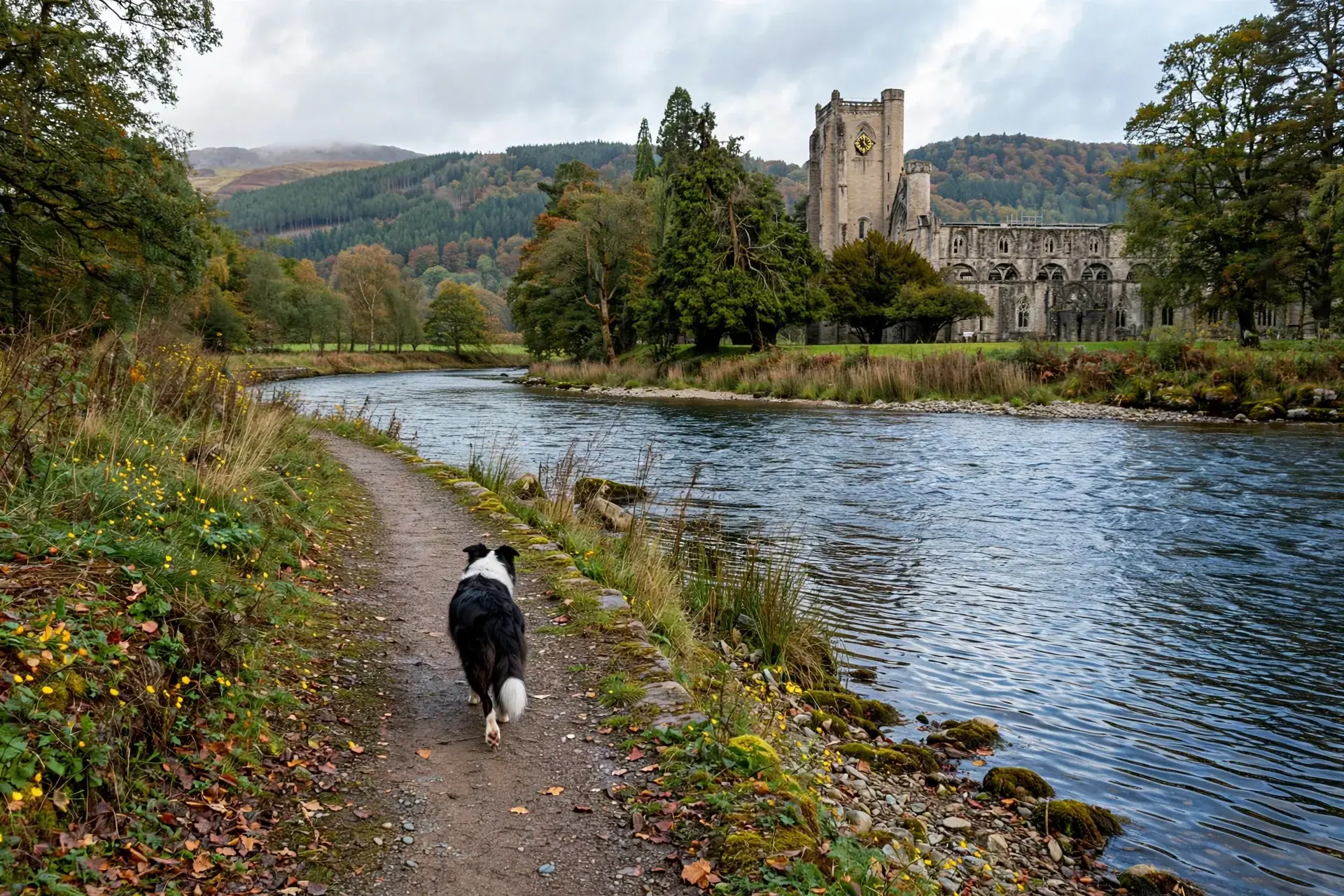
The natural first walk in Dunkeld follows the River Tay. The Tay is Scotland's longest river, and at Dunkeld it runs broad and fast, with deep pools and gravel banks that change shape after every spell of heavy rain. A path runs along the bank from the car park towards the cathedral and beyond, and it is one of those walks that suits almost every dog: flat, shaded in places, with plenty to sniff and watch. Swans, herons and dippers work the river, and in autumn the trees along the bank turn gold and drop leaves that rustle underfoot for weeks.
Dunkeld Cathedral stands at the river's edge, partly ruined and partly still in use as the parish church. The building dates back to the medieval period, and its tower and choir are the landmarks you will see in every photograph of the town. Dogs are welcome in the grounds, which are laid out with lawns, mature trees and old gravestones, and it is a good place for a slow, calm walk after a long drive. Dogs are not normally allowed inside the cathedral building itself, so if you want to look around the interior, plan for one person to wait outside with the dog or take turns. Check the official guidance before you travel, as arrangements can change for services, weddings and special events.
The bridge is worth a slow crossing with the dog on a lead. Thomas Telford's bridge, completed in 1809, carries the main road across the Tay and offers one of the best views in town: upstream to the wooded hills, downstream to the cathedral tower. The pavement is narrow and traffic is steady, so keep the dog close to the wall side and do not stop in the middle of the carriageway. On the far side lies Birnam, a village that shares the town's walks and woodland and is often quieter than Dunkeld itself.
From the bridge, the riverside path continues in both directions. Heading upstream, the path follows the river towards quieter stretches where the bank opens into meadow and the views widen. Heading downstream, the walk passes the cathedral and the car park and continues towards flatter riverside ground. Either direction works as a thirty to forty-five minute out-and-back, and both are easy enough for older dogs and puppies that are still building up their walking distance. In wet weather the riverside path can get muddy and slippery near the water, so take care with footing and keep the dog away from the edge where the bank is steep.
River safety deserves a clear warning. The Tay is a powerful river, and even on a calm day the current is strong enough to sweep a dog away. Do not let your dog swim in the Tay at Dunkeld, and be cautious about dogs that like to paddle at the edge — the gravel shelves drop away quickly and the water is cold even in summer. Keep the dog on a lead wherever the path runs close to the water, and save off-lead time for the open grassy areas of the cathedral grounds and the fields away from the river, where you have clear sightlines and your dog's recall is genuinely reliable.
Woodland walks: The Hermitage and Birnam
The woodland around Dunkeld is the main reason many dog owners come here, and the best-known destination is The Hermitage, a National Trust for Scotland woodland about a fifteen to twenty minute drive west of the town. The Hermitage is famous for its towering Douglas firs — some of the tallest trees in Britain — and for the River Braan, which tumbles through a narrow gorge past Ossian's Hall of Mirrors, a small eighteenth-century folly built to frame the view of the Black Linn Falls. The waymarked trails here are well maintained and clearly signed, with options from a short thirty-minute loop to longer walks of two hours or more, and the forest floor is soft underfoot, which suits dogs that are hard on their paws.
Expect company. The Hermitage is one of the most visited woodlands in Perthshire, and on a fine weekend the car park fills early and the main paths are busy with walkers, families and other dogs. Go early in the morning or on a weekday if you can, and keep your dog on a lead on the narrow gorge paths and near the falls, where the ground drops steeply to the river and the noise of the water makes recall harder. The wider forest tracks further from the gorge are better for off-lead time, provided your dog stays close and comes back reliably. There are no fences between the trails and the river in places, so a dog that is inclined to chase squirrels or deer needs to stay on a lead throughout — roe deer are common in these woods and can appear suddenly on the path.
Closer to town, Birnam Wood on the far side of the river is the woodland of Shakespeare's Macbeth — the wood that famously came to Dunsinane — and it offers a quieter alternative to The Hermitage. The paths here climb gently through mixed woodland with views back across the river to Dunkeld, and the ground is drier and less crowded than the gorge trails. It is a good choice for a dog that finds busy trails stressful, or for a second walk later in the day when you want something shorter and calmer. The climb is steady rather than steep, but the paths are uneven in places, so take care with older dogs and dogs that are unsure on their feet.
Further afield, the wider Tay Forest Park spreads across the hills around Dunkeld and Pitlochry, with waymarked trails of every length and car parks that are often much quieter than The Hermitage. These forests are working woodland, so you may meet forestry vehicles on the tracks and see felling operations in progress — keep your dog close and follow any diversion signs. The trade-off for the quiet is fewer facilities: bring water, a bowl and poo bags, because there may be no shop or tap for miles. In summer, carry extra water for the dog as well as for yourself, and watch for ticks after woodland walks, checking ears, armpits and groin when you get back to the car.
A practical point about woodland walking in this part of Scotland is the ground itself. After rain, the forest paths can be muddy and the riverside sections slippery, and in autumn the fallen leaves hide tree roots and uneven ground. A dog that runs flat out on a wet woodland path can slip badly, so slow the pace on downhill stretches and keep a long line on the dog if you want to give it freedom without losing control. A towel and a drying coat in the car make the drive home much more comfortable for everyone, and a quick rinse of muddy paws at the car park tap — where one exists — saves the car seats.
Cafes, pubs and the town itself
Dunkeld's main street is short enough to walk end to end in a few minutes, but it holds a good range of places to eat and drink, and several of them welcome dogs. As a general rule, outdoor seating is the most reliably dog-friendly option: dogs are usually welcome on terraces and in beer gardens, and many places will bring a water bowl without being asked. Indoor policies vary more — some cafes and pubs welcome dogs inside, others restrict them to a particular area, and a few are dogs-outside-only. The honest approach is to check the sign on the door or ask a member of staff before you settle in, rather than assuming. Policies can change with the season, and a venue that welcomes dogs in quiet winter months may restrict them when the dining room is full in August. Check the official guidance before you travel if a particular venue matters to your plans.
When you do eat out with a dog, a little preparation goes a long way. Bring a mat or blanket for the dog to lie on, which gives it a clear place to settle and keeps it out of the walkway. A chew or a stuffed Kong can keep a young dog occupied while food arrives, and a water bowl is worth carrying even if the venue provides one. Choose a table at the edge of the room rather than in the middle of the flow of people, and keep the lead short enough that the dog cannot wander into the next table's legs. If your dog barks at strangers or gets restless indoors, take the food outside or order a takeaway and eat it by the river instead — there is no shame in that, and the dog will be happier for it.
The town's shops are worth a slow wander, too. Dunkeld has a small cluster of independent shops, including a delicatessen and gift shops, and the main street rewards an unhurried browse. Not every shop admits dogs, so ask before you go in with the dog, and be ready to take turns if one of you wants to look around a shop that is dogs-outside-only. The town also has a small supermarket and a post office for supplies, which matters if you are staying nearby and need dog food, poo bags or a spare lead. If you are self-catering, stock up here rather than assuming the next village will have what you need.
One of the pleasures of Dunkeld is that it is a place to slow down. There is no rush to tick off attractions, and the best part of a visit is often the unplanned hour: sitting on a bench by the river while the dog watches the ducks, or taking a second slow lap of the cathedral grounds at dusk when the day visitors have gone. Dogs pick up on that pace, and a dog that has had a good walk and a calm hour in a cafe garden will settle happily for the evening. If your dog is the sort that struggles to settle in busy places, build in a quiet break back at the car or your accommodation between activities rather than pushing through a full day of stimulation.
Parking, leads and river safety
Parking in Dunkeld is straightforward but limited. The main public car park sits beside the River Tay at the southern end of the town, a short walk from the cathedral and the riverside paths, and it is the obvious place to start the day. There is also on-street parking around the town centre, though spaces are few and the streets are narrow. On summer weekends and bank holidays, arrive before mid-morning if you want a space in the riverside car park; later arrivals may need to park further out and walk in. Check the signs on arrival for charges and time limits, as these can change, and keep some coins or a payment card handy in case the machine does not take your preferred method.
Never leave a dog in a parked car in warm weather, even for a few minutes — a car heats up far faster than most people expect, and a shaded car park in the morning can be in full sun by lunchtime. If you need to pop into a shop that does not admit dogs, take turns rather than leaving the dog in the car. In winter, the opposite problem applies: a wet dog left in a cold car will chill quickly, so dry the dog off and keep the car warm before you drive on.
Lead rules in Dunkeld are mostly a matter of common sense rather than formal by-laws, but the places where a lead is essential are clear: the bridge, the main street, the narrow riverside stretches, the gorge paths at The Hermitage, and anywhere near livestock. Sheep graze in fields around the town and across the wider Perthshire countryside, and dogs worrying sheep is a serious matter — farmers are entitled to take strong action, and a dog that chases sheep can be shot. Keep your dog on a lead near any field with livestock, even if the sheep are not immediately visible, and be alert for lambs in spring. The Scottish Outdoor Access Code gives everyone the right to walk across most open land, but it also requires dogs to be kept under proper control, and under close control or on a lead near farm animals.
Poo bags and bins deserve a mention because Dunkeld's small-town infrastructure is not built for heavy visitor numbers. Bring more bags than you think you will need, and carry used bags until you find a bin — do not leave them hanging on trees or fences, a habit that is unfortunately common on popular trails. The riverside and cathedral grounds have bins, but the woodland trails may not, so a small sealable bag for carrying used bags back to the car is a useful addition to your kit. Picking up after your dog is not just polite; in a town where the paths run beside a river used by anglers and wildlife, it protects the water and the other people who use the paths.
Finally, think about what is in your day bag. Water and a collapsible bowl, poo bags, a spare lead, a towel, and a basic first-aid kit — including tick removers and a bandage — cover most eventualities on a Dunkeld walk. A charged phone matters too: mobile signal in the town is generally good, but it can drop in the wooded glens, so let someone know your route if you are heading off on a longer forest walk alone. The nearest vet practices are in Perth and Pitlochry, so save the number of an emergency vet before you set out, and check the official guidance before you travel if your dog has a medical condition that might need attention.
Where to stay with a dog
Dunkeld works well as a base for a few days, and there is a good range of dog-friendly places to stay in and around the town. The options include small hotels and guest houses in the town centre, self-catering cottages on the outskirts, and lodges and caravan parks in the surrounding countryside. Pet policies vary widely: some places welcome dogs of any size with no charge, others limit the number of dogs per booking or charge a nightly pet fee, and a few restrict dogs to particular rooms or ground-floor accommodation. Always confirm the dog policy in writing before you pay a deposit, and ask the specific questions that matter for your dog — whether dogs can be left alone in the room, whether there is an enclosed garden, and where the nearest evening toilet walk is.
Self-catering cottages suit many dog owners best, because they give the dog a familiar routine: its own bed, its own feeding spot, and a door to a garden. When you book a cottage, ask about the garden boundary — a low fence or an open gate is not the same as a secure enclosure, and a determined dog will test it within an hour of arrival. Ask too about flooring: stone or tile floors are easy to clean after a muddy walk but can be slippery for older dogs, so pack a non-slip mat for the feeding area and the dog's bed. If the cottage is near the river or a road, check the access from the front door, because a dog that bolts out of an unfamiliar door into traffic is a real risk.
Hotels and guest houses in the town centre have a different appeal: you can walk to dinner, the dog can come to the bar, and the riverside is minutes away. The trade-off is less space and more rules. Many hotels ask that dogs are not left alone in the room, which means planning your evenings around the dog — eating in the hotel restaurant or bar where the dog is welcome, rather than going out to a restaurant that is not. That is not a hardship in Dunkeld, where several places welcome dogs, but it is worth knowing before you book rather than discovering it on arrival. Our guide to dog-friendly holiday parks in the UK covers the same questions — fees, boundaries, unit rules — in more detail, and the checklist there works just as well for a cottage or lodge booking.
If you prefer a park or lodge stay, the countryside around Dunkeld has several options within a short drive, including sites in the Tay valley and towards Pitlochry. These suit dogs that need space: a lodge with a deck and a patch of grass beats a town-centre room for a dog that likes to be outside. Check the same practical points — how far the nearest walk is from the front door, whether the site has an enclosed dog exercise area, and what happens if the dog barks. Arriving by train is also straightforward: Dunkeld and Birnam station sits on the Highland main line between Perth and Inverness, and dogs travel free on most UK trains. Our guide to dog-friendly train stations in the UK explains the rules for waiting rooms, platforms and changing trains, which is useful if you are connecting at Perth or Edinburgh on the way up.
Seasons, midges and weather
Dunkeld is a year-round destination, but each season changes the visit in ways that matter for a dog. Spring is often the sweet spot: the woods are full of bluebells and wild garlic, the river is high and dramatic after the winter rains, and the paths are quiet before the summer crowds arrive. Lambs are in the fields from spring onwards, so lead discipline near livestock matters more than ever. The weather in spring is changeable — sunshine, showers and a cold wind can all arrive in a single walk — so pack a waterproof layer for yourself and a drying coat for the dog.
Summer brings long daylight, warm riverside evenings and the busiest version of the town. The upside is that everything is open and the cafe terraces are at their best; the downside is crowds on the popular paths and midges in the woods. Midges are Scotland's famous small biting flies, and they are at their worst on calm, damp evenings from June to August, particularly near water and in sheltered woodland. They bother people far more than dogs, but a dog with thin fur or sensitive skin can be irritated, and a midge cloud can make a peaceful evening walk miserable for the humans. A light breeze disperses them, so breezy riverside paths are often more comfortable than still forest glades. Insect repellent made for dogs — never use human products containing DEET on a dog — and a walk timed for midday rather than dusk will help.
Autumn is many regular visitors' favourite season in Dunkeld. The beech and birch woods turn gold and copper, the salmon run brings anglers and herons to the Tay, and the crowds thin out after the school holidays. The ground gets softer and muddier as the season goes on, and fallen leaves hide uneven ground, so watch your footing on woodland paths. Fireworks around early November can unsettle noise-sensitive dogs, and some local venues host displays, so if your dog is sound-sensitive, check what is happening on the nights you plan to stay and keep the dog indoors with the radio on.
Winter in Dunkeld is quiet and beautiful, with frost on the cathedral grounds and mist on the river, but it asks more of the visitor. Daylight is short — by mid-December the sun sets in the middle of the afternoon — so plan your main walk for the morning and keep the afternoon short and local. Paths can be icy, especially the shaded woodland trails and the bridge pavement, and a dog that is used to summer walking may need shorter outings in cold weather. Older dogs and short-coated breeds feel the cold quickly, so a coat is worth packing, and paws should be checked for ice and grit after a walk on treated roads. On the plus side, winter is when Dunkeld feels most like a local town rather than a visitor stop, and a dog that likes quiet streets will love it.
Day trips from Dunkeld
Dunkeld makes a good base for exploring Perthshire with a dog, and several worthwhile day trips are within an hour's drive. Pitlochry, about twenty minutes north, is a larger town with more shops, cafes and walks, including the famous salmon ladder at the dam and the woodland paths around Faskally. It is busier than Dunkeld and the car parks fill quickly, but it has a good range of dog-friendly places to eat and several walks that start right from the town centre. The drive itself is part of the pleasure: the road north follows the Tay through the Pass of Birnam and into the hills, with lay-bys where you can stop for a view.
Perth, about half an hour south, is the nearest city and the practical stop for anything Dunkeld cannot provide — a vet, a pet shop, a supermarket with a wide range. The city has riverside walks of its own, including the North Inch and the South Inch, large open parklands beside the Tay that are popular with local dog walkers. They are flat, open and easy to navigate, which makes them a good change of pace after woodland walking, though they are busy at weekends and dogs should stay on a lead near the river and the roads.
Blair Atholl, further north towards the Cairngorms, offers a wilder feel: the village sits at the foot of the hills with walks up the glens and around Blair Castle, whose grounds and gardens welcome dogs on leads in the outdoor areas. Check the official guidance before you travel, as the castle interior and some garden areas have their own rules. The walks around Blair Atholl are longer and more exposed than Dunkeld's, so they suit fit dogs and owners who are comfortable with hill paths and changeable weather. The reward is open moorland, big skies and far fewer people than the Hermitage on a summer Saturday.
For wildlife lovers, the Loch of the Lowes reserve near Dunkeld is a well-known osprey-watching site in the summer months, with a visitor centre and hides overlooking the loch. Dogs are welcome on the reserve's paths on a lead, but not in the hides or the visitor centre itself, so it is a visit best shared between two people who can take turns. The lochside paths are flat and easy, and the reserve is a good place for a gentle walk combined with a picnic. In winter, the loch attracts whooper swans and other wildfowl, and the walks are quiet. Wherever you go for the day, remember that the return drive to Dunkeld in the evening can be slow on the single-carriageway roads, especially in summer, so leave plenty of time and keep water in the car for the dog.
A relaxed one-day plan
If you have a single day in Dunkeld with your dog, the simplest plan is also the best. Start early with the riverside walk: park at the riverside car park, walk the Tay path past the cathedral, cross the bridge to Birnam and back, and let the dog have its main exercise while the town is still quiet. This loop takes about an hour at a gentle pace, and it sets the dog up for a calm rest of the day. Stop at a cafe for a late breakfast or a coffee — choose a table outside if the weather allows — and let the dog settle on its mat while you plan the afternoon.
After lunch, drive out to The Hermitage for the woodland walk, aiming to arrive in the early afternoon when the morning crowd has thinned. Walk the shorter gorge loop if the dog is older or the weather is warm, or take the longer forest trails if you both have energy left. Keep the dog on a lead on the gorge paths and near the falls, and carry water — the forest is shadier than it looks and dogs work hard on uneven ground. Allow two hours including the drive, and build in a margin for the car park being busy.
Finish the day back in Dunkeld with a slow evening stroll around the cathedral grounds and a drink or an early dinner in a dog-friendly pub. The light on the river in the late afternoon is the best of the day, and the town is at its calmest once the day visitors have left. If the dog is tired, this is the moment to accept it: a short stroll and an early night beats a forced third walk. A dog that has walked the river, the woods and the town in one day has had a full day by any measure, and the drive home will be a quiet one.
For a two-day stay, split the plan in half and add a day trip: Dunkeld and the river on day one, Pitlochry or Blair Atholl on day two, with the Hermitage fitted in wherever the weather is best. The key is to resist the urge to pack every walk into a single day. Dunkeld rewards a slow pace, and a dog that has time to sniff, rest and settle will enjoy the trip far more than a dog that is marched from one car park to the next. Build in a proper rest in the middle of the day, keep the walks varied — river in the morning, woods in the afternoon — and let the town itself be part of the entertainment rather than just a place to pass through.
Practical questions
Before you go
Can dogs go inside Dunkeld Cathedral?
Dogs are welcome in the cathedral grounds and on the riverside paths around them, but they are not normally allowed inside the cathedral building itself. Plan for one person to stay outside with the dog, or take turns visiting the interior. Check the official guidance before you travel, as arrangements can change for services and events.
Is the River Tay path at Dunkeld suitable for dogs off the lead?
The riverside paths are lovely for a lead walk, but off-lead time needs care. The Tay is a wide, fast river with steep banks in places, and the paths are shared with walkers, cyclists and other dogs. Keep your dog on a lead beside the river, and save off-lead play for the open grassy areas away from the water where you have clear sightlines and reliable recall.
Where can I park in Dunkeld with a dog?
There is a public car park beside the River Tay at the southern end of the town, close to the cathedral and the riverside paths, plus on-street parking around the town centre. Arrive early on summer weekends, as the car park fills quickly. Check the signs on arrival for charges and time limits, and never leave a dog in a parked car in warm weather.
Are there dog-friendly cafes and pubs in Dunkeld?
Yes, several cafes and pubs in Dunkeld welcome dogs, particularly in outdoor seating areas and some indoor spaces. Policies vary by venue and by season, so check the door sign or ask staff before settling in, and keep your dog on a lead and out of walkways. Bringing a mat and a water bowl helps your dog settle while you eat.
How long is the walk to The Hermitage from Dunkeld?
The Hermitage woodland is about a 15 to 20 minute drive from Dunkeld, or a longer walk of several miles along the river for fit walkers. Most visitors drive to the Hermitage car park and walk the waymarked forest trails from there. The riverside and waterfall paths are popular, so expect other dogs and walkers, and keep your dog on a lead near the falls and the river.
What is the best time of year to visit Dunkeld with a dog?
Spring and autumn are often the easiest seasons: cooler walking weather, quieter paths and fewer midges than high summer. Summer brings long daylight and lively town life but also crowds and midges in the woods. Winter can be beautiful and very quiet, but paths get muddy and daylight is short, so plan shorter walks and check the forecast before you travel.