This guide is independent and contains no paid placement. Access rules, routes and seasonal restrictions can change, so check the official guidance before you travel rather than treating any single guide as the final word.
Dunster works best as a slow, linear day: park once, walk the high street on a lead from the Yarn Market towards the castle hill, detour to Gallox Bridge and the river, then drive or walk out to Dunster Beach for open running space. Keep the castle climb optional, carry your own water, and check the official guidance before you travel for current dog access at the castle and on the beach.
Walk the street as a timeline
Dunster is best understood on foot, in order, from the bottom of the village upwards. The high street is short enough to walk slowly in a matter of minutes, yet it compresses several centuries of Somerset life into a single slope: stone cottages and inns at pavement level, a medieval market shelter standing in the middle of the road, and a castle watching from a wooded hill at the top. For a dog, that compression is a gift. There is no need for a long drive between sights, no complicated navigation, and no moment when the walk suddenly becomes a hike. The village itself is the route, and every pause — a doorway, a drinking bowl, a patch of shade — is a chance to let the dog settle before the next stretch.
Start at the lower end of the high street and let the dog take in the village at its own pace. The first few metres matter more than they look. A new village means new smells layered on old stone: bakery air from a doorway, another dog passing on a narrow pavement, a car easing past where the road narrows, a sudden flurry of pigeons or a cat slipping through a garden gate. Dogs that are allowed a few unhurried minutes of sniffing here tend to walk more calmly for the rest of the day than dogs hurried straight towards the main sight. Keep the lead short on the pavement, not because Dunster is frantic — it is not — but because the street is narrow, doorways open directly onto it, and a dog on a long line can easily wander into the path of a pedestrian, a pushchair or a reversing car.
As the street rises, the story changes underfoot and overhead. The cottages grow older in character, the stonework grows rougher, and the Yarn Market appears ahead in the middle of the road, its timber roof and octagonal shape breaking the line of the street. This is the natural halfway pause. Step to one side, out of the flow of people and traffic, and let the dog sit while you look at the structure and read any interpretation board nearby. From here, the castle hill begins to dominate the view, and the walk changes in tone: the village part is nearly done, and the decision point arrives. Dogs that are fresh, fit and keen can continue towards the castle slopes; dogs that are older, stiff, tired or simply uninterested in hills have already had a complete village walk, and there is no failure in turning back towards the river and the tea rooms instead.
Thinking of the street as a timeline also helps with pacing a full day. Morning suits the village walk, when light is soft, the street is quieter and dogs are at their freshest. Midday suits a long, shaded rest — a tea room garden, a quiet bench, or the car with windows managed safely and shade considered — rather than the steepest climb in the warmest hours. Afternoon suits the beach, when the village crowds thin and the open shore gives a dog the running space that a narrow medieval street cannot. Evening, if you are staying overnight, suits a second, slower pass along the high street, when the dog already knows the smells and the walk becomes a familiar toilet loop rather than an expedition. That rhythm — village first, hill second, beach third — is the spine of this guide, and every section below hangs from it.
One practical habit makes the timeline work for dogs of every size. Break the day into short legs with named rest points, rather than one long outing with a single distant goal. A leg might be as short as the walk from the car to the Yarn Market, or from the Yarn Market to the castle footpath entrance. Between legs, stop properly: water, a sniff, a sit, a look around. Dogs do not experience a village as a list of sights to tick off; they experience it as a sequence of smells, surfaces, sounds and temperatures. A walk planned in short legs respects that, and it also gives the human walker a built-in excuse to slow down, look up at the timber framing and stonework, and notice details — a carved doorway, a narrow alley, a garden wall — that a brisk march would miss entirely.
Yarn Market and the wool trade
The Yarn Market is the building that explains Dunster at a glance. It stands in the street itself, an octagonal shelter with a timber roof supported on stone piers, built to protect cloth traders and their goods from rain while deals were done. Dunster grew rich on wool and cloth, and the market shelter is the physical trace of that trade: a roof over bargaining, measuring and selling, set where buyers and sellers would naturally meet. For a modern visitor with a dog, the building is less a museum piece than a meeting point and a landmark. It is where walks begin, where photographs are taken, where people pause to decide whether to climb to the castle or turn towards the river, and where a dog can sit in shade on a warm day while the village moves around it.
Approach the Yarn Market with the same lead discipline as the rest of the high street. The ground around it is open to the road, people gather to look and photograph, and other dogs often pass within a metre or two. A dog that is friendly but bouncy needs a short lead and a clear sit position to one side, away from the flow of feet. A nervous dog benefits from distance: stand back, across the street where the pavement is wider, and let the dog watch the shelter from a few metres away before moving closer. There is no need to walk a dog through the middle of a crowd to prove a point; the building photographs just as well from the edge, and the dog will remember a calm pause far longer than a stressful squeeze through a group.
The wool-trade story also explains why Dunster looks the way it does beyond the market shelter. Wealth from cloth paid for substantial stone houses, inns that served travelling merchants, and a village layout built around trade rather than farming alone. Walking the high street with that in mind turns a pretty row of cottages into something more legible: wide doorways that once admitted goods, upper rooms that once stored cloth, and a street wide enough in places for carts and pack animals. Dogs will not care about any of this, but the humans walking them often enjoy the village more when they can read it, and a human who is enjoying the walk is less likely to rush the dog through it. Take time to notice the variety of stone, the steep roofs, and the way the street narrows and widens as it climbs.
Season changes the Yarn Market walk in small but useful ways. In summer, the shelter gives genuine shade, and the stone piers stay cool to the touch; a dog that lies in the shadow for a few minutes will often recover faster than one kept standing in direct sun. In autumn, fallen leaves gather around the piers and in the gutters, and leaf piles become irresistible sniffing stations — harmless in themselves, but worth checking for hidden litter or sharp debris before a dog dives in nose-first. In winter, the stone and timber can be damp and slippery underfoot, and early dusk shortens the comfortable walking window, so a morning visit with a reflective lead or collar is the safer choice. In spring, the village wakes up with visitors, and the market area can feel busier at weekends; an early start keeps the walk calm for dogs that dislike crowds.
If the dog needs a toilet break in the village, plan it before the Yarn Market rather than hoping for a convenient patch beside a listed building. Village streets rarely offer obvious grass verges, and the most considerate approach is to use any signed dog-waste bin, carry bags, and pick up immediately, even on a quiet side lane. Owners who do this consistently keep villages welcoming to dogs; a single mess left on a high street pavement does disproportionate damage to that welcome. Keep bags in an accessible pocket, not buried at the bottom of a rucksack, because the moment you need one is usually the moment the dog has already chosen its spot.
Gallox Bridge and the river
Gallox Bridge carries the village story from trade to travel. This narrow medieval packhorse bridge crosses the River Avill on the edge of Dunster, its low, humped profile and stone parapets built for a time when goods moved on the backs of horses along narrow tracks rather than on wheels along wide roads. The bridge is a short walk from the high street, and it changes the whole feel of the day: the enclosed, stone-walled village gives way to open sky, running water and riverside grass, and dogs that have been on a short lead through the street suddenly have room to look, sniff and breathe. It is the natural second act after the Yarn Market, and for many dogs it is the most enjoyable part of the village walk.
Walk to the bridge slowly and keep the dog on a lead for the approach, even if the lane looks quiet. Rural lanes around Dunster carry cars, farm vehicles and cyclists, often faster than expected around bends, and a dog that darts towards the river sound can be in the road before the walker has reacted. Once on the bridge itself, pause in the middle if it is safe and quiet to do so, and let the dog look at the water. Some dogs are fascinated by moving water; others are wary of the sound, the height of the parapet or the narrowness of the path. Neither reaction needs correcting. A dog that wants to cross briskly should be allowed to cross briskly; a dog that wants to stop and stare should be allowed to stop and stare, provided no one else is waiting to pass.
The riverside below and beyond the bridge is where lead decisions need the most thought. Open grass and a riverbank invite a longer line or a brief off-lead run, but only where that is clearly permitted and safe. Check the official guidance before you travel for current local rules, and on the day look for signs, livestock, other dogs, cyclists and the river itself before unclipping. Rivers in Somerset can run fast and deep after rain, banks can be steep and slippery, and a dog that loves water can be in difficulty before a walker on the bank has found a safe entry point. A long line gives a dog freedom to sniff and explore while keeping a connection to the walker, and it is often the best compromise on a first visit to an unfamiliar riverbank.
For older or less mobile dogs, the Gallox Bridge detour can be shaped to fit. The bridge itself is short, the riverside paths nearby are comparatively level, and a there-and-back walk to the bridge and back to the village can be a complete outing without any hill climbing at all. Bring water even for this short leg: river water is not a reliable drinking supply, especially after rain when runoff can carry farm and road contaminants, and a dog that drinks from a river and then vomits later in the day has had its outing spoiled for no reason. A collapsible bowl and a bottle from the car take seconds to pack and remove the temptation entirely.
The bridge also teaches a useful lesson about photographing a dog in a historic place. The best pictures of a dog on a packhorse bridge are taken from the bank, with the bridge and the dog both in frame, rather than by standing in the middle of a narrow crossing while other walkers wait. Step aside, let the dog sit on a level patch of grass or stone, and take the photograph quickly. Dogs held in a sit for a long photography session grow restless, and a restless dog on a narrow bridge is a hazard to itself and to passers-by. One good photograph, taken calmly, beats ten fussy ones.
Dunster Castle woods and gardens
Dunster Castle rises on a steep, wooded hill above the village, and it is the part of the day that needs the most honest assessment before it begins. The castle, its terraced gardens and its woodland walks reward a fit dog with shade, varied smells and long views, but the hill itself is not a gentle slope. The ascent is sustained, the paths wind through trees, and the return descent asks different muscles of a dog than the climb up. Dogs that bound up a hill with enthusiasm often come down more slowly, with tired legs and a reluctance that is easy to miss if the walker is focused on the view rather than the animal. Plan the castle as an optional expedition inside a village day, not as a compulsory march, and the whole outing stays enjoyable.
Before setting out, check the official guidance before you travel for current dog access to the castle building, the gardens, the woodland paths and any areas where dogs must stay on a lead or are not admitted. Historic properties revise their rules for conservation, events, livestock grazing or ground conditions, and a rule remembered from a previous year may no longer apply. The same check should cover admission arrangements, which paths are open, and whether any part of the grounds is closed for maintenance. This guide deliberately gives no admission prices or opening hours, because those details change and a wrong figure in print is worse than a prompt to check the current official information.
On the hill, surface and shade matter as much as gradient. Woodland paths under trees are usually softer underfoot than village pavements, and the canopy gives welcome shade on warm days, but after rain the same paths can be muddy, leaf-covered and slippery, especially on steeper sections where water runs across the track. Dogs with short legs, long backs or arthritic joints feel every camber and loose stone more acutely than a fit young dog, so watch the gait rather than the enthusiasm: a dog that is still wagging but shortening its stride, hopping on a turn, or pausing more often is telling you the terrain is harder than it looks. Offer water before the climb, again partway up, and again at the top, in small amounts rather than one large drink at the end.
Lead control in the castle grounds deserves particular attention. Woodland attracts wildlife — squirrels, birds and, at certain times of year, deer — and a dog with a strong chase instinct can cover a surprising distance in the seconds between spotting movement and reacting. Gardens also contain other visitors, children, and sometimes grazing animals or conservation areas where dogs must remain on a lead. Keep the lead short in enclosed garden areas and near other visitors, and use a longer line only on open woodland stretches where visibility is good, no livestock is present, and local rules clearly allow it. If in doubt, keep the dog on a lead for the whole castle walk; a lead walk through beautiful woodland is still a beautiful woodland walk.
Think about the descent as a separate walk, not as the end of the climb. Many dogs rush downhill, pulling hard and jarring their shoulders and elbows, especially on steep, hard paths. Slow the pace deliberately on the way down, use switchbacks where the path allows, and stop on level patches to let the dog recover. If the dog is panting heavily, drooling more than usual, seeking shade repeatedly or lying down unprompted, stop in the shade, offer water, and wait. Heat and exertion build quietly in woodland, where still air under trees can feel cooler to a human walker than it does to a dog working hard on a slope. A dog that recovers with rest and water can continue gently; a dog that does not recover should be carried if small enough, or walked down very slowly with frequent rests, and checked over back in the village.
For visitors whose dogs cannot manage the hill, Dunster still offers a full castle experience from below. The castle is visible from the village, its wooded hill forms the backdrop to the high street, and the level village and riverside walks give a dog a complete day without a single steep climb. There is no requirement to reach the top to have visited Dunster properly. Splitting a party — one person climbing while another walks the dog on the level — is a perfectly sensible plan, provided the dog is not left unattended in a car in warm weather. Dogs left in cars, even briefly, can overheat dangerously, and a castle visit is never worth that risk.
Dunster Beach and the open shore
Dunster Beach is the release valve at the end of a village day. After narrow pavements, a market shelter, a packhorse bridge and a castle hill, the shore offers what none of those places can: distance, wind, open sky and a long, straight run for a dog that needs to stretch its legs properly. The beach sits a short drive from the village, towards the coast near Minehead, and the change of scale is immediate. The village is measured in metres; the beach is measured in long, empty strides, and dogs that have been polite and contained all morning often transform the moment they reach the sand.
Expect a mixed shore rather than a single postcard surface. Dunster Beach combines sand, shingle and pebbles, and the balance shifts with the tide, the season and recent storms. At low tide, broad sandy stretches may appear that are ideal for running and ball play; at high tide, the usable shore narrows and the shingle band becomes more prominent. Pebbles and shingle are harder on paws than sand, especially for dogs unaccustomed to stony ground, puppies with soft pads, or older dogs with thin pads and worn nails. Check paws during the walk, not just afterwards, and look for limping, licking, or a reluctance to run that was not present on sand. Rinse paws with fresh water after the beach, and check between the toes for trapped stones or sand that can chafe on the walk back to the car.
Tides and weather deserve a check before any beach walk, and the check costs less than a minute. A rising tide can cut off a return route along the shore, wet sand near the waterline can be deceptively soft and tiring, and an onshore wind can drive sand into eyes and ears. Dogs that chase waves can swallow surprising amounts of salt water, which may cause vomiting or diarrhoea later in the day, so keep fresh water available and discourage prolonged drinking from the sea. In summer, hot sand and shingle can burn pads, just as hot pavements do; if the surface is uncomfortable for a bare hand, it is uncomfortable for paws. In winter, the beach can be superb — empty, brisk and invigorating — but wind chill, driving rain and short daylight all argue for a shorter, well-timed walk rather than a long, exposed one.
Lead decisions on the beach follow the same principle as on the riverbank: check the official guidance before you travel for current dog rules, seasonal restrictions and any local orders that apply on the day. Beach rules in Britain vary by beach and by season, and a restriction that applies in high summer may not apply in winter, or vice versa. On the day, look for signs at the access point, note other dogs and walkers, and consider wildlife: shorebirds, particularly in breeding and migration seasons, are easily disturbed by a loose dog running through the tideline. A long line on a first beach visit gives a dog most of the joy of running while keeping recall and wildlife disturbance under control, and it is a wise choice until you know how your dog responds to open space, waves and other beach dogs.
For a broader understanding of how British beach rules work — seasonal bans, public space protection orders, fines and assistance-dog exceptions — the principles are the same at Dunster as elsewhere, even though the local detail must always be checked for this specific beach. A dog that has had a calm village morning, a measured castle walk and a well-timed beach run will usually settle beautifully in the car on the way home. That settled, tired, sandy dog is the sign of a day planned in the right order: containment first, exertion second, open space last, and water and rest throughout.
Tea rooms, pubs and village stops
Dunster's tea rooms and pubs are part of the walk, not an afterthought, because a dog that has walked a medieval street, crossed a river bridge and possibly climbed a castle hill needs somewhere calm to recover while the humans eat. The village pattern is familiar to anyone who travels with a dog in Somerset: some premises welcome dogs throughout, some welcome dogs in a garden, terrace or bar area but not in a formal dining room, and some change their arrangement with the season. The only reliable approach is to ask on the day, politely and before sitting down, rather than assuming that a dog-friendly reputation from a previous visit still holds. Staff appreciate the question, and a dog that is settled under a table in the right room is a happier dog than one that has been squeezed into the wrong one.
Choose the stop that fits the dog, not just the menu. A nervous dog does better in a quiet corner away from the door, where people are not constantly passing with trays and pushchairs. A sociable dog does better where it can watch the room without blocking a walkway. A wet dog needs a washable floor and a towel, not a carpeted dining room. In every case, bring the dog's own mat or blanket if you have one: a familiar surface under a table tells a dog that this is a resting place, not a new place to patrol, and it protects furniture and floors at the same time. Keep the lead short and looped around a table leg only if the arrangement is safe and the dog cannot pull the table or wander into a walkway; otherwise, hold the lead or tuck it under a foot.
Food manners matter as much in a tea room as on a pavement. Do not feed a dog from the table as a matter of routine, because dropped food, rich cake and chocolate are all hazards, and a dog that learns to beg in one tea room will beg in every tea room afterwards. If the dog needs a snack during a long stop, offer its own food or treats quietly, under the table, at a moment when the room is calm. Offer water first, food second, and a toilet break before a long sit rather than after the dog has become restless. A dog that has toileted, drunk and sniffed before entering a tea room will settle far faster than one brought straight in from a long walk.
Shopping in the village follows the same logic. Small shops with narrow aisles and fragile displays are not always suitable for a large or excitable dog, and the considerate choice is sometimes for one person to shop while the other waits outside with the dog in the shade. That is not a failure of dog-friendliness; it is good village manners. Where a shop does welcome dogs, keep the dog close, avoid retractable leads that can wrap around displays, and leave promptly if the dog becomes restless. The village benefits when dog owners are visibly considerate, because the next dog owner benefits from the welcome that consideration preserves.
Finally, treat the tea room stop as a diagnostic moment. A dog that settles, sighs and sleeps under the table is a dog that has had enough exercise and is ready for a gentle afternoon. A dog that paces, pants, whines or cannot settle may be too hot, too tired, thirsty, in need of a toilet break, or overstimulated by the village. Each cause has a different remedy — shade and water, a quiet toilet walk, a shorter afternoon, or simply leaving sooner — and noticing the signal early prevents a difficult evening. The best village stop is not the longest one; it is the one that leaves the dog rested and ready for the beach or the journey home.
Staying overnight with a dog
Staying overnight turns Dunster from a day trip into a base, and it changes the dog's experience for the better. A dog that sleeps in the same place for two or three nights learns the morning toilet route, the evening walk and the sounds of the accommodation, and each day becomes calmer than the last. Dunster and the surrounding villages offer cottages, inns, bed-and-breakfast rooms and holiday accommodation, and the surrounding coast and moorland add further choices within a short drive. The practical question is not whether dog-friendly accommodation exists — it does — but whether the specific room, cottage or pitch fits the specific dog.
Ask the same questions for every overnight option, and ask them before paying. How many dogs are accepted, and is there a size or breed condition? Is the dog allowed in every room or only in designated rooms? Is there an enclosed garden, and how high and secure is its boundary? Where is the nearest practical toilet area after dark, and is it lit? Can the dog be left alone in the room, and if so, under what conditions? Is there a charge per dog, per night or per stay, and what does it cover? A property that answers these questions clearly, in writing, is usually a property that has thought about dogs properly. Vague reassurance — a repeated phrase about being very dog-friendly with no detail — should prompt a second, more specific question, not a booking.
For visitors weighing a longer Somerset stay, the choice between a village base and a holiday park base is worth considering carefully. A village stay in or near Dunster gives a dog a short, familiar morning walk and a quiet evening, with the castle hill and the beach as day-trip options. A park stay further afield gives more space, more facilities and sometimes a dedicated dog exercise area, but adds a drive to every village walk. Neither is universally better; the right choice depends on the dog. A dog that settles best in a quiet cottage with a small garden will thrive in the village; a dog that needs a large, secure run every morning may thrive in a park. For a detailed comparison of park stays, including fees, boundaries and the questions worth asking before payment, see our guide to dog-friendly holiday parks in Devon, which covers the practical checks that apply to park stays across the South West, even though Dunster itself sits across the county boundary in Somerset.
Packing for an overnight stay is mostly about familiarity. Bring the dog's own bed or blanket, its usual food measured for the trip plus a spare day, its regular lead and a spare, a long line for beach and riverside walks, towels and a drying coat, a collapsible bowl, bags, any medication with a written dosage note, and the contact details of the nearest veterinary practice saved in a phone before departure. Note the nearest practice and its emergency arrangements before you need them, because rural practices can close early and out-of-hours cover may be based in a neighbouring town. Check the official guidance before you travel for any local information that affects an overnight stay, and keep the accommodation's own dog rules with the booking confirmation so there is no dispute on arrival.
On arrival at overnight accommodation, give the dog the same boring first hour that works on a day trip: a toilet walk first, a sniff of the garden or immediate surroundings second, water and a familiar bed third, and unpacking last. Walk the boundary before letting the dog off the lead in a garden, checking for gaps under gates, low walls, loose fencing and tempting exits onto a road. Photograph any existing damage to the room or garden, move cleaning products and food out of reach, and establish the evening routine early. Dogs that know where they sleep, where they toilet and when they eat will settle on the first night; dogs left to improvise in a new place often spend that night restless, and a restless first night makes the second day harder for everyone.
Three ways to shape the day
The same sights make very different days depending on the dog, and the best Dunster plan is the one that matches the dog in front of you. The three outlines below are starting points, not prescriptions: shorten any of them without guilt, swap the order if the weather dictates, and always keep a shorter fallback in mind for the moment a dog tires, the rain arrives or the beach rules change.
The gentle village day suits older dogs, puppies, dogs recovering from illness or injury, and any dog that finds hills or crowds tiring. Park once, walk the high street slowly to the Yarn Market, pause there, continue to Gallox Bridge and the riverside, and return to the village for a tea room stop. The total walking distance is short, the ground is mostly level apart from the gentle slope of the high street itself, and every leg can be cut short. This day has no castle climb and no beach drive, and it is still a complete Dunster day: the dog has smelled the village, seen the river, rested in a tea room and travelled home without exhaustion. For a puppy, keep the whole outing shorter still, with frequent rests and no pressure to complete even the gentle outline.
The classic full day suits a fit adult dog that enjoys varied terrain. Begin with the high street and the Yarn Market in the morning, detour to Gallox Bridge, then take the castle woodland and garden walk in the late morning when the dog is warmed up but not yet tired. Rest properly in the village over lunch, then drive out to Dunster Beach in the afternoon for open running and a paddle, finishing with a rinse and a calm journey home. The key discipline on this day is the midday rest: without it, the afternoon beach walk becomes a test of endurance rather than a pleasure, and a dog that is pushed through tiredness may be stiff or sore the next day. Build the rest in as a fixed part of the plan, not as an optional extra.
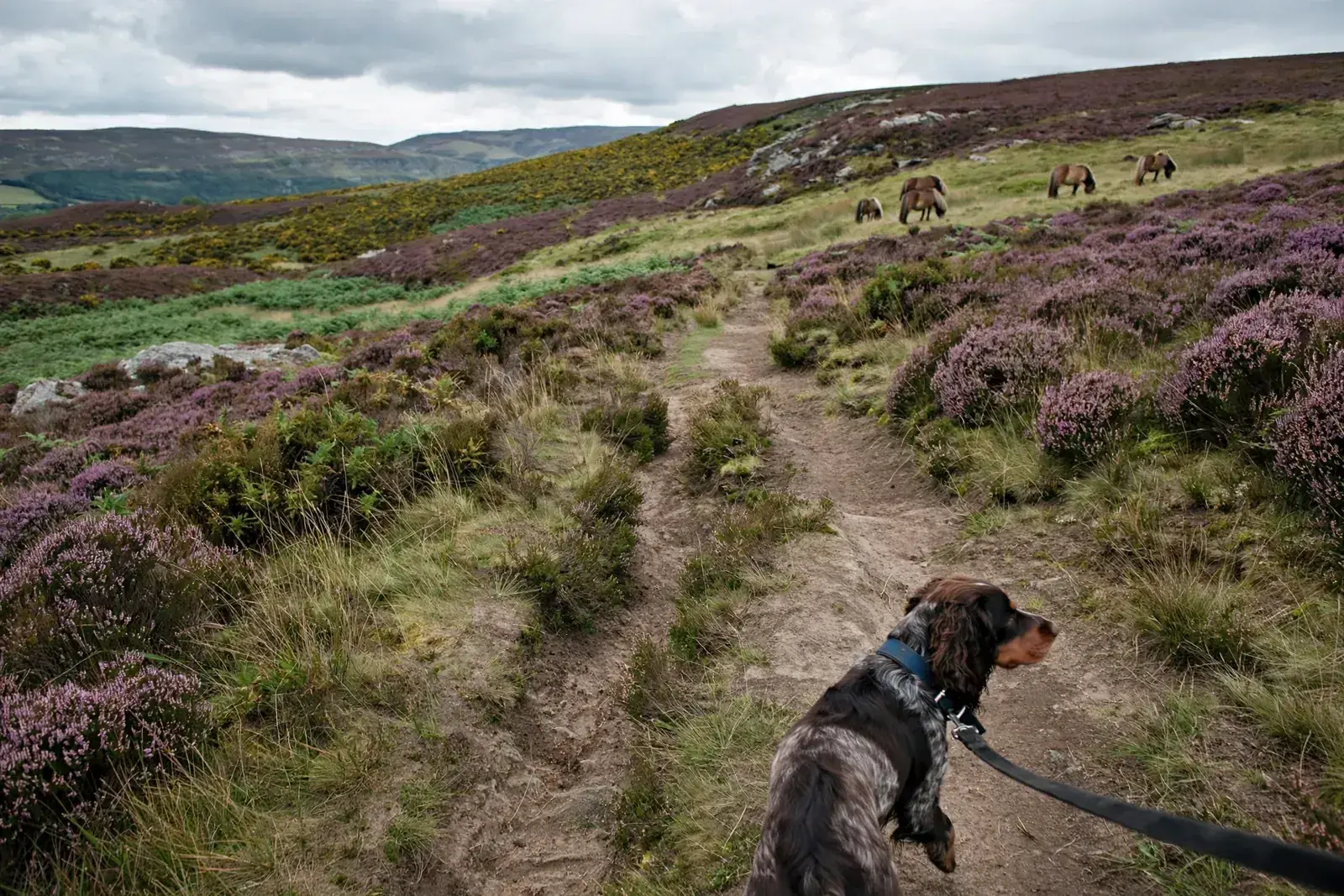
The Exmoor extension day suits walkers who want Dunster as the gentle bookend to a wilder walk. Spend the morning in the village and at the beach, or reverse the order, and use Dunster as the calm, level, sociable part of a longer Exmoor trip. For moorland planning — ponies and red deer at a distance, coast path sections near Lynmouth, river routes, ticks, livestock rules and dark-sky nights — see our Exmoor dog guide, which explains how moorland days differ from village days and what extra preparation they require. The contrast is the point: Dunster teaches a dog the village; Exmoor teaches a dog the moor. A trip that includes both, with rest between them, gives a dog the fullest Somerset and Devon experience without asking for two hard days in a row.
Whichever outline you choose, keep transport simple. Dogs travel best with a familiar blanket, a non-slip surface, water available at stops, and a break every couple of hours on a longer journey. Never leave a dog unattended in a car in warm weather, and in cold weather consider the same caution in reverse: a car parked in shade on a winter day cools quickly, and a wet dog returning from the beach will chill faster than a dry one. A drying coat and a towel in the boot, used before the journey home, prevent most of the discomfort of a wet, sandy return trip.
Seasons, tides and ground conditions
Dunster rewards visitors in every season, but each season changes the dog walk in ways worth anticipating. Spring brings longer daylight, softer light and a village waking up after winter; paths can still be muddy from winter rain, and lambing season on surrounding farmland means livestock rules deserve extra attention on any walk that leaves the village for open countryside. Keep dogs on leads near sheep and lambs without exception, and remember that a dog worrying livestock is a serious matter with legal consequences, not a minor lapse in manners. Spring is also the season when ticks become more active in woodland and long grass, so check the dog after woodland and beach walks and remove any ticks promptly and correctly.
Summer is the season of shade, water and timing. Walk the village and the castle hill early or late, rest through the hottest hours, and use the beach in the cooler parts of the day. Heat affects dogs far faster than it affects their walkers, because dogs cannot sweat efficiently and rely on panting, shade and water to cool down. Flat-faced breeds, overweight dogs, older dogs and dogs with heart or breathing conditions are at particular risk, and they may need a much shorter day than a fit, lean dog. Never rely on a single water bottle for a summer day that includes a hill and a beach; carry more than you expect to need, offer it little and often, and watch for heavy panting, drooling, wobbliness or a reluctance to continue, all of which mean stop, shade and water immediately.
Autumn is arguably the finest Dunster season for dogs. The castle woodland colours, the beach empties, the village calms after the summer peak, and the air is cool enough for longer walks without heat stress. Autumn hazards are quieter: wet leaves on steep paths, shorter daylight that can catch a beach walk by surprise, and the fireworks season, which unsettles many dogs. If fireworks are expected near your accommodation, plan an early evening toilet walk, a familiar indoor routine, and a safe, enclosed space where the dog can retreat. Autumn storms can also change beach conditions overnight, washing up debris and altering the shingle, so a first beach walk after a storm deserves a careful look at the tideline before a dog is allowed to run freely.
Winter brings empty streets, crisp light and a different kind of beauty to the castle hill and the beach, but it also brings the shortest days and the coldest ground. Keep walks within daylight, carry a light if a walk might overrun, and consider a coat for short-coated, small, elderly or ill dogs. Wet paws in winter need drying after every walk, and grit or salt from treated roads can irritate pads; rinse paws after village walks where roads have been treated. Ice on the castle paths and on the bridge demands extra caution, and a dog that slips on ice can injure a leg in a moment. If conditions look icy, choose the level village and riverside walk instead of the hill, and save the climb for a drier day.
Practical kit, leads and safety
The Dunster kit list is short, and that is part of the village's charm. A well-fitting harness or collar with an identification tag, a short lead for the village and a long line for the beach and riverside, a bottle of water and a collapsible bowl, bags, a towel and, in wet or cold weather, a drying coat: that is the core. Add a basic first-aid kit for longer days — a bandage, a small pair of tweezers for ticks, and a clean cloth for paw injuries — and keep the whole kit in one bag by the door so it is not assembled in a rush. Dogs benefit from routine in equipment as much as in walking: the same harness, the same lead and the same bowl on every trip reduce novelty and help a dog settle faster in a new place.
Lead choice deserves more thought than it usually receives. A short, fixed lead is the right tool for the high street, the Yarn Market, the bridge and any garden area, because it keeps the dog close where people, traffic and other dogs are near. A long line is the right tool for the beach and the riverside, where space allows exploration without losing control. Retractable leads are the least suitable tool for Dunster: they give a false sense of freedom on a narrow street, they tangle around other walkers, dogs and street furniture, and they make it hard to bring a dog close quickly when a car, cyclist or livestock appears. If a retractable lead is the only lead available, lock it short for the entire village walk and treat it as a short lead.
Identification and recall are the two safety nets that matter most on a mixed village, woodland and beach day. Check that the dog's tag and microchip details are current before travelling, and carry a recent photograph of the dog on a phone in case it is lost. Recall should be tested in a secure place before it is trusted on a beach or riverside: a dog that returns reliably in a garden may not return reliably when faced with waves, other dogs and open space. If recall is uncertain, keep the dog on a long line for the whole day. There is no shame in a long line; it is the responsible choice for a dog whose recall is still developing, and it still allows a full, joyful walk.
Finally, keep a simple safety routine for the whole trip. Save the nearest veterinary practice and its emergency number before departure, and note the location of the nearest pharmacy or shop for basic supplies. Carry a phone with charge, especially on the castle hill and the beach, where a twisted ankle or a cut paw is a minor incident only if help can be called. Tell someone your rough plan on a longer Exmoor extension day, particularly in poor weather. And remember the single most useful sentence in this guide: check the official guidance before you travel. It applies to castle access, beach rules, livestock, tides and seasonal closures alike, and it is the habit that turns a good Dunster day into a safe one, for the dog, for other visitors, and for the village itself.
Practical questions
Before you go
Can my dog walk the whole high street on a lead?
Yes, the high street itself is a short, ordinary village street walk, but keep your dog on a lead throughout. The street is narrow in places, cars pass through, other dogs appear around corners, and shop doorways open straight onto the pavement, so a short lead and regular pauses work better than a long line.
Is the climb to Dunster Castle suitable for older dogs?
It depends on the dog. The castle stands on a steep, wooded hill, and the ascent is the hardest part of a Dunster day. Older, arthritic or very small dogs may prefer the level high street, the riverside path and the beach, with the castle grounds enjoyed only as far as the dog is comfortable. Take the climb slowly, offer water often, and turn back without hesitation if the dog slows, pants heavily or starts to lag.
What is the surface like at Dunster Beach for paws?
Expect a mix of sand, shingle and pebbles rather than one uniform beach surface. The mix changes with the tide and after storms, so some stretches are soft and easy while others are firmer and stonier. Check paws after the walk, rinse off salt and sand, and watch for sharp stones or debris washed up along the tideline.
Where can my dog drink and rest on a Dunster day out?
Plan your own water first and treat any bowl outside a tea room or pub as a bonus, not a guarantee. Carry a bottle and a collapsible bowl, offer small drinks little and often, and build rest stops into the route: a quiet stretch of pavement away from traffic, a shaded woodland edge, and a calm patch of sand above the tideline all work well.
Is Dunster a good base for longer Exmoor walks with a dog?
Yes, Dunster sits at the edge of Exmoor country, so it pairs naturally with longer moorland and coast walks, but the two kinds of day need different preparation. A village day is short, level and easy to cut short; a moorland day needs a map, weather check, longer lead control around livestock, and a plan for getting back to the car or bus if the weather turns.
Do I need to check anything before visiting Dunster Castle with a dog?
Yes. Check the official guidance before you travel for current dog access to the castle building, the gardens, the woodland paths and any areas where dogs must stay on a lead or are not admitted. Rules, routes and seasonal restrictions can change, so confirm the latest position on the day rather than relying on a guide, a sign remembered from a previous trip, or advice from another visitor.