This guide is independent and contains no paid placement. Access rules, parking arrangements and seasonal restrictions change, so check the official latest guidance before you travel.
Exmoor is superb dog country if you treat it as working, wildlife-rich moorland rather than a giant off-lead field. Keep your dog on a short lead around ponies, red deer, cattle and sheep, choose coast path sections to match your dog's stamina, use river valleys on windy days, check for ticks after every walk, and save one clear evening for the Dark Sky Reserve. The reward is big, quiet walking that feels genuinely wild.
Ponies and red deer: watch, never approach
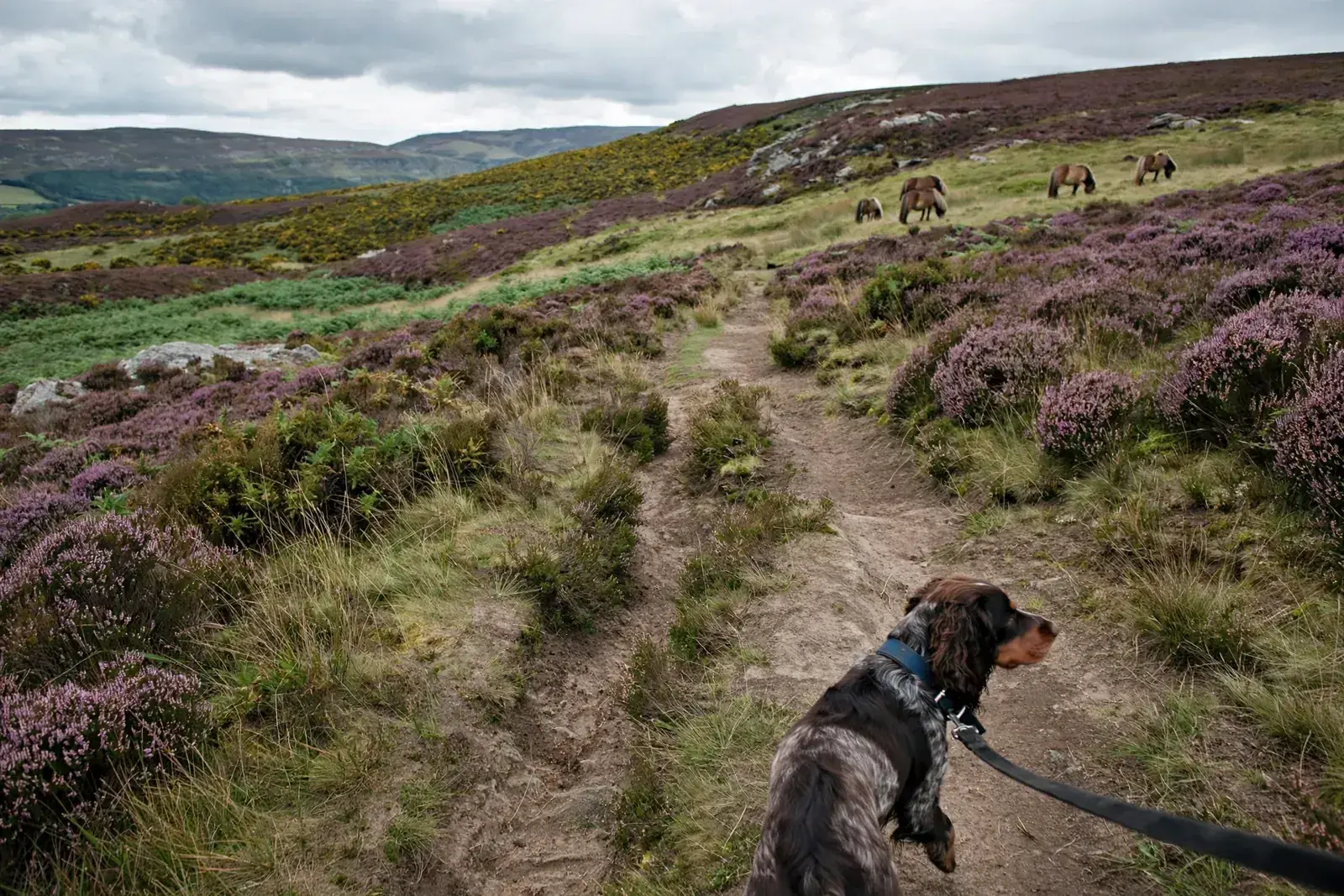
Seeing Exmoor ponies grazing against a heather skyline, or a red deer hind slipping away through bracken at first light, is the moment most visitors remember. It is also the moment that goes wrong most often, usually because someone — or someone's dog — got too close. Exmoor ponies are a hardy native breed that lives semi-feral on the open moor. They look placid, and many will barely lift their heads as walkers pass on a path. That tolerance is not tameness. A mare with a young foal at heel, a stallion in a group, or any pony startled from behind can kick or bite with very little warning, and a loose dog trotting up for a sniff is exactly the sort of surprise that triggers it.
The working rule is simple: watch from the path, from a distance, and never approach, feed or attempt to touch a pony or a deer. Feeding is a particular problem around car parks and popular viewpoints, where ponies that have learned to expect food can become pushy around cars, picnics and dogs. Keep picnic food zipped away, never hold a treat out towards an animal, and if ponies drift towards you while you are stopped, pack up calmly and move on rather than shooing them away. With your dog on a short lead and settled beside you, most encounters are uneventful: the animals read a quiet, stationary group as no threat at all.
Red deer need even more room. Exmoor holds the largest wild red deer herd in England, and the best viewing is usually at a distance with binoculars in the early morning or towards dusk, when hinds and calves feed along valley edges and woodland margins. Autumn changes the calculation. During the rut, roughly October into November, stags roar, thrash bracken and compete for hinds, and their behaviour becomes genuinely unpredictable. Give rutting deer a very wide berth, avoid walking between a stag and its group, and keep dogs especially quiet and close — a barking dog can turn a watching brief into a retreat. If any animal starts to stare, stamp, advance or block your line, do not hold your ground for a photograph: turn side-on, avoid direct eye contact and walk away steadily along your planned escape route.
It helps to plan viewing rather than stumble into it. Choose wide, open stops where you can see animals well before your dog winds them, scan ahead each time the path rounds a gorse stand or drops into a combe, and build the habit of clipping the lead on early rather than late. Dogs with a strong chase instinct, unreliable recall or a habit of barking at livestock are safest on a long line in open country, which still allows generous sniffing without any realistic chance of a pursuit. Exmoor's wildlife is the headline attraction; enjoying it at binocular distance is what keeps it wild, and keeps your dog welcome here.
South West Coast Path: Lynmouth and Porlock
Exmoor's northern edge meets the Bristol Channel in some of the highest, most dramatic sea cliffs in England, and the South West Coast Path threads along them between Minehead in the east and Combe Martin in the west. For dog walkers, the two natural bases are Lynmouth, below its cliff-railway twin Lynton, and Porlock, the village behind the pebble ridge of Porlock Bay near the park's eastern gateway. Each offers a very different flavour of coastal day, and choosing between them — or stringing both into a longer stay — is mainly a question of legs, head for heights and how your dog handles steep ground.
Around Lynmouth, the walking is spectacular and serious in equal measure. The path climbs hard out of the village towards the Valley of Rocks, a dry valley of jagged tors and feral goats just west of Lynton, and onwards along exposed cliff-top towards Heddon's Mouth and the Hangman hills. Gradients are steep, surfaces can be loose, and in several places the path runs close to unfenced drops. This is short-lead territory throughout: clip on before the first climb, use a well-fitted harness rather than a collar on the steep sections, and leave extending leads in the rucksack, where a sudden lunge towards a gull cannot translate into momentum. Older dogs, very young puppies and dogs that pull hard downhill will find a full cliff day demanding, so build in a valley alternative rather than pressing on with a tired dog on exposed ground.
Porlock offers the gentler introduction. From the village you can join the coast path across the marsh and pebble ridge of Porlock Bay towards Porlock Weir, a small harbour with a markedly calmer feel than the high cliffs further west. The walking is lower and more forgiving, though the pebble ridge itself is hard work for small paws and short legs, and sections of this coastline have been affected by coastal change and diversions in recent years. Check tide times before setting out — parts of the bay route are constrained at high water — and check the official latest guidance before you travel for current diversions, which are usually signed on the ground as well.
Whichever section you choose, treat coast path logistics as part of the walk rather than an afterthought. Fresh water is scarce on the cliff-top, so carry water for your dog as well as yourself, plus a collapsible bowl. Mobile signal is patchy in the combes, so download mapping before you leave and agree a turnaround time in advance. In hot weather the exposed path offers almost no shade, and in winter the same exposure means wind chill that bites through a thin coat. The coast path rewards an early start: quieter paths, cooler dogs, and the cliffs largely to yourselves.
Open moor, livestock and nesting birds
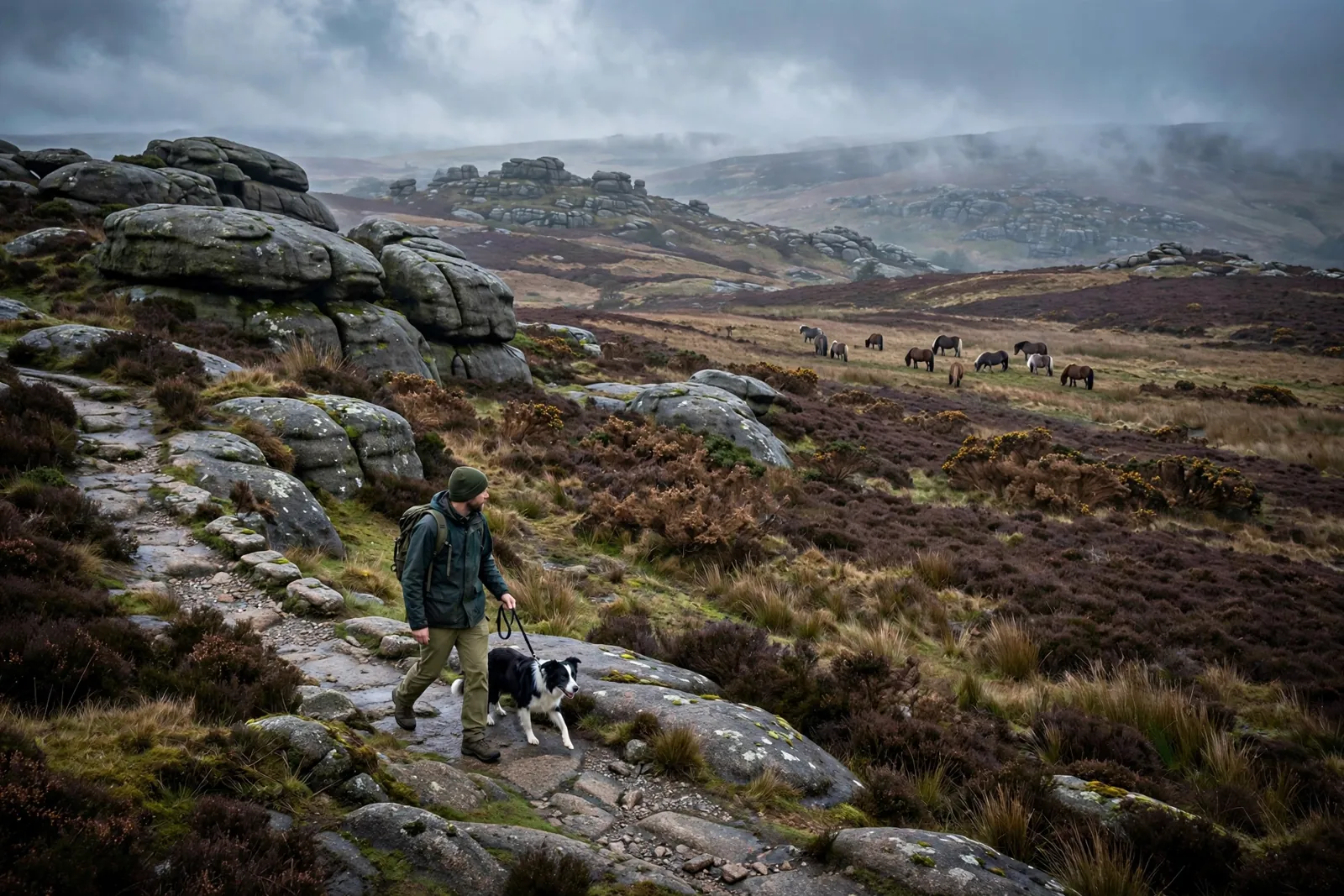
Inland, Exmoor opens out into high, rolling moorland — purple with heather in late summer, russet with bracken in autumn, and criss-crossed by bridleways, footpaths and large areas of open-access land. It feels empty, and that feeling is deceptive. The moor is a grazed, working landscape: sheep, cattle and ponies roam freely across much of it, often resting just out of sight behind gorse, in shallow valleys or on the far side of a brow. A dog ranging widely off the lead can be on top of livestock long before its owner has seen so much as an ear.
The legal and practical position points the same way. Worrying livestock — chasing, injuring or disturbing sheep and other farm animals — is an offence, and farmers are entitled to protect their animals. Our guide to the livestock worrying law for dog owners explains the rules and penalties in detail, and Exmoor is precisely the landscape it was written for. On open-access land, dogs must be kept on a short lead near livestock, and there are seasonal restrictions designed to protect ground-nesting birds. Between 1 March and 31 July, when birds such as skylarks are nesting in the heather and grass, keep your dog on a short lead on open moor even if you cannot see a single bird: nests are on the ground, invisible until you are almost standing on them, and a dog quartering through heather can destroy a season's breeding without ever catching anything.
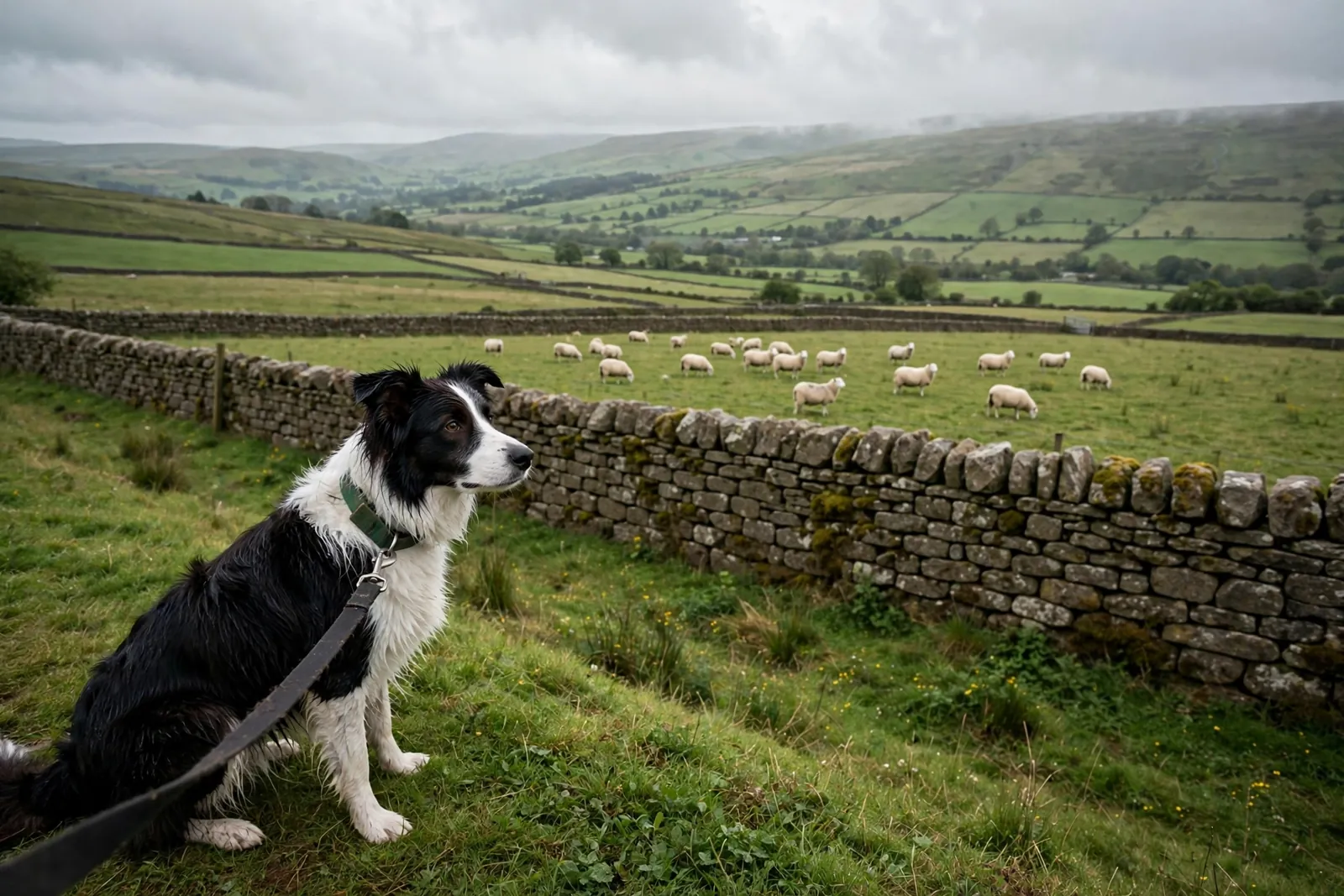
Cattle deserve a specific plan, because they behave differently from sheep. If cattle take an interest in your dog, the standard advice is to let go of the lead — a dog can outrun cattle, but you, holding the lead, cannot — move away quickly and quietly, and call your dog back once you are clear. Never position yourself between a cow and her calf, and treat bulls and groups of young, curious cattle with particular respect. Sheep, by contrast, should simply be given space: clip the lead on as soon as you see them, take the widest line the path allows, and keep walking steadily rather than stopping to admire lambs with a straining dog beside you.
None of this needs to shrink the walk. Exmoor has hundreds of miles of rights of way, many of them on enclosed lanes, valley tracks and woodland paths where a well-controlled dog can enjoy more freedom in line with local signs. The craft is in reading each stretch on its merits — open moor with stock about means a short lead, a clear enclosed track with no animals in sight may allow more scope — and in accepting that on Exmoor, the lead is not a failure of training. It is the local etiquette, and it is what keeps access for dogs in good standing with the farmers whose land makes the walking possible.
River walks: Watersmeet and Tarr Steps
When the high moor is windswept — which is often — Exmoor's steep, wooded river valleys offer the park's most sheltered and arguably most beautiful dog walking. The East Lyn River below Lynmouth is the classic example. At Watersmeet, where the East Lyn meets Hoar Oak Water in a deep oak-wooded gorge, a National Trust tea garden marks the meeting of the waters, and waymarked paths follow the river in both directions: downstream towards Lynmouth through the gorge, and upstream into quieter woodland. The river paths are mostly good underfoot but include steps, roots and stretches that run close to fast water, especially after rain, so dogs that launch themselves at any river should stay on a lead near the banks. Check National Trust opening and access information, and check the official latest guidance before you travel, as riverside paths can close after storms or flooding.
In the south of the park, Tarr Steps tells a different river story. This ancient clapper bridge — flat stone slabs laid across the River Barle near Hawkridge — is one of Exmoor's best-known landmarks, and the riverside path along the Barle valley from the bridge is gentle, shaded and ideal for dogs that prefer valley floors to hilltops. The Barle here is usually a paddling river in summer, but it rises fast after rain on the high moor, and the famous stepping slabs can become impassable or be damaged by floods; if the water is over the stones, admire from the bank and walk the valley path instead. Parking at Tarr Steps is limited and the approach lanes are narrow, so arrive early in peak season and be ready to reverse politely.
River days have their own dog checklist. Wooded valleys are prime tick habitat, so the end-of-walk tick check in the next section matters doubly here. Discourage drinking from stagnant pools at field edges, where agricultural run-off can concentrate, in favour of the water you carry. After heavy rain, treat every Exmoor river with respect: the East Lyn, the Barle and the Exe itself all drain a high rainfall plateau and can turn from paddling depth to dangerous within hours. And in summer, watch for adders sunning on warm stones near valley paths — a hazard our moorland guides return to often.
For a useful comparison when planning a South West moorland trip, our guide to dog walks on Dartmoor covers similar river-and-tor country further south, and many walkers pair the two parks in a single Devon holiday. The shared lesson is that valley routes are the reliable all-weather option: when cloud is on the tops and the wind is doing its worst, the rivers are still walkable, atmospheric and full of interest for a dog's nose.
Ticks, bracken and moorland hazards
If Exmoor has one unglamorous essential, it is the tick check. Ticks wait in bracken, rough grass and low vegetation along exactly the paths dogs love to push through, then climb aboard and feed. They are most active from spring through to autumn, but mild, damp Exmoor winters can keep them active at almost any time of year, so the check should be a habit rather than a seasonal event. Bracken deserves extra care in its own right: the dense stands that colour the moor in autumn harbour ticks in large numbers, and dogs that charge through bracken rather than walking the path will collect far more of them.
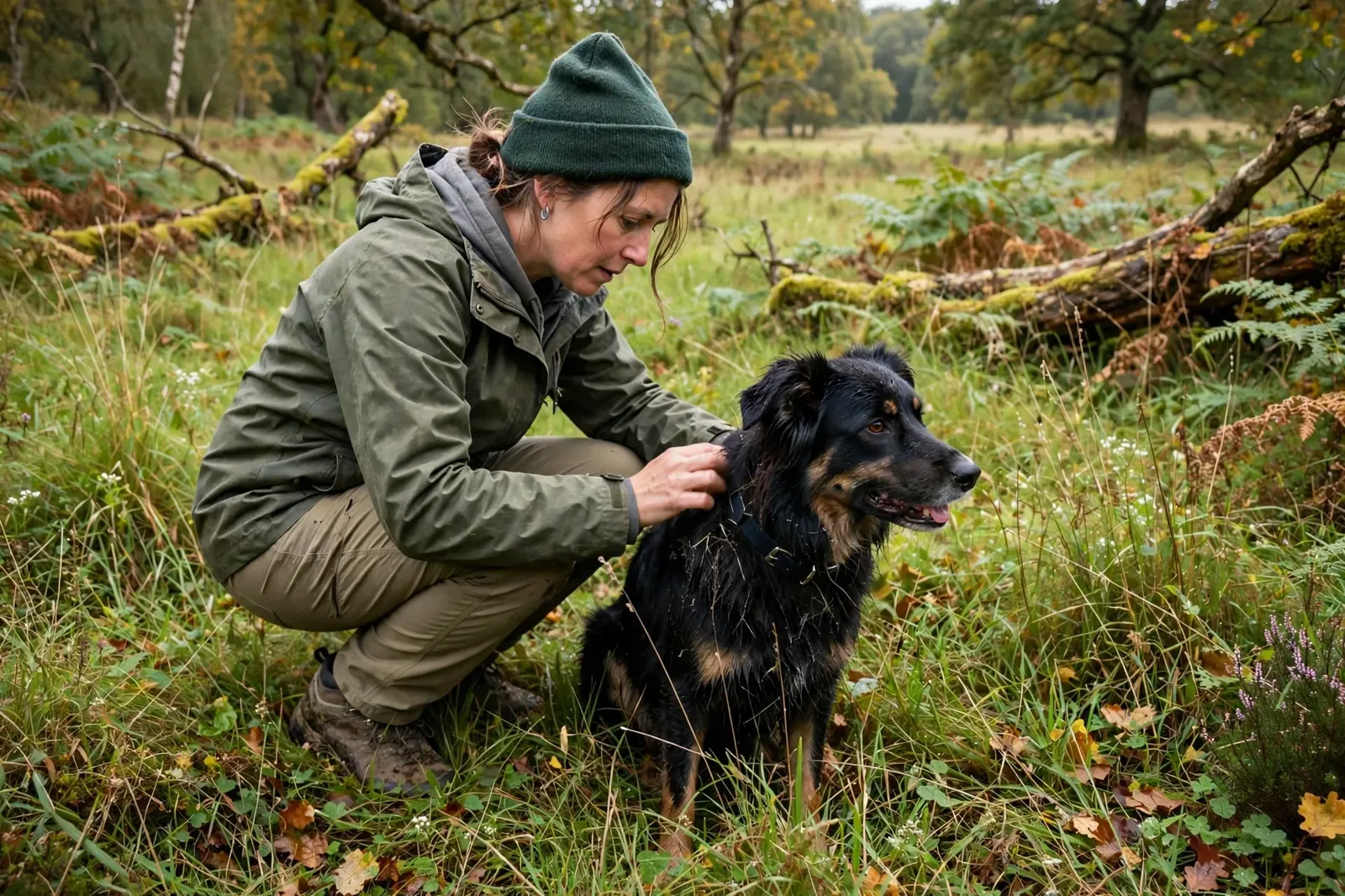
Make the check part of the homecoming routine, in daylight, before the dog settles. Work systematically over the head, ears and neck — including under the collar — then the armpits, chest, belly, groin and between the toes, feeling with your fingertips for small lumps on the skin. Our detailed guide to ticks on dogs in the UK explains safe removal step by step: use a proper tick remover or fine-tipped tweezers, twist or lift cleanly without squeezing the body, clean the site, and note the date in your phone. Never use folk remedies such as burning, alcohol gel or nail varnish, which stress the tick and increase the chance of regurgitation into the bite.
Most tick bites cause nothing worse than local irritation, but ticks in the UK can carry Lyme disease, so know the signs that justify a vet call in the days and weeks afterwards: unusual tiredness, loss of appetite, fever, stiffness or a spreading rash at the bite site. Tell the vet you have been walking deer country on Exmoor — it is genuinely useful information, because red deer are an important host for the ticks that quest in the bracken. Owners who walk Exmoor regularly should discuss preventative tick treatment with their own vet before the trip, since the right product and schedule depend on the individual dog.
Round out the hazard list with three more moorland regulars. Adders — the UK's only venomous snake — live on Exmoor's sunny slopes and bracken edges and are most likely to be encountered basking in spring and summer; a dog that investigates one can be bitten on the nose or leg, which is a same-day vet emergency. Boggy ground on the high plateau, particularly on the Chains and around headwaters after rain, can swallow a leg or a wellington with equal enthusiasm, so keep dogs on the firmer lines you would choose for yourself. And after wet weather, swollen streams cross paths that were ankle-deep last week — if a ford looks doubtful with a dog, it is doubtful: turn around and use the valley alternative instead.
Dark skies and evenings with a dog
Exmoor was designated Europe's first International Dark Sky Reserve, and on a clear, moonless night away from village lights, the Milky Way is bright enough to understand why. You do not need to leave your dog behind to enjoy it — but you do need to plan an evening outing differently from a daytime walk. The golden rule is familiarity: choose a short route you have already walked in daylight, ideally a level lane, a valley path near your accommodation or a recognised stargazing spot with firm parking, and walk it again after dark rather than exploring somewhere new by torchlight.
Keep your dog on a lead throughout an evening walk. Nocturnal wildlife — deer moving down to feed, owls hunting the field edges, bats working the tree lines — is easily disturbed by a dog ranging ahead, and livestock that you could see and avoid at noon becomes invisible at midnight. A lead also protects your dog: open moor at night conceals bogs, drainage grips and sudden drops that a daytime walker steps around without thinking. Fit a small LED collar light or clip-light so you can track your dog's position, and carry a torch with a red-light mode for yourself. Red light preserves your night vision and disturbs wildlife less than a bright white beam swept across the fields.
Village etiquette matters after dark. Park considerately in quiet lanes without blocking gateways or passing places, keep voices low near cottages and farms, and remember that a dog barking at an unfamiliar sound carries a long way on a still night. If your dog is unsettled by darkness — some dogs genuinely are, especially in a strange place — keep the outing short and close to base, and let the stargazing happen from the garden or a viewpoint by the car instead. There is no failure in that: Exmoor's skies are dark enough that even a village-edge field gate can deliver a memorable sky.
Timing improves the odds. The darkest skies come on moonless nights in autumn, winter and early spring, when darkness falls early enough for an evening walk rather than a midnight expedition; summer's short nights mean true darkness arrives late. Several communities in and around the park run dark-skies events in the autumn season, some of which welcome well-behaved dogs on leads at outdoor sessions — check event details and the official latest guidance before you travel, as arrangements vary by venue. Wrap the dog for the weather as carefully as yourself: a stationary stargazing stop in a winter wind is cold work for a thin-coated dog, even after a warm walk out.
Planning the day: weather, parking and kit
Exmoor days go best when they are planned around the park's two constants: fast-changing weather and long distances between services. The high moor around Dunkery Beacon, the park's highest point, makes its own climate — a calm, bright morning in Porlock can mean horizontal rain at 500 metres — so check a mountain-grade forecast for the tops rather than relying on a village forecast, and treat the wind chill as the number that decides your dog's day. Carry layers for yourself and, for older, young or thin-coated dogs, a coat that they are used to wearing. Fog closes in quickly on the plateau and landmarks vanish; if cloud drops, valley and coast routes are the better plan than navigating open moor.
Parking needs the same realism. Popular spots — Watersmeet, Tarr Steps, Dunkery Beacon, Porlock Weir and the Lynmouth area — fill early on fine weekends and bank holidays, and many smaller moorland car parks are unsurfaced pull-offs with limited room. Some car parks are run by the National Park Authority or the National Trust and charges and payment methods vary, so carry both a payment card and coins, and check the official latest guidance before you travel for current arrangements. Never park across gateways or on verges where your car narrows a lane used by farm traffic; on Exmoor, a blocked gate is not a minor discourtesy, it is someone's working day obstructed.
The dog kit list for Exmoor is short but specific. A standard short lead plus, if you use one, a long line for enclosed, livestock-free stretches; a harness for steep coast path ground; more water than you think you need, because moorland streams are not always reachable or safe; a tick remover in the rucksack rather than back at the cottage; a towel and a spare lead in the car, because Exmoor mud is a professional-grade product; and poo bags carried out to a bin — there is no such thing as a remote enough hillside for leaving them behind, and bags left hanging in car parks are the single most common complaint about visiting dog owners.
Finally, plan the human infrastructure before you need it. Save the details of a vet in the area you are staying — practices around Minehead, Porlock, Dulverton, South Molton and Barnstaple cover the park between them, but rural distances mean a thirty-minute drive is normal, and out-of-hours cover may be further away. Tell someone your route and expected return on longer moorland days, and keep a turnaround rule: the point at which tired legs, dropping light or rising water ends the walk, agreed before anyone is negotiating in the rain. Exmoor rewards that kind of quiet preparation with some of the finest dog walking in England — ponies on the skyline, deer in the combes, rivers in the woods, and a sky full of stars to finish.
Practical questions
Before you go
Can dogs go off lead on Exmoor?
Only where you have reliable recall, no livestock or wildlife is nearby, and local signs allow it. Much of Exmoor is open-access moor with free-roaming ponies, cattle and sheep, so most owners keep dogs on a short lead for most of the walk. During the ground-nesting bird season, typically 1 March to 31 July, keep dogs on a short lead on open moor and follow any temporary signs. Check the official latest guidance before you travel.
How close can we get to Exmoor ponies and red deer?
Stay well back and watch from the path — never approach, feed or try to touch ponies or deer, even if they appear tame. Ponies can kick or bite, especially mares with foals, and red deer stags are unpredictable during the autumn rut. Keep your dog on a lead, quiet and under close control, give animals a wide escape route, and move away calmly if they show any interest in you.
Are dogs allowed on the South West Coast Path around Lynmouth and Porlock?
Yes, dogs are generally welcome on the South West Coast Path, but keep them on a lead near cliff edges, on narrow sections and whenever livestock is present. The stretches around Lynmouth, Porlock and the Valley of Rocks involve steep climbs, exposed edges and unfenced drops, so a short lead and a harness are safer than an extending lead. Check tide times, path diversions and the official latest guidance before you travel.
When are ticks most active on Exmoor, and what should I check after a walk?
Ticks are most active from spring to autumn, especially in bracken, long grass and sheltered river valleys, but they can be present in mild weather at any time of year. After every moorland walk, check your dog's head, ears, neck, armpits, belly and between the toes, remove any tick promptly with a proper tick remover, and note the date. Speak to a vet if you find swelling, lethargy or loss of appetite afterwards.
Can we enjoy Exmoor's dark skies with a dog in the evening?
Yes — Exmoor is an International Dark Sky Reserve, and a short, calm evening walk on a familiar, safe route can be a highlight. Stick to paths you know from daylight, keep your dog on a lead so nocturnal wildlife is undisturbed, use a low red torch rather than a bright white beam, and avoid disturbing livestock or parking inconsiderately in quiet lanes. Check the official latest guidance before you travel.