This guide is independent and contains no paid placement. Opening arrangements, trail rules and transport timetables change every year, so check the official page for your chosen place before you travel.
Easter Monday can be one of the best dog days out of spring — if you treat it as a single, early, booked-where-it-counts day. Arrive at opening time, keep the dog on a short lead around trails, livestock and dropped chocolate, expect a reduced train timetable and bank-holiday traffic from mid-afternoon, and plan to be heading home while everyone else is still queueing for lunch.
Start with the clock, not the map
Most Easter Monday disappointments are timing failures, not destination failures. The place was lovely; you simply arrived at the same moment as several thousand other people, discovered the car park was full, and spent the dog's best walking hours in a queue. A one-day plan therefore starts with three fixed points on the clock, and everything else fits around them.
First, be through the gate close to opening time. That does not require a dawn alarm — most historic houses, gardens and attractions open between 10am and 11am on a bank holiday — but it does mean leaving home with the dog already walked, fed and toileted, rather than hoping to sort all three out in a busy car park. The first hour of an Easter Monday is reliably the calmest: trails are quiet, staff are fresh, and a dog that finds children, buggies and other dogs exciting gets to learn the layout before it fills up.
Second, protect the middle of the day for eating and resting, not for the headline walk. Between noon and 2pm, paths narrow, cafes queue and car parks overflow. If your dog has already had a proper morning walk, a shaded rest with water while you eat is a kindness, not a compromise. Third, decide your leaving time before you arrive — and keep it. Bank-holiday traffic builds from about 3pm, and the difference between leaving at 2.30pm and 4.30pm can be an extra hour in a warm car with a tired dog. A shorter day that ends calmly beats a longer day that ends in a jam on the ring road.
This single-day approach is deliberately different from planning a full Easter break. If you are staying away for the weekend, our guide to Easter holidays with a dog in the UK covers booking, lambing season and multi-day planning. Here, the assumption is simpler: you sleep in your own bed, you go out for one day, and you want that day to feel like a treat rather than an endurance event.
What is actually open on Easter Monday
Easter Monday is a bank holiday in England, Wales and Northern Ireland, but it is not a day when everything closes. In practice, the leisure economy is wide open and the everyday economy runs on reduced hours — which is exactly the right way round for a day out, provided you check the details that affect the dog.
Historic houses, castles and gardens run by the National Trust and English Heritage are normally open on Easter Monday, often with special Easter programming, and they expect it to be one of their busiest days of the year so far. Zoos, aquariums, farm parks and most major attractions also open, usually to Sunday or bank-holiday hours. Country parks, nature reserves, commons and beaches are, of course, open all day — and for a dog, they are often the better choice, because there is no timed ticket standing between you and the walk.
Shops follow a patchier pattern. Larger stores in England and Wales commonly open with Sunday-style hours, while many small independent shops stay closed or open late and shut early. That matters less for sightseeing than for supplies: buy dog food, poo bags and any picnic ingredients on Saturday, not in the hope that a village shop will save you on Monday. Garden centres are a notable exception — Easter Monday is one of their peak trading days, many welcome dogs on leads in outdoor areas, and they often have a cafe — but indoor dog access varies, so check before you rely on one for lunch.
Pubs are open and many actively want your Easter Monday custom, but popular dog-friendly pubs fill fast and the best garden tables go by noon. Vets run on out-of-hours cover, pharmacies operate on rota hours, and public toilets in smaller car parks may open later or close earlier than you expect. In Scotland, Easter Monday is not a standard public holiday everywhere, so opening patterns vary more by area and employer — another reason the rule for the whole day is the same: check the individual venue's bank-holiday hours on its official page before you set off, rather than trusting a search snippet written for a normal Monday.
Easter trails: the dog rules that matter
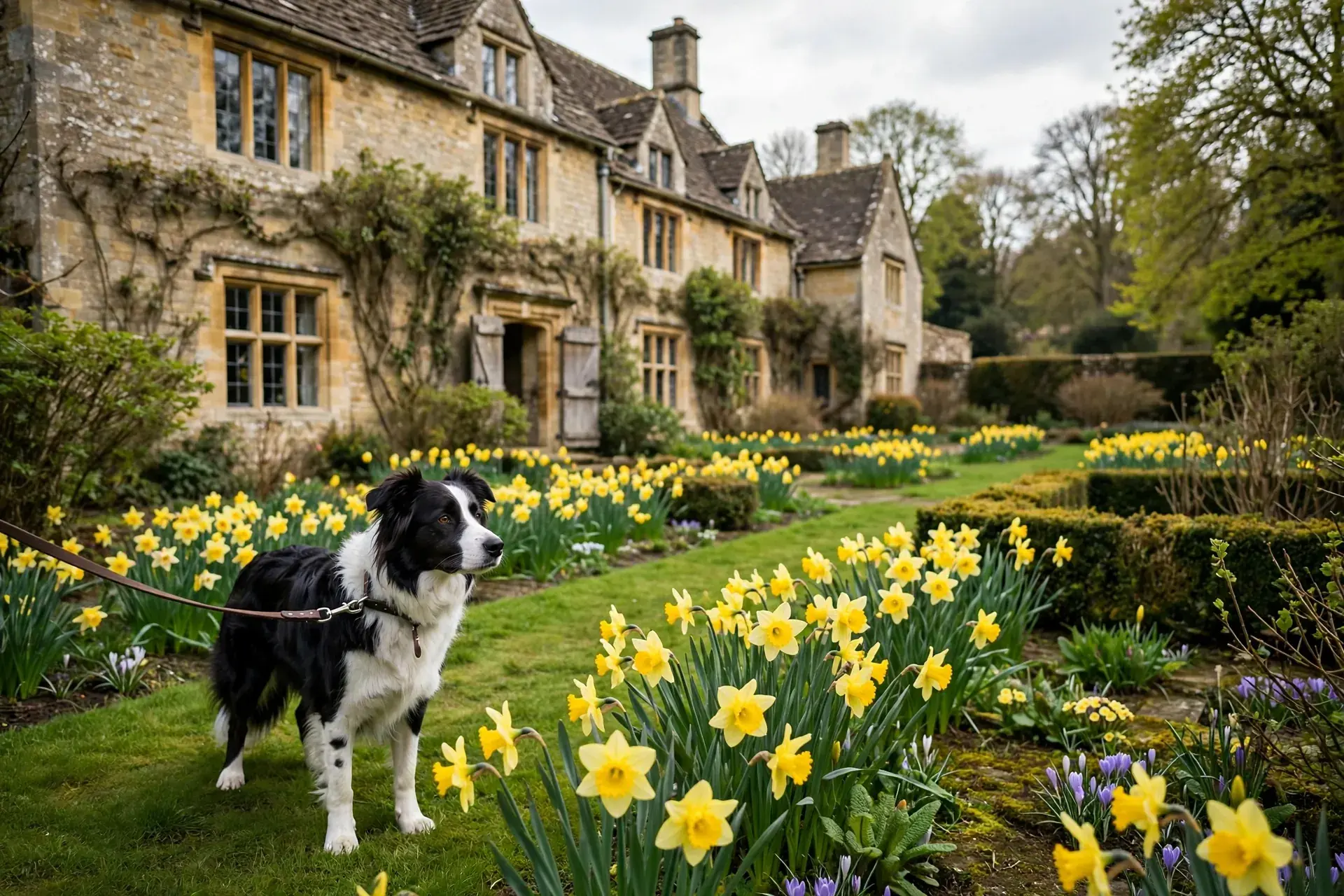
The set piece of the weekend is the Easter trail. The National Trust runs Easter trails at many of its places, typically a paid activity pack with a map, activities around the gardens or estate, and a chocolate treat at the end. English Heritage sites run their own Easter adventure quests and family events at selected properties, and countless local attractions, farm parks and gardens stage egg hunts and spring trails of their own. They can make a superb day with a dog — but only if you understand where the dog fits into an event designed mainly for children.
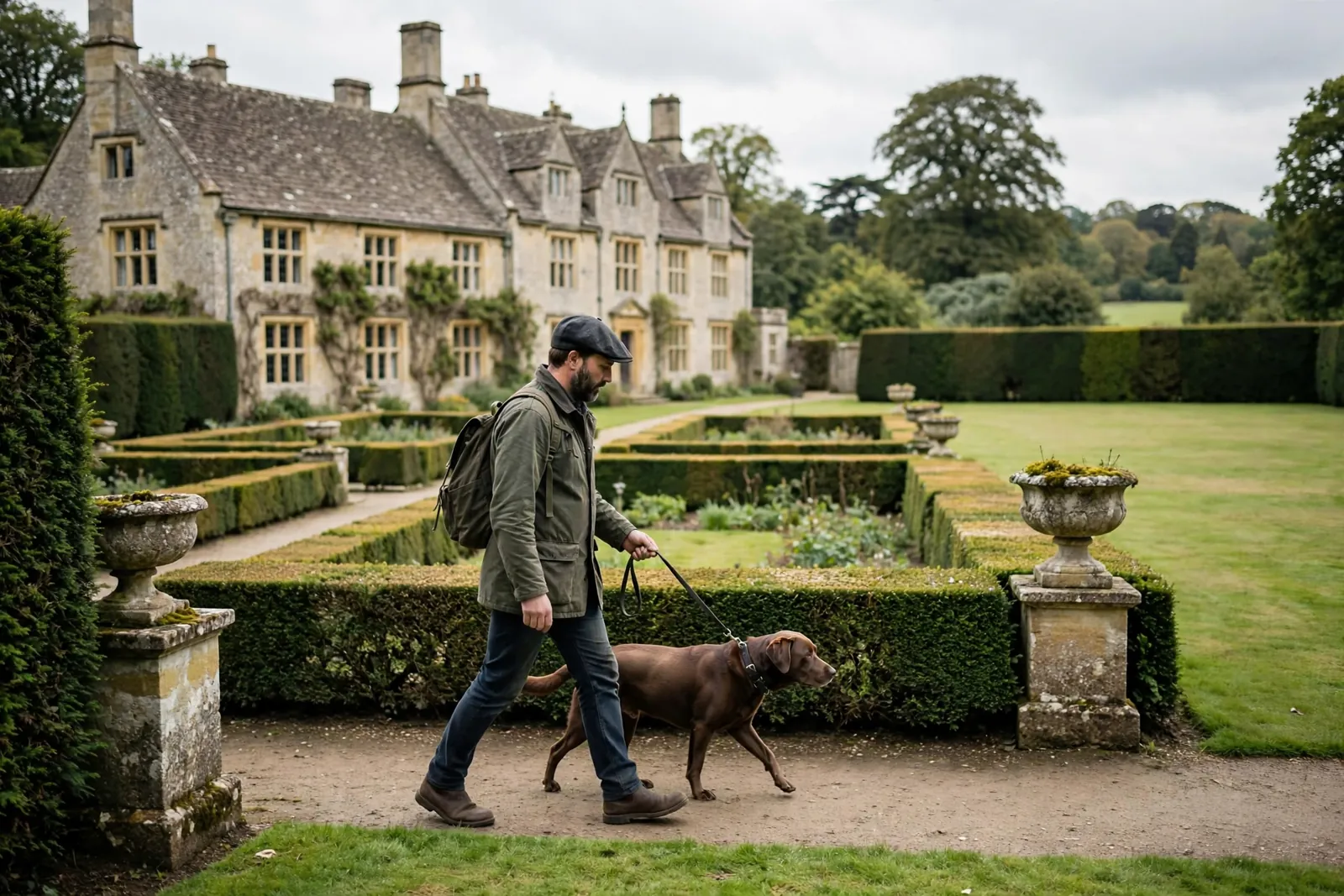
Start with the property's dog rating, not the event poster. The National Trust uses a pawprint system that tells you, place by place, whether dogs are welcome across most of the site, in limited areas, or — at a small number of places — not at all beyond assistance dogs. Our National Trust pawprint guide explains how to read those ratings before you book. In general, dogs on short leads are welcome in gardens, parkland and on most outdoor trail routes; they are rarely allowed inside the house, the main cafe or formal play areas, though many places provide a designated dog-friendly seating area, water bowls and tie-up points outside.
On the trail itself, expect three practical constraints. First, a short lead throughout: trails deliberately wind past flower beds, family activity stations and, on estate routes, fields that may contain ewes and young lambs in April. A long or extending lead around excited children hunting for clues is a trip hazard for everyone. Second, stay on the marked route even when a shortcut across the grass looks tempting — spring bulbs, ground-nesting birds and fragile turf are the usual reasons, and staff will ask you to turn back. Third, manage the finish line. Trails end with chocolate being handed to children, dropped on paths and carried at exactly dog-nose height. Walk the final stretch with your dog close, on a short lead, and eyes on the ground.
Booking deserves its own warning. Trail packs are limited, popular places sell out across the weekend, and some properties require pre-booked entry or parking even for members on peak days. Book entry, parking and the trail as early as the property allows, keep the confirmation offline on your phone in case the rural signal fails, and note the last trail start time — arriving at 3pm to find the trail closed at 2.30pm is a very Easter Monday sort of disappointment. For English Heritage and independent venues, the equivalent check is the event page for that specific site: dog rules there range from full welcome on leads to assistance dogs only, and there is no single national pattern to rely on. Where any detail is unclear, check the official latest guidance before you travel.
The chocolate problem, stated plainly
Every vet practice in the country will tell you the same thing: Easter is one of the peak seasons for chocolate poisoning in dogs, and Easter Monday — after a weekend of egg hunts, gifted eggs in other people's houses and chocolate left at child height — carries the accumulated risk of the whole weekend. Chocolate contains theobromine, which dogs process far more slowly than people. The darker and more concentrated the chocolate, the more dangerous a given amount becomes; baking chocolate and cocoa powder are the most hazardous, dark chocolate comes next, and milk chocolate, while less concentrated, can still make a small dog seriously ill.
Prevention on a day out is mostly about sightlines. Keep your dog on a short lead anywhere an egg hunt has taken place that weekend — gardens, parks, churchyards, village greens — because foil-wrapped fragments and dropped mini eggs hide in grass remarkably well. Do a quick floor check before letting your dog settle under a cafe or pub table, and be politely firm with well-meaning strangers and children who offer your dog a piece of their egg: a cheerful “he's not allowed chocolate, it can poison dogs” educates as well as protects. At home and in other people's houses, the rule is height and doors: eggs stored up high, hunt baskets out of reach, and no dog left alone in a room where Easter chocolate is open.
If the worst happens, speed matters more than certainty. Signs can include vomiting, diarrhoea, restlessness, rapid breathing, muscle tremors and, in severe cases, seizures — but do not wait to see them. Note what was eaten, roughly how much, your dog's weight and when it happened, then phone your vet or the out-of-hours service immediately; on a bank holiday, call your usual practice number and follow the recorded message to the emergency cover. Do not attempt to make your dog sick unless a vet specifically instructs you. Take the packaging with you if you are sent in — it helps the vet calculate the dose. Acting within the first hour or two gives treatment the best chance of working, which is why the emergency vet number for wherever you are spending the day belongs in your phone before you leave home, not in a panicked search at the roadside.
Spring weather, lambs and muddy ground
Easter falls anywhere between late March and late April, which means Easter Monday weather is a genuine lottery: the same bank holiday can deliver shirtsleeve sunshine one year and sleet on high ground the next. Plan for the full spring range rather than the forecast's most optimistic hour. A lightweight waterproof for you, a drying coat or towel for the dog, and a change of footwear in the car will cover most outcomes. The subtle risk is heat, not cold: the first properly warm weekend of the year catches people out, dogs that have spent winter in heated houses acclimatise slowly, and a black dog walking on sun-warmed tarmac at noon can overheat while their owner still feels pleasantly cool. Carry water for the dog on every walk, offer it little and often, and never leave a dog in a parked car while you queue for entry — even in mild spring sunshine, car temperatures climb fast.
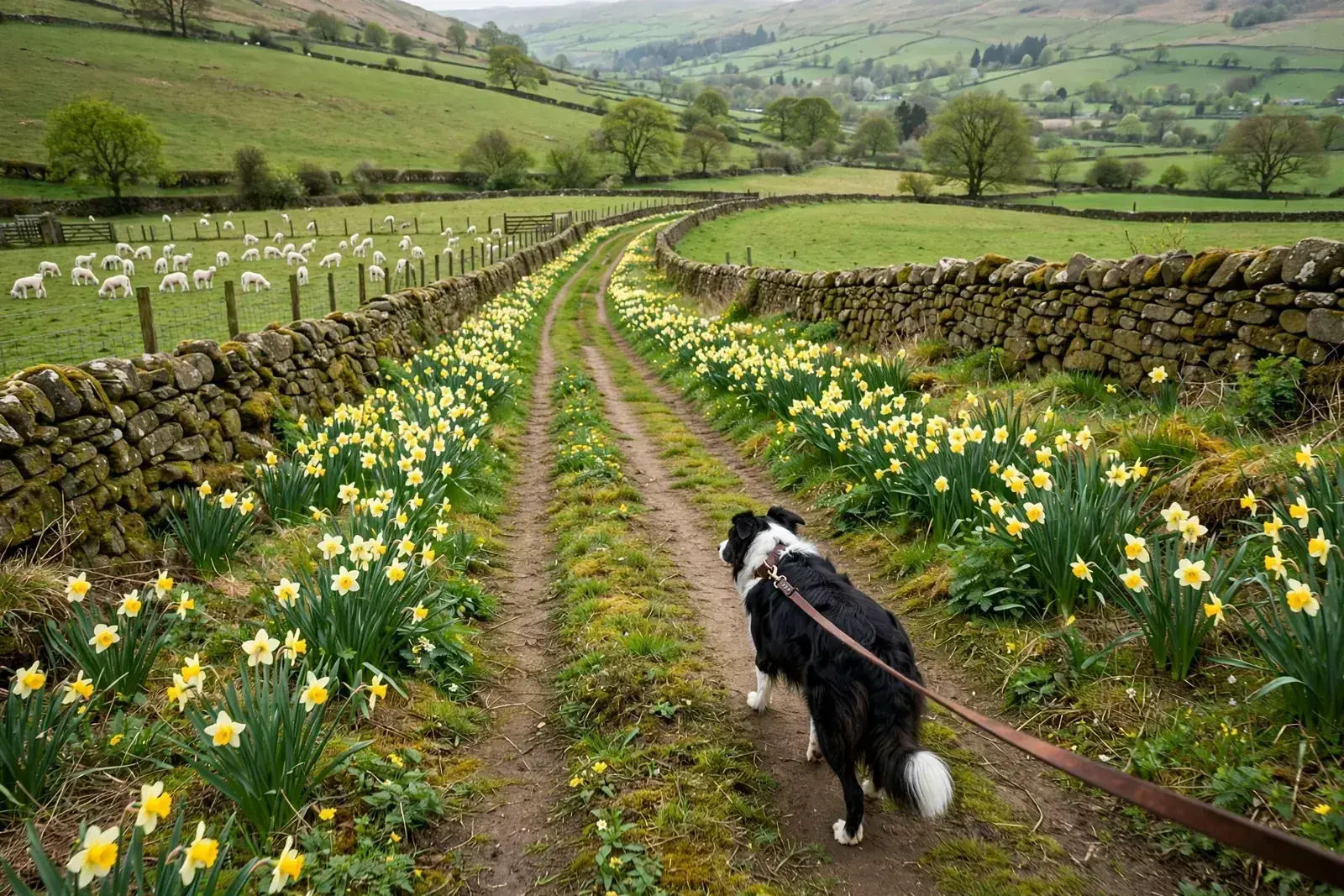
April is also the heart of lambing season and the start of the ground-nesting bird season, and Easter Monday routes pass straight through both. Keep dogs on a short lead around sheep without exception, and on moorland, heathland, coastal grassland and nature reserves follow the local lead rules, which commonly require dogs on leads or close control between March and July to protect nesting birds. A dog does not have to touch a ewe to cause harm; a loose dog running through a lambing field can separate lambs from mothers and exhaust heavily pregnant sheep. If cattle with calves are in a field on your route, the calm answer is usually a different field.
Finally, respect the ground itself. After a wet spring, unsurfaced paths, river meadows and clay woodland tracks can be genuinely hard going, and gateways churned by a weekend of visitors turn to deep mud by Monday. Choose routes with a hard surface — estate drives, forestry tracks, canal towpaths, promenades and parkland paths — if anyone in the group, human or canine, struggles with slippery ground. Check your dog's paws after the walk for packed mud and small stones, rinse off river or stagnant water if they have paddled, and dry ears and skin folds before the drive home. Spring also brings out ticks in long grass and woodland edges, so a quick tick check in the evening is a sensible end to the day.
Bank-holiday transport and crowds
Getting there is the part of Easter Monday most likely to go wrong, because every form of transport runs a reduced, altered or overloaded version of itself. On the railways, Easter Monday normally follows a Saturday or Sunday timetable, the first trains run later, and the Easter weekend is one of the traditional peaks for engineering work — meaning altered routes, slower journeys and, on some lines, replacement buses. Dogs travel free on most UK train services, kept on a lead, off the seats and out of the way of other passengers, but a replacement bus is a different proposition: acceptance can be at the driver's discretion and space is tight, so a journey that looks simple on paper can strand you. Check your exact trains, the engineering notices for your route and the return journey — not just the outbound — the day before, and again before you leave.
By car, the pattern is predictable enough to plan around. Roads towards the coast, national parks and major attractions build steadily from mid-morning, local roads near popular sites jam first, and the return peak runs from mid-afternoon into early evening. The dog-specific costs of a jam are real: no toilet stop, rising car temperature in slow traffic, and a tired, thirsty dog arriving home stressed. Build in a proper break on any drive over about an hour and a half, leave earlier than feels necessary, and have a full tank or charge before the weekend — bank-holiday queues at motorway services help nobody. Parking is the other pinch point: car parks at honeypot sites can be full by 11am, some require pre-booking on peak days, and overspill parking on grass is where cars get stuck after rain. If your first-choice car park is full, your calm, pre-decided alternative — the quieter park, common or town walk you identified the night before — is worth more than twenty minutes circling.
Crowds shape the dog's day as much as yours. A dog that copes beautifully with a Saturday market may find an Easter trail — with its squealing egg hunts, scooters, picnics at grass level and queues of other dogs — genuinely hard work. Read the day from the dog's height: dropped food, dangling chocolate, toddlers at face level. Choose wider paths over narrow ones, eat at the edge of the picnic area rather than its centre, and give your dog regular quiet minutes away from the action. For more on pacing a whole bank-holiday weekend away, see our guide to bank holiday weekend breaks with dogs — but for a single day, the crowd strategy is simply: early in, wide routes, early out.
Lunch without leaving the dog out
Easter Monday lunch fails in two familiar ways: the pub you counted on is fully booked with a queue at the door, or the cafe welcomes you warmly and the dog not at all. Solve both on Sunday evening, not at 1pm on the day. If a pub lunch is the plan, book a table and say clearly that a dog is coming, then confirm where the dog will actually be — many pubs welcome dogs in the bar and garden but not the restaurant, and a booked table in the wrong room helps nobody. Ask about garden access too: on the first warm weekend of the year, an outdoor table with space under it for a settled dog is often the best seat in the house, provided you bring a mat for cold or damp ground and water if bowls are busy.
A picnic is the flexible alternative, and Easter Monday is its natural home — but picnic with a dog takes thirty seconds of forethought. Site yourselves away from the main family games area, keep all chocolate, hot cross buns and any food containing raisins, grapes or xylitol-sweetened products zipped in a closed bag rather than on the blanket, because dried fruit and certain sweeteners are dangerous to dogs as well as chocolate. Tether or hold the lead rather than letting the dog wander between neighbouring picnics, and clear every scrap when you leave: the next dog on that grass will find whatever you dropped.
Whichever you choose, feed the dog on something close to their normal schedule with their normal food. A bank-holiday lunch is not the moment for rich leftovers, fatty scraps or a well-meant sausage from the barbecue — dietary indiscretion is the other classic reason vets see dogs after Easter. A normal meal, fresh water and a rest in the shade will set your dog up for a gentle afternoon stroll and a settled evening, which is the real prize of the day.
The quieter Easter Monday plan
None of the above obliges you to join the crowds at all. Some of the best Easter Monday dog days are deliberately small: an early walk on a familiar route while the attractions are still filling, a garden centre for spring plants with the dog welcome in the outdoor areas, a slow coffee somewhere with outdoor seating, and an afternoon at home while the roads do their worst. Dogs do not know it is a bank holiday. They know whether the walk was good, the company was calm and the routine held.
If you want a destination without the headline crowds, think one tier down from the famous names. Smaller English Heritage sites, local museum gardens, canal towpaths away from honeypot towns, forestry walks without a visitor centre, and the less celebrated end of a popular beach all offer spring at a gentler volume. Town parks with a good cafe, riverside meadows on the edge of a market town, and reservoir circuits are made for bank-holiday Mondays: proper walks, space to spread out, and a drive home measured in minutes. Arriving anywhere before 10.30am still applies — quiet is a time of day as much as a place.
Weather can make the decision for you, and that is fine. A wet Easter Monday is an argument for a short, excellent walk and a long, unhurried afternoon, not for pressing on to a booked attraction in horizontal rain because it was the plan. Keep the booking light where you can, hold the day loosely, and judge it by the dog asleep contentedly in the evening — that, and not the number of attractions visited, is the measure of an Easter Monday done properly.
The one-day kit list
A day trip needs less kit than a holiday, but Easter Monday punishes the few things people forget. Pack the car the night before with this short list, and the day runs itself.
- Lead, spare lead and ID: a normal short lead for trails and crowds, a spare in the car, and a collar tag with a current mobile number — dogs slip leads in busy car parks more often than anywhere else.
- Water and a bowl: enough for the whole day, not just the walk, plus a bottle in reserve in the car for traffic delays on the way home.
- Normal food and a mat: your dog's usual food if you will be out over a meal, and a settle mat for pubs, cafes and picnics on cold or damp ground.
- Weather layers: waterproofs for you, a towel and drying coat for the dog, sun sense for the first warm day of the year, and spare footwear for mud.
- Poo bags, in quantity: bank-holiday bins overflow by midday; carry bags out with you if the bins are full rather than leaving anything behind.
- Phone essentials, offline: entry and parking confirmations saved offline, the number of an emergency vet near your destination, and your own vet's out-of-hours number.
- A closed bag for food: every item of chocolate, every hot cross bun and all picnic food travels zipped away from the dog, in the car and on the grass.
That is the whole system: booked where booking matters, early where crowds gather, careful where chocolate and livestock are concerned, and home before the day turns into a queue. Easter Monday with a dog does not need to be ambitious to be memorable — it needs to be planned around the dog in front of you, for exactly one day, and then enjoyed at that pace.
Practical questions
Before you go
Are dogs allowed on National Trust Easter trails?
At many places, yes, on a short lead outdoors, but not everywhere and rarely inside the house, cafe or formal play areas. Each property sets its own pawprint rating and trail route, and some trails pass lambing fields or busy family zones where dogs must stay on the path. Check the individual property page and the trail booking notes the week before, and always check the official latest guidance before you travel.
What should I do if my dog eats chocolate on Easter Monday?
Treat it as urgent. Note the type of chocolate, roughly how much was eaten, your dog's weight and the time, then phone your vet or an emergency vet straight away — do not wait for symptoms and do not try to make your dog sick unless a vet tells you to. Dark and baking chocolate are the most dangerous. On a bank holiday your usual practice may run an out-of-hours service, so call the practice number and follow the recorded instructions.
Are trains running normally on Easter Monday with a dog?
No. Easter Monday usually runs to a Saturday or Sunday timetable, engineering work is common across the Easter weekend, and some routes start later or use replacement buses where dogs may face extra restrictions. Dogs travel free on most UK trains if kept on a lead and off seats, but check your exact trains, engineering notices and bus arrangements the day before and again on the morning.
What is open on Easter Monday for a day out with a dog?
Most major attractions, National Trust and English Heritage sites, garden centres, pubs and larger shops in England and Wales are open, often with Sunday or bank-holiday hours. Smaller independent shops, some cafes and many venues in Scotland, where Easter Monday is not a standard public holiday everywhere, vary more. Always check the individual venue's bank-holiday hours before you set off.
Do I need to book for an Easter Monday visit with a dog?
For popular houses, gardens and Easter trails, booking is strongly recommended and sometimes essential, even for members, because timed entry and trail packs sell out over the weekend. Book the car park as well if the site uses parking reservations. For a simple countryside walk, a common or a dog-friendly beach you usually do not need to book — arriving early is the equivalent strategy.