This guide is independent and contains no paid placement. If affiliate links are added later, they will be clearly marked and will not change our editorial checks.
Elan Valley walks with a dog are about choosing distance in a big, quiet landscape. Base yourself at the visitor centre near Rhayader, walk reservoir loops and dam viewpoints for shorter days, or take sections of the Elan Valley Trail towards Rhayader or Craig Goch for longer ones. Keep dogs on a lead around sheep and on dam and road sections, out of the reservoirs, and carry water — this is upland Wales, with weather and distances to match.
A built landscape: why the Elan Valley feels different
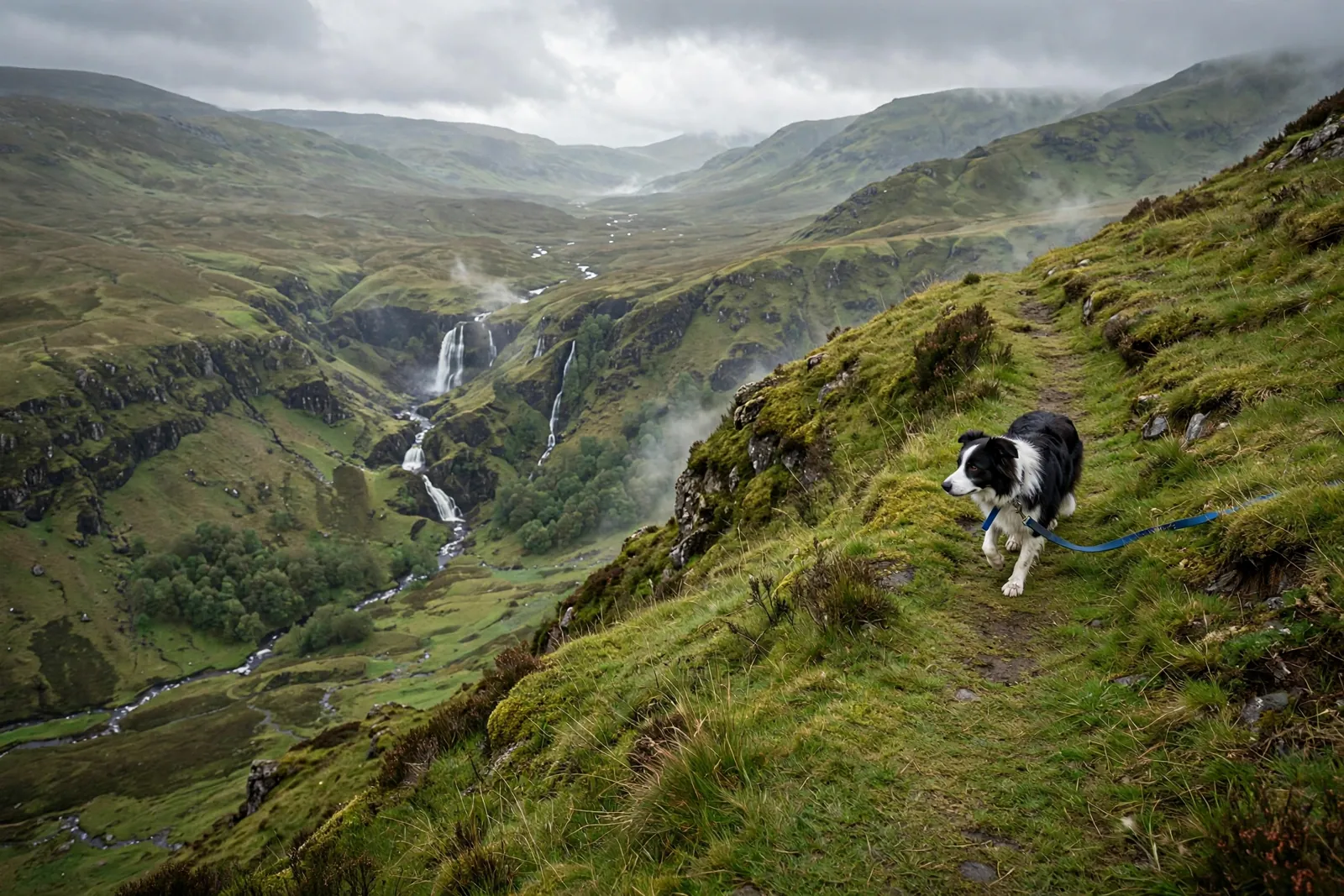
Most reservoir walks feel like a path beside water. The Elan Valley feels like a civilisation briefly installed in the hills: a chain of Victorian and Edwardian dams and reservoirs built to carry Welsh water by gravity to Birmingham, complete with a model village for workers, a grand visitor landscape of lawns and stone, and hills that close around it all in green, sheep-cropped folds. For a dog, the result is a rare combination — monumental viewpoints a few steps from the car, and genuinely remote-feeling trails an hour later, without ever leaving waymarked ground.
The estate covers a vast protected catchment in the Cambrian Mountains near Rhayader in Powys, managed today for water, conservation and access together. That management shapes your walk: the reservoirs are drinking water, so dogs do not swim or paddle in them; the surrounding land is farmed, so sheep are a constant presence; and large areas are protected for wildlife, including red kites that wheel over the valley as if employed to do so. Understanding that this is a working water landscape first and a beauty spot second makes every rule on the signs feel logical rather than bureaucratic.
Orientation starts at the Elan Valley Visitor Centre on the valley floor, where maps, trail information, facilities and the first dam — Caban Coch — set the scene. From there the valley road climbs past Garreg Ddu and Penygarreg to Craig Goch, the highest and most ornate dam, while the Elan Valley Trail runs from Rhayader through the valley and onwards. Check the latest official guidance before you travel for visitor centre hours, parking charges and any trail diversions, and take a paper or downloaded map: signal thins as the valley narrows.
Dam viewpoints and short loops: the greatest hits, gently
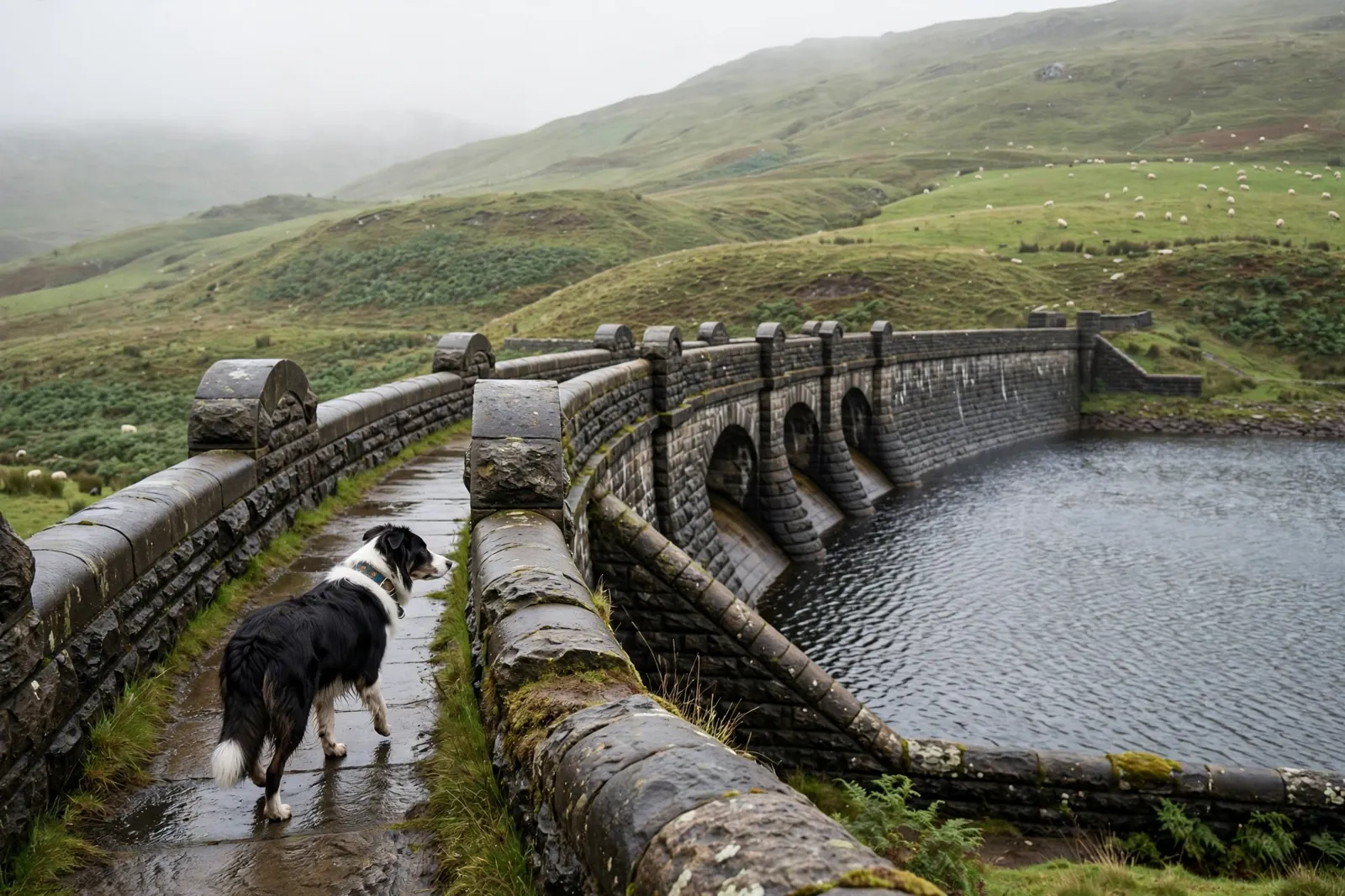
A half-day of viewpoints is a legitimate Elan Valley strategy, especially with an older dog, young children or a first visit. At Caban Coch, the lowest and largest dam, walk the bridge and admire engineering that still looks like a castle holding back a lake. Garreg Ddu, mostly submerged as a causeway arrangement with the Nant-y-Gro dam beside it, tells the stranger wartime story of Barnes Wallis's bouncing bomb trials in miniature — the smaller dam was used in early experiments. Penygarreg offers a photogenic tower and lakeside paths, and Craig Goch, curving high at the top of the chain, is the valley's showpiece, especially when water spills over its face after wet weather.
Short loops stitch these viewpoints into walks rather than stops. The paths around the visitor centre and along the River Elan below Caban Coch give a riverside hour where the dog can enjoy moving water at a safe distance — the river here, unlike the reservoirs, is a natural watercourse, though it still demands care after rain and around slippery rock. Woodland trails below the dams and around the former village site add shade and scent on warm days, when the open reservoir roads can be surprisingly exposed.
Practical rhythm helps: viewpoints have small car parks that fill in sequence on fine days, so start at the furthest point — Craig Goch — and work back down the valley against the flow of arrivals. Keep leads on at every dam, bridge and road section without debate; drops, traffic and other visitors concentrate in exactly these places. A dog that walks a dam wall calmly on a short lead, ignoring the view it cannot appreciate, is doing its owner a considerable favour.
The Elan Valley Trail: build your distance honestly
The Elan Valley Trail follows the line of the old Birmingham Corporation railway for much of its length between Rhayader and the upper valley, continuing beyond towards Craig Goch — a largely level, well-surfaced multi-use path of around nine miles end to end in its main section, shared with cyclists and horse riders. That railway inheritance is the trail's gift to dog walkers: gradients a loaded waterworks train could manage are gradients any fit dog can manage, and the distance becomes a pure choice. Walk an hour out and an hour back from any access point and you have a made-to-measure day.
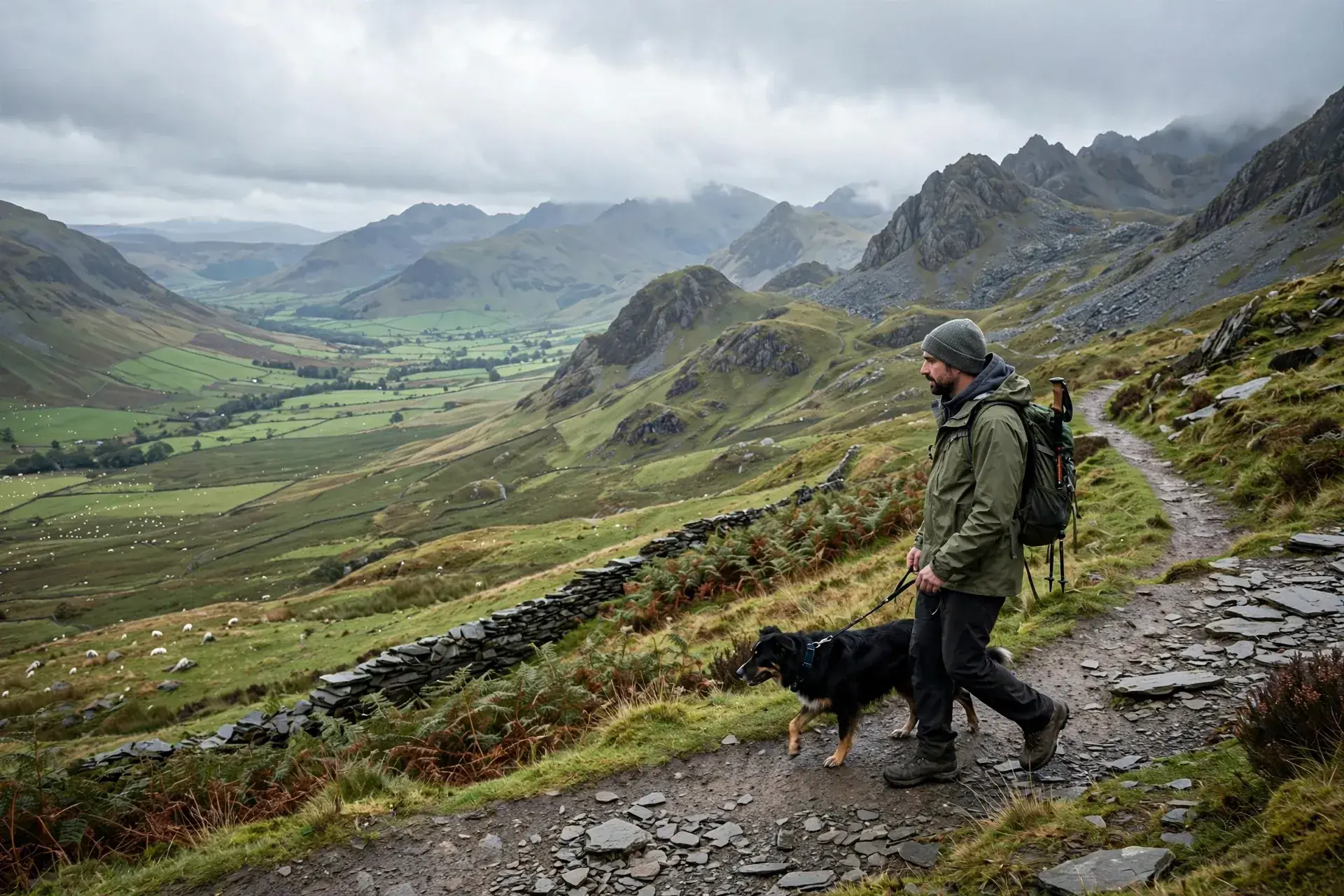
Share the trail graciously. Cyclists approach fast and quietly from behind, so keep the dog on the side away from the riding line, shorten the lead when bikes or horses approach, and step aside with the dog held close for equestrians — a loose dog around horses endangers three species at once. Long leads and extendable leads are poor tools here; a standard short lead keeps everyone predictable. On quiet midweek days the trail can feel entirely yours, with only kites, sheep and the occasional heron for company, which is precisely its charm.
For a bigger day, the trail links naturally with reservoir-side paths and the valley road to form loops, but plan loops with a map rather than optimism: bridges across the reservoirs are few, distances on the ground exceed distances on a glance, and a loop that fails leaves a long road walk as the price. Our Brecon Beacons with a dog guide covers the neighbouring uplands if your Powys week combines both landscapes, and the comparison is instructive — the Elan Valley offers the gentler gradients, the Beacons the wilder tops.
Sheep, kites and catchment rules: the lead is the ticket
There is no version of an Elan Valley walk that escapes sheep, and there should not be. The catchment is hill farmland, flocks graze the open hillsides and inbye fields, lambs fill the valley in spring, and farmers' livelihoods walk on four legs all around your route. Dogs belong on a lead around livestock — full stop — and under close control everywhere else, following the Countryside Code for Wales. If sheep move ahead of you on a path, wait, give them room to drift away, and never let a dog press a flock towards a road, a dam edge or a fence corner.
The wildlife rules run parallel. Red kites, once reduced to a handful of pairs in these very hills, now soar over the valley daily and are joined by buzzards, ravens and, around the reservoirs and rivers, dippers, goosanders and grey wagtails. Ground-nesting birds use the moorland fringes in spring and summer. A dog under control disturbs none of this; a dog ranging widely can undo a nesting season in an afternoon. The reservoirs themselves are out of bounds for dogs in the water — it is drinking water for a major city — so bring a bowl and a bottle and let the dog drink from those instead.
Waste discipline completes the ticket. Bag and carry out everything, including on remote-feeling trail sections, because catchment land drains towards the reservoirs and because other walkers deserve clean boots. Bins cluster at car parks and the visitor centre, so the system asks you to carry, not to search. Walkers who accept these three rules — lead near stock, out of the water, waste carried out — will find the valley entirely welcoming in return.
Rhayader and the valley bases: evenings and supplies
Rhayader, the market town at the valley's mouth, is the natural base: places to stay, pubs and cafés, shops for picnic and dog supplies, a vet within reach, and the start of the Elan Valley Trail at its edge. Staying in town means the dog gets a pavement-and-park evening routine and you get a choice of suppers, while staying up the valley — in the scattered accommodation near the dams and at the valley's own lodges and bunkhouses where dogs are accepted — trades choice for dawn quiet and kites over breakfast. Ask the standard dog questions wherever you book: charges, enclosed ground, dogs in eating areas, and the nearest after-dark walk that is not an unlit lane.
Eat and stock up with island-style forethought, because the valley itself offers the visitor centre café seasonally and little else beyond Rhayader. A picnic bought in town and eaten at a reservoir viewpoint, with the dog settled on a mat and its own lunch provided, will beat any improvised plan. Local lamb is justly famous on menus; keep it on your plate rather than in the dog's bowl, since rich scraps on a walking holiday are a reliable route to a midnight garden visit or worse.
If your trip extends across mid Wales, the valley connects logically with the Wye Valley downstream, the Cambrian Mountains' quiet roads, and the coast at Aberystwyth for a complete change of register. Our Pembrokeshire Coast Path with a dog guide is the natural coastal counterpart for a two-centre Welsh holiday — sea cliffs after reservoirs, with the same livestock and lead discipline serving you in both places.
Weather, seasons and the quiet valley advantage
The Elan Valley's altitude is modest but its exposure is real Cambrian weather: fronts arrive off the Atlantic with little warning, the reservoirs can sit in mist while Rhayader is merely grey, and wind funnels along the water in a way that chills dogs and owners standing at viewpoints. Pack waterproofs and a dog coat for small, old or thin-coated dogs in every month, carry water even on cool days because trail sources are not for drinking, and in summer add sun thinking — open trail and pale stone reflect heat, and shade is scarce on the reservoir roads at midday.
Seasons rearrange the valley's pleasures. Spring brings lambs, curlews returning to the moors and full reservoirs spilling after winter rain. Summer offers the longest days for the full trail, balanced against busier car parks and the need for early starts. Autumn colours the oakwoods below the dams and empties the midweek valley to almost private use. Winter, on a settled day, may be finest of all: low sun on the dams, frost on the trail, kites over empty hills and a dog that has the whole catchment's smells to itself. Ice on dam bridges and short daylight are the prices; pay them knowingly, with a torch and a finish time.
That quiet is the valley's advantage over better-known Welsh destinations, and it suits dogs that find crowds stressful as much as owners who do. A reactive dog can be walked here at off-peak times on wide trails with long sightlines, where passing other dogs can be managed with space rather than apology. Choose weekday mornings, start from the less-used access points, and the Elan Valley becomes one of the most forgiving big landscapes in Wales for a dog that needs room to breathe.
A full valley day, and a two-day pattern
For one full day, try this shape. Start at the visitor centre when it opens, walk the riverside and woodland below Caban Coch while the valley is fresh, then drive to Craig Goch and walk a section of the upper trail and viewpoints before the small car parks fill. Picnic at Penygarreg, descend to Garreg Ddu and its wartime story, and finish with an hour on the Elan Valley Trail from Rhayader as the light softens, ending in town for supper with the dog under the table where welcome. The day mixes driving stops and real walking in a ratio that suits most dogs: never more than an hour in the car, never a walk longer than their fitness.
Over two days, give day two to distance: a long trail section — Rhayader to Penygarreg and back, or an upper-valley out-and-back — walked slowly with viewpoint stops, swims firmly declined, and a proper rest day feeling built into the stops. Two-day visitors also earn the valley's best trick, which is seeing a dam twice: once in morning mist and once in evening sun, with the dog equally convinced both times that this is the finest walk in Wales.
Leave the valley as the water company, the farmers and the kites would wish: gates closed, waste carried out, leads where they belong and nothing taken but photographs of stone and water. The Elan Valley was built by people who thought in decades; walk it like a guest of that patience, and it will repay you — and your dog — at the same unhurried rate.
Shorter legs and steadier paws: Elan Valley at an easier pace
Not every dog — and not every owner — arrives in the Elan Valley ready for nine miles of trail, and the valley is unusually kind to those who are not. The visitor centre area concentrates level paths, the riverside below Caban Coch, viewpoints a short stroll from car parks and facilities into a compact circuit that delivers dams, water and kites without distance. A senior dog can have a complete Elan Valley day in a series of twenty-minute walks separated by viewpoint picnics and car naps, and will have missed nothing essential: the valley's essence is stone and stillness, not mileage.
Puppies and dogs building fitness after illness or injury can use the Elan Valley Trail the same way, as a measured instrument. Its railway gradients and firm surface make distances predictable, its access points let you choose exact lengths, and its out-and-back nature means the return is never a surprise. Build distance across the week — two miles, then three, then a viewpoint day as active rest — and watch fitness return on ground that never punishes ambition with a sudden climb. Carry water from the first mile, because a dog that is rebuilding fitness drinks more, not less.
Owners with limited mobility will find the main viewpoints and visitor centre paths among the more workable upland experiences in Wales, though surfaces and gradients vary and should be checked in current visitor information before relying on them. However a dog team moves — fast, slow, wheels, four paws or two — the valley's scale absorbs everyone without crowding. Space is the Elan Valley's accessibility feature, and it is available in every season to anyone who plans distances honestly.
Practical questions
Before you go
Can dogs swim in the Elan Valley reservoirs?
No. The reservoirs are a drinking water supply for Birmingham and dogs must stay out of the water. Let your dog drink from a bowl you carry instead, and keep it on a lead at dam edges, bridges and spillways. Rivers below the dams also need care after rain. Check the latest official guidance before you travel for current catchment rules.
How long is the Elan Valley Trail for a dog walk?
The main trail between Rhayader and the upper valley is around nine miles end to end, largely level on the old railway line. Most dog walkers use sections of it — an hour out and back from the visitor centre or Rhayader makes a good half-day. It is shared with cyclists and horses, so keep leads short when they approach.
Do dogs need to be on a lead in the Elan Valley?
Around livestock, yes — sheep graze throughout the catchment and a lead is essential near them, as well as on dams, bridges and road sections. Elsewhere keep your dog under close control following the Countryside Code, especially in ground-nesting bird season. Follow local signs on the day.
Where should we base ourselves for Elan Valley walks with a dog?
Rhayader is the practical base, with stays, food, shops and the trail starting at its edge. There is also limited accommodation up the valley for a quieter, more remote feel. Wherever you book, confirm dog charges, enclosed outdoor space and where you can walk after dark.
When is the quietest time to walk in the Elan Valley?
Weekday mornings outside school holidays are quietest, and autumn and winter on settled days can feel almost empty. Start at the furthest dam and work back to beat the sequence of filling car parks on fine days. Always allow for fast-changing upland weather and short winter daylight.