This guide is independent and contains no paid placement. If affiliate links are added later, they will be clearly marked and will not change our editorial checks.
The Pembrokeshire Coast Path is one of Britain's finest dog walks, but it is not one walk — it is a chain of very different days. Pick sections by your dog's fitness, keep a short lead near cliffs and livestock, respect seasonal beach bans at Tenby and Saundersfoot, carry all the water you need between villages, and check the official latest guidance before you travel.
Choose a section that fits your dog
The full Pembrokeshire Coast Path runs for about 186 miles between Amroth in the south and St Dogmaels in the north, passing through the Pembrokeshire Coast National Park. Few dog owners should attempt it as a single continuous push, and fewer dogs would enjoy it that way. The smarter approach is to treat the path as a menu of sections, each with a different character, and build a trip around the days that suit the dog in front of you. Distances, gradients and exit points vary enormously, so check the official latest guidance before you travel and confirm the current route, diversions and access points for the section you choose.
In the south, the stretch around Tenby, Manorbier and Stackpole combines resort beaches, limestone cliffs and relatively frequent villages — shorter gaps mean more chances for water, shade and an early finish. Further west, around Broad Haven, St Davids and the Marloes Peninsula, the coast feels wilder: villages are further apart, the path narrows, and a modest-looking section can take much longer once you add cliff climbs, gates and stiles.
The northern sections towards Newport, Fishguard and St Dogmaels are quieter still, with big views and longer-feeling days. They suit a calm, fit dog, but demand better planning: fewer bail-out points and more livestock. For a first visit, many owners do best with one base — Tenby, Saundersfoot, Broad Haven, St Davids or Newport — walking day sections by bus or taxi rather than moving every night.
Match distance to your dog, not to the guidebook. A fit adult dog used to hill walking may happily cover ten to twelve miles on a cool day with regular water and rest stops. An older dog, a puppy or any dog new to distance walking should start far shorter — five to seven miles with a clear turning-back option. Watch the dog, not the mileage target: slowing down, seeking shade, lying down at gates or lagging on climbs are signs the day is already long enough.
Seasonal beach dog restrictions
The path itself and the beaches below it are governed by different rules, and confusing the two is the most common planning mistake on this coast. You may be welcome to walk the cliff path above a beach all year, while dogs are restricted or banned on part or all of that same beach for the main summer season. If your plan depends on dropping down to the sand for a run, a swim or a rest, you need the beach rule for that exact beach, on that exact date — not a general assumption about Wales.
Tenby is the clearest example. Its popular town beaches — North Beach, Castle Beach and South Beach in particular — typically have seasonal dog restrictions during the busy season, commonly from 1 May to 30 September, and the restricted area may cover only part of a long beach rather than the whole sweep of sand. Saundersfoot, Amroth, Broad Haven and other resort beaches have their own arrangements, with different boundaries, guide-dog exceptions and enforcement. Some beaches nearby remain dog-friendly all year, and locals often prefer those quieter coves anyway, but do not guess which is which. Check the official latest guidance before you travel, read the signs at every beach entrance on the day, and have a plan B — a cliff walk, a woodland loop or a dog-friendly beach further along — for any day when the beach you wanted is closed to dogs.
Our guide to dog-friendly beaches in the UK: the rules, bans and fines explained covers how seasonal bans and partial-beach zones work, and why the sign at the slipway overrides a website listing. Tide matters for safety too: several coves are cut off at high water, so check tide times as routinely as the weather, and never let a dog swim from a beach you cannot safely leave together.
When a beach is open to dogs, keep the basics tight: rinse salt water and sand from paws at the end of the day, watch for jellyfish and fish hooks in the tideline, and take every bag of waste to a bin — bins at small coves fill quickly and some are removed outside the season.
Cliffs, livestock and narrow paths
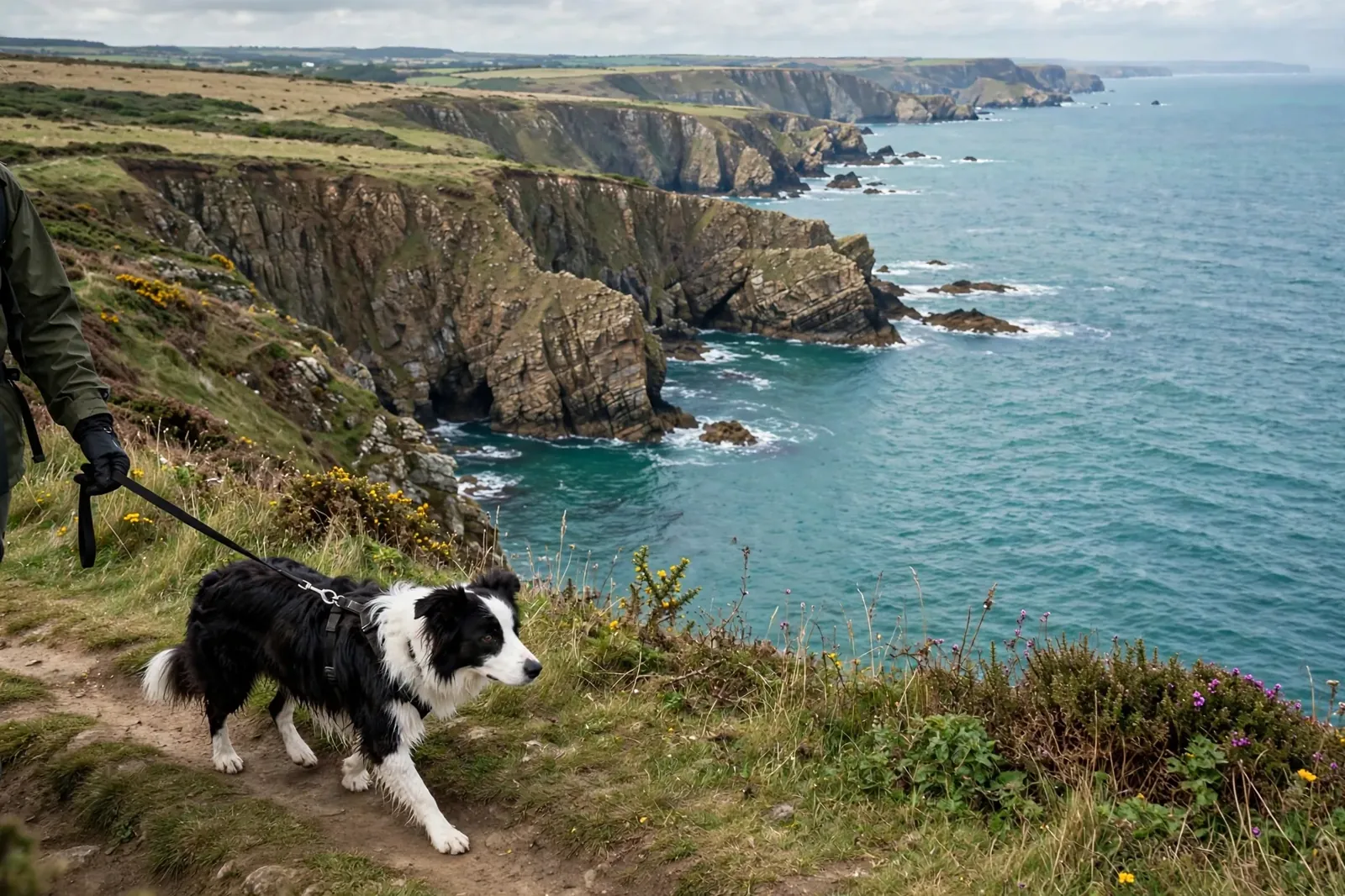
The defining hazard of this path is height. Much of the route follows unfenced cliff tops, sometimes on a narrow trod with a steep drop on one side and a fence, gorse or farmland on the other. There is no safe off-lead version of that. Keep your dog on a short, fixed lead on cliff sections — not an extending lead, which lets a dog surge to the edge before you can react — and position yourself between the dog and the drop where the path allows. Wind makes this more serious, not less: a gust that makes you stagger will move a small dog further, and a dog startled by a gull, a seal call from below or another walker rounding a bend can lunge in any direction.
Cliff erosion and diversions are a live feature of this coast. Sections are rerouted inland after rockfalls or storms, and fencing or warning signs should always be obeyed. Check the official latest guidance before you travel for current diversions, and turn back rather than improvising a route. If your dog slips, do not follow over an edge after them — call for help and keep the dog calm by voice if you can.
Livestock is the second constant. The path repeatedly crosses fields with sheep, cattle and occasionally ponies. Keep dogs on a short lead around all livestock, give cattle with calves a wide berth, and if cattle approach, let go of the lead so you can both get clear. Our guide to livestock worrying law explains the legal side, but the practical rule is simpler: a dog who chases — even without contact — can cause ewes to abort lambs. Close every gate as you found it and keep to the marked line.
Stiles and narrow bridges deserve a thought for larger, older or anxious dogs: a dog who cannot be lifted and will not jump may meet a stile that ends the day early. Scout your section in advance, carry a harness with a handle for assisted lifts where appropriate, and build turning-back time into every plan.
Lead rules and nesting birds
Pembrokeshire's cliffs and islands are internationally important for seabirds, and the mainland path passes close to nesting and roosting sites for much of the year. Choughs, peregrines, ravens, guillemots, razorbills and Manx shearwater colonies are part of what makes this coast special — and part of why lead discipline matters here beyond simple politeness. A dog ranging off the path through cliff-top grassland can flush nesting birds, trample burrows and scatter chicks, even in a few unsupervised minutes.
Seasonal rules vary by site. Reserves and National Trust land may require leads, prohibit dogs in specific zones, or close areas during the breeding season, roughly spring into mid-summer for many cliff birds, with grey seal pupping adding a sensitive season in autumn. A dog approaching hauled-out seals or pups can cause a mother to abandon a pup, so signs asking walkers to keep away from certain coves should be treated as instructions. Check the official latest guidance before you travel, and follow every sign on the ground.
The practical habit is easy: default to a short lead everywhere on this path, and treat off-lead time as something you earn in a specific safe place — a wide, enclosed field, a dog-friendly beach with clear sightlines and no livestock, or an empty inland track away from cliffs and nesting ground — rather than as the normal mode of walking. That default also protects your dog. Adders live in warm coastal grassland and dunes, ticks are common in bracken and rough pasture, and cliff-top rabbit holes have lured many a terrier into trouble. A dog close to you is a dog you can help quickly.
Other walkers are part of the lead equation too. Keep passes polite: step aside, shorten the lead, let faster walkers through, and do not let dogs meet nose-to-nose on a cliff-edge pinch point. If your dog is reactive, choose quieter northern sections and walk early in the day.
Water, shade and gaps between villages
Between the villages, this coast can be surprisingly empty of the things a dog needs. Long exposed sections have no taps, no shops, no shade and sometimes no reliable stream that is safe to drink from — livestock graze the same valleys, and coastal streams can be brackish near the sea. Cafes and pubs are seasonal, may close on certain weekdays outside summer, and cannot be treated as a water plan. Carry everything you and your dog need for the whole section, plus a margin for a diversion, a slower pace or a warmer day than forecast.
As a working rule, carry at least half a litre of water for a medium dog on a short, cool-weather section and a litre or more on longer or warmer days, alongside your own supply, and offer small drinks little and often rather than one large drink at the end. A collapsible bowl weighs almost nothing and makes dogs far more likely to drink than water dribbled from a bottle. Watch for the early signs of overheating — heavy panting that does not settle in shade, thick drool, wobbliness, glazed eyes or a refusal to continue — and stop, cool and seek help rather than pushing to the next village. Dogs in full coats, dark coats, older dogs and short-nosed breeds overheat fastest, and a sea breeze can disguise how warm an exposed cliff top actually is until you stop moving.
Shade planning is route planning. On an exposed section walked at midday in summer, there may be no meaningful shade for miles, so walk earlier or later and choose wooded valley sections on hot days. Paws need the same thought: hot sand, tarmac and sharp shingle can damage pads over distance. Check paws at every stop, rinse off salt and grit, and end the day if pads are pink, cracked or being licked persistently.
Food fits into the same gaps: keep normal meals on schedule, add only a modest extra ration on multi-day trips, and pack poo bags for the whole trip plus spares. Do not rely on phone signal either — download offline maps, and tell someone your plan and expected finish time each day.
Dog-friendly stops along the way
One of the pleasures of this coast is how many of its small places have adapted to muddy walkers and wet dogs — but “dog-friendly” varies from a bowl outside the door to a warm welcome inside, and it changes with season, ownership and how busy a place is. Plan stops as possibilities, not promises, and check the official latest guidance before you travel or a venue's own current listing before you detour for it. A closed cafe is an inconvenience; a closed cafe that was also your water plan is a problem, which is why the previous section comes first.
In the south, Tenby and Saundersfoot offer the widest choice: cafes with terraces, pubs with dog areas, ice-cream stops and shops selling forgotten leads and treats, plus vets and pet shops within easy reach — a real advantage early in a trip while you learn what your dog needs on this path. Manorbier, Freshwater East and Stackpole suit quieter stops, where a pub garden or a beach cafe break can break a cliff section into two humane halves. Around St Davids, Britain's smallest city packs cafes, galleries and outdoor seating into a compact centre that works well as a rest-day base, with Whitesands and the St Justinian's coast nearby for shorter leg-stretch days — noting the seasonal beach rules there too.
Further north, Broad Haven, Solva, Porthgain, Newport and Fishguard offer harbour pubs, gallery cafes and small shops where a settled dog under the table is unremarkable. Carry a travel towel and use it before you go inside: a quick rub-down, a shake outside, a short lead and a settle mat will get you welcomed back in most of Wales. If your dog struggles indoors, choose gardens and terraces instead.
Build one genuinely easy stop into each walking day: twenty to thirty minutes where the dog can sniff, drink, toilet and sleep in the shade while you eat. That pacing is also what makes multi-day walking, covered next, a pleasure rather than an endurance test.
Multi-day luggage and accommodation
Walking several days in a row with a dog adds a layer of logistics that a solo walk does not have, and it rewards booking in the right order: dog first, everything else second. Start by confirming that every overnight stay — hotel, inn, bed and breakfast, bunkhouse, campsite or self-catering base — accepts your specific dog, in that specific room or pitch, for the whole stay. “Dogs welcome” on a booking platform can still mean one small dog, ground-floor rooms only, no dogs in August, or a per-night charge that changes the maths. Get the dog, the fee and any rules about leaving the dog unattended confirmed in writing, and budget using our guide to dog holiday costs in the UK so transfer fees, pet charges and eating-out costs are counted before you commit.
Luggage transfer services operate along popular parts of this coast, moving a bag between overnight stops while you carry only the day's essentials. Confirm whether a firm covers your exact stops, will carry dog food and bedding, and what happens if you cut a section short. Keep one day's dog food, medication, a spare lead and a familiar blanket in your own pack — transferred bags occasionally arrive late. Campsite trips need a separate check on dog rules, tethering and keeping a dog warm and contained at night.
Transport needs the same dog-first check. Coastal buses link many sections, but timetables are seasonal and Sunday services can be sparse. Taxis vary even more: book ahead, say clearly that a dog is travelling, and carry a towel for the seat. Plan a bail-out option for every day and save the numbers offline. If you are comparing a mountain alternative, our Snowdonia with a dog guide covers similar planning for very different terrain.
Pace the days like a dog, not like a challenge event. Alternate longer and shorter days, insert a rest day every three or four days, and end each day while the dog is still willing. Check paws each evening, rinse salt and sand, and look for grass seeds between toes and ticks after farmland sections. Most multi-day dog walks fail on accumulated small tiredness, not on one dramatic incident.
Kit and daily checklist
Good kit for this path is mostly ordinary kit, chosen carefully and carried consistently. Start with the lead system: a well-fitted harness that does not rub over distance, a short fixed lead for cliffs and livestock, a spare lead in case one is lost or chewed, and an identity tag with a mobile number you will actually have with you — plus microchip details kept up to date, because a dog lost in an unfamiliar county is found through its chip and tag, not through hope. Add a lightweight long line only for safe, enclosed or wide-open dog-friendly spaces away from cliffs, never as a cliff-path lead.
Pack a collapsible bowl, food measured into daily portions, treats, waste bags in more than one pocket, a travel towel, a settle blanket that smells of home, and any medication with extra days in hand. Paw balm helps dry pads, and boots — practised at home first — suit some dogs new to stony paths. A basic first-aid kit with a bandage, tick remover and saline pods, plus your vet's number and a vet near your base, covers common small problems.
Your own kit should serve the dog as well: footwear you trust on wet limestone, layers, a headtorch, offline maps, a power bank, and cash for the cafe or bus that does not take cards. Check the forecast each morning for wind as carefully as rain — high wind should change a cliff-walking plan — and check tide times on any day involving a beach or cove. Check the official latest guidance before you travel and again during the trip.
Run the same checklist every day: water filled, food and bags packed, lead and harness checked, paws inspected, weather and tides checked, bail-out option known, phone charged. At day's end: paws washed, dog dried, fed and rested, ticks removed, tomorrow's section reviewed against how the dog actually is tonight. That rhythm is what turns a demanding trail into a holiday your dog would choose again.
Practical questions
Before you go
Can dogs walk the whole Pembrokeshire Coast Path?
Dogs are generally welcome on the Pembrokeshire Coast Path itself, but access to the beaches it connects changes by season and by beach. Some sections also cross farmland, nature reserves and military or cliff areas where leads are required or strongly advised. Plan each day around the beach rules and lead rules for that section, and check the official latest guidance before you travel.
When are dogs banned from beaches at Tenby and Saundersfoot?
Busy resort beaches in Pembrokeshire, including parts of Tenby and Saundersfoot, typically have seasonal dog restrictions in the main summer season, often from 1 May to 30 September, sometimes covering only part of the beach. Dates, boundaries and hours change, so check the official latest guidance before you travel and look for signs at each beach entrance on the day.
Does my dog have to be on a lead on the coast path?
Keep your dog on a short lead near cliff edges, livestock, ground-nesting birds and other walkers, and on any section where signs require it. Even where a lead is not legally required, a narrow cliff path is not safe for off-lead walking. A well-fitted harness, a short fixed lead and close control at gates and stiles will keep most sections straightforward.
How much water should I carry for my dog between villages?
Carry water for both of you on every section and do not rely on finding a tap, cafe or stream. As a working rule, carry at least half a litre for a medium dog on a short cool-weather section and a litre or more on longer or warmer days, offering small drinks often. If you are unsure, carry extra — the exposed sections between villages can have no shade and no reliable water at all.
Can I do a multi-day walk with luggage transfer and a dog?
Yes, if you book it as a dog trip first and a walking trip second. Confirm every overnight stay accepts your dog before you book luggage transfer, check whether transfer firms will carry dog food and bedding, and keep daily distances shorter than you would walk alone. Build in a rest day and a bail-out option by bus or taxi that will actually accept a dog.