This guide is independent and contains no paid placement. Venue dog policies, beach rules and cathedral visitor arrangements change, so check the latest official guidance before you travel.
Exeter works well with a dog if you build the day around water and green space rather than interiors. Start on the Historic Quayside, walk the River Exe and canal towpath, enjoy Cathedral Green from outside, add Northernhay and Rougemont Gardens on a lead, and keep Topsham or Exmouth as an easy extra. Do not plan on taking a pet dog inside the cathedral, shops or every cafe — check each venue first.
Start at the quay: swans, kayaks and a proper first walk
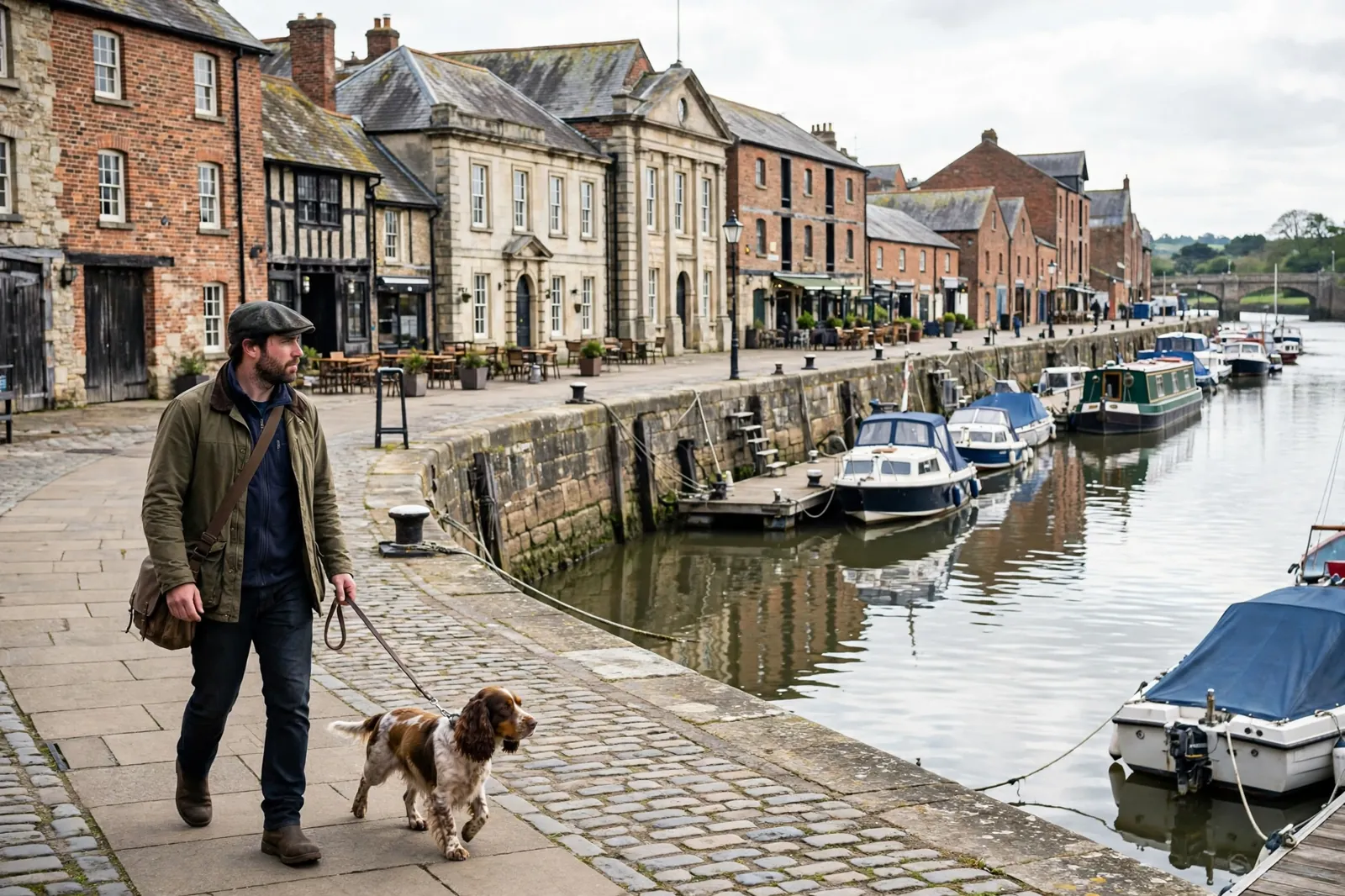
Begin down at the water, not in the shopping streets. On the Historic Quayside the River Exe is wide and unhurried, swans work the edges in hope of crumbs they should not be given, kayaks and paddleboards slide past under the bridges, and a spaniel on a lead has more to watch in ten minutes than in an hour of pavement. Old warehouses and arches give the place its character, the Custom House anchors the history, and the surfaced quayside gives you an easy, level start even if you have arrived with a tired older dog, a puppy still learning city manners, or a pushchair alongside the lead. That first impression matters because it sets the pattern for Exeter: this is a city best done outdoors, at walking pace, with the river as your compass.
Give this opening walk time instead of treating it as a photo stop. Let your dog settle to the new sounds — bicycle bells, rowing calls, gulls, cafe chairs scraping on stone — and keep the lead short where the path narrows beside moored boats and outdoor tables. There are bins, benches and plenty of natural pauses, which makes the quay ideal for a first toilet break and a water stop after a train or car journey. If your dog is reactive, come earlier in the day when the quayside is quieter and choose the wider sections; if your dog is sociable and confident, a late-morning stroll will suit you better. Either way, resist feeding the swans and keep dogs out of the water at the quay itself: banks can be steep, currents are deceptive, and the working river is not a swimming spot. Safer paddling decisions belong on beaches and shallow streams later in a Devon trip, with local signs followed.
From the quay you can read the rest of the city. Look uphill and you are heading towards the cathedral and the high street. Follow the river in either direction and you are on a walk. Turn south along the canal and you have the longest dog walk in Exeter without needing a car. That simple geography is why Exeter suits a short break: you do not need a complicated itinerary or a string of bookings. You need comfortable shoes, a lead you trust, poo bags, water for both of you, and a plan that accepts that some interiors will be people-only.
Cathedral Green, honestly: what dog owners can and cannot do
Exeter Cathedral is magnificent, and Cathedral Green in front of it is one of the most pleasant places in the city to sit with a dog. The honest part comes next. Do not build your day on taking a pet dog inside the cathedral. Access for pet dogs is restricted, services and events change what is possible, and assistance dogs are a different category from pets. If entering the cathedral matters to someone in your group, the workable pattern is to take turns: one person goes inside while the other enjoys the Green with the dog, then you swap. Check the cathedral's current visitor guidance before you travel — this guide deliberately does not promise indoor access, because that promise would be unreliable.
The Green itself is the dog-friendly prize. It is open, central and made for a pause: a short lead walk around the edges, a sit on the grass where it is permitted and not crowded, and time to take in the west front without rushing. Keep dogs close, do not let leads stretch across paths where people are queuing or children are running, and move away from picnics and buskers if your dog is likely to lunge or bark. On busy days, especially market days, graduations and summer weekends, the Green can feel crowded for a nervous dog; in that case walk through, enjoy the view, and find quieter grass in the gardens or along the river instead. There is no virtue in forcing a stressed dog to settle in the busiest square in the city just because it is famous.
Around the Green and the cathedral close you will find historic streets, small shops and places to eat, each with its own dog policy. Assume outdoor seating is more likely than indoor access, check signs rather than drifting in with a muddy dog, and be ready for a venue to say dogs are welcome in one room but not another. That patchwork is normal in British cathedral cities. Exeter is no worse than most and better than many because its best alternative — quay, river and gardens within a short walk — is genuinely enjoyable rather than a consolation prize. If you are combining Exeter with other Devon bases, our guide to dog-friendly holiday parks in Devon helps you compare rural stays where on-site dog facilities matter more than city access.
River Exe walks: the city on foot, at dog height
The River Exe gives Exeter a green spine. From the quayside, riverside paths run in both directions, linking bridges, meadows and valley parkland so you can choose a twenty-minute leg-stretch or a much longer walk without retracing the same pavement. Surfaces are generally surfaced or well used, but after rain expect puddles, muddy edges and, in the lowest sections after very high water, temporary closures or diversions. Check local notices on the day, and never climb past a closure barrier to reach a flooded path with a dog — floodwater hides dips, debris and strong currents.
North and west from the centre, the Exe Valley and routes towards Cowley Bridge and the university side feel greener and quieter, with more room for a long line where it is safe and permitted. South from the quay, the river and canal run close together towards Countess Wear and beyond, and the walking becomes flatter and more open, with reeds, waterbirds and long views. Neither direction needs a detailed turn-by-turn script in this guide; the value is in choosing distance honestly for your dog. A fit young dog might happily do the canal return described below. An older dog on a warm day will be better served by a shaded riverside hour, frequent water, and a cafe stop back at the quay. Puppies should have their distance limited by age and veterinary advice, not by how far the adults want to go.
Wildlife discipline matters on the Exe. Swans nest and defend aggressively in season, ducks and moorhens use the margins, and anglers cast from banks where a loose lead can become a tangle and a vet bill. Keep dogs on a short lead near birds, fishing spots, rowing activity and cyclists, and do not allow chasing. Shared-use paths work only if dog owners give space: step aside early, bring the dog to your side, and thank people who do the same. On narrow bridges and at lock gates, wait rather than squeeze past. These small courtesies are what keep urban river paths welcoming to dogs.
For a different kind of Devon walking later in the same holiday — open moor, tors and weather that changes by the hour — see our Dartmoor dog walks guide and plan it as a separate day with proper kit, rather than an afterthought to a city afternoon.
The canal towpath: Exeter's best long, level walk
If you only do one substantial walk in Exeter, make it the Exeter Ship Canal towpath heading south from the quayside. The canal is among the oldest of its kind in Britain, and the towpath beside it is largely level, straightforward to follow and forgiving for dogs that struggle with hills. You walk past locks, under bridges and alongside moored boats, with the river never far away on the other side of the floodplain. Because the route is linear, planning is simple: walk as far as suits your dog, note your turnaround point, and leave energy for the return unless you have arranged transport from further south.
Popular turnaround points include the area around Double Locks and, for stronger walkers, continuing towards Turf Lock and the Exe Estuary. Distances build up quickly on a return walk, so count both ways. Carry water — there is not a tap at every mile — and expect limited shade on bright days in the more open southern sections. In summer, do the canal early or late, rest often, and check paw temperature on hot surfacing. In winter, the towpath can be exposed and windy even when the city centre feels sheltered, so a dog coat for a thin-coated or older dog is sensible packing, not fussiness.
Towpath etiquette deserves emphasis because this is a shared working corridor. Cyclists can approach quietly and quickly, rowers and canoeists use crossings and stages, and other walkers may have dogs that need space. Keep your dog close at bridges and locks, never let a lead stretch across the whole path, and do not allow dogs to jump at passing bikes. If you use an extending lead on quieter stretches, shorten it the moment you see anyone approaching. Keep dogs out of the canal itself: lock chambers, steep banks and boat movements make casual swimming unsafe, and algae or water quality warnings should always be obeyed where they are posted. Fishing is common too, so watch for lines, hooks and bait on the ground.
The canal also teaches you the scale of an Exeter stay. You can spend a full, satisfying day on foot from the city centre to the estuary fringe and back, with no car, no ticket and no need to find a rural car park. That is rare in a city this size and it is the strongest reason to bring a dog to Exeter rather than simply passing through on the way to the coast.
Northernhay and Rougemont Gardens: formal green space in the centre
When you want grass without leaving the centre, head uphill to Northernhay Gardens and the adjoining Rougemont Gardens beside Exeter Castle and the museum quarter. These are formal, historic gardens — lawns, mature trees, memorials, flower displays and, in Rougemont, the remains and setting of the Norman castle. They offer a calmer, shadier contrast to the quay and they are especially useful in hot weather or as a short early-evening walk for dogs staying centrally.
Treat the gardens as on-lead territory. Keep to paths and open lawn areas where dogs are permitted, stay off planted beds, and be particularly careful around war memorials and any event setup. Rules and temporary closures can vary, so follow the signs on the gates on the day and check the latest council information before you travel if the gardens are central to your plan. If an event, maintenance work or a private hire has closed part of the gardens, do not squeeze around barriers; the river walks are a better fallback than an argument at a gate.
Used well, the gardens solve a practical city problem: the last walk of the day and the first walk of the morning. A central hotel dog does not need a major expedition at 7am or 10pm; a safe, familiar loop on a lead, with a bin nearby and good lighting on the main approaches, is enough. Walk the loop once in daylight when you arrive so the evening version feels routine. Note uneven ground, steps and slopes in Rougemont in particular — charming for people, worth checking for a dog with poor mobility or a walker using a stick or wheelchair. In wet weather the grass slopes can be slippery, and the flatter Northernhay sections are the kinder choice.
Combine the gardens with the nearby museum and library quarter for the humans in the group, again on a rota if dogs are not admitted. Exeter rewards this split-shift approach: nobody misses out entirely, the dog is never left tied outside or shut in a hot car, and the day stays relaxed. Never leave a dog unattended in a vehicle while you visit an attraction, in any season — that rule overrides every itinerary in this guide.
City centre with a dog: shopping streets, stations and common sense
Exeter's centre is compact and walkable, which helps dog owners, but compact also means busy. High Street, Princesshay and the surrounding shopping streets are best done with a clear purpose rather than as a long browse with a dog in tow. Most larger shops, food stores and indoor centres will not admit pet dogs, and crowded pavements are tiring for a dog that has to weave between legs, prams and shopping bags. Do the dog-free errands efficiently, then return to the quay, gardens or river where the city is on your side. If you are travelling as a pair, one person shopping while the other walks the dog is almost always happier than both trying to do both.
Transport is a strength. Exeter has several stations, with Exeter St Davids as the main hub and Exeter Central handy for the centre, plus local stops that make Topsham and the coast easy to reach. Dogs travel on trains under the operator's conditions — typically on a lead, not on seats, and with consideration for other passengers — but check the current conditions for your operator before you travel, especially if you have a large dog, more than one dog, or a journey at peak time. At stations, keep leads short on platforms and escalators, use lifts where they are provided and safer for paws, and give assistance dogs and their handlers clear space. Buses and taxis vary more, so check before you rely on them with a dog.
Parking and driving need the same pre-checking as anywhere in Devon. City car parks fill on event and match days, heights and payment systems differ, and a car park that works for a quick shop may be a poor base for a canal walk. If you are staying outside the centre and driving in, choose parking near the walk you actually want — quay-side for the river and canal, central for the gardens and cathedral — rather than crossing the whole city on foot before the walk begins. For dogs that travel poorly, a base in Exeter itself with everything on foot is often kinder than a cheaper rural base that means a car journey for every outing. Compare that trade-off honestly when you book.
Day trips in brief: Topsham and Exmouth without overplanning
Topsham, a few miles south on the Exe Estuary, is the easiest addition to an Exeter stay. It is a small, handsome town with an independent high street, estuary views and riverside walking that feels a world away from the city while remaining simple to reach by train, bus, bike or the riverside route itself. With a dog, the pleasures are straightforward: a lead walk along the quay and towards the nature reserve areas where dogs must be carefully controlled around birds, a browse of the outside of the shops, and a meal or drink where dogs are confirmed welcome. The estuary mud and tides demand respect — keep dogs off dangerous mudflats, follow local warnings, and do not let a dog chase wading birds, which are protected and easily disturbed, especially in winter when the estuary matters most to them.
Exmouth, at the mouth of the Exe, adds the sea. A long seafront, a marina area and a sandy beach make it the natural half-day trip for a dog that needs a proper run, but beach access for dogs varies by section and by season, with restrictions on the most popular central sections in the main season. Check current council guidance and the signs at the beach you actually use before letting a dog off the lead, and read our wider explainer on UK dog-friendly beach rules if seasonal bans are new to you. Even where dogs are allowed, keep them close at busy times, carry fresh water so they do not drink seawater, and watch for jellyfish, sharp shells and hot sand in summer. The estuary side and the less busy ends of the seafront often suit dogs better than the crowded middle.
Do not try to do Topsham, Exmouth, the canal and the cathedral in one frantic day. Exeter's appeal with a dog is its ease. Choose one extension, do it properly, and leave the other for a return visit or for a coastal base later in the trip. Dogs notice rushed days — new place, new smells, no rest — and a tired, overstimulated dog in a holiday rental at night is the price of an itinerary designed for a checklist rather than for the animal in front of you.
Staying and eating in Exeter: general rules that save disappointment
Exeter offers the usual range for a British city — larger hotels, independent guesthouses, serviced apartments and self-catering — and dog policies vary more than marketing suggests. Filter results by pets allowed, then confirm the detail directly: how many dogs, any size or breed condition, the per-dog or per-stay charge, whether dogs may be left alone in the room, and which areas they may enter for breakfast. A hotel that welcomes dogs in bedrooms but not in any eating area changes a rainy morning completely, so ask before you book, not at check-in. Ground-floor or lift-access rooms matter for older dogs; a charming third-floor room up a narrow staircase may be a poor bargain for a large dog at midnight.
Self-catering gives you more control over feeding, drying and settling a dog, but check the same practical points: is the garden or yard enclosed and how high is the boundary, is there a hard standing or hose for muddy paws, and are dogs allowed on furniture or must you bring covers? In a city property, also ask about noise and neighbours. Thin walls, a dog that barks at corridor sounds, and a late return from the pub below are a miserable combination that no listing photograph will warn you about. Be honest about your dog when you book; hosts who know in advance can often suggest a quieter room or a better check-in time.
For eating, think in categories rather than fixed recommendations, because policies change with management and season. The Quayside area is the natural first look for pubs and cafes with outdoor space and a walking route attached. In the centre and around the cathedral, expect a mix of terrace-only, bar-area-only and no-dogs-inside policies. Independent venues are often clearer about dogs than chains, but clear can still mean no. Check a venue's own website or social page on the day, call for larger dogs or groups, and arrive with a clean, dry, settled dog: towel muddy paws, keep the dog under the table and off the furniture, and leave promptly if your dog cannot settle. That behaviour, repeated by every dog owner, is what keeps Exeter venues welcoming the next dog that comes through the door.
Build a wet-weather eating plan before you need it. On a dry day almost any terrace works; on a wet Tuesday in November you need to know which places take dogs inside, which have covered outdoor areas, and which takeaway options work with a dog waiting legally and safely with a person outside. One person inside ordering while the other stays with the dog is a normal, workable pattern — tying a dog up alone outside a shop or cafe is not, however common it used to be.
A one-day Exeter plan with a dog, hour by hour in spirit
Start early with a short garden or neighbourhood loop for the dog staying centrally, then breakfast under whatever arrangement your accommodation actually allows for dogs — in the room, in a dog-friendly area, or as a takeaway back to the Green. By mid-morning, be down at the quay. Walk the quayside slowly, let the dog take in the swans, boats and kayaks from a sensible distance, and decide the day's main walk based on weather and energy: canal towpath south if you want distance and level ground, a shorter Exe Valley loop if you want shade and a slower pace.
Late morning into lunchtime suits Cathedral Green and the gardens. Take the cathedral from outside with the dog, rotate inside visits if your group wants them, then move to Northernhay and Rougemont for shade and grass. Eat where you have confirmed dogs are welcome, ideally attached to a walk so the dog arrives settled and leaves ready for a rest. Do not schedule a big lunch and a big walk back-to-back for a young dog; build in a genuine rest back at your base in the early afternoon, with water, a chew or familiar bedding, and no new stimulation for an hour.
For the afternoon, choose one thing only. Option one is Topsham by train for estuary air and a small-town change of scene. Option two is more canal, in the cooler part of the day, finishing back at the quay for an evening drink outside. Option three, in hot or very wet weather, is deliberately small: a second river loop, an early supper, and an evening garden walk. All three are successful Exeter days. The failed version is the one that tries to include shopping, the cathedral interior for everyone at once, a long canal return, Exmouth beach and a late restaurant booking — and ends with an exhausted dog and owners who feel they saw everything except the city they came for.
If you have a second day, reverse the pattern: coast first while you are fresh, city second at leisure. Exeter works as a base precisely because the second day does not need invention. The river will still be there, the towpath will still be level, and your dog will walk the morning loop with the confidence of an animal that already knows where the bins, benches and best sniffing posts are.
Practical checks: vets, weather, water and seasonal sense
Before you travel, save the details of a veterinary practice in Exeter and an out-of-hours provider, and keep your own vet's number and your dog's insurance details on your phone. City breaks feel low-risk, but hooks from fishing lines, cut paws on broken glass near busy areas, scavenged food and heat stress are city risks as much as country ones. Carry a small first-aid kit, a spare lead, and any medication your dog needs, with a margin for a delayed return. If your dog has a medical condition or is recovering from treatment, check with your vet whether a city break with long hard-surface walks is appropriate at all.
Weather shapes Exeter more than the map suggests. The Exe can rise after rain inland, towpaths and valley paths can flood or close, and summer heat reflects off quayside stone and city pavements. Check the forecast for Exeter and for the Dartmoor catchment if heavy rain is expected, follow flood and path closure notices, and test pavement heat with the back of your hand before a midday walk in summer. In a heatwave, walk at dawn and dusk, carry water even for short loops, and cancel the canal return rather than shortening it by pushing a hot dog faster. No photograph is worth a veterinary emergency.
Finally, pack for a city dog, not just a country dog. You need a short, strong lead for pavements, stations and gardens, plenty of poo bags — city bins fill quickly on event days, so carry waste to the next bin rather than leaving it — a towel and paw wipes for cafe thresholds, a familiar blanket for settling, and a high-visibility element if you will walk riverside paths at dusk in winter. Update your dog's microchip details and ensure the tag on the collar carries a number you will actually answer on holiday. Those unglamorous preparations are what turn a promising city into a genuinely dog-friendly Exeter break, and they cost far less than fixing the day that goes wrong without them. Before you travel, check the latest official guidance for any venue, beach or path where the rules matter — that final check is part of the trip, not an optional extra.
Practical questions
Before you go
Can dogs go inside Exeter Cathedral?
Do not assume so. Cathedral access for pet dogs is restricted and can change for services and events, while assistance dogs are treated differently. Cathedral Green outside is the reliable dog-friendly part of a visit. Check the cathedral's current visitor guidance before you travel if going inside matters to your plan, and arrange for someone in your group to stay outside with your dog.
Where is the best long walk with a dog in Exeter?
For distance without driving, follow the River Exe and the Exeter Ship Canal towpath south from the Historic Quayside. The surfaced, largely level route suits a steady on-lead walk and can be shortened at several bridges and access points. Watch for cyclists, rowers, swans and other dogs, keep leads short near the water, and check for flood or path closures after heavy rain.
Are dogs allowed in Northernhay and Rougemont Gardens?
Dogs on leads are generally the sensible expectation in Exeter's central formal gardens, and rules can differ between areas and events. Keep your dog on a short lead, stay off flower beds and memorial areas, and follow any signs on the gate on the day. If a garden is hosting an event or a section is closed, use the Quayside or Valley Parks for a longer, less restricted walk instead.
Can I take my dog to Exmouth or Topsham from Exeter?
Yes, both work well as short extensions to an Exeter stay. Topsham is a small estuary town a few miles south with riverside walking, while Exmouth adds a beach and a longer seafront. Beach rules at Exmouth vary by section and season, so check current signs and council guidance before letting a dog off the lead. Trains and buses have their own pet conditions, so check them before you travel.
Where can I eat in Exeter with my dog?
Look first around the Historic Quayside and in independent cafes and pubs that state their dog policy clearly, and expect terrace or bar-area only access in many places. Policies change, so check a venue's own website or call ahead for indoor access, water bowls and busy-time rules. Never assume a dog can go into a food shop or a formal restaurant, and keep leads tucked under the table so staff can move safely.