This guide is independent and contains no paid placement. Rules, firing programmes and access arrangements change, so check the latest official guidance before you travel.
Dartmoor dog walks reward preparation. Keep your dog on a short lead near livestock and during the 1 March to 31 July breeding season, give ponies wide space, check military firing times before entering the northern ranges, and treat rivers and bogs with respect after rain. Choose a tor route that matches your dog, carry navigation you can use in mist, and turn back early if the weather closes in.
Why Dartmoor is different
Dartmoor is not a country park with a fence around it. It is a working, grazed national park in Devon where sheep, cattle and semi-wild ponies roam freely across open moorland, where the army trains with live firing on northern ranges, and where weather can turn from sunshine to hill fog in under an hour. That openness is exactly what makes Dartmoor dog walks so rewarding — big skies, granite tors, wooded river valleys and miles of walking without a stile-heavy patchwork of enclosed fields — but it also means the usual lowland habits are not enough. A dog that is reliable in a local park may behave very differently when a pony foal trots across the path or a flock scatters over a slope. If you prefer gardens and historic houses to open moorland, National Trust dog rules are decided place by place — check the pawprint rating first.
Plan Dartmoor as upland walking, not as a longer version of a Sunday stroll. Distances deceive: a route that looks short on a map crosses rough, tussocky ground, boggy valley bottoms and exposed ridges where there is no shelter and no phone signal in many places. Paws take punishment too. Granite is abrasive, tracks can be stony for miles, and wet moorland softens pads before cutting them on sharp stone. Build distance gradually, check paws at every stop, and carry water for your dog even on cool days, because clean drinking water is not guaranteed on the high moor and dogs should not be encouraged to drink from stagnant pools.
The reward for that preparation is considerable. Lower, sheltered routes around reservoirs, leats and river valleys suit older dogs and puppies building fitness, while confident hill dogs can enjoy longer tor-to-tor days on clear, well-chosen routes. The sections below work through each hazard in the order you are most likely to meet it, so you can match the route to the dog rather than discovering a problem halfway across open ground with no easy way back.
Lead rules and access land
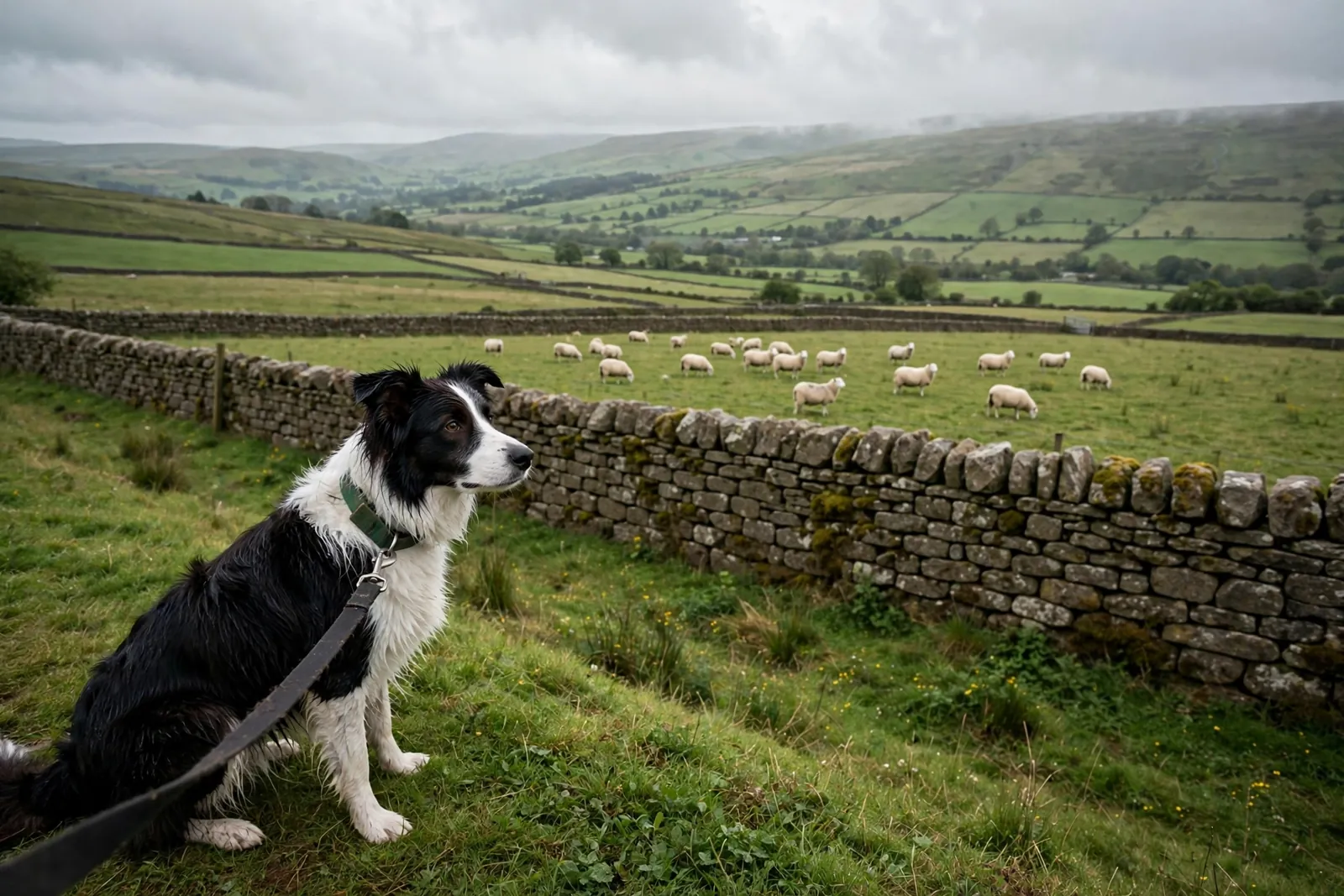
Much of Dartmoor is access land, which comes with conditions for dog walkers. The headline rule is seasonal: between 1 March and 31 July, dogs must be kept on a short lead on most open access land. That period covers lambing and the ground-nesting bird season, when skylarks, meadow pipits and other moorland birds nest invisibly in grass and heather and a single ranging dog can cause repeated, damaging disturbance without ever catching anything. Outside those dates, dogs must still be under close control at all times, which in practice means your dog stays close, returns immediately when called, and does not approach livestock, ponies, other walkers or wildlife. If your dog cannot do that reliably around sheep and cattle, a lead or a long line is not a failure — it is the correct tool for this landscape.
Local restrictions can go further. Look for signs at car parks, gates and range boundaries, obey any temporary closures, and accept that some enclosed land and reservoir areas have their own rules. Where a public right of way crosses enclosed farmland, keep to the path and keep the dog on a lead around stock even outside the spring season. The legal background matters here: worrying livestock is an offence and the consequences for the dog can be severe, so read our guide to the livestock worrying law in the UK before your first moorland trip if you are unsure where the line sits. Worrying includes chasing and attacking, not just biting, and a ewe that aborts a lamb after being chased has still been harmed.
Choose your lead for the moor, not the pavement. A short, fixed lead of around two metres gives control near stock without the tangling and sudden jolts of an extending lead, which has no place around ponies or on narrow tor paths. A well-fitted harness spreads pressure if a dog lunges unexpectedly, and a spare lead in the pack is cheap insurance against a broken clip miles from the car. Practise close, boring lead walking at home and in fields with distant stock first, rewarding calm looking-away behaviour, so the first close encounter on the moor is not also the first rehearsal.
Ponies, cattle and sheep: sharing the moor
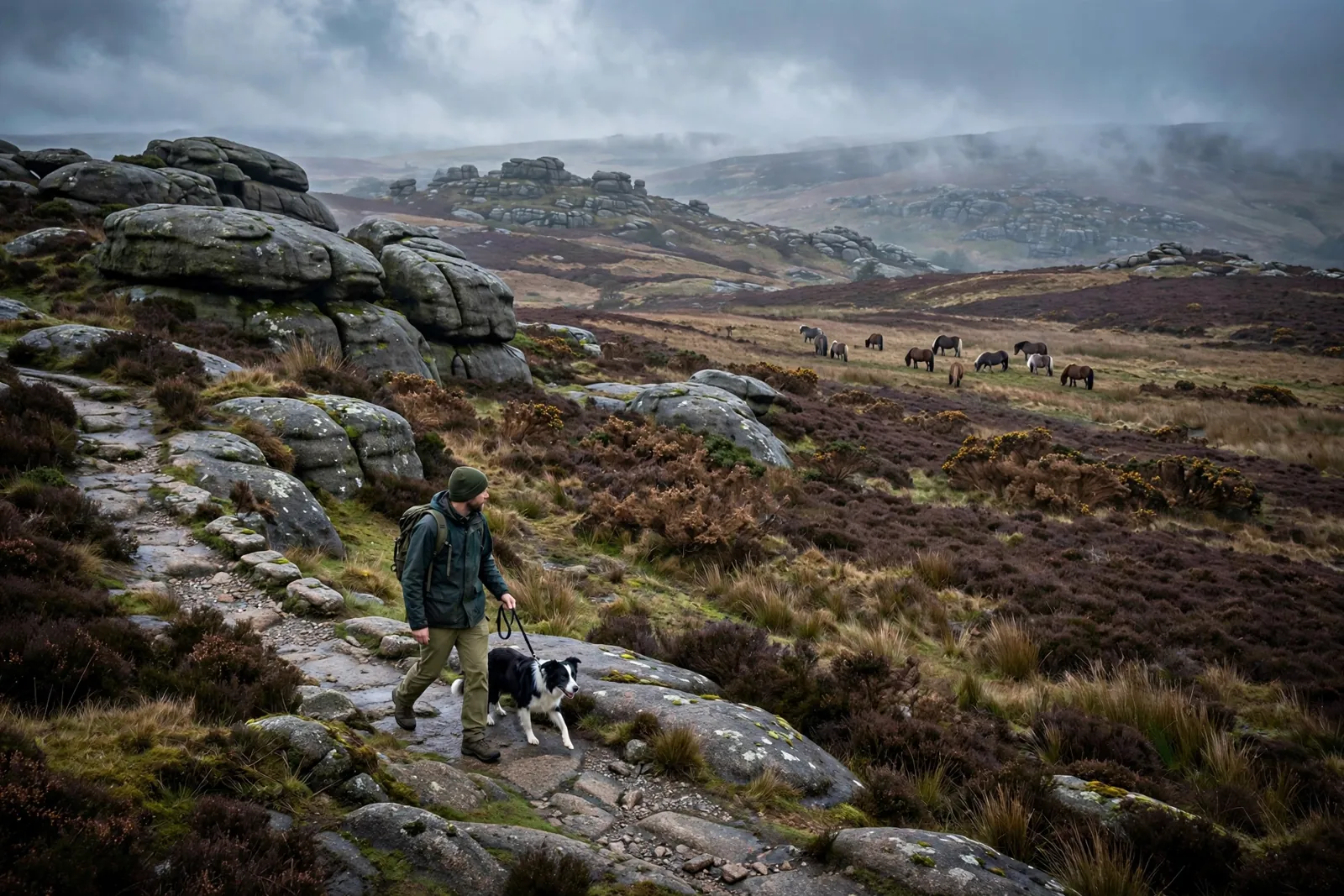
Livestock is the single biggest day-to-day consideration on Dartmoor dog walks. Dartmoor ponies look placid and photogenic, and that is the trap. They are semi-wild animals, not riding-school ponies. Mares defend foals, stallions can be unpredictable, and any pony can kick with very little warning if a dog darts behind it. Never feed ponies — it encourages them to crowd people and cars, is harmful to their health, and teaches them to approach dogs — and never let your dog bark at, chase or get between a mare and her foal. Give groups a wide arc, keep the dog on the far side of you from the ponies, and keep moving calmly rather than stopping for close photographs. If ponies block a narrow track, wait or detour around at a distance; the moor is wide and there is almost always another line.
Cattle need a different judgement. Free-roaming cows with calves graze parts of the moor and commons, and cattle that feel a dog threatens their calves may approach the handler because the dog stays close to the handler. Walk wide around herds, watch body language, and never get boxed between cattle and a fence, wall or bog. If cattle do become threatening and move towards you, the standard safety advice is to let go of the lead: the dog can usually run to safety, the cattle typically lose interest once the dog is away, and you can exit separately and reunite at a gate. Holding on to a lead in that moment puts you between the cattle and the thing they are reacting to. Afterwards, check the latest official guidance before you travel for any local advice on grazing areas, because herd locations change through the season.
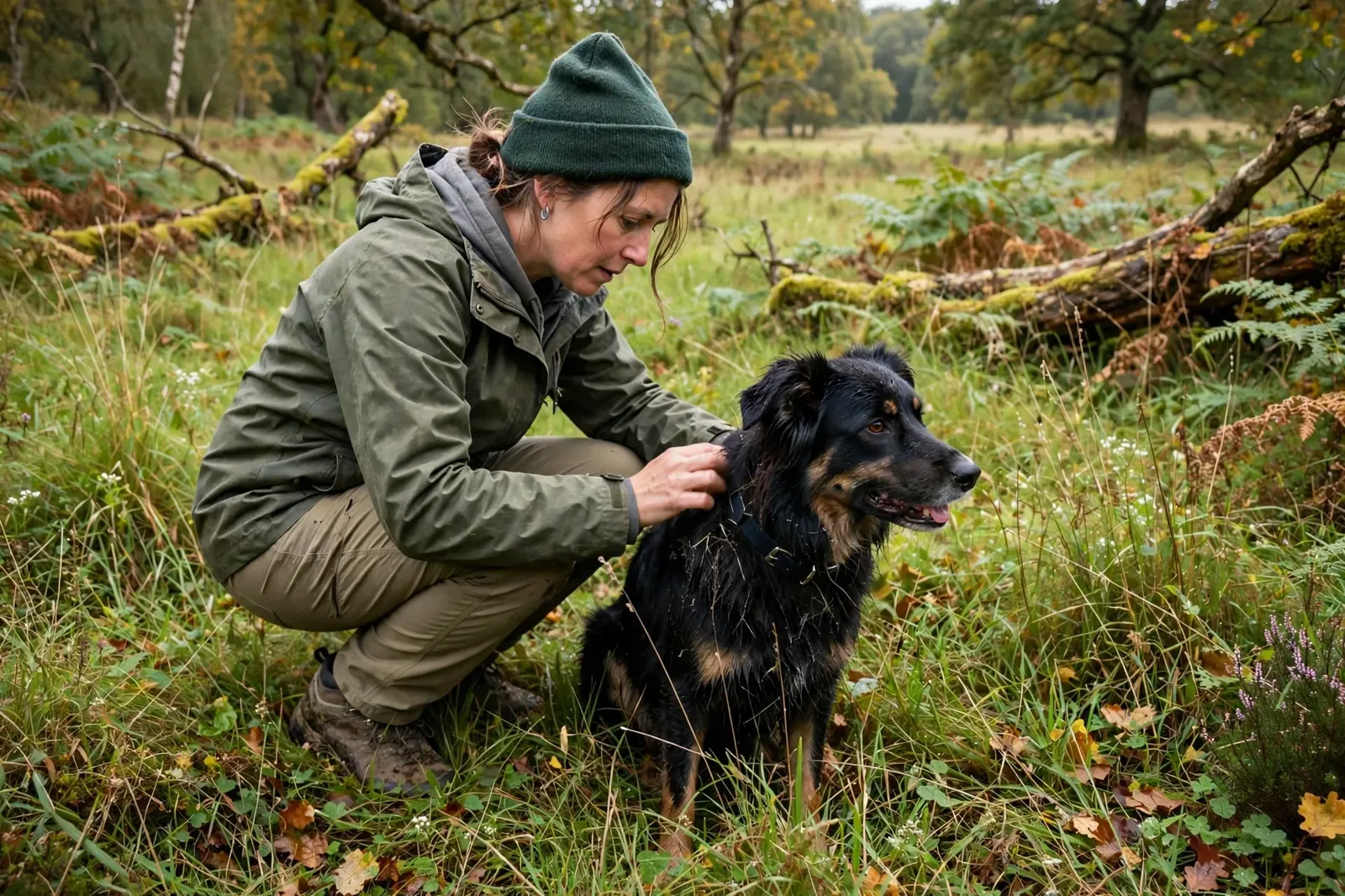
Sheep are everywhere, including places that look empty at first glance. Scan slopes and hollows before unclipping a long line anywhere, keep dogs out of bracken and long grass where lambs may be hidden in spring, and treat every ewe-and-lamb pair as a reason to add distance, not a photo opportunity. Clear up after your dog near paths, car parks and watercourses, and take waste home where there is no bin — bagging and leaving is worse than useless on open moor. Finally, after any moorland walk, check your dog's coat, ears and paws thoroughly. Ticks are common in bracken and rough grazing country, so read our guide to ticks on dogs in the UK for removal technique and the symptoms that need a vet.
Military ranges and firing times: check before you go
The northern moor includes military training ranges around Okehampton, Willsworthy and Merrivale where live firing takes place. Public access to these ranges is possible when firing is not happening, and the walking there includes some of Dartmoor's highest and wildest ground — but this is the one part of a Dartmoor dog walk where a planning mistake has consequences beyond a spoiled day. Firing programmes are published in advance and can change, so check them for your exact dates before you set out, not the night you arrive in Devon, and check the latest official guidance before you travel on the morning of the walk as well.
On the ground, the signals are simple and absolute. Red flags by day and red lights by night at range boundaries mean live firing is taking place or is about to: do not enter, even if everything sounds quiet, even if other walkers appear to be inside, and even if your planned tor is just beyond the boundary stone. Build your route so a closed range is an inconvenience rather than a trap: know your turning-back point, carry a map that shows range boundaries clearly, and have a lower, southern alternative ready for days when firing closes the north. If you find military debris or anything that looks like unexploded ordnance, do not touch it, keep your dog away, note the location and report it as official guidance directs. Keep dogs on leads near range roads and any military activity, and expect sudden noise on training days outside the ranges too — a noise-sensitive dog may be happier on the southern moor, around places where firing is never part of the picture.
Firing times also affect route timing in a quieter way. Walkers sometimes rush a northern route to clear a range before a closure, and rushing on rough ground in deteriorating weather is how ankles — human and canine — get hurt. Give any range walk a generous time margin, start early, and treat the published programme as the frame for the whole day rather than a deadline to beat. If the timings do not fit comfortably with daylight, your dog's fitness and a slow, careful descent, choose a different route that day. Dartmoor's tors are not going anywhere.
Tors, weather and navigation
Tors — the granite outcrops that crown Dartmoor's hills — are natural objectives for a walk, but they ask questions of a dog. Approaches are often steep, boulder-strewn and slippery when wet, and the clitter slopes of loose rock around many tors are hard on paws and joints. Choose tors with grassier, pathed approaches for younger, older or smaller dogs, help dogs over stiles and walls rather than letting them leap from height onto stone, and never encourage scrambling on the rock stacks themselves: a fall between boulders can trap or badly injure a dog far from road access. Senior dogs in particular may manage the distance yet struggle with repeated rock steps, so judge a route by its roughest hundred metres, not its average gradient.
Weather is the other constant. Dartmoor's high ground catches mist, wind and rain that lower country a few miles away escapes, and hill fog removes the landmarks most walkers unconsciously rely on. Carry a map and compass — and know how to use them — rather than depending on a phone with patchy signal and a battery that cold weather drains. Check a mountain-appropriate forecast before setting out, tell someone your route and expected return, and set a clear turn-back time. Dogs feel exposure too: a wet, short-coated dog standing still in wind on a tor loses heat quickly, so carry a dog coat or drying layer for stops, keep breaks short in bad weather, and watch for shivering, lagging or repeated paw-lifting as early signs to head down.
Summer brings the opposite problem. There is little shade on the open moor, granite reflects heat, and dogs overheat on climbs that feel moderate to their owners. Walk early or late, carry more water than you think you need, rest in valley shade, and cancel the high route on hot days altogether in favour of a shaded river valley at low level. If your Dartmoor trip is part of a longer Devon stay, our guide to dog-friendly holiday parks in the UK explains how to choose a base with practical walks from the door — useful on days when the high moor is the wrong plan.
Rivers, bogs and water safety
Dartmoor's rivers — the Dart, Teign, Tavy, Erme and their tributaries — are a joy for water-loving dogs in the right conditions and a genuine hazard in the wrong ones. These are spate rivers: after heavy rain on the moor they rise fast, run brown and strong, and turn a paddling spot into water that can sweep a dog downstream towards boulders, fallen trees and weirs. The rule is simple. Only let a dog enter water you have assessed first: a calm, shallow entry with an easy exit on the same bank, no strong current, and no recent heavy rain. Keep the lead or a long line on near fast water so the decision stays yours, and never throw balls or sticks into a river in spate, because a retrieving dog will follow without hesitation.
Call a dog out immediately if the water looks faster or deeper than expected, and dry ears and coat afterwards, especially for breeds prone to ear infections. Be cautious with stagnant pools and slow, warm backwaters in summer, where water quality can be poor, and prevent drinking from suspicious water where you can. After any river walk, rinse mud from paws and check between toes for cuts from sharp stones and for the small leeches occasionally found in moorland water — unpleasant rather than dangerous, but worth removing carefully and monitoring.
Bogs are Dartmoor's quieter water hazard. Valley mires and areas of deep peat can look like firm grass, particularly to a dog ranging ahead, and a panicked dog struggles deeper rather than climbing out. Keep dogs close on valley bottoms, follow visible paths and firmer ground along contours, and test suspicious ground yourself before committing. If a dog does get bogged, keep calm, spread your own weight, work from firm ground and avoid pulling sharply on a collar; prevention, as ever, is far easier. Cotton grass, sphagnum and quaking green patches are visual clues worth teaching yourself to read — where they thrive, the ground underneath is rarely a dog's friend.
Planning a safe route, step by step
A good Dartmoor dog walk is built the night before, not improvised at the car park. Work through the same sequence each time. First, choose the area and check the military firing programme if your route touches the northern ranges. Second, check the forecast for the high moor specifically, not just the nearest town, and pick a route length your dog has already managed on comparable rough ground — then shorten it slightly. Third, study the map for livestock clues (commons, enclosed grazing), river crossings that may be impassable after rain, and escape routes that drop you to a road or valley track if weather or a lame paw cuts the day short. Fourth, plan water, for you and the dog, and a turnaround time you will actually obey.
Pack for the moor you might get, not the one in the photograph. The dog kit that earns its place is short: a sturdy lead plus a spare, a harness, water and a collapsible bowl, poo bags and a bag to carry waste out, a tick remover, a small pet first-aid kit with bandage and paw protection, a drying towel or coat, and high-value treats for recalls when ponies appear at the worst moment. For you: map, compass, whistle, torch, waterproofs, warm layer and a phone kept charged and dry. Save the nearest vet's number before you travel — rural practices keep limited hours — and make sure your dog's microchip details and ID tag carry a number you will answer on the day, because a dog lost on open moor can travel a long way before being found.
On the walk itself, keep a steady rhythm of small checks: scan ahead for stock before every rise and corner, clip the lead on early rather than late, check paws and water at every stop, and reassess the weather at each tor rather than only at the start. Finish with the unglamorous essentials that protect the next walk: a full tick check, a paw inspection, fresh water, and food only once your dog has cooled and settled. Done this way, Dartmoor gives dogs what few landscapes can — space, scent, water and wildness — while the risks that make headlines stay managed, predictable and, on most days, entirely avoidable. If you are building a Devon base around several days of moor walking, the Devon holiday parks guide linked from our related reads below covers bases on the moor's edge.
Keep exploring
Heading further north in Devon next? Exmoor pairs moorland walking with ponies, red deer and coast path sections. See: Exmoor with a dog.
Practical questions
Before you go
Do dogs have to be on a lead on Dartmoor?
Dogs must be on a short lead on most open moorland during the livestock breeding and lambing season, from 1 March to 31 July, and under close control at all other times. Always use a lead near livestock, ponies, roads and ground-nesting birds, and check the latest official guidance before you travel, as local restrictions can change.
Can my dog approach Dartmoor ponies?
No. Keep your dog on a lead and give ponies a wide berth. Dartmoor ponies are semi-wild, may kick or bite if startled, and mares will defend foals. Never feed ponies, never let a dog chase or bark at them, and do not position yourself between a mare and her foal.
How do I check military firing times on Dartmoor?
Check the published firing programmes for the Okehampton, Willsworthy and Merrivale ranges before you set out, and look for red flags or red lights at range boundaries on the day. If flags are flying or lights are shown, do not enter, even if you cannot hear firing. Check the latest official guidance before you travel, as programmes can change at short notice.
Is it safe for my dog to swim in Dartmoor rivers?
Only in calm, shallow water you have checked first, and never after heavy rain when rivers rise quickly and currents strengthen. Keep dogs out of spate conditions, steep-banked stretches and water near weirs, and use a lead or long line near fast water so you can prevent a dog entering in the first place.
What should I do if cattle approach me and my dog?
Stay calm, keep moving steadily towards an exit and give the cattle space. If cattle become threatening, let go of the lead so your dog can move away freely and you can reach safety separately — most dogs outrun cattle, while a held lead puts you both at risk. Leave by the nearest gate or boundary and rejoin your dog once it is safe.