This guide is independent and contains no paid placement. Seasonal opening hours, events and services change, so check the official latest guidance before you travel.
Check your own council's half-term dates first, because they vary across the UK. Then build each day around roughly eight hours of usable daylight: one main outdoor expedition late morning, indoor anchors for the dark afternoons, and a stay with a proper drying space, hard floors near the door and a garden the dog can use after dark.
February first: plan for the weather you will actually get
Let us begin with the honest forecast. A February half term in Britain will be cold, it will get dark before the evening meal, and at some point in the week it will rain sideways on a path that was already mud. Any plan that treats those facts as bad luck will spend the week being disappointed. Any plan that treats them as the brief — waterproofs that actually fit, a main walk timed for the best of the short day, fires and board games doing the work that sunshine does in August — tends to remember the week fondly. February is not a defective summer holiday. It is a different product, and dogs, who have no opinion about seasons and strong opinions about walks and company, are often its happiest customers.
The cold itself is rarely the problem for a healthy adult dog on the move; most dogs cope well with a British February while they are active, and many positively prefer it to a hot July. The dogs who need extra thought are the very young, the elderly, the thin-coated and small breeds who lose heat quickly, and any dog standing still — waiting outside a shop, sitting through a long outdoor lunch, riding in an unheated car boot between stops. Movement is warmth. Build the day so the dog is either moving, inside somewhere heated, or wrapped in a coat and resting on something dry, and February stops being a welfare question and becomes a laundry question.
Daylight is the true constraint, and it deserves numbers. In mid-February, most of Britain gets somewhere around nine and a half to ten hours between sunrise and sunset, and the usable, pleasant part for a family walk is shorter still once breakfast, boots and driving are accounted for. That single fact should shape everything: accommodation within a short drive of the main walks, a daily rhythm that puts the big outing at eleven rather than three, and no itinerary that requires a second expedition after four. Families who fight the daylight spend the week walking in dusk and apologising; families who surrender to it discover that dark afternoons in a warm cottage are what February holidays are secretly for.
Half-term dates are not the same everywhere — check yours
Before prices, before bookings, before the dog has been promised anything, check the dates. February half term is not a single national week. School term dates are set locally — by councils in England and Wales, with variations between neighbouring authorities, and Scotland works to a different pattern again, where the February break may be a long weekend and a couple of in-service days rather than a full week in many areas. Independent schools add their own variations, and academies may set dates that differ from the council schools on the same street. Two families in adjoining counties can be on holiday a week apart, which matters for prices and crowds as much as for planning.
The practical consequence is cheerful for the flexible: if your half term falls in the less common of the two main weeks, you will find more availability and gentler prices than the peak-week crowd, and attractions and cottages may not even apply their highest rates. The practical warning is the mirror image: never book from a date you saw on a generic list or a friend's school in another county. Go to your own school's or council's published term dates, confirm them, and only then search. The same discipline applies to the other half terms, and our broader guide to half term holidays with a dog compares all three breaks and their very different weather, prices and planning horizons.
This variation also affects travelling groups. If cousins or grandparents are joining from a different area, align on dates before anyone books leave, because a mismatch discovered in January is a disappointment, while one discovered over Christmas is simply a planning problem. And if you are booking a cottage with a flexible owner, mention your dates early — February is a month when owners with gaps between the two half-term weeks sometimes agree shorter or shifted stays they would never offer in summer, particularly to guests with a dog who will plainly use the place gently and leave it clean.
Working with short daylight instead of against it
Design each February day as a sandwich. The filling is one substantial outdoor expedition, launched once everyone is fed and booted, timed to catch the middle of the day when what light there is does its best work. The bread on either side is indoor life: a slow morning with breakfast and a garden break for the dog, and a long afternoon and evening under a roof. Families who attempt two fillings — a morning walk and an afternoon attraction across the county — end up doing the second in the dark, in the rain, with a tired dog and children running on crisps. One expedition, done properly, plus home comforts, beats two expeditions done resentfully every February day of the week.
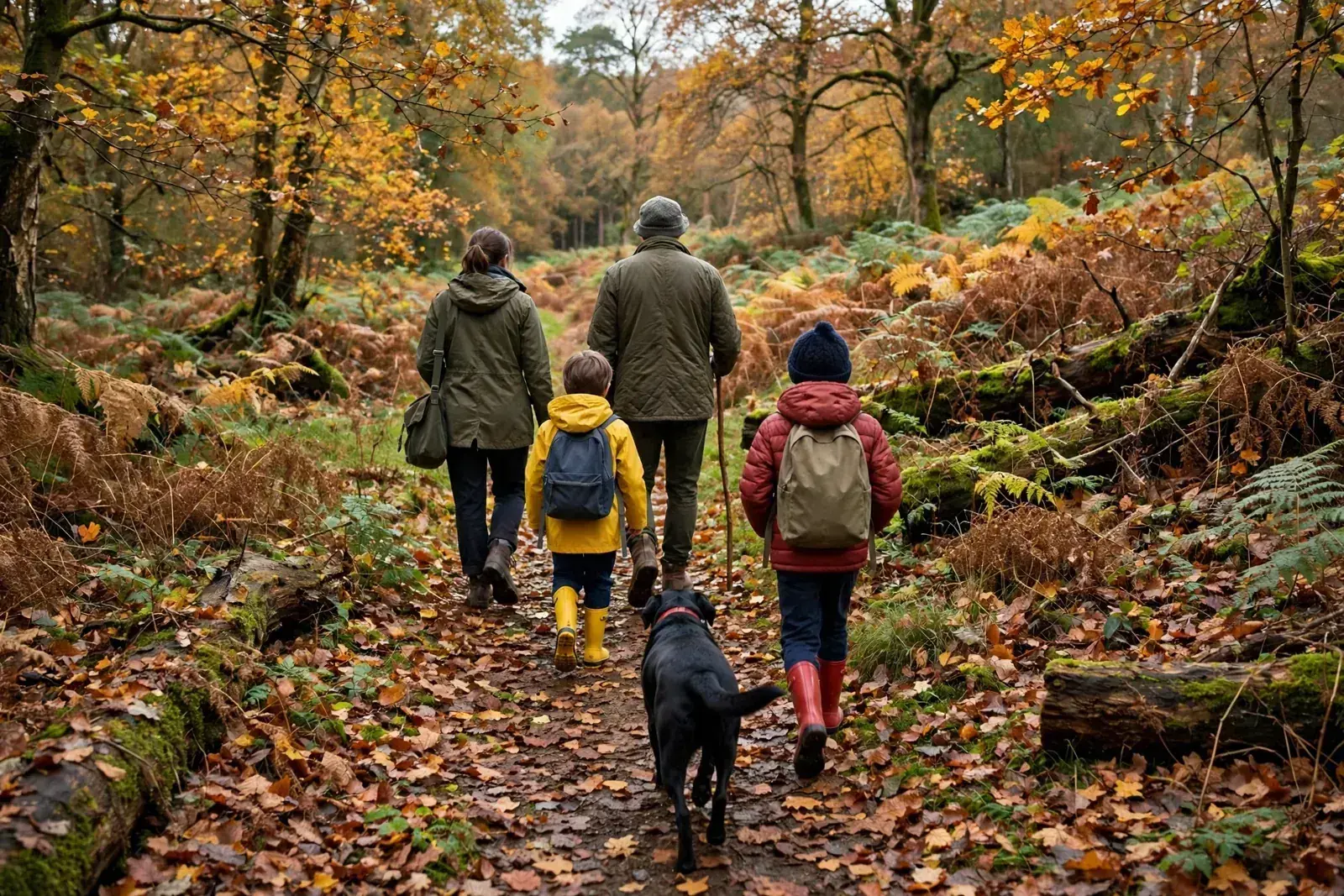
Choose the expedition for winter qualities, not summer reputation. Beaches are February's great secret: dog restrictions that apply in season are commonly lifted on many beaches in winter, the sand is firm, the crowds are absent and a dog can run in a way that August never permits — although local rules vary all year, so check the specific beach's current guidance before you travel. Forest trails hold up better than open hillside paths in wet weeks, wind is less punishing under trees, and forestry car parks usually come with the day's most reliable hot drink. Waterfalls, rivers in spate and dramatic coast paths all genuinely improve in winter, provided the route is safe in high water and the dog stays on a lead anywhere near drops, cliffs or fast rivers.
Build the return into the plan rather than bolting it on. The hour after the walk — wet dog, wet children, wet car — is where February holidays are won or lost, and it is won by a stay with the right entrance, covered below, and a routine rehearsed on day one: dog towelled and settled first, boots off at the door, kettle on, nobody sitting down in damp clothes to discover the misery later. Then the dark afternoon becomes the point of the day rather than its remains: a film, a puzzle, homework finished without warfare, the dog asleep in the warmest spot it can find, and an early night that resets everyone for the next short, bright middle of a day.
Choosing a stay that works when it is dark by five
In summer, accommodation is a base you sleep in. In February, accommodation is half the holiday, and it should be chosen like it. Start with heat and drying, the two questions summer guests never ask. Is there a porch, utility or boot room where a large wet dog can be towelled and left to drip without ruining anything? Are there hard floors between the door and that space, or a pale carpet gauntlet to cross? Is the heating genuinely controllable — a wood burner is a joy and also, for a dog, something to be guarded and supervised — and is there somewhere a wet dog coat, towels and boots can dry overnight so the next day does not begin in damp gear?
Then the garden, which in February is not a scenic extra but the dog's after-dark toilet facility. It needs to be enclosed to a standard you would trust at ten at night in the rain, close to the door, and ideally lit or at least reachable with a torch without crossing the property. Ask directly about fence height and gates, because a garden described warmly in August photographs may be a different proposition in February mud. Inside, look for a downstairs space where the dog can be with the family in the evening — the whole point of the week — and sleeping arrangements that do not require the dog to be shut away from its people all night unless that is its normal, contented routine at home.
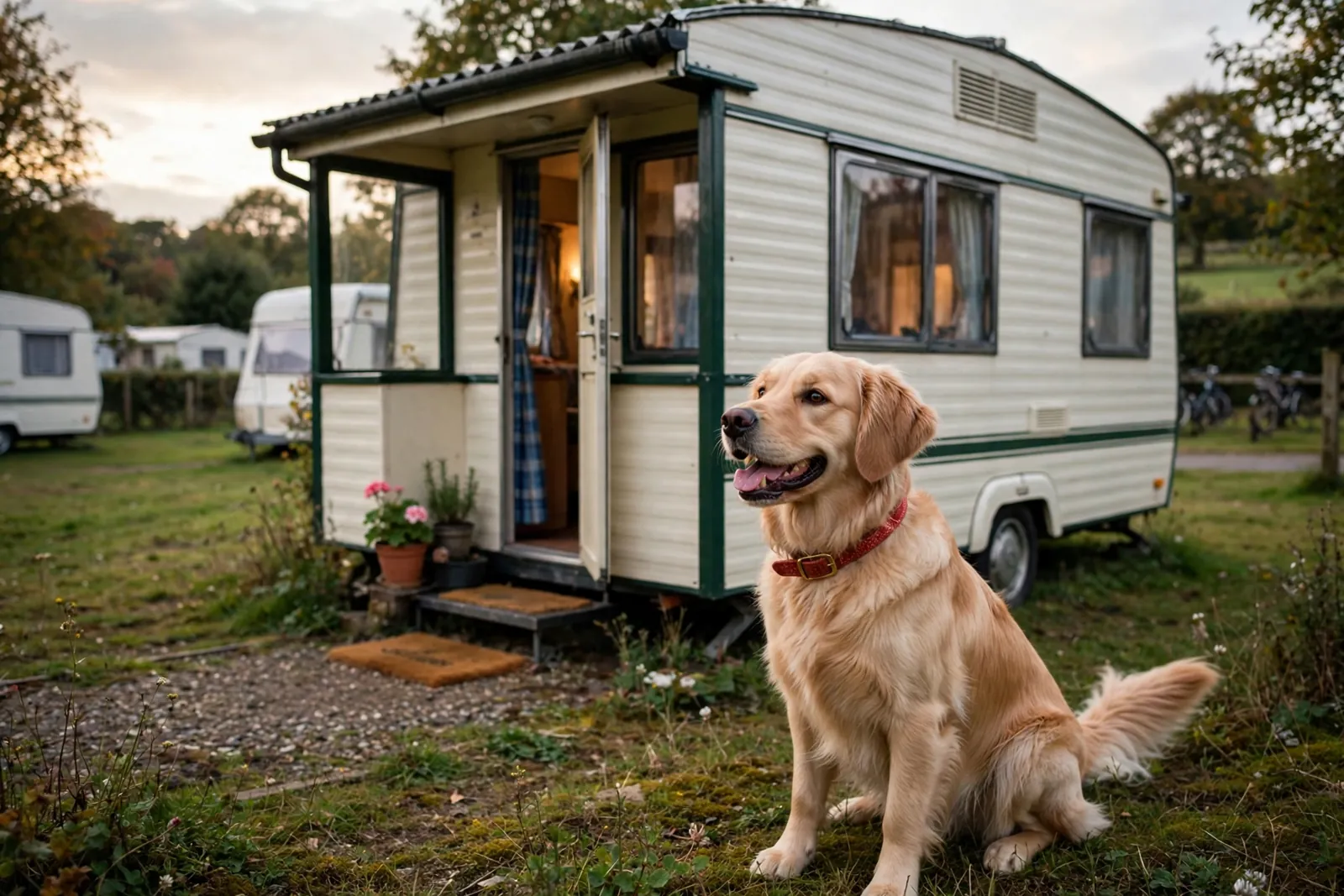
Hotels and holiday parks answer these questions differently, and neither is automatically better. A good dog-welcoming hotel gives you drying rooms, staff who take the mud in stride and cooking done by somebody else; our guide to dog friendly hotels in the UK sets out the booking questions that separate a genuine welcome from a tolerated dog. A cottage gives you control, a garden and a washing machine, at the price of doing your own catering in a week of early darkness. For February specifically, self-catering with a machine, a freezer and a big table tends to suit families with dogs best — but whichever you choose, ask the drying question out loud before booking. The answer tells you more about the next seven days than the photographs do.
Mud management: the unglamorous core skill
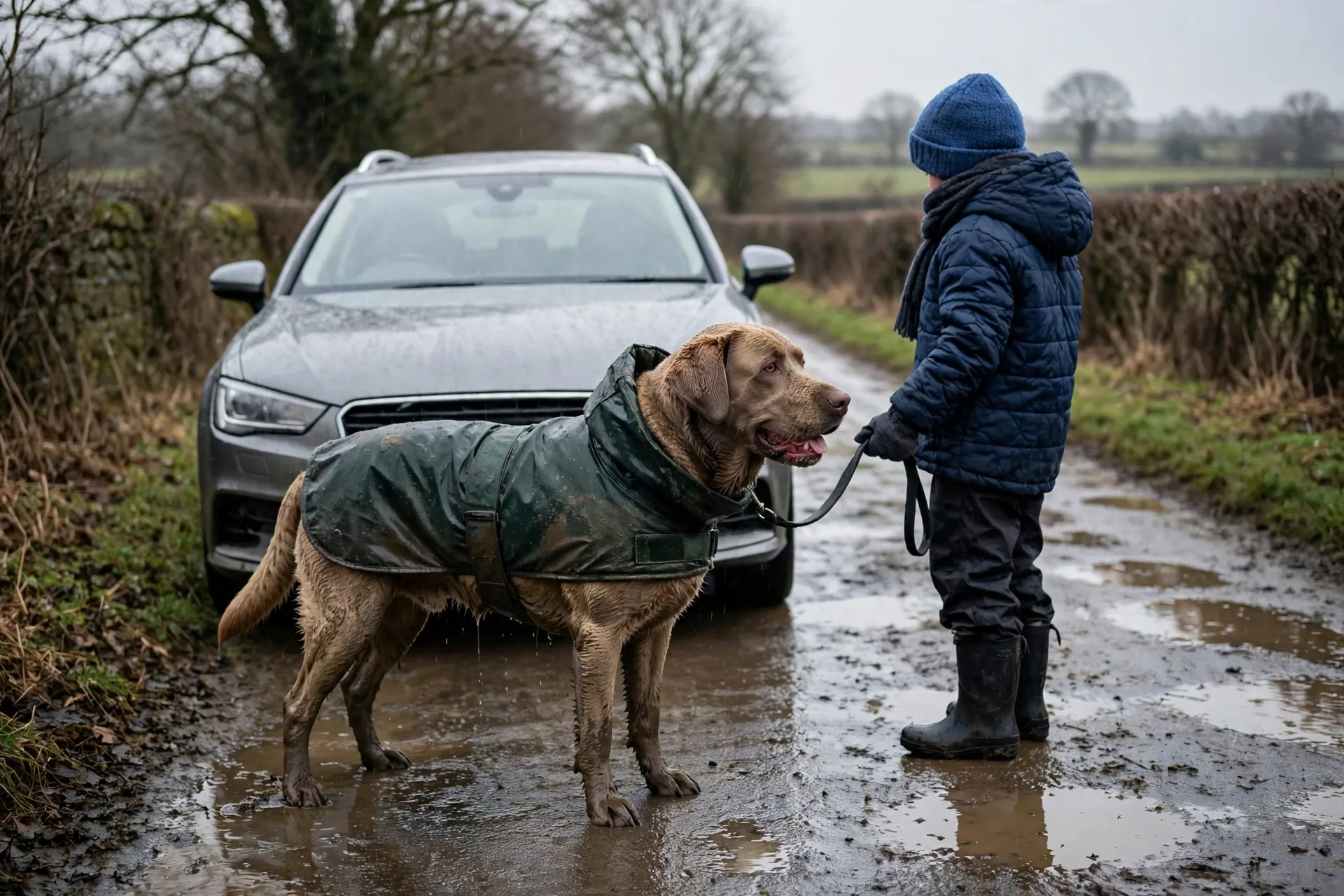
Accept the central fact early: in February, the dog will be muddy every day, and the holiday is largely a system for processing that mud without it colonising the car, the cottage and everyone's temper. The system has three stations. At the walk: a dog coat or drying coat that covers the belly — the splash zone — makes a dramatic difference to what reaches station two, and a lead walk for the last few minutes on the firmest ground available lets the worst of it walk off. At the car: towels in quantity, not the one good towel, a portable water container and brush for legs that have gone beyond towelling, and a boot liner or old blanket you are emotionally prepared to sacrifice.
At the door of the stay, the routine becomes ritual, and rituals survive bad weather better than intentions. Dog stops on the mat or in the porch. Legs and belly towelled in that order. Drying coat on. Dog released to its bed with a chew while the humans process themselves — boots in the tray, waterproofs on hooks, nothing wet draped over furniture where a shaking dog can find it. Houses that fight this sequence, insisting on a full bath after every walk, exhaust everyone by Wednesday; dogs bathed daily in winter also strip their coats of the oils that keep weather out. Rinse legs when needed, bath when genuinely necessary, towel as the default.
Pack for mud as a category, not an afterthought: more towels than seems sane, spare dog bedding or at least a washable cover, the drying coat, paw balm if your dog walks on gritted roads — grit and salt irritate paws, so rinse or wipe feet after road walks — and a cheap doormat of your own if you are precious about a cottage deposit. Mud is also the honest reason to choose walks with a facilities payoff: a forest centre or beach car park with a cafe where dogs are allowed inside or under cover turns the post-walk hour from endurance into pleasure. Nobody in the history of February half term has regretted packing too many towels.
Pacing children and dog together
Half term's hidden difficulty is that its two constituencies recover at different speeds. Children recharge overnight and demand novelty daily; dogs, especially older ones, accumulate tiredness across a week of exciting days and can be running on empty — and consequently short-tempered, sore or unsettled — by Thursday while appearing merely quiet. Plan the week in waves rather than a flat line of expeditions: a big day, a middling day with a shorter walk and an indoor attraction, a genuinely lazy day where the dog's longest outing is an hour and the humans do a pool or a cinema and leave the dog to sleep in peace. A dog left to rest in a familiar-feeling cottage, within its normal alone-time limits, is not missing the holiday; it is banking the energy the last two days will need.
Give children jobs in the system rather than roles as passengers. The towel station works better with an assigned toweller, routes are more fun with a map holder, and a child who has fed the dog its measured dinner is a child who will not also feed it half a sausage at the table. But keep responsibilities age-true and supervised: a small child does not hold the lead of a strong dog on a slippery path, does not approach the dog while it is eating or sleeping however cute it looks under the table, and does not carry the job of noticing hazards. Adults supervise; children participate. That distinction keeps everybody, including the dog, relaxed.
Evenings are where pacing pays out. A dog that has been allowed its dark-afternoon nap will join the family's evening settled and sociable; a dog that has been dragged through a second attraction, a supermarket and a relative's house will spend the evening pacing, panting or stealing food, and be misread as naughty. Protect the nap. It is the February equivalent of shade at a summer picnic — unglamorous, unphotogenic and absolutely load-bearing.
Costs, booking and February's one big advantage
Here is the compensation for everything above: February half term is usually the best-value school holiday week of the year for a family with a dog. Demand is lower than Easter or summer, many stays price the week below their spring rates, attractions run winter offers, and the dog charges — where they exist — stay the same while everything around them gets cheaper. Our guide to cheap dog friendly holidays collects the general money-saving methods, and February is where several of them combine naturally: shorter stays are easier to find, weekday gaps appear between the two half-term weeks, and free walks — beaches, forests, moorland edges — are at their emptiest and best.
Book with February risks in mind rather than summer ones. Travel disruption is the main one: the week can bring storms, flooding on rural roads or, occasionally, snow, so favour stays you can reach by more than one route, keep the first evening's food in the car rather than relying on a shop at the far end, and check cancellation and date-change terms with the same care you give the price. The second risk is shorter: some attractions, cafes and even whole villages run winter hours or close midweek in February, and a dog-friendly pub that is the plan for Wednesday lunch may not open on Wednesdays until March. Check the current opening pattern for anything the week depends on, and hold a backup plan that consists of a walk and a warm cottage, which in February is not a consolation prize at all.
Lead time can be relaxed compared with summer — many February stays are still bookable in January — but the best drying rooms go first, because experienced February families ask the same questions you now will. Book the stay early, keep the daily plans loose, and spend the money you saved on the things February actually rewards: good waterproofs, a second drying coat, and one properly good pub lunch in front of a fire with the dog asleep underneath the table, legally and welcome.
The February packing list that earns its space
For the dog: normal food for the whole week plus a spare day, because February is the wrong month to discover the local shop does not stock it and a diet change mid-holiday invites stomach trouble. Drying coat and a spare, towels in bulk, washable bedding, lead and a spare lead, collar with an up-to-date tag, any medication with doses to spare, paw balm or boots if your dog is prone to sore feet, poo bags in every coat pocket rather than one central supply, and a long-lasting chew for each evening rather than one optimistic chew for the week. A torch and a head torch, because the garden break at ten happens in full darkness and somebody will be holding a lead, a bag and a gate latch at the same time.
For the humans, the dog-relevant items matter as much as the clothes: waterproof trousers, not just jackets, because February rain arrives horizontally at exactly dog-walking height; boots that have been proofed before the week, not during it; a car kit with blankets, water and snacks in case weather closes a road; and printed or downloaded copies of the stay's directions, the vet nearest the stay and your booking details, because rural signal and a flat battery choose their moments. Look up the emergency vet for the area before you travel, save the number, and note it in the cottage for whoever might need it — the discipline our half term guide recommends for every break applies double in the darkest one.
Pack the car so the system works at the far end: towels and the drying coat reachable without unpacking, dog food not buried under suitcases, and the first-night kit — lead, food, bowl, bedding — in one bag. Arriving at a cold cottage at dusk in rain with a dog that needs feeding is February's welcome test, and the families who pass it are simply the ones who packed for it on purpose.
Practical questions
Before you go
When is February half term in the UK?
It varies. Dates are set locally — by councils in England and Wales, with a different pattern in Scotland, where the February break may be a long weekend rather than a full week — and individual schools can differ. Always check your own school's or council's published term dates before booking anything.
Are beaches dog friendly during February half term?
Many beaches that restrict dogs in the summer season allow them in winter, and February beaches are quiet, firm and excellent for running. Rules still vary beach by beach and can change, so check the specific beach's current guidance and any local signage before you travel.
What should I look for in a February dog friendly stay?
Prioritise a porch or utility for drying, hard floors near the entrance, controllable heating, a washing machine, and a securely enclosed garden close to the door for after-dark breaks. Ask the drying question directly before booking — the answer predicts the week better than the photographs do.
How do I manage a muddy dog on a winter holiday?
Use a drying coat, towel legs and belly at a fixed station by the door, rinse only when needed rather than bathing daily, and pack far more towels than feels reasonable. Choose walks that end at firm ground or a dog-welcoming cafe so the worst of the mud stays outside the car and the cottage.
Is February half term cheaper for dog friendly holidays?
Usually, yes. Demand is lower than at Easter or in summer, many stays price below spring rates, shorter breaks are easier to find between the two half-term weeks, and the best walks are free and empty. Check cancellation terms carefully, because winter weather is the trade-off.