This guide is independent and contains no paid placement. School term dates, beach restrictions and attraction rules change, so always check the official source for your dates before you book or travel.
There are usually three half terms a year for each child — autumn, spring and late May — and families get roughly six school-holiday weeks in total once you count both children if dates overlap imperfectly. Prices for the same cottage, lodge or caravan can double in those weeks. Book October and May four to six months ahead, treat February as the value break, pick a stay with a secure garden, a separate sleeping space for children and somewhere to dry muddy boots and paws, and build every day around one dog-friendly anchor activity plus a wet-weather backup. Check your own school's official term dates first: they vary by nation, council and school.
Six weeks, one calendar problem
Most families do not get to choose when they travel. They get the weeks the school calendar gives them, and for half term that means a short, fixed window that thousands of other families are given on exactly the same days. That is the whole problem in one sentence. Demand is concentrated, supply of genuinely dog-friendly family accommodation is limited, and the price on the screen is the market telling you so. A three-bedroom cottage with an enclosed garden that costs a moderate amount in a term-time week can cost twice as much in late October or late May, not because it has improved, but because every parent in the county is looking at it in the same fortnight.
Start, therefore, with timing rather than destination. Put your school's actual dates in a diary before you browse anything. Term dates vary by nation and by council, and schools add training days that quietly extend or shift a break. England and Wales broadly share an October, a February and a May half term, but the precise week differs between local authorities, and academies and independent schools can differ again. Scotland follows a different pattern, with local breaks that do not always align with the English half terms, and Northern Ireland has its own calendar. Two families in the same street, with children at different schools, can have half terms a week apart. That mismatch is occasionally useful — if your dates fall on the quieter of two overlapping weeks, say so when you enquire, because owners sometimes price the shoulder days differently — but you only know if you check. Always confirm dates against your school's published calendar and the relevant council list, and check again before paying a non-refundable balance.
A simple booking-timing strategy follows from the pressure. Decide which of the three half terms you will actually travel in, rather than vaguely hoping to use all of them. Put a decision deadline six months before that break in your diary, and a shortlist deadline a month after that. Between those two dates, do the unglamorous work: agree a maximum total budget including the pet fee, list the non-negotiables for the children and for the dog, and pick two or three areas rather than one beloved postcode. Families who bring the dog are competing for a smaller pool than everyone else, because a stay must work for children and accept a dog and ideally have outdoor space that is properly enclosed. Accepting that early is not pessimism; it is what turns a panicked late booking into a deliberate one. Our guide to bank holiday weekends with a dog covers the same compressed-demand problem in miniature, and many of its short-break tactics apply here too.
October, February and May are three different trips
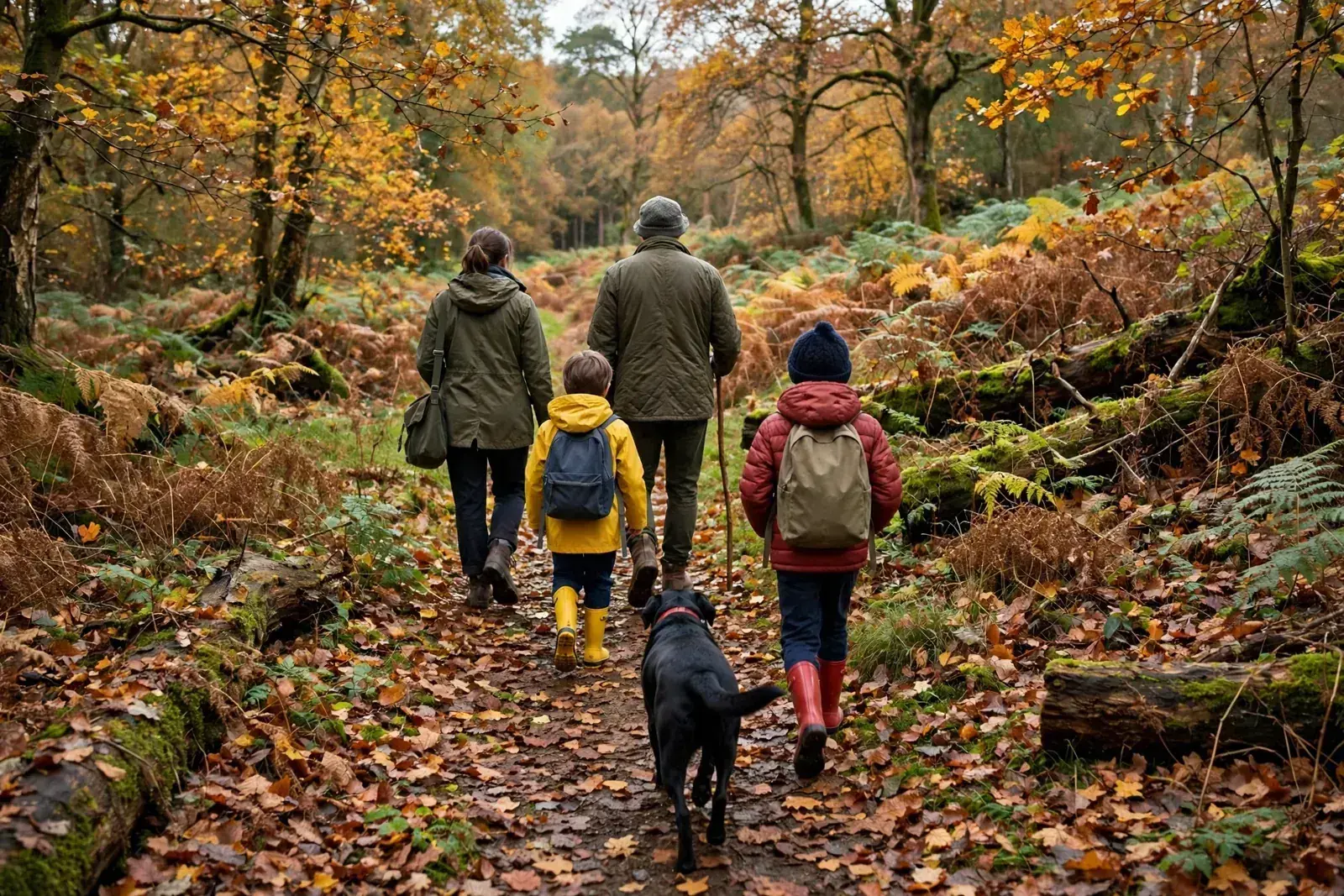
It is a mistake to treat half term as one product sold three times. October is a daylight problem. By late October, evenings draw in fast, a walk after tea may need a torch and a reflective lead, and the ground is already muddy in woodland and on farmland paths. Bonfire Night sits close to the break in many years, so fireworks can start well before 5 November and continue after it; if your dog is noise-sensitive, read our fireworks guidance for dogs, ask any park or owner directly whether displays are planned nearby, and favour a rural stay away from organised events over a town-centre base. The compensations are real: autumn colour, quieter beaches once summer restrictions lift, conkers and leaf litter that children genuinely enjoy, and prices below the summer peak. Pack for dark evenings — head torches for children, a light-up collar or lead attachment for the dog, and a planned short loop close to the door for the last outing.
February is a weather problem. It is the coldest, wettest-feeling half term for many families, daylight is short, and coastal stays can be exhilarating or simply exhausting depending on the wind. It is also, for the same reasons, usually the cheapest. The right February trip is built indoors-out: a stay with good heating, a proper drying space and room for board games and wet coats, near one or two strong indoor or sheltered attractions, with big walks treated as a bonus on the dry day rather than the plan itself. Dogs cope well with February if they get two decent outings and somewhere warm to dry; children cope if you do not promise them a beach holiday. Choose the destination for its wet-day offer first and its scenery second.
May is a daylight and restrictions problem. The evenings are long, the countryside is at its best, and it feels like the start of summer — which is exactly why it is the most expensive and fastest-selling half term. It is also when seasonal beach restrictions bite: many popular beaches limit dogs from 1 May, sometimes earlier, through to the end of September, usually by zoning part of the beach rather than banning dogs from the whole coastline. Check our guide to UK beach rules for dogs and then the specific council page for your beach, because dates and zones vary locally. A May trip planned around a beach that turns out to be largely closed to dogs is a preventable disappointment. Build the week around coast paths, riverside walks and the permitted section of beach, and treat swimming and sand time as a children-and-one-adult activity while the other adult walks the dog along the promenade.
Booking lead times and price patterns
Price patterns repeat every year, and learning them is worth real money. The first release of dates, often nine to twelve months ahead for holiday parks and popular cottages, is not always the cheapest, but it offers the widest choice of dog-friendly units — and choice matters more than a small discount when you need a secure garden and enough beds. The middle window, roughly four to six months ahead, is the sensible booking zone for October and May: most good family-and-dog stays are still available, prices have settled, and you can compare total costs calmly. Inside eight weeks, you are shopping the remainder. That does not mean nothing good is left, but what remains tends to be the expensive, the poorly located, or the stays where dog-friendly means a small hard-floored room and no garden.
February bends the pattern. Demand is lower, so the middle window stretches, and late availability is more plausible, especially inland. Even so, the best-equipped winter stays — wood burner, enclosed garden, drying room, games room nearby — are a limited set and they go to families who booked while others were still focused on Christmas. If February is your main break, booking in early autumn is a quiet advantage.
Watch how the price is constructed, not just the total. Some owners hold a headline rate and add a pet fee, a linen charge and a higher security deposit for school-holiday weeks. Parks may require a full week in May where they allow three nights in February, or move check-in to a fixed Saturday that wastes two days of a one-week break. Compare the cost per usable night: a seven-night booking you can only use for five nights because of school and work is not the bargain it looks. Note balance deadlines too. Balances commonly fall due eight to twelve weeks before arrival, which for May half term lands in the expensive spring months; put the date in the diary when you book, not when the reminder arrives. Finally, keep a short cancellation watch. In the fortnight after balance deadlines pass, some stays release cancelled dog-friendly units. If you missed out, a polite email asking to be told of cancellations costs nothing and occasionally produces exactly the secure-garden cottage you wanted.
Choosing a stay that works for children and a dog
A stay that suits adults and a dog can still fail children, and a stay children love can be miserable with a dog. The overlap is narrower than listings suggest, so check the specific features that serve both. A secure garden is the headline item for the dog — genuinely enclosed, with a fence or wall a small dog cannot slip under and a gate that latches — but it doubles as the children's safest outdoor space and the place where wet wellies and muddy paws can be dealt with before they reach a carpet. Ask for the boundary height and material, and whether the garden is private or shared with the neighbouring unit. Our guide to self-catering stays with a secure garden explains what enclosed really means in practice.
Sleeping arrangements are the second test. Bunk rooms and twin rooms matter because children who sleep badly make the whole week fragile, and a dog who usually sleeps downstairs at home will not settle if the only dog-allowed space is a bedroom corridor. Look for a layout where the dog can sleep in a kitchen, utility room or hallway with its own bed, away from the children's doors, and where an early-rising child does not have to cross the dog's space in the dark. If you have a baby or toddler, add stair gates to your questions: few listings mention them, many owners will provide one if asked in advance, and a dog plus a crawling child plus an open staircase is a problem you want solved before arrival.
The third test is mud management, unglamorous and decisive in October and February. You want an entrance that is not straight onto carpet, a hard floor where boots, coats and the dog can be dried, a tap or hose outside if possible, and enough hooks and floor space that four sets of wet gear are not draped over the kitchen chairs. Ask where you are expected to wash a muddy dog, whether towels for the dog are provided or banned, and whether there is a washing machine for the inevitable midweek load. Then check the practical extras: parking beside the unit rather than across a dark site, a freezer for children's food and the dog's raw or fresh food if you use it, blackout blinds in children's rooms in May, and heating you control yourselves in February. A stay that passes the garden, sleeping and mud tests will forgive a lot of bad weather.
Wet-weather day plans that save the week
Plan wet days before you travel, not from a soggy car park. The reliable formula is one anchor, one filler, and one treat. The anchor is a substantial activity that works in rain and welcomes, or at least accommodates, the dog: a large country-house estate where dogs are allowed in the grounds and one adult can take children into the house in turns, a heritage railway where dogs ride in standard carriages, a cavern or mine tour where one adult goes underground with the children while the other walks the dog on the surface trails, or a big dog-friendly garden with a cafe that has covered seating. The filler is short and flexible — a library, a small museum, a swimming session split between adults, a cinema where the dog rests at the stay with the other adult. The treat is the thing children talk about afterwards: hot chocolate in a dog-friendly cafe, fish and chips eaten in the car overlooking a grey sea, a new puzzle bought locally for exactly this afternoon.
Build a written plan B for each day and keep it in the car. Children handle disappointment far better when the alternative is presented as the plan rather than as a consolation. Also protect the dog's routine inside the wet-day plan. A dog who misses walks because it rained will be restless in a small cottage by evening, precisely when everyone is tired. Shorten, do not skip: a brisk thirty minutes in waterproofs, on a surfaced path or forest track that stays passable in rain, tires most dogs adequately if you add sniffing games, a scatter-feed in grass, or a few minutes of training under trees. Forest tracks, disused railway trails and reservoir circuits are the wet-weather walker's friends because they drain better than field paths. Carry a complete change for the dog's bedding if it gets soaked, a spare towel in the car as well as at the stay, and paw checks after gritty or salted surfaces in February.
Screen time and indoor space deserve honest planning too. Download films before you travel because rural connections fail under holiday load, bring the charger and the headphones, and choose a stay with a table big enough for games rather than assuming the sofa will do. None of this is a compromise. Many families report that the February day they planned most carefully — railway, cafe, forest walk between showers — is the one children remember, because it felt like an expedition rather than a washout.
Attractions that accept dogs with children
The best half-term attractions for this particular family shape share a trait: the dog is part of the visit, not a problem parked outside it. Grounds-based attractions lead the list. Many large gardens, estates and country parks welcome dogs on leads across most of the grounds while excluding them, reasonably, from the house, the play area or the formal beds. That split works well with children if you take turns rather than splitting the family for hours. Check our guide to dog-friendly National Trust places for how paw ratings and local rules work, and always read the individual property page for your date, because seasonal rules change and some properties restrict dogs during lambing, deer rut or ground-nesting season.
Transport attractions are the second strong category. Heritage railways commonly carry dogs for a small fare or free, and a steam train ride gives children a highlight while the dog simply rides and watches. Boat trips vary more: open-deck trips on lakes and rivers often accept dogs, enclosed harbour cruises may not, and ferries have their own rules, so confirm before you build a day around one. Open-air museums are a third good fit, since much of the site is outdoors and dogs on leads are frequently welcome in the grounds if not inside historic buildings.
Where an attraction excludes dogs entirely, plan the swap properly rather than improvising at the gate. One adult goes in with the children for a defined time; the other takes the dog on a named walk nearby, ideally one researched in advance rather than a trudge round a car park; then you meet for lunch somewhere the dog is welcome. Write the swap into the day plan so the adult with the dog gets the next choice, which keeps resentment out of a system that otherwise quietly penalises the keener walker. Book timed tickets with the swap in mind: the first slot of the day is usually quieter, cooler in May and warmer in the sense of a calmer dog, and leaves the afternoon flexible. Finally, check child-specific rules alongside dog rules — minimum ages for activities, height limits, whether pushchairs fit — because an attraction that welcomes your dog but excludes your youngest child from the main activity has failed the same test from the other side.
Travel-day routines for a car full of everyone
Travel day sets the emotional temperature of the whole break, and it is the day where children, dog, luggage and traffic collide. Keep the routine close to home's routine. Feed the dog at the usual time, walk them properly before you load the car rather than promising a stop you may not make, and load the dog last, into a settled space with their own blanket, water and a familiar-smelling item. If your dog travels in a crate or behind a guard, keep that arrangement identical to normal journeys; half term is not the day to experiment. Our wider guidance on dog-friendly holiday parks in the UK covers arrival routines on site, and the same principle applies in the car: boring and familiar beats novel and exciting.
Plan stops around both species. A motorway service area gives children a toilet and a drink but often gives the dog only a small, noisy exercise patch beside the car park. A better pattern for journeys over two hours is one proper stop at a country park, a canal towpath or a small town with a park, ten minutes off the route, where the dog gets a real leg-stretch and children get fresh air that actually resets them. Build the time in honestly — thirty minutes, not the ten you will claim when you are running late. Never leave a dog alone in a car at a service stop in May sunshine, and in October and February remember that a wet dog returning to a loaded car needs a towel and a designated damp corner, or the whole car smells of it by arrival.
Arrival order matters. At the stay, walk the boundary and the garden with the dog on a lead before unloading, check the gate latch yourself, then give the dog water, their bed in its chosen place, and a short sniffing walk along the route you will use after dark. Children explore the stay; one adult unpacks the dog's things and the food first, before suitcases. Feed everyone at roughly home times, keep the first evening short, and resist the temptation to head straight to a pub or park restaurant with an overtired dog and hungry children. A quiet first evening, a familiar last walk under a torch if it is October, and an early night is the single most reliable predictor of a settled week. On the return journey, run the same routine in reverse, add a proper stop before the dog's normal feeding time, and photograph the stay as you leave it — a small habit that resolves most deposit questions before they start.
Budget tactics that actually help
Half-term prices are high, but the total cost of the week is more controllable than the nightly rate suggests. Start with the honest total: accommodation, pet fee, fuel or train fares, food, attractions and parking. Families routinely find that self-catering, even at a higher nightly rate, beats a hotel once three meals a day for children are counted, and it suits a dog better. Cook the expensive meals in and eat out at lunchtime, when many pubs and cafes offer cheaper menus and are at their most dog-friendly and least rushed. One well-chosen lunch out, with the dog under the table and children fed before they are feral, is worth more than three disappointing evening meals where dogs are confined to a draughty bar corner.
Use the calendar against itself. If your school's dates differ by even a day or two from the majority — a training day on the Friday, a Monday start a week earlier than the neighbouring council — travel on those edges. Arriving the Thursday before the main Saturday changeover, or taking a Monday-to-Friday break in a park that prices weekends hardest, can cut the accommodation cost noticeably. February remains the value break overall, and May the one where early booking saves the most. Our round-up of cheaper dog-friendly holidays in the UK gathers further tactics for keeping a break affordable without settling for a poor fit, and our guide to Easter breaks with dogs shows how the same early-booking logic applies to the next school holiday on the calendar.
Cut attraction costs with membership and free anchors. A family membership you will use across three half terms usually pays for itself by the second break, and the estate grounds it unlocks are often the most dog-friendly days out available. Mix one paid highlight with free days — coast path, forest, reservoir, a town trail, a beach out of restricted hours where rules allow — because children rarely rank the week by money spent. Protect the budget from small leaks instead: parking charges at three venues a day, ice creams priced for captive audiences, and the emergency supermarket shop at a holiday-let premium. A meal plan for the first two days, a cool bag of basics, and dog food measured out in advance remove most of them. Finally, keep a contingency. A vet visit, a broken boot, a flooded path that forces a paid alternative — half term produces one surprise per trip on average, and a small reserve turns it into a story rather than a crisis. Families planning further ahead may also find our bank holiday weekend planning useful for the shorter breaks between half terms.
Practical questions
Before you go
Do half-term dates differ across the UK?
Yes. England, Wales, Scotland and Northern Ireland set different term patterns, and in England and Wales individual councils and schools can shift dates by a few days, add training days, or move a break by a week. Scotland does not follow the same October, February and May pattern everywhere. Always work from your own school's published calendar and the council list for the area, and check the official term dates again before you pay a non-refundable balance.
How far ahead should we book for half term?
For October and May, start looking four to six months ahead for popular coastal and national-park stays, and earlier if you need a secure garden, three bedrooms, or space for two dogs. February is usually a little easier outside ski-linked and city breaks, but the best dog-friendly units still go first. If you are booking late, widen the area, consider a Monday-to-Friday stay, and ask about cancellations rather than settling for a poor fit.
Are dogs allowed on beaches in May half term?
Often only on part of the beach. Many popular beaches introduce seasonal dog restrictions from 1 May, sometimes earlier, which usually run through to the end of September, but the exact dates, zones and lead rules are set locally. Check the council page and the signs at the beach itself before you travel, keep to the dog-friendly section, and have a second walk planned if the tide or a restriction changes your day.
Can we leave our dog alone while we take the children swimming?
Plan on no. Many cottages, lodges and holiday parks ban unattended dogs, and a dog left in an unfamiliar place can bark, scratch doors, or become distressed even if it settles well at home. Take turns, choose attractions and pools with a shaded waiting plan for the adult staying with the dog, use a trusted local sitter you have booked in advance, or pick activities the whole family, dog included, can do together.
What is the cheapest half term to travel in with a dog?
February is usually the cheapest of the three for accommodation, because demand and daylight are lower and many coastal stays discount heavily outside the main season. October is mid-priced but rises sharply around Halloween events, and May is often the most expensive half term short of the summer holidays. In every case the biggest savings come from booking early, travelling midweek if your school dates allow it, and comparing the total cost including pet fees.
Are dogs allowed on beaches during October half term?
Usually yes — most seasonal beach bans run from around May to the end of September, so October half term normally falls outside them. A few beaches keep year-round restrictions, so check the local council's rules for the beach you plan to visit.
When are the three half terms in 2026-2027?
As a standard England window, the three breaks are: October half term, Monday 26 October to Friday 30 October 2026; February half term, Monday 15 February to Friday 19 February 2027; and May half term, Monday 31 May to Friday 4 June 2027. Dates vary by area and school — for example, Wales February half term in 2027 is 8 to 12 February — so check your own child's school or local council before you book. Use the GOV.UK school term dates checker to find your council's dates. Once dates are fixed, check UK beach rules for a May beach trip and dog-friendly farm stays for a family stay.