This guide is independent and contains no paid placement. If affiliate links are added later, they will be clearly marked and will not change our editorial checks.
Forres is a calm Moray town with a railway station, a compact centre and some of the best dog walking in Scotland within a ten-minute drive: the tidal sands of Findhorn Bay, the pine forest and dunes of Culbin, and long beaches at Roseisle and Lossiemouth. Stay in town or near Findhorn, walk early for the big open spaces, and use the lead near birds, livestock and roads.
Why Forres works for dogs
Forres is a small market town in Moray, on the north-east coast of Scotland between Inverness and Aberdeen. It is not a resort, and that is exactly the point. The town centre is compact and walkable, traffic is light compared with the bigger Highland towns, and the walks that matter are close: the tidal shore of Findhorn Bay is a few miles to the north, the pine forest of Culbin spreads out to the west, and the Moray Coast runs in both directions with beaches that stay quiet outside school holidays. Dogs that find busy seaside towns stressful tend to settle quickly here, because the town itself is low-key and the open space is genuinely open.
The town has a long history and a lived-in feel rather than a polished tourist front. The High Street runs through the centre with independent shops, cafes and pubs, and the Tolbooth stands at its heart. Cluny Hill rises just south of the centre, topped by Nelson's Tower, and Grant Park sits at its foot with lawns, flowerbeds and paths that suit a gentle morning loop. A few streets away, the Mosset Burn threads through the town on its way to Findhorn Bay, and the surrounding farmland and woodland begin almost as soon as the houses end. For a dog, that means a walk can start at the front door rather than in the car.
Forres also works as a base rather than a single stop. Elgin is about twelve miles east, Inverness about twenty-five miles west, and the coast between them is dotted with fishing villages, harbours and beaches. The railway station sits on the Aberdeen to Inverness line, so a car-free trip is realistic, and the A96 runs past the town for drivers. That combination — a quiet base, a station, and a string of coastal day trips — is what makes Forres worth a full week rather than a passing visit. The town rewards slow travel: a morning on the bay, a lazy lunch, and an afternoon in the forest beats trying to tick off the whole coast in a day.
Expectations matter, though. Forres does not have a long strip of dog-themed attractions, and on a wet November afternoon the sensible plan is a short walk and a long cafe stop rather than a grand expedition. Shops and venues are small and independent, which means dog policies are set by the person behind the counter rather than a head-office rulebook, and they can change. The advice in this guide is written to help you check the current position before you rely on it, and the phrase to remember throughout is simple: check the official guidance before you travel. Rules on beaches, forest trails and public transport are set by the organisations that manage them, and they are the final word.
Findhorn Bay: the tidal walk
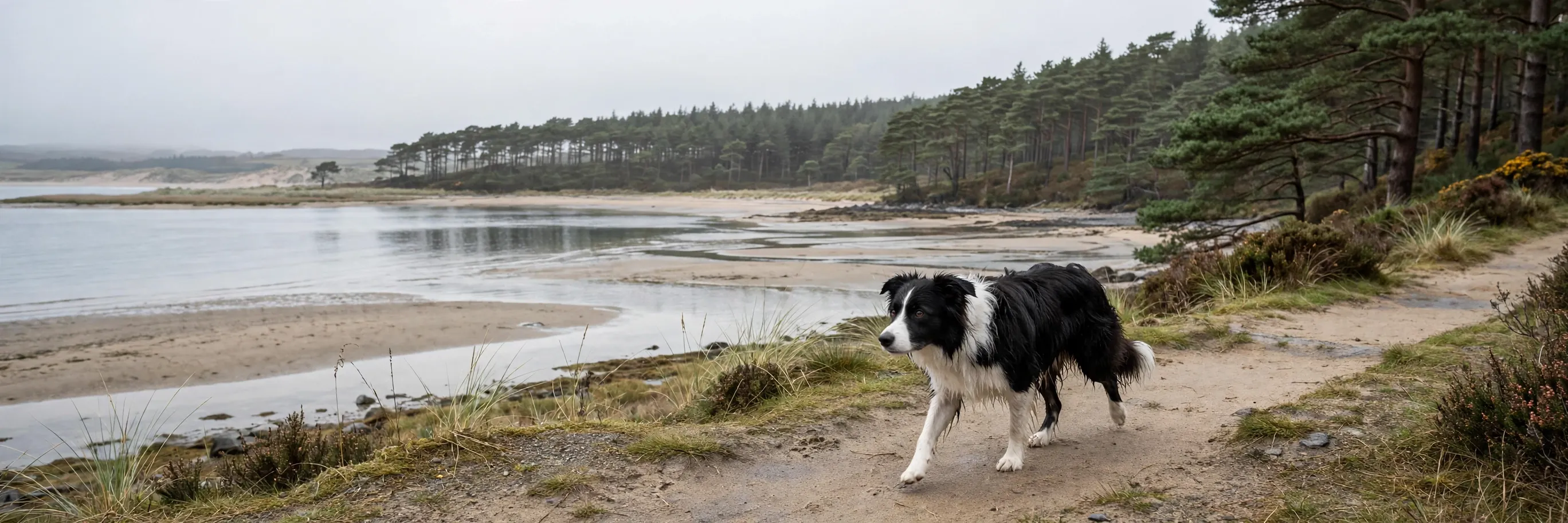
Findhorn Bay is the walk most visitors come for, and it is worth understanding before you set out. The bay is a broad, shallow tidal estuary where the River Findhorn meets the Moray Firth, and at low tide the water pulls back to reveal wide sand and mudflats. The village of Findhorn sits at the mouth of the bay, about four miles north of Forres, with a small harbour, a beach, and lanes that lead out onto the shore. On a calm morning the light across the flats is remarkable, and on a windy day the same walk feels properly wild. Either way, the bay is a place for a dog to run, sniff and paddle — within limits that protect the wildlife.
The bay matters for birds. Wading birds feed on the mudflats at low tide and roost around the shore at high tide, and the area is recognised as a local nature reserve. That means the practical rule is to keep your dog under close control near birds, and to use a lead when birds are feeding close to the path or roosting on the shore. A dog that chases birds can undo hours of feeding in a single sprint, and it is the one behaviour that draws the most frustration from other walkers. A long line is a good compromise on the open flats: the dog gets room to move, and you keep the ability to stop a chase before it starts. Check the official guidance before you travel for any seasonal restrictions, because wildlife protections can change through the year.
Tides shape the walk more than distance does. At low tide you can walk a long way across firm sand, but the returning tide can cut across low ground faster than it looks, so check tide times before you go and plan to be back on dry ground well before the turn. The shore near the village is the easiest starting point, with parking nearby and a clear route onto the sand. From there, the walk along the bay towards the dunes and the pine woods at Culbin gives a long, flat route that suits most dogs, including older ones that struggle with hills. Bring water for the dog even on cool days, because the wind and the salt air dry a dog out faster than a woodland walk, and rinse sandy paws before the drive home.
Findhorn village itself is worth an unhurried hour. The harbour area is small and photogenic, with boats, lobster pots and a view back across the bay, and the lanes around the village are quiet enough for a lead walk. The beach at Findhorn is a broad sweep of sand that faces the Moray Firth, and on a clear day you can look across to the Black Isle and the hills beyond. Dolphins are sometimes seen in the firth, and a patient watch from the shore with a settled dog is one of the quiet pleasures of the area. Keep the dog on a lead around the harbour, where boats, ropes and working gear create trip hazards, and remember that the village car park is the first to fill on sunny weekends.
Culbin Forest and the dunes
West of Findhorn Bay lies Culbin Forest, one of the largest forests in Scotland and one of the best dog walks in Moray. The forest grows on sand — the whole area was once shifting dunes that buried farms and fields in the seventeenth century, and the pines were planted to hold the ground still. The result is a landscape that feels unusual: tall Scots pine and Corsican pine over pale sandy tracks, open clearings full of heather, and sudden views out over the dunes to the sea. The paths are mostly flat and sandy underfoot, which is kind to paws and joints, and the network of forestry tracks means you can choose a short half-hour loop or a full morning's walk without ever needing to climb.
The forest is managed for timber, wildlife and recreation together, so a few practical rules apply. Dogs should be kept under control at all times, and on a lead near working areas, car parks and anywhere forestry work is under way. Ground-nesting birds use the clearings and dune edges in spring and early summer, roughly from March to July, and a dog running loose through heather can disturb nests that are invisible from the path. Staying on the marked trails during the breeding season is the simplest way to avoid the problem, and it also keeps your dog away from the adders that bask on sandy banks in warm weather. Adders are shy and bites are rare, but a dog that noses into sunny banks in summer is the most likely to meet one, so keep to the path and keep the dog close on hot days.
The dunes themselves are the wilder half of Culbin. Beyond the forest edge, the Culbin Sands run along the shore as a broad, open dune system with marram grass, sandy hollows and long views across the firth. It is a big, empty-feeling place, and dogs love it, but it is also exposed: there is little shelter from wind or rain, the sand can be soft going for older dogs, and it is easy to lose your bearings in the hollows if the weather closes in. Stick to the waymarked routes on a first visit, carry water, and save the long dune crossing for a settled day. The walk from the forest car park through the trees to the shore is one of the best short routes in the area, and it gives a dog woodland shade, open sand and a paddle in a single outing.
Parking for Culbin is at the forest car parks, the best known being the one at Wellhill on the forest edge. Arrive early on fine weekends, because the car parks are small relative to the forest and they fill with walkers, cyclists and families. There are no shops in the forest, so bring everything the dog needs: water, a bowl, a lead and a towel for sandy paws. Mobile signal can be patchy under the trees, so download your route before you set out rather than relying on a live map. And remember that forestry work can close individual trails at short notice — check the official guidance before you travel, and follow any closure signs rather than walking around them.
Walks in the town itself
Not every walk needs a drive, and Forres has a good set of town walks for the days when you want to stay local. Grant Park is the obvious starting point: lawns, mature trees, flowerbeds and a network of paths that suit a gentle loop, with benches for a sit-down and space for a sniff-heavy wander. The park sits below Cluny Hill, and the climb to Nelson's Tower gives a short, steepish walk with a view over the town, the bay and the Moray Firth on a clear day. The tower is a landmark rather than a destination in itself, but the hill path is a useful leg-stretcher, and the woodland on the hill gives shade on warm days. Keep the dog on a lead on the hill paths, which are shared with other walkers and can be slippery after rain.
The Mosset Burn walk follows the small river through the town, and it is the walk that shows Forres at its most ordinary and likeable: back gardens, old stone bridges, trees overhanging the water, and the sound of the burn under the traffic. The path is short and level, which makes it a good choice for a first or last walk of the day, for puppies, and for older dogs that have already had their big outing. Combine it with a loop of the High Street and you have a pleasant hour without touching the car. As with any urban watercourse, keep the dog out of the burn after heavy rain, when the water runs fast and the banks are slippery.
Forres also has a few pieces of history that are worth a look on a lead walk. Sueno's Stone, a tall Pictish carved stone standing in a sheltered enclosure on the edge of town, is one of the most impressive early medieval monuments in Scotland, and it is an easy stop on a walk out towards the east of the town. The Falconer Museum, a small local museum in the town centre, covers the history of the area; dogs are not usually admitted to small museums except assistance dogs, so check the official guidance before you travel if you hope to take your dog inside, and plan to take turns if one of you wants to visit. Dallas Dhu, the preserved distillery just south of the town, and the working Benromach Distillery are both part of the town's whisky story — again, check dog policies before visiting, since distillery tours and tasting rooms are not generally dog-friendly, even when the grounds and shop may be.
The practical point about town walks is that they make a longer stay work. A week in Forres is not seven identical trips to the same beach; it is a mix of big mornings on the bay or in the forest and short local loops that let the dog settle into a routine. Dogs do better with that rhythm than with a new expedition every day, and the town walks are what give the routine its shape. If your dog is nervous in new places, start with the same short loop for the first day or two, then add the bigger walks once the dog has learned where home is.
Cafes and pubs that welcome dogs
Eating and drinking with a dog in Forres is usually straightforward, provided you plan for it rather than assuming it. Many of the cafes and pubs along the High Street and around the town centre welcome dogs, and the town has a relaxed attitude that comes from being a place where dogs are part of daily life rather than a novelty. Outdoor seating is the easiest option in good weather, and several venues put out water bowls without being asked. Inside, policies vary: some places welcome dogs throughout, some keep dogs to a particular area or to the bar rather than the dining room, and some change their rules between lunch and dinner. The only reliable approach is to ask when you arrive, or to check the official guidance before you travel, and to have a backup plan if the answer is no.
A few habits make the difference between a welcome dog and a tolerated one. Bring a mat or blanket so your dog has a defined place to lie, and a chew or a stuffed food toy to keep them occupied while you order. Keep the lead short and the dog under the table or beside your chair, not stretched across a walkway where staff carrying plates have to step over it. Order at the bar or counter if that is the house style, and settle the dog before you sit down to eat rather than after. A dog that has just had a good walk is far more likely to settle than one that has been in the car all morning, so time your cafe stop after the walk, not before it. If the dog cannot settle, take the hint and leave — a short, calm visit beats a long, stressful one for everyone in the room.
Pubs deserve a special mention, because they are where Forres is most dog-friendly. The town's pubs have long been social spaces for walkers and locals, and dogs are a normal part of that picture. The Mosset Tavern, on the High Street, is the kind of traditional pub where a well-behaved dog by the fire is expected rather than remarkable — though policies can change, so check before you travel. In any pub, the rules are the same as in a cafe, with one addition: watch the floor. Dropped food, spilled drinks and the feet of other drinkers are all hazards for a dog that wanders, and a lead kept short solves all three. If you are staying for a meal, ask when you book whether dogs are welcome in the dining area, because the answer at the bar and the answer in the restaurant can be different.
Cafes are generally more variable, and smaller cafes may have limited space for a large dog. If you have a big dog, choose a cafe with outdoor seating or a spacious interior, and avoid the busiest lunch hour if your dog is nervous around crowds. A dog that barks at strangers or other dogs will not enjoy a busy cafe, and neither will anyone else — in that case, takeaway coffee and a bench in Grant Park is a better plan than a forced sit-down. The town has takeaway options that make this easy, and a coffee drunk on a park bench with a settled dog is a perfectly good Forres experience. The point is not to find the one cafe that allows dogs, but to match the venue to the dog you actually have.
Where to stay with a dog
Forres has a reasonable range of dog-friendly places to stay, though the choice is smaller than in a big resort town, so book early for school holidays and summer weekends. Self-catering cottages are the most common option, and they suit dogs well: a private front door, a kitchen for preparing the dog's food, and usually a garden or yard. When you enquire, ask the questions that actually matter rather than just whether dogs are allowed. How many dogs are permitted, and is there an extra charge per dog or per stay? Is the garden enclosed, and how high is the fence? Are dogs allowed on the furniture, or is there a rule about keeping them off beds and sofas? Is there a practical place to dry a wet dog after a beach walk? The answers tell you more about a stay than the listing photos do.
Holiday parks and lodges are another option in the wider area, and our guide to dog-friendly holiday parks in the UK covers the questions to ask before booking — pet fees, boundaries, unit locations and cancellation terms all apply just as much around Forres as anywhere else. Lodges near the forest or the coast give you walks from the door, which is a genuine advantage with a dog that needs an early outing, but check the distance to the nearest shop and vet, because a rural lodge can be a long drive from both. Bed and breakfasts and small hotels in and around Forres also take dogs, usually in ground-floor rooms or specific dog-friendly rooms, and often with a charge per night. Ask about the breakfast room rules and whether the dog can be left in the room while you eat, because many places do not allow dogs to be left unattended.
Staying near Findhorn village is worth considering if the bay is your main reason for coming. The village has cottages and small lets within walking distance of the beach, and the early-morning walk across the flats before anyone else is out is one of the best experiences in the area. The trade-off is that the village is small, with limited shops, so you will be driving into Forres for supplies. Staying in Forres town itself gives you the opposite balance: shops, cafes and the station on foot, and a short drive to every walk. Either works; the choice depends on whether you value the walk from the door or the town at your feet. Whichever you choose, get the dog policy in writing with the booking confirmation, including the pet fee and any cleaning charge, so there is no argument on arrival.
A word on arrival routines. The first hour in a new place sets the tone for the whole stay, so make it boring on purpose. Walk the garden or the nearest loop before you unpack, check the boundaries and gates, move anything chewable or dangerous out of reach, and give the dog water and a familiar bed in a quiet corner. Feed at the usual time and keep the first evening close to the home routine. Dogs read consistency as safety, and a calm first night is worth more than any amount of sightseeing on day one. If the accommodation has a rule about dogs being left alone, respect it as written — a dog that barks in a strange cottage can end a stay early, and the neighbours will not thank you either.
Parking and getting there
Getting to Forres is easy by car or train, and both routes have dog-specific details worth knowing. By car, the A96 runs between Aberdeen and Inverness and passes close to the town, and the drive from either city takes roughly forty minutes from Inverness and a little over an hour from Aberdeen in normal traffic. The roads around the coast are mostly single carriageway with passing places on the smaller lanes, so allow extra time if you are towing or driving a large vehicle, and expect agricultural traffic in harvest season. If you are driving from further south, the route through Perth and Inverness is the most direct, and it is worth planning a leg-stretch stop for the dog halfway rather than pushing through in one go.
Parking in Forres itself is straightforward. There is parking in and around the town centre, at Grant Park, and at the car parks serving Findhorn village and Culbin Forest. The town centre spaces are convenient for a cafe stop or a shop, while the coastal car parks are the ones that fill first on sunny weekends — arrive before late morning if you want a space at Findhorn on a fine day. Check the official guidance before you travel for current charges and time limits, because these change and the signs at the car park are the final word. Never leave a dog in a parked car, even on a mild day: a car heats up far faster than people expect, and the Moray Coast sun can be strong even when the air feels cool. If you need to leave the dog while you shop, take turns rather than leaving the dog in the vehicle.
By train, Forres station sits on the Aberdeen to Inverness line, with regular ScotRail services in both directions. Our guide to dog-friendly train stations in the UK covers the general rules for travelling by rail with a dog, and Forres is a good example of the small-station end of the scale: a quiet platform, a short walk into town, and no long interchange to navigate. Dogs normally travel free on UK trains when kept on a lead and under control, with small dogs in a carrier and larger dogs at your feet. Keep the dog close on the platform, away from the edge, and be ready for the train to arrive with little warning — rural stations do not always announce arrivals far in advance. The walk from the station into the town centre is short and mostly level, which makes a car-free trip genuinely practical here.
Buses also serve Forres, with Stagecoach routes along the coast and inland to Elgin and Inverness. Dogs are generally allowed on local buses at the driver's discretion, usually on the floor and not on seats, but this is not a guaranteed right, so check the official guidance before you travel and have a backup plan if the bus is full or the driver declines. For most visitors, the practical choice is the train for arrival and the car or your own feet for the walks themselves, because the best dog walks around Forres are not on bus routes. If you are travelling without a car, base yourself in the town centre rather than out at the coast, so that shops, cafes and the station are all within walking distance.
Moray Coast day trips
Forres makes a good base for the Moray Coast because the day trips are short and varied, and each one gives the dog a different kind of walk. Lossiemouth, about fifteen miles east, is the nearest proper seaside town, with a harbour, a long East Beach that stretches for miles at low tide, and a golf course edge that dogs walk beside rather than across. The beach at Lossiemouth is one of the longest in the area, and it is the place to go when you want a big, open run with firm sand and room to spread out. The harbour area is busier and needs a lead, with boats, ropes and vehicles, but the beach itself is the main event. Check the official guidance before you travel for any seasonal dog restrictions on the town beaches.
Burghead, a few miles north-east of Forres, is a working fishing village with a harbour, a promontory fort, and views across the firth that are among the best on this coast. The walk around the headland is short and bracing, with cliffs and sea birds, and it needs a lead throughout — the drops are real and the paths are narrow in places. Nearby Roseisle Beach, between Burghead and Findhorn, is a long sweep of sand backed by pine forest, and it is quieter than Lossiemouth or Findhorn on most days. The combination of forest edge and open beach makes Roseisle a good choice for a dog that likes both shade and sand, and the car park gives direct access to the shore without a long walk in. Hopeman, further east, has a small harbour and a beach that suits a short stop rather than a full day.
Elgin, twelve miles east, is the market town and administrative centre of Moray, and it is worth a half-day for the change of scene. The cathedral ruins stand in green grounds that make a pleasant lead walk, the town centre has shops and cafes, and the river Lossie runs through the town with paths along its banks. Dogs are welcome in the cathedral grounds on a lead, though the ruins themselves and any indoor spaces have their own rules — check the official guidance before you travel. Duffus Castle, a ruined medieval castle on a mound a few miles from Elgin, is another easy stop: a short climb, a big view, and open grass that suits a sniff-heavy wander, with livestock sometimes grazing nearby, so keep the dog on a lead around the castle mound.
Further afield, the coast east towards Cullen and Portsoy offers a different flavour: small harbours, cliff paths and villages that feel a world away from the busier towns. These are best saved for a second or third day trip, because the driving time adds up and the walks are shorter and steeper than the Forres beaches. A useful rule for day trips is to plan one destination per day and to be back at base by mid-afternoon, so the dog gets a proper rest before the evening walk. Dogs do not enjoy a tour any more than people do, and a day trip that ends with a tired dog sleeping by the fire is a successful one.
Tides, weather and seasons
The Moray Coast has its own weather, and it is worth planning around rather than fighting. The coast is one of the driest and sunniest parts of Scotland, thanks to the rain shadow of the mountains to the west, but the wind is a constant presence and the sea makes the air feel colder than the thermometer suggests. A calm, sunny day on the bay can still carry a sharp breeze, and a dog that is comfortable inland can feel the cold on an exposed beach. Pack a windproof layer for yourself and a drying coat for the dog, and plan your longest walk for the sheltered forest rather than the open shore when the wind is up.
Tides are the other force that shapes a Forres trip. Findhorn Bay is tidal, and the difference between high and low water changes the landscape completely: at high tide the bay is a broad sheet of water, and at low tide it is miles of sand and mudflat. Check tide times before you travel and again on the morning of the walk, because the tide waits for nobody and the return can cut across the flats faster than it appears to. The safest habit is to walk out with the tide falling and to turn back well before it turns, and never to let the dog chase the water's edge out across the flats. The same caution applies at Lossiemouth and Roseisle, where the tide can cover a long stretch of beach in a surprisingly short time.
Seasons change the trip in useful ways. Spring brings lighter evenings, nesting birds and the first warm days in the forest, but also the start of the tick season and the need for a lead near ground-nesting birds. Summer is the busiest season, with the longest days, the warmest sea and the most visitors at Findhorn and Lossiemouth; it is also midge season inland, though the coastal wind usually keeps the worst of them away from the shore. Autumn is many dog owners' favourite time in Moray: the light is low and golden, the beaches empty out, the forest turns, and the walking is at its best. Winter is quiet and atmospheric, with short days, frost on the dunes and a real chance of a storm watching from the car — but it is also the season when a torch, a warm coat and a short walk matter most, because darkness falls in the middle of the afternoon.
Whatever the season, the practical kit is the same: tide times, a weather forecast checked the same morning, and a plan B for when the weather turns. The forest is the best wet-weather walk in the area, because the pines give shelter and the sandy paths drain well, while the bay is the best fine-weather walk, because the open sky is the whole point. A week in Forres works best when you match the walk to the day rather than forcing a plan, and the town's cafes are the perfect shelter when the rain arrives.
Safety, wildlife and what to pack
Forres is a safe area for dogs, but the coast and forest have their own hazards, and a little preparation goes a long way. Ticks are the most common issue: they live in long grass, bracken and woodland edges from spring to autumn, and the Moray Coast is no exception. Check the dog after every forest and dune walk, paying attention to ears, armpits, groin and between the toes, and remove any tick promptly with a tick remover rather than pulling it off by hand. Talk to your vet before travelling about tick prevention, especially if your dog is not already on a regular treatment. Adders are present in the dunes and on sunny banks in the forest, and while bites are rare, a dog that noses into warm, south-facing banks in summer is the most likely to meet one — keep to the paths on hot days and keep the dog close.
Livestock is the other everyday hazard. Sheep graze on fields around Forres and on the coastal grassland, and dogs must be kept under close control near livestock at all times; in Scotland, the access rules require dogs to be on a lead or under close control around farm animals, and a dog that chases sheep can be shot by the farmer. That sounds harsh, but it is the law and the reality of a farming landscape. Keep the dog on a lead through any field with livestock, and do not rely on a recall that has never been tested against sheep. Ground-nesting birds in the forest clearings and dune edges need the same care in spring and early summer, and seals sometimes haul out on the shore — keep a generous distance, because a dog that rushes a seal can cause injury to both animals.
Water needs care too. The sea is safe for paddling, but do not let the dog drink seawater, which causes vomiting and diarrhoea, and rinse the dog off after a swim in salt water. Standing water in the dunes and forest can carry bacteria, so discourage drinking from stagnant pools and carry fresh water instead. After a beach walk, check paws for cuts from shells and sharp stones, and wash off sand before the drive home — sand in the car is a minor annoyance, but sand in a cut paw is a vet visit waiting to happen. In summer, remember that sand and tarmac can burn paws on hot days, and that the sun on the Moray Coast is stronger than it feels when the wind is blowing.
The packing list for Forres is short but specific: a lead and a long line, a harness that fits well, a water bottle and a collapsible bowl, a drying coat or two towels, a tick remover, poo bags, a torch for dark afternoons, and a first-aid kit with saline, bandages and the number of a local vet saved in your phone. Veterinary practices in Forres and Elgin cover routine care, and there are out-of-hours services in the wider area, but save the numbers before you need them rather than searching in a crisis. If your dog takes regular medication, bring more than you need for the trip, and carry the prescription details with you. A dog that is well prepared for the coast is a dog that can enjoy it properly.
A one-day plan with a dog
If you have a single day in Forres, this plan gives the dog the best of the area without rushing. Start early at Findhorn Bay, arriving at the village car park before the crowds and walking out onto the flats as the tide falls. Give the dog a long, sniff-heavy walk along the shore, with time to paddle and to watch the birds from a distance, and keep the lead handy for the moments when the birds are close. An hour to ninety minutes on the bay is enough for most dogs, and it is the walk that sets the tone for the day. Head back to the car before the tide turns, rinse sandy paws, and drive into Forres for a late breakfast or an early lunch.
Midday is for the town. Walk the High Street, stop at a dog-friendly cafe, and let the dog settle under the table with a chew while you eat. If the weather is fine, take a coffee to Grant Park and sit on a bench while the dog watches the world go by; if it is wet, choose a pub with a fire and a corner seat. After lunch, take the short climb to Nelson's Tower or a loop along the Mosset Burn, then give the dog a proper rest back at your accommodation. A couple of hours of sleep in the afternoon is not wasted time — it is what makes the evening walk enjoyable rather than a chore for a tired dog.
The afternoon belongs to Culbin Forest. Drive to the forest car park and take a waymarked loop through the pines towards the dunes, keeping to the trails and letting the dog enjoy the shade and the sandy paths. The forest is at its best in the late afternoon, when the light comes through the trees and the paths are quieter. Finish with a short walk on the sand if the dog still has energy, then head back to town for an early dinner at a dog-friendly pub. The day works because it mixes the three landscapes — bay, town and forest — and because it builds in rest. A dog that has had a bay walk, a cafe settle, a nap and a forest loop has had a full day, and will sleep well.
If you have more than a day, repeat the shape rather than the detail: a different beach each morning, a different cafe each lunch, and a different forest loop each afternoon. Lossiemouth one day, Roseisle the next, Burghead after that, and a rest day in the middle with nothing but town walks and a long pub lunch. That is the rhythm that makes a week in Forres feel like a holiday rather than a tour, and it is the rhythm that dogs enjoy most. The Moray Coast rewards patience, and Forres is the right place to practise it.
Practical questions
Before you go
Can dogs go on Findhorn Bay beach all year round?
Findhorn Bay and the beach at Findhorn village are generally open to dogs all year, but seasonal wildlife protections can apply, especially around roosting and nesting birds. Keep your dog under close control near wading birds, check the official guidance before you travel, and use a lead when the tide is out and birds are feeding on the mudflats.
Is Forres a good base for a dog holiday on the Moray Coast?
Yes. Forres sits between Inverness and Aberdeen with a railway station, a compact town centre, and big walks within a short drive: Findhorn Bay, Culbin Forest, Roseisle Beach, Lossiemouth and Burghead. It suits a quiet week better than a busy resort, and it works well for dogs that prefer open space to crowds.
Are dogs welcome in Forres cafes and pubs?
Many cafes and pubs in Forres welcome dogs, especially in outdoor seating areas and on the High Street, but policies vary by venue and can change. Always check before you sit down, keep your dog on a lead and settled under the table, and bring a mat and water bowl so your dog has something to do while you eat.
Where can I park in Forres with a dog?
There is parking in and around the town centre, at Grant Park, and at the main car parks for Findhorn village and Culbin Forest. Arrive early on sunny weekends, as the coastal car parks fill up first. Never leave a dog in a parked car, even on a mild day, and check the official guidance before you travel for current charges and time limits.
Can I take my dog on the train to Forres?
Yes. Forres station is on the Aberdeen to Inverness line, and dogs normally travel free on UK trains when kept on a lead and under control. Small dogs can travel in a carrier, larger dogs sit at your feet. Check the official guidance before you travel, and allow extra time for the walk from the station into the town centre.
What should I pack for a dog trip to Forres in winter?
Pack a drying coat or two towels, a waterproof lead, a torch for dark afternoons, paw balm for salt and grit, and a warm layer for short-coated or older dogs. Coastal wind makes the Moray Coast feel colder than the forecast suggests, so plan shorter walks and a warm cafe stop. Check the official guidance before you travel for local weather and tide times.