This guide is independent and contains no paid placement. If affiliate links are added later, they will be clearly marked and will not change our editorial checks.
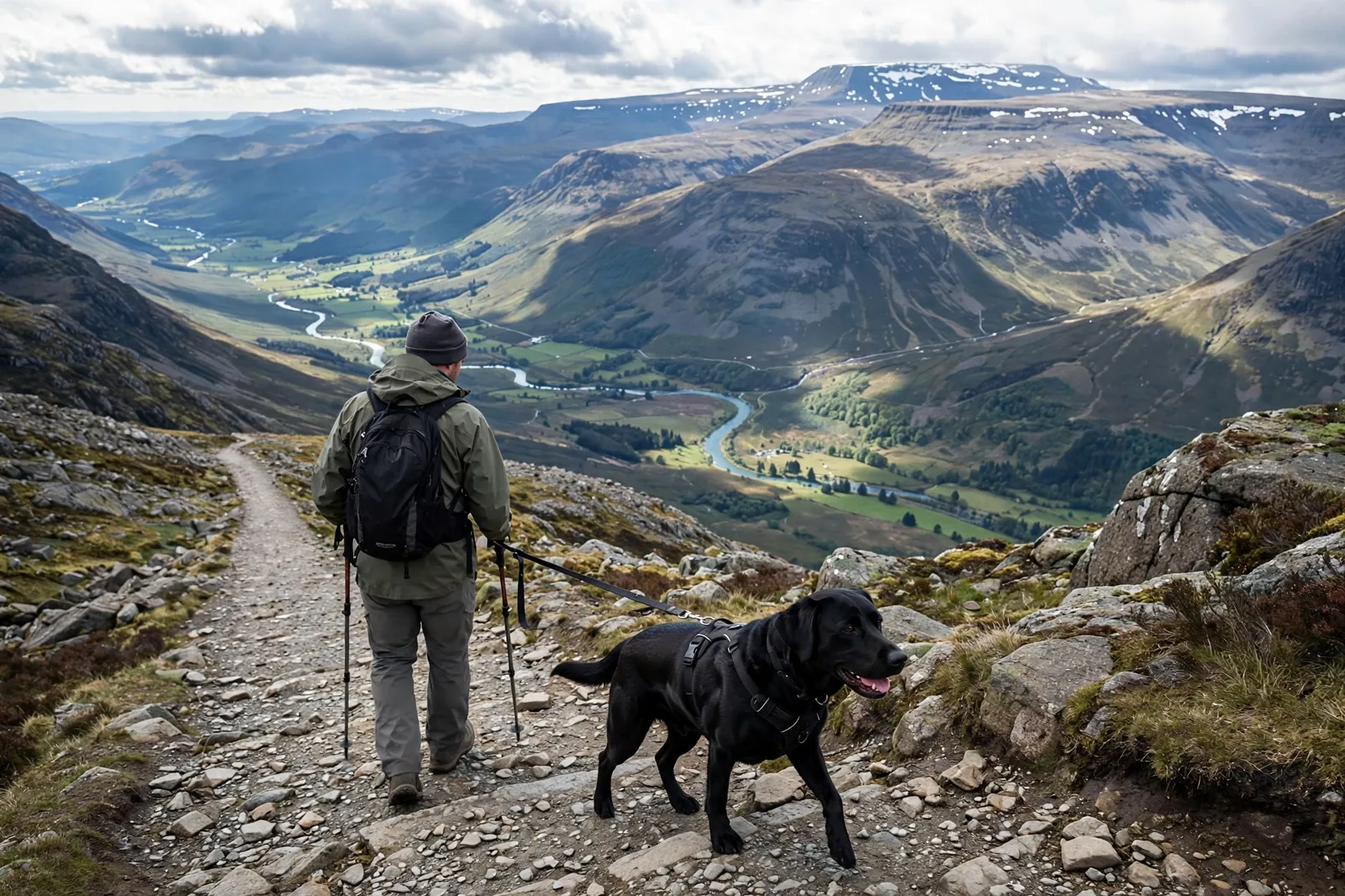
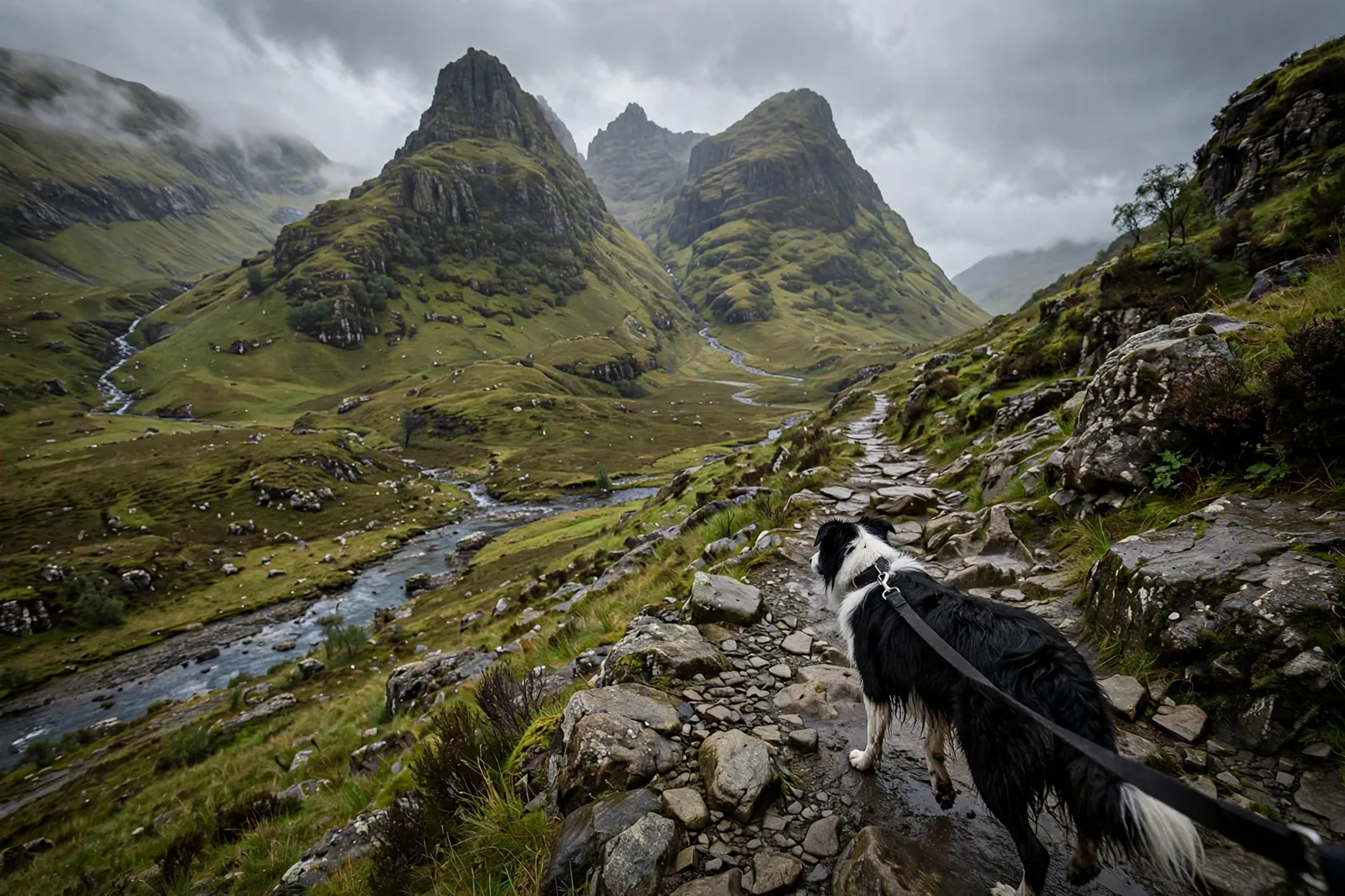
Fort William with a dog works best when you build the day around weather, not against it. Use the Caledonian Canal towpath and Neptune's Staircase for level, all-weather walking, Glen Nevis lower paths for waterfalls and river scenery on settled spells, and the Cow Hill circuit for a viewpoint over Loch Linnhe when the cloud lifts. Check the Jacobite steam train dog policy and booking terms before you travel, pack proper waterproofs for you and the dog, and book a stay with a genuine drying room — in Fort William that single feature changes the whole holiday.
Start with plan B: a rainy-day itinerary that still works
Open the curtains in Fort William, see cloud sitting halfway down the hills and rain stippling Loch Linnhe, and do not cancel the day — reorder it. This town sits in one of the wettest corners of Britain, beneath its highest mountain, and the walkers who enjoy it are the ones who treat a dry day as a bonus and a wet day as the standard operating condition. So begin with plan B, and let any sunshine upgrade it. A rainy-day itinerary that keeps a dog exercised, an owner interested and nobody miserable looks like this, hour by workable hour.
Start late and start level. After a slow breakfast, drive or walk to Corpach or Banavie and take the Caledonian Canal towpath towards Neptune's Staircase, the famous flight of eight locks lifting boats between the canal and the sea loch. The surface is firm, the route needs no navigation, the locks give you something to watch in any weather, and a dog gets a proper leg-stretch without mud to the elbows. Time it to watch boats work through the locks if any are moving, keep the dog on a short lead around lock chambers and mooring lines, and turn round whenever the rain hardens — a towpath out-and-back never strands you far from shelter.
Middle of the day belongs indoors, and Fort William is better at this than many Highland stops because it is a working town rather than a single-street village. Dry the dog thoroughly before entering any café, pub or shop that welcomes dogs, settle it on a mat under the table rather than in the aisle, and use the pause properly: hot food, a weather check, a look at the afternoon forecast rather than the morning's guess. Dog-welcoming rules vary by business and can change, so ask at the door even where a sign looks encouraging, and never leave a wet dog shaking itself over other customers' lunches. A town hour spent warm and fed is not time lost; it is what makes an afternoon walk possible.
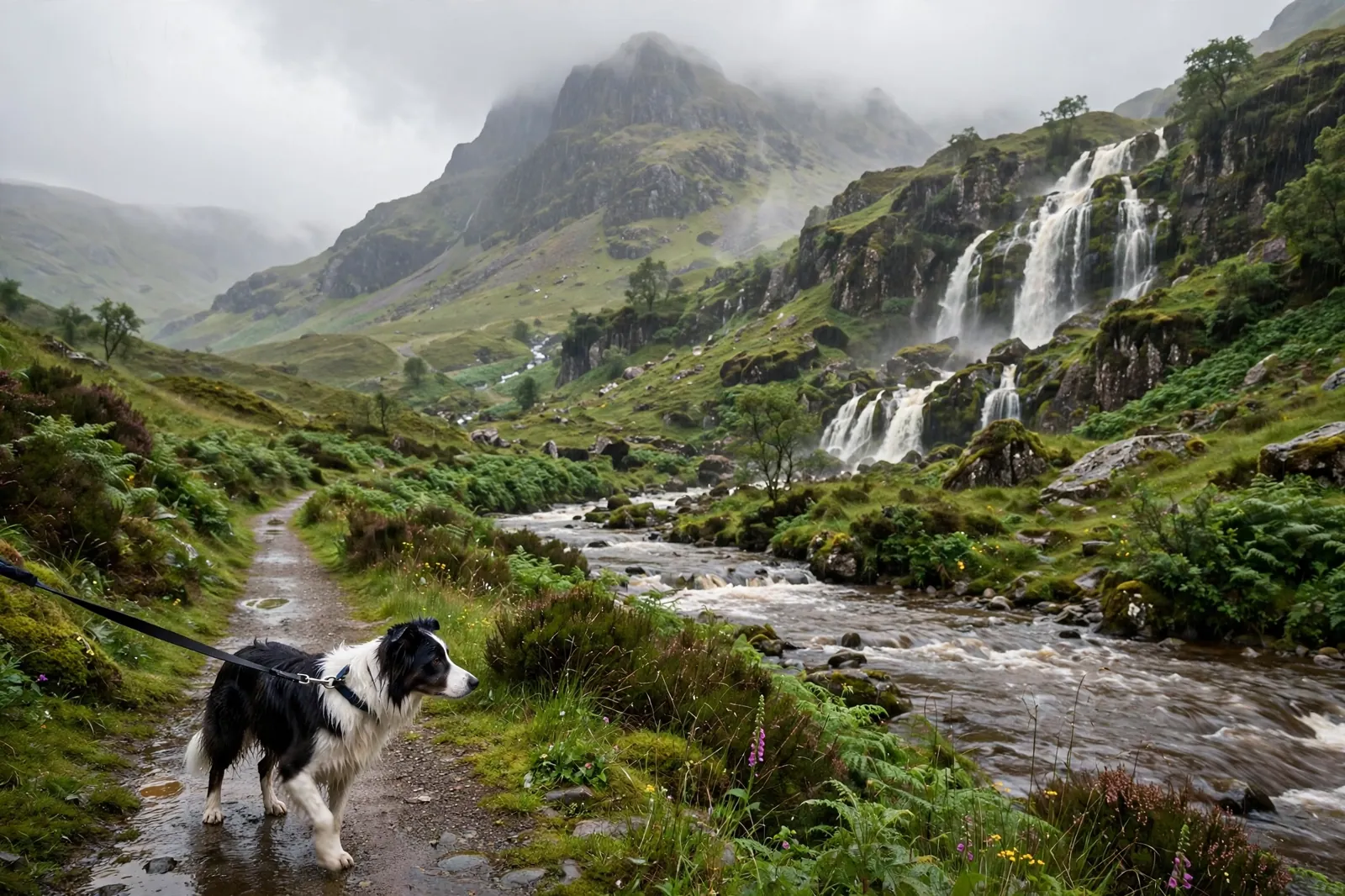
If the rain eases to drizzle by mid-afternoon, take the lower Glen Nevis paths for an hour: river, waterfalls in full voice after rain, and green so intense it seems lit from inside. If it does not ease, shorten rather than abandon — a circuit of the town's lochside and riverside paths, a second towpath stretch in the other direction, and an early return to base. Finish the plan-B day with the ritual that defines Fort William dog holidays: towels at the door, dog dried before it reaches the carpet, boots and coats into the drying room, and tomorrow's routes chosen by forecast rather than hope. A day run this way is not a consolation prize. For many dogs — no heat, no crowds, rivers high and smells everywhere — it is the best day of the trip.
Glen Nevis: waterfalls, river paths and knowing when to stop
Glen Nevis runs south-east from the edge of Fort William, a deep green corridor with the River Nevis on its floor and Ben Nevis rising on its northern side. It is the glen most visitors come for, and rightly: in a few miles it offers riverside paths, native woodland, open grazing, a dramatic gorge and, for strong and experienced hill teams only, access towards the Steall waterfall and the mountain itself. For a dog day, divide the glen into three honest zones and choose by weather and fitness, not by ambition. The lower glen suits almost everyone. The middle glen rewards care. The upper gorge and mountain demand a separate, serious conversation — the one our Ben Nevis walk with a dog guide has in full, because Britain's highest summit is no place to improvise with a tired dog.
Lower Glen Nevis, around the visitor centre and the first riverside paths, is where most dog walks should begin. Paths follow the river through woodland and meadow, waterfalls appear after rain as if switched on, and you can build anything from a half-hour amble to a half-day out-and-back without committing to difficult ground. Keep dogs under close control around the visitor centre and car parks, on a lead where grazing animals are present, and away from fast water: the Nevis is a mountain river that rises quickly, runs cold in every month, and turns banks and stepping places slippery after rain. A dog that loves water needs managing here, not indulging — let it drink from your bottle at rest stops, and save paddling for places you have checked are shallow, slow and safe that day, away from drops and currents.
Further up the glen the character hardens. The road narrows, the river cuts into a gorge, and the path towards Steall crosses rocky, exposed ground and a wire bridge that many dogs — and more than a few owners — should simply not attempt. Treat descriptions of this route casually at your peril: wet rock, a swollen river below, a dog pulling on a lead and a bridge made of cables are a combination that has no safe version. If conditions, daylight or your dog's confidence are anything less than right, the correct Glen Nevis decision is to enjoy the lower glen well and turn back with everyone uninjured and unshaken. No waterfall photograph is worth a rescue callout, and the glen will still be here on a drier day.
Practicalities shape the glen day as much as scenery. Parking concentrates at the visitor centre and the road-end car parks and fills early on fine weekends, so start early or late and have the canal as your overflow option. There is little shelter and no supply chain up the glen, so carry water, food, waste bags and a spare lead from the start. Mobile signal fades as the glen narrows; download maps and tell someone your plan. Walked with that respect, Glen Nevis gives a dog everything a Highland glen should: new smells every hundred yards, moving water to watch, and paths that feel wilder the further you go, while never being far — in the lower glen at least — from the car and the town.
Cow Hill: the town circuit with the loch view
Every mountain town needs a hill that belongs to the town itself, and in Fort William that hill is Cow Hill, the broad, track-crossed rise directly behind the streets. It is not Ben Nevis and does not pretend to be: it is the locals' dog walk, the viewpoint you can reach before breakfast, and the circuit that saves the day when the high tops are in cloud but you still want height, air and a panorama. A clear morning on Cow Hill gives you Fort William spread below, Loch Linnhe opening south-west, Loch Eil to the north-west and the great hills standing behind everything like a backdrop the town ordered specially.
The circuit is the natural way to walk it. Forestry and open tracks loop around and over the hill from several access points in and above the town, so you can join the circuit at the point nearest your stay and walk it in either direction, climbing steadily rather than steeply to the summit area and its mast. Underfoot is mostly track and path, which makes Cow Hill one of the more forgiving Fort William walks in unsettled weather, though puddles, mud on the softer sections and wind on the open top are guaranteed at times. Allow a couple of hours for the full circuit at dog pace, less for an up-and-down from the nearest access, and carry water even on this town hill — there is no reliable dog drinking stop on the top.
Cow Hill earns its name honestly. Cattle and sheep graze on and around the hill, and a dog belongs on a lead wherever livestock are in sight, however empty the track looked a minute earlier. Forestry operations can close or divert sections, so follow local signs on the day rather than a route description — including this one — and keep clear of machinery and timber stacks. Dogs that chase bikes need a short lead on the shared sections, and in the nesting season keep to the tracks across open ground so ground-nesting birds are left in peace. None of this diminishes the walk; it is simply the etiquette of a hill that is simultaneously a farm, a forest and the town's back garden.
Use Cow Hill tactically across a Fort William stay. Walk it on arrival evening to learn the town's geography from above. Walk it at dawn on the day the forecast promises a clearance, and watch the cloud lift off the loch while the big hills are still deciding. Keep it as the exercise bank for a nervous or older dog that cannot face the glen crowds or the mountain paths: a full circuit here is real exercise with real views, ending ten minutes from a towel, a bowl and a bed. Visitors rush past Cow Hill on their way to famous names; dog owners who stay a few days learn it is the walk they actually repeat.
Neptune's Staircase and the Caledonian Canal towpath
Four miles north-west of the town centre, at Banavie, the Caledonian Canal meets the sea in the most entertaining way British engineering could devise: Neptune's Staircase, a flight of eight locks raising boats step by step between Loch Linnhe and the canal. For dog walkers it is two gifts in one — a spectacle to watch, and the start of the level towpath walking that balances every Fort William itinerary. When the hills are hidden, the glen is sodden and energy is limited, this is where the day is saved.
The towpath runs alongside the canal from Corpach and Banavie north-eastwards, flat, clear and mercifully free of navigation decisions, so distance becomes a dial you set by turning round. An hour out and back gives most dogs a satisfying walk; fitter teams can link towpath sections into much longer days or combine the canal with lochside paths around Corpach, where the canal meets the sea lock and views open towards the loch and the hills beyond. Surfaces are generally firm and workable for pushchairs, wheelchairs and older dogs in most weathers, though puddles, ice and towpath works can affect short stretches, so check conditions locally if surface quality is critical for your party.
Lock etiquette matters because this is a working waterway, not a theme park. Keep dogs on a short lead around lock chambers, gates, mooring bollards and ropes, and well back when boats are moving through — lock-keepers and crews need predictable space, gates swing, ropes tension suddenly, and a dog investigating a chamber edge is in genuine danger of a serious fall into deep water. Never let a dog swim in the canal near locks, weirs or boat traffic; if your dog swims, choose only places you have verified as safe, calm and permitted, away from the navigation. Teach children in the party the same rule the dog follows: the staircase is watched from the paths and viewing areas, not climbed on.
Build the canal into the wider trip rather than treating it as a filler. It is the natural walk for arrival and departure days, when time is fragmented and a big route would be rushed. It suits multi-generational groups where the dog is the fittest member present. And it pairs beautifully with a Glen Nevis morning: waterfalls and woodland first, locks and level towpath after lunch, with the dog happily believing both were arranged for its benefit. Our Glencoe walks with a dog guide covers the other great Highland glen a short drive south, and many Fort William stays combine the two — canal-flat one day, Glencoe valley the next, mountain judgement over both.
The Jacobite steam train: dogs, tickets and tight carriages
The Jacobite steam train between Fort William and Mallaig is one of Britain's famous rail journeys — over the Glenfinnan Viaduct, past lochs and white beaches, to a working fishing port with time ashore before the return. For dog owners it raises an obvious question that deserves a careful, current answer rather than a cheerful assumption. So here is the careful version: dogs have generally been carried on this service, usually on a lead, in standard accommodation, with a dog ticket or fare payable and with the expectation that the dog stays on the floor, out of aisles and off seats. But the Jacobite is a special, heavily booked heritage-style service, not an ordinary walk-up train, and its conditions are set by its operator for each season.
That is why this guide's instruction is simple: verify before you travel, and verify again before you pay. Check the operator's current official booking pages and terms for whether dogs are accepted on your date, in which carriages or classes they may travel, whether a dog ticket must be booked in advance, and what size or number limits apply. Policies, fares and booking conditions can change by season, and third-party summaries — including older guides — are not a substitute. If the official terms and anything you have read elsewhere disagree, the official terms win. Do not arrive at Fort William station with a dog, two suitcases and a hope; on a sold-out departure, hope is not a seating plan.
If you do travel with a dog, plan the journey around the reality of a busy steam-hauled carriage. Space is tight, the day is long, and the dog will spend hours on the floor of a warm, noisy, vibrating carriage among strangers' feet and luggage. That suits a settled, travel-experienced dog that can lie quietly, toilet before boarding, and cope with whistles, steam and crowds at stations; it is a poor idea for a puppy, a travel-sick dog, a reactive dog in close quarters, or any dog on a very hot day. Carry water and a portable bowl for the Mallaig break, keep the lead short on platforms and at Glenfinnan, and never let a dog lean from windows or door areas. Give the dog a proper walk before the morning departure — the canal or lochside from an early start — and another on return, so the train day is framed by exercise rather than consisting only of confinement.
Finally, keep a non-train version of the day in your pocket. If dog places sell out, if the policy has changed, or if your dog is simply not a train dog, the same coastline can be reached by road, Mallaig and the ferry ports explored on foot, and the viaduct viewed from the Glenfinnan area paths with the dog on solid ground. The journey is famous; it is not compulsory. A Fort William holiday measured by the dog's experience will sometimes choose the towpath over the viaduct — and the dog, asleep under a café table in Mallaig or chasing canal-side smells at Corpach, will not file a complaint either way.
Wet-weather gear and the drying-room question
Fort William will test your kit more honestly than almost any British destination, because the rain here is not an interruption but a climate. The right response is not optimism; it is equipment. For the human end of the lead that means a genuinely waterproof jacket and overtrousers rather than showerproof optimism, boots that grip wet rock and boardwalk, spare socks in the pack, and a hat that stays on in a lochside wind. For the dog it means a well-fitting coat for small, elderly, thin-coated or clipped dogs, a harness that does not rub when soaked, a lead that does not turn into a heavy, filthy rope when wet, and — unglamorous and essential — more towels than you think any holiday could require. One towel per walk is the Fort William unit of measurement; a wet week uses them all.
Pack for water on the walk itself. Rivers rise, fords deepen and paths become streams, so carry a spare lead and collar in case one is lost or soaked through, waste bags in a waterproof pocket, a headtorch from autumn onwards because glen light goes early under cloud, and drinking water even on rainy days — a working dog in a coat can still overheat and dehydrate, and upland water sources are not automatically safe for dogs. Rinse mud and grit from paws after walks to check for cuts from sharp stone, and dry between the toes: constantly damp paws sore quickly, and a dog that starts the week sound can be limping by Thursday on nothing more dramatic than wet feet and gritty paths.
Then ask the question that separates a good Fort William stay from a damp ordeal: where does everything dry? A proper drying room — a heated space with racks, boot storage and room for coats, towels and dog bedding to actually dry overnight — transforms a wet week. Boots are warm by morning, the dog's coat no longer smells like a swamp, and nobody is draping soaked waterproofs over the only chair. When booking, ask specifically, because listings use the idea loosely: is there a dedicated drying room or just a radiator, can wet dogs enter it or is there a separate utility space, is there an outside tap or hose for rinsing a muddy dog before it comes in, and are hard floors at the entrance or carpet all the way? The answers predict your holiday's comfort more accurately than thread counts or breakfast menus.
In the room itself, run a nightly system and the week stays pleasant. Dog dried at the door before it reaches soft furnishings. Towels rotated, not reused damp. Walking kit into the drying space immediately, not in a steaming heap. The dog's bedding aired whenever the room is dry enough to allow it. And keep one completely dry set of clothes — yours and a dry towel and bedding layer for the dog — sealed away for the journey home, however wet the week becomes. Travel home in dry socks while the dog sleeps on a dry blanket, and Fort William rain becomes a story rather than a sentence.
Choosing your base: town, glen or canal side
Where you sleep in Fort William decides what your dog's evenings look like, so choose the base by routine rather than by photograph. Staying in the town itself puts you on foot for the station, shops, cafés, a vet and the everyday services a dog holiday quietly depends on, with lochside and riverside strolls for the last walk of the day and no driving after supper. Town stays suit train travellers, shorter breaks and anyone whose dog settles best where life continues around it. Check the practical details that listings bury: which floor, whether there is a lift a nervous dog will use, where the nearest grass is at midnight, and what the dog charge covers.
A Glen Nevis base reverses the bargain: you wake at the foot of the paths, walk from the door before the car parks fill, and hear the river from the garden — and you drive for almost everything else. For a walking-focused week with a fit dog, that trade is often worth it, especially in self-catering where muddy routines are your own to manage. A canal-side base around Corpach or Banavie offers the quietest version: towpath from the door, locks for entertainment, big loch views, and a village rather than town feel, with Fort William a short drive or bus ride away for supplies and evenings out. Reactive dogs and owners seeking calm often do best here, exercising on wide, sight-lined towpaths at quiet times.
Whichever base you choose, run the same booking checklist, and get answers before you pay a deposit. How many dogs, what size, and what total charge for the stay — not per night ambiguity. Is there enclosed outdoor space, and is the fencing genuinely secure for your dog's size and determination? Are dogs welcome in eating areas, or is there a practical alternative in wet weather? Is there a drying room or utility space, an outside tap, and hard flooring where a wet dog will actually walk? What is the after-dark walk from the door, and is it lit, trafficked or beside livestock? A host who answers these questions precisely is telling you the stay is run by people who have hosted wet dogs in the Highlands before; vague answers forecast improvisation at your expense.
Round the stay off with rest built in, because Fort William tempts owners to stack famous names until the dog is quietly exhausted. Alternate the demands: a glen day, then a canal day; a Cow Hill morning, then a town afternoon; a train day, then a late start. Watch the dog in front of you rather than the itinerary on the fridge — eating well, sleeping deeply, keen at the door in the morning. That dog, dried, fed and rested under a Highland roof while rain works on the windows, is the real measure of a Fort William base chosen well. Check the latest official guidance before you travel for accommodation terms, train bookings and any local access notices, and let the glen, the canal and the weather divide the days between them.
Practical questions
Before you go
Can dogs travel on the Jacobite steam train?
Dogs have generally been carried on the Jacobite service between Fort William and Mallaig, usually with a dog ticket and on a lead under or beside your seat, but carriage space is tight and the policy, fares and booking conditions can change by season. Check the current official booking terms for dogs before you travel and before you buy tickets, and do not assume a dog can travel in every carriage or class.
What is the best short walk in Fort William with a dog?
For most dogs the Caledonian Canal towpath from Corpach towards Banavie and Neptune's Staircase is the easiest short walk: level, clear to follow and rewarding without a climb. The Cow Hill circuit is the best short option when you want a view over the town and Loch Linnhe and your dog is fit for a steady uphill track.
Can dogs walk in Glen Nevis in wet weather?
Lower Glen Nevis paths can work well in wet weather if you keep to clear tracks, avoid swollen river edges and wire bridges, and turn back at flooded or slippery sections. Higher and gorge routes become hazardous after heavy rain. Check river levels, the forecast and local path notices before you set out, and choose the canal towpath instead if the glen feels unsafe.
Do dogs need to be on a lead around Fort William?
Keep dogs on a lead around livestock, on roads, at stations and canal locks, and on busy town and visitor-centre paths. Sheep and cattle graze in and around Glen Nevis and on Cow Hill. Elsewhere keep your dog under close control following the Scottish Outdoor Access Code, and use a lead whenever you cannot guarantee an instant recall.
Where should we stay in Fort William with a dog?
Stay in Fort William itself for trains, shops, vets and evening walks, in Glen Nevis for immediate access to the glen paths, or around Corpach and Banavie for quieter canal-side starts. Wherever you book, confirm dog charges and numbers, ground-floor or lift access, and crucially whether there is a real drying room or heated space for wet coats, boots and dog towels.