This guide is independent and contains no paid placement. If affiliate links are added later, they will be clearly marked and will not change our editorial checks.
Gairloch suits a family with a dog because one village gives you three different days in one place: a sandy beach with shallow water for children and dogs, a sheltered garden a short drive away, and mountain trails with sea views for the walkers. Base the day on the beach, use the garden as the calm middle, and save the hills for when everyone still has energy.
The beach sets the day
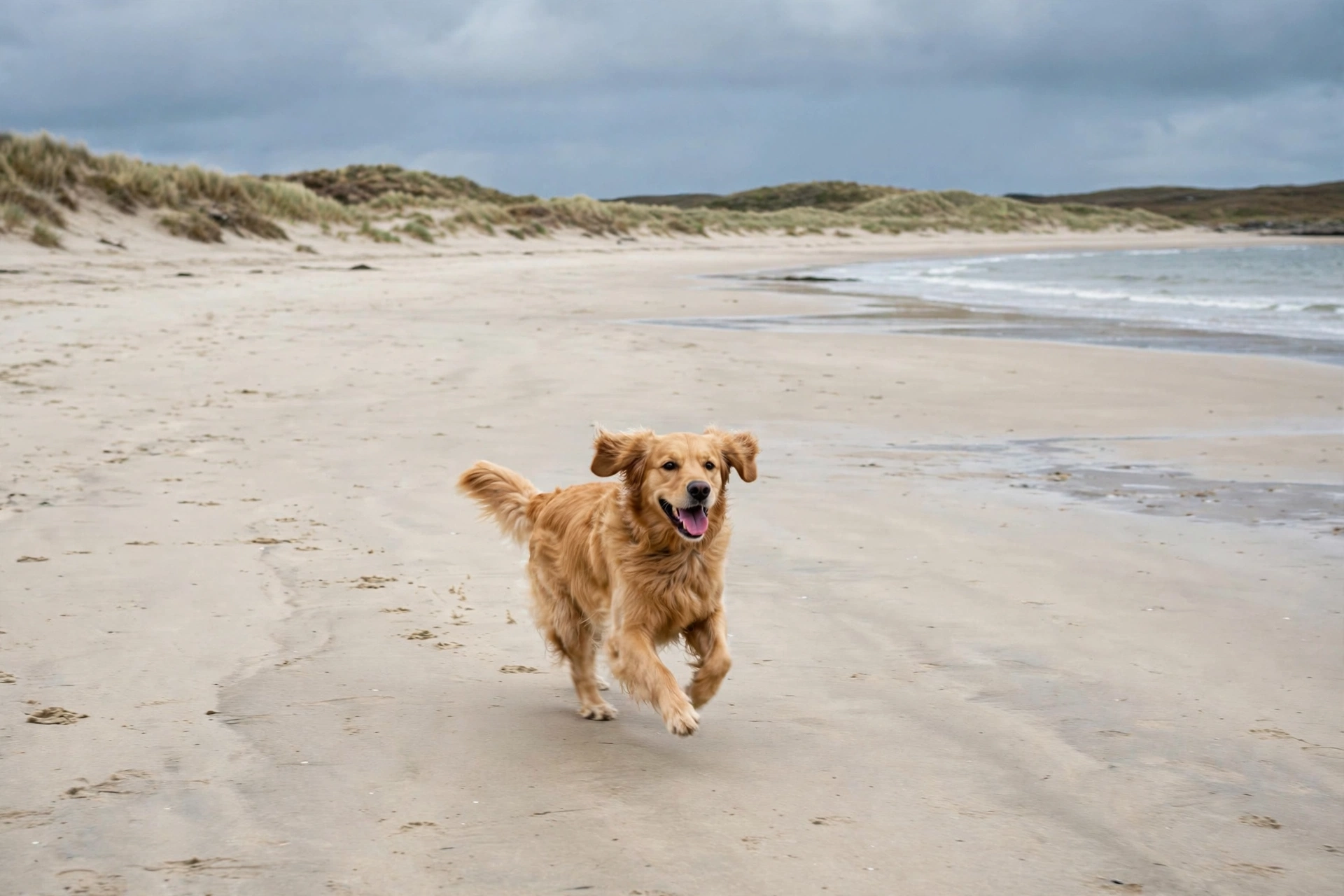
The first thing to understand about Gairloch is that the beach does the planning for you. The village sits on the shore of Loch Gairloch, a sea loch on the north-west coast of the Highlands, and its main beach is a wide sweep of pale sand that shelves gently into clear, shallow water. At low tide the wet sand firms up into a running track that dogs seem to read as an invitation, and the water stays shallow a long way out, which is exactly what you want when small children are paddling in the same stretch of shore as a wet spaniel. You do not need to choose between the children's day and the dog's day here, because the same patch of sand serves both.
Arrive with a plan for where the dog plays and where the children play, because that small piece of organisation is what keeps a shared beach day calm. Set your base — towels, windbreak, picnic — on the drier sand above the high-tide line, and let the dog's running happen on the firm wet sand near the water's edge. If your dog's recall is unreliable around other dogs or around food, use a long line for the first half hour until you can see who else is on the beach. A long line on a beach is not a failure of training; it is how you give a dog freedom without giving up control in a place full of picnics, toddlers and other people's dogs. Keep a second lead in the bag for the walk back through the village, where pavements and traffic return.
The sand itself is kind to paws and to bare feet. Unlike shingle beaches further down the coast, Gairloch's main beach has few sharp stones at the waterline, and the gradient is gentle enough that a dog can wade and splash without suddenly dropping into deep water. That matters for older dogs and for puppies on their first proper beach day, both of which tire faster than they look as if they will. Watch for the moment a dog starts to slow down on the run back — that is the moment to call them in, dry them off and let them rest in the shade of the windbreak, rather than letting them run until they are stiff and cold.
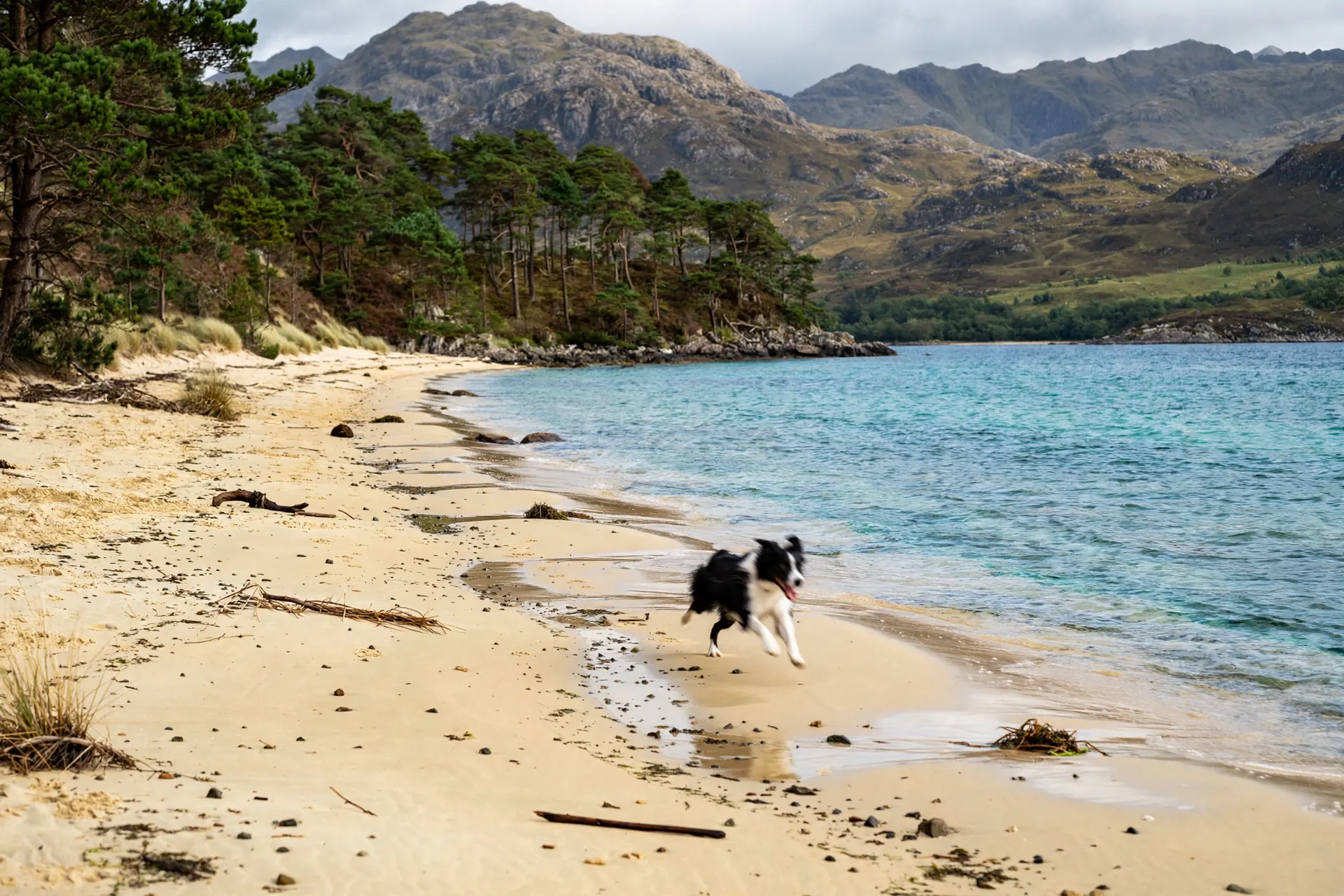
Beyond the village beach, the wider Gairloch area offers more sand for days when you want a change of scene. Big Sand, a short drive north of the village, is a long, quiet stretch that suits dogs who need space to run without meeting another dog every two minutes. Red Point, further on, is wilder and more exposed, with views across to the Isle of Skye on a clear day, and it rewards families who are happy to trade facilities for emptiness. Both are worth knowing about, but neither replaces the village beach for a first day, because the village beach is the one with parking, toilets and a short walk back to the car when a child or a dog has had enough. For a broader picture of Scotland's coast, our guide to dog-friendly beaches in Scotland covers seasonal rules, tides and the kit that makes a beach day work anywhere in the country.
Tides shape a Gairloch beach day more than the clock does, so check the tide times before you leave your accommodation. Low tide opens up the widest sand and the best running; high tide pushes everyone up against the dunes and the sea wall, and the beach can feel crowded even when it is not. A rising tide also changes the water at the edges, so keep an eye on where the children are paddling and where the dog is swimming, and move your base up the beach as the water comes in rather than packing up in a rush. Fresh water matters here too: dogs will drink seawater if they are thirsty, and a bellyful of salt water usually means an unhappy afternoon, so bring a bottle and a bowl and offer water regularly, especially on a warm day when the dog has been running hard.
A family day, hour by hour
A good Gairloch day with a dog and children has a rhythm, and the rhythm is: beach first, garden second, hills last — if the hills happen at all. Start early, while the beach is quiet and the light is low. Dogs are at their freshest in the morning, children are at their most patient, and the sand is empty enough for a proper run without weaving between other people's picnics. Let the dog burn off the morning energy on the wet sand, let the children build whatever the tide has not yet claimed, and eat a proper breakfast back at the cottage or in the car before the day warms up.
By late morning, move on while everyone is still happy rather than waiting for the first complaint. This is the moment for the garden stop, because a garden is a change of pace: slower, greener, quieter, and full of things to look at instead of things to chase. A dog on a lead can walk the paths, children can hunt for the tallest tree or the brightest flower, and the adults get a bench in the shade. The garden break also does something practical — it gets the dog out of the sun at the hottest part of the day and gives wet paws time to dry before the car. If the weather turns, a garden with sheltered paths and a cafe is a far better rainy-hour plan than a beach in a squall.
After lunch, judge the afternoon honestly. If the children are still bright and the dog is still keen, take the short hill or lochside walk described in the trails section below — something with a view at the end, a clear path, and a turnaround point you can reach without committing to a full mountain day. If anyone is flagging, skip the hill and go back to the beach for a second, shorter session at low tide, or walk the village shore road and let the children spot boats in the harbour. The mistake to avoid is the one every family makes once: pushing on to the big walk because the map says it is there, and arriving back at the car with a tired child, a stiff dog and nobody enjoying the drive home.
Build in the boring logistics before you need them. Know where the nearest toilets are, where you can refill the dog's water bottle, and where the car is parked relative to the beach, because the walk back with a wet dog, a bucket and spade, and a child who has decided they cannot walk another step is longer than it looks on the map. Keep a towel and a dry blanket in the car at all times, and keep the dog's dinner to its normal time even on holiday — a dog that eats late after a long hot day is more likely to be sick in the car. A small routine, kept the same every day, is what lets a dog relax on a trip instead of staying wired from morning to night.
Evenings in Gairloch are for the slow things: a walk along the shore road as the light fades, fish and chips eaten on a bench while the dog waits hopefully underneath, and an early night for everyone. The village is small enough that an evening stroll can be the whole entertainment, and the dog will be grateful for it — a short sniff-heavy walk after dinner settles a dog far better than another hour of running. If you are staying for several days, resist the urge to fill every hour; a dog that gets one big outing and one quiet evening each day will enjoy a week in Gairloch far more than a dog dragged through three attractions before lunch.
Gardens and green corners
Gairloch's great surprise is how green it is. The Gulf Stream warms this stretch of the west coast, and the result is a landscape where palm-like trees and lush planting grow at a latitude where you would expect bare moor. The best-known expression of that is Inverewe Garden, a National Trust for Scotland garden a short drive north of the village near Poolewe, and it is the single best calm stop in the area for a family with a dog. Dogs on leads are welcome in the outdoor areas, the paths are well kept, and the planting changes with every turn — walled garden, woodland walks, ponds and open lawns with views out over Loch Ewe. It is a place to walk slowly, which is exactly what a dog needs after a morning of running on sand.
Plan the garden visit as a proper outing, not a drive-by. Arrive with the dog already exercised, so the lead walk through the garden is a pleasure rather than a test of patience. Keep the dog on a short lead among the beds, stay on the paths, and be ready to step aside on narrow sections when other visitors pass — a dog that is fine on a wide beach can still be a trip hazard on a narrow garden path. Children tend to love the scale of the place: trees planted more than a century ago, hidden corners, and the sense that the next turn brings something different. Give them a job, such as counting the different colours of rhododendron in season or finding the tallest tree, and the walk becomes theirs as well as the dog's.
Check the practical details before you go, because gardens have more rules than beaches. Opening times vary by season, some areas may be closed for maintenance, and access rules for the house, cafe and any indoor spaces can differ from the rules for the garden itself. Dogs on leads are welcome in the outdoor areas, but the cafe and shop may have their own policies, so check the official guidance before you travel rather than assuming the dog can come everywhere you can. Bring water for the dog even on a cool day — garden walks are longer than they look, and there is not always a tap where you need one.
Closer to the village, the green corners are smaller but just as useful. The Flowerdale Glen, which runs inland from the village, is a wooded valley with a burn, a waterfall and a path that feels a world away from the beach in ten minutes of walking. It is a good choice for a hot afternoon, when the trees give shade the open sand cannot, and for a wet day, when the canopy keeps the worst of the rain off. The village itself has grassy areas around the harbour and the shore road where a dog can sniff and a child can watch the boats, and the community garden and the grounds of the local church are the kind of quiet spots that reward a slow evening walk. None of these replaces the big garden visit, but together they mean you are never far from a green, calm place when the dog needs one.
One more thing about gardens and dogs: respect the planting. A dog that digs in a flower bed or lifts a leg on a rare shrub will not be welcome back, and neither will its owner. Carry poo bags even in a garden — there will be a bin somewhere, and if there is not, carry the bag out with you. The gardens of the west Highlands survive because visitors treat them gently, and a dog owner who does the same is part of the reason dogs are still welcome there.
Mountain trails with a dog
The mountains are the reason many people come to this corner of the Highlands at all, and Gairloch sits within sight of some of the finest. To the south, the Torridon mountains — Beinn Alligin, Liathach and Beinn Eighe — rise in great ridges above Loch Torridon, and on a clear day their profiles dominate the horizon from the village. These are serious mountains, and the full ridge walks are not family dog walks: they are long, steep, exposed and, in places, require scrambling that no dog should be asked to do. Knowing that in advance is part of planning well, because the area also has plenty of lower, kinder walking that gives you the mountain feeling without the mountain risk.
The best family-and-dog walking around Gairloch stays low. The Flowerdale Glen path climbs gently through woodland beside a burn, with a waterfall as a natural turning point and benches where you can sit and watch the dog paddle. The beach circuit from the village links sand, shore road and quiet lanes into a loop that suits pushchairs as well as paws, and the lochside paths around Loch Maree, a short drive east, offer flat walking with big views and plenty of places to stop. These are the walks to build your days around: short enough to finish before anyone gets tired, interesting enough that children do not ask how much further, and with a clear end point so the dog knows when the work is done.
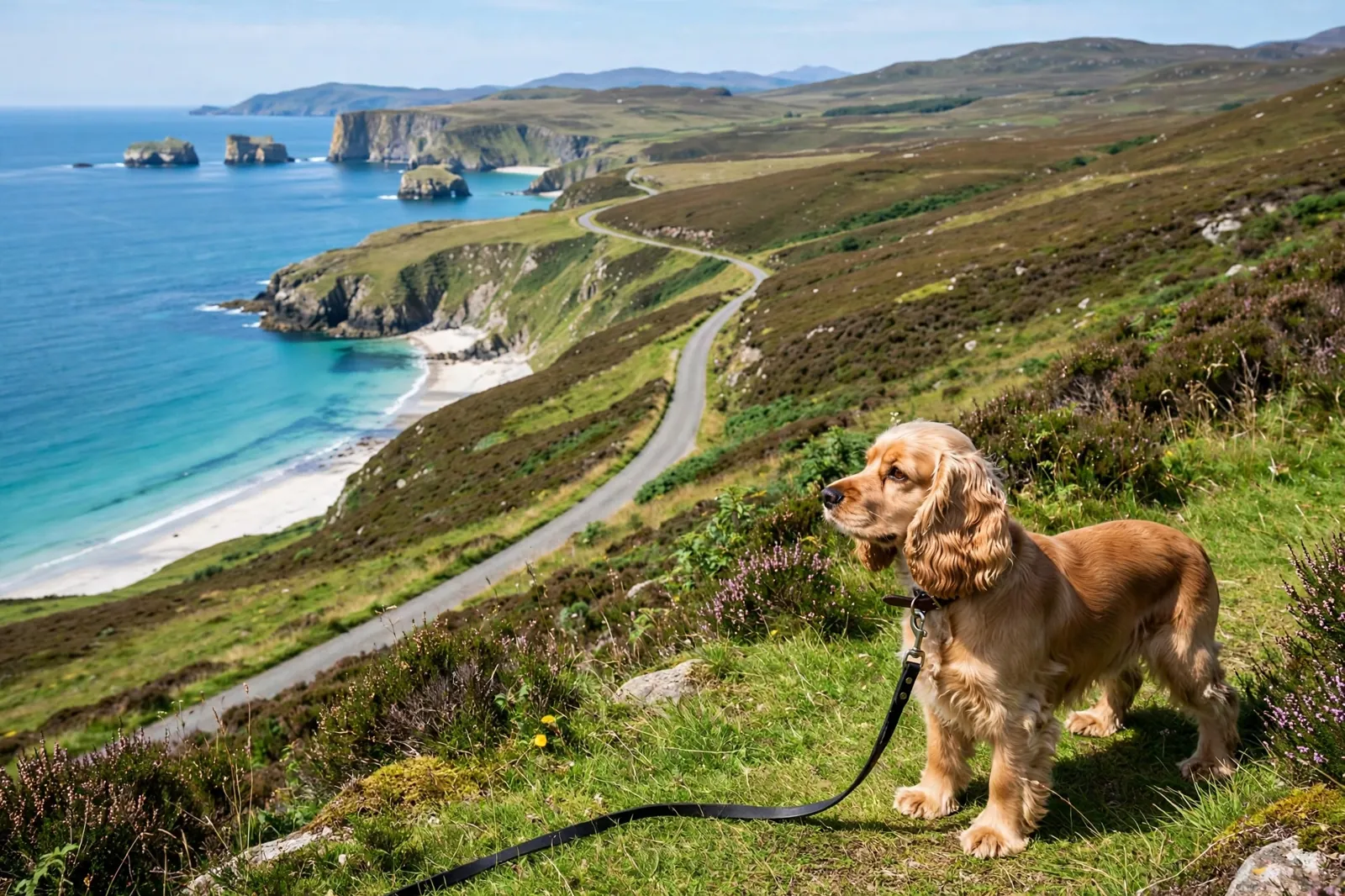
For stronger walkers with older children and a fit dog, the lower slopes and the coastal paths offer a step up. The path towards the hills above the village gives views back over the loch and out to the islands, and the reward-to-effort ratio is excellent — a steady climb, a wide view, and a downhill return that a dog will enjoy as much as the ascent. Even here, though, the rules of Highland walking apply: check the weather forecast before you set out, tell someone where you are going, carry water for the dog as well as for yourselves, and be ready to turn back. A dog cannot tell you it is overheating or that its paws are sore on rough rock, so watch for slowing down, seeking shade, or lifting paws — all signs to stop, rest and head down.
Livestock is a real consideration on Highland trails, and Gairloch is no exception. Sheep graze the open hillsides and the rough ground beside many paths, and the law and the local custom are clear: keep dogs on a lead or under very close control around livestock, at all times of year and especially in lambing season. A dog that chases sheep can cause serious harm and can put itself in danger too. Ground-nesting birds are another reason to keep a dog close on open moorland in spring and early summer — a dog running free through the heather can disturb nests that are invisible from the path. The countryside code is simple and it works: a lead on, a dog close, and a walk that leaves the landscape as you found it.
The wider North Coast 500 route passes through this area, and many visitors fold Gairloch into a longer Highland road trip. If that is your plan, our guide to the North Coast 500 with a dog covers the 516-mile route in detail — single-track road manners, campsite rules, midges and a daily rhythm that keeps a long drive enjoyable for the dog in the back seat. Treat Gairloch as the place to stop for two or three nights in the middle of that route, not as a place to rush through in an afternoon, and the mountains will still be there tomorrow.
Where to stay with a dog
Gairloch has a good range of places to stay for a village of its size — hotels, bed and breakfasts, self-catering cottages and campsites — but the honest truth is that the number of places that genuinely welcome dogs is small, and the best of them book early, especially in school holidays. Start looking as soon as the dates are fixed, and treat "dogs welcome" on a listing as the start of the conversation rather than the whole answer. The questions that matter are specific: is there a pet fee, and what does it cover; can the dog be left in the room or cottage briefly while you eat; is there an enclosed garden or a safe area for a last outing at night; and are there other dogs on site, which matters if yours is nervous or reactive.
Self-catering cottages often suit a family with a dog better than a hotel room, because they give you a kitchen, a door you can open straight onto a garden, and no shared corridor where a dog meets strangers at every turn. Look for cottages with hard floors downstairs, an enclosed garden, and a drying area by the door — three features that turn a wet Highland week from a chore into a holiday. Ask about the garden fence before you book: a low wall or a gap under a gate is enough for a determined terrier to escape, and a cottage that describes itself as having a garden is not automatically a cottage with a secure garden. If the cottage is near the shore, check whether the garden is fenced on the sea side as well as the road side.
Hotels and bed and breakfasts can work well, particularly for a shorter stay, but they need a different set of questions. Ask which rooms take dogs — it is often only the ground-floor rooms, and those may be the ones nearest the road or the car park. Ask where the dog eats and sleeps, whether the dog can come into the bar or the breakfast room, and what happens if the dog barks when you leave the room. A hotel that answers these questions clearly and without fuss is a hotel that has thought about dogs; a hotel that answers with a vague reassurance is one to be careful about.
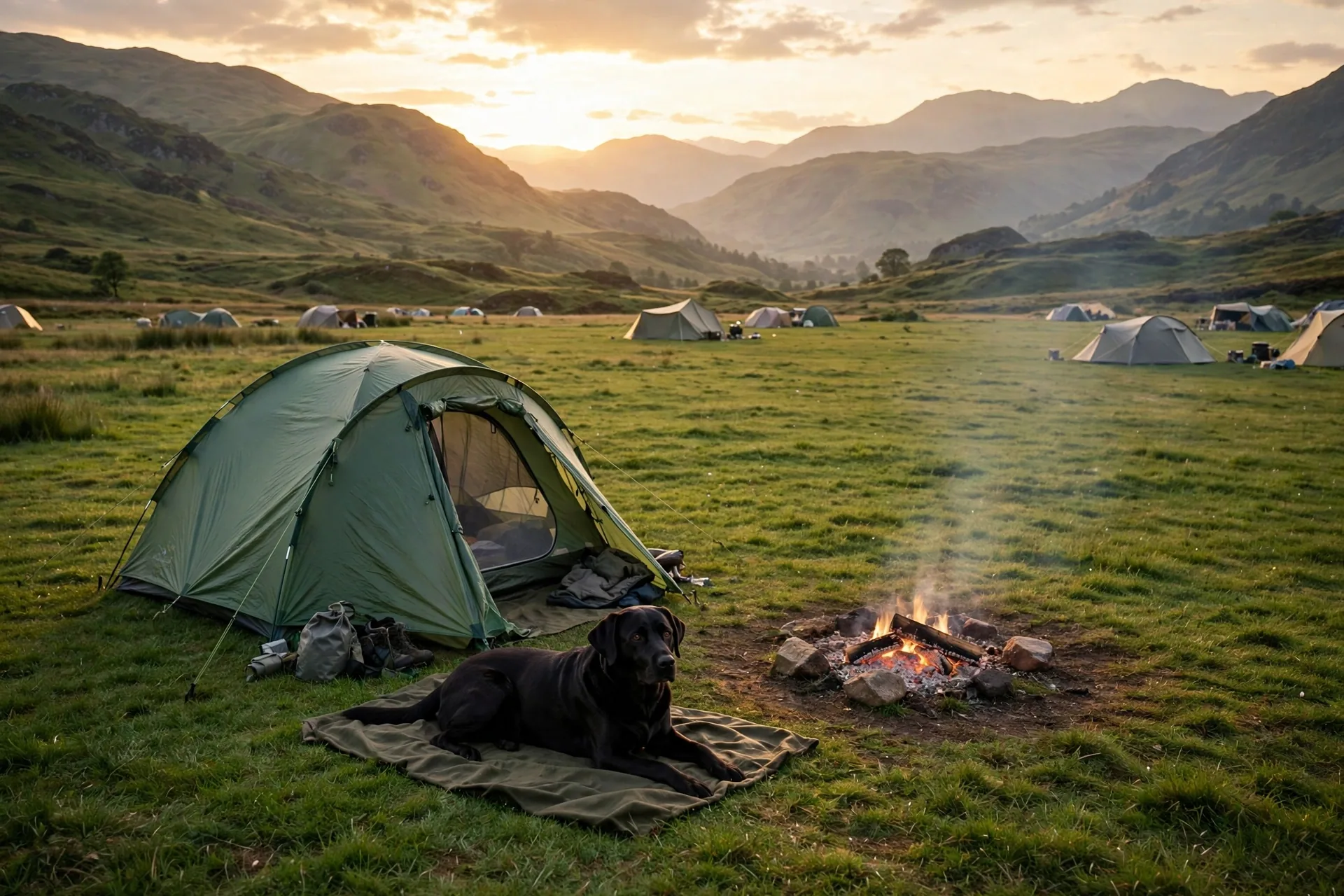
Campsites and caravan sites around Gairloch suit families who like the outdoors to start at the tent door, and several in the area welcome dogs. The same checks apply as for cottages — enclosed pitch, distance to the toilet walk, rules about dogs on leads — with one extra: ask about midges, because a still evening beside a loch can be miserable for humans and dogs alike, and a site with a breeze or a little elevation is worth choosing over a sheltered hollow. Our guide to camping with a dog in the UK covers site choice, tent setups, sleeping arrangements and the packing list in full, and it is worth reading before a first camping trip in the Highlands.
Whatever you book, get the dog arrangements in writing. A short email confirming the pet fee, the number of dogs, any size or breed conditions, and the rules about leaving the dog unattended is worth more than a phone call you cannot prove. Keep that email with your booking confirmation, and arrive with the dog's bed, food and water bowl from home — familiar smells settle a dog in a new place faster than anything else you can pack.
Eating out with a dog
Eating out with a dog in a small Highland village is easier than in a city, because so much of it happens outdoors. In good weather, cafes and pubs with terraces and beer gardens are the natural choice, and many in Gairloch welcome dogs outside. The pattern is familiar across the Highlands: dogs on the terrace, dogs in the beer garden, and a water bowl that appears without asking. Inside is a different matter — some places welcome dogs in the bar area, others do not, and the rules can change between lunch and dinner, so ask before you sit down rather than after you have ordered.
Plan meals the way you plan walks: with a backup. If the cafe you wanted is full, or the terrace is closed because of rain, have a second option in mind, and keep a picnic in the car for the days when nothing works. A picnic is often the best meal of a Gairloch day anyway — sandwiches eaten on the beach while the dog waits for the crusts, or a takeaway eaten on a bench above the harbour as the light goes. Fish and chips, the classic Highland seaside meal, suits a dog owner well, because it travels, it eats outdoors, and it leaves the dog with something to hope for.
Inside the places that do welcome dogs, a little preparation goes a long way. Bring a mat or a blanket for the dog to lie on, so it has a place that is its own and is not sprawled across a walkway. Order the dog's water first, before your own drinks, and give the dog a chew or a stuffed toy to work on while you eat — a busy mouth is a quiet mouth. If your dog is not settled in busy rooms, choose the quiet table by the door rather than the one in the middle, and be ready to take the dog outside for a short break halfway through the meal. A dog that has had a walk, a drink and something to chew is a dog that can lie quietly for an hour; a dog that has had none of those things is a dog that will tell the whole room about it.
Shopping for food with a dog is straightforward in the village: the local shops cover the basics, and the larger supermarkets are a drive away in the bigger towns. Stock up on the way in rather than assuming you can buy everything in the village, especially if your dog eats a particular food or needs medication with meals. Keep the dog's food in a sealed container in the car or the cottage, because Highland midges are not the only creatures interested in an open bag of kibble.
Getting there and getting around
Gairloch sits on the A832, the coast road that runs west from the A9 corridor through the Highlands to the sea. Most visitors arrive by car, and a car is close to essential once you are there: the village, the garden, the beaches and the trailheads are spread out along the coast, and public transport is thin. The drive itself is part of the trip — single-track roads with passing places, sheep on the verge, and views that make you want to stop every few minutes — so allow more time than the map suggests and plan the dog's comfort into the journey.
For the dog, a long Highland drive needs the same care as a long walk. Stop every two hours, offer water, and let the dog stretch its legs somewhere safe before you carry on. Never leave a dog in a parked car on a warm day, even with the windows open — a car in Highland sun heats up fast, and a dog that was fine at the start of a lunch stop can be in distress by the end of it. A sunshade for the back window, a cool mat, and a frozen water bottle wrapped in a towel all help on a hot day, and a familiar blanket on the back seat helps a nervous dog settle for the miles in between.
Single-track roads deserve a paragraph of their own, because they surprise first-time visitors. The rule is simple: use the passing places, let faster traffic overtake, and never park in a passing place. When you meet another car, the vehicle nearest a passing place pulls in; if the passing place is on your left, pull in, and if it is on your right, stop opposite it and let the other driver pull in. Dogs do not care about any of this, but they do care about the sudden stops, so keep the dog secure in the back and avoid the sharp braking that comes from meeting a car around a blind bend. Drive slowly, expect sheep and walkers around every corner, and enjoy the fact that the road itself is part of the holiday.
If you are arriving without a car, the nearest railway stations are a long drive away, and the bus service to the village is infrequent, so check timetables carefully and check the official guidance before you travel. Taxis are available but should be booked in advance, and not every taxi will take a dog, so confirm that when you book. For most families with a dog, the practical answer is to drive — and to treat the drive as the first day of the holiday rather than a chore to be endured before it starts.
When to visit
Gairloch changes with the seasons, and the best time to visit with a dog depends on what you want from the trip. Late spring and early summer bring long days, wildflowers, and the gardens at their best, but they also bring the midges. The Highland midge is a small biting fly that appears in calm, damp conditions, usually from late May to September, and it is worst at dawn and dusk near water and sheltered ground. Dogs are bitten too, particularly around the ears and belly, and a dog that is miserable with bites is a dog that will not enjoy the evening walk. A breeze is your friend — midges cannot fly in wind — so choose exposed beaches and hilltops on still evenings, carry repellent that is safe for dogs, and check the official guidance before you travel for the latest advice on midge protection.
Summer is the busiest season, and it has the most to offer: the longest days, the warmest sea, the gardens in full flower, and the village at its liveliest. It is also the season when accommodation books out first and the beaches are at their busiest, so book early and arrive at the beach early in the day. The sea is at its warmest in late summer, which matters for dogs that swim — a dog that will paddle happily in August may refuse the water in April, and there is no point in arguing with a cold dog about it.
Autumn is, for many dog owners, the best season of all. The midges fade, the crowds thin, the light turns golden, and the hills take on their autumn colours. September and October are often dry and bright, the sea is still warm enough for a swim, and the beaches empty out so that a dog can run without meeting another dog every few minutes. The days are shorter, so plan walks for the middle of the day and carry a torch for the walk back to the car, but the trade is worth it: an autumn week in Gairloch can feel like having the whole coast to yourself.
Winter is quiet, wild and beautiful, and it suits a particular kind of trip. The days are short, the weather can be fierce, and some attractions and cafes close or reduce their hours, so check opening times before you travel. But a winter beach with a dog, the mountains white above the loch, and a fire waiting back at the cottage is a holiday in its own right. Pack for the weather you might get rather than the weather you hope for: waterproofs, warm layers, a drying coat for the dog, and a head torch for the early dark. A dog that is warm, dry and fed will enjoy a winter beach as much as a summer one — and will have it almost entirely to itself.
Packing for beach, garden and hill
A Gairloch trip asks one bag to serve three different days — beach, garden and hill — so pack for all three and let the bag do the work. The essentials are the same for every day: fresh water and a bowl, poo bags, a lead and a long line, a towel, a drying coat, and a first-aid kit with tick removers, antiseptic and any medication your dog takes. Add a spare lead and a spare collar, because a lead lost in the sand or snapped on a fence is a small problem that becomes a big one if you have no backup.
For the beach, add a windbreak or a small shelter, a blanket for the dog to lie on, and a bucket for rinsing sandy paws before the car. Rinse the dog with fresh water after swimming in the sea — salt water dries into the coat and irritates the skin, and a dog that licks salt off its fur will drink more seawater than it should. A drying coat does more than keep the dog warm: it keeps the car seats dry on the way home, which matters more than it sounds after a week of wet dogs.
For the garden and the village, add a short lead, a mat for the dog to lie on in cafes, and a chew or a stuffed toy for quiet moments. For the hills, add a rucksack with water for everyone, a bowl that packs flat, a whistle for recall, a torch, and a warm layer for the dog if it is small, old or short-coated. A dog first-aid kit for the hills is worth a few minutes of thought: tick removers are essential in the Highlands, where ticks are common in bracken and long grass from spring to autumn, and a small pair of tweezers and a magnifying glass make checking a wriggling dog much easier.
Finally, pack for the car as well as for the dog. A waterproof seat cover or an old blanket, a box for muddy leads and wet towels, a dustpan and brush for the sand that will get everywhere, and a bag for rubbish. Highland sand has a way of appearing in places you did not know existed, and a five-minute clean at the end of each day is easier than an hour of cleaning at the end of the week. Keep the dog's food, bed and water bowl in the same place every day, and the dog will settle into the routine of the trip within a day or two.
Safety: tides, livestock and weather
Three things deserve respect on a Gairloch trip: the tide, the livestock and the weather. The tide is the most predictable of the three and the easiest to get wrong, because a beach that is wide and safe at low tide can narrow quickly as the water comes in. Check the tide times every morning, keep an eye on the water while the children paddle, and never let a dog swim near a river mouth or a harbour entrance, where currents are stronger than they look. If the dog swims, watch it the way you would watch a child: a dog that is tired, cold or caught in a current will not always make a fuss about it, and the moment to call it in is before it gets into trouble, not after.
Livestock is the second thing to respect, and the rule is simple: dogs on leads around sheep, cattle and horses, every time, without exception. The Highlands are a working landscape, and the fields and hills around Gairloch are grazed by animals that do not know your dog and do not want to meet it. Lambing season, roughly spring, is the most sensitive time, but the rule applies all year. If you meet cattle on a path, give them a wide berth, keep the dog close, and walk calmly past rather than running — and if cattle block the path, find another way round rather than pushing through with a dog.
Weather is the third, and Highland weather changes faster than anywhere else in Britain. A sunny morning can become a wet, windy afternoon in an hour, and a hill that was clear at breakfast can be in cloud by lunch. Check the forecast before every walk, carry waterproofs even on a sunny day, and be ready to change the plan — the beach instead of the hill, the garden instead of the beach. A dog that is cold and wet is a dog that will not enjoy the next day either, so dry the dog properly after every outing, check paws for cuts and thorns, and keep an eye out for ticks after walks through bracken and long grass.
Know where the nearest vet is before you need one. The nearest practices are a drive away, and rural vets may have limited hours, so save the number in your phone on arrival and note the out-of-hours arrangements. If the dog eats something it should not have on the beach — fish hooks, bait, or the remains of a picnic are all possible — call the vet rather than waiting to see what happens. A little preparation, done on the first evening, is what turns a small scare into a short phone call instead of a long drive in the dark.
Practical questions
Before you go
Are dogs allowed on Gairloch beach all year?
Gairloch beach is generally dog-friendly all year, with no seasonal dog ban of the kind some busier resorts enforce. Dogs should be kept under close control, especially around children and other beach users, and owners should pick up after them. Local rules can change, so check the official guidance before you travel.
Is Inverewe Garden dog-friendly?
Dogs on leads are welcome in the outdoor areas of Inverewe Garden, which makes it a good calm stop between beach and hill days. Keep your dog on a lead among the planting, stay on the paths, and check the official guidance before you travel, because access rules for the house, cafe and any indoor spaces can differ.
Can children and dogs share the same beach day in Gairloch?
Yes, and that is exactly what Gairloch does best. The village beach has firm sand, shallow water at low tide and space for children to paddle while a dog runs nearby. Set up in one spot, give the dog a long line if recall is unreliable, and keep the dog's play area separate from small children's sandcastles so everyone stays happy.
Which Gairloch walks suit a dog and a family together?
The beach circuit from the village, the Flowerdale Glen path and the low-level lochside walks suit mixed groups best: short distances, gentle gradients and plenty of interest for children. Save the higher mountain routes for a adults-only or older-children day, and always check the official guidance before you travel for path conditions.
Where can we stay in Gairloch with a dog?
Gairloch has dog-friendly hotels, bed and breakfasts, self-catering cottages and campsites, but the number of genuinely dog-welcoming places is small, so book early in school holidays. Ask in writing whether the dog can be left briefly, whether there is an enclosed garden, and what the pet fee covers before you pay.
What should I pack for a dog beach day in Gairloch?
Pack fresh water and a bowl, a long line, towels and a drying coat, a windproof layer for everyone, sun protection, poo bags, a first-aid kit and a spare lead. Highland weather changes fast, so bring warm layers even on a sunny morning, and take a car blanket for the drive home after a wet, sandy swim.