This guide is independent and contains no paid placement. If affiliate links are added later, they will be clearly marked and will not change our editorial checks.
Base yourself at the docks: a flat quayside loop past Victorian warehouses and canal locks, a short walk to the cathedral for a split visit, and miles of riverside and towpath walking on the Severn and the Gloucester and Sharpness Canal. Keep the dog on a lead by the water, check flood conditions in winter, and ask at each pub or cafe before settling in.
Why Gloucester works with a dog
Gloucester is not the obvious first choice for a dog break in the South West, and that is part of its appeal. It is a small, flat cathedral city on the River Severn, about 40 miles north-east of Bristol and close to the edge of the Cotswolds, with a historic dock basin that has been turned into a walkable waterfront rather than a fenced-off attraction. The centre is compact enough to cross on foot in twenty minutes, the ground is mostly level, and the best dog walking in the city — the quaysides, the canal towpath and the riverside paths of Alney Island — starts within a few minutes of the car parks.
The city has been a port for a very long time. Roman Glevum stood here, and the docks that survive today are Victorian: a basin and warehouses built in the 19th century, when Gloucester handled timber, grain and other cargoes brought up the Severn and along the Gloucester and Sharpness Canal, which opened in 1827 and still runs about 16 miles south-west to the Severn estuary at Sharpness. The warehouses are now shops, offices, museums and flats, but the water, the locks, the swing bridges and the working boats are still there, which gives a dog walk here far more to look at than a standard town-centre circuit.
For a dog owner, the practical case is straightforward. There is a natural loop around the dock basin that takes under an hour at a sniffing pace, with benches, bins and places to stop. The cathedral sits on a green at the top of the city, with open grass where a dog can rest while the humans take turns inside. The canal towpath offers a flat, car-free out-and-back walk of any length you like, which suits older dogs, puppies in training and anyone travelling with a pushchair alongside the lead. And because Gloucester is a working city rather than a resort, prices for parking, food and rooms are generally lower than in the honeypot towns of the Cotswolds a few miles east.
That said, Gloucester is a city with real water hazards, and the guide that follows is built around them. The dock basin, the canal and the tidal River Severn are all unfenced in places, and the Severn floods. Dogs should be on a lead beside water unless you are in a spot you know to be enclosed and safe, and winter visits need a quick check of river levels before you plan a riverside walk. None of this is difficult; it just rewards a little planning, which is what the rest of this guide is for.
The docks loop: warehouses, locks and water
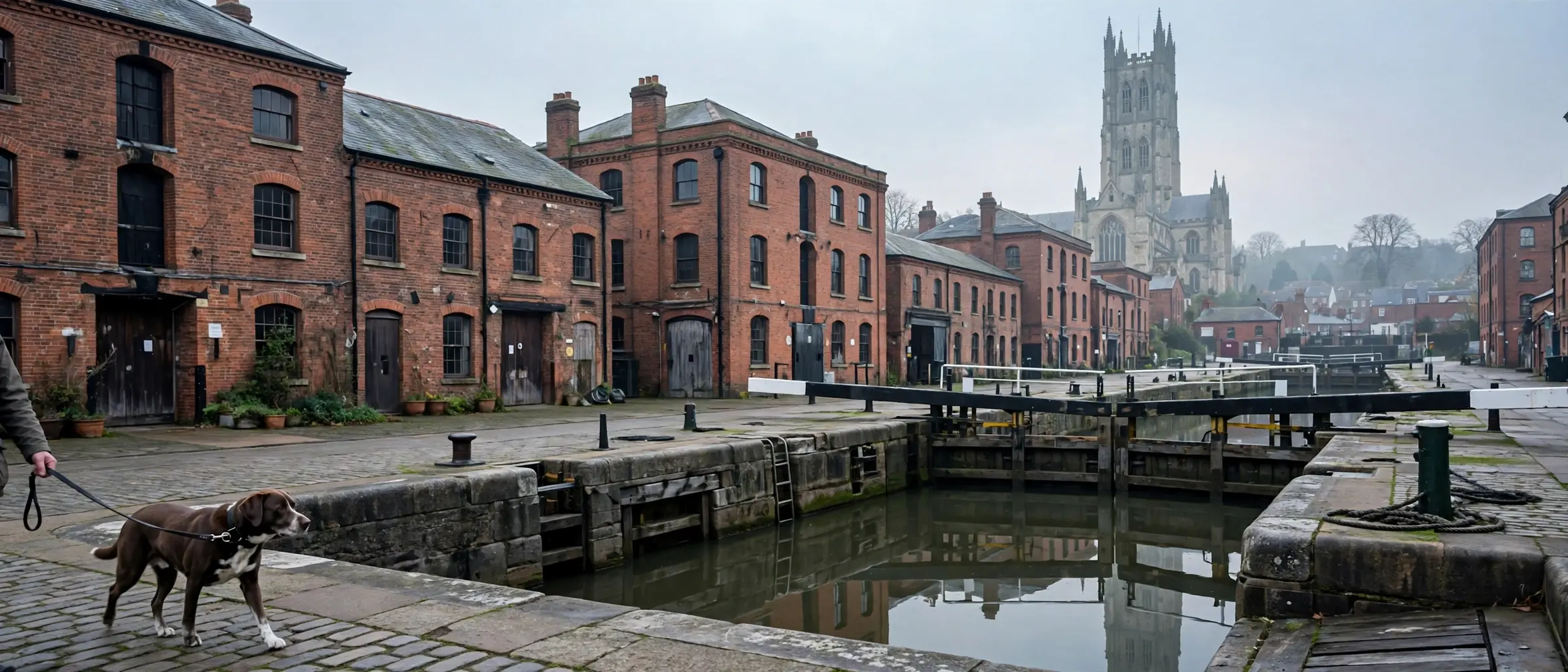
The obvious place to start is the docks themselves, and the obvious way to see them is a slow loop around the basin. The main basin is fringed by tall red-brick warehouses, most of them listed buildings from the 19th century, with the Mariners' Chapel, the dry dock and the lock gates that connect the basin to the canal at one end and to the Severn at the other. A full circuit on the quayside is roughly a mile, flat and paved, and takes most dogs 40 to 60 minutes once you allow for the inevitable pauses to watch boats, ducks and the lock mechanisms.
Walk the loop clockwise from the quayside near Gloucester Quays and you pass the main basin, the barge arm and the entrance to the canal, where narrowboats and larger craft moor. The locks are the most interesting part for a human and the part that needs the most care with a dog: the ground can be wet and slippery, the edges are low, and there is no fence between the towpath and the water in several places. Keep the lead short here, keep the dog on the landward side of the path where possible, and do not let a dog investigate the lock gates or the chains. The same applies at the swing bridge and at the dry dock, where the drop is greater than it looks from above.
The National Waterways Museum sits on the quayside in a former warehouse, and it is worth knowing before you arrive that dogs are generally not allowed inside museum buildings of this kind, with assistance dogs the usual exception. The outside is the point for a dog owner anyway: the moored historic boats, the dockside cranes and the open quays give you most of the atmosphere without a ticket. If one person in your party wants to go inside, the split-visit pattern works here as it does at the cathedral — one person stays with the dog on the quayside while the other looks around, then you swap. Check the official guidance before you travel for current admission rules and any seasonal opening hours.
Llanthony Secunda Priory, a short walk south of the docks along the canal side, is another worthwhile stop. The priory was founded in the 12th century and its surviving buildings, including a medieval tithe barn, stand in open grounds near the water. The grounds are a quieter contrast to the busy quayside and a good place to let a dog settle for a few minutes, on a lead, before you head back. The area around the priory and the canal is also where you are most likely to meet moored boats with dogs of their own living aboard, so keep greetings controlled and ask the other owner before letting dogs approach.
Two habits make the docks loop work well. First, walk it early. The quayside is at its best in the morning, before the shops and cafes fill up, when the light is low on the warehouse brickwork and the water is calm. Second, carry water for the dog in summer: the quayside is exposed, with little shade on the south side of the basin, and a dog walking on warm paving will need a drink before the loop is done. There are cafes and pubs around the docks where you can refill a bowl, but do not rely on finding one open at the far end of the circuit.
Cathedral and city centre, dog in tow
Gloucester Cathedral dominates the city from College Green, a broad stretch of grass at the top of Westgate Street. The building began as an abbey church in 1089, and what stands today is one of the finest examples of English Perpendicular Gothic architecture, famous for its great east window, its fan-vaulted cloisters and its tower, which can be seen from the docks and from the canal. The cloisters are well known to film fans, having appeared in several Harry Potter films, and they draw visitors year-round.
Dogs are not generally allowed inside the cathedral, except for assistance dogs, so plan a split visit. The arrangement that works best is simple: walk the dog to College Green first, let them settle on the grass with water and a chew, then one person goes inside while the other stays with the dog. The cathedral interior rewards at least 30 to 45 minutes, so the person outside should have a book, a bench and a plan for a short loop around the close if the dog gets restless. Swap over, and the second person gets the same time inside. Check the official guidance before you travel, because rules for services, concerts and special events can differ from the usual visiting arrangements, and the cathedral sometimes closes parts of the building for filming or private functions.
College Green itself is a good dog stop even without the cathedral visit. It is open, grassy and relatively quiet compared with the shopping streets, and it gives a dog a proper sniff and rest after the paved walk up from the docks. Keep the dog on a lead: the green is next to roads, and it is a place where people sit, eat lunch and take photographs, so a loose dog will be noticed quickly. Pick up after your dog here as everywhere in the city — the green is a well-used public space and the bins are easy to find.
From the cathedral, the city centre runs downhill along Westgate Street and Eastgate Street towards the Cross, where the four main streets meet, and on to Southgate Street and the docks. The shopping streets are pedestrianised in places and busy at weekends, so walk them with a short lead and be ready to step aside into a doorway if your dog is nervous in crowds. The covered market and the shops are not dog-friendly indoors as a rule, so treat the centre as a place to walk through and look at rather than a place to browse at length with a dog. If you need supplies, there are supermarkets and pet shops within a short drive of the centre, and it is easier to do that errand without the dog in tow.
Two smaller city-centre stops are worth knowing about. The Folk of Gloucester, a museum of local life in a row of Tudor buildings on Westgate Street, and the Soldiers of Gloucestershire Museum at the docks both follow the usual pattern for museums: assistance dogs only inside, so use the split-visit approach if you want to go in. The Guildhall and the King's Square area are open public spaces where a dog on a lead is fine, and King's Square has been redeveloped as an events space, so check what is on before you walk through with a reactive dog — markets, fairs and performances can turn a quiet square into a noisy crowd with little warning.
Riverside and towpath walks
The walking beyond the docks is where Gloucester earns its keep for dog owners, because the city sits between two long, flat waterways. To the west is the River Severn, the longest river in Britain at about 220 miles, and to the south-west runs the Gloucester and Sharpness Canal, a straight, level channel with a towpath that is one of the easiest long walks in the region. Both are within a few minutes of the centre, and both reward a dog that likes water, birds and long, straight sniffs.
Alney Island is the nearest proper riverside wild space. It is a low island of meadows and wet woodland between two channels of the Severn, just west of the city centre and reached on foot from the docks area or from the west bank. The island is a nature reserve, and its paths are grassy and can be very muddy after rain, so wear boots and expect a muddy dog. Birds are the main attraction here — herons, egrets, ducks and, in winter, wading birds — which means a dog should be on a lead throughout, both for the wildlife and because the riverbanks are steep and the current is strong. Do not let a dog swim in the Severn: the river is tidal this far down, the banks are undercut in places, and the water is cold and fast even when it looks calm.
The Severn Way, a long-distance walking route that follows the river from its source in Wales to the sea, passes through Gloucester, and the sections near the city are the easiest to use for a short out-and-back walk. North of the city, the path follows the river towards the villages of the Severn Vale; south of the city, it runs towards the estuary. Both directions are flat, but the paths are unsurfaced in places and flood in winter, so check conditions before you set off and have a dry alternative in mind. A practical rule is to walk out for 30 minutes and turn back, rather than committing to a long linear route with a tired dog and no easy exit.
The canal towpath is the more reliable option in wet weather and for dogs that need a predictable surface. From the docks, the towpath runs south-west alongside the canal for about 16 miles to Sharpness, passing through the villages of Hempsted, Quedgeley and Hardwicke. The first two or three miles from the city are the most used and the best surfaced, with a wide, level path that suits older dogs, dogs recovering from injury and anyone walking with a pushchair. Walk out for as far as suits your dog — an hour out and an hour back is a solid half-day — and turn at a bridge or a mooring where you can cross back towards the road if you need a lift or a shortcut home.
Canal etiquette matters more here than on a riverside path, because the towpath is shared with cyclists, anglers and boat crews. Keep your dog on a lead at all times on the towpath, and keep to the landward side so that dogs do not step into the path of a cyclist coming up behind. Move aside at locks and bridges, where the path narrows and boat crews are working with ropes and windlasses, and never let a dog jump onto a moored boat or drink from the canal near a boat's water intake. Anglers deserve a wide berth: give their lines and tackle plenty of room and keep the dog from investigating their bait boxes.
If you want a bigger open space, Robinswood Hill Country Park, on the south-eastern edge of the city, offers about 250 acres of hill, woodland and grassland with views across the Severn Vale to the Cotswolds and the Forest of Dean. The climb to the top is steep in places and not suitable for every dog, but the lower paths and the open grass at the base give a good hour of off-lead-friendly walking where the ground allows — check the official guidance before you travel for current access rules, as parts of the park are managed for wildlife and livestock may be present. After rain, the hill paths are slippery, so use the surfaced tracks and save the summit for a dry day.
Eating and drinking with a dog
Gloucester's dog-friendly eating and drinking scene is concentrated in two places: the docks and the city centre. Around the quayside, several pubs and cafes have outdoor seating where dogs are welcome, and a few allow dogs inside in defined areas. The pattern is the same as in most British cities — it varies by venue, by season and sometimes by the manager on duty — so the rule is to ask before you settle in, and to have a backup in mind if the first place says no.
Start with the terrace. In good weather, the quayside pubs and cafes put tables outside facing the water, and these are the easiest places to eat with a dog: the dog can lie under or beside the table, there is usually a water bowl on request, and nobody minds a well-behaved dog settling down for an hour. Bring a mat or a blanket for the dog to lie on, because quayside paving is hard and cold, and keep the lead short enough that the dog cannot wander into the walkway or under a neighbouring table. In winter, the same venues may have a dog-friendly area inside, often near the door, but indoor space is limited and it is worth ringing ahead, especially at weekends or during events at the docks.
In the city centre, the pubs on Westgate Street and around the Cross are the most likely to welcome dogs, and the cafes on the quieter side streets are worth trying too. The same habits apply: ask at the door, choose a table out of the main walkway, settle the dog with a chew or a stuffed Kong, and order at the bar rather than leaving the dog alone at the table. If your dog barks at strangers or other dogs, pick a table at the edge of the room and keep visits short — a calm twenty minutes with a coffee is better for everyone than a stressed hour over a full meal.
Food shopping and picnics are a practical alternative, and Gloucester suits them well. Buy sandwiches or picnic food from the city centre or the Quays, then eat on a bench at the docks or on the grass at College Green, where the dog can rest beside you without the pressure of a busy dining room. The farmers' market, which runs on selected days in the city centre, is worth a look for local food, but markets are crowded and noisy, so walk through with a short lead and do not linger with a nervous dog. Check the official guidance before you travel for market dates, as these change through the year.
A final point on cafes and pubs: water is the dog's priority, not yours. Carry a collapsible bowl and offer water at every stop, especially in summer on the exposed quayside. Most venues will refill a bowl without being asked, but do not rely on it, and do not let a dog drink from the dock basin or the canal — the water is not clean, and the edges are dangerous for a dog that slips in.
Staying overnight with a dog
Gloucester has a useful range of dog-friendly places to stay, from city-centre hotels and bed and breakfasts to self-catering cottages and holiday parks on the edge of the city and in the surrounding villages. The docks area has hotels overlooking the water, which put you straight onto the quayside loop in the morning, while the villages towards the Cotswolds and the Forest of Dean offer quieter bases with gardens and direct access to country walks. Choose the base that fits your dog: a calm older dog will be happy in a city-centre hotel with a short walk to the docks, while a young, energetic dog will be better in a place with a garden and a field nearby.
Whatever you book, confirm the dog rules in writing before you pay. Ask the same five questions every time: how many dogs are allowed, what the pet fee is, whether dogs can be left alone in the room and for how long, whether dogs are allowed in the bar or restaurant, and where the nearest toilet walk is after dark. A hotel that charges £10 per dog per night with a clear rule is a better bet than one that says "dogs welcome" and then produces a list of restrictions at check-in. If you are comparing self-catering options, our guide to dog-friendly holiday parks in the UK explains pet fees, boundaries and the questions that matter most before you book a longer stay.
Rooms need a little preparation. Bring the dog's own bed and a familiar blanket, because a hotel room smells of other dogs and a known bed is the fastest way to settle a nervous animal. Pack a non-slip mat for hard floors, a spare lead, poo bags, a towel for wet paws and a chew for the evening. Check the room on arrival for hazards — trailing cables, cleaning products under the sink, chocolate or biscuits left as a welcome gift — and move anything the dog could reach. If the room has a balcony or a low window, keep the dog away from it.
Leaving a dog alone in a room is the question most owners get wrong. Many hotels and cottages prohibit it outright, and those that allow it usually limit it to a short period with the dog crated and quiet. Plan as if the answer is no: eat where the dog can come too, use split visits for attractions, and take the dog with you for the evening. If you must leave the dog, keep it to under an hour, leave the television or radio on low, and tell reception where you are going and when you will be back. A barking dog in a hotel corridor is noticed quickly, and a complaint can end a stay.
For longer stays, consider using Gloucester as a base for the wider area. The Cotswolds begin a few miles east, the Forest of Dean is about half an hour west, and the Severn Vale villages offer quieter walks within a short drive. A week in a cottage with a garden, using the city for the docks and the cathedral and the countryside for the long walks, is a better shape for most dogs than a week in a city-centre hotel. Our city guide to York with a dog shows the same split-visit and base-planning approach applied to another historic city, and the habits transfer directly — plan the day around the dog's walking and resting needs first, and fit the sightseeing around them.
Getting there, parking and getting around
Gloucester is easy to reach by road. The M5 runs past the city, with junction 12 serving the south of Gloucester and the docks, and junction 11a serving the north and the route towards Cheltenham. From London, the usual route is the M4 to the M5 or the A40 through the Cotswolds, and from Birmingham it is a straight run south on the M5. Allow extra time on summer weekends and during events at the docks, when the roads around the quayside and the city centre can be slow. If you are towing a caravan or driving a large motorhome, check the official guidance before you travel for height and width limits on the routes into the docks area, as some of the older streets are narrow.
By train, Gloucester station is about a ten-minute walk from the docks and the city centre, with services to Bristol, Birmingham, Cheltenham, Cardiff and London Paddington, usually with a change. Dogs travel free on most UK trains if they are kept on a lead and under control, and small dogs can travel in a carrier on your lap. The walk from the station to the docks is flat and paved, but it crosses busy roads, so keep the dog on a short lead and use the pedestrian crossings. Check the official guidance before you travel for engineering works and timetable changes, which are common on this line at weekends.
Parking is straightforward if you plan it. The docks area has several car parks within a few minutes' walk of the quayside, including the car parks at Gloucester Quays, and the city centre has multi-storey car parks near the shops. Charges vary by location and by day of the week, so check the official guidance before you travel for current prices and any height restrictions if you are in a tall vehicle. Park-and-ride sites on the edge of the city, including the site at Waterwells on the south side, are a calmer option in busy periods and at Christmas, when the city centre fills up. From a park-and-ride, the bus into the centre is short, but dogs on buses are at the driver's discretion, so check with the operator before you rely on it — walking in from a nearby car park is often simpler with a dog.
Once you are in the city, walking is the best way to get around. The centre is compact, the docks are flat, and the towpath is car-free. If you need to drive between walks — to Robinswood Hill, to Alney Island from the west bank, or out to the Severn Vale villages — the roads are short and the drives are easy, but remember that rural lanes around the Severn can flood after heavy rain, and a road that was open in the morning can be closed by the evening. Keep the car stocked with water, a towel and a spare lead, and never leave a dog in a parked car in warm weather, even for a few minutes: the interior of a car heats up far faster than most people expect.
Local buses serve the villages and the park-and-ride sites, and taxis are available from the station and the city centre. If you are booking a taxi with a dog, say so when you ring, because some drivers will not take dogs and it is better to know before the car arrives. For a longer stay, a car is worth having: the best dog walks around Gloucester — the Severn Vale, the Cotswolds edge and the Forest of Dean — are all much easier to reach by car than by public transport.
Seasons, tides and the Severn
Gloucester works in every season, but the city changes character with the river, and the best visit is the one that matches the conditions. Spring and autumn are the easiest seasons for a dog break: the temperatures are mild, the quayside is quiet, the canal towpath is firm underfoot, and the city centre is calm outside school holidays. May and September are often the sweet spot, with long daylight, open cafes and fewer crowds than the summer peak.
Summer brings the busiest docks. The Tall Ships Festival and other waterfront events draw large crowds to the quayside, and the city centre and the Quays fill up at weekends. These events are worth seeing, but they are not ideal for a nervous or reactive dog: the crowds are dense, the noise carries across the water, and the quayside walkways become bottlenecks. If you visit during an event, walk the docks early in the morning before the crowds arrive, use the canal towpath for the dog's main exercise, and keep the dog's evening walk to the quieter streets. Summer heat is the other concern: the quayside is exposed, with little shade, and the paved surfaces get hot. Walk early or late, carry water, and check the paving with your hand before you set off — if it is too hot for your palm, it is too hot for paws.
Winter is the season that needs the most respect for the river. The Severn floods regularly, and the low-lying paths on Alney Island and along the riverbank can be under water for days after heavy rain. The Severn Bore, the tidal wave that runs up the river on large tides, is a famous local spectacle and draws crowds to the riverbank at places like Over and Minsterworth, but it is not a dog event: the banks are crowded, the water is fast and the ground is slippery. If you want to see the bore, go without the dog or watch from a safe distance with the dog on a short lead well back from the bank. Check the official guidance before you travel for bore times, flood warnings and road closures.
Autumn brings its own hazards. Fallen leaves hide slippery paving and wet towpaths, conkers and acorns are a poisoning risk for dogs that eat them, and fireworks around early November unsettle noise-sensitive dogs across the city. Keep the dog on a lead near horse chestnut and oak trees in parks and on the towpath, and plan fireworks night around the dog: stay in, keep the curtains closed, and walk early before the displays start. In spring, the canal and the riverbanks are busy with nesting birds, so keep the dog on a lead and away from the water's edge where ducks and swans are nesting.
A practical packing checklist
A Gloucester trip does not need specialist kit, but a little preparation makes the water, the mud and the city crowds much easier. Pack for three conditions at once: paved quaysides, muddy riverside paths and a hotel or cottage room. That means a short lead and a long line, a harness that fits well, and a collapsible water bowl that lives in your pocket rather than in the car.
- Two leads: a short lead for the quayside, the city centre and the locks, and a long line for the open grass on Alney Island and Robinswood Hill where the rules allow it.
- Water and a bowl: a bottle and a collapsible bowl, refilled at every cafe stop. Do not let the dog drink from the dock basin, the canal or the Severn.
- Towels and a drying coat: riverside paths are muddy after rain, and a wet dog in a hotel room is nobody's idea of a good evening. Two towels and a drying coat cover most trips.
- Poo bags and a holder: the docks, the towpath and College Green all have bins, but carry more bags than you think you need, especially on the long canal walk where bins are spaced out.
- A mat or blanket: for the dog to lie on in pubs, cafes and on the quayside, where the paving is hard and cold.
- A chew or stuffed Kong: for split visits at the cathedral and the museums, when one person stays outside with the dog.
- Boots and a waterproof: for you, not just the dog. Riverside paths and the towpath are slippery and muddy in winter, and the Severn Vale is an exposed, windy place in bad weather.
- An old towel for the car: to protect the seats and to dry the dog before the drive home.
Before you travel, save three numbers in your phone: the nearest vet to the docks, the number of your accommodation, and the number for the local council's dog warden service. Check the official guidance before you travel for flood warnings, event dates at the docks and any changes to cathedral visiting hours. Then plan the day the way the city rewards: docks in the morning, cathedral at midday with a split visit, a long towpath walk in the afternoon, and an early evening on a quayside terrace with the dog settled under the table. Gloucester is at its best taken slowly, and a dog is the perfect excuse to do exactly that.
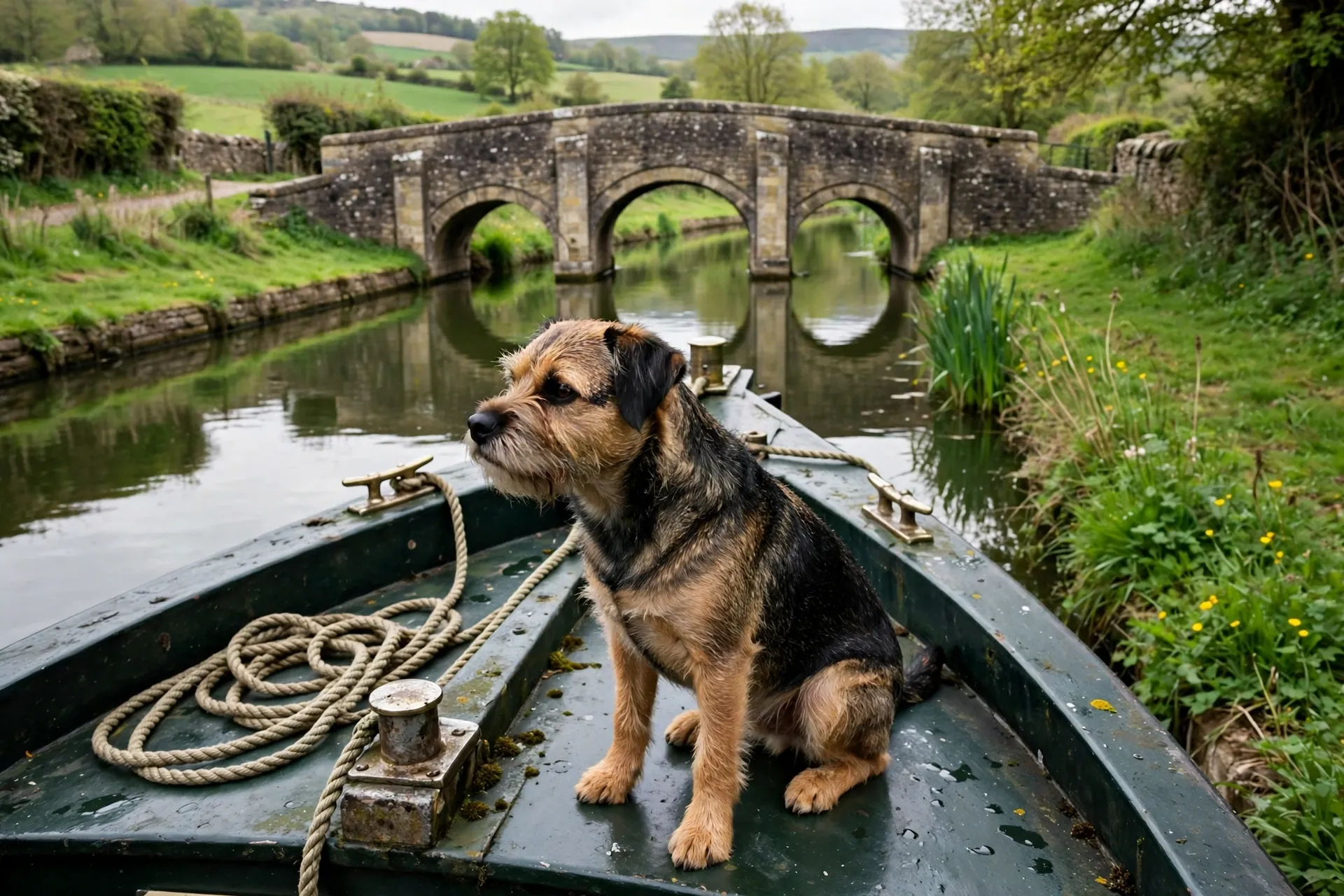
If the waterways have caught your imagination, our guide to canal boat holidays with a dog covers hiring a narrowboat, life jackets, locks and mooring routines for a slower holiday on the canals — a natural next step after a first walk along the Gloucester and Sharpness Canal towpath.
Practical questions
Before you go
Can my dog go inside Gloucester Cathedral?
No, dogs are not generally allowed inside the cathedral itself, except for assistance dogs. Plan a split visit: one person stays outside with the dog on College Green or in the cathedral grounds while the other goes in, then swap. Check the official guidance before you travel, as rules for events and services can change.
Is the Gloucester docks area good for a dog walk?
Yes, the docks are one of the best dog-walking spots in the city. The quaysides are mostly flat and paved, with water on several sides, warehouse facades to look at and plenty of room to pass other walkers. Keep your dog on a lead near the water, locks and moored boats, and watch for cyclists on the shared paths.
Where can I walk my dog along the River Severn in Gloucester?
Alney Island, just west of the city centre, offers riverside paths and open grass, and the Severn Way long-distance path runs through Gloucester. The riverbank can be muddy and slippery after rain, and parts flood in winter, so check conditions before you set off and keep your dog on a lead near fast water and steep banks.
Are dogs allowed on the Gloucester and Sharpness Canal towpath?
Yes, dogs are welcome on the canal towpath, which runs about 16 miles from Gloucester Docks to Sharpness. Keep your dog on a lead near locks, bridges and moored boats, and move to one side for cyclists. The towpath is mostly flat and surfaced near the city, making it a good option for older dogs.
Where should I park in Gloucester with a dog?
The docks area has several car parks within a short walk of the quayside, and the city centre has multi-storey car parks near the shops. Park-and-ride sites on the edge of the city are a calmer option in busy periods. Check the official guidance before you travel for current charges, height limits and opening hours.
What should I do if the River Severn floods while we are visiting?
Do not walk through flood water and keep your dog well away from swollen riverbanks, which can be undercut and unstable. Stick to high, paved routes, avoid Alney Island and low riverside paths until water levels fall, and check the official guidance before you travel for flood warnings and road closures.