This guide is independent and contains no paid placement. If affiliate links are added later, they will be clearly marked and will not change our editorial checks.
A canal boat holiday with a dog works best when you cruise slowly, keep the dog in a life jacket on deck, manage locks with one person on the dog, and plan moorings around toilet walks. Choose a route with frequent moorings and pubs, not the longest route you can fit in a week.
How a canal boat holiday works
A canal boat holiday, usually on a narrowboat, is a self-drive holiday on Britain's canals and navigable rivers. You hire the boat for a weekend, a short break or a week, receive a handover and a safety briefing, and then cruise at about four miles per hour along a route, stopping at moorings overnight. There is no hotel to check into each night; the boat is your transport, your accommodation and your kitchen, and the towpath is your walking route. For dogs, this combination is often ideal, because the pace is slow, the scenery changes gradually, and walks start at the boat door.
Most first-time hirers are surprised by how little driving skill is needed, and how much attention is needed instead. Steering a narrowboat is straightforward on a straight canal, but locks, bridges, mooring and passing other boats all need care, especially in wind. Hire companies give a full briefing and usually stay nearby for the first stretch, and many offer a short trial cruise before you are left alone. You do not need a licence for a hire boat in the UK, but you do need to follow the hire company's instructions, canal rules and speed limits, and to respect other boaters, anglers and towpath users.
A typical day follows a rhythm that dogs learn quickly. Morning toilet walk and breakfast, a cruise of a few hours with stops at locks, a lunchtime mooring and walk, an afternoon cruise or a rest day, and an evening mooring near a pub or a village. Dogs that settle into this rhythm become remarkably calm on board, watching the banks go by from a favourite spot, sleeping through long stretches, and waking for locks and walks. Dogs that are anxious, noise-sensitive or unable to settle may find the confined space harder, so a short break as a first trip is a sensible test before a full week.
It is also a holiday where weather and water levels matter. Heavy rain can raise canal levels, strong wind makes steering harder, and a canal closure for maintenance can change a route. Hire companies will advise you, and the Canal and River Trust publishes notices for its waterways, so check the official guidance before you travel and again during the trip if conditions change. A canal holiday is not a holiday to rush; it rewards patience, and dogs, who live entirely in the present, tend to understand that better than their owners do.
Choosing a boat and a route
Boat choice starts with size and layout, not with luxury. A narrowboat for two people and one dog feels very different from a boat for six people and two dogs, because space for beds, a galley, a saloon and a dog's bed all compete. Look for a boat with a well deck or a cruiser stern where a dog can sit safely outside while cruising, a saloon with space for a dog bed that does not block a walkway, and steps that your dog can manage. Older, arthritic or small dogs struggle with steep, narrow boat steps, so ask about step height, handrails and whether a ramp can be used at moorings.
Ask the hire company directly about dogs, because policies vary. Some companies welcome dogs on all boats, some only on certain boats, some charge a dog fee, and some limit the number or size of dogs. Ask about the fee, the cleaning terms, whether dogs are allowed on beds and furniture, whether a crate is required, and what happens if a dog damages the boat. Get the answers in writing, and be honest about your dog's size, behaviour and toilet training, because a company that knows what to expect is a company that will welcome you back.
Route choice matters as much as boat choice. For a first trip with a dog, choose a route with frequent moorings, villages and pubs, gentle locks, and towpaths that are good for walking. The Kennet and Avon, the Llangollen, the Oxford Canal and the Stratford Canal all offer classic routes, but the best route for you depends on where you can reach easily, how many locks you want to handle each day, and whether you want a circular route or an out-and-back trip. Avoid routes with long tunnels, very busy flights of locks, or long stretches with no moorings for a first trip, because those are the stretches where a dog's needs become hardest to meet.
Plan distance realistically. A relaxed week with a dog usually covers 50 to 80 miles, with rest days and short days built in. A route that looks achievable on a map can become tiring if every day involves ten locks, a long tunnel and a late mooring, especially with a dog that needs walks, toilet breaks and settling time. Build in a spare day, or at least a short day, so a delay, bad weather or a tired dog does not turn the holiday into a race. The canal will still be there next year, and a slow first trip is far more likely to lead to a second one.
Water safety and life jackets
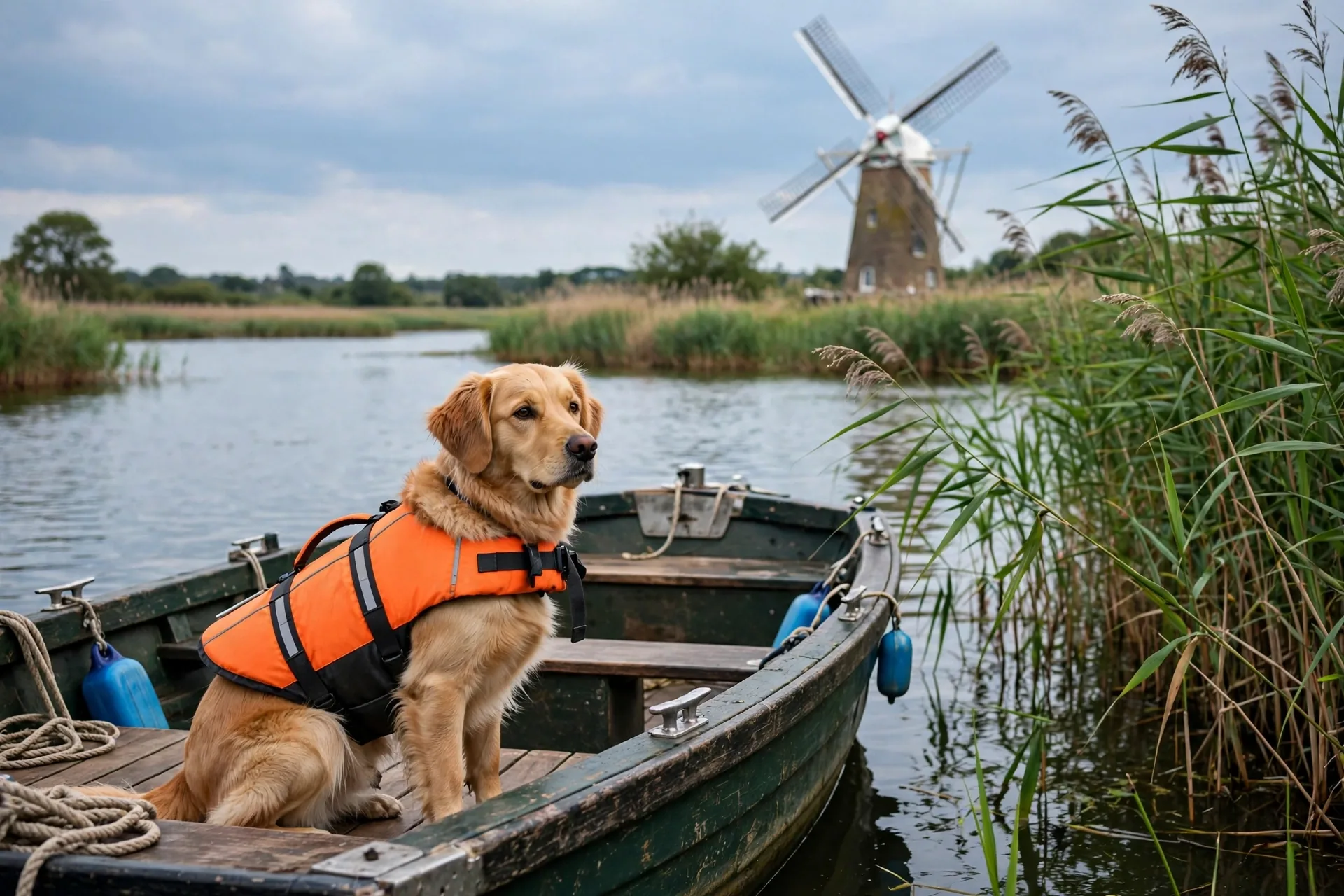
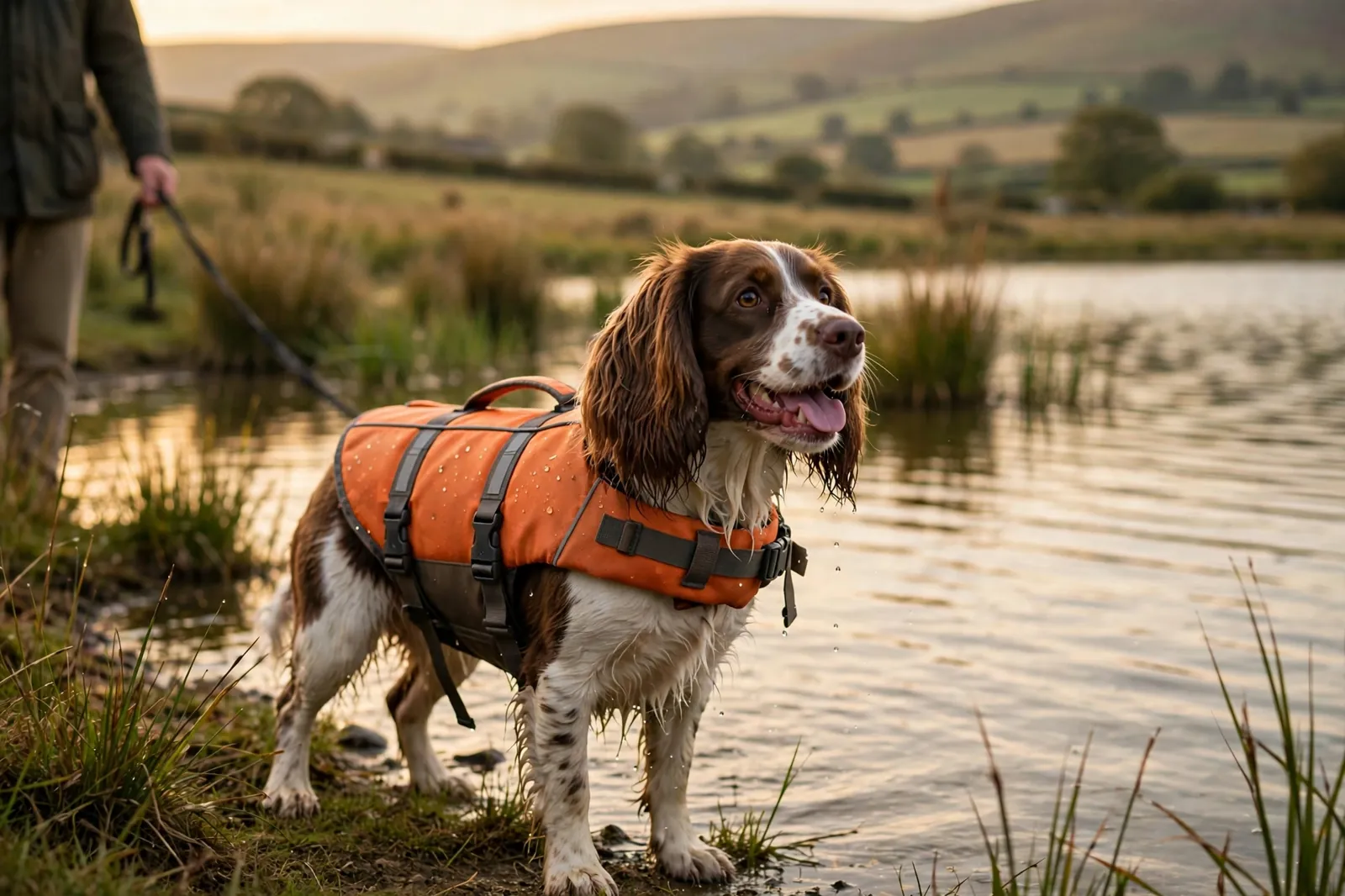
Water safety is the most important safety topic on a canal boat, because canals are deeper, colder and harder to climb out of than they look. A dog that falls in from a boat or a towpath may panic, may not find a bank it can climb, and may be swept towards a lock or a weir. A life jacket does not make a dog invincible, but it keeps the dog afloat, visible and liftable, and it buys time for you to help. Choose a jacket that fits snugly without restricting breathing or movement, has a sturdy handle on top for lifting, and is bright or reflective so you can see the dog in the water.
Fit the jacket at home, before the trip, and let the dog wear it for short periods indoors and on walks, so it is not a new, strange garment on the first day of the holiday. Check the straps, the fit when the dog is wet, and whether the jacket rides up over the head when lifted. For dogs that are strong swimmers, a jacket is still sensible on a canal, because a canal is not a lake: banks are often vertical, with stone or metal edging, and a dog that can swim well in a lake may still be unable to climb out of a canal. For puppies, older dogs, small dogs and brachycephalic breeds, a jacket is essential, not optional.
Teach the dog the boat rules for water before you cruise. The dog should have a designated place on the boat while cruising, usually in the well deck or on a mat in the saloon, and should not be allowed to jump on and off the boat at will, to lean over the side, or to chase ducks from the bow. Keep the dog on a lead on the towpath near water, especially near locks, bridges and weirs, and never let a dog swim in a canal near a lock, a tunnel entrance or a busy mooring. If you want the dog to swim, choose a safe, quiet stretch with a sloping bank, away from locks and boat traffic, and check the water for blue-green algae, pollution and strong currents first. Our guide to dog swimming safety explains algae, tides, cold water, life jackets and emergency steps in detail, and is worth reading before any water holiday.
Have a plan for a dog in the water. Know where the nearest bank, ladder or mooring is, keep a lead and a towel accessible, and practise lifting the dog by its life jacket handle on land first, so you are not learning the technique in an emergency. If a dog falls in, stay calm, move to the nearest safe exit point, guide the dog towards it with your voice, and lift it out by the jacket, not by its collar or legs. If you cannot reach the dog safely, call for help from other boaters or passers-by, and do not jump in yourself unless you are certain it is safe, because a rescuer in cold, deep water quickly becomes a second person in need of rescue.
Locks, towpaths and bridges
Locks are the part of a canal holiday that worries new boaters most, and they are also the part where dogs need the clearest management. A lock is a chamber with gates, paddles and moving water, and a dog that is loose near a lock can fall in, get caught in a gate, or panic at the noise and rush of water. The simple rule is: one person works the lock, the other person holds the dog, on a lead, well away from the edge, gates and balance beams. Never tie a dog to a bollard near a lock, never let a dog walk across a lock gate, and never leave a dog on the boat while it is in a lock unless the hire company specifically advises that and the dog is secure inside.
Work locks slowly, especially on a first trip. Watch other boaters, ask for help, and do not be embarrassed to take your time, because experienced boaters expect new hirers to be slow and are usually happy to help. Keep the dog's lead short near locks, reward calm behaviour, and move the dog to a safe spot, such as a grassy area away from the lock, while gates are moving. If you are single-handed with a dog, plan locks carefully: moor the boat safely, secure the dog on the boat or on a lead in a safe place, work the lock, and return for the dog, rather than trying to do both at once. Some hire companies and canal organisations offer advice for single-handed boaters with dogs, so ask before you book.
Towpaths are the dog's main walking route, and they vary widely. Some are wide, smooth and well maintained, ideal for a dog walk. Others are narrow, muddy, uneven or shared with cyclists, runners and horse riders. Keep the dog on a lead on narrow towpaths, give way to cyclists and other walkers, and be aware of other dogs, anglers and wildlife. A towpath walk is not an off-lead free run unless you are certain it is safe, wide and clear, and even then, a dog that runs ahead around a bend can meet a cyclist, another dog or a lock without warning. Use a long line on wide, quiet towpaths if you want to give the dog more freedom, and clip it short near locks, bridges and moorings.
Bridges, tunnels and aqueducts need their own care. A dog that is nervous about noise or enclosed spaces may find a tunnel stressful, so keep the dog inside the boat or in a secure, calm place during a tunnel, with a familiar bed and a reassuring voice. On an aqueduct, keep the dog away from the edge and on a lead, because the drop is high and the towpath is narrow. At bridges, slow down, check for oncoming boats and towpath users, and keep the dog close. These are all small disciplines, but together they make a canal holiday safe rather than stressful.
Living on board with a dog
Living on a narrowboat is living in a long, narrow space with limited storage, a small kitchen, a bathroom, and beds that may fold away during the day. For a dog, the key is a designated place that is theirs, from the first hour. Set up the dog's bed in a spot that does not block a walkway, a door or the galley, and that is not in direct sun or draught. Keep food and water bowls in a corner where they will not be kicked over, preferably on a non-slip mat, and keep the dog's lead, towel and treats in one known place. Dogs settle faster when their place is consistent, even if the scenery outside changes every day.
Steps, floors and furniture need thought. Narrowboat steps are steep and often open-tread, which small, elderly or arthritic dogs find difficult. A portable ramp, a helping hand, or a decision to lift the dog on and off at moorings can solve this, but practise at the hire base before you cruise, not on a windy mooring. Floors are often wood or vinyl, which are slippery for dogs, especially when wet, so a non-slip mat by the door and by the bed helps. Furniture rules vary by hire company: some allow dogs on sofas with a cover, others do not, so bring a blanket or a throw for the sofa if dogs are allowed, and a crate if the dog uses one and the company requires it.
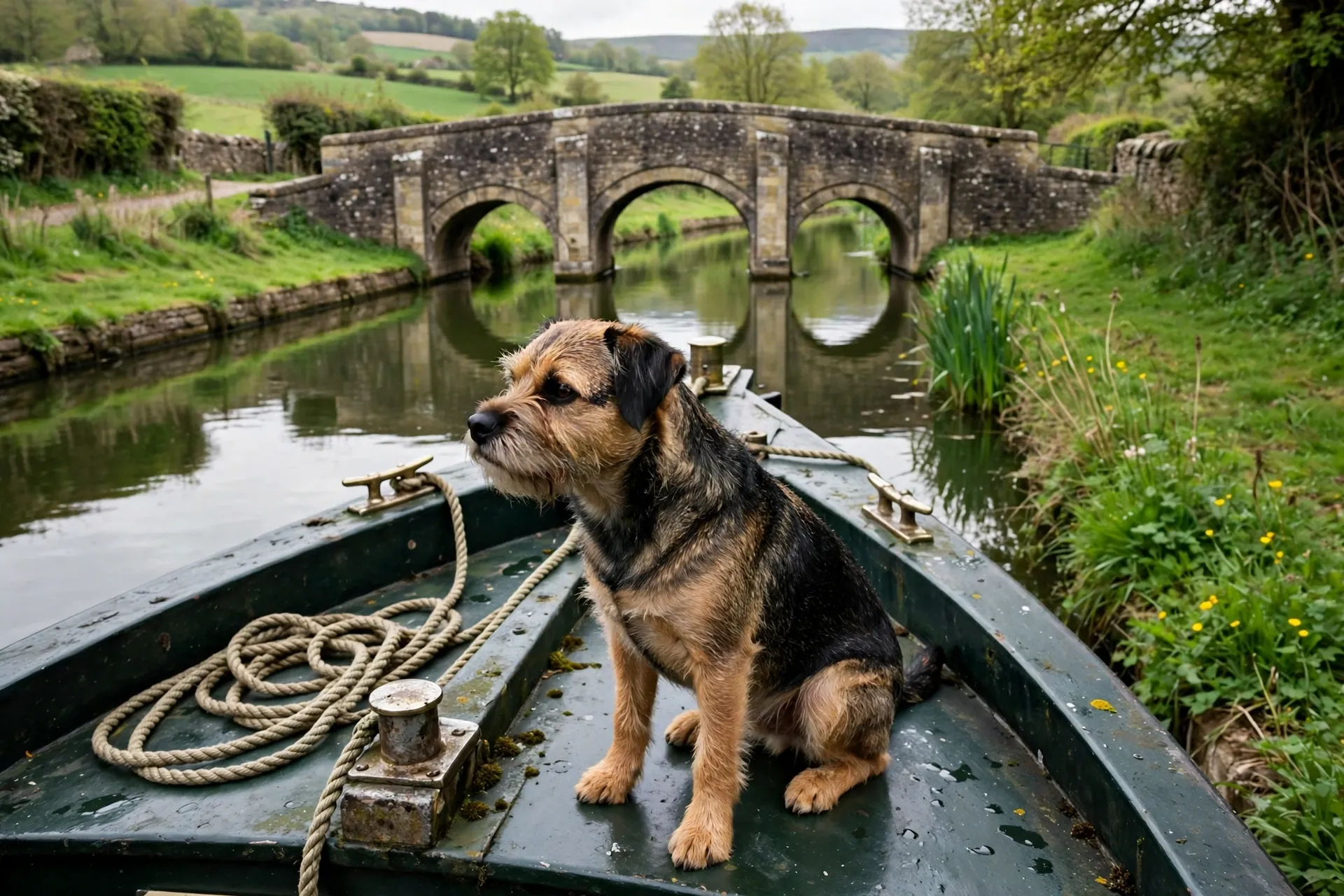
Noise and movement take getting used to. The engine vibrates, the boat rocks gently, water slaps against the hull, and locks clunk and rush. Most dogs adapt within a day, especially if they have a calm routine and a familiar bed, but a nervous dog may need more time, more reassurance, and a quiet first day with a short cruise. Do not force a nervous dog to stay on deck in wind or rain; let it settle inside where it feels safe, and build up deck time gradually. A dog that is happy inside is a dog that will enjoy the holiday, even if it never becomes a bow-sitting canal dog in a photograph.
Heating, ventilation and cooking need care with a dog on board. Narrowboats are heated by stoves, diesel heaters or radiators, and a stove can be a burn risk for a curious dog, so use a guard if the hire company provides one, and keep the dog away from hot surfaces. Ventilation matters when cooking, because a small boat fills with steam and smells quickly, and a dog that is already warm may overheat. Keep water available at all times, and do not leave a dog alone on a boat with a stove lit or with cooking in progress. These are house rules for a floating home, and they are worth discussing at the handover, when the hire company can show you the specific boat's systems.
Toilet walks and mooring routine
Toilet walks are the timetable of a canal holiday, because a dog cannot toilet on a boat, and a boat cannot moor everywhere. Plan walks first thing in the morning, at lunchtime, in the evening, and last thing at night, with extra walks for puppies, older dogs or dogs that need frequent breaks. Moor in places where a toilet walk is easy: a grassy bank, a towpath with open space, or a village green, rather than a narrow, busy mooring with no grass. If you are cruising late, moor earlier than you planned rather than pushing on to a better mooring while the dog is uncomfortable.
Carry poo bags on every walk, without exception, and carry a bag for used bags if the mooring has no bin. Many moorings have no bins, and towpath bins can be few and far between, so a dog walk that ends with a used bag in your pocket is normal, not a failure. Clean up after the dog on towpaths, moorings and village greens, because canal communities notice, and a dog owner who cleans up is a dog owner who is welcome back. If the dog toilets on a mooring or a towpath where other boaters walk, clean it immediately, even if it is inconvenient.
Mooring itself needs a routine. Approach slowly, check the bank for depth, mooring rings or pins, and hazards such as broken glass, fishing tackle or steep banks. Tie the boat securely, with pins or rings, and check that the dog can get on and off safely, with a plank or a ramp if the bank is high or muddy. Keep the dog on a lead until the boat is secure and you have walked the mooring area, because a dog that jumps off a moving boat onto a muddy bank can slip, fall in, or run off. Once moored, let the dog explore the immediate area on a lead, find the toilet spot, and settle, before you relax for the evening.
Overnight moorings vary in facilities. Some have water points, rubbish disposal, pubs and shops nearby. Others are wild moorings with no facilities at all, just a bank and a towpath. Both can be wonderful, but wild moorings need more planning: water for the boat and the dog, food for the evening, a torch for night walks, and a plan for the morning. Check the mooring guide for your route, ask the hire company about recommended moorings, and do not moor in a place that is signed as no mooring, private, or unsafe, even if it looks perfect. A good mooring is one where the dog can toilet, walk and settle safely, not just one with a pretty view.
Evenings, pubs and days off
Evenings on a canal boat are often the best part of the holiday: a mooring near a village, a walk along the towpath at dusk, a pub dinner, and a quiet night on the water. Dogs can join this, if you plan it. Check whether pubs welcome dogs inside, on a terrace, or not at all, and choose pubs that genuinely welcome dogs rather than tolerating them. Bring a mat for the dog to lie on, a chew or a toy to settle it, and treats for calm behaviour. A dog that has had a good walk, a toilet break and a meal will usually settle well in a pub, while a dog that is tired, hungry or over-excited will not, so time the pub visit after a walk, not instead of one.
Days off, where you do not cruise at all, are essential on a canal holiday with a dog. A rest day lets the dog explore a village, walk a local footpath, swim in a safe place, or simply sleep on the boat while you read, cook or visit a market. Rest days also give you a chance to clean the boat, do laundry if facilities allow, restock food and water, and check the route ahead. A week with two rest days and five cruising days is usually more enjoyable, for dog and owner, than a week with seven cruising days and no time to enjoy any single place.
Other boaters, anglers and towpath users are part of the canal community, and dogs need to fit into it. Keep the dog on a lead near other boats, do not let it bark at passing boats, anglers or other dogs for long periods, and apologise promptly if it does. Canal communities are small and friendly, and a dog owner who is considerate, who cleans up, and who keeps a dog under control is a dog owner who will be helped, advised and welcomed. A dog owner who lets a dog bark, run loose and foul towpaths will quickly become unpopular, and will find moorings and pubs less welcoming.
If you want a different kind of water holiday, or if a canal boat feels too confined for your dog, consider the Norfolk Broads, where boats are wider, moorings are more open, and the water is broader. Our guide to Norfolk Broads with a dog covers boat hire, life jackets, safe mooring, towpath walks and algae risks for that waterway, and many of the routines there transfer directly to canals. Similarly, if your holiday involves a ferry crossing to reach a canal or a Broads base, our guide to dogs on UK ferries explains operator rules, costs and where dogs spend crossings, which helps you plan the journey as well as the holiday.
Costs, booking and seasons
Costs for a canal boat holiday vary with boat size, season, duration and hire company. A small boat for a weekend in low season can cost a few hundred pounds, while a large boat for a peak week in summer can cost well over a thousand pounds, plus a dog fee, fuel, damage deposit and any extras such as bedding, parking or a starter pack. Ask for the total, including the dog fee, fuel estimate, deposit terms and cancellation policy, before you book, because a boat that looks cheap with a high dog fee and a fuel surcharge may cost more than a boat that looks expensive with everything included.
Booking early is essential for peak weeks, school holidays and popular routes, where boats with dog-friendly policies book out months ahead. If you need a specific boat layout for an elderly, large or reactive dog, contact the hire company directly rather than relying on a booking filter, because filters rarely capture step height, deck layout or garden access at moorings. A direct conversation also lets you ask about the handover, the first-day support, and what happens if the boat breaks down or the canal closes, which are the questions that matter when something goes wrong.
Seasons change the holiday significantly. Spring offers quiet canals, lambing fields and blossom, but also cold nights and muddy towpaths. Summer offers long daylight, warm evenings and busy canals, but also crowded moorings, booked pubs and hot boats that need ventilation for dogs. Autumn offers quiet water, harvest colours and lower prices, but shorter days and wetter towpaths. Winter canal holidays are possible with some companies, but need heating, short cruising days, and a dog that is comfortable in cold, dark conditions. For most first-time dog boaters, late spring or early autumn offers the best balance of weather, quiet and price.
Finally, check insurance, breakdown cover and emergency contacts before you leave. Know who to call if the boat breaks down, if the dog is ill, or if you need a vet, and save the numbers in your phone. Keep the hire company's number, the nearest vet's number, and the Canal and River Trust's contact details accessible, and check the official guidance before you travel for any closures, restrictions or safety notices on your route. A canal boat holiday with a dog, planned with care, is a slow, calm, deeply enjoyable holiday, and the planning, far from spoiling it, is what makes the slow days possible.
Practical questions
Before you go
Do dogs need a life jacket on a canal boat?
A life jacket is strongly recommended for most dogs on a canal boat, especially puppies, older dogs, small dogs and dogs that are not strong swimmers. Canals are deeper than they look, banks can be steep, and a dog that falls in may struggle to climb out. Choose a jacket that fits well, has a handle for lifting, and is bright enough to see in the water.
Can a dog be left alone on a canal boat?
Only if the dog is settled, the boat is safely moored, and the hire company allows it. Many companies ask guests not to leave dogs alone on board, or allow it only for short periods. Plan as if the dog comes with you to locks, pubs and shops, and ask the hire company for its exact rule before you book.
How do dogs cope with locks?
Most dogs cope well if locks are handled calmly. Keep the dog on a lead, away from the lock edge and gates, and preferably with one person while the other works the lock. Never let a dog walk across a lock gate or balance beam, and never leave a dog tied to a bollard near a lock where it could fall in. Practise lead manners before the trip.
Where do dogs toilet on a canal boat holiday?
Dogs toilet on towpath walks at moorings and at regular stops, not on the boat. Plan walks first thing in the morning, at lunchtime, in the evening and last thing at night, and carry poo bags everywhere. Some moorings have bins, but many do not, so carry used bags until you find one.
Are canal boats suitable for a dog that cannot swim?
Yes, with care. A non-swimming dog can enjoy a canal holiday if it wears a life jacket on deck, is kept on a lead near water, and is never allowed to jump in. Teach the dog where it may sit on the boat, practise getting on and off safely, and keep the dog inside or on a secure part of the deck while cruising.
How far can you cruise in a week with a dog?
A relaxed week with a dog usually covers 50 to 80 miles with locks, depending on the route and how often you stop. Plan for four to six hours of cruising on moving days, with rest days or short days for walks and pubs. Dogs need regular stops, so a slower route with good moorings is better than a long route that rushes every day.