This guide is independent and contains no paid placement. If affiliate links are added later, they will be clearly marked and will not change our editorial checks.
Glyndwr's Way runs 135 miles from Knighton to Welshpool through some of the emptiest country in Wales, and that emptiness is both its charm and its challenge with a dog. Plan for long gaps between shops, water and stays, keep dogs on leads through sheep country, and walk it in six to nine days at a steady pace. The trail rewards walkers who carry enough, check the weather, and let the dog set the rhythm on the moorland stages.
The trail in one walk
Glyndwr's Way is the quietest of Wales's national trails, and that is a deliberate choice rather than an accident. At 135 miles from Knighton on the English border to Welshpool near the Severn valley, it crosses the empty middle of the country: the Radnor Forest, the hills above the Severn, the moorland around Plynlimon, and the long, wooded valleys that run down to Machynlleth and back up towards the border. It is named for Owain Glyndwr, the Welsh leader whose rising in the early fifteenth century still shapes how Wales tells its own story, and the trail passes through places connected with that history, but the walking itself is the point. There are no crowds here, no queues at stiles, and on some stages you will walk for hours without meeting another person. For a dog, that is close to paradise, as long as the practical planning is done properly.
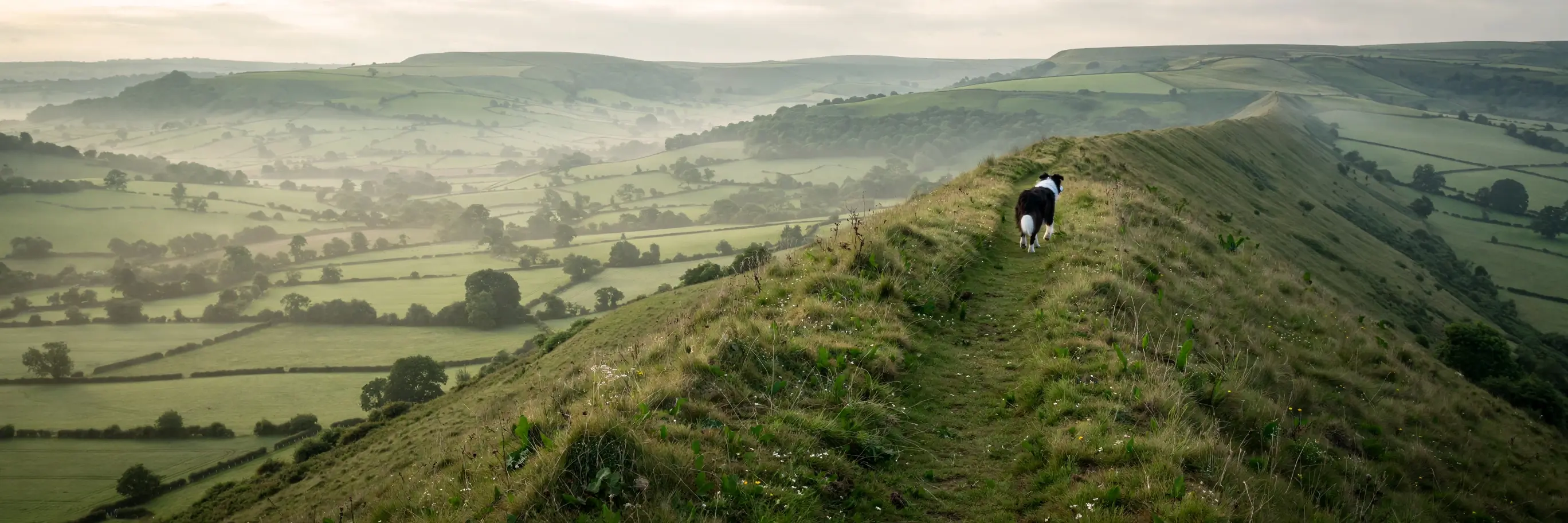
The first thing to understand is that this is not a trail of dramatic peaks or famous viewpoints. The highest ground is rolling moorland rather than mountain, the villages are small and widely spaced, and the pleasures are cumulative: a long ridge walk with the dog trotting ahead, a woodland descent to a village pub, a night in a small town where the dog is welcome in the bar. Walkers who come expecting Snowdonia will be disappointed. Walkers who come expecting space, quiet and a proper sense of journey will find it in abundance. The trail is usually walked in six to nine days, depending on fitness and on how much time the dog needs, and most people walk it west to east or east to west without a strong preference, although the prevailing wind and the logistics of the start and finish often decide the direction for you.
For a dog, the trail is demanding in a particular way. The distances are long, the ground is often rough and wet underfoot, and the gaps between water, food and shelter are longer than on the more popular trails. A fit, healthy adult dog in good condition can manage it comfortably with training, but a puppy, an older dog, or a dog that has never walked more than a few miles a day will struggle. The preparation matters more than the fitness: build the dog's mileage up over several weeks before the trip, check paws and joints after every day, and be ready to shorten a stage or take a rest day if the dog is telling you it needs one. The trail will still be there tomorrow, and a dog that is walked into exhaustion on day two is a dog that cannot enjoy day five.
This guide works through the trail stage by stage, then covers the practical questions that decide whether the walk succeeds: navigation on ground where the path can be faint, water and food in the long gaps, livestock rules, accommodation and baggage, and the weather that makes the Welsh moors both beautiful and unforgiving. The advice is written for walkers with a dog, but the trail does not care who you are. It asks the same things of everyone: carry enough, plan ahead, and respect the land you are crossing.
Knighton to Llanbadarn Fynydd: the gentle opening
Knighton, on the border between England and Wales, is a good place to start because it is easy to reach and because the first day is gentle enough to settle into the rhythm of the trail. The town sits in the Teme valley with the hills rising on both sides, and the trail leaves it by climbing out through farmland and woodland towards the open moor. The first stage to Llanbadarn Fynydd is around ten miles, and it gives you a fair sample of what the trail will be like: field paths, woodland tracks, a long climb onto the moor, and then a descent to a small village where the pub and the bed and breakfast are the whole evening. It is not the hardest day on the trail, but it is a proper introduction, and a dog that has travelled a long way to get here will appreciate a stage that does not ask too much on the first afternoon.
The walking on this first stretch is a mix of surfaces that a dog will find easy underfoot. The field paths are grass and earth, the woodland tracks are firm and shaded, and the moorland sections are open grass with heather and bilberry underfoot. There are stiles and gates to negotiate, and some of the stiles are the awkward kind that need a dog to be lifted or guided through, so check each one before you commit the dog to it. The climbs are steady rather than steep, but they are long, and the dog will need water on the way up, especially on a warm day. Carry a collapsible bowl and offer water at every stop, because the streams on this stretch are not always accessible from the path.
Knighton itself is worth an evening before you start. It has a railway station on the Heart of Wales line, which makes a car-free arrival possible, and the town has shops where you can buy any last supplies, a couple of places to eat, and accommodation that welcomes walkers. The Offa's Dyke Centre in the town tells the story of the border and the dyke that runs along it, and it is worth a visit if you have the time, although dogs are not allowed inside, so plan for one person to stay outside with the dog. The town's position on the border means you will be walking between two countries for much of the first day, and the sense of crossing and recrossing the line is one of the quiet pleasures of the trail.
From Llanbadarn Fynydd onwards, the trail begins to feel more remote. The village is small, with a church, a pub and a handful of houses, and the accommodation is limited, so book ahead rather than hoping for a room on arrival. The pub is a proper walkers' pub, with a fire in the colder months and a welcome for muddy boots and wet dogs, but check its current dog policy before you rely on it, because policies change. The next stages take you deeper into the Radnor Forest and the hills above the Severn, and the villages get smaller and further apart, so use this first stage to check your kit, your dog's paws and your own fitness, and to make sure you are carrying enough for the days ahead.
Plynlimon: where two rivers begin
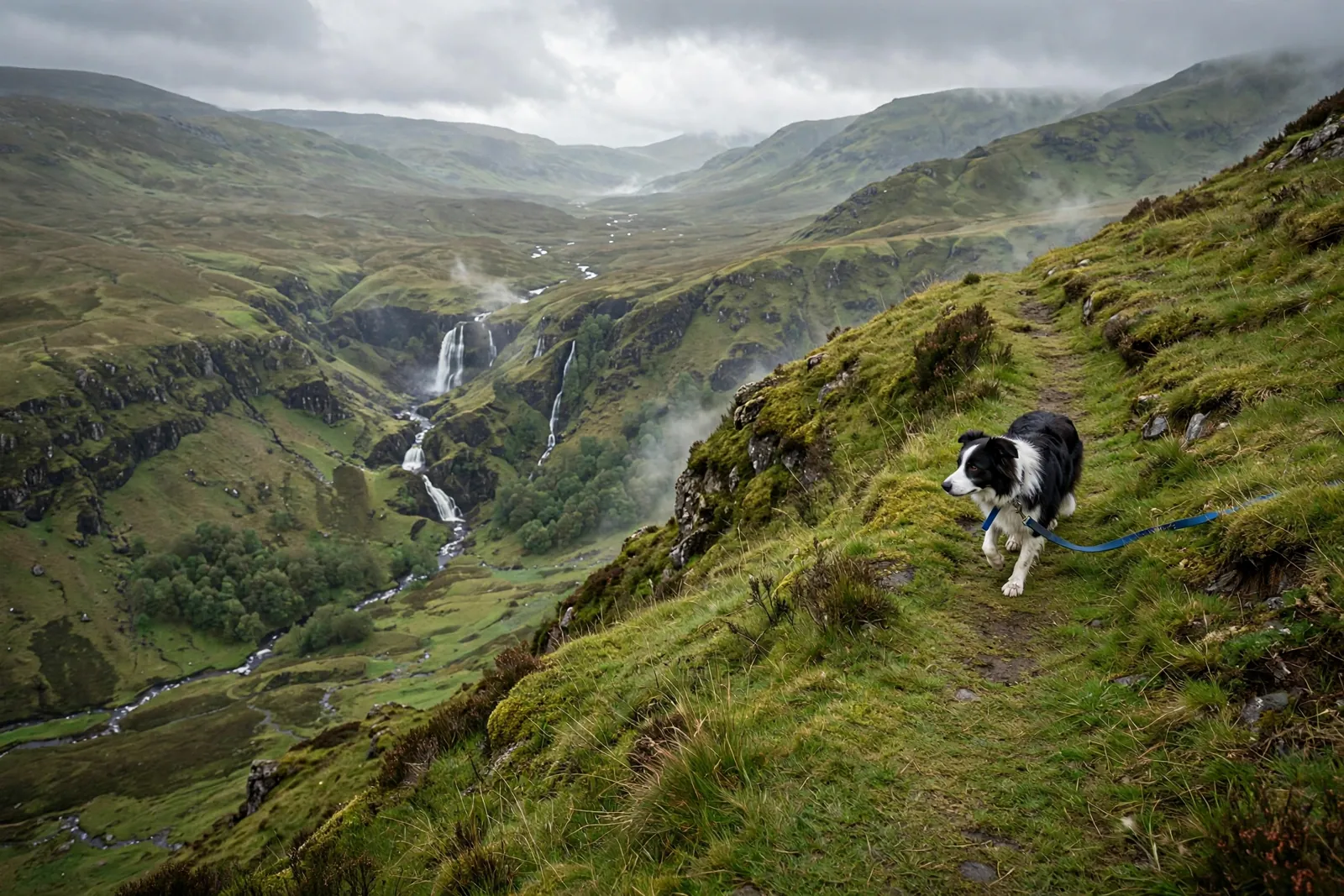
There is a stretch of moor in the middle of Wales where you can stand with one foot in the catchment of the Severn and the other in the catchment of the Wye, and the rain that falls on your shoulders will end up in two different seas. Plynlimon is that place, and Glyndwr's Way crosses it, which is why the middle of this trail feels different from the rest. The ground is high, wet and open, the horizons are long, and the only sounds are the wind, the curlews and your own boots in the peat. It is the wildest part of the walk, and the part that asks most of you, because there is nothing here to hide behind: no trees, no villages, no shortcuts.
Llanidloes, the town before the moor, is where you prepare. It has shops, a market hall, cafes and places to stay, and it is the last town with a proper range of supplies until Machynlleth, two days away. Buy food for both days, fill every bottle, and check the forecast with the people who live here, because they will tell you what the moor is doing in a way that a weather app cannot. The climb out of Llanidloes is long and steady, through farmland and then onto the open hill, and the views open up behind you as you climb: the Severn valley, the town getting smaller, and the moor ahead, green and gold and empty.
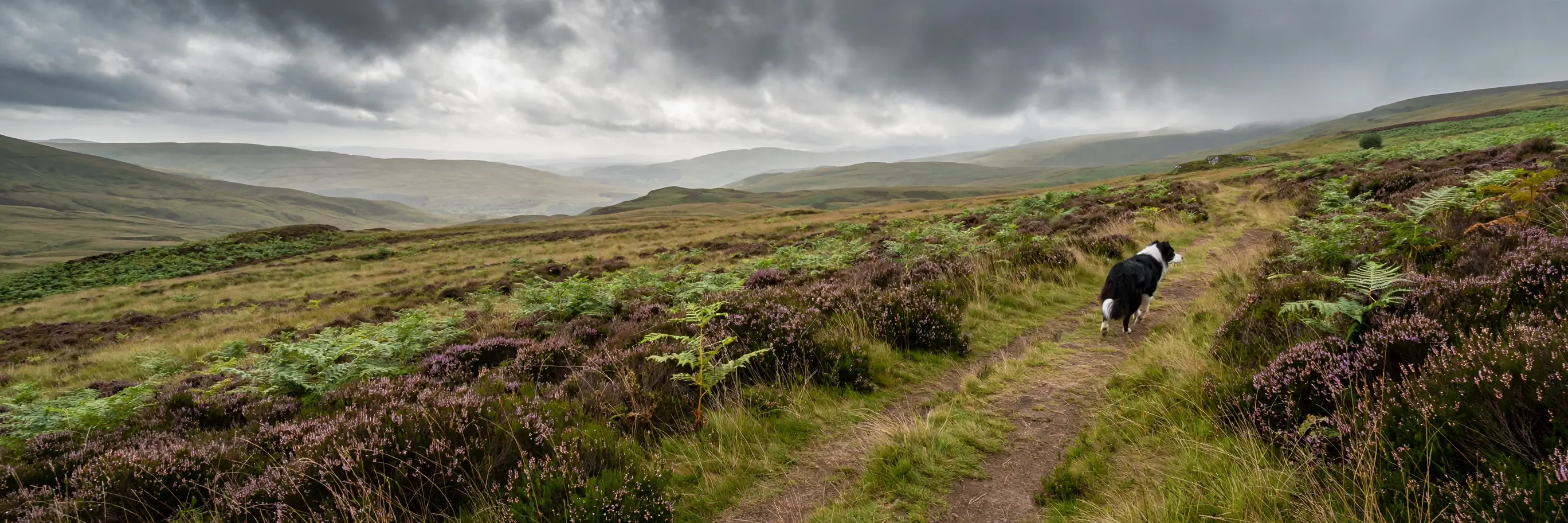
Underfoot, the moor is a mixture of grass, heather and peat, and after rain it holds water in every hollow. The path is a faint line through the heather in places, and it can disappear entirely where the ground is wet, so the map matters here more than anywhere else on the trail. The streams are your water supply, but they are not always where you need them, and after a dry spell the smaller ones vanish, so carry more than you think you need and fill up whenever you can. A dog that has walked fifteen miles across wet moorland will be tired, wet and muddy, and it will need a towel, a drying coat and a proper meal at the end of the day, not just a biscuit.
Machynlleth, at the end of the moorland, is a reward. It is a market town with a long history, shops, cafes, pubs and a good range of places to stay, and it sits in the Dyfi valley with the moor behind it and the hills ahead. The cafes are relaxed about dogs, the pubs are walkers' pubs, and the town's position makes it a natural place to stop for a day. Rest the dog, wash the kit, dry the boots, and enjoy a town that has welcomed walkers for generations. The moor will still be there tomorrow, and you will be glad you crossed it, but you will also be glad to be off it.
Machynlleth to Welshpool: the long finish
The final section of Glyndwr's Way, from Machynlleth to Welshpool, is the longest and in some ways the most varied part of the trail. It runs for around fifty miles through the Dyfi valley, over the hills above the Severn, and down into the border country, passing through small villages and market towns that feel a long way from the moorland. The walking is gentler than the middle section, with more woodland, more farmland and more frequent villages, but the distances are still long, and the trail asks for the same steady effort. Most walkers take three days for this section, stopping at Llanbrynmair and Meifod or at similar points, but the exact stages depend on where you can find accommodation, so plan the nights first and let the days follow.
The villages on this final stretch are small and charming, but they are not all equipped for walkers. Some have a pub and a bed and breakfast, some have only a church and a handful of houses, and a few have nothing at all. That means the planning needs to be done in advance, with each night booked and each day's food carried. The pubs that do welcome walkers are often the centre of village life, and a dog is usually welcome in the bar or the garden, but always ask before you settle in, and be prepared for a place that is full or closed on a particular night. The accommodation in this part of Wales is often in farmhouses and small guest houses, and the hosts are usually generous with walkers and their dogs, but they need to know in advance that a dog is coming.
Welshpool, the finish, is a market town on the edge of the Severn valley, and it makes a satisfying end to the trail. It has a railway station, shops, places to eat and a good range of accommodation, and the town's position near the border makes it easy to get home. The trail ends at the town, and the sense of completion after 135 miles is real, even if the finish is quieter than the end of a more famous trail. Take a photograph at the trail marker if you like, but the real reward is the dog, tired and content, lying at your feet in a pub garden with a bowl of water and a biscuit, and the knowledge that you have walked across the middle of Wales together.
For walkers who want to keep going, Welshpool is also a good base for exploring the Severn valley and the border country, and the town's position on the railway line makes it easy to reach Shrewsbury, Birmingham or the Welsh coast. Our guide to Offa's Dyke Path with a dog covers another border trail that pairs well with Glyndwr's Way, and our Wales Coast Path guide is the right next read if you want to swap moorland for sea.
Carrying a day in your pack
The weight on your back is the price of walking through empty country, and on Glyndwr's Way that price is higher than on most trails. Between Knighton and Welshpool there are days when the only water you will see is a stream you cannot reach, and the only food is what you carried out of the last town. The arithmetic is simple and unforgiving: a walking dog on a warm day can drink a litre or more, and a walking human twice that, so a day's water alone can weigh four kilos before you add food, waterproofs and the dog's supplies. There is no way around the weight. The only choice is whether to carry it, or to run short and regret it by mid-afternoon.
The resupply points are few, and they are worth using properly. Knighton has shops for the start, Llanidloes is the last proper town before the Plynlimon moor, Machynlleth restocks you for the final stretch, and Welshpool is the finish. Between those towns, the villages are small and their shops, where they exist at all, may be closed, out of stock, or simply not there any more. Buy more than you need for the next day, and ask the person behind the counter what lies ahead, because they will know which village has a shop, which pub is open, and whether the stream at the bottom of the hill is running. The people of mid Wales are generous with walkers, and a five-minute conversation can save you a long, thirsty afternoon.
Streams on the moor are usually clear and cold, but they are not always where the map says they will be, and after a dry spell some of them disappear altogether. Fill up at every reliable source you pass, even when your bottle is still half full, and carry a filter or purification tablets for the days when the only water is a slow, peaty pool. Never let the dog drink from standing water near farmland, and offer the dog your own water in preference to whatever it finds, because a dog that drinks from a ditch can spend the night with an upset stomach, and there is no vet in the middle of the moor. A collapsible bowl weighs nothing and saves the dog from trying to drink from your bottle.
Food for the dog deserves the same attention as food for you. A dog that is walking fifteen miles a day burns far more than it does at home, so the daily ration needs to go up by a quarter or a third, and the extra should be offered as small snacks during the day rather than one huge meal at night. A dog that is fed properly recovers overnight and walks well the next morning; a dog that is underfed gets slower, sorer and less enthusiastic with every day. Keep the dog's food in the day pack, not in the bag that is being carried ahead, and carry a chew for the evening, because a dog that has something to settle with after a long day will sleep better, and so will you.
The sheep are the trail's real residents
There are more sheep than people on Glyndwr's Way, and they have been there longer. The flocks on the Radnor hills and the Plynlimon moor are hefted, which means they belong to a particular stretch of hill and they know it, and they react to a dog the way hill sheep always have: by running, scattering, and sometimes by abandoning a lamb. A dog that chases them can do serious harm in seconds, and the law gives the farmer the right to shoot a dog that is worrying livestock. The rule that follows from that is not complicated, but it has to be followed without exception: if you can see sheep, the dog is on a lead. If you are walking through a field where sheep might be, the dog is on a lead. If you are not sure, the dog is on a lead.
The lead should be short, because a long line still lets a dog reach a sheep twenty metres away, and a dog on a long line that suddenly lunges can pull a walker off balance on rough ground. A harness is better than a collar for a dog that pulls, because it spreads the pressure and it gives you control without choking the dog. On the moorland stages, where the sheep are often out of sight until you are close to them, the safest habit is to keep the dog on the lead for the whole stage, and to save the off-lead running for the enclosed garden of your night's stay. It feels restrictive, and it is, but the alternative is a dead lamb, an angry farmer and a dog that has learned that chasing sheep is fun.
Cattle need a different kind of care. The trail crosses fields with cattle, and in spring and summer some of those fields hold cows with calves, which are protective and unpredictable. Walk through a cattle field calmly and steadily, giving the animals as much room as the path allows, and keep the dog on a short lead and close to your side. If the cattle start to move towards you, or if they look agitated, let the dog off the lead and walk away from the animals, because a dog that is free can run clear, while a dog on a lead can drag you into the middle of a herd. This is the one situation in which letting the dog go is the safer choice, and it is worth deciding in advance that you will do it.
Lambing season, from late winter into spring, is the time when the rules matter most. Ewes are protective of their lambs, and a dog that approaches a lambing field can cause a ewe to abandon her lamb, which is a loss the farmer feels directly. During lambing, some fields are closed or the path is diverted, and the signs should be followed even when the diversion adds half a mile to the day. In summer, the sheep move onto the open moor, and the dog will be on a lead for long stretches, which is frustrating for a dog that wants to run, but it is the price of walking through working farmland. Reward the dog for walking calmly on the lead, and remember that the lead is not a punishment, it is the thing that lets you walk here at all.
Where the beds are, and how the bag gets there
Walk this trail in your head backwards, starting from the beds. Knighton has a hotel and guest houses. Llanbadarn Fynydd has a pub with rooms. Llanidloes has a market town's worth of bed and breakfasts. Machynlleth has hotels. Meifod and the villages east of it have farmhouses. Welshpool has a station and a choice of places to stay. That list, short as it is, is the skeleton of your walk, and the days hang off it. A stage ends where a bed is, not where the map draws a line, and a walker who accepts that will sleep well every night. A walker who fights it will spend the last two hours of every day wondering where the next bed is.
Ring ahead. Email is fine, but a phone call tells you more: whether the host sounds pleased to hear about a dog, whether the garden is fenced, whether the dog can come into the bar, whether there is a charge and how much it is. Say how big the dog is, say whether it will be left alone, and ask where the dog sleeps. A host who answers those questions easily has done this before. A host who hesitates has not, and you would rather find that out on the phone than at the door at six in the evening with a wet dog and a heavy pack. The charge for a dog is normal, and it is worth paying without argument, because it is the price of a host who will welcome the next walker with a dog.
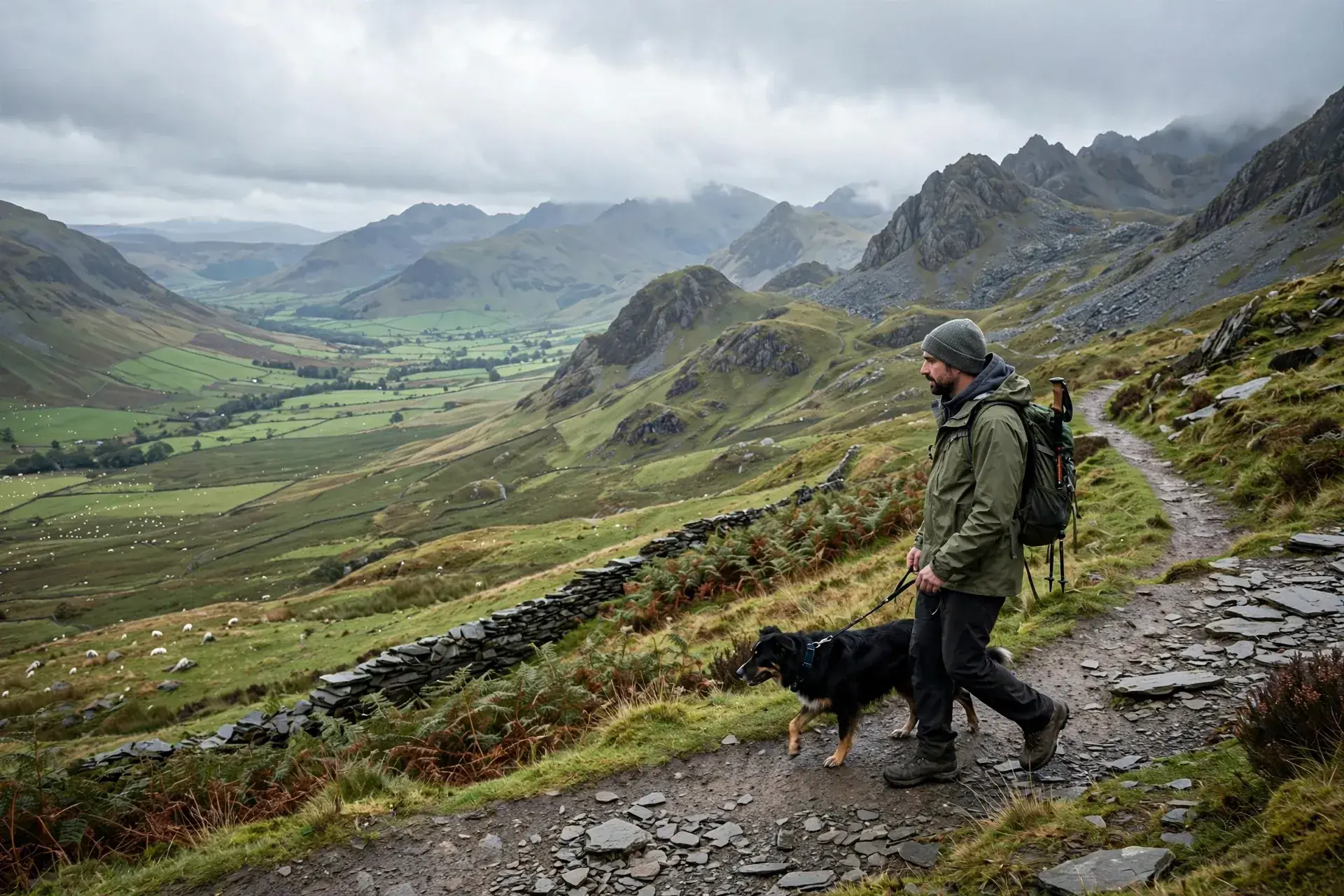
What you carry is the other half of the same question. A pack with nine days of food in it is a pack that will hurt your shoulders by the second day, and a dog that carries its own food in a rucksack can only carry a tenth of its body weight, so the answer is to let someone else move the bag. The services that do this on Glyndwr's Way collect your main bag in the morning and leave it at that night's stay, and they need to be booked before you leave home, with the names of every stay on the list. Keep the day's essentials with you: the dog's food, the water, the first aid, the map, the waterproofs. Everything else can travel ahead, and you will walk further and happier for it.
Getting home is the last thing to settle, and it is easy to forget until the last day. Knighton is on the Heart of Wales line, Welshpool is on the Cambrian line, and the trains that connect them run through some of the prettiest country in Wales, but they are not frequent, and the connections take time. If you drove to the start, work out how you get back to the car before you leave home, because a taxi from Welshpool to Knighton is a long and expensive ride. Some walkers leave the car at the finish and take the train to the start, which is the tidiest solution if the timetable works. Decide it now, not on the last morning.
Six weeks to a trail-ready dog
Think of the preparation as a calendar, not a single heroic walk. Six weeks before the trip, walk the dog for an hour a day on varied ground, with a few hills, and watch how it recovers. Five weeks out, add a longer walk at the weekend, ten miles on grass and track, and check the paws that evening for pinkness or cracks. Four weeks out, do two long days back to back, a Saturday and a Sunday, because that is what the trail actually asks: not one long day, but one long day followed by another, on legs that are already tired. Three weeks out, add the pack, and let the dog wear its rucksack, lightly loaded, so that it gets used to the feeling before the trip.
Two weeks out, do the hardest weekend of the training: fifteen miles on the Saturday, twelve on the Sunday, on rough, wet ground if you can find it, with the full pack and the dog's food in the day bag. Watch the dog on the Sunday morning. If it is stiff, slow and reluctant, the training has done its job, because you have found the limit at home, where you can do something about it, rather than on the second day of the trail, where you cannot. One week out, taper: short, easy walks, plenty of rest, good food, and a final check of the paws, the claws and the coat. The dog should arrive at Knighton rested, fit and keen, not tired from a last-minute effort.
On the trail, the day is built around the dog's needs, not the walker's ambitions. Water every hour, a snack at mid-morning, a proper lunch with the dog's food and a rest in the shade, and a slow finish into the night's stay, with time to wash the paws, dry the coat and settle before dark. A dog that is looked after in this way will walk fifteen miles a day for a week and still be keen on the last morning. A dog that is pushed, underfed and walked too fast will slow down on day three, go lame on day four, and hate the trail by day five. The trail does not care how fast you walk. The dog does.
Machynlleth is the place to stop, and the stop is part of the plan, not a failure of it. A day off the trail, with a short walk around the town, a wash for the kit, and a proper meal, will do more for the second half of the walk than any amount of pushing through. The muscles recover, the paws harden, and the mind resets, for the walker as much as for the dog. The fifty miles from Machynlleth to Welshpool are the longest part of the trail, and they are walked far better by a pair who have rested than by a pair who are tired. Take the day. The trail will wait.
Weather, kit and the moorland reality
The weather on the Welsh moors is the one thing you cannot control, and it is the thing that most often decides whether a day on Glyndwr's Way is a pleasure or an ordeal. Mid Wales is wet, windy and changeable, and the moorland stages are exposed to whatever weather comes in from the Atlantic. A sunny morning can turn into a wet, windy afternoon in an hour, and a walker who is not prepared for the change will be cold, wet and miserable by the evening. The answer is not to avoid the trail in bad weather, but to be ready for it: full waterproofs, warm layers, a hat and gloves even in summer, and a dry set of clothes in the bag for the evening.
For the dog, the weather matters in a different way. A dog that is wet and cold for hours can become chilled, especially a small, short-coated or older dog, and a dog that is hot and dehydrated on a warm day can overheat just as quickly. Carry a dog coat for the wet and windy days, and a drying coat for the evening, so the dog can warm up and dry off after a wet walk. Offer water regularly on warm days, and watch for the signs of overheating: excessive panting, drooling, lethargy and a reluctance to walk. If the dog shows these signs, stop, find shade, offer water, and cool the dog down with wet towels before continuing. In cold weather, watch for shivering and a reluctance to move, and cut the day short if the dog is struggling.
The kit for the trail is a balance between carrying enough and carrying too much. The essentials are a good pair of boots, waterproofs, warm layers, a map and compass, a first-aid kit for you and the dog, water and food for the day, and a head torch for the short days of winter. The dog's kit is a lead, a harness, a collapsible bowl, food, a coat, a towel and a small first-aid kit with paw balm, tweezers for ticks and any medication the dog needs. A dog rucksack can be useful for a fit dog, because it lets the dog carry its own food and water, but it should not be loaded with more than a tenth of the dog's body weight, and the dog should be trained to wear it before the trip.
Finally, respect the moorland. The ground is fragile, the wildlife is vulnerable, and the farmers who live and work here depend on the land for their livelihood. Stick to the path, close gates behind you, keep the dog under control, and take all your litter home with you. The trail is a privilege, not a right, and the walkers who treat it with respect are the ones who are welcomed back. Glyndwr's Way is not the easiest trail in Britain, and it is not the most famous, but for a walker with a dog who wants space, quiet and a proper sense of journey, it is one of the best. Walk it slowly, walk it well, and the dog will thank you for it.
Practical questions
Before you go
How long does Glyndwr's Way take with a dog?
Most walkers take six to nine days for the 135 miles, depending on fitness and on how much rest the dog needs. A steady pace of 15 to 20 miles a day suits fit walkers and fit dogs, but slower walkers and older dogs should plan for nine days and include a rest day in Machynlleth. The trail is not a race, and the walkers who enjoy it most are the ones who let the dog set the pace.
Are dogs allowed on Glyndwr's Way?
Yes, dogs are allowed on the whole trail, but they must be kept under control at all times and on a lead through farmland and near livestock. Sheep graze much of the route, and a dog that chases livestock can be shot by the farmer, so the lead rules are not optional. Check the official guidance before you travel for any temporary closures or diversions.
Is there anywhere to buy food and water on the trail?
The gaps between villages are long, and some stages have no shop, pub or reliable water source for fifteen miles or more. Carry a full day's water and food for yourself and the dog, and restock in Knighton, Llanidloes, Machynlleth and Welshpool. Ask locals about the road ahead, because they know which villages have a shop and which do not.
Can I walk Glyndwr's Way without a car?
Yes, Knighton has a railway station on the Heart of Wales line and Welshpool has a station on the Cambrian line, so a car-free walk is possible. Dogs are generally allowed on trains if they are well behaved, but check the official guidance before you travel. Plan the return journey before you leave home, because rural buses in mid Wales are infrequent.
What is the hardest part of Glyndwr's Way with a dog?
The moorland middle, from Llanidloes to Machynlleth, is the most demanding section, because the ground is exposed, wet and rough underfoot, and the gaps between villages are at their longest. The weather can change quickly on the high ground, and navigation needs care when the path is faint. Walk this section in good weather if you can, and carry extra water and food.
Where can I stay with a dog on Glyndwr's Way?
Accommodation is a mix of bed and breakfasts, small hotels, farmhouses and self-catering cottages, and it is limited and scattered, so book every night before you leave home. Confirm the dog policy in writing when you book, including any pet fee and whether the dog can be left alone in the room. A walking holiday company can book the stays and arrange baggage transfer for you.