This guide is independent and contains no paid placement. If affiliate links are added later, they will be clearly marked and will not change our editorial checks.
Offa's Dyke Path is 177 miles from Prestatyn to Chepstow. Most dog walkers take 12 to 14 days, keep the dog on a lead through farmland and near sheep, carry water on the dry ridge sections, and book dog-friendly stays in the border towns well ahead.
A border made of earth
Long before there was a line on a map, there was a bank of earth. In the eighth century, King Offa of Mercia ordered a great dyke to be built along the western edge of his kingdom: a ditch and a bank running for mile after mile through the hills, marking where Mercia ended and Wales began. The earthwork still survives in long stretches today, a grassy ridge sometimes several metres high, with the modern National Trail following its line for much of the way. Walking it with a dog is a strange and satisfying experience, because the border is not a fence or a wall but a landscape — one minute your dog is in England, the next in Wales, and the sheep on either side could not care less which.
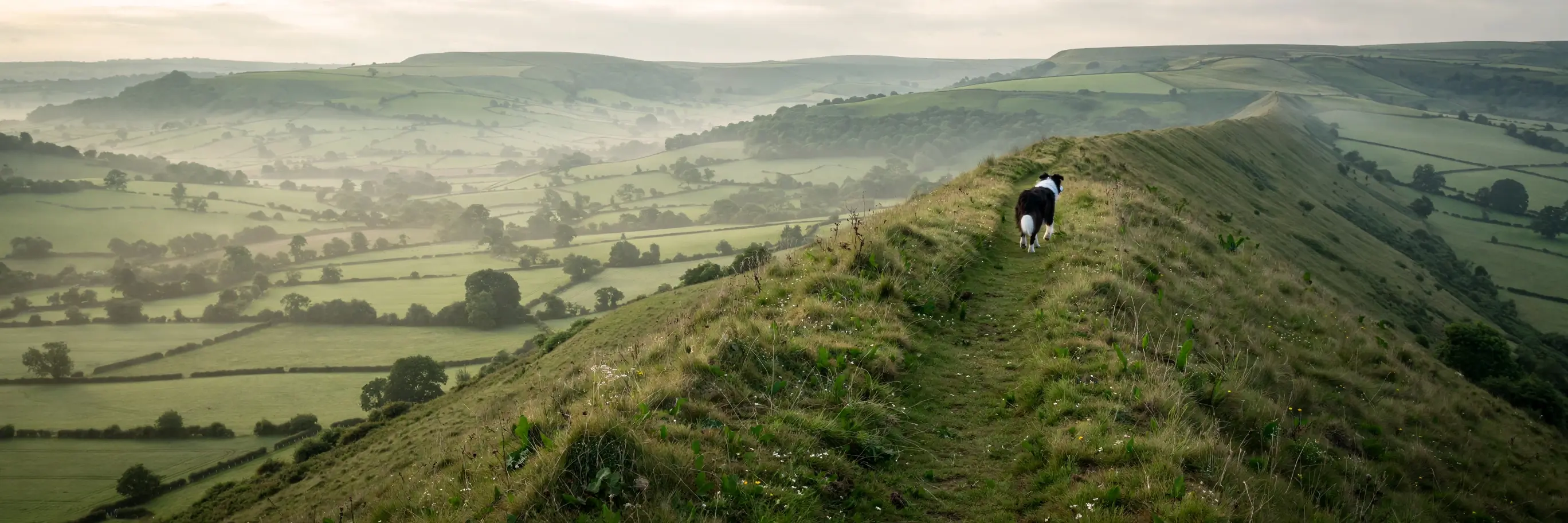
That history shapes the practical walk in ways that matter for a dog. The Dyke was built along high ground wherever possible, because high ground is defensible, which means the path spends a great deal of its length on ridges and hilltops, looking down into valleys on both sides. The views are superb, and the walking is exposed: wind, sun and rain all reach the ridge unhindered, and there is often no shelter for miles. The earthwork also crosses working farmland for long stretches, because the border runs through farming country, not wilderness, so the lead rules and the livestock rules apply for day after day rather than for an occasional field.
The trail was opened as a National Trail in 1971, and it remains one of Britain's longest and least crowded long-distance routes. It does not have the fame of the Coast to Coast or the crowds of the South West Coast Path, which is part of its charm: the villages are quiet, the pubs are local, and the path often feels like yours alone. For a dog that is nervous around crowds or reactive to other dogs, that quietness is a genuine advantage. For the walker, it means planning matters more, because there are fewer places to buy food, find a vet or catch a bus if things go wrong, and check the official guidance before you travel for the latest information on the route, the access rules and any diversions.
The route at a glance
Offa's Dyke Path runs 177 miles (285 kilometres) from Prestatyn on the North Wales coast to Chepstow on the River Wye, at the edge of the Severn estuary. Most people walk it southwards, from Prestatyn to Chepstow, which has the advantage of finishing in the gentler Wye Valley and of putting the hardest hills — the Black Mountains — in the second half, when you and the dog are trail-fit. The route can also be walked northwards, and some walkers prefer it that way because the prevailing wind is then behind them, but the southbound direction is the more common choice and the one this guide follows.
The stages in the table are the ones most walkers settle on once they have looked at the map and the list of overnight stops. The mileage is approximate — guidebooks disagree by a mile or two, and the figure shifts with the exact place you sleep and with any diversion in force that year. Use the table to shape the fortnight, then confirm the current line of the path and any closures on the official trail pages before you travel.
| Stage | From – to | Miles | Character |
|---|---|---|---|
| 1 | Prestatyn – Bodfari | 12 | Coastal hills, then the Clwydian Range |
| 2 | Bodfari – Llangollen | 16 | Long ridge walking, open moorland |
| 3 | Llangollen – Knighton | 25 | Two days: hills, valleys and villages |
| 4 | Knighton – Hay-on-Wye | 26 | Two days: Black Mountains begin |
| 5 | Hay-on-Wye – Monmouth | 25 | Two days: high ridges, steep descents |
| 6 | Monmouth – Chepstow | 16 | Wye Valley woods and riverside paths |
The shape of the route is what catches people out. The first two days are deceptively gentle, the middle is relentlessly hilly, and the final stretch along the Wye is beautiful but rough underfoot, with tree roots, mud and steep wooded slopes. A dog that copes easily with the Clwydian Range may still struggle in the Black Mountains, where the climbs are longer and the descents steeper, and where a tired dog has fewer places to stop. Plan the trip around the hard middle, not the easy start, and keep a rest day in reserve for Knighton or Hay-on-Wye, the two towns where a day off does the most good.
Section by section: what each stretch is really like
The walk begins at Prestatyn, on the North Wales coast, and climbs quickly onto the Clwydian Range, a chain of heather-covered hills with wide views across the Vale of Clwyd. The path here is open and grassy, with sheep grazing the hillsides and skylarks overhead in spring. It is a fine introduction: not too steep, not too remote, and with villages below the ridge where water and food are easy to find. Dogs that are used to open moorland will be happy here, but keep the lead handy, because the sheep are everywhere and the ground-nesting birds are easily disturbed.
From Llangollen the route turns south into the border hills, crossing a landscape of steep-sided valleys, wooded slopes and high pastures. Llangollen itself is a lively town with dog-friendly pubs and cafes, and a good place to restock before the quieter days ahead. South of Llangollen the path becomes more remote: the villages are smaller, the farms are further apart, and the walking is on field paths and farm tracks where the dog stays on a lead for long stretches. Knighton, roughly at the halfway point, is the natural rest stop: it is the only town actually on the Dyke, it has the Offa's Dyke Centre, and it has dog-friendly accommodation and a railway station.
The southern half is the hardest and the finest. From Knighton the path climbs into the Black Mountains, crossing high ridges with views in every direction, then drops steeply into the Wye Valley at Hay-on-Wye, the famous book town. The section from Hay to Monmouth is the most demanding walking on the whole trail: long exposed ridges, few water sources, steep descents on loose ground, and weather that can change in an hour. Monmouth to Chepstow, along the wooded Wye Valley, is gentler but rough underfoot, and the finish at Chepstow Castle, above the tidal River Wye, is a satisfying end to nearly two weeks of walking.
Border terrain and the hills
The defining feature of Offa's Dyke Path is that it follows high ground for much of its length, and high ground in this part of Britain means long, steady climbs. The hills are not mountains — the highest point on the route is only a little over 700 metres — but the ascents are sustained, often climbing 200 or 300 metres without a break, and they come day after day. For a dog, the effort is cumulative: the first big climb is fine, the third in a week is harder, and the fifth is where tired legs and sore paws start to show.
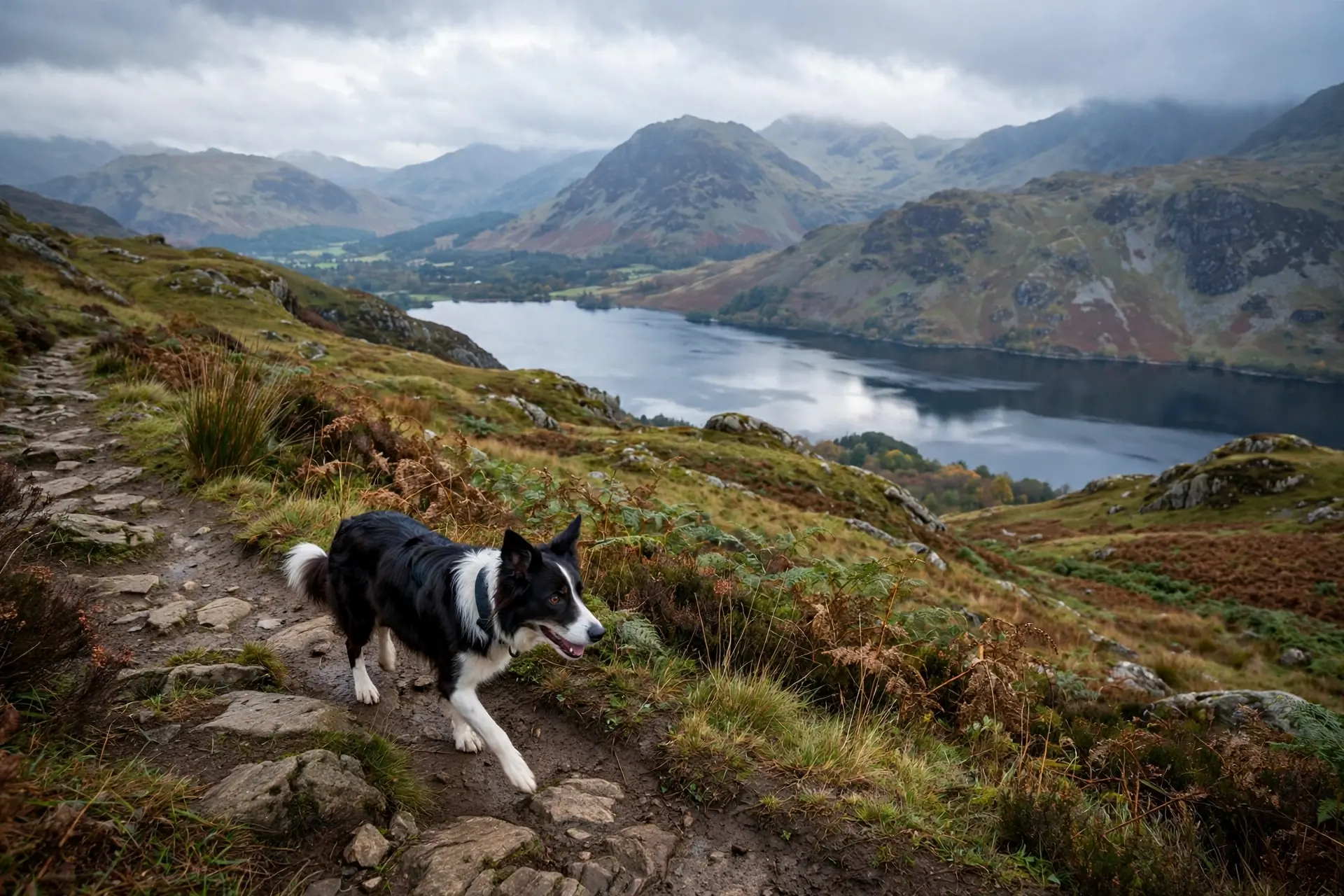
The descents deserve as much respect as the climbs. The path drops steeply off the ridges into the valleys, often on grassy slopes that are slippery after rain, or on rocky tracks that jar the joints. Older dogs, dogs with arthritis and dogs carrying any extra weight will feel the descents in their shoulders and elbows, and a dog that bounds downhill on day one may be stiff and reluctant by day five. Keep the dog on a lead on the steep descents, walk slowly, and use zigzags where the path allows it. A harness with a handle helps here: it lets you steady a dog on a slippery slope without pulling on its neck.
The ground underfoot changes every few miles, and the dog feels each change first. Heather moor on the Clwydian Range gives way to rough pasture, then to rutted farm tracks, then to woodland where roots cross the path and leaf mould hides the stones underneath. In the Wye Valley the track turns to mud after rain and stays soft for days. There is no single surface to prepare for, which is why the evening paw check matters more on this route than on a trail that keeps one kind of ground all the way.
Farmland, sheep and leads
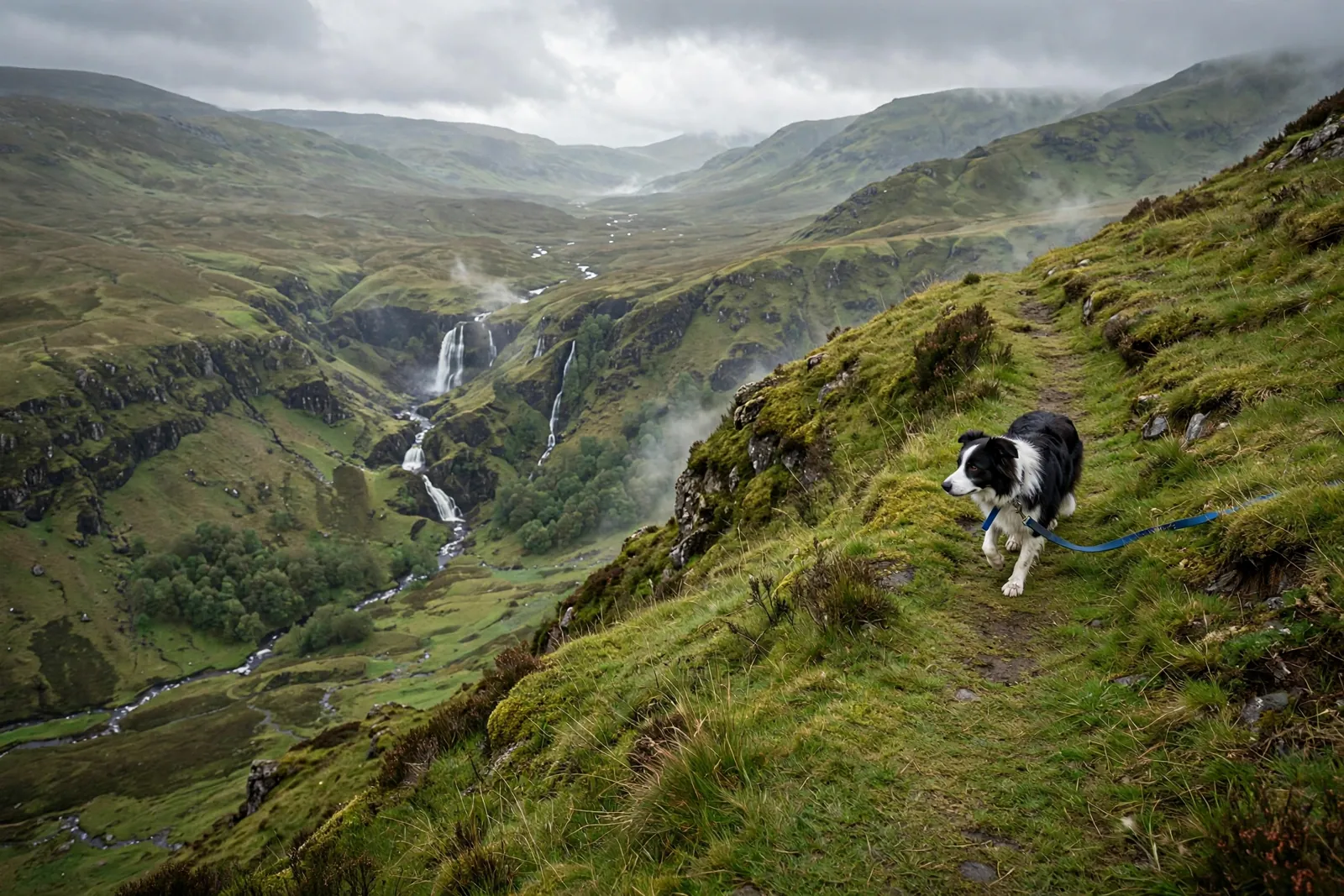
Sheep are the background of this walk for almost all of its 177 miles. They graze the open hills above Prestatyn, the pastures of the border valleys and the high ground of the Black Mountains, and in spring the fields fill with lambs that a dog can frighten badly without ever laying a paw on them. Clip the lead on before you step into a field, not after the sheep have already noticed the dog, and keep it on across open moorland from March to July, when ground-nesting birds are breeding in the same grass. On a trail this long the lead is not a rule for one afternoon — it is the habit that carries the whole fortnight.
Cattle are thinner on the ground than sheep here, but they own the valley sections, and a field of cows with calves at foot is no place for a loose dog in any circumstances. Give the herd a wide berth, keep the dog tight on a short lead at your side, and never step between a cow and her calf. If the cattle crowd the path, or the dog starts to fret, back out and walk around the field rather than forcing a way through. The farmers along the border welcome walkers who treat their stock with care, and nothing shows that care faster than a dog kept close.
Curlew, lapwing and skylark nest on the ground on the Clwydian Range and in the Black Mountains, and a dog quartering rough grass can crush a nest in a few seconds. The harm never shows itself: a nest left empty because a dog came too close looks just like a patch of grass where nothing ever nested. Stay on the marked path through the breeding season, lead on, and do not let the dog range wide over the open tops. The same lead rules apply across the Welsh uplands, and our guide to walking in the Brecon Beacons with a dog walks through them on similar high ground.
The wilder, rougher stretches
Not all of Offa's Dyke Path is a tidy footpath. Some sections cross open access land where the way is marked by posts rather than a worn track, and the dog may be walking through heather, bracken or rough grass with no clear path underfoot. Navigation matters here: carry a map and know how to use it, because the ridge in mist is a confusing place, and a dog that runs ahead can lead you astray as easily as it can lead you on. A GPS app on your phone is a useful backup, but do not rely on a phone signal, which is patchy in the hills.
Bracken is a hazard in its own right. In summer it grows head-high in places, hiding the path, the ground and the ticks that live in it. Check the dog for ticks every evening, and carry tick tweezers in the first-aid kit. Bracken also hides rabbit holes and uneven ground, so a dog running through it can easily twist a leg or cut a paw on a hidden stone. Keep the dog close and on a lead through the worst of the bracken, and walk the path rather than letting the dog push its own way through.
The wooded sections along the Wye Valley are rough in a different way: tree roots, mud, fallen branches and steep slopes that are slippery after rain. These are not difficult miles in terms of climbing, but they are tiring, because the dog has to pick its way carefully and you have to watch your own footing. In wet weather, the Wye Valley paths hold water for days, and a dog that hates mud will be miserable. A waterproof coat and a towel in the day pack help, and so does a realistic plan: allow extra time for the wooded miles, and do not expect to make up lost time on them.
Towns to rest and resupply
The border towns are the lungs of the walk: places to rest, eat properly, buy dog food, wash clothes and let the dog sleep on a real bed. Prestatyn, at the start, has everything a walker needs, including a railway station and a beach where the dog can stretch its legs before the hills begin. Llangollen is a favourite stop, with dog-friendly pubs, cafes and accommodation, and a riverside walk that makes a gentle rest-day outing. Knighton, at the halfway point, is small but perfectly placed: it has the Offa's Dyke Centre, a handful of pubs and guesthouses, a railway station and a genuine sense of being the border town.
Hay-on-Wye is the most famous town on the route, and with good reason: it is a book town, full of second-hand bookshops, cafes and dog-friendly pubs, and it sits in the beautiful Wye Valley at the foot of the Black Mountains. It is also the best place to restock after the hard miles from Knighton, and to make a decision about the days ahead: the section from Hay to Monmouth is the toughest on the trail, and a tired dog benefits from a full rest day here. Monmouth, further south, is a proper market town with supermarkets, a vet and a railway bus link, and it makes a good base for the final stretch to Chepstow.
Chepstow is a satisfying place to finish: a castle on the rock above the tidal Wye, pubs that welcome muddy boots and wet dogs, and a station with trains to Newport, Cardiff and Bristol for the journey home. Stand on the old bridge at the end of the walk and the whole border lies behind you — the Clwydian hills, the Shropshire valleys, the Black Mountains. Walkers who finish here and start dreaming about the next long trail often look at the Coast to Coast walk with a dog next, a very different kind of crossing.
Water and food on the trail
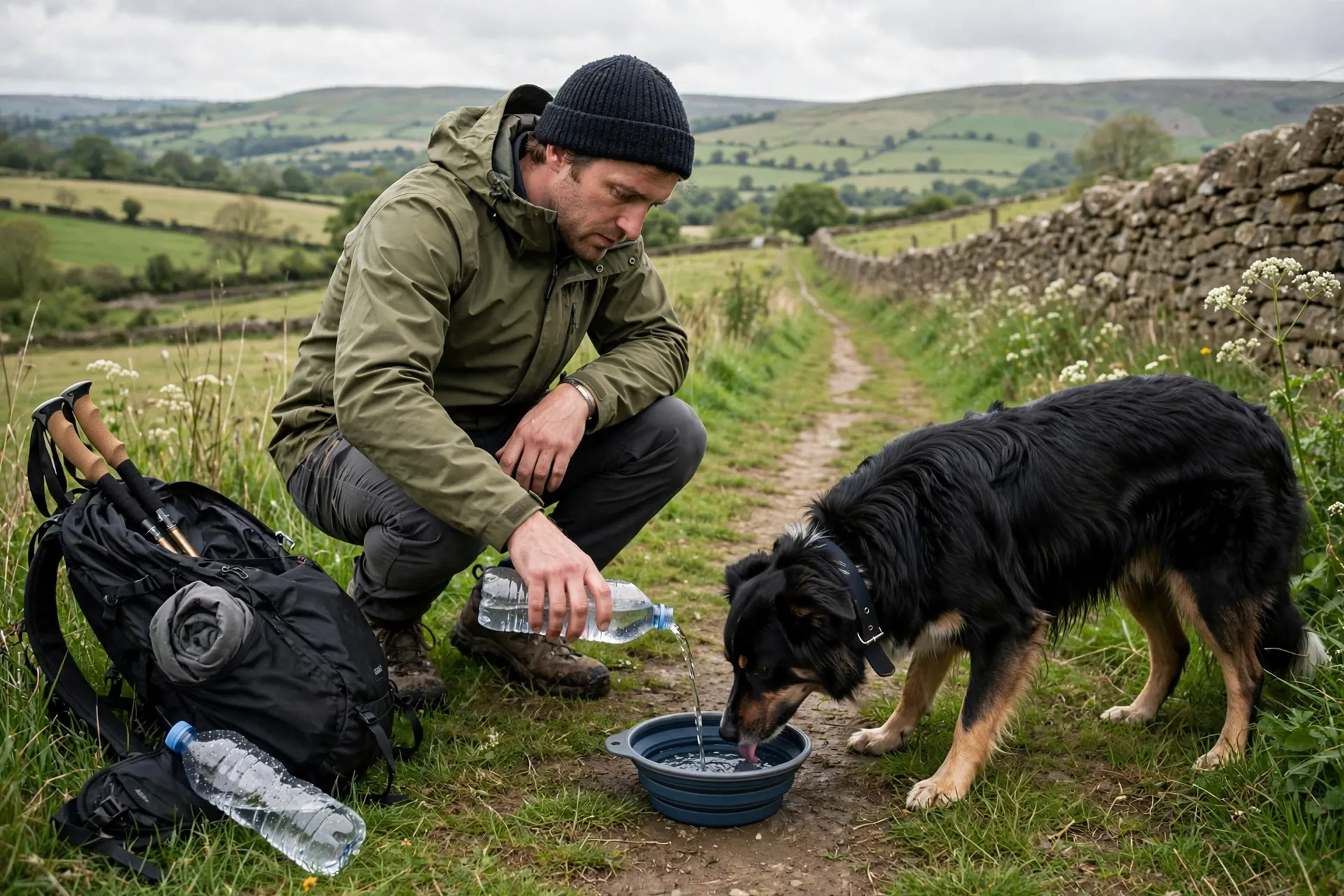
Water is the problem that takes most walkers on this route by surprise. Down in the valleys there is plenty — streams, becks, farm taps — but up on the ridges the path can run dry for miles: the Clwydian Range, the long hills south of Llangollen, the Black Mountains all have stretches with no certain source at all. Start each ridge day with a litre for the dog over and above your own water, and more when the day looks warm. Top up at every sure point you pass — the overnight stop, a pub, a village tap, a cafe — and carry a bowl the dog will drink from willingly. Test the bowl at home first: plenty of dogs turn their nose up at a new one when they are hot and tired.
A stream on the map is not a promise. After rain the water runs brown with soil and farm run-off, and in a dry spell the pools left on the ridge turn green and still. Let the dog drink from a stream that runs clear and fast if it wants to, but never build the day around finding one, and never let it drink water that is green, stagnant or running out of a farmyard. In hot weather, give water in small amounts often, and splash the dog's belly and paws at any stream you cross — the cooling matters as much as the drinking. Watch for a dry mouth, dull eyes, thick saliva and a dog that will not get up: those are signs to stop for the day, find shade and cool the dog down, not to press on to the next village. Our guide to dog hydration on long walks sets out the quantities and the rhythm in full.
Two weeks of walking needs a feeding timetable that survives repetition. Morning and evening meals of the dog's usual food, no big meal in the middle of the day, and a pocketful of its ordinary kibble or treats for energy on the climbs — that is the whole system, and it works because nothing in it is new to the dog. A sudden change of diet halfway along the border is a reliable way to spend a night dealing with an upset stomach, so stock up on the dog's normal food before you leave Prestatyn and top up in Knighton, Hay-on-Wye and Monmouth, where the shops carry pet food. Pack it in sealed portions marked by day, keep one day's worth in your day pack in case a transferred bag goes astray, and always leave fresh water beside the bowl at the overnight stop. A dog walking thirteen miles a day burns far more than it does at home, so the evening meal can be a little more generous than usual.
Where to stay with a dog
Sort the beds out early, because the dog-friendly ones along the border are thin on the ground and the walking season fills them from May to September. The stops follow a repeating pattern — a village pub with rooms, a small bed and breakfast, a farmhouse, a campsite — with the towns adding hotels and guesthouses. Most pubs and bed and breakfasts take a dog, but often in just one or two rooms, and many charge a small nightly fee for it. Ask for an email that spells out the dog terms before you pay: which room, what the fee is, whether the dog may wait in the room alone while you are at dinner, and where its bed should go. A friendly yes over the phone can mean something much narrower when you arrive with a wet border collie at dusk.
Camping suits a dog that is happy in a tent, and pitches sit close to the path in the Clwydian Range, near Knighton and down in the Wye Valley. A tent is the dog's own den for the night, with familiar smells instead of a strange room, but it means carrying the tent, the bed and the food, and a dog that barks at every footstep past the tent will not make friends with the rest of the field. Hostels are a mixed bag on this route: a few have private rooms that take dogs, others take none at all, so ask each one directly. Whatever the night's roof, hold the evening steady — feed at the usual time, put the same bed down, take a short last walk before dark, and leave an hour of quiet for the dog to settle.
Book the town nights first, because the towns hold the most beds and draw the most walkers. Knighton and Hay-on-Wye in particular can be full weeks ahead in the walking season, and a night without a bed in the middle of a two-week walk is a problem that lands at six in the evening with nowhere good to go. If the first choice is full, a taxi to a nearby village usually works — but check the taxi position before you commit, because rural firms need booking ahead and some do not run on a Sunday evening at all.
Baggage transfers and transport
On a walk this long, having the heavy bag carried for you is less a luxury than a necessity with a dog. Local firms move bags between the overnight stops along the whole route, usually charging a daily rate per bag, and arranging the full fortnight in one booking is cheaper and simpler than sorting it night by night. For each stop, settle the morning pick-up hour, how heavy the bag may be, and the precise address it goes to, and mark the bag with your name and that night's stop. The day pack then carries only the walking essentials — water, the bowl, rain gear, a pocket of treats and a small first-aid kit — and the dog's own essentials stay in it too: the day's food, any medicine, poo bags, a spare lead and a towel, never in the bag that travels separately.
Prestatyn station sits on the North Wales coast line, with trains from Chester and Holyhead, and Chepstow station serves Newport, Cardiff and Bristol at the far end. In between, Knighton has a station on the Heart of Wales line, which is handy if you need to join or leave the walk halfway through, and several towns have buses to bigger stations. A dog usually travels on British trains without a ticket, on a lead and off the seats, but each operator sets its own rules, so look up the ones for the services you plan to catch before you travel. Drivers can park at one end and use the train to get back, or book a transfer firm that moves walkers as well as bags.
Buses run along parts of the border and can shorten a day or rescue a tired dog, but they are thin: some villages see one or two buses a day, and a Sunday service cannot be assumed. Never build a day around a bus without reading the timetable first, and have a fallback in mind — a taxi number, or a shorter day that ends at a station. If you drive, think about parking at one end and riding back by public transport, or booking a transfer service that carries walkers as well as bags. On a 177-mile route the journey to the start and home from the finish deserves the same attention as the walking itself.
Paws, weather and fitness
The ridge paths are grassy and forgiving, which is the good news; the bad news is everything in between. Farm tracks are stony, woodland paths are laced with roots, and the lanes near the towns are hard on pads, so a single day can wear a dog's feet in three different ways. Build the evening paw check into the routine: run a thumb over each pad for splits and swelling, look between the toes for grit and small cuts, wash the mud off with clean water and dry the paws well. Paw balm helps pads that are drying out. A dog that starts to limp should be rested, not pushed on — a day off in a town costs far less than three more days on a worsening limp.
Weather on the border turns fast. The ridges stand open to wind and rain off the west, and mist can roll in within minutes and cut visibility to a few metres, so waterproofs for both of you are not optional, and a waterproof coat for the dog is worth carrying on any wet week — above all for short-coated, older or small dogs that chill quickly. Summer brings the opposite problem: the same open ridges have no shade, so heat becomes the risk, and the answer is an early start, a long rest through the middle of the day, and a watch for heavy panting or a dog that refuses to move. A harness with a handle earns its keep on the steep descents and the slippery woodland slopes, steadying a dog where a collar and lead cannot.
Two weeks of walking is built in stages, not wished into being. Give yourself five or six weeks. In the first weeks, stretch the daily walks and add hills until the dog is comfortable with long days on mixed ground. Then practise the part most people skip: two long days back to back, with the second walked while the dog is still tired from the first, and the day pack loaded as it will be on the trail. Rehearse the routine as well — breakfast, a long walk with water stops, an evening meal, a night in a strange bed — and taper in the final week so the dog starts fresh. Any dog with arthritis, a heart problem or an old injury should see the vet before you book, and the vet's advice should settle the question. For an older dog, walking the route in sections over several trips is often the kinder answer, and the border is still there next year.
What to pack for the dog
Pack by the moment the dog will need each thing. Before you leave the overnight stop: a padded harness with a grab handle you can hold on steep ground, a collar with an ID tag, a lead and a spare lead tucked where you can reach it. On the ridge: a bowl that folds flat, room to carry a litre of water for the dog, that day's meals sealed in a bag, poo bags, a towel, a rain coat for the dog for wet or chilly days, paw balm, a compact first-aid kit, tick removers, and the dog's daily tablets. At the overnight stop: the rest of the food, the dog's bed or blanket so each new room smells familiar, and a spare towel for the end of a wet day. Before the trip itself, store the number of a vet close to the route in your phone and take a copy of the vaccination record.
Keep the food in one labelled stuff-sack inside the transferred bag, with a separate small pouch in your day pack holding that day's meals and treats. Each morning, count what is left in the stuff-sack against the days still to walk — a thirty-second check that stops a nasty surprise in Knighton or Hay-on-Wye. Take more poo bags than the maths suggests, because a fortnight of walking gets through them far faster than a weekend, and carry every used bag out: the Dyke is a scheduled monument and the border a working landscape, and a bagged parcel left by the path is litter. A small dry bag for the dog's food and medicine keeps both dry when the rain comes in sideways, and it weighs next to nothing.
Walk the border slowly and it pays you back. The dog will stop to sniff every gatepost, every beck, every patch of sheep-scented grass, and those stops are the walk itself rather than delays in it. Allow for them in the plan, and two weeks along an eighth-century earthwork feels spacious instead of rushed. A bank of earth, walked at a dog's pace, is one of the quiet pleasures of British walking.
Practical questions
Before you go
Can dogs walk the full Offa's Dyke Path?
Yes — dogs can walk the whole 177 miles from Prestatyn to Chepstow, but long stretches cross farmland where the lead is required, and parts of the route cross open access land with grazing sheep and ground-nesting birds. Look up the current access rules and any seasonal restrictions on the official trail pages before you set out.
How long does Offa's Dyke Path take with a dog?
Most walkers take 12 to 14 days, covering about 13 to 15 miles a day. With a dog, 13 or 14 days is the kinder plan, especially through the Shropshire Hills and the Black Mountains, where the climbs are long. Building in a rest day at Knighton or Hay-on-Wye gives a tired dog time to recover.
Is Offa's Dyke Path very hilly for a dog?
It is hillier than most people expect. The route crosses the Shropshire Hills, the Black Mountains and the Wye Valley, with long steady climbs rather than short sharp ones. Fit dogs cope well, but older dogs and very small dogs will find the southern half demanding, and the descents are hard on knees and paws alike.
Where can the dog drink on Offa's Dyke Path?
Carry water and top up in villages, pubs and at your overnight stop. The ridge sections can run dry for miles with no reliable stream, while the valleys have plenty of becks. Take a folding bowl and at least a litre of water for the dog, and carry more on hot days.
Are dogs allowed on Offa's Dyke itself?
The path follows public rights of way along the line of the eighth-century earthwork, and dogs on leads are welcome on the trail. The Dyke itself is a scheduled monument, so keep the dog on the path and do not let it dig or scramble on the bank. Look up any local restrictions on the official trail pages before you set out.
What is the hardest section of Offa's Dyke Path for a dog?
Most walkers name the Black Mountains, between Hay-on-Wye and Monmouth: long exposed ridges, few water sources, steep descents and changeable weather. The Shropshire Hills around Knighton run it close. Plan these sections for cool weather, start early, carry extra water and keep the dog on a lead near sheep.