This guide is independent and contains no paid placement. If affiliate links are added later, they will be clearly marked and will not change our editorial checks.
The Great Glen Way suits most fit dogs, including older ones, because long stretches are flat canal towpath. Walk it in 6 days with a rest day, take the high sections above Loch Ness slowly, book dog-friendly stays ahead, and check cruise dog policies before you promise the dog a boat trip.
A fault line, a canal and four lochs
The Great Glen is one of the great geological features of Britain: a straight fault line that runs from coast to coast across the Highlands, filled with a chain of deep lochs. The Way follows that line for 79 miles, from Fort William on the Atlantic side to Inverness on the Moray Firth, and the walking follows the water for most of the way. That is what makes the route different from the West Highland Way, which climbs over the high ground. Here the ground stays low, the path stays near the water, and the dog's legs get a far easier week.
History is woven into the route at every stage. The Caledonian Canal, built in the early 19th century, joins the lochs into a single waterway, and its towpath carries the walker for long, flat stretches. The locks at Neptune's Staircase, the swing bridges, the old canal cottages and the ruined castles along the shore are all part of the walk, and they give the route a character that no moorland trail has. A dog that walks the towpath is walking through two hundred years of Highland engineering, and the flat ground is a bonus.
The four lochs give the journey its shape. Loch Linnhe opens the route at Fort William, Loch Lochy follows, then the smaller Loch Oich, and finally Loch Ness, the longest and the most famous, which carries the walker most of the way to Inverness. Each loch has its own shore path, its own villages and its own views, and the walking changes with each one. The canal sections are flat and easy; the lochside paths are gentle and scenic; and the hills above Loch Ness, where the route leaves the water and climbs, are the one stretch that asks for real effort.
Most people finish the route in 5 to 6 days, and with a dog, 6 days plus a rest day is the sensible plan. The stages are arranged around the villages of the Glen, so the overnight stops are known and the distances between them are manageable. And because the route starts where the West Highland Way ends, many walkers join the two together into a single 175-mile journey from Milngavie to Inverness. That combined walk is one of the finest long journeys in Britain, and the Great Glen Way is the gentler half of it, which is exactly why it works so well as a first long trail for a dog.
The Caledonian Canal towpath
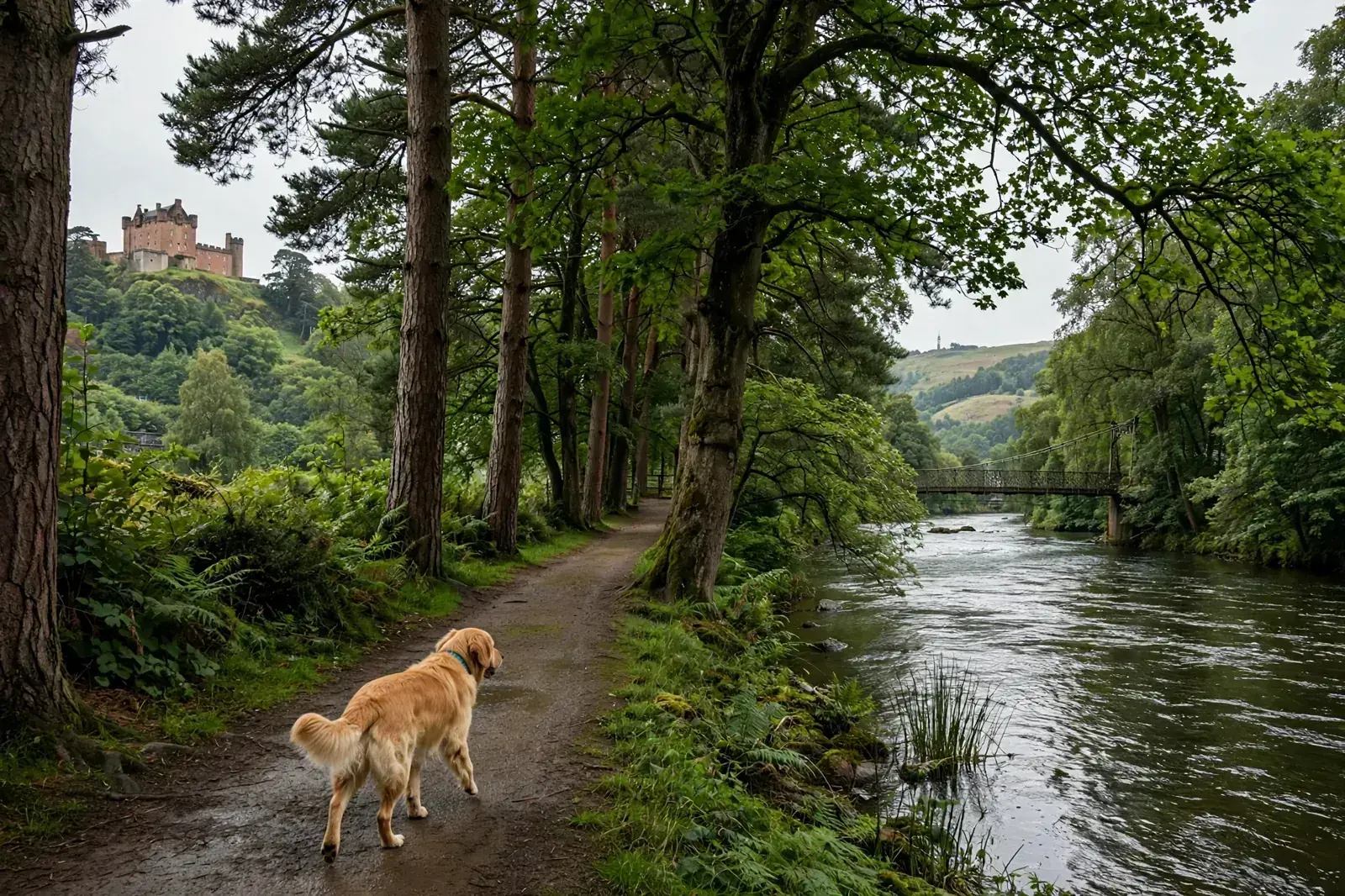
The Caledonian Canal is the spine of the Great Glen Way, and its towpath is the easiest walking on the route. The canal was built in the early 19th century to link the lochs of the Great Glen, and its towpath is flat, well surfaced and easy underfoot, which makes it ideal for a dog. The walking is gentle, the views are open, and the locks, with their gates and balance beams, are a piece of living industrial history. A dog that has struggled on the hills of the West Highland Way will find the towpath a relief, and a dog that is older or less fit will find it the most comfortable walking on the whole route.
Towpath walking has its own etiquette. Keep the dog on a lead near the locks, where the ground is wet and slippery and the machinery is moving, and keep it away from the edge of the canal, where a dog that falls in can struggle to climb out. Cyclists use the towpath too, and they can appear quickly and quietly, so keep the dog close and on the inland side. If a boat is passing through a lock, give it room, keep the dog still, and do not let it bark at the crew. The canal is a working waterway, and the people who use it deserve the same consideration as the walkers.
The canal sections are also the best places to plan a rest day or a short day. The towpath from Fort William to Gairlochy, and from Fort Augustus to Inverness, is flat and easy, and it can be walked at a gentle pace with plenty of stops. The locks at Neptune's Staircase, near Fort William, are the most dramatic feature of the canal, with eight locks in a row, and they are worth a slow morning. The dog will enjoy the flat ground, the water and the open views, and the walker will enjoy a day that does not demand a climb.
One more practical point: the canal towpath is exposed to the wind in places, and a cold wind off the loch can chill a small or short-coated dog quickly. Carry a dog coat from the start of the trip, and put it on at the first sign of a cold wind rather than waiting for the dog to shiver. A dog that is warm and comfortable on the towpath will walk further and enjoy the day more than one that is cold and miserable.
Loch Ness, shore to shore
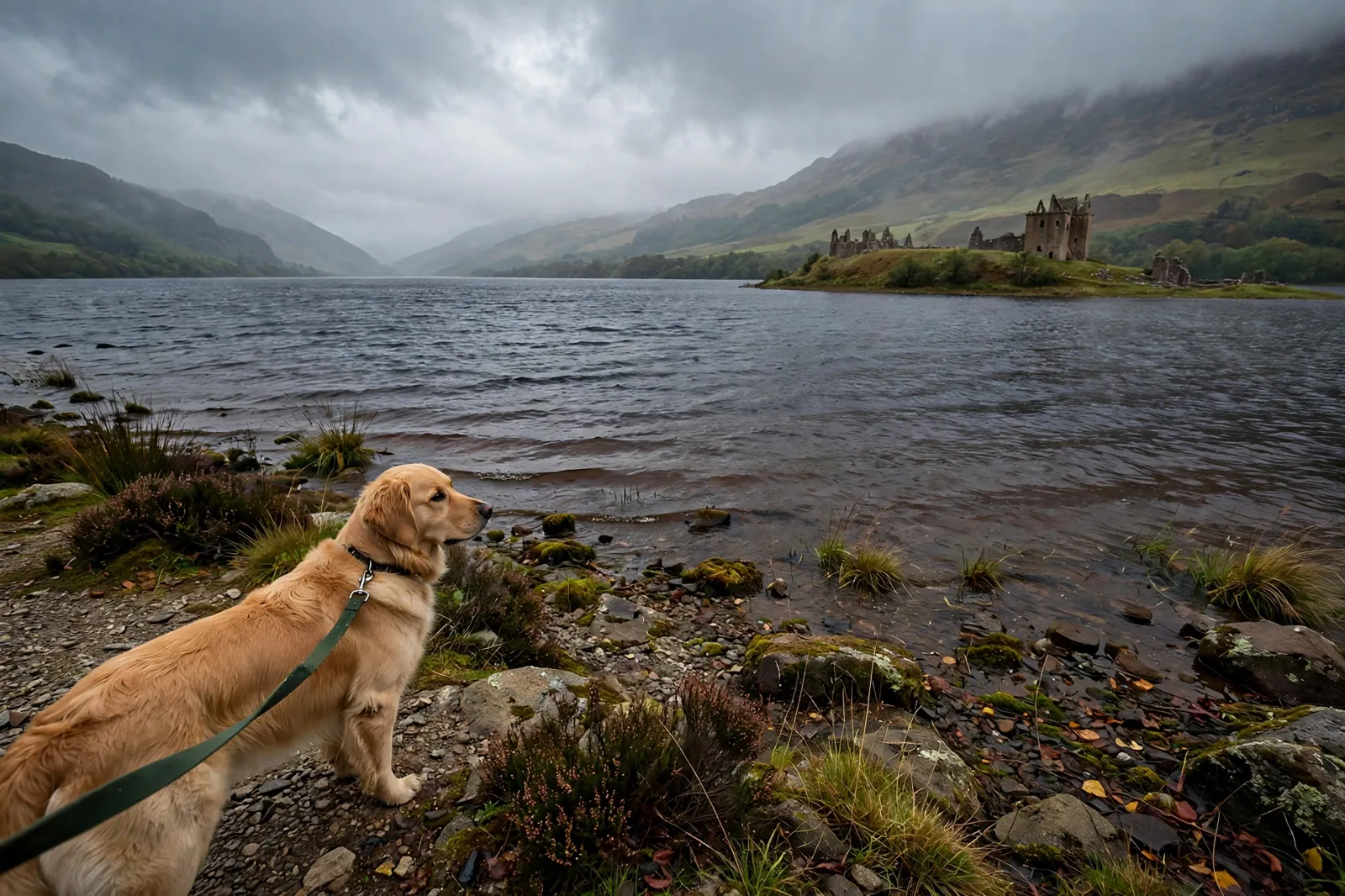
Loch Ness is the heart of the Great Glen Way, and it is the loch that gives the route its character. The loch is 23 miles long, up to 230 metres deep, and famous the world over for the monster that may or may not live in it. For a dog walker, the loch is a constant presence: the path follows its shore for long stretches, the views across the water to the hills are superb, and the villages along the shore — Fort Augustus, Drumnadrochit and Invermoriston — are the natural overnight stops.
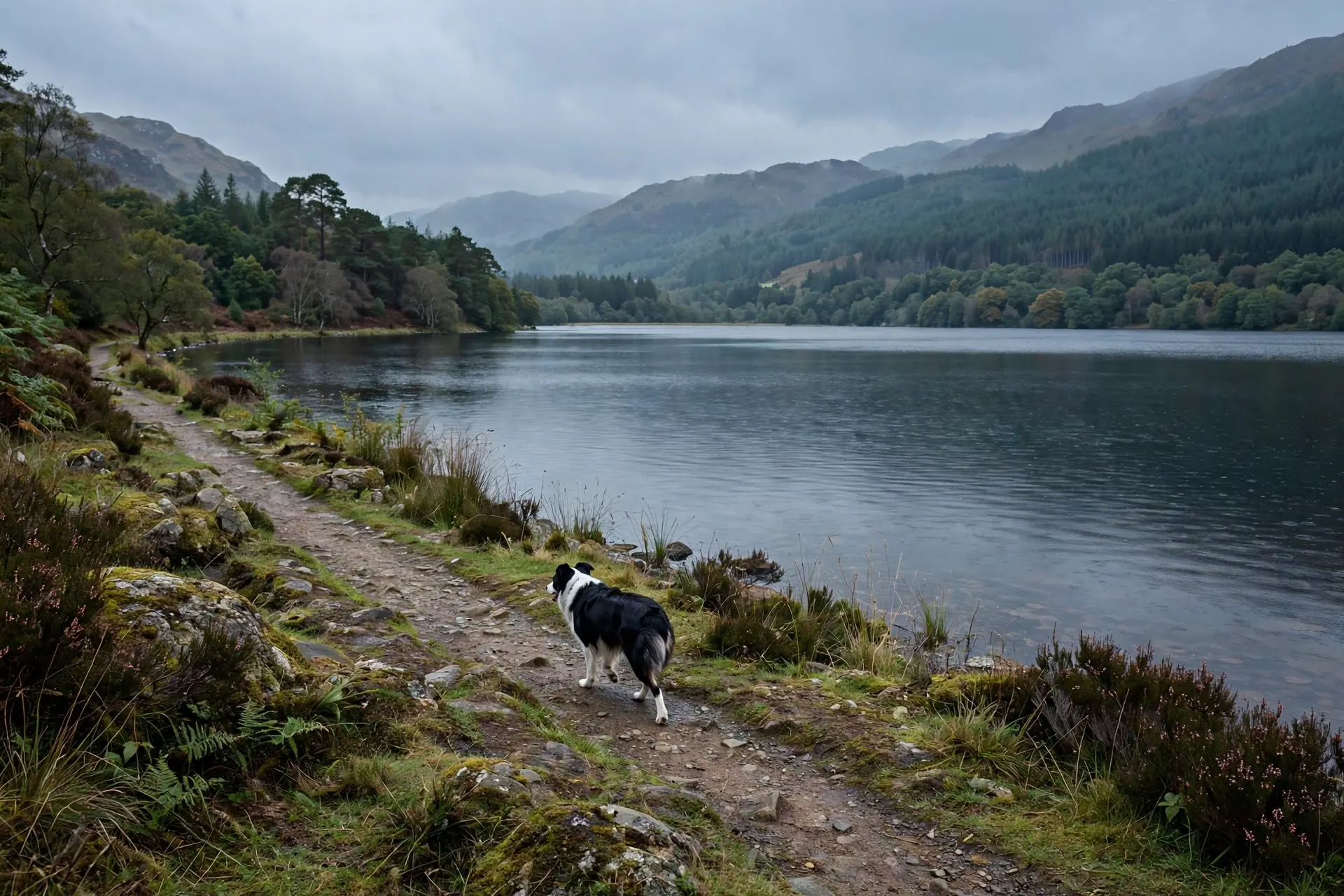
The lochside walking is generally easy and flat, which makes it good recovery walking after the high sections, and the water is tempting for a hot dog. Keep the dog out of the water if there is a blue-green algae warning, and never let a dog swim where there are boats or strong currents. After a swim, rinse the dog with fresh water if you can, and check the paws for cuts from the rocky shores. The loch water is cold, even in summer, and a dog that swims for too long can become chilled, so keep swims short and dry the dog off afterwards.
Urquhart Castle, on the shore near Drumnadrochit, is the most visited site on the loch, and it is worth knowing the rules before you go. Dogs are welcome in the grounds on a lead, though they are not allowed inside the visitor centre or the castle itself. The castle is a good place for a rest day, with views across the loch and a cafe nearby, but it is busy in summer, and a dog that is nervous in crowds should visit early in the morning or late in the afternoon.
Our guide to Loch Ness with a dog covers the loch's cruises, the Loch Ness Trail, the castle rules and the best bases at Drumnadrochit and Fort Augustus in more detail, and it is worth reading before you plan the lochside stages, because the facilities and the cruise policies change with the season.
The high sections above the loch
The high sections above Loch Ness are the Great Glen Way's one serious test, and they are the days that catch out the unprepared. Between Drumnadrochit and Inverness, and between Fort Augustus and Drumnadrochit, the route climbs away from the loch shore and crosses the hills above the water, with steep climbs, rough ground and exposed ridges. These sections are far harder than the flat canal towpaths, and they are the reason the route is not simply a flat walk. A dog that has coped happily with the towpath may find the high sections tiring, so they should be taken slowly, with plenty of water and rest breaks.
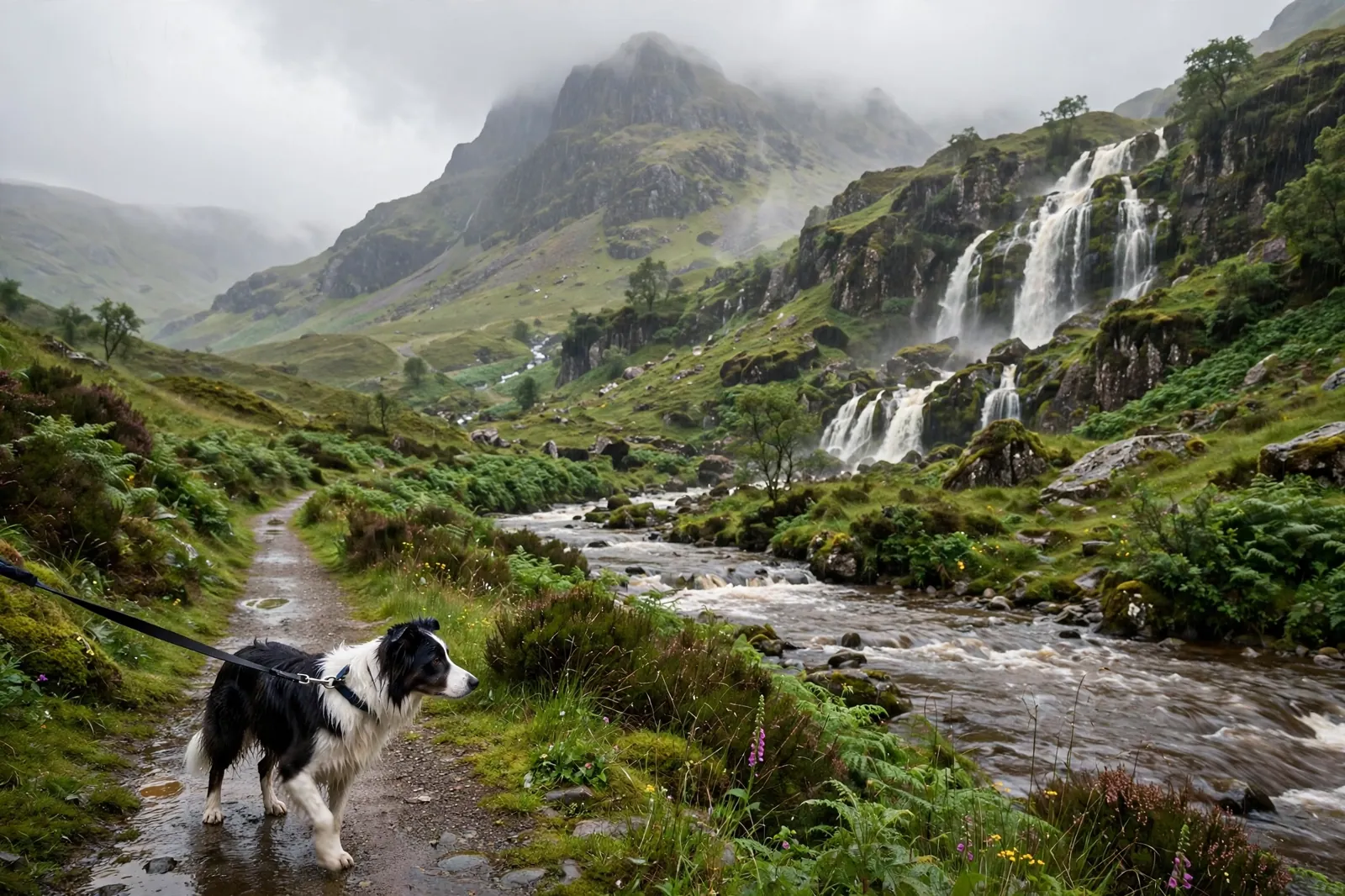
The high sections are also the most rewarding part of the route. The views from the hills above the loch are superb, with the water below and the mountains beyond, and the sense of space is unlike anything on the towpath. The walking is on forest tracks and open hillside, with a mix of conifer plantation and open moorland, and the ground can be boggy after rain. Keep the dog on a lead where the path crosses open moorland in the breeding season, and keep it close on the steep descents, where a dog that pulls downhill can unbalance a walker on loose ground.
Weather on the high sections can be very different from the weather on the loch shore. A calm, sunny morning at Fort Augustus can become a windy, rainy afternoon on the hills, and fog can close in quickly. Check the forecast every morning, carry a map and a compass, and be ready to take a lower-level alternative if the weather turns. The high sections are no place for a dog in a thunderstorm, and a day cut short is not a failure; it is the decision that lets you walk again tomorrow.
There are lower-level alternatives for some of the high sections, and they are worth knowing about. The road along the loch shore is the most obvious, though it is busy with traffic and not pleasant walking. The forest tracks below the high route are a better option, offering shelter and easier ground. Ask local walkers or the staff at your stay about the alternatives before each day, and do not be afraid to use them. A dog that arrives at Inverness fit and happy is worth more than a dog that has ticked off every high section.
Combining it with the West Highland Way
The Great Glen Way and the West Highland Way join at Fort William, and the combination is one of the finest long walks in Britain. The West Highland Way runs 96 miles from Milngavie to Fort William, and the Great Glen Way runs 79 miles from Fort William to Inverness, making a single journey of 175 miles. Most walkers take 12 to 14 days for the combined route, with at least one rest day, and the journey takes in lochs, glens, moorland and the Highlands' two most famous trails in a single trip.
Planning the combined route is a matter of logistics as much as walking. The stays must be booked for the whole journey, the baggage transfer must be arranged for both trails, and the food and water must be planned for the gaps on both routes. The West Highland Way is the harder of the two, with its midges, its exposed moorland and its long stages, while the Great Glen Way is the gentler, with its flat towpaths and its lochside walking. A dog that has walked the West Highland Way will find the Great Glen Way a relief, and a walker who has planned well will enjoy the change of pace.
The rest day is the key to the combined journey. Fort William is the natural place for it, at the junction of the two trails, with shops, pubs, a choice of stays and a chance to wash the mud off everything. A day in Fort William, with a short walk to Glen Nevis or a visit to the town, will do more for the second half of the journey than another 15 miles. If the dog is tired, an extra rest day is worth more than any single stage, and the trail will still be there tomorrow.
Transport for the combined journey is straightforward. Milngavie has a direct train from Glasgow, and Inverness has trains to Edinburgh, Glasgow and the south, which means the return journey is a matter of a single train. Dogs travel free on most trains, though they must be kept on a lead and off the seats. That ease of transport is one of the combined route's great attractions, and it is worth factoring into the planning: a journey that is easy to reach and easy to leave is a journey you can walk without a car.
Where to sleep in the Glen
The villages of the Glen are used to walkers, and the beds are better than on most Highland trails. Fort William has hotels, hostels and campsites; Spean Bridge has a hotel and a bunkhouse; Fort Augustus has pubs with rooms, bed and breakfasts and a campsite; Drumnadrochit has hotels, hostels and campsites; and Inverness has everything from hostels to hotels. The choice is wide, but the dog-friendly rooms are still limited, and they are the first to fill in summer. Book the whole route before you leave, in order, and confirm the dog on every booking.
Hostels are a particularly good fit for this route. They are cheap, they have drying rooms for wet gear, they have kitchens where you can cook a proper meal, and several of them welcome dogs. A hostel with a drying room after a wet day above Loch Ness is worth more than a hotel without one, and a kitchen lets you feed the dog its normal food in peace while you cook for yourself. Bunkhouses offer the same advantages at a similar price, and the ones that take dogs are worth booking early.
Pubs with rooms are the classic Great Glen stay, and many of them expect muddy boots and tired dogs. A pub that lets the dog into the bar, with a bowl of water by the fire, is a very good end to a walking day, but the rooms that take dogs are few, and they book up early. When you book, ask whether there is a charge per dog, whether the dog can sleep in the room, whether there is a secure place for a last outing, and whether there is a tap for muddy paws. A host who answers clearly has thought about dogs; a host who is vague probably has not.
Campsites are the cheapest option, and several of the villages have one, with the lochside sites among the prettiest places to camp in Scotland. Check whether dogs must stay on a lead at all times, and whether the site is sheltered from the wind off the loch. And arrange the baggage transfer before you leave: several companies move bags along the route for a fee per bag per day, collecting them from one night's stay and delivering them to the next. Confirm that every stay is on the courier's list, check the weight limit, and keep the dog's food and medicine in your own pack.
Eating well in the Glen
Food is one of the easier parts of the Great Glen Way, because the settlements are bigger and the shops are better than on the West Highland Way. Fort William has supermarkets where you can buy a week's worth of dog food before you start, and Inverness has the same at the other end. In between, Spean Bridge has a shop, Fort Augustus has a village store and a choice of cafes, and Drumnadrochit has shops, pubs and a supermarket of its own. The gaps are short, and a walker who shops at each village will never be far from the next meal.
That does not mean the food takes care of itself. A village store may not stock the brand your dog eats, and a small shop may have very little choice in the way of dog food at all. The safe approach is to carry the dog's food for the whole route from Fort William, measured into one bag per day, and to use the village shops for your own food and for top-ups. A walking dog eats roughly a third more than it does at home, and on a cold day above the loch that figure rises, so measure generously rather than exactly. If you use a baggage courier, the food can ride in the transferred bag, but keep a day's ration in your own pack, in case the courier is delayed.
Water is plentiful along the Glen, because the canal and the lochs are never far away, but it is not all drinkable. Loch water should not be drunk untreated, and still pools in warm weather can carry blue-green algae. Carry a litre for the dog and a litre for yourself, with a collapsible bowl, and fill up at every pub, cafe, hostel and campsite. Burns that run fast over stones are generally fine, but offer the bottle water first, and keep the dog out of any pool that looks green or smells stale.
The pubs and cafes of the Glen are part of the pleasure of the route, and they are worth planning for the dog as well as for the walker. A pub that welcomes dogs will have a bowl of water by the door and a quiet corner under a table, and a dog that can settle there while you eat is a dog that will be welcome at the next pub too. Time the dog's meals around the walking: a main meal an hour before the start, a small top-up at lunchtime, and the evening meal an hour after the day ends. A deep-chested dog that exercises on a full stomach is at risk of bloat, so the hour before and the hour after walking matter more than the food itself.
Boats, cruises and ferries
Loch Ness is famous for its cruises, and many walkers want to take a boat trip as part of the journey. Some cruise operators welcome dogs, usually on the open deck, while others do not allow them at all. Policies vary by operator and by boat, and they can change with the season, so check before you book and confirm the dog in writing. If a cruise does not accept dogs, the lochside paths and the viewpoints at Urquhart Castle and Fort Augustus offer the same views from the shore, and the dog will be happier on the path than on a crowded boat in any case.
The Caledonian Canal also carries boats, and the locks are a working part of the waterway. A dog should be kept on a lead near the locks, where the ground is wet and slippery and the machinery is moving, and kept away from the edge of the canal. If a boat is passing through a lock, give it room, keep the dog still, and do not let it bark at the crew. The canal is a working waterway, and the people who use it deserve the same consideration as the walkers.
Ferries are a smaller part of the Great Glen Way than of some other trails, but they are worth knowing about. There is no ferry that the route depends on, which is a relief for a dog owner, because a ferry that does not run can add miles to a day. The boats that do operate on the loch are pleasure cruises rather than transport, and they are an optional extra rather than a necessity. If you plan a cruise, book it in advance in summer, confirm the dog policy, and have a plan for the dog if the cruise is cancelled or the weather turns.
One more practical point: the loch and the canal are both cold water, even in summer, and a dog that falls in can become chilled quickly. Keep the dog on a lead near the water, and never let it jump in from a lockside or a jetty. If a dog does fall in, help it out as quickly as possible, dry it off, and keep it warm. The water is beautiful to look at, and it is cold to fall into, and the dog's safety is worth more than a photograph.
Five days from Fort William to Inverness
Day one runs from Fort William to Gairlochy, about 10 miles along the canal towpath, past Neptune's Staircase and its eight locks. It is a gentle start, flat and easy, and it is the day to settle into the rhythm of the trail rather than to push the pace. The dog will enjoy the flat ground, the water and the open views, and the walker will enjoy a day that does not demand a climb. Gairlochy has a lock keeper's cottage and a quiet mooring, and it is a good place for a first night.
Day two continues from Gairlochy to Laggan, along the canal and the shore of Loch Lochy. The walking stays easy, with the loch on one side and the hills on the other, and the day is a good one for building distance without building fatigue. Day three runs from Laggan to Fort Augustus, with the first of the higher ground and a village at the end that has shops, pubs and a choice of stays. Fort Augustus is a natural rest-day stop, with the canal locks, the loch and a good selection of places to eat.
Day four is the longest lochside day, from Fort Augustus to Drumnadrochit, with Urquhart Castle as a reward near the end. The path follows the shore, with views across the water to the hills, and the walking is gentle, though the day is long. Drumnadrochit has shops, pubs and a choice of stays, and it is a good place for a second rest day if the dog needs one. Day five runs from Drumnadrochit to Inverness, through forest and over the hills above the city, and finishes with a descent into the Highland capital.
That five-day shape is a plan, not a prescription, and it should be bent to fit the dog in front of you. An older dog will do better with six days, splitting the longest stages and adding a rest day at Fort Augustus. A young, fit dog may manage the five days comfortably, and may even add a detour to a viewpoint or a castle. The point is the pattern: a gentle start, a steady build, a rest in the middle, and a finish that leaves the dog tired but happy. Book the stays first, then fit the walking to the stays, and leave a spare half-day at the end for a delayed bus or a day lost to weather.
Packing for canal paths and lochside hills
The Great Glen Way is a gentler trail than the West Highland Way, and the packing can be lighter, but the Highlands still demand respect. The core of the list is the same as for any Highland walk: waterproofs that work, layers that stay warm when wet, and boots that have been broken in on rough ground. The towpath sections are flat and easy, and some walkers are tempted to wear light shoes for them, but the hills above Loch Ness are rough and steep, and boots with good grip are the safer choice for the whole route. A walking pole helps on the descents, and a head torch belongs in the pack for any day that runs late.
The dog's kit is short and specific. A harness that fits and does not rub, a lead that is comfortable to hold in the rain, a spare lead, a bowl that folds flat, a litre of water, the day's food in a labelled bag, poo bags, a towel, and a coat for the wind off the loch. A paw balm for the evening, a few booties for a cut pad, a tick remover, and a small first-aid kit with bandages and antiseptic complete the list. Ticks live in the bracken and the long grass from spring to autumn, so sort out a vet-recommended treatment before the trip, and check the dog's ears, armpits and toes every evening.
Midges are a feature of the Glen from late May to September, and they gather at dawn and dusk beside the lochs. A head net for the walker is the most useful item in summer, and long sleeves help even on a warm day. For the dog, ask your vet for a suitable repellent, and never use a human repellent without checking that it is safe for dogs. A light coat can protect the dog's belly and back, and the best defence of all is timing: walk in the middle of the day, and be inside with the door shut when the midges are at their worst. May and late September avoid the season altogether.
Maps and navigation matter here too, even though the route is well waymarked. Carry a paper map and a compass, and download offline maps as a backup, because the phone signal vanishes in the glens and the battery dies faster in the cold. Keep the phone in a waterproof case with a power bank in a dry bag. And carry the paperwork: the dog's vaccination record, the vet's number, and the number of the nearest emergency vet for each night's stay. A phone with the numbers saved, a charger and a power bank complete the kit, and the best kit list is the one you have tested on a wet walk at home, not the one you wrote the night before.
For the Highland capital at the end of this trail, our guide to Inverness with a dog covers the River Ness and Ness Islands walks, the canal towpaths, Culloden rules and the dog-friendly stays that make a good base for the days after the walk.
Practical questions
Before you go
Can dogs walk the Great Glen Way?
Yes, if the dog is a healthy adult in good condition. The trail is 79 miles of waymarked path from Fort William to Inverness, usually walked in 5 to 6 days. It follows canal towpaths, forest tracks and lochside paths, with climbs over the hills above Loch Ness. A lead is needed near farm animals and at the canal locks. Check the official guidance before you travel for current conditions.
How long does the Great Glen Way take with a dog?
The usual time is 5 to 6 days, at 13 to 16 miles a day. With a dog, 6 days plus a rest day at Fort Augustus or Drumnadrochit is the wiser target, since the high ground above Loch Ness is far harder than the flat towpaths. The route is often walked as a continuation of the West Highland Way, making a 12-day journey from Milngavie to Inverness.
Can the Great Glen Way be combined with the West Highland Way?
Yes, and plenty of walkers do. The West Highland Way finishes at Fort William, where the Great Glen Way starts, so the two join into one 175-mile journey from Milngavie to Inverness. Allow 12 to 14 days in total, with at least one rest day, and reserve every stay ahead, because the combined route is busy in summer.
Are dogs allowed on Loch Ness cruises?
It depends on the operator. Some Loch Ness cruises take dogs, usually on the open deck; others take none at all, and the rules can differ from boat to boat. Check before booking and get the dog confirmed in writing. If a cruise will not take dogs, the lochside paths and the viewpoints at Urquhart Castle and Fort Augustus give the same views from dry land.
Where can I stay with a dog on the Great Glen Way?
Fort William, Spean Bridge, Fort Augustus, Drumnadrochit and Inverness all have pubs with rooms, bed and breakfasts, hostels, bunkhouses and campsites, and most stops have somewhere that takes dogs, though they fill early in summer. Reserve every night before departure, get the dog confirmed in writing and check the pet fee. Baggage couriers work the whole route.
Is the Great Glen Way suitable for an older dog?
It is one of Scotland's gentler long trails, because long stretches follow flat towpaths and forest tracks. The high ground above Loch Ness is the exception, with steep climbs and rough going. An older dog can manage it if the days are shortened, the high sections are taken slowly and a rest day is included, but check the official guidance before you travel and be ready to drop to a lower path on the hard days.