This guide is independent and contains no paid placement. If affiliate links are added later, they will be clearly marked and will not change our editorial checks.
Base in Inverness if you want Highland scenery without moving beds every night. Walk the River Ness and Ness Islands straight from the centre, use the Caledonian Canal towpath for longer flat miles, visit Culloden on a lead, day-trip down Loch Ness, and treat the city as the sensible staging post for the NC500 — with vets, shops and fuel on hand before the roads empty out.
Why base yourself here
Most Highland trips involve a trade-off. Stay somewhere remote and every rainy day, forgotten bag of dog food or minor injury becomes a long drive. Stay in a large city and the walks that justify the journey sit an hour away. Inverness is the rare middle option: a small, walkable city where a proper river walk starts minutes from the central streets, and where the Highlands begin at the edge of town rather than beyond a ring road.
That matters more with a dog than without one. Dogs need a reliable morning and evening routine wherever you sleep. In Inverness that routine does not depend on driving anywhere. You can give a dog a genuine walk before breakfast, return to your accommodation, and only then decide whether the day calls for a battlefield, a loch shore or a canal towpath. On a wet or windy day, when a mountain plan would be unwise, the city still delivers a satisfying outing on foot.
Use Inverness as a hub rather than a stopover. Three to five nights is a practical minimum if you want to combine the city walks, Culloden and at least one Loch Ness day without rushing. A single night works as an NC500 staging post, but it leaves the Ness Islands and the canal as little more than an evening leg-stretch. Build the plan around one main outing per day, plus the two short local walks that bookend it, and both you and the dog will finish the week in better shape than a checklist sprint would allow.
Arrival logistics are straightforward by Highland standards. The city sits on the A9 and the A82, has a railway station in the centre and an airport to the east with connecting transport — but check the latest official guidance before you travel on timetables, pet carriage rules and any engineering work, because services in the Highlands run less frequently than in larger cities and a missed connection can mean a long wait with a tired dog.
River Ness and Ness Islands: the walk you will use every day
If you only learn one route in Inverness, learn this one. The River Ness runs from Loch Ness through the heart of the city to the Moray Firth, and its banks carry continuous paths that link bridges, gardens and the wooded Ness Islands. It is flat, scenic and forgiving — exactly what a first evening after a long drive, or a last walk before bed, needs to be.
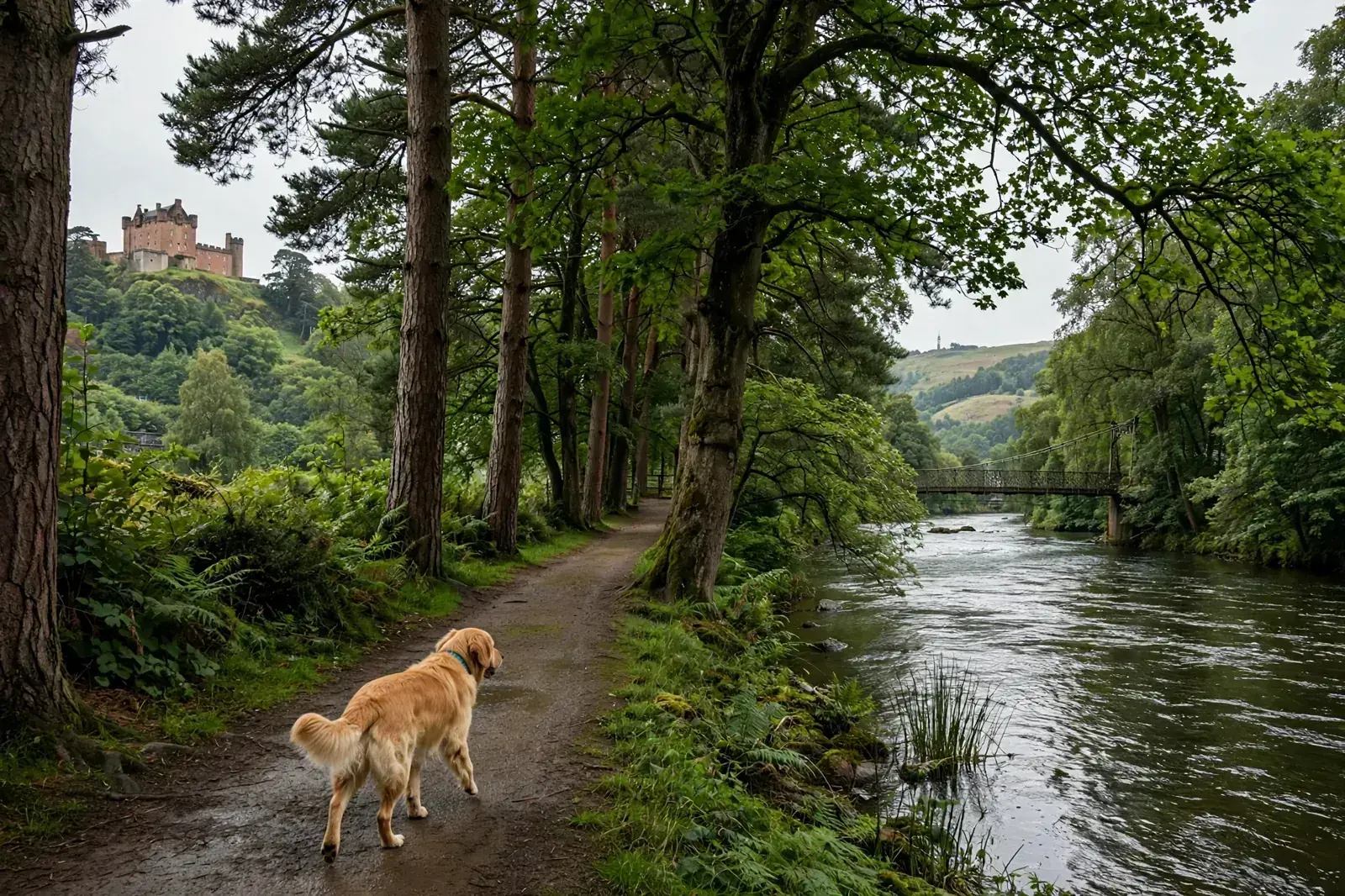
The Ness Islands are a linked group of small, tree-covered islands mid-river, reached by elegant suspension bridges. Under the canopy the city noise drops away, paths wind between mature trees, and the river splits and rejoins around you. For dogs, the appeal is variety in a small area: new smells at every turn, squirrels to watch rather than chase, and enough other walkers to feel sociable without feeling crowded outside peak summer afternoons. Keep dogs under close control here. The bridges are narrow, cyclists and runners share the paths, anglers may be casting from the banks in season, and the river, while calm-looking in places, is fast and cold. A short lead on bridges and at busy junctions, with more freedom on quieter stretches where your dog's recall is reliable and local signage allows it, is the sensible pattern.
Extend the walk in either direction to change its character. Upstream, the riverside leads towards the canal and the start of Loch Ness. Downstream, paths continue towards the firth, where the air turns saltier and seabirds replace garden birds. A simple out-and-back can be twenty minutes or two hours, which is precisely why this route becomes the backbone of a stay: it scales to the weather, the light and the dog in front of you. In winter, daylight in the Highlands is short, so plan the longer version for late morning and keep the evening version on lit, familiar ground near the centre.
Practical points are easy to overlook. After prolonged rain, low sections of island path can be muddy, slippery or occasionally impassable if the river is high, so wear footwear that grips and be ready to shorten the route. There are benches and bins along the main riverside stretches, but carry waste bags anyway and take litter home if a bin is full. If your dog likes to swim, think twice here: currents, submerged branches and anglers' lines make the Ness a river to paddle beside rather than plunge into, and always check the latest official guidance before you travel on water quality and any local warnings.
Caledonian Canal towpath: long, flat and quietly beautiful
When a dog needs distance rather than novelty, head for the Caledonian Canal. The canal runs from Inverness south-west through Loch Ness and the Great Glen towards Fort William, and its towpath offers the kind of steady, level walking that tires a dog's body and settles its mind. From the city you can join the canal near its northern end and follow the water as locks, moored boats and wooded banks replace streets.
Towpath etiquette is simple but important. Keep left where paths are shared, move aside for cyclists rather than letting a lead stretch across the route, and keep dogs close near locks, where there are drops, machinery and people working boats through. Never let a dog swim in a lock or jump between a boat and the bank. Around moored craft, remember that some boaters travel with their own dogs, which may be resting on deck at nose height to yours — a short lead past moorings prevents an unnecessary confrontation.
Plan towpath walks as linear routes unless you arrange a return. The pleasure of a canal is that it keeps going; the trap is walking out enthusiastically for an hour and realising a tired or older dog now faces the same hour back. Set a turnaround time before you start, carry water for the dog as well as yourself — canal water is not a drinking bowl — and note where you can leave the towpath for a road or bus route if plans change. For a longer day, pair the canal with our guide to Fort William with a dog, which covers the other end of the Great Glen and helps you understand how the whole corridor fits together.
Season changes the towpath experience. In summer, midges can gather in still, shaded stretches, particularly towards evening, so insect repellent for people and a brisk pace through the worst sections help. In autumn and winter the path is quieter and the light over the water can be superb, but surfaces may be icy in shaded spots and daylight is limited. Whatever the season, tell someone your rough plan for longer walks and carry a charged phone, while remembering that signal along parts of the Great Glen can be patchy.
Culloden battlefield with a dog: go informed, walk respectfully
A short drive east of Inverness, Culloden is the site of the last pitched battle fought on British soil, in 1746, and it is a place many visitors want to include. With a dog, it can work well — the battlefield itself is open moorland crossed by paths — provided you approach it as a memorial landscape first and a dog walk second.
Dogs are generally welcome in the grounds on a lead, but access rules for the visitor centre, exhibition and cafe are separate matters and can change, so check the latest official guidance before you travel and do not assume indoor entry. Keep to the paths, keep your dog close around memorial cairns and clan markers, and be mindful that many visitors are there for quiet reflection. This is not the place for ball games, off-lead charging or letting a dog investigate every stone. A calm, lead-led circuit, with toilet breaks taken before you enter the main battlefield area and waste carried out with you, respects both the site and other visitors.
Weather shapes a Culloden visit more than most. The moor is exposed, with little shelter when wind and rain arrive, and paths can be wet underfoot. Dress for conditions a grade worse than the city forecast suggests, and in summer carry water, because there is little shade. If your dog is nervous around crowds, choose a quieter time of day; if your dog struggles with long, solemn, on-lead walking, balance Culloden with a freer run earlier in the day on the riverside or towpath so the dog arrives settled rather than frustrated.
Combine Culloden sensibly. It pairs naturally with a gentle city afternoon rather than another major attraction, and it deserves unhurried time. Visitors planning a wider Highland history route may also find our Loch Ness with a dog guide useful for sequencing days, because Culloden, the city and the loch form a triangle of short drives that can be arranged in any order around the weather.
Loch Ness day trips: big water, small decisions
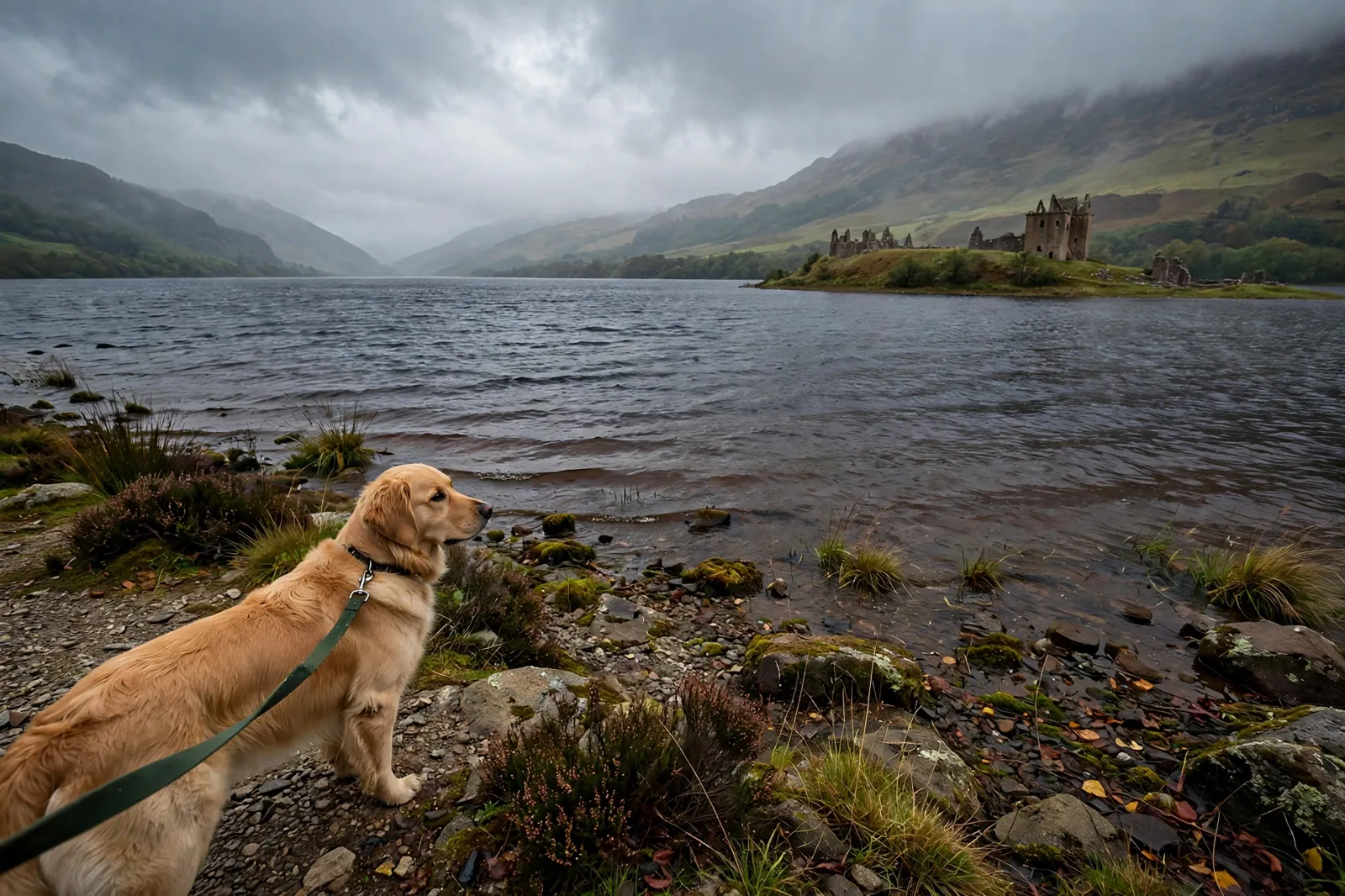
Loch Ness begins just south-west of Inverness, which makes it an unusually easy famous landmark to visit with a dog: no dawn start, no relocation, just a day trip down the shore and back to a familiar bed. The loch is long, deep and steep-sided, so the experience is less about beaches and more about viewpoints, woodland paths, small villages and the sheer scale of dark water running between hills.
Choose a focus for each trip rather than trying to conquer the whole loch. One day might follow the busier northern shore, with its villages, parking and services, stopping for short shore walks and viewpoints. Another might explore quieter stretches, waterfalls or woodland trails a little further afield, accepting longer drives between stops. Castles, boat trips and visitor attractions each set their own dog policy — some welcome dogs in grounds but not interiors, some not at all, and boat operators vary — so check each one individually and check the latest official guidance before you travel, especially if a specific attraction is the point of your day.
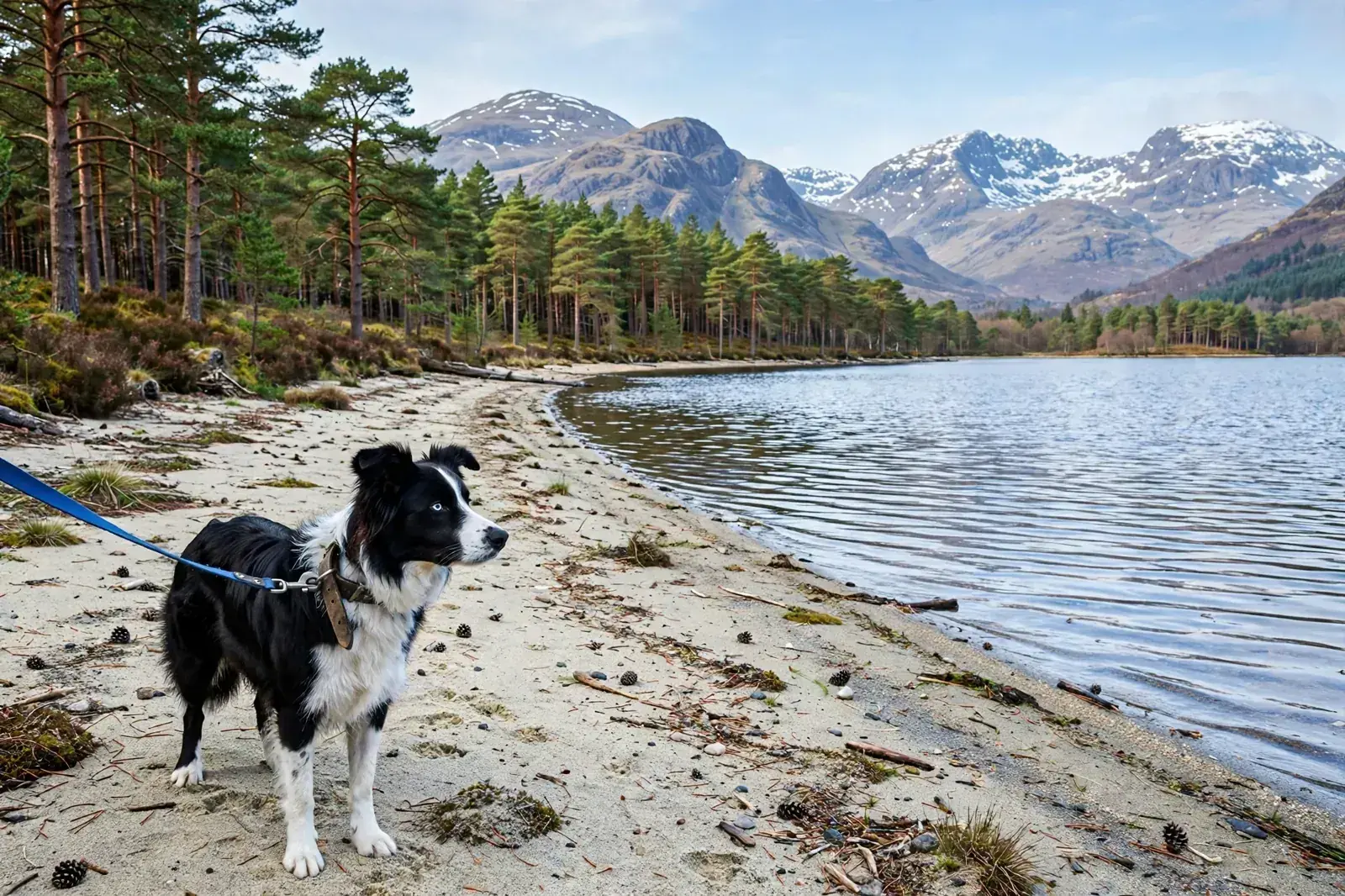
On the shore itself, keep expectations realistic. Loch Ness has few broad sandy beaches; edges are often stony, shelving quickly into very cold, deep water. Dogs that love to swim need careful handling: enter only where the shore is gentle and exit is easy, avoid algae blooms in warm weather, never let a dog chase birds or livestock along the banks, and dry the dog thoroughly afterwards. A long line can give a water-loving dog some freedom at the edge without the risks of free swimming in deep water.
Driving needs respect too. Roads around the loch include fast main routes and, on the quieter side, narrower single-track sections with passing places. Allow more time than the map suggests, stop only in proper lay-bys and car parks, and never walk a dog along a verge because a viewpoint looked tempting. Fuel, food and phone signal are all easier on the northern side; if you venture further, carry what the dog needs for the whole day, including a meal if you will be out over feeding time.
Where to stay: city convenience versus quiet edges
Inverness offers the full range — central hotels, guest houses, self-catering flats and houses, and sites on the outskirts — but dog policies vary as widely here as anywhere, so the label on a listing is only the start. Confirm the essentials in writing before you book: how many dogs are accepted, whether there is a per-dog or per-stay charge, which rooms or units dogs may use, whether dogs may be left alone, and where the nearest sensible toilet walk is after dark.
Location is the decision that shapes every day. A central stay puts the River Ness walk, cafes and the station within easy reach and suits travellers without a car, but it can mean busier streets, limited parking and more noise for a sensitive dog. An edge-of-city or suburban stay usually brings easier parking, quieter nights and faster access to the A9, the canal or the road to Culloden, at the cost of a drive or longer walk into the centre. For NC500 travellers with a loaded car, parking beside the accommodation is worth more than a prettier postcode.
Self-catering suits many dog owners best here, because Highland days start early, end wet and rarely follow restaurant hours. A washing machine, a hallway or utility space for drying gear, and a secure place to leave a dog crate transform a week. Ask specific questions: is the garden, if there is one, genuinely enclosed and how high is the boundary? Are floors hard or carpeted? Is there an outdoor tap? Hotels can work beautifully for shorter stays, especially those that provide dog beds, bowls and towels, but check whether dogs are welcome in any dining space or only in bedrooms and designated areas, so breakfast plans do not collapse on the first morning.
Book ahead for summer and for any dates around local events, because dog-friendly rooms are a subset of an already busy Highland market. If you are travelling with more than one dog, a large breed, or a dog with particular needs, say so plainly when you enquire. Hosts who know in advance can usually help; hosts surprised at the door often cannot.
Eating, drinking and filling the rainy hours
A Highland capital gives you options a village cannot, which matters when rain closes in for a day. Inverness has cafes, pubs and restaurants across the centre, and a growing number welcome dogs in at least part of the premises — but policies differ by business and can change with refurbishments or seasons, so check before you set out with a hungry dog rather than negotiating at the door. Terraces and bar areas are the most common dog-welcome spaces; full restaurant access is less common.
Make cafe stops work for the dog, not just the people. Choose a table away from the main walkway, settle the dog on a mat with water, and keep leads out of foot traffic. A dog that has already had a proper walk along the Ness will lie quietly while a rested-but-unwalked dog will audition for the whole room. In busy summer periods, earlier or later visits dodge the worst queues and give nervous dogs more space.
For self-catering, the city is the place to stock up. Supermarkets, pet supplies and outdoor shops are all easier to find here than anywhere further north or west, so treat Inverness as your provisioning stop: dog food for the whole onward trip, spare waste bags, a replacement lead if one is wearing thin, and anything you forgot, from tick removers to drying coats. It is far easier to solve a kit problem in Inverness than on a single-track road two days later.
Rainy-day planning deserves honesty. Some indoor attractions will not admit dogs, and pretending otherwise wastes a day. Build wet-weather days around a long towpath or riverside walk in the best window of weather, a dog-welcome cafe, browsing the city's shops that allow dogs, and an early evening in your accommodation with a rested dog. A Highland holiday is rarely ruined by one wet day; it is ruined by having no plan for it.
Vets, emergencies and practical backup
One of Inverness's biggest advantages is backup. As the Highland capital, the city has several veterinary practices, pet shops and services that simply do not exist further into the hills. That does not remove the need to plan. Practices may not accept unregistered holiday visitors for routine matters, opening hours are shorter than in big cities, and out-of-hours care is provided through specific emergency arrangements — so save the details before you need them, not at midnight with a limping dog.
Before you travel, assemble a small dog health file: vaccination record, microchip details, current medications with doses, your home vet's phone number, insurance details if you have them, and a note of any allergies or long-term conditions. Photograph it on your phone as well as carrying paper. If your dog takes regular medication, bring more than the trip requires, because Highland pharmacies and suppliers may not stock an exact product at short notice.
Know the Highland hazards. Ticks are common in woodland, bracken and deer country for much of the year, so check the dog daily, especially around the ears, neck and belly, and carry a tick remover. Adders live in parts of the Highlands and are most active in warmer months; keep dogs close on heather and sunny paths and seek veterinary help immediately if a bite is suspected. Blue-green algae can appear in still water in summer, livestock with young are protective in spring, and deer on rural roads at dawn and dusk are a driving hazard as much as a walking one. None of this should put you off; all of it rewards the owner who reads signs, keeps a lead handy and checks the latest official guidance before you travel.
If something does go wrong, phone first. A practice can direct you to the right site, advise whether the problem can wait, and prepare for your arrival. Keep the car ready to move — another reason an Inverness base beats a remote one when a dog is unwell.
Starting the NC500 from Inverness with a dog
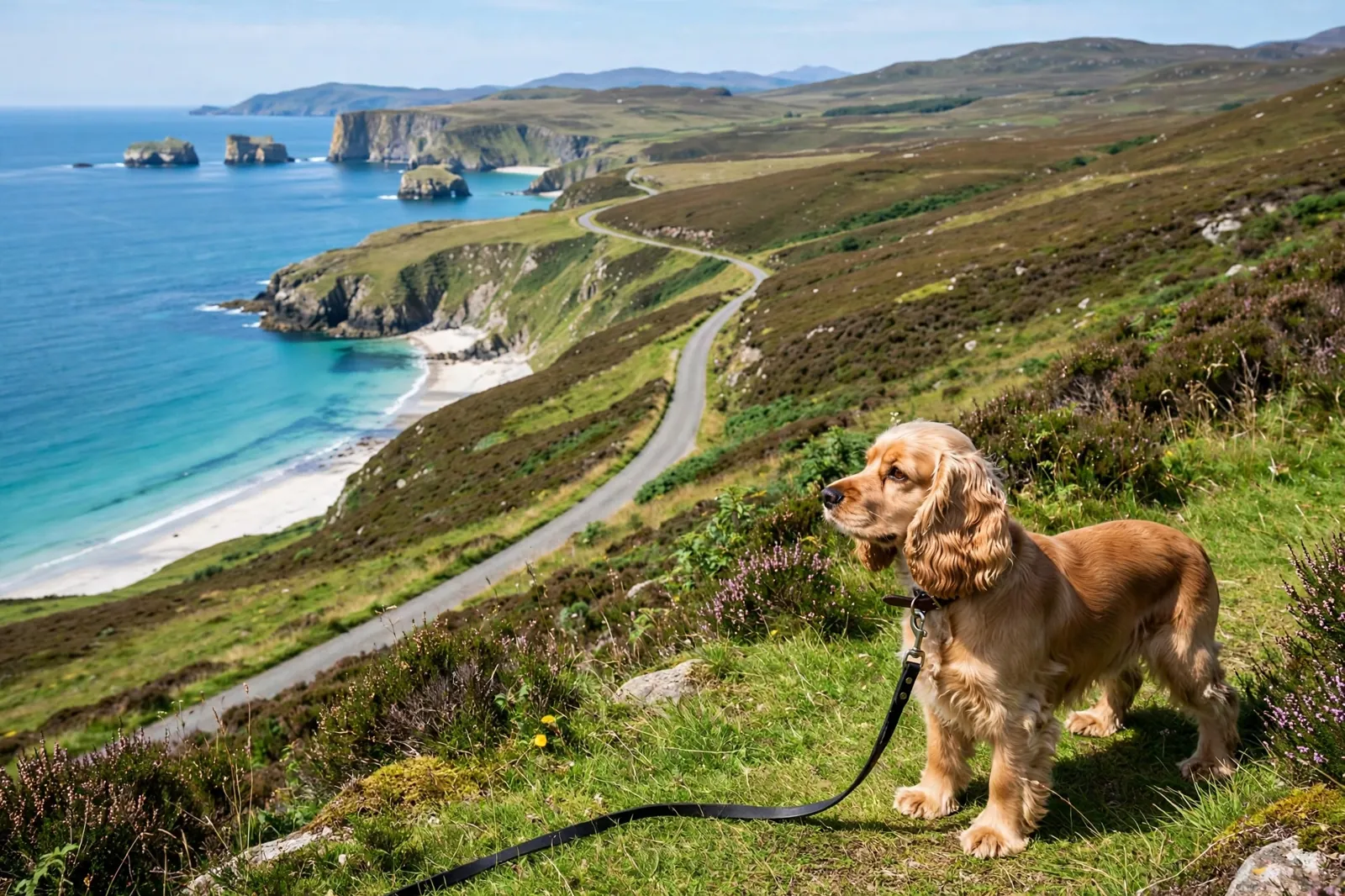
Inverness is the traditional start and finish of the North Coast 500, the roughly 516-mile loop around the far north of Scotland. With a dog, the city is not just a ceremonial start line; it is the last place for a long while where everything is easy. Use it deliberately.
Do your final provisioning here: fuel, food for people and dog, cash for honesty-box parking and small sites, and any prescription or specialist item. Download maps and your accommodation details for offline use, because signal gaps on the route are normal. Check the car as a dog space, not just a vehicle — bedding secured, water accessible at stops, ventilation planned, and a routine for breaks every couple of hours at most. Our full North Coast 500 with a dog guide covers the route itself in depth, including pacing, single-track driving and booking strategy.
Decide your direction and first stops before you leave the city. The opening legs, whether you head north towards the Black Isle and the east coast or west towards Loch Ness and the mountains, set the rhythm for the whole loop. Book dog-friendly accommodation well ahead for the entire route in peak season, confirm each stop's dog rules individually, and resist overlong first days: a dog that arrives at the first stop calm and walked will travel better all week than one unloaded, stiff and frantic, after five hours in the car.
Finally, keep the return to Inverness in the plan. Finishing where you started means a familiar river walk, a known vet if the trip has taken a toll, and a city that can absorb a delayed arrival. Many travellers find that last night in Inverness, with the loop complete and the dog asleep after one final circuit of the Ness Islands, is one of the most satisfying of the trip.
A three-day pattern that works
Day one belongs to the city. Arrive, settle the dog into the accommodation with familiar bedding, then walk the River Ness and Ness Islands slowly, learning the route you will use morning and evening. Stock up on supplies, locate the vet practice you have saved, and keep the evening simple. A dog that understands its new base will handle bigger days better.
Day two is the history-and-hills day. Give the dog a proper morning walk first, then visit Culloden in a quieter part of the day, walking the battlefield calmly on a lead. Return to the city for a dog-welcome cafe or an early evening on the towpath. If energy remains, a short canal section at golden hour shows a different Inverness from the one in the guidebooks.
Day three goes to the water. Head down Loch Ness with one clear focus — a shore area, a village, a woodland trail — and time to stop properly rather than collecting viewpoints through a windscreen. Back in Inverness, repeat the favourite riverside route and notice how familiar it already feels. Travellers with more days can add a longer canal walk, a second Loch Ness focus, or use the city as a springboard to Aviemore and the Cairngorms with a dog, which pairs naturally with Inverness in a two-base Highland trip.
Whatever pattern you choose, protect the bookends. Morning and evening walks in the same, familiar place are not wasted time on a dog holiday; they are the structure that lets everything else happen. Inverness rewards that approach better than almost anywhere in the Highlands, because its best everyday walk is also one of its most beautiful.
Practical questions
Before you go
Are dogs allowed on the Ness Islands and along the River Ness?
Yes, the riverside paths and the Ness Islands are public walking routes where dogs are commonly walked. Keep your dog under close control near cyclists, anglers and other walkers, use a lead on the narrow suspension bridges, and clear up after your dog. After heavy rain some island paths can be slippery or partly flooded, so check conditions on the day.
Can I take my dog to Culloden battlefield?
Dogs are generally welcome in the battlefield grounds on a lead, but rules for the visitor centre, exhibition and cafe can differ and may change. Keep to paths, respect memorial areas and other visitors, and check the latest official guidance before you travel rather than assuming indoor access.
Is Inverness a good base for Loch Ness with a dog?
Yes. Inverness sits at the northern end of Loch Ness, so villages, viewpoints and shore walks along the loch are realistic day trips without changing accommodation. Plan fuel, parking and lead rules in advance, allow extra time on single-track sections, and check boat and attraction policies individually because dog rules vary by operator.
Where do I find a vet in Inverness with a dog on holiday?
Inverness has several veterinary practices and an out-of-hours emergency route, but opening hours and registration rules change. Save the phone number of a local practice and its emergency provider before you arrive, carry your dog's vaccination and medication details, and phone ahead rather than turning up, especially at weekends.
What should I check before starting the NC500 from Inverness with a dog?
Book dog-friendly stops well ahead, plan fuel and food stops around long gaps between services, and download maps for areas with weak signal. Keep a lead, water, food, bedding and waste bags accessible in the car, break long driving legs with proper walks, and check the latest official guidance before you travel on road conditions and site rules.