This guide is independent and contains no paid placement. If affiliate links are added later, they will be clearly marked and will not change our editorial checks.
Guildford works as a dog day out because everything is close together: the castle grounds sit above the river, the Wey towpath runs south to Godalming, Stoke Park gives dogs open grass, and the North Downs Way starts almost at the edge of town. Arrive by train or park at Bedford Road, keep your dog on a lead by the locks and around livestock, and plan the castle and the towpath before the High Street.
A county town on the Wey
Guildford is the county town of Surrey, set where the River Wey cuts a gap through the North Downs about thirty miles south-west of London. The town grew up around a ford and then a bridge across the river, and that geography still shapes a visit with a dog: the castle stands on the hill above the west bank, the High Street runs down towards the water, and the river itself offers a flat escape route out of town in either direction. Nothing in the centre is far from anything else. From the station to the castle grounds is roughly ten minutes on foot, and from the castle down to the towpath is less than five, which means a dog can move from train to grass without a long march through traffic.
Trains from London Waterloo reach Guildford in around thirty-five to forty minutes, and dogs travel free on the train, so the town is one of the easiest Surrey days out for owners without a car. Guildford station sits on the west side of the river, and the walk from the platforms into town crosses the Wey on the footbridge beside the road bridge. Drivers have the A3 running past the town, and the usual approach is to aim for one of the central car parks and then leave the car alone for the day. Bedford Road car park is the most useful for dog owners because it sits beside the river, a short walk from both the castle grounds and the towpath, and the riverside walk from the car park gives a dog an immediate chance to stretch its legs. York Road and Farnham Road car parks are also central, and Onslow Street serves the station end of town. All of them are pay-and-display, so check the official guidance before you travel for current charges, and note that some have height restrictions that matter if you travel with a roof box.
The shape of the town rewards a simple order of visiting. Start at the castle, because the climb is best done while both of you are fresh and because the grounds give a dog a proper sniffing walk before the busier streets. Drop down to the river next, follow the towpath for as far as suits your dog, then come back through the High Street for lunch and finish in Stoke Park if the afternoon is warm. That sequence keeps the steepest ground early, the flat riverside walking in the middle of the day, and the open park grass for the end, when a tired dog will appreciate space to settle. It also keeps you close to the station and the car parks at every stage, so a tired or wet dog never has far to go at the end of the day.
Guildford Cathedral stands on Stag Hill to the north-west, above the University of Surrey, and it is worth knowing about even though it is not the focus of a dog day. The cathedral is a twenty-minute walk uphill from the town centre, and the grounds around it are open, but the building itself is a working church rather than a dog attraction, so plan it as a human detour while one person stays outside with the dog. The same logic applies to the museums in the town centre: the Guildford Museum in Castle Street sits below the castle grounds and covers the town's history, including the castle and the river trade, but check the official guidance before you travel for current opening times and any rules about dogs inside.
One thing that surprises first-time visitors is how quickly Guildford changes character. The High Street and the Friary Centre feel like any busy Surrey shopping town, but ten minutes in almost any direction the streets thin out into riverside meadows, wooded slopes and chalk downland. That contrast is what makes the town work for dogs: you can have a proper country walk and a town lunch in the same hour, and you never need to drive between the two. The other surprise is the gradient. Guildford is a hilly town. The climb from the river to the castle and the climb from the High Street up towards the cathedral are both short but steep, and the North Downs paths east of town climb further still. Older dogs and small breeds manage the town centre comfortably, but plan the downland sections with the hills in mind, and carry water in summer because the open chalk paths have little shade.
Guildford Castle and its gardens
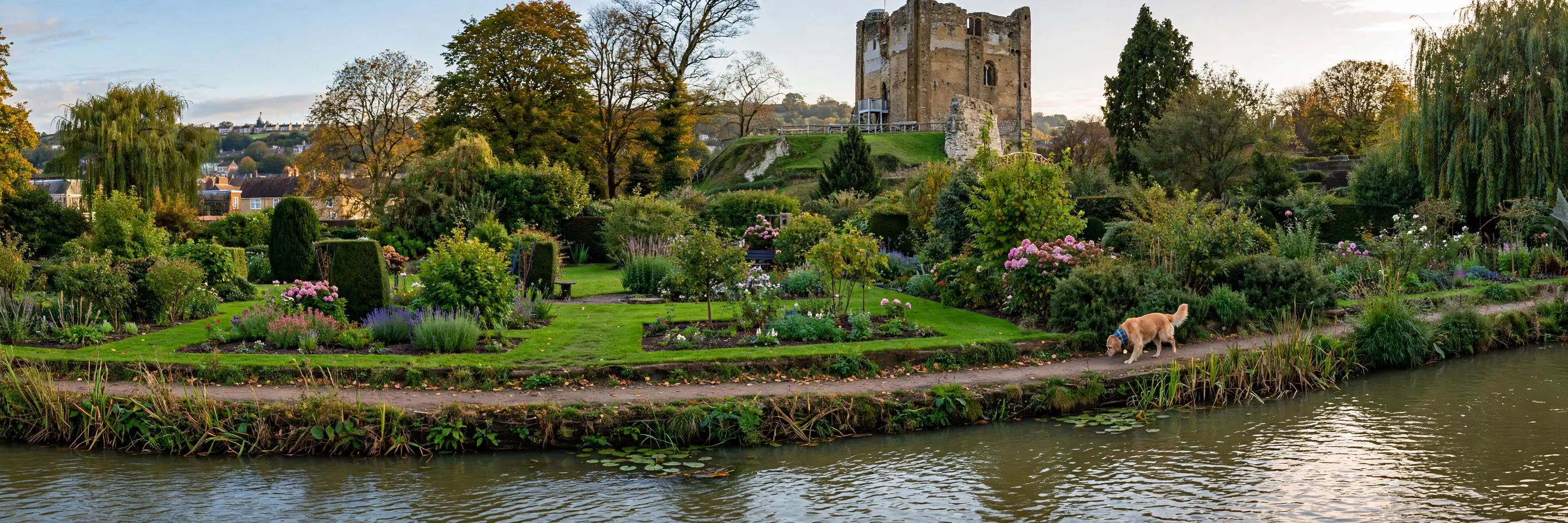
Guildford Castle is the town's landmark, and it is also its best dog walk in the centre. The castle was built in the years after the Norman Conquest, and the stone keep that survives today dates largely from the twelfth century. The keep stands inside walled castle grounds that are laid out as public gardens, free to enter, and they sit on the hill above Quarry Street and Castle Street with views across the rooftops to the downs beyond. For a dog, the grounds are the point: lawns, flower beds, mature trees and winding paths, all enclosed by old walls, with benches in the shade and a steady stream of other dogs on leads. The keep itself is a separate ticketed attraction, open seasonally, and the climb to the roof is by narrow stone stairs, so it suits the humans in the party while one person waits outside with the dog. Check the official guidance before you travel for current keep opening times and admission prices, because the season and the hours change through the year.
The approach matters. The gentlest way up is from Castle Street, where the road climbs past the museum and the old houses towards the castle gate. The steeper way is from Quarry Street, which rises sharply from the High Street end of town. Either way, take the climb slowly with an older dog, and remember that the cobbles and stone steps around the castle can be slippery after rain. Once inside the grounds, the main lawn spreads out below the keep, and the paths loop around the flower beds and the trees. Dogs should stay on a lead throughout the grounds, because the gardens are planted beds rather than open common land, and because children and picnickers use the same lawns on sunny days. There is no dog water tap inside the grounds, so bring a bottle and a bowl, especially in summer when the walled garden traps the heat.
The castle grounds hold one of Guildford's most photographed details, and dog owners walk straight past it. A statue of Alice through the Looking Glass stands in the grounds, a reminder that Lewis Carroll lived in Guildford in his later years at a house called The Chestnuts on Castle Hill, and is buried in the town. The statue is a popular meeting point, and the flower beds around it change with the seasons, so the gardens look different in spring, when the bulbs are out, and in high summer, when the bedding plants are at their best. The grounds are also one of the best viewpoints in town. From the terrace below the keep you can look across the High Street roofs towards the cathedral on Stag Hill and the downs beyond, which gives you a useful sense of the town's layout before you set off for the river.
Plan for about forty-five minutes in the grounds, including the climb up and the walk back down. That is enough to walk every path, let the dog sniff the borders properly, sit on a bench and look at the view, and decide what to do next. If the keep is open and you want to climb it, allow another half hour and take turns with the dog, because the stairs are steep and the roof platform is exposed. If the keep is closed, the grounds alone are still worth the visit, and they are at their quietest early in the morning before the town fills up. On summer weekends the lawns attract families and the keep queue can be long, so an early start pays off. In winter the gardens are quieter and the bare trees open up the view, but the stone paths can be icy, so keep the dog on a short lead on the steps.
Below the castle, Castle Street itself is worth a slow walk back down. The street holds the Guildford Museum and some of the town's oldest houses, and it leads directly into the lower end of the High Street. The museum is small and free, and its displays cover the castle, the river trade and the town's brewing and coaching history, but check the official guidance before you travel for current opening times. From Castle Street you can also reach the river in a few minutes by following the slope down towards the town bridge, which is the natural next step in the day.
The River Wey towpath
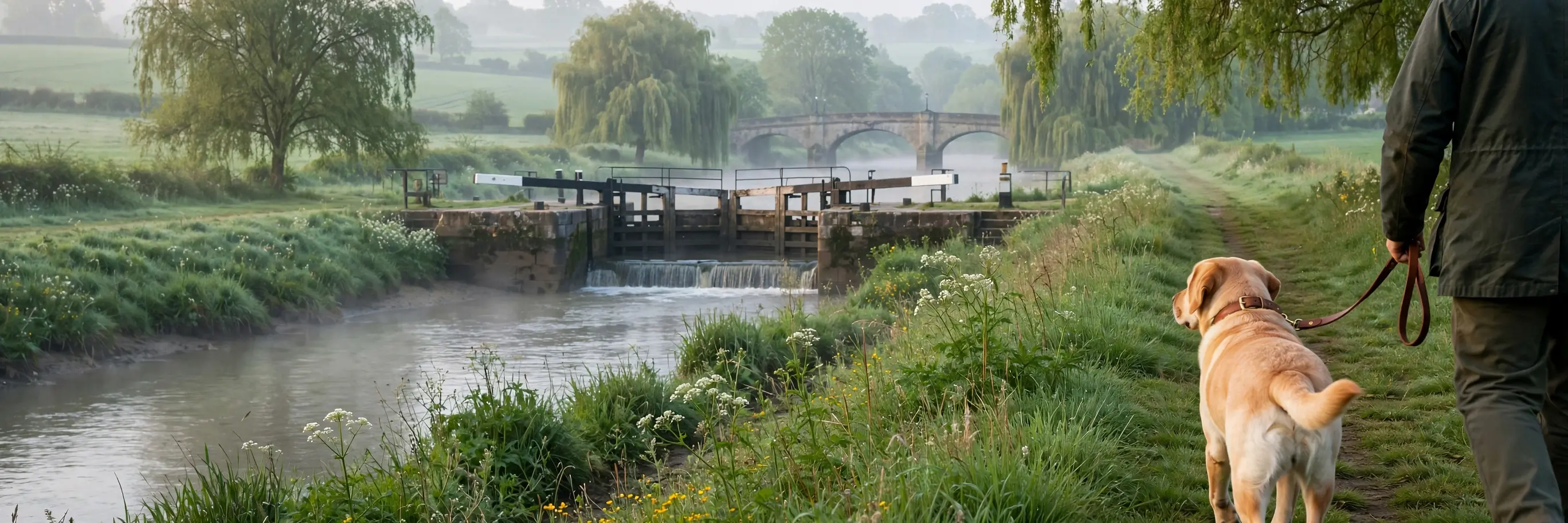
The River Wey is the spine of a Guildford dog walk. The river was made navigable in the seventeenth century, when the Wey Navigation opened in 1653, and the towpath that once served horse-drawn barges now runs for miles through meadows and woodland. In Guildford the towpath is at its most useful: it leaves the town centre beside the river, passes under the road bridges, and heads south through water meadows towards Shalford and Godalming. The surface is mostly flat and well walked, which suits dogs of all ages, and the river is always beside you, so a dog that likes water will find plenty to look at. Keep the dog on a lead along the towpath, because the path is shared with cyclists, the river bank drops straight into deep water in places, and moored boats and locks need a wide berth.
Dapdune Wharf, just north of the town centre, is the place to understand what the navigation was for. The wharf is cared for by the National Trust and holds the old barges, the workshops and the visitor centre that explain how the river carried timber, grain and gunpowder between Guildford and the Thames at Weybridge. The wharf is a short walk up the towpath from the town bridge, and the open yard gives a dog space to walk while the humans look at the boats. Boat trips run from the wharf in the season, but check the official guidance before you travel for current times and whether dogs can travel on the boats, because the rules vary with the trip. The wharf is also a good turning point for a short walk: town bridge to Dapdune Wharf and back is an easy half-hour loop that suits puppies, older dogs and anyone short on time.
The longer walk south is the classic. From the town bridge, follow the towpath past the rowing club and the riverside gardens, under the railway bridge, and out into the water meadows towards Shalford. The path stays close to the river the whole way, with locks at intervals, narrowboats moored along the bank, and kingfishers, herons and swans in the quieter stretches. Shalford is about two miles from the town centre and makes a natural halfway stop, with a village pub and a mill pond. Godalming is about six miles from Guildford, and the full walk takes most dogs two to three hours one way, so many owners walk to Shalford and back, or walk one way to Godalming and catch the train back to Guildford from Godalming station. Check the official guidance before you travel for current train times, because the service is not frequent enough to rely on without checking.
Water safety deserves a clear word. The Wey looks gentle, but the water is deep beside the locks and the weirs, the current is strong after rain, and the banks are steep and muddy in places. Do not let a dog swim near a lock, a weir or a moored boat, and do not let a dog jump in where you cannot see the bottom. The river also carries the usual risks of a lowland waterway: blue-green algae can appear in warm weather, and the water is not drinking water, so carry fresh water for the dog and discourage drinking from the river. After heavy rain the towpath floods in the lowest stretches, particularly in the meadows south of town, so check the official guidance before you travel if there has been a wet week, and be ready to turn back rather than wade through standing water with a dog.
Cyclists are the other towpath hazard. The path is a popular commuter and leisure cycling route, and bikes approach quickly and quietly from behind, so keep the dog on the side away from the cycle line and shorten the lead at blind corners and under bridges. The same care applies at the locks, where the ground is uneven, the gates are heavy, and a loose dog can easily slip into the lock chamber. The National Trust asks visitors to keep dogs under close control around the wharf and the locks, and the same rule is sensible for the whole navigation. For a longer riverside journey, the Wey joins the Thames at Weybridge, and the towpath walking tradition continues along the Thames itself, which our Thames Path guide covers from source to sea, including the lock crossings and lead rules that apply on the longer route.
Stoke Park and the lido
Stoke Park is Guildford's biggest open space, and it is where the town's dogs go to run. The park covers about fifty-two acres on the east side of the town centre, off London Road, and it mixes formal gardens, open grass, sports pitches, a model boating pond and mature trees. For a dog, the attraction is simple: long sightlines, plenty of room, and other dogs to greet. The park is not a fenced dog field, so recall matters, and dogs should be kept under control around the children's play area, the sports pitches and the formal flower beds. The open grass in the middle of the park is the best place for a game of fetch, while the tree-lined paths around the edges suit a slower sniffing walk. The park is busiest on Saturday mornings, when the parkrun brings runners through, and on summer afternoons, when the paddling pool and the play area fill up, so a weekday morning or a late afternoon is the calmest time for a nervous dog.
Guildford Lido sits on the edge of the park, and it is one of the town's best-known landmarks. The lido opened in 1933 and is a large outdoor heated swimming pool, open through the summer season, with lawns for sunbathing and a cafe. Dogs are not allowed inside the pool enclosure, so the usual arrangement is for one person to swim while the other walks the dog around the park, then meet afterwards on the benches outside. Check the official guidance before you travel for current lido opening times and prices, because the season and the sessions change each year. The lido's popularity means the park's car park and the surrounding streets get busy on hot days, so arrive early if you plan to combine a swim with a dog walk, or use the park as the morning walk and save the lido for later.
The park's other facilities shape how a dog walk works. The model boating pond sits in the middle of the park and attracts ducks and geese, so keep the dog on a lead near the water and do not let it chase the birds. The sports pitches host football and cricket in season, and dogs should stay off the marked pitches and away from matches. The formal gardens near the London Road entrance are planted beds, so keep the dog on the paths there. The children's play area and the paddling pool are fenced, which helps, but a dog on a long lead can still reach the fence, so shorten the lead as you pass. There are bins around the park for dog waste, and the park's paths are surfaced and mostly flat, which suits older dogs and pushchairs. Water is the one thing to plan for: there is no dedicated dog water point in the park, so bring a bottle and a bowl, especially on a hot day when the open grass offers little shade.
Stoke Park also hosts Guildford's larger outdoor events, including the summer fairs and the fireworks display, and those days change the park completely. A dog that is happy in the park on a quiet Tuesday may not enjoy it when the fairground is in and the crowds arrive, so check what is on before you travel if you are visiting on a summer weekend. The park's size means you can still find quiet corners during events, particularly in the wooded paths at the far end, but a noise-sensitive dog is better walked early in the morning before the event opens. The Guildford Spectrum leisure centre sits beside the park, and its car park is sometimes used by park visitors, but check the official guidance before you travel for current parking rules, because the Spectrum car park is primarily for leisure centre users.
Allow at least an hour for Stoke Park, and two if the dog wants a proper run. A good loop is to enter from London Road, walk the tree-lined paths around the edge of the park, cross the open grass for a game of fetch, pass the boating pond and the formal gardens, and come back along the far side. The loop is about a mile and a half, flat throughout, and it gives a dog a mix of open running, shade, water to look at and other dogs to greet. Finish at the benches near the lido, where you can sit with a coffee from the park cafe while the dog settles, and then walk back into town along London Road, which takes about ten minutes to the High Street.
The High Street
Guildford's High Street is one of the most recognisable shopping streets in the south of England, and it is also the most practical part of a dog day in town. The street is cobbled and slopes down from the top, by the Tunsgate arch, towards the river, and the Guildhall with its projecting clock dominates the middle of the street. The clock dates from 1683 and is one of the town's symbols, and the Guildhall itself is worth a look from the outside while the dog waits. The street is pedestrianised in part, which makes walking with a dog easier, but it is still busy, so keep the dog on a short lead, watch for shoppers with bags and pushchairs, and avoid the narrowest stretches at lunchtime on a Saturday.
The High Street works for dogs because it is a street of cafes and pubs with outdoor seating as much as a street of shops. Several cafes put tables and chairs on the pavement, and a dog can settle under a table while the humans eat, provided the dog is calm and the lead is short. Pubs are the more reliable option for a dog owner who wants to sit down properly: many of the town centre pubs welcome dogs in the bar area, and some keep water bowls and dog treats behind the bar. The rule is to check each place as you arrive, because policies change and a pub that welcomed dogs last year may have changed its mind. Look for the signs at the door, ask the staff before you sit down, and have a backup in mind if the first choice says no. The Britannia, the King's Head and the Star Inn are among the historic pubs in and around the centre, but check the official guidance before you travel for current dog policies, because a pub's rules are set by its management and can change.
Shopping with a dog in Guildford is a matter of knowing which doors to use. The Friary Centre and White Lion Walk are the town's covered shopping centres, and dogs are generally not allowed inside the centres themselves, so plan to leave one person outside with the dog while the other goes in, or stick to the open street. Many of the independent shops along the High Street and the side streets are happy for a well-behaved dog to come in, particularly the bookshops, the outdoor shops and the gift shops, but always ask first and keep the lead short inside. The farmers' market, held in the High Street on the first Tuesday of the month, is a good time to visit with a dog if the dog is comfortable in a crowd, because the stalls sell local food and the atmosphere is lively, but check the official guidance before you travel for current market dates, because the schedule can change.
Practical details matter on the High Street. There are public toilets in the town centre, and several of the larger stores have customer toilets, but the dog will need to wait outside with one person while the other goes in. Water bowls appear outside some shops and cafes in summer, but do not rely on them, and carry your own bottle. The cobbles are the other detail: they are attractive but uneven, and they can be hard on small paws and uncomfortable for an older dog, so walk the dog on the smoother paving at the edges of the street where possible, and avoid the steepest cobbled section at the top of the street if the dog struggles with its footing. The Tunsgate arch at the top of the High Street leads through to Castle Street and the castle grounds, which closes the loop back to where the day began.
Budget about an hour for the High Street, including lunch, and treat it as the social part of the day rather than the walking part. The dog will have done its serious exercise by then, at the castle and on the towpath, so the High Street is a chance to settle under a table, watch the town go by and rest before the walk back to the car or the station. If the dog is tired, skip the shopping centres entirely and stick to one cafe stop and a slow walk down the street. If the dog is still full of energy, a second loop of the castle grounds or a longer stretch of the towpath is a better use of the time than another hour on the pavement.
The North Downs on the doorstep
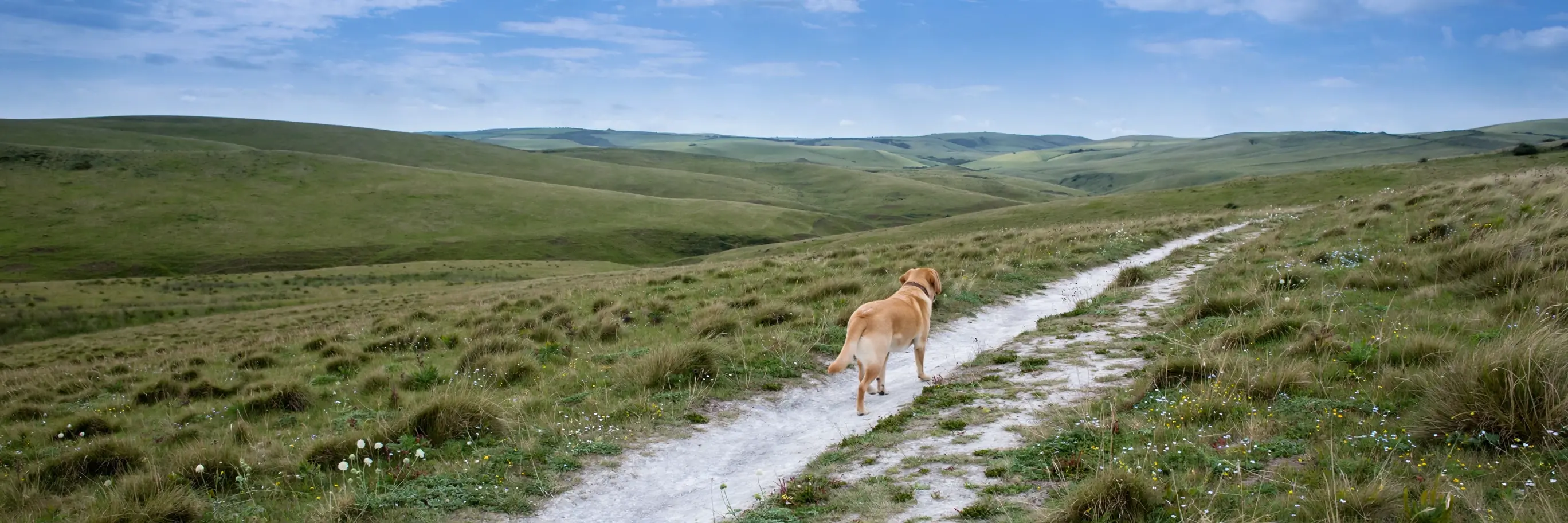
The North Downs are Guildford's great advantage as a dog destination, because the chalk ridge runs right past the town and the walking starts almost at the edge of the streets. The North Downs Way, the long-distance trail that runs from Farnham to Dover, passes through Guildford, and the sections east of town are among the most rewarding short walks in Surrey. The ground is chalk grassland, open and rolling, with wide views across the Weald to the south and the Thames valley to the north. The paths are generally good underfoot, well signed, and easy to follow, which makes them suitable for a half-day walk with a dog, provided you plan for the hills and the lack of water on the open downland.
Pewley Down is the nearest piece of downland to the town centre, and it is the obvious first taste. The down sits just south-east of the town, above the Pewley Down nature reserve, and the walk from the town centre takes about thirty minutes, climbing steadily through the streets and then onto the open chalk. The reserve is managed for its chalk grassland flowers, and in summer the slopes are covered in wildflowers and butterflies, which makes it a lovely walk but also a place to keep the dog on the paths and on a lead, because the grassland is fragile and ground-nesting birds use it in the breeding season. The views from Pewley Down look back over Guildford and across to the cathedral, and the down connects to the wider network of paths that run east towards St Martha's Hill and Newlands Corner.
St Martha's Hill is the walk most Guildford dog owners recommend, and it is easy to see why. The hill stands about two and a half miles east of the town centre, and the little church of St Martha-on-the-Hill sits on its summit, a landmark visible for miles around. The walk from Guildford climbs through Chantry Wood and then up the open hillside, and the views from the churchyard stretch across the Weald to the South Downs. The climb is steady rather than steep, but it is a proper hill, so allow an hour each way from the town centre, and carry water because there is no drinking water on the hill. The churchyard is a peaceful place to sit, and the hill is popular with walkers, so keep the dog on a lead near the church and on the narrower paths. The return can be made by a different route through the woods, which gives a circular walk of about five miles that suits a fit dog.
Newlands Corner is the viewpoint that draws visitors from across Surrey, and it is a short drive east of Guildford on the A25 towards Albury. The car park at Newlands Corner sits on the ridge, and the paths from it run along the top of the downs with views south across the Weald and north towards the town. The area is managed as open access land, and dogs can run off the lead on the open grass provided they are under control, but keep them on a lead near the car park, the cafe and the road, and near any grazing animals. The paths from Newlands Corner connect to the Silent Pool, a spring-fed pool in the valley below Albury that is one of Surrey's prettiest spots, and the walk down to the pool and back is about two miles, steep in places and muddy after rain. The Silent Pool is a quiet place, so keep the dog on a lead there and do not let it swim in the pool, because the water is a protected chalk spring and the banks are fragile.
The practical rules for the downs are the same as for any chalk downland, and they matter more here than in town. Keep the dog on a lead near sheep and cattle, because the downs are grazed and a loose dog can worry livestock and cause a serious incident. Check for ticks after a walk through long grass and bracken, and watch for adders in the warm months, particularly on sunny banks and in the heather, because the downs are one of the places in Surrey where adders are found; if a dog is bitten, get to a vet immediately. Carry water, because the chalk paths have no streams and little shade, and a dog that runs freely on the open grass will get hot faster than it would in the woods. The downs are also exposed in bad weather, so check the official guidance before you travel if high winds or storms are forecast, and choose the sheltered river walk instead. For walkers who want to go further, the North Downs Way continues east from Guildford towards Dorking and the Surrey Hills, and our South Downs Way guide covers the chalk ridge walking tradition on the longer trail to the south, including the seasonal advice and water warnings that apply on open downland.
Practical questions
Before you go
Can dogs go into the Guildford Castle grounds?
Yes, dogs on a lead are welcome in the castle grounds, which are free to enter. The keep itself is a separate ticketed attraction with narrow stone stairs, so check the official guidance before you travel for current opening times, admission prices and whether dogs are allowed inside.
How long is the River Wey towpath walk from Guildford to Godalming?
The towpath from Guildford to Godalming is about six miles each way along the River Wey Navigation, mostly flat and easy underfoot. Most walkers with dogs allow two to three hours one way, and the return journey can be made by train from Godalming station, so check the official guidance before you travel for current timetables.
Are dogs allowed in Guildford Lido?
No, dogs are not allowed inside the lido pool enclosure. The lido sits on the edge of Stoke Park, so the usual plan is for one person to swim while the other walks the dog around the park, then meet at the park benches afterwards. Check the official guidance before you travel for current lido opening times and prices.
Where is the best place to park in Guildford with a dog?
Bedford Road car park is the most useful choice for dog owners, because it sits beside the river and a short walk from the castle grounds and the towpath. York Road and Farnham Road car parks are also central. All three are pay-and-display, so check the official guidance before you travel for current charges and any height or time limits.
Is the North Downs Way near Guildford suitable for dogs?
Yes, the North Downs Way passes close to Guildford and the chalk paths around Pewley Down, St Martha's Hill and Newlands Corner make rewarding half-day walks. Keep your dog on a lead near grazing sheep and cattle, carry water because there is little shade or drinking water on the open downland, and check the official guidance before you travel for current path conditions.