This guide is independent and contains no paid placement. If affiliate links are added later, they will be clearly marked and will not change our editorial checks.
Hastings is one of the most rewarding seaside towns in southern England for a dog trip, provided you plan around the beach rules. Dogs are allowed all year on Rock-a-Nore and Stade beach in the Old Town, while the central bathing beach bans dogs from 1 April to 30 September. Dogs must stay on a lead on the promenade all year. From 1 October to 31 March the whole beach opens to dogs. Base yourself in the Old Town, use the cliff lifts or the country park for the big walks, and check the official guidance before you travel.
Why Hastings works with a dog
Hastings is a town of two halves squeezed between two steep sandstone hills, and that geography is exactly what makes it work so well with a dog. At sea level you have a compact, walkable Old Town, a working fishing beach and a long flat promenade. Above you, on both sides, are open hilltops and a 660-acre country park. A dog can go from sniffing around beached fishing boats to running across open grassland in the space of a single morning, without ever needing a car.
The town sits on the East Sussex coast, about 60 miles south-east of London, between Bexhill to the west and Rye to the east. It is best known for the Battle of Hastings in 1066, although the battle itself was fought about seven miles inland near the present-day town of Battle, after William of Normandy landed at Pevensey on 28 September 1066. Hastings lent its name to the battle, and the town has been trading on the connection ever since. For a dog owner, the history matters less than what it left behind: a castle on the West Hill, the 1066 Country Walk that runs through the surrounding countryside, and a strong sense of place that makes even a short stroll feel like more than a seaside wander.
What sets Hastings apart from many south-coast resorts is that its beach is still a working place. The Stade, the shingle beach at the eastern end of the Old Town, is home to the largest fleet of beach-launched fishing boats in Europe. There is no harbour to shelter them, so the boats are winched up onto the shingle after each trip, and the tall black net shops behind them — narrow wooden huts once used to store fishing gear — are one of the most photographed sights on the Sussex coast. Dogs are part of the everyday scene here: fishermen, dog walkers, cafe owners and shopkeepers are used to them, and the town has a relaxed, slightly scruffy charm that suits a muddy-pawed visitor far better than a polished resort.
That said, Hastings is not a town to visit unprepared. The beach rules change with the season, the promenade has a year-round lead rule, the cliff paths are steep and exposed, and the Old Town's narrow streets get crowded on summer weekends. This guide works through each of those points in turn, so you can plan a day — or a weekend — that fits your particular dog.
Beach rules: where dogs can go, and when
Beach rules are the single most important thing to get right in Hastings, because they change by stretch of beach and by season, and they are enforced under a Public Space Protection Order (PSPO) made by Hastings Borough Council. Getting them wrong can mean a £100 fixed penalty, rising to up to £1,000 if the matter goes to court. The good news is that the rules are generous by south-coast standards: there is always somewhere in Hastings where a dog can go on the beach, in every month of the year.
From 1 April to 30 September, dogs are excluded from two zones. The first runs from the west of the Harbour Arm to the east side of Hastings Pier — the central bathing beach in front of the town centre. The second runs from the west end of Bottle Alley to opposite the Royal Victoria Hotel, in St Leonards. During those months, dogs are allowed on the beach, on or off lead, on the stretches between and beyond those zones: from the Rother district boundary in the east to the east of the Harbour Arm; from the west of Hastings Pier to the west end of Bottle Alley; and from opposite the Royal Victoria Hotel westwards to the Rother boundary.
The most useful consequence for visitors is that Rock-a-Nore and Stade beach, the fishing beach in the Old Town, allows dogs all year round. The council removed the summer exclusion from Rock-a-Nore and the Stade after a public consultation, with the change taking effect from 2025, and the ban that had been introduced in 2023 no longer applies there. That makes the Old Town the natural base for a summer dog trip: you can step out of a cafe on George Street and be on a dog-friendly beach within minutes, whatever the month.
From 1 October to 31 March, the rules relax completely. Dogs are allowed on every part of Hastings beach, on or off lead, for the whole winter period. Winter is, in many ways, the best season for a dog trip to Hastings: the beaches are quiet, the light is low and dramatic, and a dog can run the full length of the seafront from the Stade to St Leonards without a single restricted stretch. The trade-off is weather — the shingle beach and the exposed promenade take the full force of south-westerly gales — so check the forecast and pack accordingly.
Three rules apply all year. First, dogs must be kept on a lead on the promenade at all times, even in winter when they may be off lead on the beach itself. Second, the council's PSPO limits any one person to walking a maximum of six dogs. Third, you must pick up after your dog: the PSPO covers fouling as well as beach exclusions, and bins are provided along the seafront and in the Old Town. Our guide to dog-friendly beaches in the UK explains how seasonal bans and PSPO fines work in general, and how to check a beach before you go.
One practical point: the boundaries are marked by signs on the beach and promenade, but the signs are easy to miss when you are watching a dog rather than reading a notice board. Learn the landmarks before you arrive — the Harbour Arm, the pier, Bottle Alley and the Royal Victoria Hotel — and if you are unsure whether a stretch is in or out of an exclusion zone, walk to the next sign or ask a local. Check the official guidance before you travel, because the council reviews the restrictions and the PSPO is renewed periodically.
Old Town and the Stade
The Old Town is the heart of a dog trip to Hastings, and it is best explored on foot, slowly, with a dog on a lead. It occupies a narrow valley between the West Hill and the East Hill, and its two main streets — the pedestrianised George Street and the High Street — are lined with crooked old buildings, independent shops, antique dealers, cafes and pubs. Narrow passageways called twittens thread between the streets and up towards the hills, and dogs on short leads cope with them far better than dogs on long lines, which tangle around corners and other walkers.
George Street is the social centre of the Old Town. It is closed to traffic for much of its length, which makes it one of the easier places in Hastings to walk a dog through a crowd, although it still gets busy on market days and summer weekends. The High Street runs parallel and is quieter, with bookshops, galleries and food shops. Both streets reward a slow pace: there are water bowls outside many cafes and shops, and the Old Town's traders are generally welcoming to dogs, though individual shops set their own policies, so look for a sign on the door or ask before taking a dog inside.
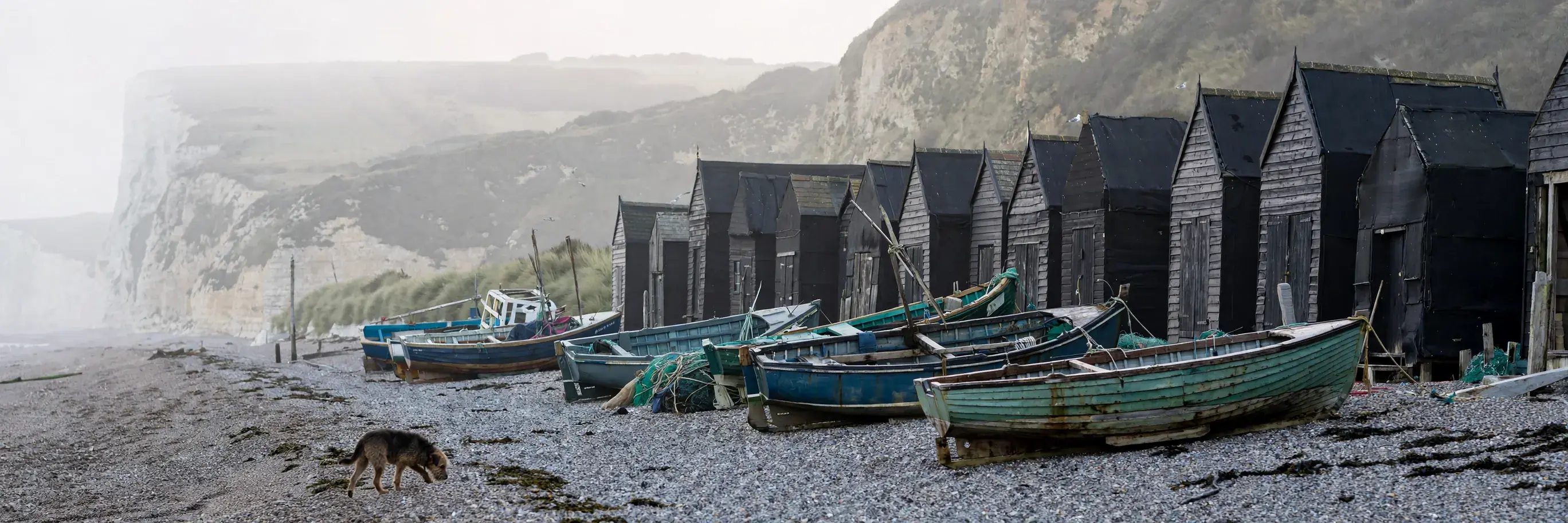
At the eastern end of the Old Town, the streets open onto the Stade. The name is Saxon for a landing place, and boats have been hauled up here for more than a thousand years. Today the shingle is scattered with fishing boats, winches, ropes, crates and nets, and the tall black net shops stand in rows behind the beach. The huts are weatherboarded, tarred black and built tall and narrow because the ground they stand on was limited — fishermen built upwards rather than outwards. Several survive from the 18th and 19th centuries, and they are protected as part of the town's fishing heritage.
The Stade is a working beach, not a manicured one, and that changes how you walk a dog there. Keep your dog on a lead among the boats and gear: there are ropes, hooks, fish crates and winch cables at dog height, and a curious nose can get caught or cut. Fish offal and bait can attract dogs, and some of it is not safe to eat, so practise a solid "leave it" before you arrive, and keep a close eye on scavengers. The shingle itself is hard on paws — it is made of smooth flint pebbles that shift underfoot — so build up the time your dog spends on it, and check their pads after a long session, especially if they are used to sand or grass.
Around the Stade you will find the Fishermen's Museum, housed in a former church on Rock-a-Nore Road among the net shops, and the Shipwreck Museum nearby. Both are small, free or low-cost, and worth a look, but dogs are not generally admitted inside museums, so plan for one person to wait outside with the dog, or admire the buildings from the street. Hastings Contemporary, the black-tiled gallery on the Stade, is similarly best enjoyed in turns. The Stade also hosts the town's big community events, including the Jack in the Green festival in May and the Bonfire Procession in October — both are spectacular, but both involve crowds, drums, fire and noise, so check the official guidance before you travel if your dates coincide, and consider whether your dog would cope or would be happier on a quiet walk in the country park instead.
For a first walk, try this simple loop. Start at the western end of George Street, walk its full length to the Stade, cross the shingle to the Rock-a-Nore end, then return along the seafront and back up the High Street. It takes about forty-five minutes at a dog's pace, it stays flat, and it gives you the Old Town, the fishing beach and the sea in one easy circuit. Save the hills for later in the day, when you know how your dog is coping with the shingle and the crowds.
Hastings Castle and the 1066 story
Hastings Castle stands on the West Hill, above the Old Town, and it is the most visible reminder of the Norman Conquest in the town. William of Normandy ordered a castle built here soon after his landing in 1066, first as a wooden fortification and later in stone. What survives today is a ruin: broken walls, the remains of a chapel and a Norman arch, set on a grassy hilltop with wide views over the town, the beach and the English Channel. It is an atmospheric place, and it is worth the climb, but it is also exposed, uneven and unfenced in places, so it needs a little more care with a dog than a flat park.
Dogs on leads are generally welcome in the outdoor grounds of the castle, but opening arrangements and dog policies can change, so check the official guidance before you travel. The site is managed as a visitor attraction with seasonal opening hours and an admission charge, and the castle is sometimes closed for events or in poor weather. The ground inside the ruins is rough grass and stone, with steps and sudden drops, so keep your dog on a short lead and away from the unfenced cliff edges on the seaward side. There is very little shade on the hilltop, and the wind can be strong even on a calm day at sea level, so bring water for your dog in summer and a windproof layer for yourself in winter.
The castle is reached from the Old Town by the West Hill lift, which climbs from George Street, or by a steep set of steps from the town. The lift is the easier option for most dogs and their owners, but the climb on foot is short and rewarding if your dog is fit — allow ten minutes and take the steps slowly. Either way, the view from the top is the payoff: the whole sweep of the bay from the Stade to St Leonards, the pier, and on a clear day the coast stretching east towards Fairlight and Dungeness.
The 1066 story does not end at the castle. The Battle of Hastings was fought on 14 October 1066 near the present-day village of Battle, about seven miles north-west of Hastings, and the battlefield and abbey there are managed by English Heritage. It makes an easy half-day trip from Hastings by car or bus, and the 1066 Country Walk — a long-distance footpath of about 31 miles — runs from Pevensey, where William landed, through Battle and Hastings to Rye. You do not need to walk the whole route to enjoy it: the section between Hastings and Battle crosses woodland, farmland and the High Weald, and it is a good option for a longer dog walk if your dog is fit and you arrange transport back. Shorter sections near Hastings, including the paths through the country park and the glens, give a taste of the same landscape without the logistics.
Back in the town, St Clement's Caves are another West Hill attraction, a network of sandstone caverns beneath the castle with a 140-metre tunnel known as Monk's Walk. The caves are an indoor, guided attraction, so they are not a dog-friendly stop — plan for one person to wait outside with the dog, or skip them and spend the time on the hilltop instead. The same applies to the Smugglers Adventure in the caves: interesting for people, impractical with a dog in tow.
East Hill, West Hill and Hastings Country Park
The two hills that frame the Old Town are the best walking in Hastings, and they suit very different dogs. The West Hill is the shorter, sharper climb: castle, caves and views, all within a few minutes of George Street. The East Hill is the gateway to Hastings Country Park, a 660-acre nature reserve of cliff-top grassland, woodland glens and coastal paths that stretches east towards Fairlight. If your dog needs a proper run, the East Hill is where to go.
Hastings has two Victorian cliff railways, one on each side of the Old Town, and both are run by the council. The West Hill lift starts on George Street and opened in 1891; it runs mostly through a tunnel in the cliff in Victorian wooden carriages, and it was powered by a gas engine until 1971. The East Hill lift starts on Rock-a-Nore Road beside the net shops and opened in August 1902; the council describes it as the steepest funicular railway in the United Kingdom. Both lifts run daily from March to September, typically from 10am to 5.30pm, and on reduced hours in winter — the East Hill lift runs at weekends only from October to February, while the West Hill lift runs daily with shorter hours. Timetables and fares change, so check the official guidance before you travel.
Dogs and lifts deserve a thought before you queue. The West Hill lift has no step-free access, and its tunnel section is dark, enclosed and rattling, which some dogs find stressful. The East Hill lift has step-free access and runs in the open air, which most dogs tolerate better. Dog policies on the lifts can change, so check the official guidance before you travel, and if your dog is nervous in enclosed spaces, walk up instead — the cliff paths are steep but short, and the views on the way up are a reward in themselves. Never force a frightened dog into a carriage: a bad five minutes in a lift can colour the rest of the day.
From the top of the East Hill lift, Hastings Country Park opens out in front of you. The park covers the cliffs and glens east of the town, including the Firehills — an area of open heathland named for the gorse that burns gold in summer — and the wooded glens of Ecclesbourne and Fairlight. The Saxon Shore Way and the 1066 Country Walk both pass through the park, and there are waymarked trails of various lengths, from a short cliff-top loop of under an hour to a full day's walk east to Fairlight Glen and the coastguard cottages at Fairlight. The glens are cool, shaded and full of birdsong in summer, which makes them a good option on a hot day when the beach is too exposed.
Off-lead walking in the country park is generally the best in Hastings, but it needs judgement. Keep your dog on a lead near the cliff edges — the sandstone cliffs are soft, they crumble, and there are unfenced drops along much of the coast path. Keep them on a lead near livestock, where grazing animals are present, and around other walkers, runners and horse riders on the narrower paths. Some areas of the park are managed for wildlife, including ground-nesting birds in spring and summer, so read the signs and respect any seasonal restrictions. A dog with reliable recall can enjoy long stretches off lead on the open grassland; a dog without it should stay on a long line, which gives freedom without the risk of a cliff-edge chase.
Footwear and paws matter here. The cliff paths are a mix of chalk, clay and sandstone that turns slippery after rain, and the steps down to the beach at Ecclesbourne Glen and Fairlight Glen are steep and uneven. Wear proper walking shoes, not seaside sandals, and check your dog's paws after a long walk on the rough ground. Carry water: there are no taps on the cliff tops, and the only reliable water points are back in the town or at the visitor centre. In summer, start early — the cliff tops have no shade, and the combination of sun, wind and exertion can overheat a dog faster than you expect.
A good half-day route is the East Hill circuit. Take the East Hill lift or the path up from Rock-a-Nore, walk east along the cliff top through the Firehills to Ecclesbourne Glen, drop down to the beach if the tide allows, and return through the glen and along the coast path. Allow two to three hours with a dog, including stops, and check the tide times before you descend to any beach below the cliffs: at high tide the shingle disappears against the cliff base, and there is no safe route back along the shore. For a shorter outing, the West Hill loop — lift up, castle, viewpoint, steps down — takes about an hour and suits older dogs and shorter legs.
Promenade, pier and St Leonards
West of the Old Town, Hastings opens out into a classic seaside promenade that runs for more than two miles to St Leonards-on-Sea. The promenade is flat, surfaced and easy walking, which makes it the best option in Hastings for older dogs, dogs recovering from injury, puppies on short walks, and anyone pushing a buggy or using a wheelchair. It is also the most rule-bound part of the seafront: dogs must be kept on a lead on the promenade all year round, without exception, and the rule is enforced.
Starting from the Stade and walking west, you pass the boating lake and the miniature railway — the Hastings Miniature Railway runs along the seafront, and dogs are generally welcome to ride, though you should check the current policy before you travel — then the amusement arcades, the pier and the wide open stretch of beach and promenade in front of the town centre. Hastings Pier, rebuilt after a fire in 2010 and reopened in 2016, is a long, open structure with views back along the coast. Dogs on leads are welcome on the pier, but it is exposed and can be very windy, and the decking can be hot underfoot in summer sun, so keep visits short on a hot day and check your dog's paws.
The stretch from the pier westwards to Bottle Alley is one of the dog-friendly beach sections in summer, so in the warmer months this is where to drop down onto the sand and shingle for a run. Bottle Alley itself is a covered walkway decorated with coloured glass bottles set into the concrete — a local landmark and a useful shelter in a shower. Beyond Bottle Alley, the summer exclusion zone runs to opposite the Royal Victoria Hotel, so keep your dog on the promenade through that stretch between April and September, and use the beach again once you are past the hotel and into St Leonards.
St Leonards-on-Sea, the Regency resort built next door to Hastings in the 19th century, is quieter and more spacious than Hastings town centre, and it suits a dog walk well. The seafront here is lined with stucco terraces, the beach is wide, and the crowds thin out noticeably once you pass the Royal Victoria Hotel. There are cafes and pubs along the front, including the Goat Ledge, a beach hut serving seafood and ice cream, and the walk west from Hastings to St Leonards and back makes a satisfying two-hour round trip of about four miles, almost all of it flat. In winter, when the whole beach is open to dogs, you can walk the entire length on the sand and shingle instead of the promenade, which is a much pleasanter surface for a dog that dislikes hard paving.
A note on the promenade in bad weather: the seafront at Hastings faces south-west, and in a gale the waves can break over the promenade, particularly around the pier and the Harbour Arm. If the sea is rough, keep your dog on a short lead, stay on the landward side of the promenade, and be ready to turn back. Never let a dog swim in rough seas or near the Harbour Arm, where currents are strong and the water is deep close to the shore.
Dog-friendly cafes, pubs and places to eat
Hastings is a good town for eating out with a dog, because so much of its food scene is built around the Old Town's small cafes and pubs rather than formal restaurants. The general pattern is that dogs are welcome on terraces and in the bar areas of pubs, and in many cafes, but not in formal dining rooms — and individual policies change, so treat any recommendation as a starting point and check on the day.
In the Old Town, the cafes along George Street and the High Street are the easiest option. Many have outdoor seating where dogs are welcome, and several keep water bowls and dog biscuits by the door. The pedestrianised stretch of George Street works well for a long lunch: your dog can settle under the table while you eat, and the passing foot traffic gives them something to watch without the pressure of a crowded indoor room. Look for places with a sheltered terrace rather than a pavement table on a busy corner — a dog that can lie down out of the flow of people will settle far faster than one that is constantly being stepped over.
Pubs are often the best bet for a proper meal with a dog. The Old Town has several traditional pubs, including freehouses on All Saints Street and the High Street, where dogs are welcome in the bar and sometimes in the whole ground floor. Pubs with a garden or a courtyard are worth seeking out in summer, and a pub that serves food all afternoon is more useful than one that stops serving at 2.30pm, because dog walks rarely run to a timetable. Ask the staff where your dog is most welcome when you arrive — a corner table away from the door is usually better than a table in the middle of the room, and staff will often tell you honestly if the kitchen is too busy for a dog that day.
For fish and chips, the Stade and Rock-a-Nore Road are the obvious place: the catch is landed metres away, and several takeaways and cafes serve fish straight off the boats. Takeaway food is the most dog-friendly option of all — buy it, find a bench on the Stade or a spot on the promenade, and eat with the dog beside you. Watch out for seagulls, which are bold in Hastings and will snatch food from an unwatched hand, and keep chips and batter away from your dog: fried food, bones and hot oil are all hazards, and fish bones in particular can be dangerous.
A few practical points apply wherever you eat. Bring a mat or blanket for your dog to lie on, so they have a defined place in a cafe or pub and are not lying on a cold floor or in a walkway. Bring water, because not every cafe provides a bowl. Feed your dog before you sit down, so they are not begging while you eat, and keep treats in your pocket for rewarding calm settling. If your dog barks at other dogs in enclosed spaces, choose a terrace or a takeaway rather than a crowded indoor cafe — a stressful meal helps nobody, and there are plenty of outdoor options in Hastings.
Beyond the Old Town, the seafront cafes between the pier and St Leonards are useful for a mid-walk stop, and the cafes in the town centre around the station and the Priory Meadow shopping area are handy before a train home. As with everywhere else in this guide, policies change: a cafe that welcomed dogs last year may have changed hands, so look for the sign on the door, ask a member of staff, and have a takeaway fallback in mind. If you are comparing Hastings with other south-coast towns, our guide to Brighton with a dog covers a bigger city's version of the same questions — seasonal beach bans, promenade rules, cafes and train tips — and the contrast is useful: Brighton is busier and more built-up, while Hastings is smaller, quieter and closer to open countryside.
Getting there: train, car and parking
The train is the easiest way to reach Hastings with a dog, and it is the option this guide recommends for most visitors. Hastings station is served by direct trains from London Charing Cross and London Bridge via Tunbridge Wells, with a journey time of around one hour and forty minutes from London. There are also trains along the coast from Brighton to the west and Ashford International to the east, which makes Hastings an easy stop on a longer south-coast trip. Dogs travel free on UK trains when kept on a lead or in a carrier, and they should not occupy a seat. On a busy summer weekend train, a mat on the floor between your feet keeps a dog settled and out of the aisle.
The walk from the station to the seafront takes about ten minutes, and the Old Town is a further ten to fifteen minutes along the promenade. That walk is flat and straightforward, and it gives you a good first look at the town. If you arrive by train and plan to walk the country park, remember that the hills are a stiff climb from sea level — allow extra time, and take the East Hill lift up if your dog is older or the day is hot. Trains back to London run until late in the evening, but check the last departure before you set out for a long walk, and leave a margin: a dog that has spent the day on the beach is not a dog you want to rush for a train.
By car, Hastings is reached from London via the A21, and from the west via the A259 coast road from Brighton and Eastbourne. The A21 is a single-carriageway road for much of its length and can be slow on summer weekends, so allow more time than the satnav suggests. The coast road is prettier but slower still, and it passes through several villages with low speed limits. Whichever route you take, plan a stop for your dog: there are services and lay-bys on the A21, and a break every hour or so is good practice on a warm day.
Parking in Hastings needs a little planning. The Old Town has limited on-street parking, and the streets are narrow and busy. The most useful car parks for a dog trip are the seafront car parks along the promenade, the Rock-a-Nore car park near the Stade, and the car parks around the town centre and the station. Most are pay-and-display, run by the council, and charges apply for much of the day. In summer, the seafront car parks fill early — aim to arrive before 10am if you want a space near the Old Town, or park further west towards St Leonards and walk in along the promenade. Check the official guidance before you travel for current charges and any changes to the car parks.
Two warnings matter for drivers. First, never leave a dog in a parked car on a warm day: a car can overheat in minutes, even with the windows open, and the seafront car parks are exposed to full sun. Second, the shingle beach and the Old Town streets are hard on a car as well as on paws — the Stade car park is close to the sea and the wind carries salt and sand, so expect a gritty windscreen by the end of the day. If you are staying overnight, ask your accommodation about parking: some Old Town guesthouses have no parking of their own and use a nearby public car park, which affects where you leave the car and how far you carry luggage.
Staying over with a dog
Hastings rewards an overnight stay, because the best walking — the country park at dawn, the empty winter beach, the Old Town before the day-trippers arrive — happens outside the middle of the day. The town has a good range of dog-friendly places to stay, from Old Town guesthouses and bed and breakfasts to self-catering cottages, flats and hotels along the seafront and in St Leonards. As with cafes, policies vary by property and by room, so always confirm the dog policy for the specific room you are booking, and get it in writing with any pet fee itemised.
Old Town guesthouses and small hotels are the most atmospheric option, and they put you within a few minutes of the Stade and the George Street cafes. The trade-off is that Old Town buildings are old: expect steep stairs, small rooms, and sometimes a shared entrance. If your dog struggles with stairs, is large, or needs a ground-floor room with direct access to a garden or the street, say so when you book and ask for the exact arrangement — a first-floor room with a narrow staircase is a poor fit for an arthritic Labrador, however charming the building. Self-catering cottages in the Old Town often suit dogs better, because they give you a front door, a kitchen and space to dry a wet dog, but check whether the cottage has an enclosed garden: many Old Town cottages open directly onto the street, which is fine for a calm dog and a problem for an escape artist.
Seafront hotels and guesthouses in St Leonards are quieter and often have more space, larger rooms and easier parking. They suit visitors who want a longer promenade walk and a calmer base, and they are a good choice if you are travelling with children as well as a dog. The walk from St Leonards into the Old Town takes about thirty minutes along the promenade, which is a pleasant morning stroll but a long way to carry shopping or a tired dog at the end of the day — factor the distance into your plans.
If you prefer a holiday park or a rural base outside the town, the countryside around Hastings has dog-friendly parks, cottages and farm stays within a short drive, and the 1066 Country Walk and the High Weald are on the doorstep. Our guide to dog-friendly holiday parks in the UK explains how to compare pet fees, boundaries and walks properly before you book, and the questions worth asking about any park stay. Whatever you choose, book early for summer weekends and school holidays: the dog-friendly rooms and units in Hastings are limited, and they sell out well ahead of the standard rooms.
Before you arrive, ask your accommodation four questions: is there a charge per dog and how much; is there a limit on the number or size of dogs; can the dog be left alone in the room, and under what conditions; and where is the nearest place for a late-night toilet walk. The answers will tell you more about the stay than any number of photographs. Pack as if the room has no dog facilities: bring your dog's bed, bowls, towels, a drying coat and a torch for the last walk of the day. And remember that a dog in a new place needs the same settling routine as at home — a quiet first evening, the same feeding time, and a familiar bed will do more for a good night's sleep than any amount of sightseeing.
Tides, cliffs and a practical packing list
Hastings is a safe and rewarding place for a dog trip, but the coast here has real hazards, and most of them are easy to avoid once you know about them. The three that matter most are tides, cliffs and the working beach.
Tides are the first. Hastings has a large tidal range, and at high tide the shingle beach narrows sharply against the sea wall and the cliff base, particularly at Ecclesbourne Glen and Fairlight Glen below the country park. Always check the tide times before you walk below the cliffs or along a beach that has no easy exit, and plan to be off the shore well before high tide. A good rule is to start a beach walk on a falling tide, so the beach is getting wider as you walk, and to avoid the shore entirely for two hours either side of high tide if the beach has cliffs behind it. If you are cut off, stay calm, move to the highest point and call for help — do not try to climb the cliffs.
Cliffs are the second. The sandstone cliffs around Hastings are soft and crumbly, and falls of rock are common, particularly after heavy rain or frost. Keep your dog on a lead near the cliff edge and at the cliff base, and never let them dig or scramble at the foot of a cliff. On the cliff tops, keep a sensible distance from the edge — the grass can overhang an undercut, and what looks like solid ground may not be. The same advice applies to the castle hilltop and the viewpoints: the views are best from a few steps back, and a dog on a long line near a cliff edge is a risk, not a freedom.
The working beach is the third. The Stade is full of fishing gear: ropes, hooks, winches, crates and nets, and the boats themselves are heavy and sometimes move on their cradles. Keep your dog on a lead among the boats, watch for fish hooks and bait, and do not let your dog drink from puddles on the beach, which can contain fuel or fish waste. After a walk on the shingle, check paws for cuts from flint and for fishing line tangled between the toes.
Beyond those three, the usual seaside precautions apply. Seawater is not drinking water, and a dog that drinks a lot of it can become ill, so carry fresh water and a bowl. The shingle reflects the sun and can be hot underfoot in summer, so test it with your own hand before a long walk, and consider dog boots for a dog with sensitive pads. In summer, watch for heat: the cliff tops and the beach have no shade, and a thick-coated dog can overheat quickly. In winter, the wind chill on the promenade and the cliff tops is severe, and a short-coated dog may need a coat. Adders are present in the rough grassland and heathland of the country park in the warmer months — they are shy and bites are rare, but keep your dog on the paths in adder habitat and know the signs of a bite.
A practical packing list for a day in Hastings: a lead and a long line, a harness, a water bottle and a collapsible bowl, poo bags, a towel and a drying coat, a blanket or mat for cafes, treats and a chew for settling, a torch for evening walks, dog boots if your dog needs them, and a first-aid kit with a tick remover. For an overnight stay, add your dog's bed, food and bowls, any medication, and the number of the nearest vet — save it in your phone before you travel, because the nearest emergency vet may be a drive away in the evening. If your dog has a health condition, tell your accommodation and carry the relevant information with you.
Hastings is at its best when you slow down and let the town set the pace: a morning on the Stade, a climb to the castle, a long walk in the country park, and an evening in a pub garden with the dog asleep under the table. Plan around the beach rules, respect the cliffs and the tides, and the town will give you one of the most varied dog trips on the south coast.
Practical questions
Before you go
Can dogs go on Hastings beach in summer?
Yes, on the stretches that are not covered by the summer exclusion zones. From 1 April to 30 September dogs are excluded from two zones: from the west of the Harbour Arm to the east side of Hastings Pier, and from the west end of Bottle Alley to opposite the Royal Victoria Hotel. Dogs are allowed all year on Rock-a-Nore and Stade beach, on the stretch from the west of the pier to the west end of Bottle Alley, and from opposite the Royal Victoria Hotel westwards. From 1 October to 31 March dogs are allowed on every part of the beach. Check the official guidance before you travel, and read the signs on the day, because the boundaries are enforced by a Public Space Protection Order.
Are dogs allowed on the promenade in Hastings?
Yes, but dogs must be kept on a lead on the promenade all year round. The lead rule applies even in winter, when dogs are allowed off lead on the beach itself. Keep the lead short around the pier, the amusement arcades and the busiest stretches near the town centre, where crowds, food smells and other dogs can unsettle even a calm dog.
Can dogs ride the East Hill and West Hill lifts?
The two cliff railways are run by the council and their dog policies can change, so check the official guidance before you travel. In general, well-behaved dogs on leads are commonly carried on the lifts, but the West Hill lift runs mostly through a tunnel in Victorian wooden carriages and has no step-free access, which can unsettle nervous dogs. The East Hill lift has step-free access. If your dog dislikes enclosed, rattling carriages, take the cliff paths instead and save the lift for the return journey.
Is Hastings Castle dog-friendly?
Hastings Castle is a largely open-air Norman ruin on the West Hill, and dogs on leads are generally welcome in the outdoor grounds, but opening arrangements and dog policies can change, so check the official guidance before you travel. The site is exposed and windy, the ground is uneven, and there is little shade, so bring water for your dog and keep them on a lead near the unfenced cliff edges.
Where can dogs walk off lead near Hastings?
In winter, from 1 October to 31 March, dogs are allowed off lead on every part of Hastings beach. In summer, the dog-friendly stretches of beach allow dogs off lead too, including Rock-a-Nore and Stade beach. Away from the beach, the open grassland and woodland glens of Hastings Country Park above the East Hill offer the best off-lead walking, provided your dog has reliable recall and you keep them on a lead near cliff edges, livestock and other walkers. Always check the signs, because some areas of the park are managed for wildlife.
How do I get to Hastings with a dog by train?
Hastings station is served by direct trains from London Charing Cross and London Bridge via Tunbridge Wells, and by trains along the coast from Brighton and Ashford. Dogs travel free on UK trains when kept on a lead or in a carrier, and they should not occupy a seat. The walk from Hastings station to the seafront takes about ten minutes, and the Old Town is a further ten to fifteen minutes along the promenade. Arrive early on summer weekends, when trains and the promenade get busy.