This guide is independent and contains no paid placement. If affiliate links are added later, they will be clearly marked and will not change our editorial checks.
Ilkley works as a three-part dog day: big-sky moorland walking around the Cow and Calf rocks, a gentler riverside stretch along the Wharfe, and a compact spa town for cafes, pubs and a proper rest. Keep dogs on lead near sheep and signed restrictions, treat the river with respect after rain, and check the official guidance before you travel for any venue rule that matters to your plan.
The Cow and Calf rocks: start here
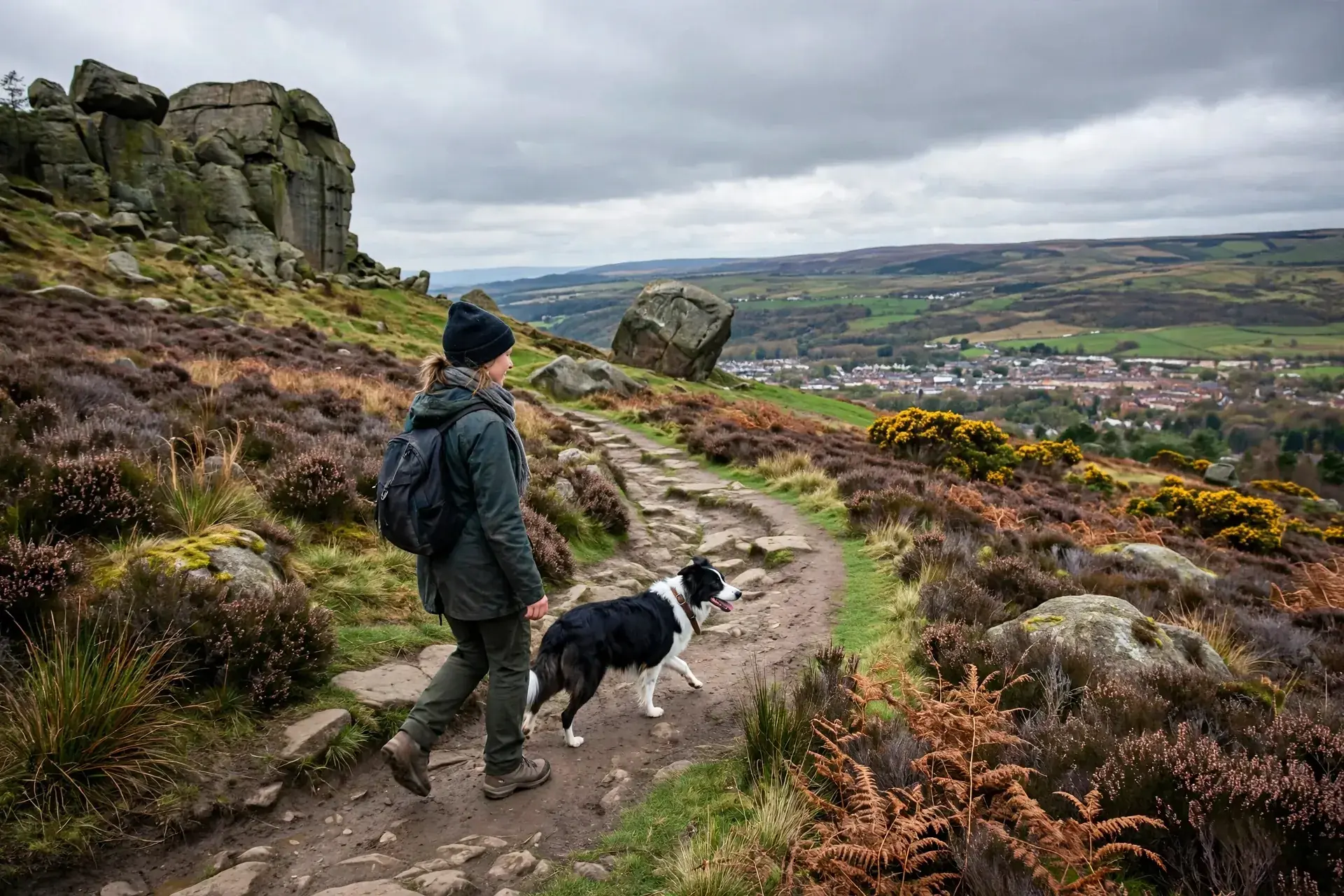
The two great gritstone boulders above Ilkley, known as the Cow and the Calf, are the natural front door to a dog walk here. They sit on the edge of Ilkley Moor, high enough to give a wide view down the Wharfe valley, and close enough to the town that you can reach them without committing to a full day on the tops. For a dog, that combination matters: there is open ground to sniff, firm rock to investigate, and a clear point to turn back if the wind picks up or little legs tire sooner than expected. Begin at the rocks rather than in the town centre, and the whole day reads differently, because the walk starts with space instead of pavements.
The rocks themselves are a climbing landmark, so expect other people, ropes and camera bags on a fine weekend, especially around the main outcrop. That is useful socialisation practice, but it is not the place for a long-line tangle or an uncontrolled greeting. Keep your dog close as you approach, let them take in the new smells and sounds, and move on to the quieter moor paths once everyone has settled. The ground around the rocks is uneven gritstone, heather and short grass, so dogs that scramble will enjoy it and dogs with sore paws or stiff joints will prefer the smoother tracks that run alongside. Watch for loose stones underfoot and for gaps between boulders where a small dog could slip out of sight for a moment.
From the rocks, the moor opens in every direction, and that openness is both the attraction and the thing to manage. There are no fences to do the thinking for you, so recall, lead discipline and awareness of other moor users all matter from the first five minutes. Grouse moor, sheep grazing and ground-nesting birds all share this landscape at different times of year, and the rules that protect them are not decorative. Read any notice at the access point before you set off, and if a sign asks for dogs on leads, follow it even if the moor looks empty. A quiet moor can hide a curlew nest, a lamb behind a bank, or a mountain biker coming fast around a bend.
Photographs at the rocks are tempting, and the view rewards a pause, but the best dog walking here is the walking that comes next, not the posing at the start. Take the photo, give the dog water, check paws and lead, and then choose a direction while energy is still fresh. If you are visiting with a dog that pulls, the first stretch is the time to settle the pace: short lead, steady walking, and a few calm stops to sniff rather than a sprint across open ground. Dogs that arrive over-aroused tend to stay over-aroused for the rest of the walk, while dogs that start slowly usually cope better with livestock, cyclists and other dogs later on.
Ilkley Moor in three parts
It helps to think of Ilkley Moor as three different walking environments rather than one big expanse of heather. The first is the rocky edge around the Cow and Calf, where paths are firm, views are immediate and other visitors are most frequent. The second is the open top, where wide tracks cross heather and bilberry, the wind is stronger, and distances feel longer than they look on a map. The third is the gentler slope back toward town, where paths narrow, bracken and woodland edge appear, and the walk gradually turns from expedition back into neighbourhood stroll. A dog experiences each part differently, and planning for all three avoids the common mistake of treating a moor walk as a single uniform effort.
On the open top, navigation deserves more attention than it usually gets on a town walk. Heather moorland can look identical in every direction, low cloud can arrive quickly, and a phone battery drains faster in cold wind than most people expect. Carry a charged phone and a basic map or downloaded offline map, and agree a turn-back point before you leave the rocks, especially with an older dog or a puppy. Water matters here too: there are no cafe taps on the tops, and a dog that has run hard in wind can be surprisingly thirsty. A collapsible bowl and a bottle carried for the dog, not just for you, should be standard kit, and on warm days you should plan shade breaks even though the moor offers very little natural shade.
The slope back toward town is where many dogs finally relax, because the wind drops, the ground softens, and the smells change from heather to gardens and woodland. It is also where leads often need to go back on, because paths meet roads, driveways, gardens and other dog walkers in quick succession. Do not let a tired dog drift off a moor path onto a road while you are still in expedition mode. A deliberate transition helps: lead on at a chosen landmark, a short pause for water, and a slower pace for the last stretch. Dogs that are allowed to decompress gradually arrive in town calmer, which makes the cafe stop that follows much easier for everyone.
Weather changes the moor more than it changes the town below. Rain turns gritstone slippery and heather paths boggy, strong wind makes scent and sound harder for dogs to read, and bright sun on a still day can overheat a thick-coated dog faster than the temperature suggests. Check the forecast for the tops, not just for the town, and be ready to shorten the moor section and lengthen the riverside section if conditions turn. There is no prize for completing a planned loop in deteriorating weather, and a dog that has enjoyed a shorter walk will be in better shape for the rest of the day than a dog that has been pushed through wind and rain to satisfy a route plan.
Choose a route for your dog
The right Ilkley route depends less on fitness bragging rights and more on the dog in front of you. A young, fit dog that needs to burn energy will enjoy a longer loop across the tops, with time to run on a long line where it is safe and legal to do so. An older dog, a small breed, or a dog recovering from an injury will get far more from a short out-and-back to the Cow and Calf and a gentle descent, followed by a long riverside stroll. A reactive dog needs a route with space to move aside, clear sightlines and escape options, which the open moor provides better than a narrow riverside path at a busy hour. Matching the route to the dog is the single most useful decision you will make all day.
For a first visit, a short moor circuit is the sensible default. Walk to the rocks, follow a clear track for twenty to thirty minutes across the top, then loop back by a different path rather than retracing every step. This gives variety without distance, and it leaves energy for the river later. Dogs that are new to moorland often need time to adjust to the scale of it: wide horizons, wind-borne scents and distant sheep are a lot of information at once, and a shorter first walk builds confidence. If the dog finishes bright-eyed and keen, you can extend the riverside section instead of adding moor miles, which is kinder on paws and joints.
For a longer day, link the moor to the valley by descending on a clear path and joining the riverside, rather than trying to force one giant moor loop. The descent gives the dog a change of surface and scent, and the river section provides water, shade and flat walking after the climb. Plan the descent carefully, because steep, loose paths are harder on dogs going down than going up, and a dog that has already tired on the tops can slip or strain on a steep slope. If your dog is elderly or has joint problems, choose the gentlest descent you can find and accept a longer, flatter route over a shorter, steeper one.
Whatever route you choose, build in turn-back points and use them without guilt. A good rule is to decide the turn-back time before you start, based on the slowest member of the party, and to treat it as a plan rather than a failure. Dogs do not measure a walk by distance, and a walk that ends with the dog still happy is a better walk than one that ends with a dog limping, panting heavily or refusing to move. If you are walking with children, remember that their energy and the dog's energy rarely decline at the same rate, so the adult in charge of the route needs to watch both and call the turn while everyone is still enjoying themselves.
Down to the River Wharfe
The second act of an Ilkley dog day belongs to the River Wharfe, and the change of pace is the point. After the wind and openness of the moor, the riverside offers flat paths, trees, ducks, other dogs and the sound of moving water. Many dogs that have been alert and forward on the moor visibly settle beside the river, sniffing the bank, paddling at the edge and watching the current. That settling is valuable, because it turns a high-energy walk into a full day out rather than a single burst of exercise followed by a long car journey home. Plan the riverside as a destination in its own right, not as a shortcut back to the car.
The riverside paths around Ilkley are popular with families, runners, cyclists and other dog walkers, so lead manners matter more here than on the open moor. Keep leads short on narrow stretches, move aside for runners and pushchairs, and watch for children who may run toward a friendly-looking dog without warning. Ducks and other water birds are a strong distraction for many dogs, so a lead is wise near the bank even for dogs that are reliable elsewhere. If your dog is reactive to other dogs, choose a quieter time of day for the riverside section, or walk the less busy bank, rather than forcing a head-on meeting on a narrow path at midday on a sunny Saturday.
Swimming deserves a careful, honest paragraph, because the Wharfe is not a swimming pool. In calm, shallow places it can be a joyful paddle, but after rain the river can run fast, deep and deceptively strong, and currents near bridges, weirs and narrow channels are dangerous for dogs and for owners who go in after them. Never let a dog swim near a weir, never throw a ball into fast water, and never assume that because other dogs are swimming, the conditions are safe for yours. A dog that is tired from the moor, cold, or a weak swimmer is at greater risk, and a long coat that soaks up water adds weight and drag. Short, supervised paddles at a shallow edge, with a towel ready, are the sensible version of river fun.
Water quality is another reason to be cautious rather than casual. Rivers carry agricultural runoff, algae and other hazards that vary with season and rainfall, and dogs that drink river water or lick their coats after swimming can pick up stomach upsets. Carry fresh water and offer it regularly so the dog is not driven to drink from the river out of thirst, and rinse or towel a dog that has been in the water before the car journey home. If your dog develops vomiting or diarrhoea after river swimming, contact a vet promptly and mention the river exposure. Check the official guidance before you travel for any current water-quality warnings that apply to the stretch you plan to use.
The riverside also gives you practical options that the moor does not: benches, bins, toilets, nearby shops and an easy escape route if the weather turns or a dog tires. Use them. A riverside bench is a good place to practise settling, with the dog on a mat, watching the world go by, while you have a drink and check the map for the town section. Dogs that never learn to settle in busy places often struggle in cafes afterwards, so ten calm minutes on a riverside bench can be more useful than another mile of walking. End the riverside section with a short lead walk and a toilet break before heading into town, so the dog arrives clean, calm and ready for the third act.
The spa town: rest and refuel
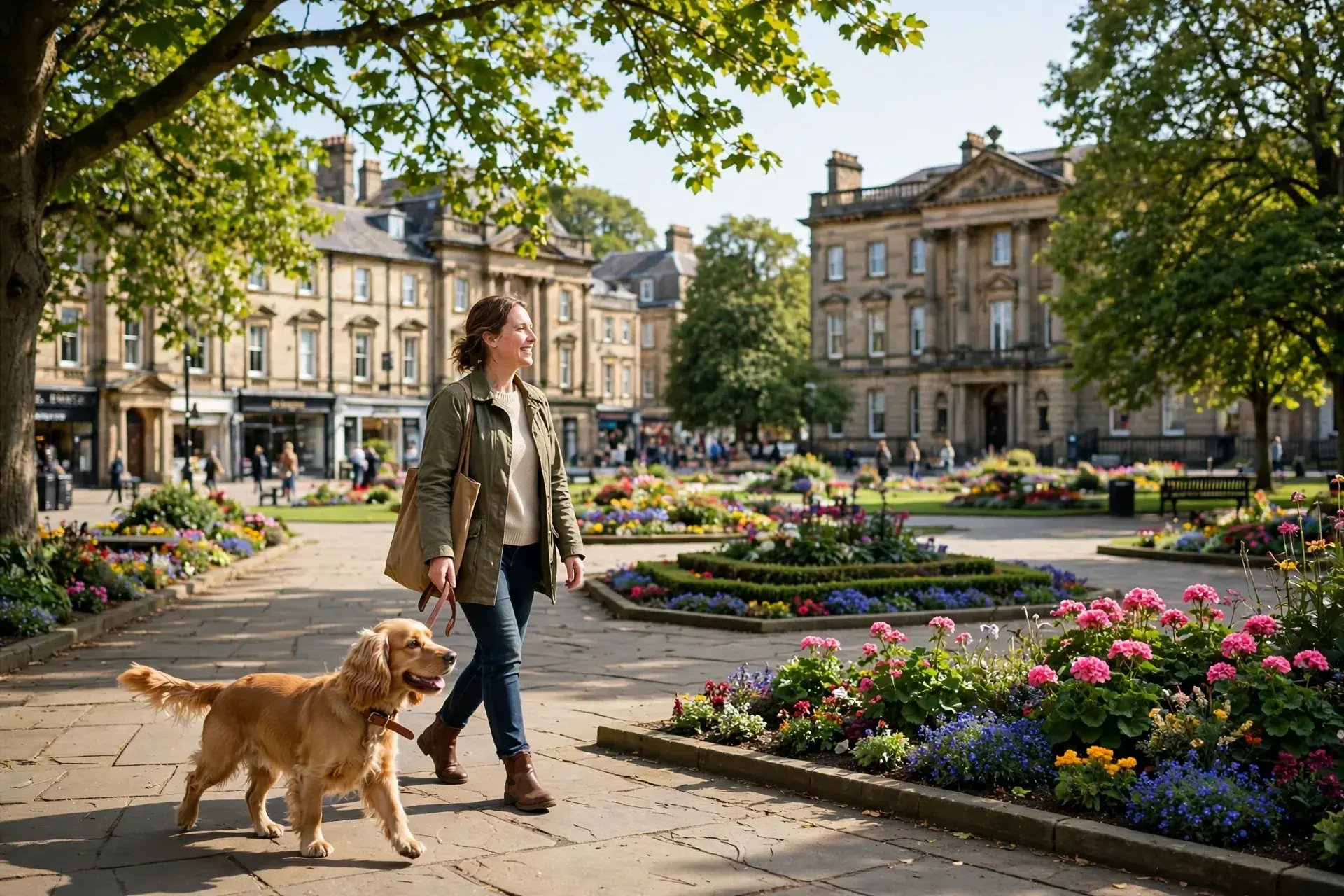
Ilkley earned its spa reputation in the nineteenth century, when visitors came for the waters and the moor air, and the town still feels built for slow recovery. The Grove, the main shopping street, is compact and walkable, with independent shops, cafes and pubs within a short stroll of each other. That compactness suits dog owners: you can browse, sit outside, move to another venue and still be near the car or the station, without the long pavement marches that tire small dogs in bigger towns. The town rewards a slow pace, and a dog that has walked moor and river will usually be happy to match it.
Cafes are the natural first stop, and many Ilkley venues welcome dogs, particularly in garden areas and ground-floor rooms. Policies vary by venue and can change, so check the official guidance before you travel and confirm the specific area you plan to use, rather than assuming that a welcome at one table applies to the whole building. Our wider advice on dog friendly cafes in the UK explains how to tell a genuinely dog-welcome venue from one that merely tolerates a dog outside, and the same checks apply here: water bowls, space under or beside the table, a mat-friendly floor, and staff who greet the dog rather than merely ignoring it. Bring your own mat and water bowl even when bowls are promised, because a familiar mat helps a dog settle faster in a new room.
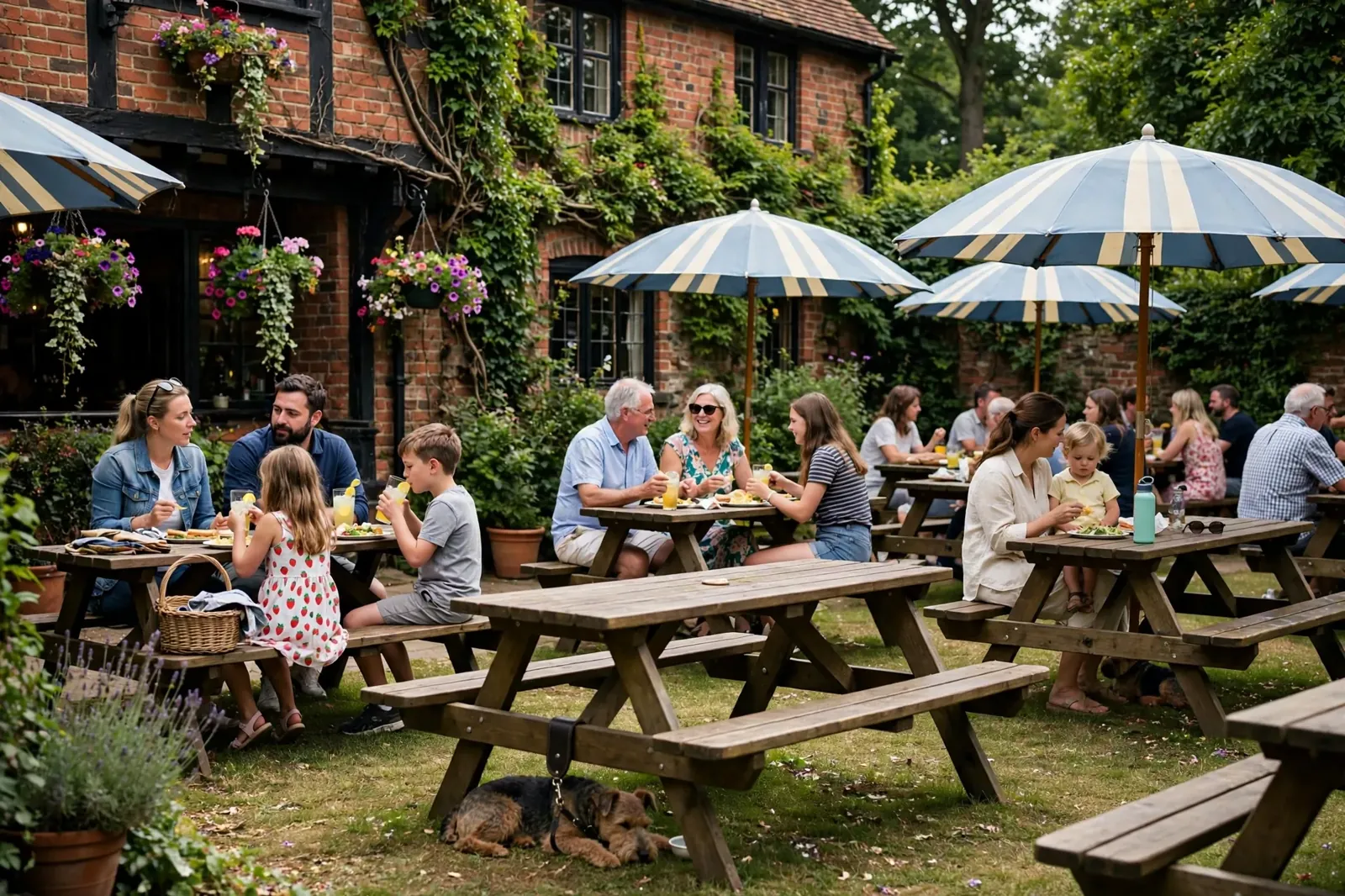
Pubs suit the later part of the afternoon, when the dog is tired and the town is quieter. Ilkley has traditional pubs and bars where dogs are a normal part of the furniture, and a garden or terrace is often the easiest option on a fine day. Our guide to dogs in pub gardens covers the details that make garden drinks relaxed rather than stressful: short leads, tables away from the main thoroughfare, water before food, and a plan for what happens if another dog arrives at the next table. In Ilkley, as elsewhere, the dogs that do best in pubs are the dogs that have already had their walk, had water, and had a chance to settle, so do not expect a pub to fix a dog that is still full of moor energy.
Shopping with a dog in Ilkley is mostly a matter of asking and adapting. Some independent shops welcome dogs, others prefer dogs to wait outside with one member of the party, and a few have narrow aisles where a large dog on a long lead is impractical. Split visits work well here: one person browses while the other waits with the dog, then swap, so nobody has to rush and the dog is never left tied outside a shop. Never leave a dog tied unattended outside a shop in a busy town, and never leave a dog in a car on a warm day, even for a short errand. If you need provisions, a quick, planned shop with the dog settled in the car in cool conditions and one person staying with the car is a different matter from an unplanned absence.
The spa town character also gives Ilkley a useful role as a rest stop rather than just a walk start. If you are touring the Yorkshire Dales, a night or an afternoon in Ilkley lets dogs recover on flat ground, lets owners do laundry, restock and check paws, and lets everyone reset before bigger Dales routes. The town has bookshops, a small cinema, and places to sit and plan, which matters on a wet day when the moor is not inviting. Treat Ilkley as a place to recover properly, not as a place to rush through on the way to somewhere more dramatic, and the dog will benefit from the slower rhythm as much as you will.
A three-part day plan
A workable Ilkley dog day has three parts in a deliberate order: moor first, river second, town third. Start with the moor while energy and weather are freshest, because the open tops are the most demanding section and the easiest to shorten if needed. Move to the river when legs begin to tire, because flat riverside walking feels like recovery even though it is still exercise. Finish in town when the dog is ready to settle, because a tired dog in a cafe is a calm dog, while a fresh dog in a cafe is often a frustrated one. Reversing the order, with town first and moor last, usually produces a dog that is overstimulated in shops and exhausted on the tops, which is the worst of both worlds.
Timing matters within that order. Arrive early enough to enjoy the moor before the busiest period, especially on weekends, when the Cow and Calf area and the riverside both fill up by late morning. A mid-morning moor walk, a late-morning river stretch, and an early-afternoon town stop gives a natural arc, with lunch at a point when the dog can settle under a table rather than begging through a meal. If you are travelling a long way to Ilkley, consider arriving the night before or planning a shorter first day, because a long car journey followed immediately by a long moor walk is a lot for any dog, and travel sickness, stiffness and toilet needs all complicate the first hour.
Build a wet-weather version of the same plan before you leave home, not when rain starts on the moor. The wet version shortens the moor section to a brief visit to the rocks and a short track walk, lengthens the riverside and town sections, and adds indoor options such as a longer cafe stop and a browse around shops that welcome dogs. A dog that has a good wet day in Ilkley, with drying towels, a warm car and a calm cafe, will remember the town fondly, while a dog that has been dragged around a sodden moor for hours will associate the place with misery. Flexibility is not a failure of planning; it is the plan.
For multi-dog households, the three-part plan needs one extra consideration: energy levels rarely match. Walk the dogs together on the moor and river, but plan town stops where both dogs can settle, and be ready to split the party if one dog needs more walking and another needs rest. A common solution is for one person to take the energetic dog for an extra riverside loop while the other rests with the older dog in a cafe garden. That split only works if both dogs are comfortable being separated briefly and if the cafe venue genuinely welcomes the resting dog, so check both points in advance rather than discovering a problem at the table.
Seasons, livestock and ground conditions
Spring on Ilkley Moor brings ground-nesting birds, lambs and fresh growth, and it is the season when lead discipline matters most. Birds such as curlew and lapwing nest on open ground, and a dog running free through nesting areas can destroy a nest without the owner ever seeing it. Lambing season adds another reason for leads: ewes with lambs are easily stressed, and a dog that chases, even playfully, can cause injury and panic. In spring, keep dogs on lead across open moorland unless you are certain of the local rules and your dog's recall, and treat any signed restriction as mandatory. The moor in spring is beautiful, but it is also a working landscape and a wildlife habitat, not just a dog park.
Summer brings heat, ticks, adders and busy paths, and each needs a different response. Heat is the most underestimated summer risk on the moor, because there is little shade and the wind can mask how hot a dog is getting. Walk early or late, carry extra water, watch for heavy panting and slowing, and never leave a dog in a parked car. Ticks are common in bracken and long grass, so check your dog thoroughly after moor walks, especially around ears, armpits and groin, and remove any tick promptly with a tick remover. Adders are present on some moorland, though bites are uncommon; keep dogs out of dense bracken and rocky crevices in warm weather, and seek vet advice immediately if you suspect a bite. Summer weekends also bring the most other walkers, cyclists and climbers, so early starts pay off.
Autumn is arguably the best Ilkley season for dogs. The heather has flowered, the light is softer, the moor is quieter after the summer holidays, and the ground is usually firm before winter rain sets in. Grouse shooting season and estate management can still affect access on some moorland, so read notices and follow any temporary restrictions, and keep dogs close when shooting or management work is taking place nearby. Autumn also brings fungi, fallen fruit and conkers in woodland edges, all of which can be toxic or cause stomach upsets if eaten, so a reliable leave command and a watchful eye on the descent paths are worth more than any gadget.
Winter on the moor is dramatic but demanding. Short days, low cloud, ice on gritstone and sudden wind all make navigation and footing harder, and a wet, cold dog loses heat quickly after exercise stops. Winter walks should be shorter, with a clear route, a charged phone, a headtorch if there is any chance of fading light, and warm, dry clothing and towels waiting in the car. Older dogs and short-coated breeds may need a coat on the tops, and all dogs benefit from a post-walk towel dry before a car journey. The town section becomes more important in winter, because a warm cafe stop is not a luxury but part of keeping a dog comfortable after a cold walk.
Parking, transport and vets
Parking in Ilkley is straightforward if you plan it around your route rather than improvising on arrival. Town centre car parks put you close to shops, cafes and the riverside, which suits a river-and-town day, while moor-edge parking suits walkers heading straight for the Cow and Calf rocks. Check signs, charges and time limits on arrival, since rules can change, and avoid leaving valuables visible in the car at any car park. On busy weekends, arrive early or accept a slightly longer walk from a town car park rather than circling moor lanes looking for a space, which stresses dogs and drivers alike. If you park on a moor lane, park considerately, keep gates and passing places clear, and never block access for farm or emergency vehicles.
Ilkley has a railway station with services toward Leeds and Bradford, which makes a car-free visit possible for many people, and a train journey can be easier on a dog than a long drive if the dog is settled on trains. Check the official guidance before you travel for current timetables, dog rules and any engineering work, and plan the walk from the station with the dog's needs in mind: the station to moor route involves town streets before open ground, so allow time for toilet breaks and settling. Bus services also serve Ilkley and the Wharfe valley, but timetables and dog policies vary by operator, so confirm before relying on a bus for the return leg. A car-free day needs a firmer plan than a car day, because there is no warm car to retreat to if plans change.
Before any moor and river day, save the details of a local vet and an emergency vet, and carry your own vet's number as well. Moor injuries are usually minor, such as cut paws on gritstone, thorns, or stomach upsets from scavenged food, but a cut pad can bleed impressively and a dog that has swallowed something unknown needs prompt advice. A small first-aid kit for the dog, including a bandage, tick remover, saline wash and a spare lead, weighs little and covers most minor incidents. If your dog has a medical condition, carry medication in its original packaging, tell your walking companions about it, and plan routes that keep you within reasonable reach of help rather than heading for the remotest part of the moor.
Toilets, water and bins deserve a mention because they shape the practicality of a dog day more than any scenic highlight. Ilkley town has public facilities and many cafes, while the moor has none, so use town facilities before heading up and plan a toilet break for the dog on the way back down. Carry bags, use bins where provided, and take bags home if no bin is available, because bagged waste left on moorland is a genuine problem for wildlife and other walkers. Water refill points are easier in town than on the moor, so fill bottles before the moor section and top up again at the riverside or in town.
Staying over with a dog
Ilkley works well as an overnight base, and a night here changes the dog day for the better. Arriving the evening before means the moor walk starts with a rested dog rather than a car-weary one, and staying a second night means you can split moor and river across two days instead of cramming both into one. Dog-friendly accommodation in and around Ilkley includes hotels, guesthouses, self-catering cottages and holiday lets, but dog policies vary widely: some accept dogs throughout, others only in selected rooms, and most have rules about dogs left alone, dogs on beds and dogs in dining rooms. Confirm the exact room, the pet charge, the number of dogs allowed and the alone-time rule in writing before you pay, and do not assume that a venue that welcomed a dog last year has the same policy today.
A good dog stay in Ilkley has a few practical features worth asking about: a ground-floor room or easy step access for older dogs, a nearby toilet area for last thing at night and first thing in the morning, somewhere to dry a wet dog, and a secure place to leave the dog if you need to pop out. A room near a busy road or a breakfast room can be a poor choice for a noise-sensitive dog, while a quiet room at the back with a garden view is often worth paying a little more for. If you are planning day trips from Ilkley, nearby Harrogate with a dog makes a natural companion visit, with its own spa town parks, gardens and cafes, and the two towns together give a gentle introduction to Yorkshire spa town walking without long daily drives.
Self-catering stays suit many dog owners because they remove the dining-room question and give the dog a familiar base with a kitchen and a door to a garden. Check the garden boundary before letting a dog out unsupervised, because a pretty cottage garden is not automatically a secure one, and check whether the garden is shared with other guests. Holiday lets often have stricter cleaning expectations for dogs, so bring your own dog bedding, towels and throws to protect furniture, and leave the place as you found it. A dog that has its own bed, its own bowl and a familiar blanket settles faster in a new cottage, and a settled dog is a quiet dog, which matters for neighbours in a converted barn or a terraced cottage.
For longer stays, Ilkley is a useful base for the southern Yorkshire Dales and the Wharfe valley, with day trips to Bolton Abbey, Grassington, Kettlewell and the wider Dales all possible without moving accommodation. That base-camp style suits dogs because it keeps the sleeping place constant while the walks vary, and it suits owners because laundry, vet access and familiar cafes are all in one town. Plan rest days deliberately: a day with only a short riverside stroll and a long cafe afternoon is not a wasted day, it is recovery, and dogs that get rest days walk better on the big days that follow. A week of daily moor miles without rest will tire most pet dogs, however fit they look at the start.
What to pack for Ilkley
Packing for Ilkley is packing for two landscapes, and the list is short but specific. For the moor, you need a lead and a long line if you use one, a harness that fits well and does not chafe on a long walk, water and a bowl, poo bags, a tick remover, and a towel for the car. For the river, add a second towel, because a dog that paddles will soak a car seat, and a spare lead in case the first gets wet and muddy. For the town, add a mat for cafe floors, a water bowl, and a chew or enrichment item that keeps a tired dog settled under a table without disturbing other guests. Pack the car the night before so the morning departure is calm rather than a scramble.
Clothing and footwear for the owner matter as much as kit for the dog. Moor paths are uneven, gritstone is slippery when wet, and heather hides ankle-turning holes, so walking boots with ankle support beat trainers for the moor section. Waterproofs are essential even on a promising forecast, because moor weather changes faster than town weather, and a waterproof layer for the dog is worth considering for short-coated or elderly dogs in rain. Sun protection, including water and a hat, matters on bright moor days too, because there is almost no shade on the tops. Dress for the moor, not for the cafe, and change into dry layers for town if needed.
Food and treats need a plan as well. A dog that has walked moor and river will be hungry, but feeding a large meal immediately after hard exercise can cause stomach problems, so offer small treats on the walk, water regularly, and the main meal after a rest period back at the car or accommodation. Carry high-value treats for recall on the moor, especially if sheep or other dogs appear, and carry a little more food than you think you need in case the walk extends. If your dog has dietary needs or medication with food, keep that routine as close to home as possible, because a new town, new smells and a long walk are already enough novelty for one day.
Finally, pack for the unexpected without overloading yourself. A charged phone, a power bank, a basic map, a headtorch in winter, a spare lead, a bandage and your vet numbers cover most minor problems. A whistle can help recall on open moorland if your dog is trained to it, and a bright collar or harness helps other walkers and cyclists spot your dog in low light or heather. The goal is not to carry a shop, but to avoid the situation where a small problem, such as a cut pad or a flat phone, turns a good day into a stressful one. Most Ilkley dog days need none of this emergency kit, and that is exactly why it is worth carrying.
Practical questions
Before you go
Can dogs go off lead on Ilkley Moor?
Often yes on open moorland, but keep your dog on a lead near livestock, ground-nesting birds in spring and summer, other walkers, and any signed restriction. Recall must be reliable before you let go, and a long line is a sensible middle step.
Is the River Wharfe safe for dogs to swim in at Ilkley?
Not always. The Wharfe looks gentle in places but can run fast and deep after rain, and currents near weirs and bridges are a real hazard. Choose a shallow, slow edge only when conditions are calm, keep sessions short, and never let a dog swim near a weir.
Where can I park for a dog walk in Ilkley?
Town centre car parks put you close to shops, cafes and the riverside, while moor-edge parking suits walkers heading straight for the Cow and Calf rocks. Check signs and charges on arrival, since rules and prices can change, and leave nothing valuable visible in the car.
Are dogs welcome in Ilkley cafes and pubs?
Many Ilkley cafes and pubs welcome dogs, especially in gardens and ground-floor areas, but policies vary by venue and can change. Check the official guidance before you travel, confirm the specific room or terrace you plan to use, and bring a mat and water bowl.
What should I do if my dog meets sheep on the moor?
Put your dog on a lead immediately, move calmly away, and keep the lead short until you are well clear. Never let a dog chase livestock: it is distressing for the animals, dangerous for the dog, and can have serious legal consequences for the owner.
Is Ilkley a good base for a longer Yorkshire Dales trip with a dog?
Yes. Ilkley sits at the southern edge of the Yorkshire Dales area, with rail links and road routes toward the Dales, Harrogate and the Wharfe valley. It works well as a first or last stop, with gentler walks for arrival day and bigger moor routes once everyone is settled.