This guide is independent and contains no paid placement. If affiliate links are added later, they will be clearly marked and will not change our editorial checks.
An Isle of Mull with a dog trip succeeds or fails at the ferry terminal. Book the Oban to Craignure crossing early, keep your dog settled in the car or in the designated pet areas as the operator directs, and base yourself in Tobermory or near Craignure and Salen to cut driving. On the island, expect single-track roads, sheep on open ground, superb beaches with seasonal wildlife rules, and weather that rewards a flexible, lead-ready plan.
Ferry first: the crossing shapes everything
Most Mull itineraries begin with the CalMac sailing from Oban to Craignure, a crossing of roughly three quarters of an hour that delivers you to the island's main gateway. There are also smaller routes — Lochaline to Fishnish, and Kilchoan to Tobermory — that suit travellers already touring Argyll or Ardnamurchan. Whichever you choose, book vehicle crossings well ahead in spring and summer, because sailings fill and a missed boat is not a minor delay on an island; it can cost you half a day and a very restless dog.
For the dog, prepare the crossing like any other transport leg. Walk and toilet your dog thoroughly before boarding, feed lightly rather than serving a full meal just before sailing, and carry water, a familiar blanket and waste bags in the cabin or car as the operator's rules allow. Dogs on CalMac services are generally carried free, with arrangements varying by vessel — many dogs stay in the vehicle or use designated pet lounges or deck areas — so check the latest official guidance before you travel and follow crew instructions on the day.
If your wider trip involves several crossings, our dogs on UK ferries guide compares operator rules, costs and how crossings work across the country, and it is worth reading before you book a multi-island route. Build slack around sailings: arrive in Oban with time for a harbour-side walk, and never schedule a tight onward commitment for the hour after you dock at Craignure. Island time starts on the boat, and dogs settle best when their owners are not clock-watching.
Choosing a base: Tobermory, Salen or Craignure
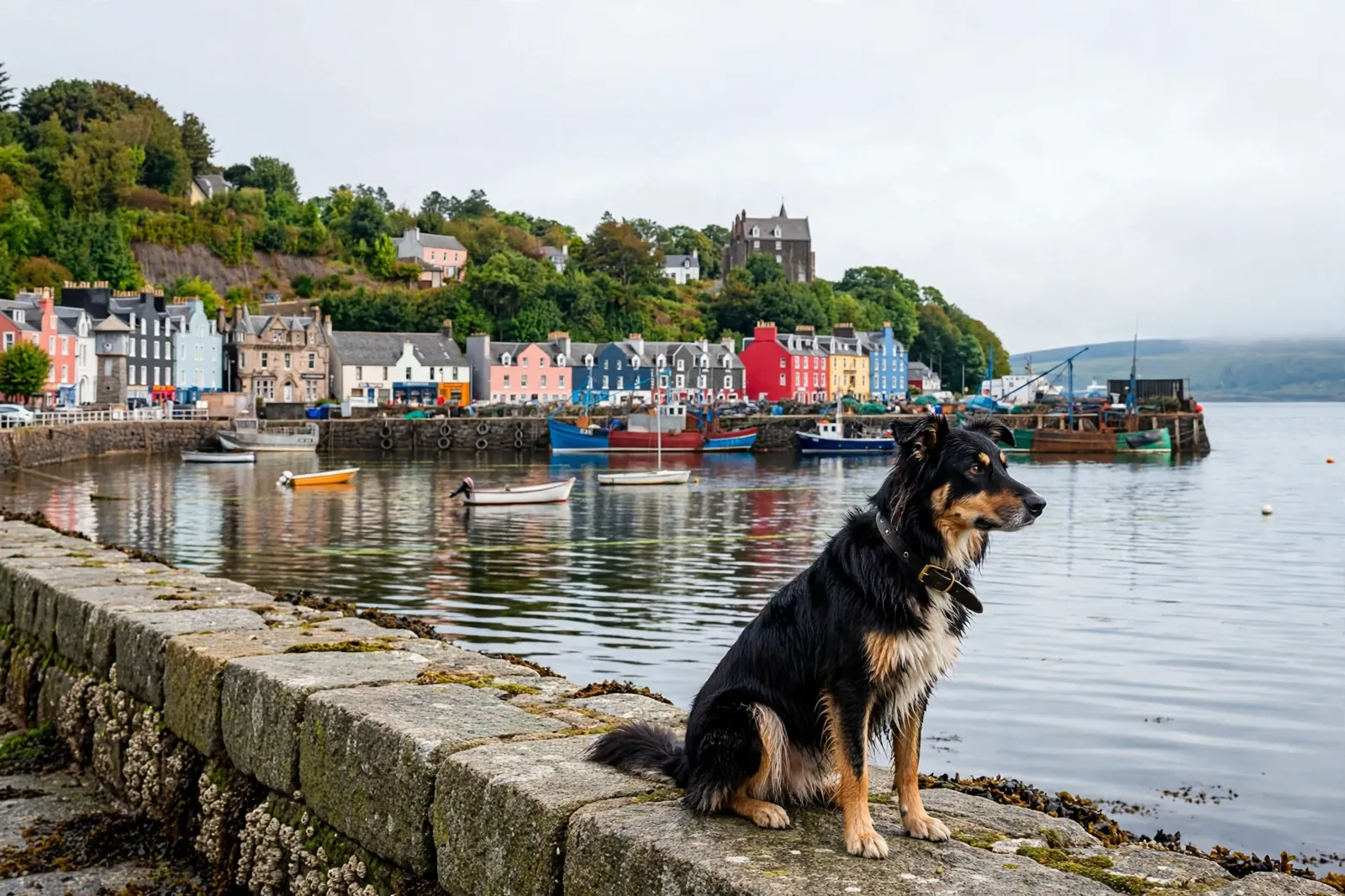
Tobermory, the island's main town, is the most convenient base for most dog owners. Its famous row of brightly painted harbour buildings holds cafés, a bakery, shops, pubs and the harbour itself, and staying in town means morning and evening walks without starting the car. The trade-offs are summer bustle, limited parking and premium prices on the harbour front. Ask any accommodation the usual dog questions — pet charge, number and size of dogs accepted, whether dogs may stay in bedrooms and eating areas, and where the nearest sensible late-night walk is.
Salen and the Craignure area suit travellers who want to tour widely. Mull is bigger than first-timers expect — Tobermory to Fionnphort, for the Iona ferry, is a long single-track journey that can take well over an hour and a half — and a central base halves many day trips. Craignure itself is small but practical, with the ferry pier, a pub and shops nearby. South Mull bases near Bunessan and Fionnphort put beaches and the Iona crossing on your doorstep but lengthen every other excursion; choose them if the south is your main interest.
Self-catering often works best with dogs on Mull, giving you a boot space for wet gear, a kitchen for early breakfasts before long drives, and no dining-room dilemmas. Whatever you book, confirm the garden or yard situation in plain terms: enclosed, shared, or simply a door onto open crofting ground where sheep may wander past. A photograph of the fence line is worth more than the phrase dog-friendly in a listing, here as everywhere.
Tobermory walks: harbour, lighthouse and woodland
Tobermory offers a complete walking day without driving anywhere. The harbour circuit itself — boats, lobster pots, gulls and the comings and goings of the marina — is a rich sniffing environment, though keep leads short around working quays, traffic and other dogs in a confined space. From the town, the path out to Rubha nan Gall lighthouse follows the shore through woodland to one of the finest viewpoints on the island, looking across to Ardnamurchan. It is a there-and-back walk of a few kilometres with uneven, muddy stretches, and it suits a dog that is steady on narrow paths.
Behind the town, the woodland and gorge paths around the Tobermory river and Aros Park, the former estate grounds just south of the town, provide sheltered walking in wind or rain: lochan, waterfalls, mixed woodland and a choice of loop lengths. Aros Park is the sort of place dogs love in any weather and owners underuse because the harbour steals attention. Combine park loops in the morning with the lighthouse path in clearer afternoon weather and you have a full, varied day with the car untouched.
Evening walks matter too. Tobermory's harbour lights, quieter streets and short stroll options make the last outing easy, which you will appreciate after a long touring day. Keep to lit routes after dark, use a lead-light or reflective gear on unlit lanes beyond the town, and remember that deer move at dusk around Mull's woodland edges — a dog off lead at twilight near roads is a risk nobody needs.
Beaches and wildlife: sharing the island politely
Mull's beaches are the stuff of island dreams: Calgary Bay in the north-west, with its white shell sand and machair, is the best known, while the south offers broad sands and quiet coves around Fionnphort, Uisken and Ardalanish, and the Ross of Mull hides smaller bays reached by short walks. Beach rules for dogs are generally permissive compared with resort beaches elsewhere in the UK, but permissive is not careless. Keep dogs under close control around other users, clear up without exception, and give hauled-out seals a very wide berth — disturbing seals is both unkind and, in pup season, dangerous for the pups and for a dog that gets too close.
Wildlife is Mull's headline act. The island is famous for white-tailed sea eagles, golden eagles, otters, red deer and, offshore, whales, dolphins and basking sharks in season. For a dog owner, that fame translates into lead discipline: eagles and other protected species must not be disturbed, otters appear suddenly on shore paths, and deer are everywhere. If you join a wildlife tour or boat trip, assume dogs are not carried unless the operator says so explicitly, and plan care for your dog ashore rather than hoping to bring it along.
Around Tobermory and across the island, boat trips to Staffa and the Treshnish Isles — including the puffin colony on Lunga in season — are the excursion everyone asks about. Treat them as people-only days: book a morning or afternoon sailing, walk the dog thoroughly beforehand, and leave it settled at your accommodation only if it is genuinely content alone and your host agrees. If that does not describe your dog, share the trip — one person sails while the other enjoys a harbour day — rather than forcing a plan that worries everyone.
Single-track roads and the art of slow driving
Outside the Craignure to Tobermory and Salen roads, much of Mull is single-track with passing places, and this changes dog touring more than any other factor. Journeys take longer than the map suggests, stops for walks are opportunistic rather than scheduled, and your dog will spend more of the day in the car than on a mainland trip covering the same miles. Break drives deliberately: a beach here, a woodland loop there, a viewpoint stretch every hour or so. A dog that arrives fresh enjoys the walk; a dog unloaded after two unbroken hours explodes with energy at exactly the wrong moment.
Passing-place etiquette is simple and matters: use passing places to let following traffic overtake as well as to pass oncoming vehicles, wave thanks, and never park in a passing place to walk the dog — it blocks the road's working system and local goodwill with it. Sheep, cattle and deer use these roads too, and animals on the carriageway are a daily reality. Drive at a speed that assumes a ewe and two lambs are standing around the next blind bend, because sooner or later they will be.
Fuel, food and vets need the same forward thinking. Fill up in Tobermory or on the mainland rather than running the tank low in the south, carry picnic supplies instead of relying on a café being open, and save the number of the island's veterinary practice before you need it. Mobile signal is patchy away from the towns. None of this is hardship; it is simply island rhythm, and dogs, who live by routine and rhythm anyway, tend to approve of it. Our Isle of Skye with a dog guide develops the same slow-driving philosophy for Mull's larger northern neighbour.
The south, Fionnphort and the Iona question
The drive down the Ross of Mull to Fionnphort is one of Scotland's great slow journeys: lochs, moorland, sea views opening and closing, and beaches that reward every stop. Uisken and Ardalanish, reached by a side road from Bunessan, offer wide sand, dunes and machair with room for dogs to enjoy a proper run where it is safe and away from livestock and nesting birds. Knockvologan and the tidal Erraid shore further west are wilder and need tide awareness. Check tide times before any tidal shore walk, and check the latest official guidance before you travel for local access notes.
At Fionnphort most visitors take the short passenger ferry to Iona. Here the dog plan needs honesty. Iona is a small, sacred, working island with livestock, a famous abbey and strict practicalities; dogs must be kept under control and on leads around stock, and the abbey and other buildings have their own rules. Many owners find the crossing works well with a calm dog for a half-day visit, walking the island's lanes and shores rather than attempting every interior. Others prefer to leave the dog with a travelling companion in Fionnphort and cross solo. Either is respectable; what fails is arriving at the pier undecided.
Build the south into your week rather than bolting it onto a Tobermory day. A night or two in the south, or a full unhurried day with early starts and long stops, beats a there-and-back dash that leaves everyone — dog included — car-weary. The light on the Ross in the evening, with the Treshnish Isles offshore, is reason enough to linger, and a dog walked on a quiet southern beach at the end of the day will sleep the deep sleep of the justly exercised.
Rain, midges and the Mull backup plan
Mull weather is Atlantic weather: fronts arrive, rain sets in sideways, and then, without apology, the island produces an evening of gold light that forgives everything. Dress and plan for the first and you will be present for the second. Woodland walks at Aros Park and around Salen, short harbour circuits, and cafés that welcome dogs in bar areas form your wet-weather spine. The Mull Museum in Tobermory and other indoor attractions have their own dog policies — most indoor heritage spaces do not admit pet dogs — so verify before you set out rather than assuming.
Midges deserve a straight paragraph. In still, damp summer conditions, especially at dawn and dusk near woodland and water, they can make standing still miserable. Dogs are less troubled than thin-skinned humans but are not immune around eyes and ears. Walk in the breeze on open shore instead of sheltering in still woods, keep moving, time long stops for breezier spots, and use repellent on yourself. A windy Calgary Bay on a midge evening will be full of locals making exactly the same calculation.
Finally, protect the return crossing. Know your sailing, keep the booking reference handy, and if disruption threatens — weather does cancel island ferries — act early: speak to the operator, extend your stay if you can, and keep a buffer of dog food and any medication in the car for precisely this scenario. Island travellers who pack one extra day of dog supplies never regret it. For another island rhythm to compare, see our Isle of Wight with a dog guide, where the crossings are shorter but the same buffer thinking applies.
Packing for Mull: what the island cannot lend you
Mull's shops are good but not endless, and the island's geography turns a forgotten item into a half-day expedition. Pack as if for a self-sufficient week: more waste bags than feels reasonable, a spare lead and collar because salt water and sand are hard on clips, a familiar blanket for ferry and accommodation, and enough of your dog's usual food for the whole stay plus a buffer day, because changing diet mid-holiday on an island with one vet practice within reach is a gamble nobody needs. A long line can be useful on empty beaches where local rules and safety allow, giving a young dog controlled freedom without testing recall against deer scent and sea wind.
Weather packing deserves its own list-within-the-list. Waterproofs for humans, a drying coat or towel set for the dog, and a second towel that lives permanently in the car will be used daily. In summer add midge repellent and a plan for still evenings; in winter add a torch with spare batteries, because island darkness outside the villages is complete and last walks happen by starlight and headtorch beam. Save offline maps of the whole island before you leave the mainland, and photograph your ferry bookings and accommodation details so a flat battery or absent signal cannot strand your plans.
Finally, pack a small dog first-aid kit scaled to island reality: tick remover, antiseptic wipes, a bandage, any regular medication in buffer quantity, and your own vet's number alongside the island practice. Check paws each evening for sand packed between toes, cuts from shell and rock, and the beginnings of soreness from longer walks than home routine provides. Mull asks a little more preparation than a mainland break and returns a great deal more in exchange — space, wildlife, beaches and a pace of life your dog will vote for with every contented sigh.
Practical questions
Before you go
Can I take my dog on the ferry to Mull?
Yes. Dogs are generally carried free on the main CalMac routes to Mull, staying in the vehicle or using designated pet areas depending on the vessel. Walk and toilet your dog before boarding, carry water and waste bags, and follow crew directions. Check the latest official guidance before you travel because arrangements vary by ship and sailing.
How long is the Oban to Craignure ferry?
The Oban to Craignure crossing takes roughly 45 to 50 minutes. Arrive in good time for vehicle check-in, and allow a harbour-side walk in Oban beforehand so your dog boards settled. In peak season, book the vehicle crossing well in advance — sailings fill and alternatives on the day may not exist.
Where is the best base on Mull with a dog?
Tobermory suits most owners, with walks, cafés and shops on foot from the harbour. Salen and Craignure are more central for touring the whole island by car. The south around Bunessan and Fionnphort is best if beaches and the Iona crossing are your priority. Confirm garden security and pet charges wherever you book.
Can dogs go on wildlife boat trips from Mull?
Usually not. Wildlife cruises and trips to Staffa and the Treshnish Isles generally do not carry pet dogs. Plan those as people-only excursions: walk your dog thoroughly first and leave it only if it settles happily alone with your host's agreement, or take turns travelling while one person stays ashore with the dog.
Are dogs allowed on Mull's beaches?
Generally yes, including at Calgary Bay and the southern beaches, but keep dogs under close control, clear up every time and give seals a wide berth. Around livestock on machair and croft land behind the beaches, use a lead. Seasonal wildlife sensitivities apply, so check the latest official guidance before you travel.