This guide is independent: no one paid to be included in it. If affiliate links are added later, we will label them clearly, and they will not influence the checks we carry out on the route, the rules or the facilities.
The Isle of Wight Coastal Path runs about 67 miles around the island. Book a dog-friendly ferry first — Wightlink, Red Funnel or Hovertravel all take dogs — then walk the loop in sections, keep your dog on a lead on the chalk cliffs, check beach rules before you let the dog off, and use the island buses for the return journey.
Getting there: ferries with a dog
Three companies, three sets of rules: that is the first thing to grasp about the ferry crossing. Wightlink runs car ferries from Portsmouth to Fishbourne and from Lymington to Yarmouth, plus a fast passenger catamaran from Portsmouth to Ryde Pier Head. Red Funnel runs car ferries from Southampton to East Cowes and a passenger service from Southampton to West Cowes. Hovertravel runs a hovercraft from Southsea, near Portsmouth, to Ryde, and at about ten minutes it is the fastest crossing, although it is also the most exposed to the weather.
Dogs are welcome on all three operators, and they usually travel free or for a small charge, but the exact arrangements differ. On the car ferries, dogs can usually stay with their owners on the passenger decks, on a lead, although some services ask dogs to stay in the car or in a designated pet area. On the passenger catamaran and the hovercraft, dogs are welcome on the passenger decks, on a lead, although space is limited and the crossing can be noisy. Confirm the current pet policy of the operator and route you plan to use before you travel, because rules and charges can change, and book ahead in school holidays, when the ferries are busy and the dog-friendly spaces fill up.
For a walking trip, the choice of ferry shapes the walk. Arriving at Ryde, on the north-east coast, puts you close to the eastern section of the coastal path and to the towns of Ryde, Sandown and Shanklin. Arriving at Fishbourne puts you close to the east coast and to the town of Ryde as well. Arriving at East Cowes or West Cowes puts you on the north coast, close to the towns of Cowes and Newport, and to the western section of the path. Arriving at Yarmouth puts you on the west coast, close to the Needles and to Freshwater, and it is the best arrival point if you want to start with the most dramatic walking on the island. Choose the ferry that suits your first day's walk, not just the cheapest fare.
On the day of the crossing, give the dog a good walk before you board, and a toilet stop at the terminal, because the dog may not have another chance until you arrive. Carry water and a bowl, and a familiar blanket or mat so the dog has somewhere comfortable to lie during the crossing. If your dog is nervous on boats, the hovercraft is the shortest crossing but also the noisiest and the most bumpy, while the car ferry is the slowest but also the calmest. A calm dog that has been walked, fed and watered before the crossing will usually settle quickly, and the crossing is short enough that most dogs cope well. For a fuller guide to the island beyond the coastal path, our Isle of Wight dog guide covers ferries, beaches, walks, attractions and places to stay in detail.
The 67-mile loop in sections
The Isle of Wight Coastal Path runs about 67 miles, or roughly 106 kilometres, around the whole island, and it is waymarked with the acorn symbol and with the coastal path's own signs. The route is a loop, so you can start anywhere and finish where you began, and most walkers take five to seven days to complete it, walking ten to thirteen miles a day. The terrain is varied: the north coast is gentle, with estuaries, woodland and quiet villages; the west coast is dramatic, with high chalk cliffs and the Needles; the south coast is steep and exposed, with landslips and undercliffs; and the east coast is sandy and resort-like, with wide beaches and seaside towns.
The north coast is the gentle end of the island. From Ryde to Cowes and Yarmouth you get estuary views, woodland and the towns of Cowes and East Cowes, with the path running through the Medina estuary, past the marshes and the creeks, and along the seafront at Cowes, where the yachts and the sailing boats are part of the scene. It is the stretch for older dogs, and for first days while legs are still warming up.
The west coast from Yarmouth to Freshwater and the Needles is the most dramatic stretch, with high chalk cliffs, the Needles rocks and the lighthouse, and the views across the Solent to the mainland. The path here climbs and falls steeply, with steps and narrow sections, and it is the hardest walking on the island for a dog. The south coast from Freshwater to Ventnor is steep and exposed, with the undercliff at Blackgang and the landslips that have closed parts of the path in the past. Check the official guidance before you travel for any diversions or closures on the south coast, because the cliffs are unstable and the path can change after winter storms.
The east coast is the resort end of the island. From Ventnor to Ryde you get the sandy beaches of Sandown and Shanklin, the seaside towns and the promenades, and the cliff-top path at Culver Down. The walking here is easier than on the south coast, with good facilities and frequent buses, and it suits the last days of a walk, when legs are tired and a beach afternoon is welcome. A long weekend is best spent on the east coast, where the scenery, the facilities and the transport are all at their easiest; the west coast keeps the best cliffs and the north coast the easiest walking.
White cliffs, the Needles and safety
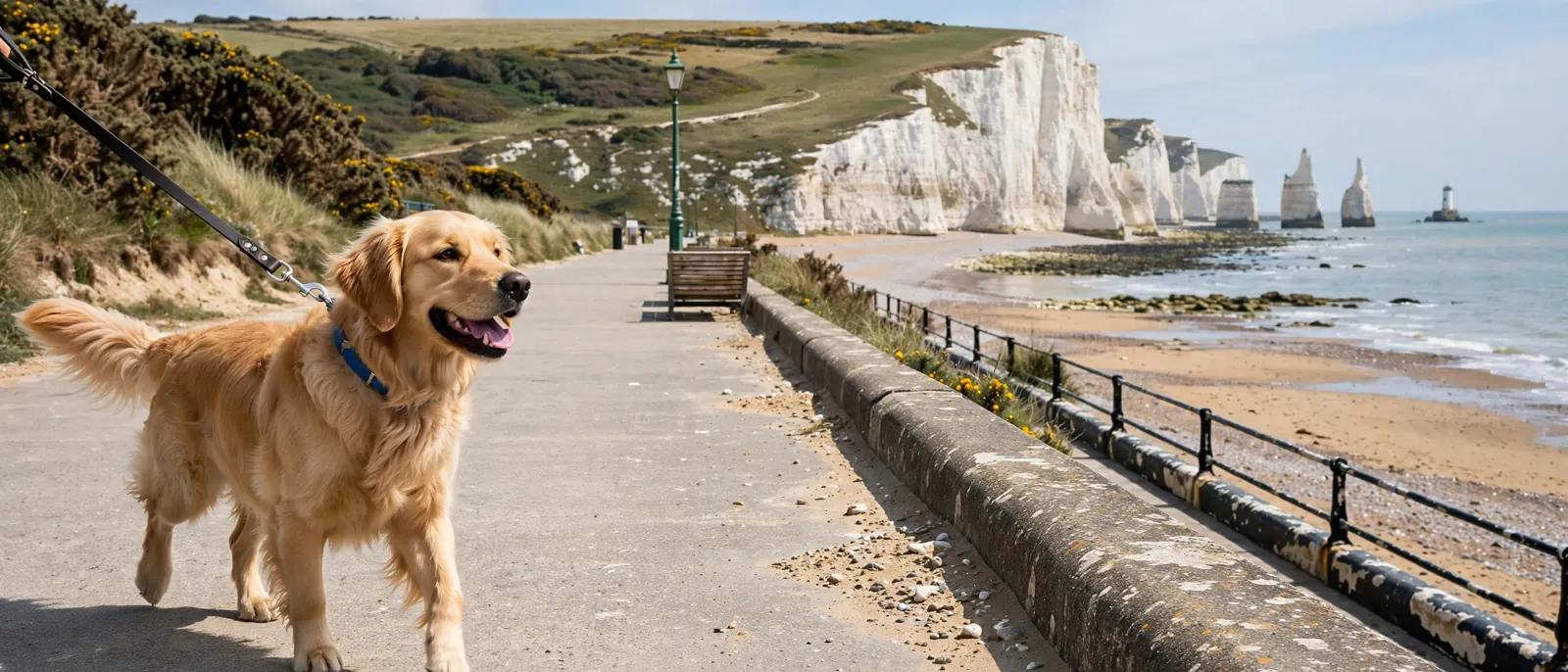
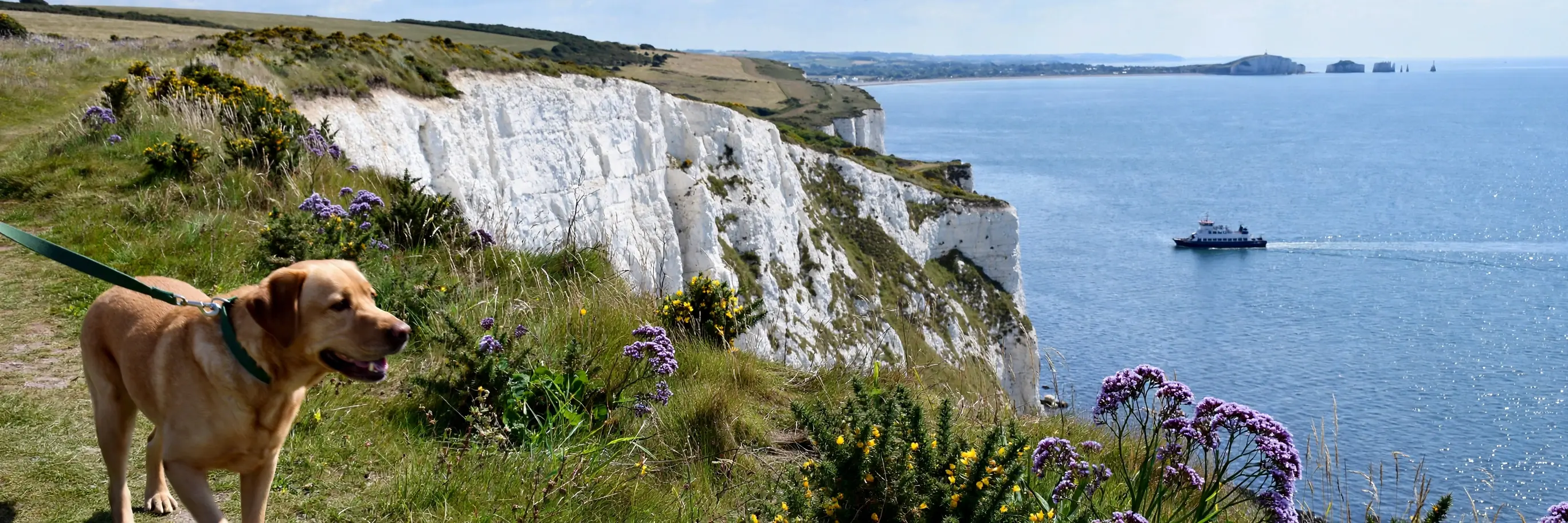
Chalk is the island's beauty and its danger. The cliffs at the Needles, Freshwater and Culver Down are high, steep and unstable, and a fall of chalk can happen with no warning at all. The tops are often unfenced, and the turf at the edge can be hollow underneath, so keep the dog on a short lead on every cliff section, even a dog that is normally steady off the lead. A harness with a handle lets you hold the dog if it slips or lunges, and it spreads the weight better than a collar if you need to lift or steady it. Stay well away from the base of the cliffs at low tide too, because rockfalls happen there without warning, and the chalk is at its least stable after rain.
The Needles are the island's most photographed landmark: three chalk stacks rising out of the sea at the western tip of the island, with a lighthouse at the end of them. The coastal path runs along the cliff top above, looking down at the rocks and across to the mainland. Keep the dog on a lead here and take the view from the top; the chalk edge is not a place to test a dog's recall. The walking on this stretch is steep and exposed, with steps and narrow sections, and it is the hardest walking on the island, so save it for a fit day and take plenty of water.
The cliffs at Freshwater and Tennyson Down are also high and exposed, with the monument to the poet Alfred, Lord Tennyson on the down above the bay. The walking here is steep and open, with wide views across the Solent and the English Channel, and it is one of the best stretches on the island for a fit dog. The chalk paths can be slippery when wet, and the steps at Freshwater Bay are hard on older dogs, so plan a shorter day on this section and carry extra water. The undercliff at Ventnor and Blackgang is a different world: a jumbled landscape of landslips, woodland and hidden paths, where the coastal path has been diverted several times because the ground is unstable.
The island is small, but help can still be a long way off. The signal drops out on the south and west coasts, so tell someone which route you are walking and when you expect to be back before you set out on a remote stretch. Pack a charged phone, a first-aid kit for the dog, and the number of the nearest vet before you leave. The coastguard is on 999 in an emergency, and the RNLI lifeboat stations at Cowes, Yarmouth and Bembridge cover the island's coast. A dog that has fallen or been cut off by the tide should be left to the professionals: call for help early and keep yourself out of danger. Stay away from the cliff base at low tide as well: rockfalls happen without warning, and chalk is at its least stable after rain.
Seaside towns and beaches
The Isle of Wight's seaside towns are part of the charm of the coastal path, and they give the walk its rhythm: a beach in the morning, a town for lunch, a cliff in the afternoon. Ryde is the largest town, with a long sandy beach, a pier, a promenade and a good choice of cafes and pubs. Sandown is a classic seaside resort, with a wide sandy beach, a pier and a promenade, and it is popular with families. Shanklin is prettier and quieter, with a sandy beach, a village and the Shanklin Chine, a wooded ravine that runs down to the sea. Ventnor is a steep, picturesque town built into the undercliff, with a beach, a harbour and a good choice of cafes, and it is the warmest town on the island, sheltered by the downs behind it.
Cowes is the sailing capital of the island, with a harbour, a marina and a good choice of pubs and restaurants, and it is famous for Cowes Week, the sailing regatta that takes place every August. Yarmouth is a small, quiet town on the west coast, with a harbour, a pier and a castle, and it is the arrival point for the Wightlink ferry from Lymington. Freshwater is a village rather than a town, with a bay, a beach and a good choice of pubs, and it is the base for the Needles and for Tennyson Down. Each town has its own character, and each one is worth an hour's stop, even if you are walking a long day.
The beaches are why most dog owners pick this island. Ryde beach is sandy and popular, with a long stretch of sand at low tide that is excellent for dogs when they are allowed. Sandown beach is wide and sandy, with a promenade and a pier, and it is one of the best beaches on the island for a family dog. Shanklin beach is sandy and sheltered, with a village behind it and a chine to explore. Ventnor beach is sandy and sheltered, with a harbour and a good choice of cafes. Compton Bay, on the west coast, is a wild, sandy beach backed by cliffs, and it is one of the best places on the island for a dog to run, although the cliffs are unstable and the beach should be used with care.
The rule changes beach by beach. Ryde, Sandown and Shanklin all close part of their sand to dogs in summer: the main bathing beach is restricted, usually from 1 May to 30 September, while the rest of the beach stays open to dogs all year. The edge of the restricted area is normally signposted at the beach entrance, so read the notice when you arrive rather than following where other people happen to be. Beach rules are made by the local council and they can change, so look up the current position for each beach before you go. For the national picture, our guide to dog-friendly beaches in the UK sets out how seasonal bans work, what a public space protection order is, and what happens if you break one.
Island buses and getting back
The bus is the walker's best friend on this island. The main bus operator runs services that connect the main towns and villages, and the routes follow the coast in places, which makes them useful for linear walks. The bus from Ryde to Sandown, Shanklin and Ventnor runs along the east and south coasts, and the bus from Newport to Cowes, Yarmouth and Freshwater runs along the north and west coasts. Dogs are welcome on board, as long as they stay on a lead and on the floor, and the driver is happy with that. In summer the buses run often enough to build a linear walk around.
Do not trust the bus times to memory. The winter service runs less often, Sunday buses are limited, and the timetable is the kind of thing to save offline on your phone, because the signal is patchy on the south and west coasts and you may not be able to look it up when you need it. The stops sit close to the coastal path in most towns and villages, and the drivers know walkers with dogs well. A day ticket or a weekly rover ticket is good value if you plan to ride several times, and it saves buying a ticket for every journey.
Walk one way and ride back: park at one end, walk to the other, and catch the bus to your base. The bus network is good enough that you can walk a linear section almost anywhere on the island and catch a bus back, although the last bus is often in the early evening, so plan to finish by late afternoon. A second car works well for a group, and taxis are available in the larger towns, although they need to be booked in advance in the smaller villages. The railway on the island, the Island Line, runs from Ryde Pier Head to Shanklin, with stops at Ryde, Brading, Sandown and Lake, and it is useful for the east coast section.
Newport is the hub, not the coast. It sits in the middle of the island and is the best base for bus connections, with services running in every direction, although it is not on the coast. Ryde is the best base for the east coast, with the ferry, the railway and the buses all close together, and Freshwater is the best base for the west coast, with the Needles and the cliff-top walking on the doorstep. Whichever you pick, settle the way back before you set out, because a missed bus on a winter evening means a long walk home in the dark with a tired dog.
Where to base yourself
Ryde has the widest choice of places to stay, with the ferry, the railway and the shops all close at hand, and it suits walkers who want the transport links as well as the town. Sandown and Shanklin have a good choice of hotels, guest houses and holiday flats, and they make good bases for the east and south coasts. Ventnor is prettier and quieter, with a good choice of bed and breakfasts and holiday cottages, and it is a good base for the south coast. Freshwater and Yarmouth are the best choices if the west coast matters more than the town, with the Needles and the cliff-top walking a short distance away.
Ask the host, not the booking site, about the practical things. Is the garden enclosed, and is there a tap or a shower outside for sandy paws? Where do wet coats and leads dry, and where does the dog sleep at night? How far is it to a sensible toilet walk once it is dark, and is the route lit? A house with hard floors and a secure garden will serve a walking dog far better than a smarter house with pale carpets and no outside tap, and a host who really welcomes dogs will answer these questions straight away. Campsites work well for many walkers on this island, because they are cheap, flexible and close to the coast, although some keep dogs to certain pitches or insist on a lead throughout the stay.
The island's caravan and holiday parks cluster on the east coast, especially around Sandown and Shanklin, and many have direct access to the beach. Book ahead for the school holidays, for August, and for Cowes Week, when the island is at its busiest: dog-friendly places on the island go early. In winter some places close or cut their hours, so check before you go that the place, the pub and the cafe you are counting on will actually be open. The island is a popular destination for walkers, and the best dog-friendly places go early, especially in the summer season.
Split the island in two: one base in the east around Ryde or Sandown, one in the west around Freshwater or Yarmouth. Packing, driving and settling in every day eats into walking and rest, and a dog that has to settle into a new house every night will not sleep well. Two bases keep the bus journeys to each day's start short, and the dog comes back to the same bed every night. Bag-carrying services exist for the Isle of Wight Coastal Path, but they have to be booked ahead, so look into them before you travel if you would rather not carry your own bags.
Kit, water and paws
Cliffs, steps and beaches: that is the whole kit list for this island. A harness with a handle that fits well, a short lead for the cliffs and the towns, and a longer lead or a long line for the beaches will cover most of the walking. A collapsible bowl and a litre of water per dog per half day is the minimum: the coast here offers few streams and fewer taps. Carry more than you think you need on the west and south coasts, where there are long stretches with no reliable source, and remember that the water in the rock pools is salt water, not drinking water.
Twelve miles of cliff and beach is a big day for a dog. It takes far more out of them than a day at home, so a dog that is under-fed will flag early and take longer to recover, and food needs more thought on a multi-day walk than on a day trip. Add a little to the evening meal instead of a heavy breakfast before a long climb, and keep high-value treats in your pocket for recall and for rewarding steady behaviour near cliff edges and livestock. If your dog eats a raw or special diet, plan where you will buy or store it: the small village shops on the island may not stock what you need, and the larger supermarkets are in Ryde, Newport and Cowes.
Chalk and flint are hard on feet. They wear the pads down, along with sand, salt and the steps at Ventnor and Freshwater, and a dog that is used to grass and pavements needs time to get used to them. Look at the paws each evening, rinse them with clean water after every beach walk, and check between the toes for cuts and for grit that has worked its way under the pads. A paw balm helps when pads are dry or cracked, and boots are worth thinking about for a dog with tender feet on the chalk and flint sections. If the dog starts limping, keeps licking one paw, or simply will not walk any further, the day is over: stop there and rest the foot. For the full routine, our guide to dog paw care after the beach covers what to rinse, what to look for between the toes, and how to deal with small cuts.
Wind first, sun second: that is the order to pack for on this island. A thin waterproof coat is the difference between a miserable dog and a happy one when the rain and wind come in, especially for a short-coated or older dog, and a drying coat or a couple of old towels waiting in the car makes the end of a wet walk far pleasanter. In summer, pack a cooling mat and a damp towel for the car: both help a hot dog cool down after a walk, and a sunshade is worth having if the dog waits in the car at all. Never shut a dog in a parked car on a warm day, even with a window open, because the inside of a parked car heats up far quicker than the air outside. For shade, look to a pub garden or a wooded chine rather than a tree on the cliff top, and keep water and rest in the plan all day.
Seasons and weather
Spring on the island starts with the primroses. The days lengthen, the air warms up, and the cliff tops come into flower, while the beaches stay quiet before the summer season. April and May are especially good, with gorse and primroses in flower and the seabirds coming back to the cliffs, although nesting means dogs must stay on a lead near the colonies without exception. Waterproof boots are worth packing, and so is a towel for the dog: the ground stays wet long after winter, and the wind on the south and west coasts bites even when the sun is out.
Cowes Week is the island at its busiest, and summer is when the heat matters most. The weather is at its warmest and the beaches are at their busiest, with some of them closing parts of the sand to dogs. Walking in July or August, set out early, carry extra water, and plan the day around shade and a chance to swim. Heat is a genuine risk for a dog on this trail, because there is often no shade on the cliff tops and the sun reflects off the sea. Watch for a dog that pants heavily, drools, seems confused or starts to wobble, and stop straight away in the shade with water if you see any of these signs. Once the heat of the day has eased, an evening walk is often the most enjoyable of all.
October is the island's quiet month. September and October bring quieter paths, warm sea temperatures and the end of the summer beach restrictions on many beaches, although the exact dates are still worth confirming before you travel. The light is softer, the blackberries are out along the hedgerows, and the island feels at its most peaceful. Winter is the quietest season of all: dramatic seas, empty paths and big skies, but also short days, strong winds and a risk of cliff path closures after storms. Winter walking is for experienced walkers with good waterproofs and a flexible plan; it is not the time to try the full loop for the first time.
The Channel makes its own weather. The island catches wind and rain from the south-west, and a fine morning can cloud over by lunchtime, especially on the south and west coasts. Check the forecast the evening before, and check it again over breakfast. Pack waterproofs even when the day looks fine, and be ready to cut a walk short or swap a cliff stretch for a beach or a town walk if the wind picks up. The Met Office forecast for the island is a decent place to start, and a word with the staff at a cafe or a campsite is usually worth more than a national forecast for the next few hours.
Livestock, wildlife and lead rules
The downs are sheep country. Sheep graze the downs and the cliff tops, cattle stand in the meadows behind the beaches, and horses are kept in the fields beside the path in several places, so livestock is part of walking this coast. Dogs must stay on a lead near livestock, and in lambing season, from roughly March to May, the rule is absolute. A dog that runs at sheep can frighten a ewe into losing her lamb, or cut a lamb off from its mother, and farmers are allowed by law to shoot a dog that attacks their sheep. Keep the lead short and the dog at your side, and when animals are in the field, walk steadily through the middle of the path without letting the dog go near them.
The estuaries and the woods hold the island's rarest wildlife. The cliffs at the Needles, Freshwater and Culver Down are important seabird colonies, and the estuaries at Ryde, Cowes and the Medina matter for wading birds and wildfowl. Dogs stay on a lead through the nature reserves and along the estuary paths in spring and summer, and they should not be allowed to chase birds on the beach. The island is also home to red squirrels, which are rare on the mainland, and the woodlands at Borthwood Copse and Firestone Copse matter for them. Keep your dog on a lead in the woods, and do not let it chase squirrels or disturb the woodland floor.
The island follows the same countryside rules as the mainland. Shut gates behind you or leave them as you found them, take your litter home, stay on the waymarked path where it crosses farmland, and always clean up after your dog. Bins stand at the popular beaches and car parks, but not out on the remote stretches, so bring bags and carry waste with you until you reach a bin. Keep the dog under control, on a lead where it should be, and always cleaned up after, and you will be welcome almost everywhere on the island; it is also what keeps the path open for the next dog owner.
Summer crowds are the test of a dog's manners on this path. The narrow stretches by the cliffs and the stiles fill up with families, runners and other dog owners, and the narrow sections can be busy in summer. Keep your dog close as you pass, give way on narrow stretches so faster walkers can get by, and ask first before letting your dog greet another dog, because plenty of dogs would rather not be approached. Keep a treat ready and your voice low, and most encounters will pass without any trouble. A dog that can walk past other dogs politely will enjoy the whole island.
A realistic walking plan
Six days, seven stretches, one rest day in Yarmouth: Ryde to Sandown on day one, Sandown to Ventnor on day two, Ventnor to Freshwater on day three, Freshwater to Yarmouth on day four, a rest day in Yarmouth on day five, Yarmouth to Cowes on day six, and Cowes to Ryde on day seven. That works out at roughly ten to twelve miles a day, and it gives the dog a mix of beaches, cliffs and towns. Any day with a big cliff climb can be cut short, and an older or less experienced dog will want a second rest day after the south coast.
A long weekend is the way most people first meet this island. Base yourself in Ryde and walk the east coast to Sandown and Shanklin over two days, with a beach afternoon on the third day. Or base yourself in Freshwater and walk to the Needles one day and over Tennyson Down the next, with a rest morning in between. A week gives you the whole loop, the most varied walking on the island, with estuaries, cliffs, beaches and towns in a single week. Whatever you choose, sort the ferry out first and build the walking around it: the best dog-friendly places go early in summer, and the ferries fill up in the school holidays.
There is no shade on the south coast after midday, which is the best reason to be out early, especially in summer. Setting out in the morning means cooler air, quieter paths, good light for photographs, and a dog that is still fresh rather than already worn out by the heat. Aim to be back by mid-afternoon, so the dog can rest, eat and sleep before the evening walk. An evening stroll to a beach or a pub garden is a better end to the day than a forced extra mile, and it gives the dog time to settle before night. If the weather turns, cut the day short and feel good about it: there is always tomorrow, and a dog that enjoyed the walk will be ready to go again.
The ferry home is the full stop at the end of the week. The Isle of Wight Coastal Path is a waymarked trail, looked after for walkers, dogs included. Tell the trail authority about a damaged stile, a fallen waymark or a blocked path, and respect any temporary diversion: it is usually there because a cliff has become unsafe. Walked slowly, with time to watch the sea, the birds and the white cliffs, and with a dog that is enjoying every mile, the path gives you far more than the number of miles on the map. For a longer mainland challenge afterwards, the South West Coast Path offers 630 miles of cliffs and coves to plan for next time.
Practical questions
Before you go
How long is the Isle of Wight Coastal Path and how many days does it take with a dog?
The Isle of Wight Coastal Path runs about 67 miles around the island, and most walkers take five to seven days at 10 to 13 miles a day. With a dog, plan for six to seven days with at least one rest day, because the cliff climbs, the steps and the beach sections add effort that flat mileage does not show. Many dog owners walk it in weekend sections instead, using the island buses to get back to the start.
Can I take a dog on the ferry to the Isle of Wight?
Yes. Dogs travel on all three ferry operators to the Isle of Wight: Wightlink, Red Funnel and Hovertravel. Dogs usually travel free or for a small charge, and they are welcome on the passenger decks on most services, although the exact rules differ by operator and by route. Check the official guidance before you travel for the current pet policy, because rules and charges can change, and book ahead in school holidays.
Are dogs allowed on Isle of Wight beaches in summer?
Most of them do. Some of the most popular beaches close part of the sand to dogs in summer, usually from 1 May to 30 September, but the restricted area is often only a stretch of the beach, and the rest stays open all year. The rules are set beach by beach through local orders and they can change, so look up the current position before you travel, and read the signs at each beach entrance before you let your dog off the lead.
Is the Isle of Wight Coastal Path safe for dogs near cliffs?
The waymarking is good, but the edges are not fenced. Several stretches run close to cliff edges with no fence, especially around the Needles, Freshwater and Ventnor, and the chalk cliffs can be undercut and unstable. Keep the dog on a lead on every cliff section, on narrow paths, and anywhere the ground drops away steeply. In strong wind, keep well back from the edge, and do not let your dog go near the cliff base at low tide, because rockfalls can happen without warning.
Can dogs use the buses on the Isle of Wight?
Yes, on most services. Dogs are welcome on the island's buses as long as they stay on a lead and on the floor; the driver has the final say. The bus network is useful for walkers, because it connects the main towns and villages and follows the coast in places. Look up the current timetable and the dog policy before you travel, and keep the timetable saved offline, because the signal can be patchy on the coast.
What is the hardest part of the Isle of Wight Coastal Path for a dog?
The west coast is the hardest. The cliff climbs around the Needles and Freshwater, the steep steps at Ventnor, and the long beach walks at low tide ask the most of a dog. The chalk paths turn slippery when wet, the steps are tough on older dogs, and water is hard to find on some of the exposed stretches. Keep the days on those sections shorter, carry extra water, and rest the dog for a day after the hardest walking.