This guide is independent and contains no paid placement. Ferry times, dog rules and seasonal restrictions change, so check the official guidance before you travel.
Kingsbridge works best as a tide-shaped day out: walk the quay and the lower estuary paths when the water is in, take the ferry to Salcombe when you want a longer outing, and save Bowcombe valley for a calm, shaded walk when the town and the water are busy. Keep dogs on a lead around quays, slipways and livestock, and treat mudflats as scenery, not as a playground.
Let the tide set the timetable
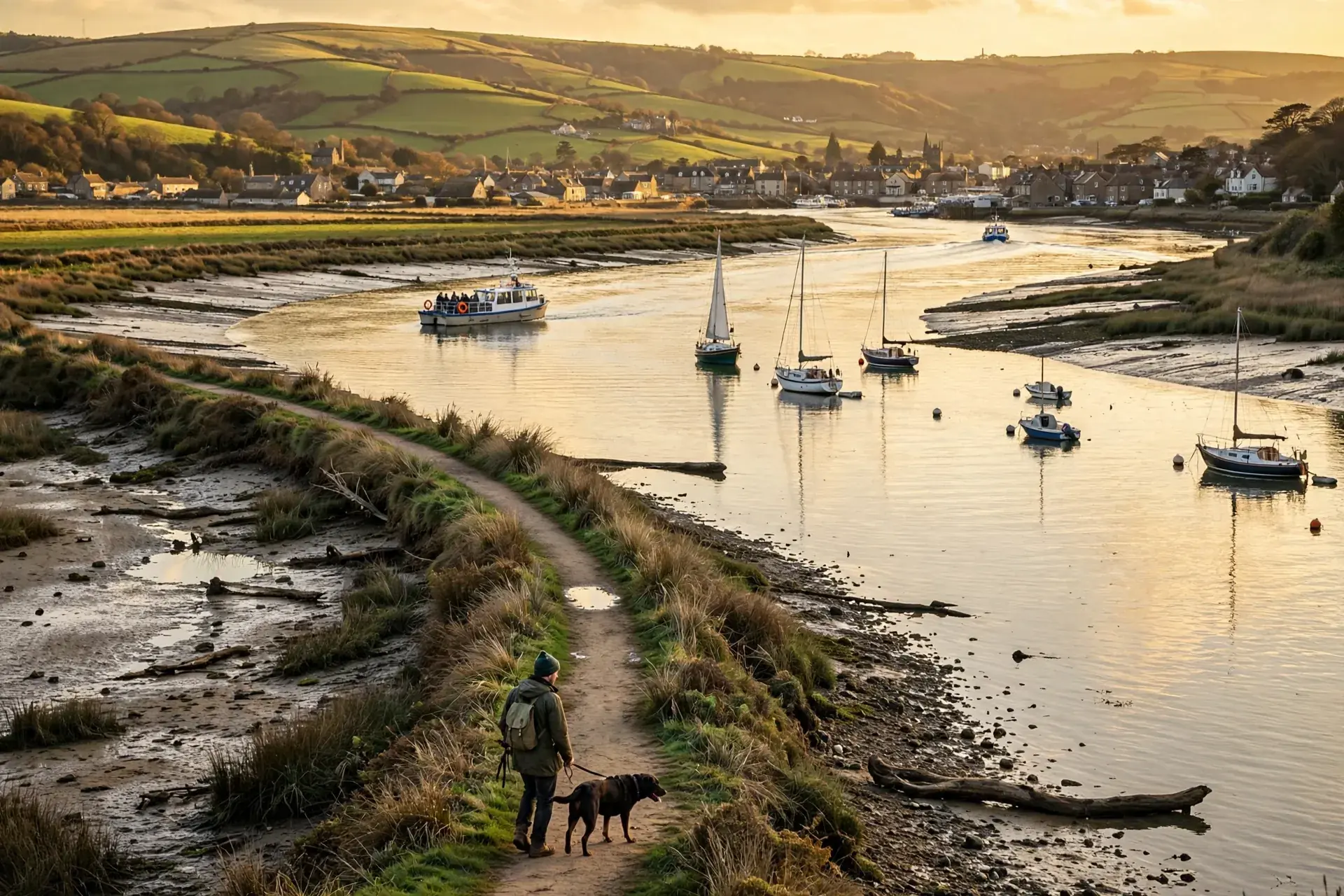
Kingsbridge sits at the head of a long, winding estuary in the South Hams, and the estuary is not a backdrop that stays still. Twice a day the water rises to fill the channel past the quay, then falls away to reveal broad banks of mud, winding creeks and the hulls of boats resting on their moorings. A dog walk planned without a glance at the tide table can still be pleasant, but it will miss the point of the place. The same path feels completely different at high water, when reflections, boats and birds fill the view, and at low water, when the landscape opens out into something quieter, wider and more exposed to wind.
The practical rule is simple: check the tide before you choose the route, not after you have parked. A high tide suits a short, sociable walk around the quay, a coffee stop and a ferry crossing, because the water is close, the boats are afloat and the town feels at its liveliest. A falling or low tide suits the longer, more open stretches further down the estuary, where the views stretch and the paths are less crowded, provided you stay on firm ground and keep well clear of soft mud. If you are travelling with a dog that loves water, high tide also makes it easier to find a safe, shallow edge for a paddle, whereas low tide can leave a long, muddy walk before you reach any water at all.
Tides also affect the small decisions that make a dog day run smoothly. Slipways get slippery as the water retreats, steps down to the water can be steep and weed-covered, and a path that was dry in the morning may be cut off or muddy by the afternoon. Dogs that chase birds need closer control at low tide, when wading birds feed on the exposed mud and are easily disturbed. Dogs that are nervous around boats do better when the quay is quiet, which often means early morning or a weekday rather than a summer Saturday at high tide. In short, the tide table is not an extra detail for Kingsbridge; it is the first thing to look at, ahead of parking, cafes and even the walk itself.
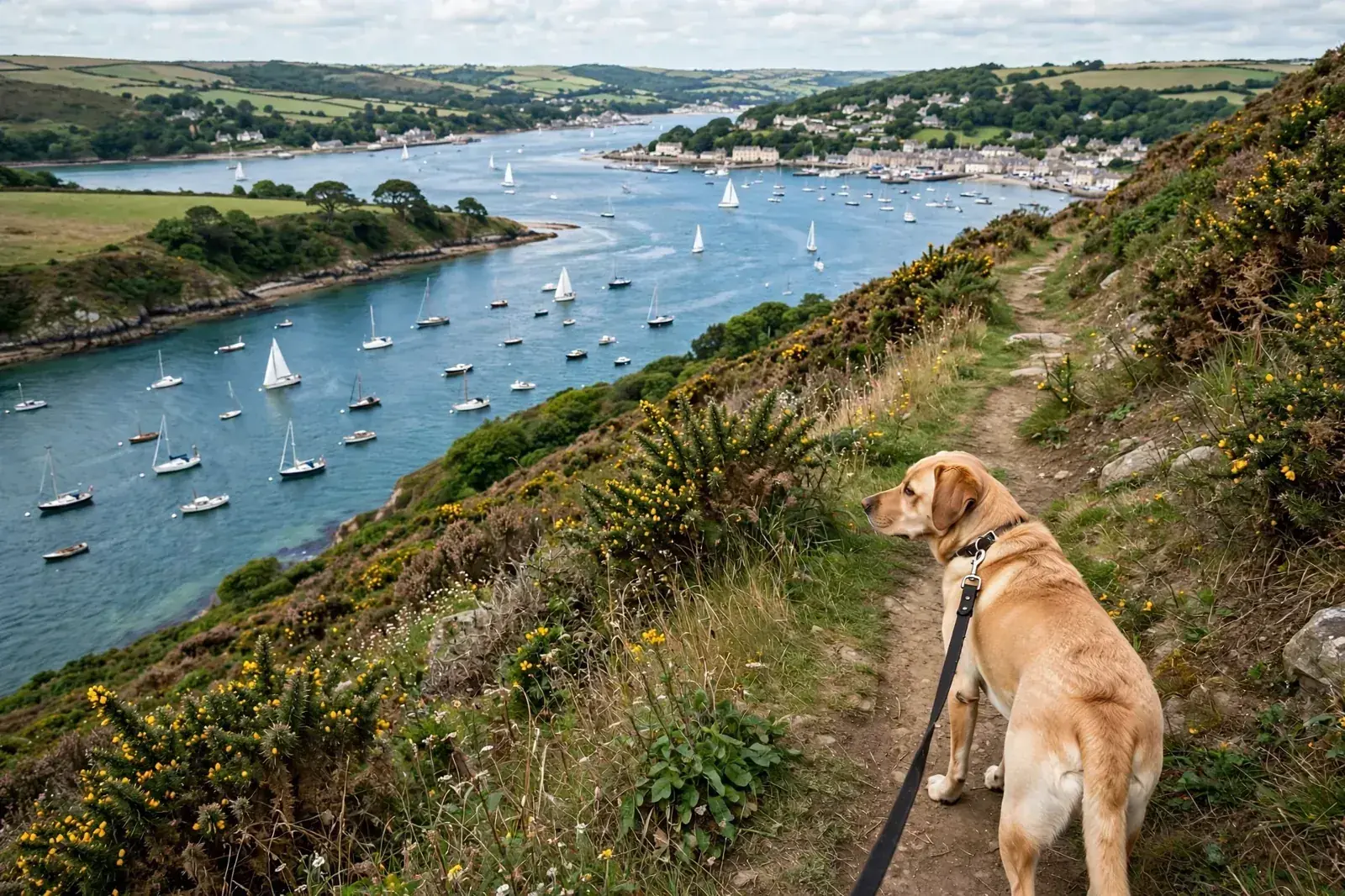
It helps to think of the estuary as three different places sharing one name. The town end is urban, paved and social, with shops, cafes, traffic and other dogs. The middle reaches are greener and calmer, with fields, creeks and wooded banks. The lower estuary towards Salcombe is more maritime, with sailing boats, deeper water and a stronger sense of being by the sea. A single day does not need to cover all three, and most dogs will enjoy one of them done well far more than all three rushed. Pick the mood that fits your dog, then let the tide decide the order.
Weather layers itself on top of the tide. A south-westerly wind can push water higher than the table suggests and make the quay feel exposed, while a still, bright morning after rain can turn the valley paths into a mud bath even when the estuary itself looks calm. If you are visiting in winter, short daylight hours matter as much as the tide: plan to finish wooded or unlit paths well before dusk, and carry a torch if there is any chance of a late finish. The habit that serves every season is the same one: look at the tide, look at the sky, and then choose the walk that fits both.
The quay and the town behind it
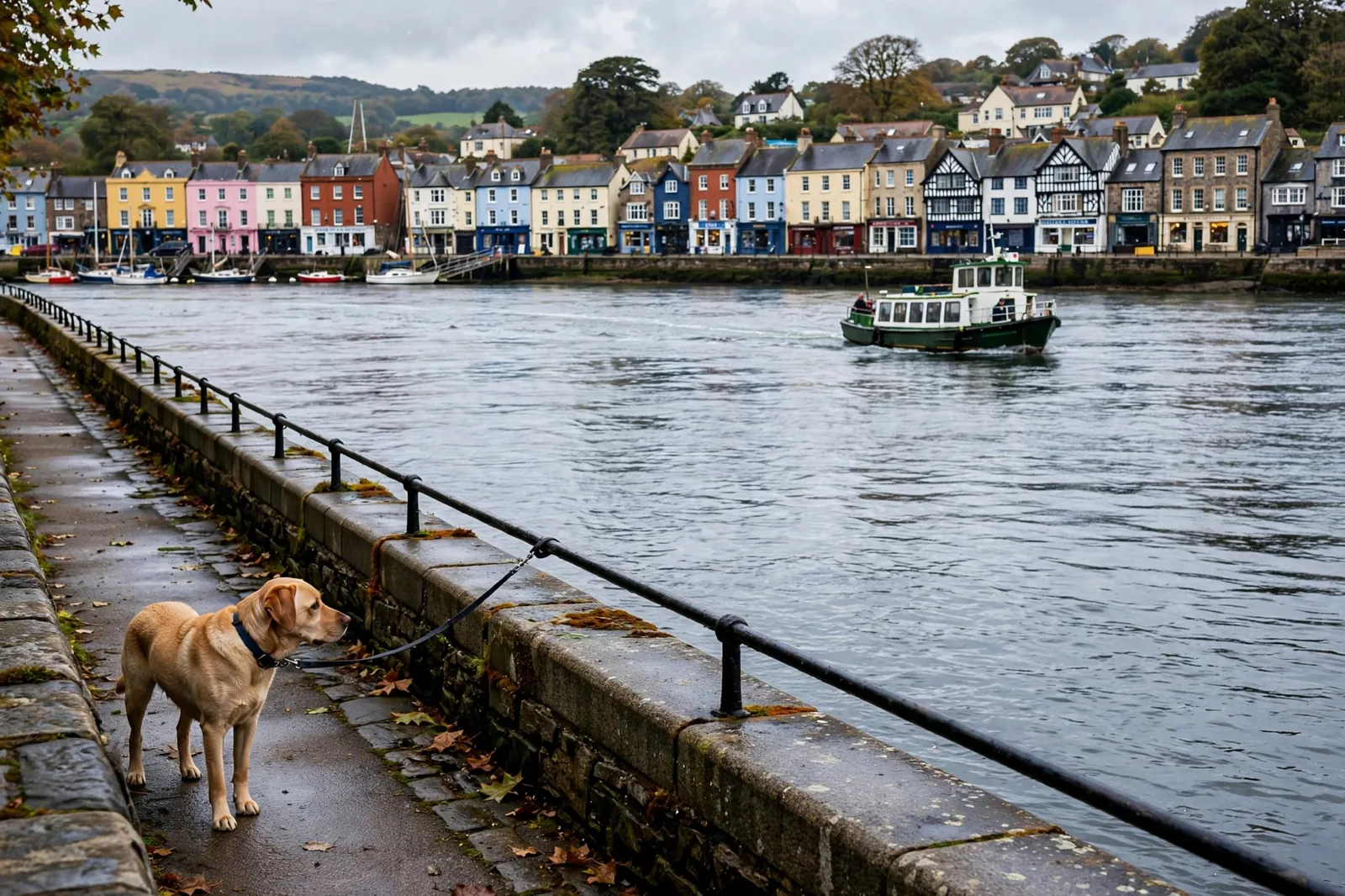
Kingsbridge is a working market town first and a visitor destination second, and that is part of its charm for dog owners. The quay is compact and easy to read: boats, water, a promenade-style walk and the town rising behind it. For a first visit, a slow circuit of the quay and the streets immediately behind it gives a dog time to settle, sniff and learn the place without a long drive to a remote trailhead or a steep climb. It also gives the owner a chance to judge the day honestly. Is the dog relaxed around traffic, other dogs and waterfront noise, or would a quieter valley walk suit the afternoon better? The quay answers that question in twenty minutes.
Keep the dog on a short lead here, even if the dog is usually excellent off lead. Quaysides combine several hazards in a small space: vehicles reversing towards slipways, cyclists, children running between boats, ropes and mooring lines at ankle height, and sudden drops into water where a dog cannot easily climb out. A short lead also makes it easier to step aside for other walkers and to keep a dog from lunging at gulls, which gather in numbers around boats and fish. The town streets behind the quay are narrow in places, with pavements that can be busy at market and school times, so the same short-lead rule applies until you are on an open path.
The town itself rewards a slower pace. Kingsbridge has the everyday infrastructure that makes a dog trip easier: places to buy water, snacks and forgotten poo bags, benches for a rest, shade on warm days and shelter when a shower passes. That matters more than it sounds. A dog that can drink, rest and cool down in the town is a dog that will enjoy the longer walk afterwards, whereas a dog dragged straight from a hot car to a long estuary path often starts tired and thirsty. Build in a pause. Let the dog drink, sit somewhere quiet for ten minutes, and only then decide whether the ferry, the valley or a shorter return to the car is the right next step.
Dog owners should also plan for the unglamorous parts of a town walk. Bins are not always where you need them, so carry bags until you find one rather than leaving waste by a wall or a boat. Puddles and drains after rain can hide broken glass or sharp stones, so watch where a dog puts its paws on older quayside surfaces. In summer, stone and tarmac around the quay can get hot underfoot, so test surfaces with your own hand and choose shaded or grassy stretches for a rest. None of this is dramatic, but it is the difference between a walk that feels easy and one that ends with a sore paw or a stressed dog.
If you are staying for more than a day, the town makes a good base precisely because it is ordinary. You can walk the quay in the morning, drive or take the ferry for a longer outing, and return to familiar streets, food and parking in the evening. That familiarity helps anxious dogs settle faster than a new beauty spot every day. It also means bad weather is not a wasted day: a short quay walk, a cafe stop where dogs are welcome, and a valley walk when the rain eases can still add up to a satisfying day without forcing a long exposed route in poor conditions.
The ferry to Salcombe
The ferry from Kingsbridge towards Salcombe is the classic dog-friendly outing in this corner of Devon, and it works because it turns the journey into the attraction. Instead of driving around the estuary, you cross the water itself, watching the banks, boats and birdlife slide past while the dog sits at your feet. For many dogs, a short boat ride is less tiring than a long walk and more interesting than another car journey. It also opens up Salcombe without the need to find parking in a town that can be very busy in peak season, which is a real advantage for anyone travelling with a dog that does not cope well with crowded car parks.
Before you queue, check the official guidance before you travel. Ferry services in this area can vary by season, by day of the week and by tide, and dog rules can differ between operators and vessels. Some services run more frequently in summer and reduce sharply in winter, while others may be affected by weather, maintenance or very low tides. Confirm the timetable, the boarding point, the fare and the dog policy on the day, and have a backup plan in case the return sailing is full, delayed or cancelled. A dog that has waited happily at the quay deserves a calm plan B, not a scramble for a taxi or a long walk back in the dark.
Boarding well matters more than most people expect. Arrive early enough that the dog is not rushed onto a crowded gangway, keep the lead short and the dog close to your leg, and choose a seat away from the main flow of passengers if you can. Some dogs settle best on the floor between their owner's feet, where movement is limited and the view is low; others prefer a bench edge where they can watch the water without being stepped over. Bring a small blanket or mat if the deck is wet or cold, and a chew or a familiar toy for a dog that needs something to do during the crossing. If your dog is noise-sensitive, sit away from engines and loud groups, and keep your own body language calm and unhurried.
Once you reach the Salcombe side, the day changes character. Salcombe is prettier, steeper and busier than Kingsbridge, with narrow streets, waterfront steps and beaches that have their own seasonal dog rules. That is why a linked guide helps: our Salcombe with a dog guide covers estuary walks, North and South Sands, the East Portlemouth ferry and peak-season advice in detail, so you can plan the Salcombe half of the day properly rather than improvising at the top of a steep hill with a tired dog. If Salcombe feels too steep or too crowded on the day, there is no shame in staying on the Kingsbridge side and enjoying the estuary from the quieter bank instead.
For the return journey, build in slack. Dogs tire, weather changes and ferries fill up, especially on sunny afternoons when day visitors all head back at once. Aim for a sailing earlier than the last one, carry water for the wait, and know where the nearest shade and toilet stop are at both ends. If the dog is wet, muddy or cold, dry the dog before boarding rather than after, and keep a towel in the day bag for exactly this moment. A ferry day done calmly is one of the best dog days Devon offers; a ferry day done in a rush, with a dog that has run out of patience, is a lesson best learned from this paragraph rather than from experience.
Finally, remember that the ferry is a shared space. Not every passenger loves dogs, and some will be carrying food, children or luggage that a loose lead can tangle. Keep the lead short, keep the dog off seats unless the operator clearly allows it, and clean up promptly if the dog is sick or has an accident. Good ferry manners are also good dog training: a dog that learns that boats mean calm sitting and watching the water will enjoy every future crossing far more than a dog that learns that boats mean excitement and pulling.
Bowcombe valley, taken slowly
If the estuary is Kingsbridge at its most open and social, Bowcombe valley is the opposite: shaded, enclosed and quiet, a wooded stream valley that feels a world away from the quay even though it is close to town. That contrast is what makes it so useful. On a hot day it offers shade and cooler air. On a busy weekend it offers a calmer alternative to the waterfront. On a day when a dog is overstimulated by boats, traffic and other dogs, it offers a place to decompress, sniff and walk at a natural pace without constant negotiation with other people.
Walk the valley as an out-and-back route rather than as a loop you must complete. Start at the lower, gentler end, follow the stream, and turn back whenever the dog, the ground or the light tells you to. This approach suits almost every dog, but it is especially kind to older dogs, puppies, dogs recovering from illness and dogs that simply prefer sniffing to marching. A twenty-minute walk that ends with a relaxed dog is a better walk than a forced hour that ends with a dog that is sore, muddy and unwilling to walk the next day. The valley rewards patience: the stream, the birdsong, the damp woodland smells and the changing light are the point, not the distance covered.
Ground conditions deserve respect here. Woodland valley paths can stay muddy long after the town pavements have dried, especially after rain or in winter. Tree roots, uneven steps and narrow bridges can trip an unsteady dog, and a stream that looks shallow can be surprisingly fast after heavy rain. Use a short lead on bridges and narrow sections, watch for slippery boardwalks and stone steps, and keep the dog out of fast or deep water. If the dog loves streams, choose a calm, shallow edge away from any drop or culvert, and keep the lead in hand so you can guide the dog out quickly if the current surprises you.
Wildlife and livestock awareness matters in a valley walk. Birds nest in dense cover, small mammals use the stream banks, and fields adjoining the valley may hold sheep or cattle at certain times of year. Keep the dog close, use a lead near field boundaries, and do not let the dog crash through undergrowth where ground-nesting birds or other animals may be hidden. The valley is also a place where ticks and midges can be a nuisance in warmer months, so check the dog afterwards, especially around ears, armpits and between toes, and carry a tick remover if you walk wooded ground regularly.
After the walk, the valley routine is as important as the walk itself. Dry paws and legs before the dog gets back into the car, check for mud packed between toes, and offer water even if the dog has drunk from the stream. Stream water is not a substitute for clean drinking water, and dogs that drink from streams can pick up stomach upsets, so a bowl of fresh water at the end of the walk is always worth carrying. If the dog is wet through, a drying coat on the way home prevents chills and keeps the car clean, and a short, calm walk around the quay afterwards can help a valley-walk dog settle before a longer journey home.
Bowcombe valley also pairs well with the estuary rather than competing with it. A good pattern is valley first, when the dog is fresh and the air is cool, followed by a short quay walk and a rest, or quay and ferry in the morning followed by the valley as a shaded afternoon wind-down. Either order works, and the right choice depends on the tide, the heat and the dog in front of you. The valley does not need to be the main event to be the most memorable part of the day; sometimes the quietest walk is the one a dog remembers best.
Longer estuary routes for strong walkers
Strong, fit dogs with reliable recall and owners who enjoy a longer day have options beyond the quay and the valley. The estuary lends itself to linear walks, where you walk one way along the water and return by ferry, by bus or by retracing your steps, and to longer circuits that link estuary paths with lanes and field paths inland. Linear walks have a particular advantage for dogs: the scenery changes constantly, there is always water or woodland to sniff, and the return journey does not repeat the same ground, which keeps a keen dog interested for longer.
Longer routes need longer planning. Check the tide, the daylight hours and the availability of return transport before you set off, and carry more water, food and layers than a short walk requires. A dog that runs ahead on a short walk may tire badly on a long estuary route, especially in heat or on soft, energy-sapping ground. Plan rest stops at shaded or sheltered spots, offer water little and often rather than waiting until the dog is panting heavily, and watch for the early signs of tiredness: slowing pace, lagging behind, seeking shade or lying down unprompted. Those are signals to shorten the route, not to push on to a planned viewpoint.
Navigation also matters more on longer routes. Estuary paths can fork unexpectedly, field paths can be diverted, and a permissive path that was open last year may be closed for land management or wildlife protection this year. Carry a charged phone and a paper or offline map, note the names of farms, creeks and landing points as you pass them, and check the official guidance before you travel if you are unsure about access or seasonal closures. If you are combining a walk with a ferry or a bus, confirm the last return time in writing or with a photograph of the timetable board, because a missed connection at the far end of an estuary is a long walk back.
For a wider South Devon context, two neighbouring guides are worth reading before you extend the day. Our Dartmouth with a dog guide explains River Dart embankment walks, castle access, ferries and nearby beaches, which helps if you are thinking of pairing Kingsbridge with a second estuary town on another day. For an overnight trip rather than a day walk, our Devon holiday parks guide compares coast, moor and quiet-season planning, which is useful if you want to stay in the area and explore the estuary over several days instead of cramming everything into one long walk.
Finally, longer does not always mean better, even for strong dogs. A dog that has had a long, exciting estuary walk may need a quieter day afterwards, with shorter walks, more sleep and gentler stimulation. Build recovery into a multi-day trip: alternate a long day with a short valley or quay day, watch appetite and stiffness the next morning, and do not stack a long walk, a ferry crossing and a busy town visit into a single day unless the dog has shown it can cope with that level of activity. The best long walks end with a dog that is tired in a contented way, not exhausted, and that distinction is worth protecting.
Seasons, mud and estuary safety
Spring is often the kindest season for Kingsbridge dogs. Days lengthen, paths dry out, birdsong fills the valley, and the estuary feels lively without the peak-season crowds. It is also a season for extra care around wildlife: nesting birds, young livestock and new growth along paths all deserve space, and dogs should be kept close where ground-nesting birds or lambs may be present. Spring showers can still leave valley paths muddy, so a towel and a drying coat remain essential even on a bright morning.
Summer brings the busiest quays, the fullest ferries and the warmest walking conditions, which means the earliest starts are often the best. Walk before the heat builds, seek shade in Bowcombe valley at midday, and never leave a dog in a parked car, even for a short stop. Check seasonal dog restrictions on nearby beaches and in Salcombe before you travel, because rules that are relaxed in winter may tighten in summer, and a beach that welcomes dogs in March may restrict them in August. Heat affects dogs faster than people, so watch for heavy panting, drooling or reluctance to walk, and stop, shade and cool the dog immediately if any of those signs appear.
Autumn is a favourite season for many regular visitors. The light softens, the crowds thin, the valley colours change, and the estuary often feels at its most atmospheric. It is also the season when mud returns, daylight shortens and storms can arrive quickly from the south-west. Pack a torch, a waterproof layer for the dog as well as for yourself, and a plan for finishing wooded paths before dusk. Autumn is also a time when fallen leaves can hide uneven ground, holes and slippery roots, so keep an unsteady dog on a lead on leaf-covered paths.
Winter has its own rewards: empty quays, crisp light, quiet ferries and dogs that often walk better in cool air. It also has the sharpest hazards: short days, cold water, icy slipways and valley paths that stay wet for weeks. Keep winter walks shorter and closer to the car or to a warm cafe, dry the dog thoroughly afterwards, and watch older dogs for stiffness after cold, damp walks. If a winter storm is forecast, postpone the estuary walk rather than testing the dog against wind, rain and a rising tide; the estuary will still be there on a calmer day.
Mud deserves a paragraph of its own, because estuary mud is not ordinary mud. Tidal mudflats can be deep, soft and surprisingly dangerous, and a dog that runs onto them may become stuck, distressed or cut off by a rising tide. Never let a dog chase birds or balls onto mudflats, never follow a dog onto soft mud yourself, and keep to firm paths, slipways and beaches where the ground is clearly safe. If a dog does get stuck, stay calm, call the dog back with a familiar voice, and seek help rather than wading in after the dog. The same caution applies to creek edges and saltmarsh: they look firm from a distance and can be anything but firm underfoot.
Water safety follows the same principle of respect. Estuary currents can be strong even when the surface looks calm, channels can be deep close to the bank, and boat traffic can appear suddenly around a bend. Let a dog paddle only in shallow, calm water where you can see the bottom, where there is an easy exit, and where no boats are manoeuvring. Keep the lead in hand near slipways, and never throw a ball into deep or fast water expecting the dog to swim back against a current. After any swim or paddle, rinse the dog if you can, dry ears and coat, and watch for limping or soreness that might indicate a cut from a shell, stone or hidden debris.
A tide-shaped day plan
A good Kingsbridge day starts the night before, with a tide table and a weather forecast rather than a fixed itinerary. Note the high and low tide times, the wind direction and the hours of daylight, then sketch two versions of the day: one for a morning high tide and one for a morning low tide. The difference is not trivial. A morning high tide favours a quay walk, a ferry crossing and a Salcombe lunch, with Bowcombe valley as a shaded afternoon return. A morning low tide favours a longer, quieter estuary walk first, with the quay and town as a sociable finish when the water returns. Having both versions ready means you are not replanning in a car park while the dog waits.
On the day itself, start with water, shade and a toilet stop before any long walk. Let the dog drink, toilet in a suitable place and settle for a few minutes, then walk the first section at a pace the dog chooses rather than a pace a timetable demands. Dogs that are allowed to sniff, pause and investigate in the first ten minutes usually walk more calmly for the rest of the day, whereas dogs that are marched straight past every interesting smell often pull harder later. Build sniffing time into the plan as if it were a scheduled stop, because for a dog it is the main event.
Midday is the natural pivot. If the morning has been a ferry day, use midday for shade, water and rest, either in Salcombe or back in Kingsbridge, and save the valley for the cooler afternoon. If the morning has been a valley walk, use midday for a town break, a cafe stop and a short quay circuit, and save any longer estuary stretch for late afternoon when the light softens. In summer, avoid the hottest hours for strenuous walking altogether; in winter, use midday for the longest walk, when light and warmth are at their best. The pivot is also the moment to reassess honestly: is the dog still keen, or is a shorter afternoon kinder? A flexible plan that shortens gracefully is better than a rigid plan that exhausts the dog.
End the day the way you started it: calmly. A short, familiar walk near the car, a drink, a towel-down and a few minutes sitting quietly help a dog transition from an exciting day to a car journey or an evening at home. If the dog is muddy, clean paws and legs before the car, check for ticks after valley or field walking, and offer a small meal or snack at the usual time rather than a large, unusual treat that might upset the stomach on the journey home. Dogs remember the endings of days as well as the exciting middles, and a calm ending makes the next outing easier.
For a two-day trip, resist the urge to repeat the best day twice. Use the first day for the estuary and ferry, and the second for Bowcombe valley and a different stretch of water, or for a neighbouring town such as Dartmouth or Salcombe explored on foot rather than by ferry. Alternating water days with valley days, busy days with quiet days, and long days with short days keeps the trip varied for the owner and sustainable for the dog. A dog that returns home tired but not sore, curious but not overstimulated, is the best measure of a well-planned Kingsbridge break.
Parking, cafes and staying over
Parking in Kingsbridge is easiest when you plan around the town rather than around a single car park. Arrive early on summer weekends and market days, allow time to walk from a car park to the quay rather than expecting to park beside the water, and keep the dog's needs in mind when you choose a spot: shade in summer, a short walk to a toilet area, and a route to the quay that does not cross the busiest roads. Check parking charges, time limits and payment methods before you leave the car, because a walk cut short by an expiring ticket helps nobody, least of all a dog that has just settled into a good sniff.
When you return to the car, make the car itself part of the dog's comfort plan. A shaded, ventilated car with water, a familiar blanket and a non-slip boot liner is a good rest stop; a hot, cluttered boot with no water is not. Never leave a dog unattended in a car in warm weather, and even in cool weather keep absences short, shaded and ventilated. If the dog is wet or muddy, a towel and a drying coat in the boot turn a messy return into a quick routine, and a spare lead means a broken clip does not end the day early.
Cafes and pubs around the quay and town vary in their dog policies, and the variation is worth checking rather than assuming. Some welcome dogs inside, some offer a terrace or garden, and some allow dogs only in a specific area or at certain times. Ask before you sit down, keep the dog on a lead under the table, bring a mat for the dog to lie on, and order with the dog's needs in mind: water first, then food, then a rest. A dog that has a mat, water and a quiet corner will usually settle for a surprisingly long lunch, while a dog expected to lie on a cold, busy floor with nothing to do will fidget, bark or beg.
Staying over turns Kingsbridge from a day trip into a proper break, and the same tide-first logic applies to choosing accommodation. Look for a stay with a practical toilet area for early mornings and late nights, a drying space for wet dogs, and a location that does not require a long drive for every walk. Ask about dog fees, the number of dogs allowed, any restrictions on leaving a dog unattended, and the exact rules for shared gardens or terraces before you book, and get the answers in writing. A stay that suits a quiet older dog may not suit a young, vocal dog, and honesty about your dog at booking stage prevents awkward conversations on arrival.
Finally, think about the journey home as part of the stay, not as an afterthought. A tired, wet or muddy dog needs water, a toilet stop and a comfortable car setup for the drive, and an owner who has walked a long estuary route needs a break too. Plan a stop on the way home, keep the dog's routine as close to normal as possible that evening, and check paws, ears and coat once you are home. A Kingsbridge trip that ends with a clean, dry, well-fed dog asleep in a familiar bed is a trip worth repeating, and the estuary, the ferry and the valley will all still be there when you return.
Practical questions
Before you go
Can dogs travel on the Kingsbridge to Salcombe ferry?
Dogs are generally welcome on local estuary ferries in this area, but the exact rule can vary by operator, vessel and season, so check the official guidance before you travel. Keep the dog on a lead, choose a seat away from busy gangways where possible, and carry water for the wait at the quay.
Is the Bowcombe valley walk suitable for older dogs?
The valley is best treated as a flexible out-and-back walk rather than a fixed loop. The lower, gentler sections suit older dogs well, while the steeper, muddier upper stretches can be skipped without losing the best of the walk. Turn back at the first comfortable point and let the dog set the pace.
When is the Kingsbridge Estuary at its best for dogs?
A rising or high tide usually gives the prettiest water views and the liveliest quay, while low tide exposes wide mudflats that are best admired from the path rather than walked on. Spring and autumn often bring quieter paths and cooler walking weather, and winter days can be superb if the wind is low and the dog is kept warm and dry afterwards.
Where can dogs swim safely around Kingsbridge?
Do not treat the estuary as a swimming pool. Tidal currents, deep channels, mud and boat traffic all change with the tide, and water quality can vary after heavy rain. Let a dog paddle only in calm, shallow, clearly safe water away from slipways and moored boats, keep the lead in hand, and check the official guidance before you travel.
Do dogs need to be on a lead along the estuary?
Use a lead on quays, slipways, roads, ferry queues and anywhere livestock, wildlife or other dogs are close by, even if your dog is normally reliable off lead. Save off-lead time for open, clearly permitted ground where you can see well ahead and recall is certain, and clip the lead back on well before the path narrows or meets a road.
What should I pack for a tidal estuary walk with a dog?
Pack water and a bowl, a towel and a drying coat, a long lead and a short lead, poo bags, a torch if the walk may end near dusk, and a basic first-aid kit. Add a spare lead, a high-visibility layer for the dog in poor light, and a dry bag for the car so a muddy dog does not end the day in a wet boot.