This guide is independent and contains no paid placement. Ferry, railway, castle and beach dog rules change, so where this guide flags a check, please confirm the latest official information before you travel.
Dartmouth works well with a dog if you plan around water. Base the day on the level embankment and the mile-long walk past Bayard's Cove to Dartmouth Castle, cross to Kingswear by passenger ferry for the steam railway, and treat castle entry, ferry fares and beach access as things to check on the day — English Heritage, ferry operators, the railway and individual beaches all set their own current dog rules. Dartmouth has no large town beach and no railway station; its strengths are river walks, views and boat-linked exploring.
The embankment is the town plan
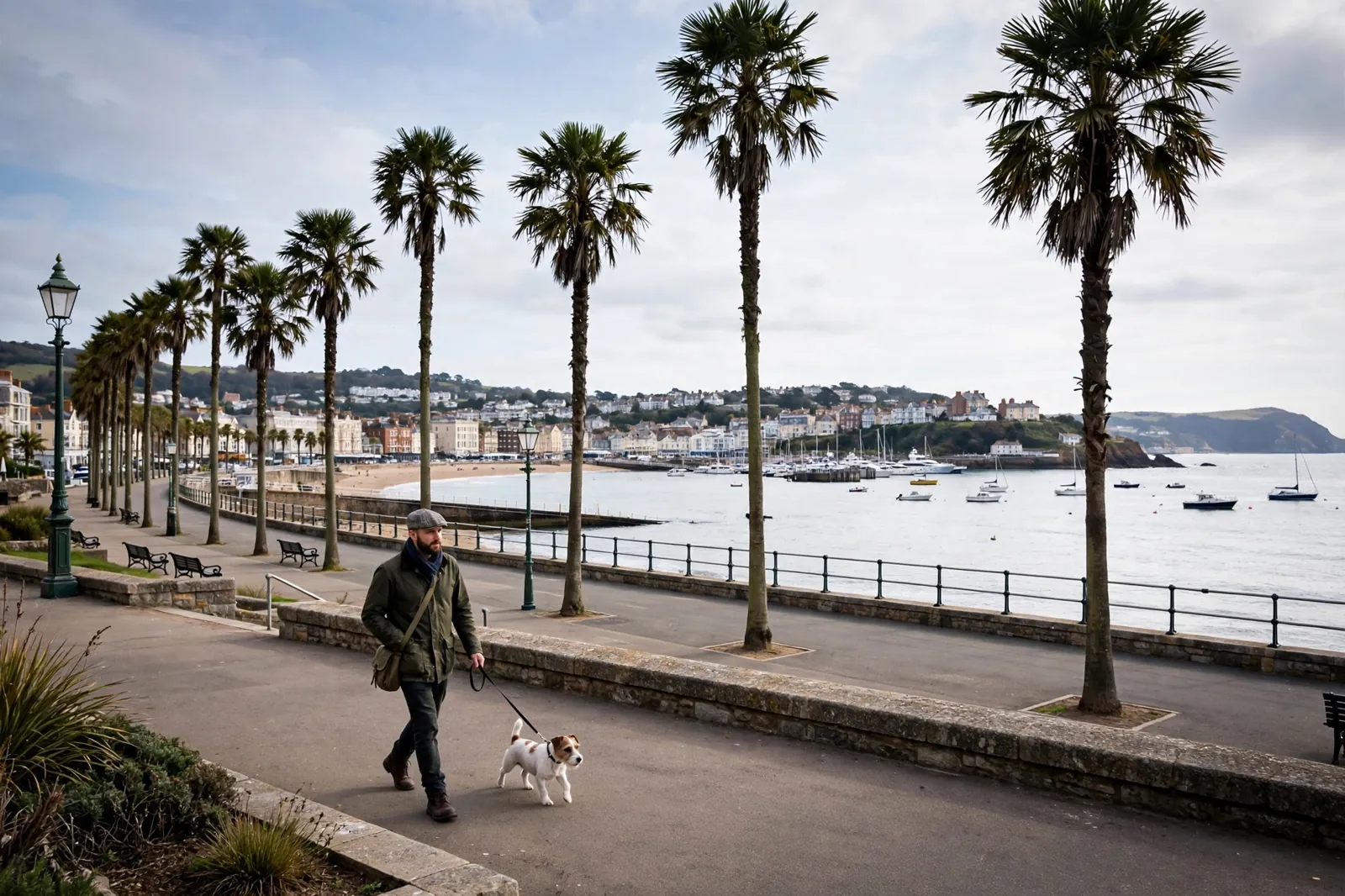
Dartmouth makes most sense once you stop looking for a centre in the usual sense and start reading it as a strip of town pressed between a steep hill and a deep river. The flat ground is the embankment. Almost everything a dog owner needs in the first hour — a level walk, a view to settle a travelled dog, benches, bins, the passenger ferry landing, cafés a street back, and the small inner harbour known as the Boat Float — sits along or just behind the North and South Embankments. Start there, whatever the rest of the day holds, because a dog who has walked the waterfront on arrival will cope far better with what Dartmouth asks next: narrow pavements, steep side streets, steps, crowds funnelled into small spaces, and the constant distracting presence of gulls, boats and other dogs doing exactly the same circuit.
The embankment walk itself is simple, and that is its virtue. Follow the river frontage at a dog's pace, let the sniffing happen in the planted areas and around Royal Avenue Gardens rather than in shop doorways, and use the gardens as a pause rather than a playground: they are a formal town garden, not an off-lead run, so a short lead and a settled sit are the right mode. Watch the edges. Pontoons, mooring bollards, chains, slipways and fishing lines all occur at dog height or dog nose height along a working waterfront, and the drop to the water is real in places. A dog who lunges at gulls should be on a short lead here long before the gull proves it.
Behind the embankment, Dartmouth's old town repays slow exploring with the right dog: Foss Street, Duke Street and the lanes around the Market Square are full of independent shops and historic frontages, but they are narrow, often stepped, and busy in season. Go early if your dog dislikes crowds, keep to the wider side of each street, and do not assume a shop that looks welcoming admits dogs — policies are set shop by shop, and food shops in particular may not. The Britannia Royal Naval College dominates the hill above town and shapes Dartmouth's identity, but it is a working naval establishment, not a dog-walking attraction, so admire it from the river and do not build it into a dog itinerary. Dartmouth rewards that kind of realism throughout: the town gives generously, but only along the lines the river sets.
Living with a tidal river: walks along the Dart
The River Dart at Dartmouth is an estuary, wide, tidal and busy, and it behaves nothing like a gentle inland river. Tides change the shape of the shore twice a day, currents run strongly, especially around ferry crossings and the river mouth, and the water is full of moving hazards a dog cannot judge: ferries, yachts under power, rowing boats, paddleboarders and moored boats swinging on the tide. Treat swimming as the exception, not the default. Do not let a dog chase a stick into the main channel, jump from pontoons, or swim after birds among moorings. If your dog swims, choose only a quiet, shallow, clearly safe spot away from boats and slipways, check the tide first, and keep a long line on a dog whose recall fades near water. Many visiting dogs are happiest, and safest, simply walking beside this river rather than getting into it.
For walking, think in three directions. The first is the castle direction, covered in the next section: the town's best everyday route, mostly on lanes and paths, with coves and creek views. The second is inland along the Dart valley side paths and lanes towards Stoke Gabriel and Dittisham on either side of the river, using an up-to-date map and expecting mud, stiles, livestock in fields and stretches of road without pavements; this is proper Devon lane walking, beautiful and not to be improvised from a phone screenshot. The third is across the water: Kingswear, on the east bank, has its own steep lanes, marina views back to Dartmouth and onward coast path, and a dog who has crossed by ferry experiences the estuary as locals do — as a connection, not a barrier. Our wider guide to dogs on UK ferries covers the general etiquette that applies to all of these crossings, from keeping leads short on deck to never leaving a dog alone in a vehicle in hot weather.
River hygiene needs a brief, unglamorous word. After heavy rain, water quality in estuaries can deteriorate, and harbour areas collect debris, hooks, discarded bait and food waste. Rinse a dog who has been in or near the water, check paws for cuts from shells, glass and sharp stone on slipways and foreshore, and watch for the scavenging opportunities a port provides: fish remains and picnic waste are plentiful, and neither agrees with dogs. Carry water with you rather than letting a hot dog drink estuary water, which is brackish here in any case. Bins are reasonable along the embankment and scarce once you leave town, so bags travel out and back with you.
The walk to Dartmouth Castle: go for the walk itself
If you do only one walk in Dartmouth, make it this one. From the town centre, the route out to Dartmouth Castle is roughly a mile each way, following the river past the lower ferry area, Bayard's Cove — a small, atmospheric cobbled quay with an early Tudor artillery fort — and along the lane and path beside Warfleet Creek, past St Petrox Church, to the castle at the mouth of the estuary, where the Dart meets the sea and Kingswear Castle stands opposite on the far shore. It is the rare famous walk that suits almost every dog: largely level by Devon standards, rich in smells and views, with natural pause points, and with a clear destination that stops a walk becoming an aimless drift. Allow far longer than the distance suggests, because every section invites a stop.
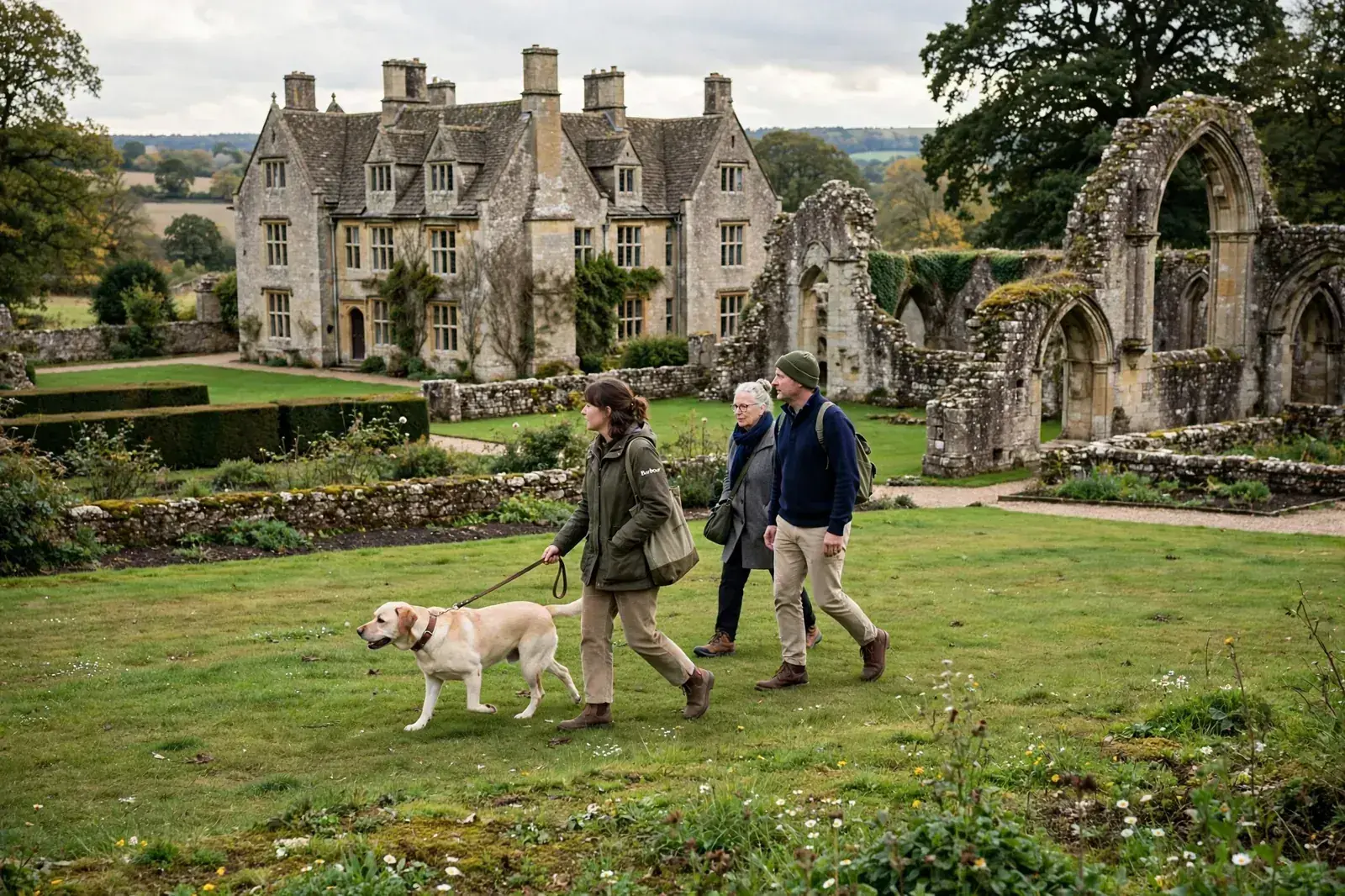
Now the honest part, because castle visiting with a dog is where vague guides do the most damage. Dartmouth Castle is managed by English Heritage, and dog access at its sites is limited and set individually: at many properties dogs on leads are welcome in grounds but not in indoor spaces, roofed exhibitions, shops or tea-rooms, and the position at Dartmouth can change with conservation work, events and revised policy. This guide therefore does not promise your dog entry to any part of the castle. Read our guide to English Heritage sites with dogs for how the pattern usually works, then check English Heritage's current dog policy for Dartmouth Castle itself before you go — that official page, checked close to your visit, outranks anything written here or anywhere else. If dogs are not admitted where you hoped, the outing is not ruined: the castle exterior, the church, the gun platform setting above the water and the coves are the landscape your dog came for in any case.
Pairs can work a split visit, as at other great sites: one person goes inside while the other walks the dog along the shore paths and waits in any outdoor area where dogs are currently permitted, then you swap, timing it so neither dog nor human is left hanging around in heat, rain or wind. Solo visitors should plan on the exterior and the walk, and treat any admission for the dog as a bonus confirmed on the day. Never leave a dog in a car near the castle or back in town while you tour inside: there is no shaded, safe version of that plan, in Dartmouth or anywhere else.
On the way back, the small coves near the castle, often referred to as Castle Cove and Sugary Cove, tempt dogs towards the water. They are small, tidal and can disappear or become cut off as the tide rises, and access involves steps and uneven ground that not every dog or owner will manage comfortably. Check tide times before relying on them, keep dogs under close control around other beach users and wildlife, and leave while the way back is still obvious. End the walk where it began, at Bayard's Cove, which at quiet times of day is one of the most characterful corners in Devon to simply sit with a dog and watch a harbour work.
Ferries across the Dart: three crossings, three sets of rules
Dartmouth and Kingswear face each other across a river with no bridge at the town — the nearest road crossing is far upstream — so ferries are not a novelty here, they are the transport system. For a dog owner there are three crossings to understand, and they are run separately, which is why no single dog rule covers them all. Check the official latest guidance before you go for the specific crossing you intend to use, including fares, operating hours and any seasonal changes, because all three vary across the year and in poor weather.
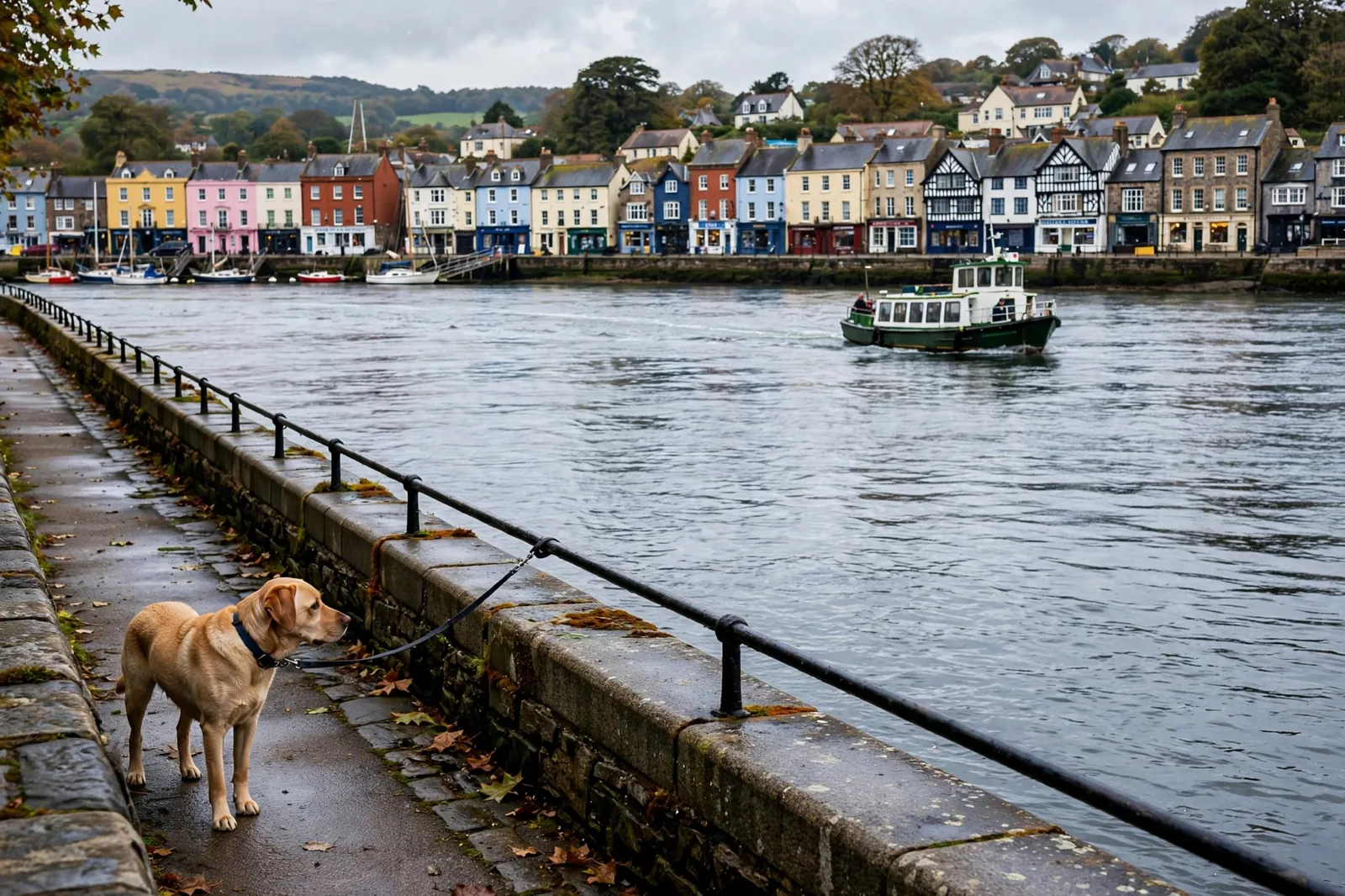
The passenger ferry is the one most dog owners will use. It links Dartmouth's embankment with Kingswear, where the steam railway station sits almost at the landing, and the crossing is short, frequent in season and part of the classic Dartmouth day out. Dogs on leads are commonly carried, but boarding is onto a boat, often via a pontoon or steps that move with the tide and can be slippery or steep at low water. Judge your own dog honestly: a large, nervous or mobility-impaired dog may find a low-tide boarding harder than the timetable suggests. Keep the lead short, let foot passengers settle, follow crew directions about where to stand or sit, and keep your dog off seats and away from the edge. A dog who has never been on a boat should do this short crossing as a first experience rather than a longer harbour cruise.
The Higher Ferry and Lower Ferry are vehicle ferries, carrying cars across on different routes, with pedestrians also carried. If you are driving, your dog will usually stay with you in or beside the vehicle for the short crossing, but do not treat that as a rule to quote: stay in the vehicle if directed, keep windows and ventilation appropriate to the weather, and never assume you can walk a dog around a deck full of manoeuvring cars. Queues for both vehicle ferries build on the slipways in high season, engines run, and the ground is steep and hard; a dog waiting in a queue needs shade, water and distance from exhausts and reversing vehicles. For many dog owners on foot, the passenger ferry plus Kingswear's lanes is simply the calmer crossing, and crossing as a foot passenger and leaving the car on one side can remove half the stress of a Dartmouth day.
Beyond the crossings, seasonal boat trips run on the Dart — river cruises towards Totnes, boats to Dittisham and harbour trips among them, with operators, routes and dog policies that change from season to season. The same discipline applies: a boat that carried dogs last summer may not this summer, a landing stage may involve a long wait on a pontoon, and a round trip commits your dog to the full duration whatever the weather does. Ask the operator directly before booking, choose the shortest suitable trip for a first outing, and take water, a familiar mat or blanket if the operator allows it, and bags — a dog cannot be taken ashore for a toilet break mid-river, so a proper walk before boarding is part of the ticket price.
Steam railway to Kingswear: the station Dartmouth never had
One of Dartmouth's best stories is written on its old station building on the embankment, now in other use: Dartmouth has a station building but never had trains, because the line was built to Kingswear, across the water, and passengers completed the journey by ferry. That arrangement survives as one of Britain's most enjoyable dog-day logistics. Cross to Kingswear, step onto the Dartmouth Steam Railway, and ride the line along the Dart estuary and the coast through Churston and Goodrington to Paignton. The views back across the river, the viaducts and the simple pleasure of a steam train make it a destination in itself, and for car-free visitors it is also a practical route in and out of Dartmouth, connecting at Paignton with mainline trains.
Dog policy needs the careful phrasing this operator deserves. Dogs have historically been carried on this railway for a small fee, with assistance dogs carried free, and generations of dogs have ridden it happily. But a historic practice is not a current promise: fares, the carriages or parts of the train where dogs may travel, and restrictions on the busiest services are all matters the operator can and does revise. So check the operator's current terms and the current dog fare before you travel, every time, and do not quote an old fare or an old guide — including this one — at the ticket office. Our national guide to taking a dog on UK trains explains the etiquette that heritage railways share with the mainline network: short lead, dog on the floor and off the seats, no blocking of aisles or doors, and a dog who is settled before the whistle, not trained during the journey.
Plan the railway as a half-day decision, not an add-on. The full return trip, with the ferry at both ends of the Kingswear leg and time in Paignton, takes longer than the map suggests, and the last ferry and last train of the day matter more in Dartmouth than in a town with a road bridge. In Paignton, a dog will need a proper walk after the ride; the seafront and nearby greens give one, but Paignton's beaches have their own seasonal dog restrictions, so check signs rather than assuming the nearest sand is available. If your dog is sound-sensitive, consider carriage position and the reality of whistles, steam and crowded platforms before committing to a peak-season service: heritage railways are loud, joyful and enclosed, which is a wonderful combination for a confident dog and a long afternoon for a frightened one. On quieter services, outside the highest season, nervous dogs usually find the whole experience markedly easier — another reason Dartmouth rewards those who can travel off-peak.
Beaches and the coast path: what Dartmouth is not
Visitors sometimes arrive in Dartmouth expecting a resort beach in town and are briefly disappointed. Managing that expectation is a kindness. Dartmouth is a port and river town built for boats, not bathing, and its shoreline in town is embankment, pontoon, slipway and cove. The sand, such as it is nearby, lies outside town: the small coves on the castle walk, and, a drive or a serious walk away, larger beaches such as Blackpool Sands to the south-west, a privately managed beach in a striking bay, and the long shingle of Start Bay further on. Each operates its own dog arrangements, with seasonal restrictions that have historically been strict at some of these beaches in the main season, and charges, parking and facilities that change. There is no honest shortcut: check the current council, beach operator and on-site information for the beach and date you have in mind before setting off, and be ready for an answer that sends you to a coast path walk instead.
The coast path, fortunately, is Dartmouth's real compensation, and for many dogs it beats a beach anyway. The South West Coast Path passes through Dartmouth and the castle point. South-westwards it climbs and dips towards Stoke Fleming and Blackpool Sands and on towards Start Bay; across the ferry, the Kingswear side runs towards Brixham through wooded, steep country with some of the finest estuary and sea views in Devon. This is demanding walking in places: narrow paths, steps, exposed sections, livestock in adjoining fields and long stretches without water or bins. Keep dogs on leads around livestock and near cliff edges without exception, carry more water than the mileage suggests, check a route description with distances and gradients before committing an older dog or a puppy, and remember that a coast path, like a railway line, has a return journey built into it unless you have planned a bus, taxi or second car, each with its own dog rules to check.
For a gentler taste of the same landscape, the National Trust countryside around Little Dartmouth, above the river mouth on the town side, offers shorter walks, big views and the kind of open, breezy ground that suits a dog who needs a proper stretch after days of lead walking in town. Parking there and at other rural car parks is limited and fills early in season, charges and dog guidance can change, and fields around the paths may hold cattle as well as sheep, so read signs at the gate and give all livestock a wide, calm berth. Between castle, coast path and Little Dartmouth, a Dartmouth dog can be thoroughly exercised every day of a stay without ever needing a beach to be dog friendly — which is just as well, because on many summer dates the nearest large ones will not be.
Eating in a steep, narrow town: pubs, cafés and queues
Dartmouth feeds visitors well, and dog owners share in that — with the usual Devon caveat that welcome is decided door by door, day by day. The town has pubs with river views, cafés in the old streets, fish and seafood restaurants for which it is known, and takeaways that pair naturally with an embankment bench. Some pubs and cafés welcome dogs inside, some welcome them in gardens, terraces or designated areas only, and some food premises do not admit dogs beyond assistance dogs. None of that is a criticism; it is how a small, food-focused town works. Check a venue's current dog policy before you queue, ask cheerfully at the door, and have a second choice ready on busy days, because the most famous rooms fill first and a hungry wait on a narrow pavement with a restless dog helps nobody.
Timing solves most eating problems in Dartmouth. Eat earlier or later than the main lunch and evening peaks and both choice and dog-friendliness improve at once: more tables, more space under them, staff with time to say yes and mean it. Apply the courtesies that keep that welcome alive — dog on the floor and off seats and benches, lead short and out of serving routes, no feeding from the plate, and a dog who has been walked and toileted before you sit down. Wet river-town paws are understood here, but a towel before going inside, and a mat for a dog to settle on, mark you out as the kind of guest venues want back. If you are comparing a base along this coast, our guide to Torquay with a dog shows how a larger resort town handles the same questions with more seafront and more space; Dartmouth's version is smaller, steeper and more concentrated, which is exactly its charm and exactly why planning matters more.
Two cautions belong on the table. First, a harbour town drops food constantly — chips, shellfish waste, ice cream and bait among it — and shellfish shells and cooked bones on pavements and around bins are genuine hazards for a scavenging dog, so the walk to the restaurant deserves the same attention as the walk to the castle. Second, Dartmouth's events calendar, including its well-known regatta period and food festival season, transforms the town: crowds, road closures, fireworks on some occasions and pressure on every table and ferry. Those weeks can be thrilling with a confident dog and miserable with a nervous one, and accommodation, ferries and restaurants all need booking and checking earlier than usual. If your dog dislikes fireworks or dense crowds, choose your Dartmouth week with the events calendar open in front of you, not as an afterthought.
Stays, parking and arriving: the hill decides a lot
Where you sleep in Dartmouth matters more than in a flatter town, because the hill is not scenery, it is logistics. The old town climbs steeply from the embankment in tiers of narrow streets, and properties that look moments apart on a map can be separated by a serious flight of steps. When choosing a hotel, inn, bed and breakfast, self-catering house or apartment, ask the questions that Dartmouth makes essential: How many steps are there from street to door, and from door to room? Where does the dog go last thing at night, and is that route lit, level and enclosed? Is there parking, is it guaranteed or first come, and how far will you walk with luggage and a dog if it is full? How many dogs are allowed, what is the charge, may a dog be left alone and under what conditions, and are there areas of the building — breakfast rooms are the common one — where dogs cannot go? A host who answers those questions in detail is a host who genuinely hosts dogs.
Enclosed gardens deserve special scrutiny on a hillside. Terraced gardens can have drops, gaps under gates onto lanes, steps a small dog can slip through and levels a determined dog can jump between, with neighbouring gardens and the street closer than a photograph suggests. Inspect on arrival before the first off-lead moment, not after. Flooring and drying space matter too: a dog who walks the castle lane and the coast path in Devon weather will come home wet and sandy most days, so ask where a dog can be rinsed and dried, bring your own towels, bedding and a drying coat, and favour hard floors over pale carpets wherever you have the choice. Stays outside the centre — towards Stoke Fleming, Strete, Dittisham, Stoke Gabriel or back up the valley — often trade the embankment outside the door for easier parking, more space and quicker access to coast and lanes, which suits many dogs better than a prettier address in town.
Arriving by car means approaching on winding South Hams roads, principally down the hill into town from the Totnes direction, and then meeting Dartmouth's scarcest resource. Central parking, including the main town car parks around Mayor's Avenue, fills early on fine days and in season, charges and limits change, and a seasonal park and ride has operated from the edge of town — check the council's current parking and park and ride information before you travel rather than relying on any guide's summary. Better still, consider arriving without the car altogether: trains to Totnes connect with buses and taxis down the valley, and trains to Paignton connect with the steam railway and ferry described above, both of which can turn arrival into part of the holiday. Whichever route you choose, the rule that outranks all parking news applies here as everywhere: never leave a dog alone in a parked car in Dartmouth while you explore, eat or visit the castle, whatever the weather seems to be doing. Save local veterinary details, including out-of-hours cover, in your phone before you need them, and carry the plain kit that keeps small problems small on steep ground: water, bags, a spare lead, a towel, a charged phone and maps downloaded for offline use, because signal in the lanes and on the coast path is patchy.
Two days in Dartmouth, paced by the tide
A single Dartmouth day can be done from elsewhere in South Devon, but two days show you why people stay. On the first day, resist the urge to start with a boat or a train. Walk the embankment early, before the day visitors arrive, continue through the old streets while they are quiet, then take the castle walk at a dog's pace, with Bayard's Cove, Warfleet Creek and St Petrox as natural chapters and the castle as a landscape first and a ticketed visit second, checked and split as described above. Take lunch late, somewhere that has confirmed it welcomes your dog, or as a takeaway on the embankment, and let the afternoon slow down: Royal Avenue Gardens, a harbour-side sit, a short evening circuit of the Boat Float, and an early night in a town that quiets noticeably once the day boats and coaches leave. That slower first day is not under-ambition; it teaches you and the dog the town's geography, which makes every crossing and connection on day two easy.
On the second day, cross the water. Take the passenger ferry to Kingswear with a walked, toileted dog, ride the steam railway as far as time and your dog's confidence allow — checking the operator's current dog terms and the last return connections before you set off — and spend time in Kingswear itself, looking back at Dartmouth from the quieter bank, which is the view that explains the town best. Back in Dartmouth, use the remaining energy according to the dog in front of you: Little Dartmouth or a short coast path section for a dog still full of running, a final embankment amble and a pub garden for a dog who has done enough. Fit beach ambitions, if the season and the current rules allow them, into a separate half-day by car rather than bolting them onto the ferry and railway day; Dartmouth punishes overloaded itineraries with missed boats, full car parks and tired dogs on steep streets.
Leave with the right expectations set for a return. Dartmouth will not give a dog a big town beach, an off-lead park in the centre or a station on its own platform, and it does not try to. What it gives instead is rarer: a town where the daily walk is a mile of river, creek and castle; where crossing the water is part of going anywhere; and where the dog's needs — a level start, a long interesting route, a quiet bench, a checked rule rather than an assumed one — map neatly onto the best way for a human to see the place too. Plan it around tides, ferries and the hill, check the official latest guidance before you go for the castle, crossings and railway, and Dartmouth becomes one of the most satisfying small-town dog breaks in Devon.
Practical questions
Before you go
Can dogs go into Dartmouth Castle?
Only in a limited way, and the detail changes. Dartmouth Castle is managed by English Heritage, and dog access at English Heritage sites is set site by site: dogs may be allowed in some outdoor areas on a short lead while indoor spaces, exhibitions and the tea-room are usually closed to dogs other than assistance dogs. Do not count on entry to any particular part of the castle. Check English Heritage's current dog policy for Dartmouth Castle before you go, plan a split visit if you want to see inside, and use the castle walk, St Petrox churchyard and the coves nearby as the dog-friendly part of the outing.
Can dogs ride the ferries across the River Dart?
Dogs on leads are commonly carried on the Dartmouth passenger ferry to Kingswear and are generally carried in vehicles on the Higher and Lower vehicle ferries, but each crossing is run separately, vessels and boarding arrangements differ, and fares and rules can change. Keep your dog on a short lead, stay where the crew direct you, keep clear of cars manoeuvring on the slipways, and check the official latest guidance for the specific ferry you plan to use before you go.
Can dogs travel on the Dartmouth Steam Railway?
Dogs have historically been carried on the Dartmouth Steam Railway between Paignton and Kingswear for a small fee, with assistance dogs carried free, but fares, where dogs may sit and any restrictions on busy services are the operator's to change. Phrase your plans around a check, not a promise: confirm the operator's current terms and the current dog fare before you travel, keep your dog on a short lead and off the seats, and remember that Dartmouth itself has no station, so the journey finishes with the passenger ferry from Kingswear.
Are there dog-friendly beaches near Dartmouth?
Dartmouth itself is a river town rather than a beach town, and its small coves near the castle are tidal and change with the tide. Larger beaches nearby, including Blackpool Sands and the beaches along Start Bay, operate seasonal dog restrictions that vary by beach and by year, and some are privately managed. There is no single rule that fits them all. Check the current council, beach operator and on-site signs for the exact beach and date before you go, and keep dogs away from slipways, moorings and swimming areas even where they are allowed on the sand.
Is Dartmouth easy to visit with a dog without a car?
Yes, and it can be easier than driving, because central Dartmouth has steep, narrow streets and limited parking. The usual routes are by train to Totnes and then by bus or taxi into Dartmouth, or by train to Paignton and then by the steam railway to Kingswear and the passenger ferry across to Dartmouth. Buses, taxis and the railway each set their own dog rules and timetables change seasonally, so check the official latest guidance for every leg before you go and allow extra time for the ferry connection.