This guide is independent and contains no paid placement. Venue, ferry and beach dog rules change, so where this guide flags a check, please confirm the latest official information before you travel.
Salcombe rewards a dog owner who works with the water: walk the estuary paths early, choose beaches by the tide and the signs on the day, use the East Portlemouth ferry for the quieter eastern shore, and take the South West Coast Path towards Bolt Head or Gara Rock for the big views. In peak season the town is expensive, narrow and very busy, so book stays early, arrive before the car parks fill, and keep a lead on around the harbour, livestock and cliffs.
The estuary comes first
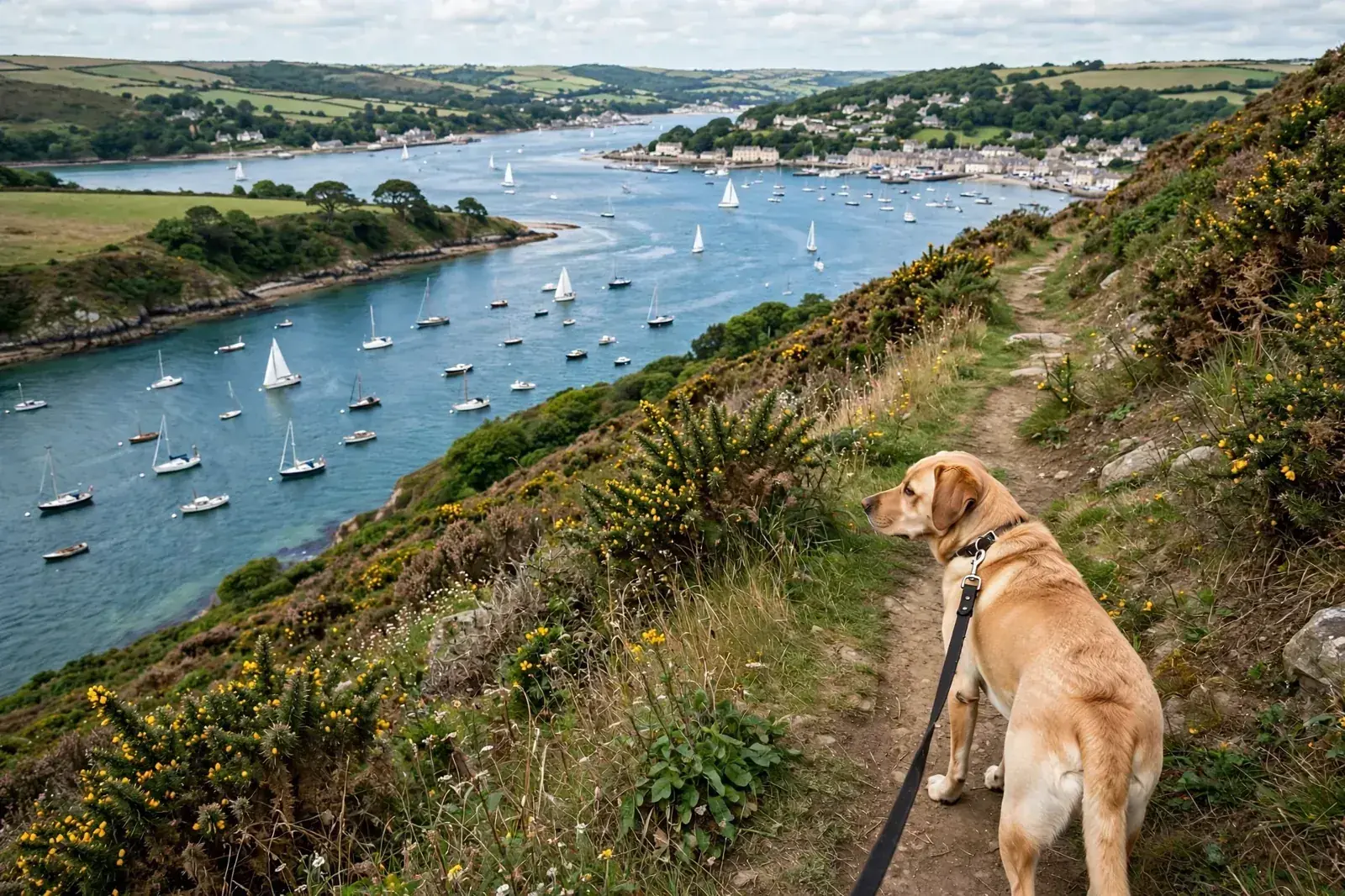
Most Devon towns have a centre and then, separately, a waterfront. Salcombe does not work like that. The town is the waterfront. It sits on the western bank of the Kingsbridge Estuary — a wide, flooded valley, often called a ria, rather than a conventional river mouth — and almost every decision on a Salcombe dog trip is shaped by that water: where you can walk at a given state of the tide, which beach is reachable without a long drive, whether the little ferry is the sensible route or a queue worth avoiding, and where the crowds will concentrate when the sun comes out.
That is good news for a dog. The estuary gives Salcombe a natural rhythm that suits canine visitors better than a purely beach-based resort does. There is interest at almost every hour — boats moving on moorings, gulls, waders on exposed mud at low water, the smell of seaweed and diesel and salt — without a dog needing to be in the water to enjoy it. A lead walk along the harbour and out towards North Sands or South Sands can be a complete outing in itself, especially for an older dog or a puppy who should not be doing cliff-path miles. And when the town centre gets tight, the water is always the escape route: follow it in either direction and the pavements widen, the noise drops and the dog gets grass, shade and space again.
Respect the estuary, though, because it is a working, tidal harbour, not a lake. Currents run strongly, especially around the harbour mouth and the Bar at the entrance, deep water sits close to quays and pontoons, and mud exposed at low tide can trap a dog as effectively as it traps people. Keep dogs on a lead on quays, slipways and pontoons, well back from boat traffic and fishing gear, and do not let a dog swim from harbour steps or chase birds out onto the mud. If your dog is going to swim, choose a proper beach, check conditions and tide direction first, and recall your dog well before it drifts towards moored boats or a channel. A dog who loves water will find plenty of legitimate chances in Salcombe; the harbour itself should stay a look-but-do-not-leap place.
Tides are the timetable underneath everything else here. At high water some beaches shrink to a strip and some shore paths feel very different from their low-tide versions; at low water the estuary opens up, sand and mud appear, and routes that looked cut off become obvious. Build the habit of checking tide times each morning alongside the weather, in the same way you would check them for any estuary town, and plan the long beach and coast walks for the tide that flatters them. Check the official latest guidance before you go for harbour, ferry and beach information, because local arrangements are updated seasonally and after storms.
Town, harbour and narrow streets
Salcombe's centre is compact, handsome and, in summer, remarkably narrow for the number of people trying to use it. Fore Street and the streets running down to the water were built for a smaller, slower place: a fishing and boatbuilding town that became a sailing centre and then one of the most sought-after holiday towns in the South West. Pavements are tight in places, delivery vehicles, pushchairs, shoppers and dogs on leads all compete for the same few feet, and a large or reactive dog will feel that pressure more than the postcards suggest. None of this makes Salcombe unsuitable for dogs — far from it — but it does mean timing and lead discipline matter more here than in a spacious seaside town with a long promenade.
The practical technique is simple. Walk the centre early or later in the day when you can, keep the lead short in Fore Street and around the harbour, and position your dog on the quieter side of you, away from shop doorways and cafe tables. Use the harbour-side areas and the open spaces by the water for pauses, training resets and water breaks, rather than stopping in the narrowest part of a shopping street with a dog stretched across the pavement. Dogs who struggle with close passing, skateboards, buggies or other dogs at nose-to-nose distance will have an easier holiday if the town centre is treated as a short, purposeful transit — in, shop, out — and the real walking is saved for the beaches and paths either side of town.
Around the harbour itself, expect boats, boat kit and rules to match. Harbours are workplaces as well as beauty spots: there are ropes, hooks, fuel, trailers and moving vehicles, and harbour authorities set local rules for dogs on quays and pontoons that should be followed exactly as signed. Keep clear of slipways when boats are launching, never let a dog cock a leg on coiled ropes or fishing equipment, and clear up immediately anywhere near the water. It is also worth teaching, or refreshing, a reliable settle before you arrive. Salcombe has many places where a dog who can lie quietly under a bench or table for twenty minutes will be welcome, and many more where a dog who patrols, barks at every passing spaniel or surfs neighbouring tables will quietly ensure you are not asked back.
For supplies, plan rather than assume. A small, expensive holiday town does not always stock the exact food, medication or kit your dog needs, and the drive out to a larger town takes longer than the map distance suggests on South Hams lanes. Bring enough of your dog's normal food for the trip, any medication with a margin for delays, a spare lead, bags, a towel and a drying layer. Save the details of the nearest veterinary practice and its out-of-hours arrangements in your phone before you set out on a coast walk, not when you are standing on a headland with a cut paw and one bar of signal.
Beaches on both banks: choose by tide and by sign
Salcombe is unusual in having useful beaches on both sides of the estuary, and a dog trip works best when you learn to think of them as two separate groups. On the town side, to the south, lie North Sands and South Sands. On the eastern side, reached by the little ferry or by a much longer drive around the estuary, lie the East Portlemouth beaches, including the coves around Mill Bay. Each beach has its own character, its own access and — crucially — its own dog rules, which vary by beach and by season. Our national explainer on dog-friendly beaches in the UK and their rules sets out how these local, signed systems work, and Salcombe is a textbook example of why you must read the sign for the beach you are actually standing on, not the one you visited yesterday.
North Sands, a short walk south from the town past the ruins of Salcombe Castle, also known as Fort Charles, is often the most practical town beach for dog owners, with a broad sweep at low tide and a wilder feel than its size suggests. South Sands, a little further on, is a handsome, sheltered cove closely associated with sailing and watersports and, in season, with a distinctive passenger ferry link from the town that uses a sea tractor at the beach end. In recent seasons the dog rules for these two neighbouring beaches have not been identical, with seasonal restrictions applying on one beach while the other has remained more permissive — which is exactly why this guide does not print a permanent table of dates. Rules are set locally, they are reviewed, and they change. Check local signs on the day and check the official latest guidance before you go, and if a beach is restricted when you arrive, treat the alternative beach or the coast path as the plan, not as a disappointment.
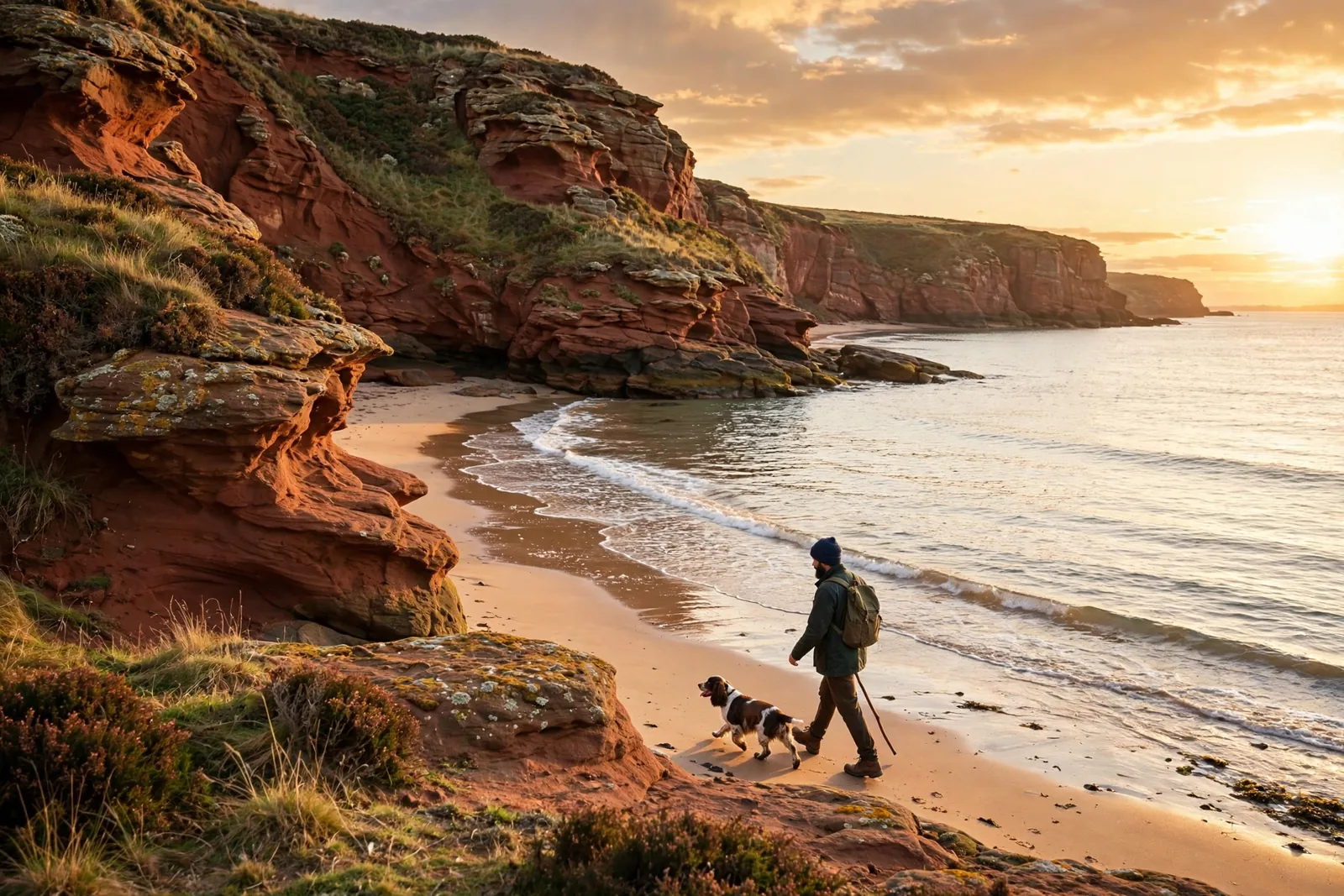
The East Portlemouth shore feels different again: quieter, more rural and, outside peak weeks, noticeably calmer than the town side. A string of small sandy coves faces back across the water towards Salcombe, so you get the postcard view of the town without being in its crowds. At low tide the coves link up into a longer, exploratory walk; at high tide each cove becomes more separate and some access points matter more. Facilities are thinner on this side, shade can be scarce, and you are dependent on the ferry timetable or a long drive if you need to leave quickly, so carry water for the dog, sun protection for yourself and a clear turnaround time. That self-sufficiency is part of the appeal for a dog who needs space, but it is a poor choice for a dog who is unwell, overheating or frightened of boats if the only quick exit is across the water.
Whichever beach you choose, apply the standard Salcombe cautions. Sand gets hot in summer sun, so test it with the back of your hand and walk sensitive paws on wet sand or in the cooler parts of the day. Jellyfish, including stinging species, wash up on South Devon beaches at times, and dogs investigate them with noses and mouths, so scan the strandline and steer well clear of anything translucent and tentacled, alive or dead. Keep dogs away from rockpool wildlife, under close control near swimmers, paddleboarders and kayaks, and out of any zoned or lifeguarded swimming area where signs require it. And always check the tide before settling: on a rising tide, coves shrink, exits narrow and a dog walked a long way along the shore can find the return route very different from the way out.
The East Portlemouth ferry: small boat, big shortcut
The passenger ferry between Salcombe and East Portlemouth is one of the defining details of a Salcombe visit, and for dog owners it is more than a novelty. Without it, reaching the eastern shore means driving all the way around the head of the estuary through Kingsbridge, a journey that turns a beach visible from your breakfast table into a half-day logistics exercise. With it, the crossing takes only a few minutes and puts you straight onto the East Portlemouth side for its beaches, its shore path and coast path connections towards Gara Rock. Our wider guide to dogs on UK ferries covers the general principles for travelling on water with a dog; this little open boat is the simplest possible version of them, and the same good habits apply.
Practically, expect a small passenger boat, a pontoon or steps at each end, and a crossing where your dog needs to be close, calm and under tight control. Dogs are generally carried, usually on a lead and at the crew's discretion, with a fare sometimes charged — but operators, vessels and arrangements change, so check the official latest guidance before you go and ask the crew on the day rather than presenting a large, wet, excitable dog as a surprise. Keep the lead short on the pontoon, where gaps, movement and deep water are all close at hand, lift or guide small dogs over any gap as directed, and sit or stand exactly where the crew asks you to. A dog who has never been on a boat should have a short, positive first crossing in quiet conditions, not a first attempt at the busiest hour of an August Saturday with a queue behind you.
Queues and interruptions are part of ferry life, and planning for them is the difference between charm and stress. Crossings can be affected by weather, tide, mechanical issues and sheer demand, the last boat matters, and in peak season the queue for the return crossing builds long before the end of the afternoon. Decide your return deadline before you cross, keep it in your phone, and leave a margin: a dog who needs to get back for medication, a booked table or a drive home should not be depending on the final sailing of the day. If the ferry is not running, or the queue would mean an hour on a hot pontoon with no shade, switch plans without regret. The town-side beaches and paths are a perfectly good day, and no cove is worth a distressed dog and a missed last boat.
There is also a second ferry experience closely associated with South Sands in season, linking the town with that beach and famous for the sea tractor that meets it in the shallows. Treat information about it in the same way: it is seasonal, weather dependent and subject to change, so admire the idea, check the official latest guidance before you go if you hope to use it, and always have a walking route as your fallback. For most dogs, the walk out to South Sands and back is in any case the better exercise, and it removes timetable pressure from the middle of a beach day entirely.
South West Coast Path walks: Bolt Head one way, Gara Rock the other
If the estuary is Salcombe's heart, the South West Coast Path is its horizon. The path passes through Salcombe and offers, in both directions, some of the finest coastal walking in Devon — and some of the most demanding dog management on this stretch of coast. This is not level promenade walking. Expect steep climbs and descents, narrow sections, stiles and gates, exposed headlands with no shade, and cliff edges that require a lead and your full attention even with a normally reliable dog. Walked with that respect, it is superb. Walked casually, in the wrong footwear, with an off-lead dog near stock, it is how good holidays go wrong.
West and south-west from town, the path climbs towards Bolt Head and on towards Bolt Tail and Hope Cove, passing high, dramatic ground with views back over the estuary mouth and out to sea. Sharp Tor and the rocky ground around Bolt Head give this direction its character: airy, rugged and, on a clear day, unforgettable. Shorter out-and-back walks to a chosen viewpoint will suit most holiday dogs better than an attempt at the full onward distance, especially in summer heat. Turn around while the dog is still keen, because every steep descent on the way out is a steep climb on the way back, and there is little water available for dogs on the exposed sections. Carry more than you think you need, for the dog as well as yourself.
East from East Portlemouth, the path runs towards Gara Rock and on towards Prawle Point, through a softer-looking but still serious landscape of coves, fields and headlands. This direction pairs beautifully with the ferry: cross the water, walk a defined section, and return the same way with the ferry deadline as your discipline. Gara Rock, with its well-known lookout and views back towards Salcombe, makes a natural objective for a longer walk, while shorter sections between coves suit dogs who need frequent paddling and sniffing stops. Check for path diversions before you set off, because cliff falls and erosion work do reroute the Coast Path on this coast, and check the official latest guidance before you go for any local closures or livestock notices.
Livestock, cliffs and wildlife set the rules on every section. Keep dogs on a lead around cattle and sheep — and give cattle, especially with calves, a wide berth or a different route altogether — and on a lead near cliff edges without exception, however good the recall. Ground-nesting birds and other wildlife need space in spring and summer, adders favour sunny banks and path edges in warm weather, and after wet periods the path can be muddy and slippery in ways that turn a manageable slope into a fall risk for a handler being pulled by a strong dog. Fit the walk to the dog in front of you: a fit adult dog with hill experience will relish a Bolt Head morning, while a puppy, a senior dog or a short-nosed breed in summer heat needs the estuary, a beach at low tide and a short, shaded loop instead. There is no virtue in completing a named walk with the wrong dog on the wrong day.
Eating and drinking with a dog
Salcombe has no shortage of places to eat and drink, from harbour-side pubs and seafood-focused restaurants to cafes, bakeries, delis and ice-cream stops, and many of them welcome dogs in at least part of the premises. The pattern familiar across Devon applies, with a Salcombe premium attached: the most famous, most central and most view-commanding places are the most likely to restrict dogs to a terrace, a bar area or outdoor tables, to be fully booked in season, and to charge prices that reflect both quality and postcode. None of that is a reason to avoid them. It is a reason to check, book and ask the dog question specifically — inside, outside only, or not at all — before you build an evening around a particular venue, because policies change with refurbishments, seasons and new management, and a listing that says dog friendly may mean one small terrace that fills by noon.
Good dog etiquette buys goodwill in a town where space is the scarcest commodity. Arrive with a dog who has been walked and toileted, towel off wet sand and mud before going inside, and bring a mat or settle layer so your dog has a defined place on the floor, out of walkways and away from neighbouring tables. Keep the lead short and attached, never tied to a table leg where a sudden lunge can drag furniture, and do not allow feeding from the table, begging tours or meet-and-greet sessions in a crowded room. If your dog cannot settle in a busy space, choose the many honourable alternatives Salcombe offers: a takeaway eaten on a bench above the water, fish and chips with a harbour view and the dog on a mat beside you, or a picnic assembled from the town's food shops and taken to a beach or viewpoint where a restless dog inconveniences nobody. Those are not second-best Salcombe experiences; for many dogs they are the best ones available.
Two local temptations need managing. The first is dropped and discarded food: crab shells, chips, ice-cream cones and picnic waste accumulate around the harbour and popular beaches in season, and cooked bones, corn cobs and shell fragments are all genuine veterinary risks for a scavenging dog. Keep the pavement and strandline scan going all day, use a reliable leave-it, and consider a quieter eating spot if your dog treats every bin as a buffet. The second is rich human food offered kindly by strangers, from pub crisps to ice cream. A small taste is a human social ritual; for a dog with a sensitive stomach, a weight problem or a medical condition it can undo a holiday. Decline cheerfully, carry your own dog treats, and let Salcombe's famous food stay firmly on the human side of the occasion, with the possible exception of a plain dog ice cream bought specifically for the purpose.
For a contrasting Devon base with a broader, more traditional seafront and a different eating scene, compare our guide to Torquay with a dog before you decide where to spend a longer South Devon stay.
Where to stay: the honest version
Here is the part of the Salcombe guide that needs to be said plainly, because it shapes everything else: Salcombe is expensive. It is regularly counted among the most expensive seaside towns in Britain for property, and holiday accommodation prices follow the same logic. Harbour-view apartments, hotels in converted grand houses, cottages on the desirable streets and stays on the East Portlemouth side all command a premium, and that premium peaks exactly when most people want to come — the school summer holidays, regatta and sailing weeks, bank holidays and sunny weekends. A dog does not reduce that bill, and an additional per-dog charge, where it applies, is the smallest part of it. Budget honestly, compare total prices including parking, dog charges and any cleaning or linen fees, and do not let a headline nightly rate for a tiny room in January set your expectations for a cottage in August.
What that money should buy you, as a dog owner, is location, and in Salcombe location beats luxury. A modest place within flat, easy walking distance of the harbour, a morning toilet walk and an evening stroll is worth more than a grander house up a steep hill, along narrow lanes with no pavement, or a drive away from town that commits you to the parking battle twice a day. Check the immediate surroundings as carefully as the interior: Is there a safe, lit route for the last walk of the night? A small enclosed outdoor space, genuinely enclosed rather than merely described as such? Hard floors or a host who understands wet dogs? A place to rinse sand off a dog before it reaches a pale sofa? Steep gardens, balconies, open staircases and direct access onto a lane all matter more with a dog than thread count ever will.
Consider the edges and the alternatives without treating them as failure. Staying just outside Salcombe, in the wider South Hams, can bring prices down, parking up and dog space with it, at the cost of driving or bussing in for town days — a trade that suits many dog owners very well, particularly those whose main plan is coast path and beaches rather than harbour-side dining. Our guide to dog-friendly holiday parks in Devon is a useful comparison if you want a park base with more predictable dog facilities and costs. Within Salcombe itself, shoulder season is the connoisseur's answer: spring and early autumn bring lower prices, easier parking, quieter paths and a town that still has most of its life, though some businesses move to seasonal hours, so check opening before relying on a favourite place. Winter is quietest and cheapest of all, atmospheric on the estuary in good weather and genuinely limited in a storm week, when short days and closed venues test even an enthusiastic walker.
Whatever you book, interrogate the dog terms before you pay, in writing where possible. How many dogs, of what size, at what charge? May a dog be left alone in the property, and if so under what conditions — many Salcombe lets say no, which affects whether both halves of a couple can ever go out for a dog-free dinner? Are dogs allowed on furniture, in bedrooms, in the whole property? What happens, and what does it cost, if a wet dog meets a cream carpet? Hosts in an expensive market have heard every version of the muddy-dog story, and the clear, fairly stated house rules at booking stage are a sign of a stay that will go well, not a warning against it.
Getting there, parking and getting around
Salcombe sits at the end of the South Hams road network, and the journey in is part of the destination's character. The nearest mainline stations are some distance away, at places such as Totnes, with onward travel by bus, taxi or hire car, so most visitors with a dog, luggage and walking kit arrive by car — and then meet Salcombe's central constraint head-on: there is very little room for cars. The lanes approaching the town are narrow in places, the town's own streets narrower, and in peak season traffic, delivery vehicles, pedestrians and drivers hunting for a space all slow each other down. Arrive patient, arrive early, and arrive with your parking plan already made. If you are travelling by train and bus, check connections, dog carriage and luggage practicality for the specific services you will use, and check the official latest guidance before you go, because rural timetables change seasonally.
Parking deserves its own honest paragraph. Salcombe's main car parks sit on the edges of and above the town rather than in its heart, they are well used, and in peak season they fill early in the day — after which there is no overspill of easy on-street alternatives in a town of tight streets and residents' needs. Seasonal park-and-ride or similar arrangements have operated at times, charges and time limits change, and some car parks suit a full beach day while others suit a short town visit. Read the current official information and the signs on arrival rather than trusting any guide's prices, including this one, and factor the walk from car park to town into your dog's day: a steep climb back to the car with a hot, tired dog at the end of a beach trip needs to be planned, not discovered. And the rule that outranks every parking convenience applies here as everywhere: never leave a dog alone in a parked car, in any weather that could turn warm, for any duration described as just popping in.
Once you are in Salcombe, the best transport is the one the town was built for: your feet, and the ferry. Most stays work best when the car is parked once and then ignored, the days are built around walking range from your door, and the East Portlemouth ferry is used as local transport rather than as an excursion. Taxis in a small, busy seasonal town are a scarce resource at peak times, and not every vehicle will carry a dog, so book ahead and state the dog clearly if you need one. Buses connect Salcombe with Kingsbridge and the wider South Hams, which can open up linear coast walks — walk one way, ride back — but rural services are infrequent enough that a missed bus is a long wait with a tired dog, so carry the timetable, a charged phone and a fallback plan. In short: the less your Salcombe dog trip depends on moving a car around at midday in August, the happier it will be.
A plan that fits the tides
A good Salcombe dog day is built the night before, in about five minutes, from three pieces of information: the tide times, the weather and wind, and the ferry situation if you intend to cross. Start with an early harbour and town walk while the streets are still waking up — the settling walk that makes everything after it easier — with a toilet break on grass, a harbour-side pause to watch the boats, and any town-centre shopping done in that same early, uncrowded window. Follow it with breakfast and a proper rest at your base if you are staying in town. Dogs who have had that unhurried start cope measurably better with a busy beach or a ferry queue later, and so do their owners.
Give the middle of the day to one main event, not three. On a town-side day, that event is North Sands or South Sands, chosen by the signs and restrictions you have checked that morning, timed for the tide that gives you the most sand, with shade, water and a firm departure before the dog is tired, hot or overstimulated. On an eastern-shore day, it is the early ferry to East Portlemouth, a cove morning or a defined coast path section towards Gara Rock, and a return crossing taken in good time rather than at the deadline. On a walking day, it is Bolt Head: out early, to a viewpoint you have chosen in advance, and back with daylight, water and energy to spare. Trying to combine a ferry, two beaches and a headland in a single summer day produces a rushed dog, a stressed handler and a parking ticket's worth of regret. Salcombe is small, but its pleasures are dense; one a day, done properly, is the correct pace.
Let the late afternoon and evening return to the estuary. This is Salcombe at its best for a dog: day visitors leaving, light softening on the water, the harbour busy with boats coming in rather than crowds going out, and the town's terraces and benches usable again. A slow lead walk, a settled drink where dogs are welcome, a takeaway above the water or an early supper booked with the dog question already answered — then a last proper walk before dark and a tired dog asleep while the boats knock against their moorings outside. Repeat that shape, varying the main event, and you have a Salcombe stay rather than a Salcombe scramble. Come in spring or autumn and the same plan gets easier still: the same water, the same paths, the same little ferry when it is running — with room to breathe in all of them.
Practical questions
Before you go
Can dogs travel on the East Portlemouth ferry from Salcombe?
Yes, dogs are generally carried on the small passenger ferry between Salcombe and East Portlemouth, usually on a lead and at the crew's discretion, with a fare sometimes charged. Crossings are weather and tide dependent and queues build quickly in summer, so check the official latest guidance before you go, keep your dog close on the pontoon and boat, and have a plan if the ferry is not running.
Are dogs allowed on Salcombe beaches all year?
No single rule covers every Salcombe beach. North Sands and South Sands and the East Portlemouth beaches have different seasonal and zoned restrictions that can change, so check local signs on the day and the official latest guidance before you go. Where dogs are allowed, keep them under close control near swimmers and wildlife, clear up immediately, and respect any lead-only areas.
Is Salcombe good for dogs in peak summer?
It can be, but peak summer is the hardest time to visit with a dog. Streets and car parks are very busy and narrow, popular beaches and the ferry queue, prices are at their highest, and shade and parking are scarce. Visit early or late in the day, book accommodation and parking in advance where possible, walk the coast path and quieter beaches at less busy times, and consider spring or early autumn for a calmer trip.
Can dogs walk the South West Coast Path around Salcombe?
Yes. Dogs are welcome on the South West Coast Path, including the sections towards Bolt Head and Bolt Tail in one direction and towards Gara Rock and Prawle Point in the other, but keep them on a lead near cliff edges, livestock and ground-nesting birds. Paths are steep and exposed in places with stiles and gates, so check the route, weather and official latest guidance before you go and carry water for your dog.
Where can I park in Salcombe with a dog?
Parking in Salcombe is limited and fills early in peak season, with main car parks on the edges of and above the town and very little on-street space in the narrow centre. Arrive early, check current charges, time limits and any park-and-ride arrangements on official signs and the official latest guidance before you travel, consider staying within walking distance of the town, and never leave a dog alone in a parked car.