This guide is independent and contains no paid placement. If affiliate links are added later, they will be clearly marked and will not change our editorial checks.
Kirkcaldy works best as a beach-and-park day: start on Seafield Beach, walk the Esplanade, then choose between Ravenscraig Park and the Fife Coastal Path east, or Beveridge Park and Raith Lake inland. Dogs are allowed on both main beaches all year round, the coastal path runs through the town in both directions, and the train from Edinburgh makes it an easy car-free trip — but check tide times and any bathing-water advice before letting a dog swim.
First, pick your kind of Kirkcaldy day
Kirkcaldy is not a resort town dressed up for visitors, and that is exactly why it works well with a dog. It is a former royal burgh on the north shore of the Firth of Forth, about 11 to 12 miles north of Edinburgh, with a population of around 49,000 recorded in 2011, making it Fife's second-largest settlement. The town grew on harbour trade, salt, coal and linen, and later became famous worldwide as a producer of linoleum — the "Lang Toun", as locals call it, because the town stretches for a long way along the coast. What that history leaves a dog owner today is a long, flat seafront promenade, two sandy beaches, a Victorian park inland, a wooded coastal park with a ruined castle, and a long-distance coastal path that passes through the middle of town.
The mistake is trying to do all of it in one visit. Kirkcaldy rewards a single clear plan, chosen around the dog in front of you, rather than a checklist of sights. A young, fit dog that needs to run will be happiest with a beach morning and a coastal-path afternoon. An older dog, a puppy, or a dog that finds other dogs stressful will do far better with a quiet loop in Beveridge Park or Ravenscraig Park, a short stretch of beach at a quiet hour, and a long sit outside a cafe. A reactive dog needs the opposite of the busy Esplanade on a sunny Saturday: an early start, the far end of Seafield Beach, and the woodland paths of Ravenscraig Park, where sightlines are short and other dogs are easier to avoid.
Think of the town as three zones. The seafront zone runs from Seafield Beach in the south-west, along the Esplanade and the harbour, past Pathhead Sands and on to Dysart Harbour in the north-east. The park zone sits just inland: Beveridge Park and Dunnikier Park to the north, with Raith Lake beyond them. The coastal-path zone connects the two and then keeps going, west towards Kinghorn and Burntisland, east towards East Wemyss, Buckhaven and the East Neuk. Most good Kirkcaldy days use one zone properly and borrow a little from a second, rather than racing between all three.
Weather decides more here than in most Scottish towns, because almost everything good about Kirkcaldy is outdoors. A still, bright morning on the Forth is genuinely lovely, with Edinburgh and Arthur's Seat visible across the water on a clear day. A wet, windy afternoon on the same promenade is a different trip entirely, and the sensible move then is a short beach walk, a park loop under trees, and a long cafe stop. Check the forecast the night before, and have a wet-weather version of your plan ready before you leave home — it is much easier to switch plans in the kitchen than on a windswept car park with a wet dog.
One more thing to settle before you go: what "dog-friendly" means for each stop. Scotland has no English-style seasonal dog bans on most beaches, and the Scottish Outdoor Access Code is the framework that governs access — dogs under control, on a short lead near other people, livestock and nesting birds. That is a freedom, and also a responsibility. A beach that allows dogs all year still expects you to pick up, to keep a dog away from swimmers and picnics, and to read the signs on the day. Indoor access is a separate question everywhere in town: galleries and museums generally do not admit pet dogs, while cafes and pubs set their own rules, area by area. The sections below treat each place on its own terms, so you can plan around the actual rules instead of a hopeful guess.
Getting there and getting around
Kirkcaldy is one of the easiest Fife towns to reach without a car. Kirkcaldy railway station sits to the north-west of the town centre, on both the Fife Circle Line and the East Coast Main Line, and the journey from Edinburgh takes roughly half an hour. Dogs travel free on most UK trains when kept on a lead and under control, which makes the train a genuinely good option: no car-park hunting, no dog left in a hot or cold car, and a walk from the station into town that doubles as the dog's first toilet break. From the station, Kirkcaldy Galleries and the War Memorial Gardens are close by, the High Street is a short walk, and the seafront is a longer walk or a short bus or taxi ride. If you are arriving by train for a beach day, allow for that last stretch rather than assuming the station is on the sand.
By car, the A92 passes just north of the town, connecting Dunfermline to the west with Glenrothes and Dundee to the north, and the A910 runs through the western and central parts of Kirkcaldy. The A955 follows the coast from Dysart towards East Wemyss and Buckhaven. Parking is the practical detail that shapes a dog day more than the route in. Seafield Beach has free parking right beside the beach, which is one reason it is so popular with local dog walkers, and there is parking at Beveridge Park and at Ravenscraig Park. Town-centre and harbour parking is tighter and busier, especially on market days and sunny weekends, so if you want a calm arrival, park at the beach or a park and walk in, rather than circling the centre with a dog getting restless in the back.
Edinburgh Airport is about 26 miles away, which matters if you are flying in for a Fife trip and hiring a car. For most visitors, though, Kirkcaldy is a day trip from Edinburgh or a stop on a longer Fife tour, and the train is the least stressful way to do it. Buses run along the coast and inland, but check the official guidance before you travel for current routes and times, and remember that a dog on a bus needs to be under control and out of the way of other passengers — a tired dog that will settle at your feet is a different proposition from a young dog that wants to greet everyone on board.
Once you are in town, the geography is forgiving. The seafront is largely flat, the Esplanade is a long, level promenade, and the main parks have well-surfaced paths. The exceptions are the coastal path itself, which has hilly stretches and steps in places, and the Ravenscraig Park circular walk, which includes two long staircases. If your dog struggles with steps, or you are pushing a buggy or using a wheelchair, stick to the Esplanade, the beach at low tide, and the flat paths of Beveridge Park, and save the cliff-top sections for another day. A portable ramp and a non-slip mat help in accommodation, but they do not help on a coastal staircase — choose the route, not the equipment, for that problem.
Toilets, water and bins are the unglamorous details that decide whether a day is easy. There are public toilets near the seafront and in the parks at some times of year, but opening hours vary, so do not plan a long walk around a single facility. Carry water for the dog even on a beach day: seawater is not drinking water, and a dog that has been running on sand needs fresh water before the walk home. Bring more poo bags than you think you need, and use the bins provided — Kirkcaldy's beaches are kept clean largely because walkers do, and a beach that welcomes dogs all year depends on that continuing.
Seafield Beach: the main dog beach
Seafield Beach is the beach most Kirkcaldy dog owners mean when they say "the beach". It sits south-west of the town centre, a sandy beach about 600 metres long that slopes gently towards the water, designated as a bathing water by the Scottish Environment Protection Agency (SEPA). Dogs are allowed all year round, and the beach is listed that way in the main dog-beach guides for Scotland, which note that most Scottish councils have no beach dog bans and that the Scottish Outdoor Access Code applies instead: keep dogs under control, and on a short lead near other people and in the bird nesting season.
What makes Seafield work so well for dogs is the combination of space, surface and access. Six hundred metres of sand is enough for a proper run without crowding other beach users, the gentle slope means the water stays shallow for a long way out at low tide, and the free parking right beside the beach means a wet dog goes straight into the car and home, rather than through half the town. Local walkers use it all year, and on a weekday morning it can feel almost empty; on a sunny weekend it fills up with families, swimmers and other dogs, and the etiquette changes with it. Off-lead is a judgement call, not a right: a dog with reliable recall on a quiet beach is a different case from the same dog weaving through a crowded Sunday afternoon.
The beach won a Scotland's Beach Award in 2025, and a pop-up sauna has appeared on the grass above the beach, which tells you something about how locals use the place — cold-water swimming, regular dog walks, and a community that treats the beach as an everyday asset rather than a summer attraction. That everyday use is a good sign for dog owners: the beach is maintained, watched and walked in all weathers, and the regulars tend to know the tide and the conditions. It also means you should expect other dogs, other swimmers and other walkers, and plan for them rather than being surprised by them.
Water quality is the one thing to check every time, not just once. SEPA advises that bathing is not advised during or for one to two days after heavy rainfall, because of the risk to bathers' health from water pollution, and temporary advice against bathing is posted at the beach when microbiological contamination is suspected. That advice applies to paddling and swimming, and the notices explicitly say to keep pets away from the water while it is in force. Do not let a dog drink from or swim in the sea when a warning sign is up, and check the official guidance before you travel if there has been heavy rain in the previous few days. A dog that swallows contaminated seawater can become ill, and the signs are there for exactly that reason.
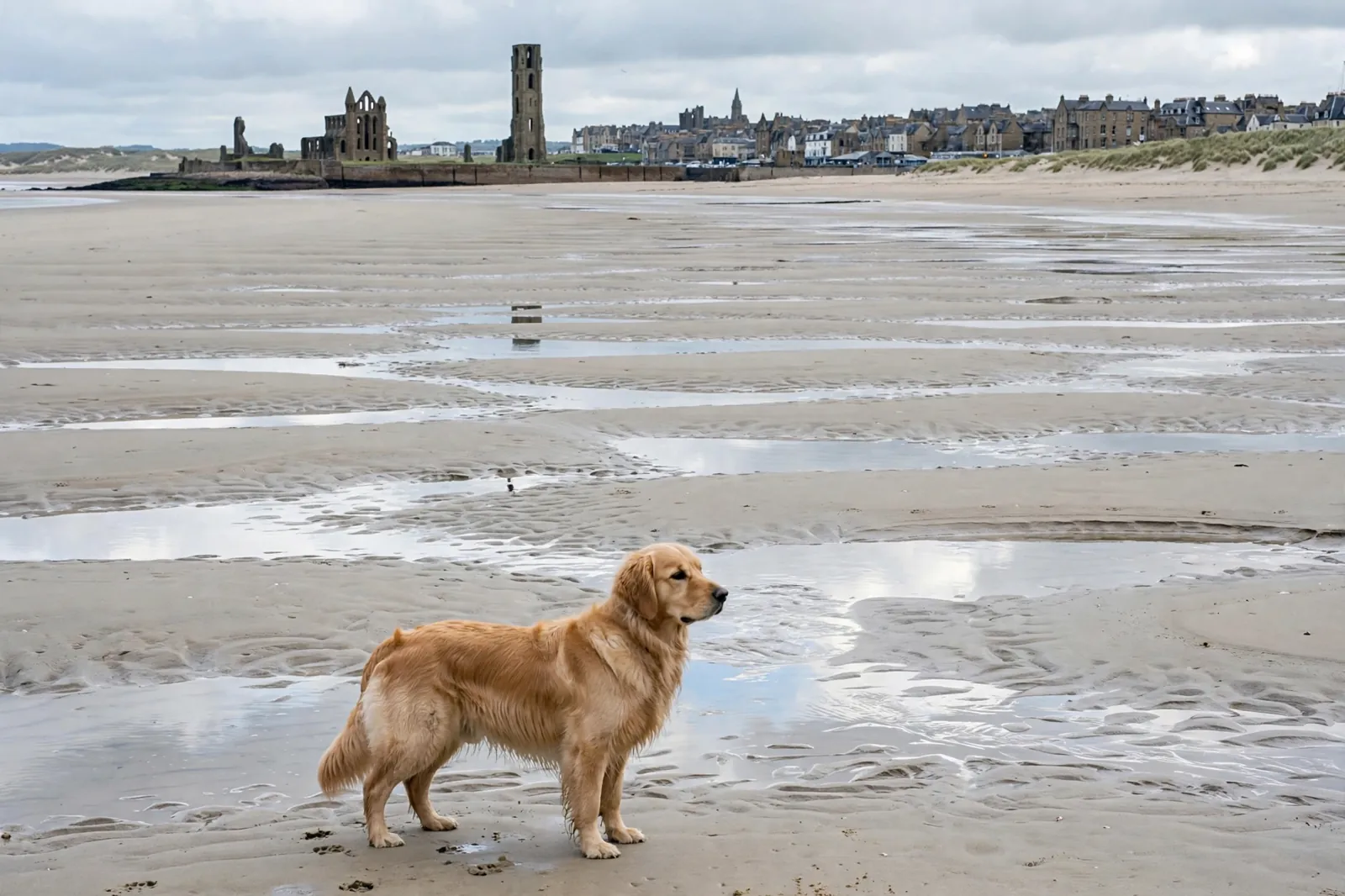
At low tide the beach changes character completely. The sand stretches out, rock pools and wet sand appear, and the walk feels twice as long. That is the best time for a dog that loves to run, but it is also the time to watch the tide: the Forth tide comes in steadily, and a dog chasing a ball towards the water's edge can end up cut off from the car park by a rising tide on a rocky stretch. Check tide times before you go, keep the dog in sight, and start heading back well before the water turns. The harbour wall at the edge of the beach has been eroded by storms over the years, and waves can crash over it in rough weather — keep dogs well back from the wall in a swell, and do not walk the beach at all in a storm.
After the beach, the grass above Seafield is a useful decompression space: a sniff, a drink of fresh water, a towel-down before the car. Bring two towels, not one, because a dog that has been in the Forth in October will soak the first towel before you have finished the legs. A drying coat earns its keep here, and a change of clothes for you is not overkill if the dog shakes at exactly the wrong moment. The beach is the start of the day, not the whole day — and a dog that has had a good run on sand is a much better companion for the calmer, on-lead walking that follows.
Pathhead Sands and the Esplanade
Pathhead Sands sits further along the coast towards Dysart, a smaller sandy stretch that is also listed as allowing dogs all year round. It is quieter than Seafield, less of a destination in its own right and more of a stop on a longer coastal walk, which suits dogs that prefer space to crowds. The same access rules apply — dogs under control under the Scottish Outdoor Access Code — and the same cautions about tides and signs. If Seafield is busy, Pathhead Sands is the obvious alternative, and the walk between the two along the seafront is part of the pleasure of the town.
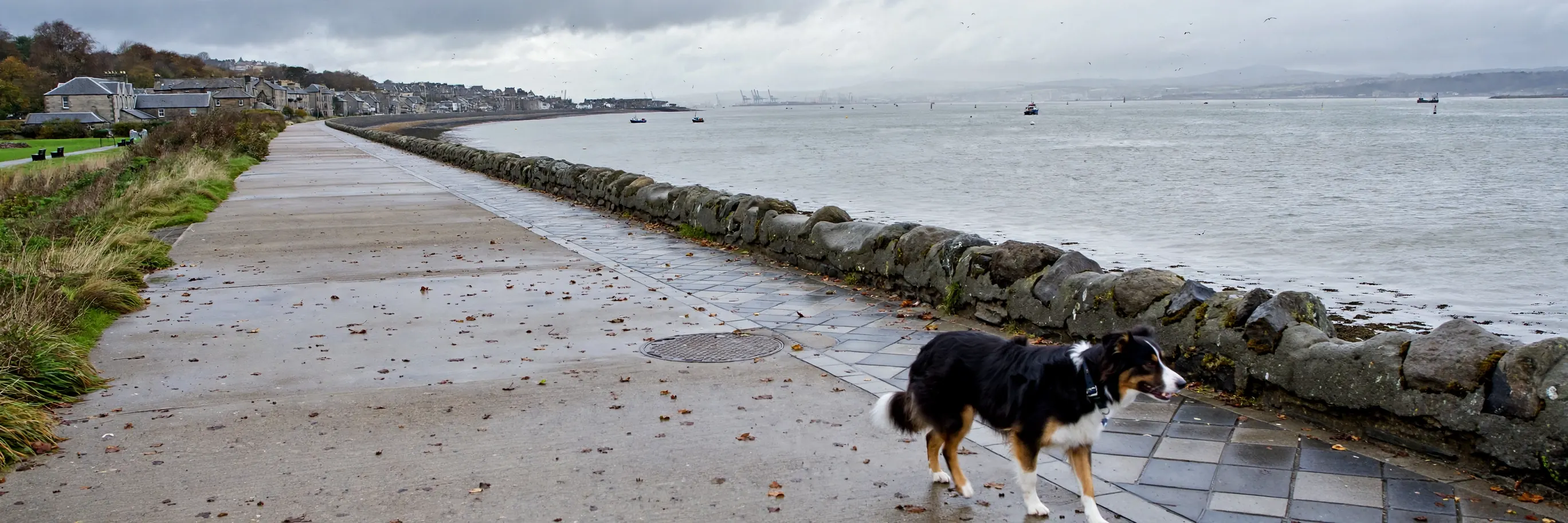
The Esplanade is the thread that ties the seafront together. It is a long, flat promenade above the beach, with the Firth of Forth on one side and the town on the other, and it is the easiest walk in Kirkcaldy with a dog: level, wide, with views across the water to Edinburgh and, on a clear day, to Arthur's Seat. The Esplanade is also where the town tells its own history in public. Information boards along the sea wall cover local figures including Adam Smith, the Kirkcaldy-born economist whose book The Wealth of Nations was published in 1776, and a mosaic walk celebrates the town's seafaring past with ships and anchors in blue tile. The sea wall itself was built in 1922 to 1923 by the Corporation of Kirkcaldy during the Great Trade Depression, to relieve unemployment — a piece of history you can read while the dog sniffs the railings.
Walking the Esplanade with a dog is straightforward, but it has its own etiquette. The promenade is shared with runners, cyclists, families with pushchairs and other dog walkers, and a long lead across the path is a trip hazard for everyone. Use a short lead here, keep the dog on the landward side when cyclists pass, and move off the path entirely if your dog needs space from an approaching dog. The Esplanade is also exposed: there is no shelter from wind or rain, and a dog that is fine on a still day can be miserable in a Forth gale. On a windy day, cut the promenade short and drop into the shelter of Ravenscraig Park or Beveridge Park instead.
The harbour area, between the Esplanade and Pathhead, is worth a slow pass rather than a long stop. Kirkcaldy's harbour was the engine of the town's early growth, and the old harbour buildings and the view back along the coast give a sense of the "Lang Toun" as a working port. Keep dogs on a lead around the harbour: there are drops to the water, moored boats, ropes and fishing gear, and a dog that jumps into a harbour basin is a rescue problem, not a swimming opportunity. The same applies at Dysart Harbour further along the coast, which is covered in its own section below.
For a dog that needs a toilet break or a short leg-stretch between longer walks, the Esplanade is ideal. For a dog that needs to run, it is not — the promenade is a transit route, not an exercise area, and the beach is where running belongs. That distinction is the key to a calm Kirkcaldy day: run on the sand, walk on the promenade, sniff in the parks. Dogs that get all three, in that order, tend to settle well for the cafe stop afterwards.
The Fife Coastal Path through Kirkcaldy
The Fife Coastal Path runs for about 117 miles from Kincardine to Newburgh, following the Fife coast past beaches, rocky shores, harbours and fishing villages, and Kirkcaldy sits roughly in the middle of it. That matters for a dog owner because it turns the town from a single destination into a junction: you can walk a short section as part of a day out, or use Kirkcaldy as a base and a train station for a longer linear walk with a public-transport return. Our stage-by-stage guide to the Fife Coastal Path with a dog covers the whole route in detail, including distances, beach rules, cliff and livestock safety, bases, tides and train returns — read it alongside this guide if you are planning anything longer than a couple of hours.
West from Kirkcaldy, the path runs towards Kinghorn and then Burntisland, a stretch that walkers describe as easy to follow, curving around bays and beaches with views across the Forth to Edinburgh. You pass under the railway, with the island of Inchkeith visible offshore, and reach Kinghorn, a small town with an old, picturesque heart, before the path opens out to Pettycur beach and on to Burntisland, whose sands at low tide are among the most impressive in this part of Scotland. This is a lovely linear walk with a dog, and the train back from Burntisland to Kirkcaldy is the obvious return — but check the official guidance before you travel for current train times, and do not rely on a train that runs only a few times a day without checking first.
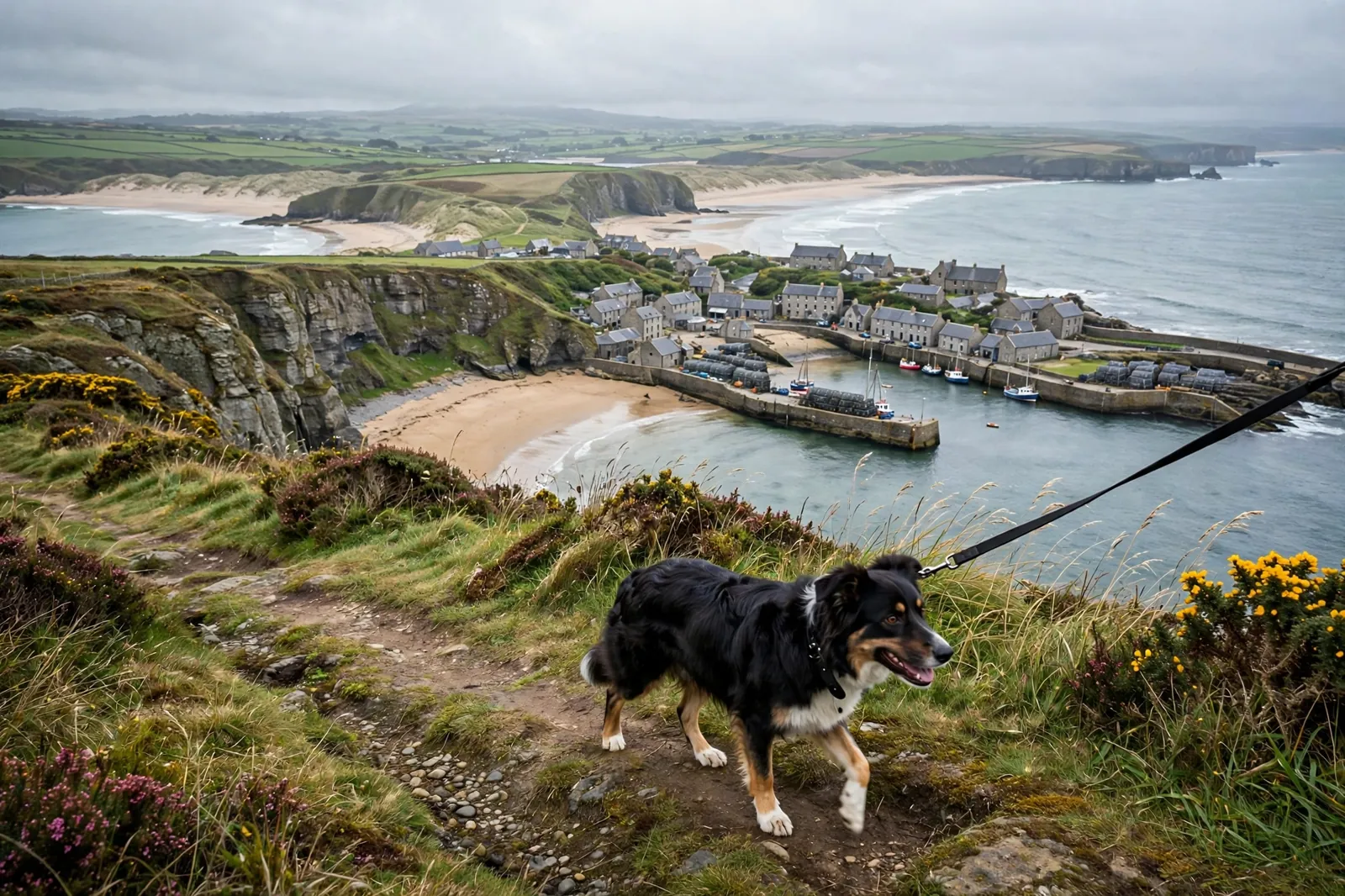
East from Kirkcaldy, the path runs through Ravenscraig Park, past West Wemyss and Wemyss Castle, and along a pebble beach to East Wemyss. The Kirkcaldy to East Wemyss stretch is about 11.7 kilometres, generally considered moderately challenging, taking an average of two and a half to three hours, with about 109 metres of elevation gain. The route is a mix of paths and paved roads, and one recent report notes that erosion blocks the end of the trail towards West Wemyss, so check the official guidance before you travel and be ready to turn back or divert if the path is closed. This eastern section is the wilder of the two: rocky shore, woodland, castle grounds and a pebble beach, with seals sometimes visible offshore and birds in the woods and on the shore.
On either section, the lead rules are the same and they matter. Keep dogs on a lead near cliff edges, on road sections, near livestock, and when other walkers, runners or cyclists are passing. The path is narrow in places, and a dog on a long lead across a cliff-top path is a danger to everyone, including the dog. Off-lead is for the beach sections, when they are quiet and the dog's recall is reliable — not for the cliff tops, the woodland where deer and other wildlife may be present, or the stretches that run beside the railway or the road.
Waymarking on the Fife Coastal Path is generally good, with the familiar path signs pointing the way along the whole 117 miles, and distance markers showing how far it is to Newburgh in one direction and Kincardine in the other. Even so, carry a map or a charged phone with the route downloaded: phone signal is usually fine along the coast, but a dead battery on a cliff path is a poor time to discover it. Tell someone your route and expected return time if you are walking alone, and carry water for the dog — there are stretches of the coastal path with no fresh water, and a dog that has been walking for two hours in sun needs to drink.
The best way to use the path from Kirkcaldy is as a one-way walk with a planned return. Walk west to Kinghorn and take the train back, or walk east to East Wemyss and arrange a lift or a bus back, or simply walk out for an hour and walk back the same way, which is perfectly respectable and much easier to plan. A dog does not care whether a walk is linear or out-and-back; it cares about the smells, the space and the pace. Choose the version that leaves you both with energy in reserve, because the walk back to the car is always longer than the walk out.
Ravenscraig Park and Ravenscraig Castle
Ravenscraig Park is the coastal park on the north-east side of Kirkcaldy, a wooded park with views over the Firth of Forth and the ruins of Ravenscraig Castle at its heart. It is one of the best dog walks in the town: a circular walk of about 1.7 miles, rated easy and taking roughly half an hour to an hour, through woods and open field, with two long staircases as the only real challenge. Walkers report seeing seals offshore and birds in the woods, and the park has a dedicated car park, which makes it a popular starting point for coastal walks.
Ravenscraig Castle is the reason many people come. It is a 15th-century ruined castle on a rocky promontory above the Forth, begun around 1460 for Mary of Gueldres and completed by the Sinclair family, and notable as one of Scotland's earliest purpose-built artillery-defence strongholds, with heavy landward defences including two D-plan towers and a deep rock-cut ditch. It is now a scheduled monument managed by Historic Environment Scotland, free to visit, and commonly visited for short walks, coastal views and photography. Dogs are welcome in the park and around the castle exterior — visitors describe walking there with their dogs and enjoying the sea views — but the courtyard has at times been closed for repair work, and you cannot climb around the ruins as freely as in the past. Check the official guidance before you travel for current access, keep dogs on a lead around the castle walls and cliff edges, and do not let a dog scramble on the stonework.
The park itself is where the dog walking happens. The circular walk loops through woodland and open grass, with the sea visible through the trees and the castle appearing and disappearing as you go round. The woodland paths are sheltered from the wind, which makes Ravenscraig a good choice on a day when the Esplanade is too exposed, and the mix of woodland smells, open-field running space and coastal views keeps most dogs engaged for a full loop. The two long staircases are the thing to know about in advance: if your dog is old, very small, or struggles with steps, you can still enjoy the lower paths and the castle area without doing the full loop, but do not commit to the circular route without knowing the stairs are there.
Wildlife is part of the park's appeal and part of its management. Seals are seen offshore, and the woods hold birds and small mammals that will distract a dog with a strong prey drive. Keep dogs under control, on a lead if their recall around wildlife is not reliable, and do not let a dog chase birds or seals. The park is also popular with other walkers, runners and families, so the usual courtesies apply: short lead on narrow paths, step aside for others, and pick up.
Ravenscraig Park connects directly to the Fife Coastal Path, which is what makes it such a useful base. You can do the short circular walk as a standalone outing, or use the park as the start of the longer walk east to East Wemyss, or as the end of a walk west from Dysart. Parking at the park, walking the loop, and then deciding whether to continue along the coast is a flexible plan that works for dogs of different energy levels — the fit dog carries on, the tired dog goes back to the car, and nobody has committed to a three-hour walk before seeing how the dog is feeling.
Beveridge Park, Raith Lake and Dunnikier
Beveridge Park is Kirkcaldy's great Victorian park, gifted to the town in the late 19th century when Provost Michael Beveridge bequeathed a section of the Raith Estate to the people of Kirkcaldy in 1892. It is a large urban park with formal gardens, a boating pond, play facilities and sports facilities, and it is one of the most popular dog-walking spots in the town. A circular walk of about 2.1 miles takes roughly half an hour to an hour, on flat, well-surfaced tarmac or paved paths for most of the main areas, and a longer loop out to Raith Lake and through Long Braes Plantation covers about 3.4 miles in about an hour and ten minutes.
Dogs are welcome in Beveridge Park, and the guidance from dog-walking guides is consistent: keep dogs under control, especially around the boating lake to avoid disturbing waterfowl, near the formal gardens, near children's play areas, and when other park users are present. There are open parkland sections where dogs can be off-lead when it is quiet, but the park is not a free-for-all — the lake, the gardens and the play areas are on-lead territory, and a dog that chases ducks into the boating pond is a problem for everyone. The longer Beveridge Park to Raith Lake loop is listed as dogs on a leash, so if you take that route, plan for an on-lead walk rather than an off-lead run.
There is also a secure dog exercise field at Riverside, inside Beveridge Park, which is a different kind of resource and worth knowing about. It is a small enclosed field, bookable in time slots, where dogs can run off-lead safely, with bins for waste and a box of toys. The terms are strict and sensible: keep your dog in the car until the previous user has left, keep dogs on a lead until safely inside the field, close the gates, supervise at all times, and do not use the field if your dog has shown signs of kennel cough, sickness or diarrhoea in the past 72 hours. Dogs must be immunised and up to date with worm treatment. For a reactive dog, a dog with unreliable recall, or a puppy that is not ready for the open beach, a bookable secure field is worth more than any amount of open space. Check the official guidance before you travel for current booking details and prices.
Raith Lake, reached by the Mill Dam Path following the river through woodland along the edge of Beveridge Park, is a quieter extension to the park walk. The path is relaxing and suitable for families, and the lake and Long Braes Plantation give a woodland feel that the formal park does not. Dunnikier Park, to the north of the town, offers more paths and open space, and the trails in Craigarter Plantation are a quieter woodland option, though they are also used by mountain bikers — keep dogs on a lead and to the side of the trail there. Together, Beveridge, Raith Lake, Dunnikier and Craigarter give Kirkcaldy a proper inland walking network, which matters on a day when the coast is too windy or too busy.
The Beveridge Park Cafe, inside Kirkcaldy Rugby Club in the park, is dog-friendly and a natural end to a park walk. It serves breakfast, sandwiches, soup and cakes, and dog owners specifically praise its pet-friendly policy. Opening hours are limited — Sunday to Thursday, 9am to 3pm, is the pattern reported — so check the official guidance before you travel rather than assuming it will be open when you arrive. A park walk that ends with a coffee and a cake, with the dog settled under the table, is a good Kirkcaldy morning.
Dysart Harbour and the old town
Dysart is the historic harbour village at the north-east end of Kirkcaldy, and it feels like a different place from the modern town centre: narrow streets, old harbour buildings, and a harbour basin that dries out at low tide, leaving boats sitting on the mud. Dysart Harbour is a stop on the Fife Coastal Path — a popular loop runs from Pathhead along the path to Dysart Harbour and back — and there is parking near the harbour with direct access to the path. The Dysart Coffee Cabin, near the harbour, is described as dog-friendly, which makes Dysart a natural coffee stop on a coastal walk.
The harbour is a working historic place, not a beach, and the dog rules follow from that. Keep dogs on a lead around the harbour basin, the quays and the slipway: there are drops to the water and to the mud, moored boats, ropes and chains, and a dog that jumps into a drying harbour basin can be injured on the mud or stranded by the tide. At low tide the mud is the other hazard — dogs that run onto harbour mud can get stuck, and the mud is not a surface to let a dog explore freely. Admire the harbour from the quay, let the dog sniff the harbour wall, and save the running for the beach.
Dysart's history is worth a slow walk even without going inside anywhere. The village was once a thriving port in its own right, and the old buildings around the harbour tell that story more vividly than any single attraction. The coastal path from Dysart onwards, towards West Wemyss and East Wemyss, passes Wemyss Castle and the pebble beach, and the Dysart to East Wemyss stretch is part of the longer Kirkcaldy to East Wemyss walk described above. If you are walking with a dog, Dysart works best as a pause point: a coffee, a look at the harbour, a drink of water for the dog, and then a decision about whether to continue east or turn back towards Kirkcaldy.
One practical note: Dysart Harbour is exposed to the same tides as the rest of the coast, and the path around the harbour can be slippery when wet. Wear proper footwear, keep the dog on a short lead on the quayside, and do not try to walk around the harbour basin at low tide. The harbour is a place to look at the sea, not to walk into it.
The town itself: galleries, High Street and the Links Market
Kirkcaldy Galleries, in the War Memorial Gardens beside the train station, is the town's cultural hub: a free-to-enter museum, art gallery, library and cafe, opened in 1925 with the support of the philanthropist and local industrialist John Nairn. The museum covers the town's history from early settlements to the industrial boom of the 19th and 20th centuries, including the linoleum industry, the maritime past and the coal mining industry, and the galleries hold a significant collection of Scottish art. Entry to the museum and art galleries is free, and the building has a ramp, automatic doors, a lift, a Changing Places facility and induction loops.
Dogs, however, are a different matter. As with most museums, pet dogs are not admitted inside the galleries, with the exception of assistance dogs. That does not make the Galleries useless to a dog owner — it makes them a split-visit stop. One person can go inside while the other walks the dog in the War Memorial Gardens, or you can admire the building and the gardens from outside and save the galleries for a dog-free visit. Do not leave a dog tied up outside a museum while you go in: it is stressful for the dog, a security risk, and unfair to other visitors. Plan the Galleries as an exterior stop, or not at all, and the day stays calm.
The High Street is one of the longest in Scotland, which is the origin of the "Lang Toun" nickname, and it is a practical rather than a pretty shopping street: everyday shops, cafes, and the town's services. Walking the High Street with a dog is fine — it is a normal town-centre walk, on a lead, with pavements and crossings — but it is not a destination in itself for a dog owner. The Adam Smith statue on the High Street marks the birthplace of the economist, who was baptised at the Old Kirk of Kirkcaldy in 1723, and the Old Kirk itself, whose Norman tower is the oldest building in continuous use in the town, is worth a look from outside. The kirk is open for visits during the summer months, but dogs are not admitted inside, so treat it as an exterior stop too.
The Links Market is the exception that proves the rule about Kirkcaldy's calendar. Chartered in 1304, it is described as Europe's longest street fair, held on the Esplanade, with a Ferris wheel and fairground rides along the seafront. It is a major event for the town, and it is also exactly the wrong place to take a dog that is nervous, reactive or noise-sensitive: crowds, loud music, flashing lights, food smells and dropped food, and thousands of people in a confined space. A calm, bombproof dog on a short lead might cope with a brief pass through the quieter edge of the market, but for most dogs the right plan during the Links Market is to walk the beach early, avoid the Esplanade at peak hours, and come back another day. Check the official guidance before you travel for the market's dates, and plan around them rather than into them.
For a dog owner, the town centre's real value is practical: vets, pet shops, pharmacies, supermarkets for supplies, and cafes for a break. The Pet Shop in Kirkcaldy is listed among the town's dog-related businesses, and there are vets in the town for emergencies — save the number of the nearest vet before you need it, as you should on any trip. If you are staying overnight, the town centre is also where you will find most of the accommodation and the evening food options, which are covered in the sections below.
Eating and drinking with your dog
Kirkcaldy's dog-friendly eating scene is modest but real, and it is mostly pubs and cafes rather than restaurants. That suits a dog day well: a pub or a cafe is a place where a dog can settle under a table, whereas a formal restaurant rarely is. The key is to confirm the current rules with each venue before you go, because dog policies change by area — inside, terrace, beer garden — and by season, and a venue that welcomed dogs last year may have changed its policy since.
The Home Farm View, on Dean Park Way just outside Kirkcaldy, is the most clearly dog-friendly pub in the area. Its own website describes it as a dog-friendly pub serving chargrilled food — steaks, burgers, chicken skewers and meat-free options — and it lists dog-friendly among its facilities, alongside free off-street parking, outdoor seating and a beer garden. Visitors report fresh water bowls and treats for dogs, and the pub's own social media shows dogs indoors on the carpet and outdoors on the grass in front of the picnic tables. It is a good choice for a proper meal after a long walk, especially if you are driving, because of the parking and the garden space.
No 91 Coffee House, at 91 Victoria Road, is the town-centre cafe to know. Reviewers describe it as a lovely little cafe with a great range of coffee, cakes and food, vegetarian and vegan options, and a dog-friendly atmosphere with water bowls provided and outdoor seating when the weather allows. It is a small, calm place, which suits a dog that settles well, and it is close enough to the High Street and the Galleries to be a natural break on a town walk. The King's, a cafe and live performance venue in the town, also welcomes dogs with treats and water, with indoor and outdoor seating and takeaway options, opening Wednesday to Sunday from 10am to 3pm for the cafe and a bar from 11am — check the official guidance before you travel for current hours.
O'Connell's Bar and Diner, on the High Street, is listed as dog-friendly inside, with a beer garden, and its home page says it is dog-friendly. The Path Tavern, at 5 to 7 Mid Street, is a cosy, family-run pub serving home-cooked meals, described as having a dog-friendly policy and a relaxed, welcoming atmosphere. The Abbotshall, another Kirkcaldy pub with a beer garden, is also listed among the town's dog-friendly places. These are the kind of pubs where a dog under the table is normal rather than exceptional, but they are also busy local pubs, so go at a quiet time if your dog is nervous, and keep the dog on a lead and out of the walkway.
The Dysart Coffee Cabin, near Dysart Harbour, is described as dog-friendly on the venue's Facebook page, and the Beveridge Park Cafe, inside Kirkcaldy Rugby Club, is dog-friendly with dogs featured in its own promotion. Tranquility Coffee House is listed as welcoming dogs at its outdoor patio tables, serving breakfast and lunch to order. Between them, these cafes cover the three zones of a Kirkcaldy day: the town centre, the harbour, and the park. That is the practical point — you do not need to carry the dog's lunch and your own across town, because there is a dog-friendly stop in each area.
A few rules make eating out with a dog work anywhere in Kirkcaldy. Feed the dog before you go in, or bring a chew to keep it occupied. Ask on arrival where dogs are welcome — the answer is often a specific area, not the whole venue. Keep the dog on a lead, on the floor, and out of the way of staff carrying hot food. Bring a mat or a blanket for the dog to lie on, which signals "settle" far better than a bare floor. And if the dog will not settle, leave gracefully and try a takeaway instead: a stressed dog in a busy pub is not enjoying itself, and neither are you.
Staying overnight with a dog
Kirkcaldy is usually a day trip, but it also works as an overnight base for a longer Fife tour, and the questions to ask of any accommodation are the same as anywhere in Scotland. Confirm in writing that dogs are accepted in the specific room or unit you are booking, how many dogs are allowed, whether there is a pet fee and what it covers, and whether dogs can be left alone in the room — many places prohibit it outright, and the rest allow it only if the dog is crated and quiet. A "dog-friendly" listing that turns out to mean "one small dog, in selected rooms, for a fee, never left alone" is a different booking from the one you thought you were making.
Ask about the practical details that matter at 11pm. Where is the nearest toilet walk after dark, and is it lit? Is there parking beside the room, or a walk across a car park? Is there somewhere to dry a wet dog, and somewhere to wash muddy paws? Is the room on the ground floor, or are there stairs? Does the accommodation have a garden or an enclosed area, and how high is the fence? The answers matter more than the star rating, because a dog that cannot toilet safely at night or dry off after a beach walk will make the stay miserable regardless of how nice the room is.
Location matters too. A base near the seafront gives you the beach and the Esplanade on your doorstep, but it can be noisy on a market weekend and exposed to the wind. A base near Beveridge Park gives you a quiet morning walk and a calmer night, but a longer walk to the beach. A base on the edge of town, towards Dysart or towards the A92, gives you parking and quiet, but you will drive to everything. Choose the base that matches the dog: a nervous dog needs quiet and a short toilet walk; a fit dog needs space and a long morning run; an older dog needs level access and a short distance to grass.
If you are using Kirkcaldy as a base for the wider Fife coast, the train is your friend. Edinburgh is about half an hour away by train, and the line continues north through Fife towards Dundee, which makes day trips to St Andrews, the East Neuk and the Tay coast straightforward without moving accommodation. Our guide to St Andrews with a dog covers West and East Sands, the cathedral grounds and the Fife Coastal Path links from the town, and our Edinburgh with a dog guide covers Arthur's Seat, Holyrood and the Water of Leith for the city end of the trip. A Kirkcaldy base with a railcard and a dog that travels well on trains is a flexible, low-stress way to see a lot of Fife.
Finally, be honest about the dog when you book. A host that knows the dog is a large, hairy, mud-loving spaniel will put you in the right room; a host that discovers it on arrival may not. Declare the breed, the size and the number of dogs accurately, ask about any breed or size conditions, and get the confirmation in writing. Assistance dogs are a separate category and should not count against pet limits or incur pet fees. The booking that starts with an honest conversation is the one that ends well.
Seasons, tides and water quality
Kirkcaldy changes with the seasons more than a first visit suggests, and the best season depends on the dog. Spring, from April to June, is arguably the best time: the beaches are quiet, the parks are green, the coastal path is at its best, and the days are long. Ground-nesting birds are active from April to July, so keep dogs under control and on a lead near nesting areas, and be aware that livestock may be in fields beside the path. Summer brings the crowds, the Links Market, and the warmest sea temperatures, but also the busiest beaches and the most dogs — go early in the day if your dog dislikes crowds, and carry extra water.
Autumn, from September to November, is the connoisseur's season in Kirkcaldy. The summer crowds have gone, the light on the Forth is at its best, and the beaches are quiet enough for a proper off-lead run. The sea is at its warmest in early autumn, and the parks are full of colour. Rain becomes more frequent, and the wind picks up, so pack a drying coat and a towel, and check the forecast before a coastal-path walk. Fireworks around early November can unsettle noise-sensitive dogs — ask your accommodation whether displays are planned nearby, and keep a nervous dog indoors on the night itself.
Winter in Kirkcaldy is bracing rather than impossible. The beaches are empty, the light is low and dramatic, and a fit dog will love a winter run on sand. But the wind off the Forth is cold, the days are short, and the sea is not a place for a dog to swim in winter — cold-water shock is a real risk for dogs as well as people, and a dog that falls into cold water can become hypothermic quickly. Keep winter walks shorter, keep the dog on a lead near the water's edge in rough weather, and have a warm, dry car and a drying coat ready. Short days also mean planning your walk around daylight: a coastal-path walk that is easy in June can be a walk back in the dark in December.
Tides deserve their own paragraph, because they are the single most underestimated hazard on the Fife coast. The Firth of Forth has a significant tidal range, and the tide can come in fast across flat sand, cutting off stretches of beach and rocky shore. Always check tide times before a beach or coastal-path walk, and check the official guidance before you travel for any local warnings. Walk out with the tide going out, or at low tide with a clear plan for when to turn back, and never let a dog chase a ball or a bird towards the water's edge without knowing how the tide is moving. If you are unsure, stay on the promenade and the upper beach, where the tide cannot reach you.
Water quality, as noted at Seafield, is checked by SEPA and can change after heavy rain. The pattern is consistent across the Fife coast: bathing is not advised during or for one to two days after heavy rainfall, and temporary advice against bathing is posted at the beach when contamination is suspected. The advice applies to paddling and swimming, and the notices say to keep pets away. If you see a "Temporary Advice Against Bathing" sign, do not let the dog in the water, do not let it drink from the sea, and wash its paws and coat after the walk. The beach itself is still usable for walking — the advice is about the water, not the sand — but the water is off limits until the sign comes down.
Coastal safety: cliffs, seals and livestock
The Kirkcaldy coast is not dangerous if you respect it, and it is unforgiving if you do not. The three risks that matter most are cliffs, water and livestock, and they are all manageable with a lead and a little attention. Cliff edges near Ravenscraig and on the coastal path towards Kinghorn and East Wemyss are unfenced in places, and the ground can be undercut by erosion — keep dogs on a lead near any cliff edge, keep them away from the edge even when they seem calm, and do not let a dog chase a ball or a bird towards a drop. A dog that goes over a cliff edge is a rescue for the coastguard, not a walk.
Seals are seen offshore around Ravenscraig and along the coastal path, and they are a delight to watch from a distance. They are also wild animals, and a dog that chases a seal on a beach or in shallow water can be bitten, can be dragged into deep water, or can cause the seal to abandon a pup. Keep dogs on a lead when seals are hauled out on a beach or on rocks, keep a good distance, and do not let a dog swim towards seals. The same applies to seabirds and wading birds: the Forth is an important area for birds, especially in the nesting season from April to July, and dogs should be kept under control and on a lead near nesting areas and feeding shorebirds.
Livestock is a risk on the inland stretches of the coastal path and on the paths around Raith Lake and Dunnikier. Fields beside the path may hold sheep or cattle, and dogs must be kept on a lead and under control near livestock — this is a legal requirement under the Scottish Outdoor Access Code, and a dog that chases livestock can be shot by a farmer in some circumstances. If you see livestock ahead, put the dog on a lead, move to the far side of the path, and keep the dog close. Do not let a dog run through a field with livestock in it, even if the field looks empty at first glance.
Other hazards are smaller but worth knowing. Blue-green algae can appear in still water, including ponds and lakes, in warm weather — do not let a dog drink from or swim in a pond with a green scum on the surface. Adders are present in some parts of Scotland, though they are uncommon on the Fife coast; if a dog is bitten, keep it calm and still and get to a vet immediately. Ticks are present in woodland and long grass from spring to autumn — check the dog after every walk, remove ticks promptly, and consider a tick treatment. Jellyfish can wash up on beaches in summer; keep dogs away from them, alive or dead, because the sting can still be active.
Finally, know where the nearest vet is before you need one. Save the number in your phone, and note the opening hours and the out-of-hours arrangements. Rural and small-town vets can be twenty minutes away and close early, and a dog that has eaten something on the beach or cut a paw on a rock needs a vet, not a search engine. A first-aid kit for the dog — bandages, saline, tweezers, a muzzle for a painful dog — is worth carrying on any coastal walk, and a phone with a charge is the most important item of all.
Day trips from Kirkcaldy
Kirkcaldy's position on the Fife coast makes it a good base for day trips, and the train is the easiest way to do most of them. St Andrews is the obvious one: a historic town with two great beaches, West Sands and East Sands, cathedral grounds, and the Fife Coastal Path running through it. West Sands is the famous Chariots of Fire beach, almost two miles of flat sand, and dogs are welcome on most of it, though they are asked to stay off the town end in summer — follow the signs on the day. Our St Andrews guide covers the beach rules, the cathedral grounds, golf-path safety and the cafes and stays that truly welcome dogs.
Edinburgh is half an hour away by train, and it is a different kind of day: a city walk rather than a coastal one. Arthur's Seat and Holyrood Park give a proper hill walk in the middle of the city, the Water of Leith is a long, green, largely traffic-free path, and there are dog-friendly cafes and pubs across the city. The festival crowds in August are the thing to avoid with a nervous dog, and the castle is a split-visit stop — dogs are not admitted inside, so one person goes in while the other walks the dog. Our Edinburgh guide covers the hill walks, the castle split-visit rules, the Water of Leith and the festival crowd strategy.
Closer to home, Burntisland and Kinghorn are short train rides west, and both are worth a half day. Burntisland Beach is a Blue Flag beach, family-friendly, with a long stretch of sand at low tide, and the walk from Kirkcaldy along the coastal path to Burntisland is one of the best short sections of the Fife Coastal Path. Kinghorn is a smaller, quieter town with an old harbour and a beach at Pettycur, and the path between Kirkcaldy and Kinghorn is a good introduction to the coastal path for a dog that has not walked it before.
East along the coast, the East Neuk villages — Elie, St Monans, Pittenweem, Anstruther and Crail — are a longer day, best done by car or by bus, and they reward a slow pace. Elie and Earlsferry have a huge sweep of sand, famous for beach cricket in summer, and Ruby Bay at Elie is a small, scenic beach good for beachcombing. The East Neuk is also where the Fife Coastal Path is at its most village-to-village, with harbours, cafes and beaches in quick succession, which suits a dog that likes frequent stops. Check the official guidance before you travel for current bus times, because the coastal bus services are less frequent than the trains.
Dundee, about 27 miles north, is the other city option. The waterfront walk by the Tay, Broughty Ferry beach, and the parks at Camperdown and Baxter give a dog a proper day out, and the city is compact enough to walk. Our Dundee guide covers the waterfront, the beach rules and the parks. Whether you go north to Dundee, south to Edinburgh, or east to St Andrews, the pattern is the same: Kirkcaldy is the quiet base, and the day trip is the busy contrast — and the dog will tell you which it prefers.
A one-day plan that actually works
A good Kirkcaldy day with a dog has a shape: beach first, park second, town third, and a cafe in the middle of each transition. The plan below is for a fit, sociable dog on a dry day in spring or autumn, with a car. Adjust it down for an older dog, a puppy, or a wet day, and do not try to do all of it if the dog is tired — the plan is a menu, not a march.
Start at Seafield Beach, arriving by 9am if you can. Park beside the beach, check the signs for any bathing-water advice, and let the dog run on the sand while it is quiet. An hour on the beach, with fresh water and a ball or a toy, is enough for most dogs — more than that, and the dog will be tired for the rest of the day. Towel the dog down on the grass above the beach, give it water, and let it sniff and settle before you move on.
Next, drive to Ravenscraig Park and walk the circular loop, about 1.7 miles and half an hour to an hour. This is the on-lead, sniffing part of the day: woodland paths, the castle exterior, views over the Forth, and the chance of seeing seals. If the dog is still full of energy, continue east along the Fife Coastal Path towards East Wemyss for an hour, then turn back. If the dog is tiring, do the loop and stop. Either way, you have had a beach run and a woodland walk, which is a good morning for any dog.
Lunch is at a dog-friendly pub or cafe — the Home Farm View if you are driving and want a proper meal, No 91 Coffee House if you are in the town centre, or the Dysart Coffee Cabin if you have walked to Dysart. Feed the dog first, or bring a chew, and let the dog settle under the table while you eat. A dog that has had a beach run and a park walk will usually settle well for an hour, which is all a lunch needs.
The afternoon is for the town or for Beveridge Park, depending on the dog. A calm dog can handle a slow walk along the Esplanade, a look at the harbour, and a pass by the Galleries and the War Memorial Gardens. A dog that is tired, or that finds the town busy, will do better with a quiet loop in Beveridge Park, a sit by the boating pond, and a coffee at the Beveridge Park Cafe. Either way, keep the afternoon short and on-lead, and be home or back at your accommodation by late afternoon, before the dog is overtired and the light goes.
The wet-weather version is simpler: a short beach walk in the rain, a loop in Beveridge Park under the trees, and a long cafe stop. The dry-weather version is the one above. The version for a reactive dog is different again: an early start, the far end of Seafield Beach, the quiet paths of Ravenscraig Park, and a takeaway coffee rather than a busy pub. All three are good Kirkcaldy days — the right one is the one that fits the dog you have.
What to pack for a Kirkcaldy day
Packing for Kirkcaldy is packing for a Scottish coastal day, and the list is short but specific. Bring a lead and a long line: the lead for the promenade, the parks and the coastal path, the long line for the beach when the dog's recall is good but not perfect. Bring a harness that fits well, because a dog pulling on a coastal path in a collar is a dog that will hurt its neck. Bring more poo bags than you think you need, and a small bag to carry them in until you find a bin.
Water is the item people forget most. Bring a bottle and a collapsible bowl, and offer water regularly — after the beach, after the park loop, and before the car journey home. Seawater is not a substitute, and a dog that has been running on sand will drink more than you expect. Bring a towel, or two, and a drying coat if you have one. A wet dog in a car is a wet car, and a wet dog in a cafe is a cold dog. A blanket or a mat for the dog to lie on in a cafe or pub is worth its weight: it gives the dog a place, and it protects the venue's floor.
Food and treats are for settling, not just for rewarding. Bring the dog's normal food if you are staying overnight, a chew for the cafe, and high-value treats for recall on the beach. Bring any medication the dog needs, and a copy of the vaccination record if you are staying in accommodation that asks for it. Bring a tick remover and a small first-aid kit — bandages, saline, tweezers — and know where the nearest vet is before you leave.
For yourself, pack for the Forth wind: a waterproof jacket, layers, and proper footwear with grip, because the coastal path and the harbour quays are slippery when wet. A phone with a charge and the route downloaded is essential on the coastal path, and a paper map is a useful backup. Sun cream and a hat matter on a bright day on the beach, even in Scotland, because the wind hides the sun and the sand reflects it. And bring a change of clothes for the car journey home, because a wet dog will shake at the worst possible moment, and it is always the worst possible moment.
Finally, pack patience. Kirkcaldy is not a town that performs for visitors, and that is its charm — but it also means the best moments are unplanned: a seal offshore at Ravenscraig, a quiet stretch of sand at Pathhead, a coffee in a park cafe with the dog asleep under the table. The plan gets you to the right places; the patience lets you enjoy them. If the dog is tired, stop. If the weather turns, go to a cafe. If the beach is busy, walk the park instead. The town will still be there tomorrow.
Practical questions
Before you go
Can dogs go on the beach at Kirkcaldy all year round?
Seafield Beach and Pathhead Sands are both listed as allowing dogs all year round, with dogs kept under control under the Scottish Outdoor Access Code. There is no English-style seasonal dog ban to work around, but always read the signs on the day, keep dogs away from bathing-water warnings, and check the official guidance before you travel if water quality advice has changed.
Is the Fife Coastal Path at Kirkcaldy suitable for dogs?
Yes, in sections. The path runs through Kirkcaldy in both directions, west towards Kinghorn and Burntisland and east through Ravenscraig Park towards East Wemyss. The Kirkcaldy to East Wemyss stretch is about 11.7 kilometres and takes roughly two and a half to three hours. Keep dogs on a lead near cliffs, roads, livestock and other walkers, and plan a train or bus return rather than walking back along the same route.
Where can dogs go off the lead in Kirkcaldy?
The beaches are the most reliable off-lead space when they are quiet, provided the dog has a solid recall and stays under control. Beveridge Park allows dogs in its open parkland areas, with dogs kept under control around the boating pond, formal gardens and play areas. There is also a bookable secure dog exercise field at Riverside in Beveridge Park for reactive or unreliable-recall dogs; check the official guidance before you travel for current booking details.
Are there dog-friendly places to eat in Kirkcaldy?
Yes. The Home Farm View on Dean Park Way describes itself as dog-friendly, No 91 Coffee House on Victoria Road welcomes dogs with water bowls and outdoor seating, O'Connell's Bar and Diner on the High Street is listed as dog-friendly inside, and the Dysart Coffee Cabin and the Beveridge Park Cafe both welcome dogs. Policies change, so confirm the current dog rules with the venue before you go.
Can I get to Kirkcaldy by train with a dog?
Yes. Kirkcaldy station is on the Fife Circle Line and the East Coast Main Line, about 11 to 12 miles north of Edinburgh, and dogs travel free on most UK trains when kept on a lead and under control. The station sits to the north-west of the town centre, a short walk from Kirkcaldy Galleries and the High Street, and the seafront is a longer walk or a short bus or taxi ride away.
What should I watch out for on the Kirkcaldy coast with a dog?
Tides, cliffs and water quality are the three main ones. The Firth of Forth tide can cut off stretches of sand and rock, cliff edges near Ravenscraig and Kinghorn are unfenced in places, and SEPA sometimes issues temporary advice against bathing at Seafield after heavy rain. Keep dogs out of the water when a warning sign is up, keep them on a lead near cliff edges, and check the official guidance before you travel.